


The Design and Fabrication of a Ladder-Climbing Robot †
Abstract
1. Introduction
2. Methodology
2.1. Material Specifications and Major Equipment
| Drive Motors: |
| Type: DC Geared Motors |
| Capacity: 12 W |
| Speed: 30 rpm |
| Voltage: 12 V |
| Number of Motors: 5 |
| Base Plate: |
| Material: Mild Steel |
| Thickness: 2 mm |
| Size: 14 × 12 inches |
| Square Pipes: |
| Material: Mild Steel |
| Thickness: 2 mm |
| Size: 25 × 25 mm, 20 × 20 mm, 18 × 18 mm |
| Arm Flats: |
| Material: Mild Steel |
| Size: 12 × 3 mm |
| Thickness: 3 mm |
| Rack: |
| Material: Mild Steel |
| Size: 20 × 20 mm |
| Length: 3 feet |
| Tooth profile: 5 mm pitch |
| Pinion: |
| Material: Mild Steel |
| Width: 25 mm |
| Outer diameter: 40 mm |
| Inner diameter: 32 mm |
| Pitch: 5 mm |
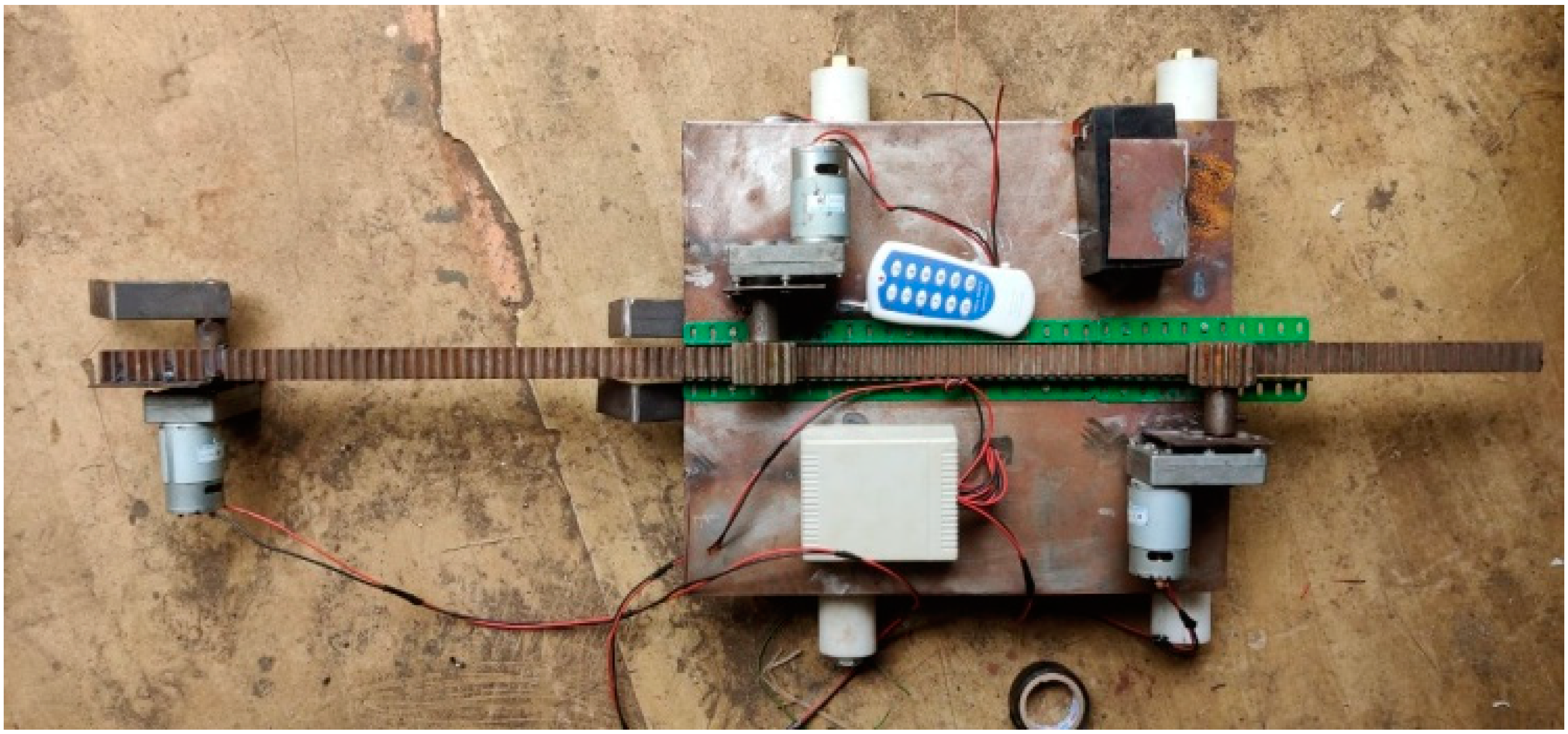
2.2. Fabrication of Ladder-Climbing Robot
3. Results
| For the motor mounted with the longer arm: |
| Mass (m) = 9 kg |
| Radius (r) = 65 mm = 0.065 m |
| Force (F) = m × g = 9 × 9.81 = 88.29 N |
| Torque (T) = F × r = 88.29 × 0.065 = 5.738 N-m |
| Power (P) = (2πNT)/60 = 6.008 watt |
| For the motor mounted with the shorter arm: |
| Mass (m) = 4 kg |
| Radius (r) = 55 mm = 0.055 m |
| Force (f) = m × g = 4 × 9.81 = 39.24 N-m |
| Torque (T) = F × r = 39.24 × 0.055 = 2.158 N-m |
| Power (P) = (2πNT)/60 = 2.259 watt |
| For the motor mounted with the pinion: |
| Mass (m) = 3 kg |
| Radius (r) = 0.020 m |
| Force (f) = m × g = 3 × 9.81 = 29.43 N |
| Torque (T) = F × r = 29.43 × 0.020 = 0.5886 N-m |
| Power (P) = (2πNT)/60 = 0.616 watt |
| Overall power required: |
| Power consumed by all motors (P) = P1 + P2 × 2 + P3 × 2 = 6.008 + (2.259) × 2 + (0.616) × 2 = 11.758 watt |
| Battery calculations: |
| Number of machines operated on a single battery = 5 |
| Overall motor power = 11.758 watt |
| Voltage of the battery = 12 V |
| Working hours of the battery = 1 h |
4. Conclusions
Author Contributions
Funding
Institutional Review Board Statement
Informed Consent Statement
Data Availability Statement
Conflicts of Interest
References
- Agrawal, S.K.; Yan, J. A three-wheel vehicle with expanding wheels: Differential flatness, trajectory planning and control. In Proceedings of the IEEE/RSJ International Conference on Intelligent Robots and Systems, Las Vegas, NV, USA, 27–31 October 2003; pp. 1450–1455. [Google Scholar]
- Gupta, R.; Singh, C.; Dang, R.K. Stair Climbing Robot. Int. J. Sci. Res. 2015, 4, 50–53. [Google Scholar]
- Yang, H.-A.; Rojas, L.C.V.; Xia, C.; Guo, Q. Dynamic Rocker-Bogie: A Stability Enhancement for High-Speed Traversal. Int. J. Robot. Autom. 2014, 3, 212–220. [Google Scholar]
- Deepak BB, V.L.; Parhi, D. Intelligent adaptive immune-based motion planner of a mobile robot in cluttered environment. Intell. Serv. Robot. 2013, 6, 155–162. [Google Scholar] [CrossRef]
- Maheswari, R.; Rani, S.S.; Gomathy, V.; Sharmila, P. Real Time Environment Simulation through Virtual Reality. Int. J. Eng. Technol. (IJET) 2018, 7, 404–406. [Google Scholar]
- Deepak, B.B.V.L.; Bahubalendruni, M.R.; Biswal, B.B. Development of in-pipe robots for inspection and cleaning tasks: Survey, classification and comparison. Int. J. Intell. Unmanned Syst. 2016, 4, 182–210. [Google Scholar] [CrossRef]
- Yadav, N.; Bhardwaj, B.; Bhardwaj, S. Design analysis of Rocker Bogie Suspension System and Access the possibility to implement in Front Loading Vehicles. J. Mech. Civ. Eng. 2015, 12, 64–67. [Google Scholar]
- Chinchkar, D.; Gajghate, S.; Panchal, R.; Shetenawar, R.M.; Mulik, P.S. Design of Rocker Bogie Mechanism. Int. Adv. Res. J. Sci. Eng. Technol. 2017, 4, 46–50. [Google Scholar]
- Siegwart, R.; Lamon, P.; Estier, T.; Lauria, M.; Piguet, R. Innovative design for wheeled locomotion in rough terrain. Robot. Auton. Syst. 2002, 40, 151–162. [Google Scholar] [CrossRef]
- Gunji, B.; Deepak, B.B.V.L.; Saraswathi, M.B.L.; Mogili, U.R. Optimal path planning of mobile robot using the hybrid cuckoo–bat algorithm in assorted environment. Int. J. Intell. Unmanned Syst. 2019, 7, 35–52. [Google Scholar] [CrossRef]
Disclaimer/Publisher’s Note: The statements, opinions and data contained in all publications are solely those of the individual author(s) and contributor(s) and not of MDPI and/or the editor(s). MDPI and/or the editor(s) disclaim responsibility for any injury to people or property resulting from any ideas, methods, instructions or products referred to in the content. |
© 2024 by the authors. Licensee MDPI, Basel, Switzerland. This article is an open access article distributed under the terms and conditions of the Creative Commons Attribution (CC BY) license (https://creativecommons.org/licenses/by/4.0/).
Share and Cite
Rathan, B.V.; Tarun, M.; Venkatesh, P.H.J.; Phaneendra, Y. The Design and Fabrication of a Ladder-Climbing Robot. Eng. Proc. 2024, 66, 12. https://doi.org/10.3390/engproc2024066012
Rathan BV, Tarun M, Venkatesh PHJ, Phaneendra Y. The Design and Fabrication of a Ladder-Climbing Robot. Engineering Proceedings. 2024; 66(1):12. https://doi.org/10.3390/engproc2024066012
Chicago/Turabian StyleRathan, Bathula Vineela, M. Tarun, P. H. J. Venkatesh, and Y. Phaneendra. 2024. "The Design and Fabrication of a Ladder-Climbing Robot" Engineering Proceedings 66, no. 1: 12. https://doi.org/10.3390/engproc2024066012
APA StyleRathan, B. V., Tarun, M., Venkatesh, P. H. J., & Phaneendra, Y. (2024). The Design and Fabrication of a Ladder-Climbing Robot. Engineering Proceedings, 66(1), 12. https://doi.org/10.3390/engproc2024066012

