


Efficiency of Sulfonated UiO-66 on Biodiesel Production from Oleic Acid: An Optimization Study with ANCOVA †

Abstract
1. Introduction
2. Materials and Method
3. Results and Discussion
4. Conclusions
Funding
Institutional Review Board Statement
Informed Consent Statement
Data Availability Statement
Conflicts of Interest
References
- Xie, W.; Li, J. Magnetic solid catalysts for sustainable and cleaner biodiesel production: A comprehensive review. Renew. Sustain. Energy Rev. 2023, 171, 113017. [Google Scholar] [CrossRef] [Scilit]
- Taddeo, F.; Vitiello, R.; Russo, V.; Tesser, R.; Turco, R.; Di Serio, M. Biodiesel Production from Waste Oil Catalysed by Metal-Organic Framework (MOF-5): Insights on Activity and Mechanism. Catalysts 2023, 13, 503. [Google Scholar]
- Yaakob, Z.; Mohammad, M.; Alherbawi, M.; Alam, Z.; Sopian, K. Overview of the production of biodiesel from waste cooking oil. Renew. Sustain. Energy Rev. 2013, 18, 184–193. [Google Scholar]
- Matthäus, B. Utilization of high-oleic rapeseed oil for deep-fat frying of French fries compared to other commonly used edible oils. Eur. J. Lipid Sci. Technol. 2006, 108, 200–211. [Google Scholar] [CrossRef] [Scilit]
- Niu, S.; Ning, Y.; Lu, C.; Han, K.; Yu, H.; Zhou, Y. Esterification of oleic acid to produce biodiesel catalyzed by sulfonated activated carbon from bamboo. Energy Convers. Manag. 2018, 163, 59–65. [Google Scholar] [CrossRef] [Scilit]
- Wang, Y.T.; Yang, X.X.; Xu, J.; Wang, H.L.; Wang, Z.B.; Zhang, L.; Liang, J.L. Biodiesel production from esterification of oleic acid by a sulfonated magnetic solid acid catalyst. Renew. Energy 2019, 139, 688–695. [Google Scholar] [CrossRef] [Scilit]
- Marzouk, N.M.; El Naga, A.O.A.; Younis, S.A.; Shaban, S.A.; El Torgoman, A.M.; El Kady, F.Y. Process optimization of biodiesel production via esterification of oleic acid using sulfonated hierarchical mesoporous ZSM-5 as an efficient heterogeneous catalyst. J. Environ. Chem. Eng. 2021, 9, 105035. [Google Scholar] [CrossRef] [Scilit]
- Gecgel, C.; Turabik, M. Synthesis and sulfonation of an aluminum-based metal–organic framework with microwave method and using for the esterification of oleic acid. J. Inorg. Organomet. Polym. Mater. 2021, 31, 4033–4049. [Google Scholar] [CrossRef] [Scilit]
- Yılmaz, E.; Sert, E.; Atalay, F.S. Synthesis and sulfation of titanium based metal organic framework; MIL-125 and usage as catalyst in esterification reactions. Catal. Commun. 2017, 100, 48–51. [Google Scholar] [CrossRef] [Scilit]
- Pang, H.; Yang, G.; Li, L.; Yu, J. Esterification of oleic acid to produce biodiesel over 12-tungstophosphoric acid anchored two-dimensional zeolite. Chem. Res. Chin. Univ. 2021, 37, 1072–1078. [Google Scholar] [CrossRef] [Scilit]
- Liu, W.; Wang, F.; Meng, P.; Zang, S.Q. Sulfonic Acids Supported on UiO-66 as Heterogeneous Catalysts for the Esterification of Fatty Acids for Biodiesel Production. Catalysts 2020, 10, 1271. [Google Scholar] [CrossRef] [Scilit]
- Gouda, S.P.; Ngaosuwan, K.; Assabumrungrat, S.; Selvaraj, M.; Halder, G.; Rokhum, S.L. Microwave assisted biodiesel production using sulfonic acid-functionalized metal-organic frameworks UiO-66 as a heterogeneous catalyst. Renew. Energy 2022, 197, 161–169. [Google Scholar] [CrossRef] [Scilit]
- Lu, P.; Li, H.; Li, M.; Chen, J.; Ye, C.; Wang, H.; Qiu, T. Ionic liquid grafted NH2-UiO-66 as heterogeneous solid acid catalyst for biodiesel production. Fuel 2022, 324, 124537. [Google Scholar] [CrossRef] [Scilit]
- Abou-Elyazed, A.S.; Sun, Y.; El-Nahas, A.M.; Abdel-Azeim, S.; Sharara, T.Z.; Yousif, A.M. Solvent-free synthesis and characterization of Ca2+-doped UiO-66 (Zr) as heterogeneous catalyst for esterification of oleic acid with methanol: A joint experimental and computational study. Mater. Today Sustain. 2022, 18, 100110. [Google Scholar] [CrossRef] [Scilit]
- Li, H.; Han, Z.; Liu, F.; Li, G.; Guo, M.; Cui, P.; Yu, M. Esterification catalyzed by an efficient solid acid synthesized from PTSA and UiO-66 (Zr) for biodiesel production. Faraday Discuss. 2021, 231, 342–355. [Google Scholar] [CrossRef] [Scilit] [PubMed]
- Li, H.; Chu, H.; Ma, X.; Wang, G.; Liu, F.; Guo, M.; Yu, M. Efficient heterogeneous acid synthesis and stability enhancement of UiO-66 impregnated with ammonium sulfate for biodiesel production. Chem. Eng. J. 2021, 408, 127277. [Google Scholar] [CrossRef] [Scilit]

| Temperature (°C) | Time (h) | Catalyst Amount (wt.%) | Methanol/Oleic Acid Molar Ratio | Reference |
|---|---|---|---|---|
| 50–60–70–80–90 | 0.5–1–1.5–2–3–4–5 | 4–6–8–10–12 | 6–8–10–12–14 | Li et al. (2021a) [15] |
| 70–80–90–100–110 | 0.5–0.7–0.8–1.0–1.2 | 2–4–6–8–10 | 5–10–15–20–25 | Gouda et al. (2022) [12] |
| 60–65–70–75–80 | 0.5–1–1.5–2–2.5 | 4–6–8–10–12 | 4–6–8–10–12 | Li et al. (2021b) [16] |
| Variance Source | Degree of Freedom | Sum of Square | Mean Square Value | F-Value | p-Value |
|---|---|---|---|---|---|
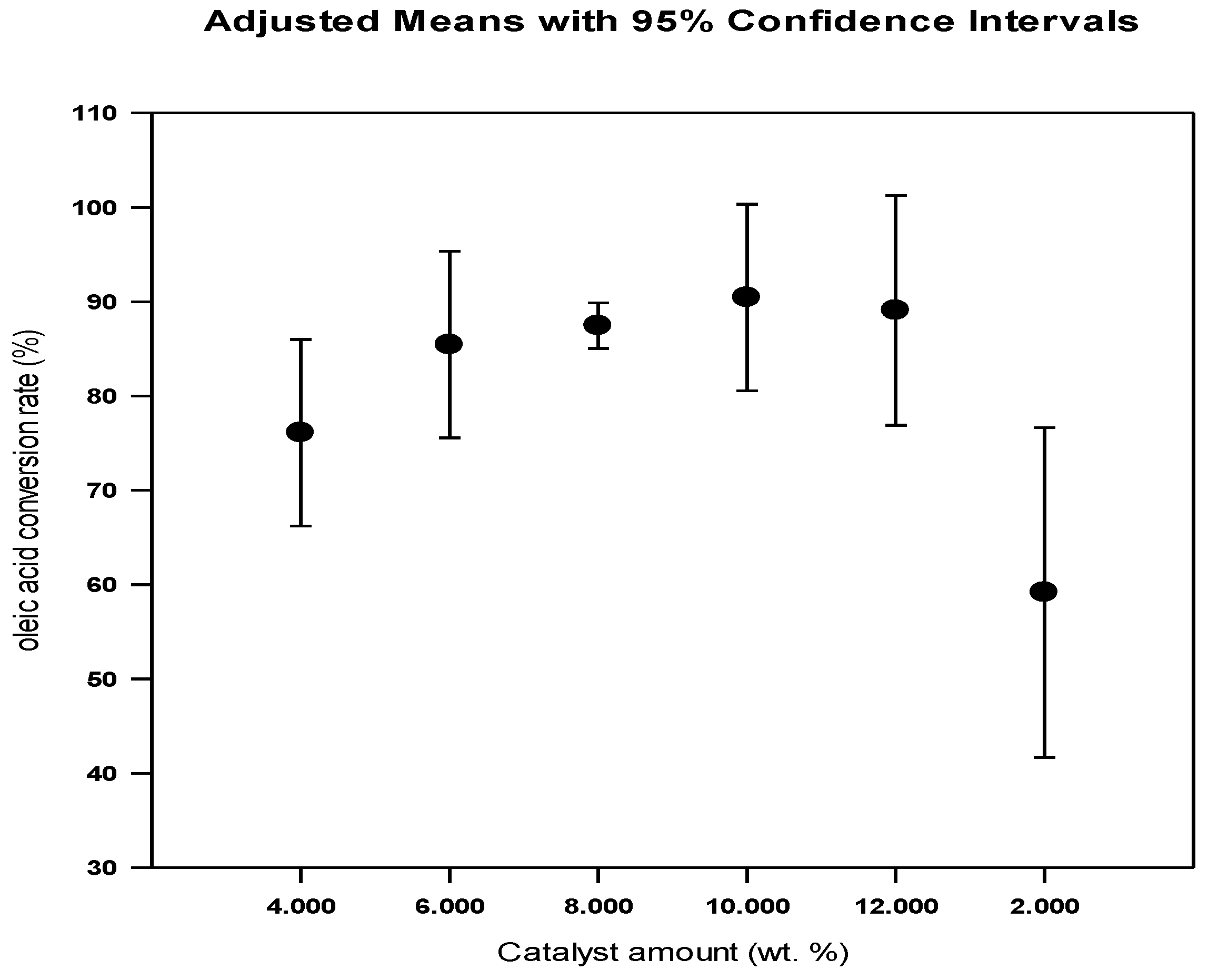
| Catalyst amount (wt.%) | 5 | 1138.589 | 227.718 | 3.126 | 0.015 |
| Temperature (°C) | 1 | 174.536 | 174.536 | 2.396 | 0.128 |
| Time (h) | 1 | 807.785 | 807.785 | 11.088 | 0.002 |
| Methanol/Oleic Acid Molar Ratio | 1 | 909.085 | 909.085 | 12.479 | <0.001 |
| Residual | 53 | 3861.085 | 72.851 | -- | -- |
| Total | 61 | 6457.242 | 105.856 | -- | -- |
| Catalyst Amount (wt.%) | Equations |
|---|---|
| 2 | oleic acid conversion rate (%) = 50.061 − (0.185 × Temperature (°C)) + (5.836 × Time (h)) + (1.132 × Methanol/Oleic acid molar ratio) |
| 4 | oleic acid conversion rate (%) = 67.010 − (0.185 × Temperature (°C)) + (5.836 × Time (h)) + (1.132 × Methanol/Oleic acid molar ratio) |
| 6 | oleic acid conversion rate (%) = 76.343 − (0.185 × Temperature (°C)) + (5.836 × Time (h)) + (1.132 × Methanol/Oleic acid molar ratio) |
| 8 | oleic acid conversion rate (%) = 78.364 − (0.185 × Temperature (°C)) + (5.836 × Time (h)) + (1.132 × Methanol/Oleic acid molar ratio) |
| 10 | oleic acid conversion rate (%) = 81.343 − (0.185 × Temperature (°C)) + (5.836 × Time (h)) + (1.132 × Methanol/Oleic acid molar ratio) |
| 12 | oleic acid conversion rate (%) = 79.985 − (0.185 × Temperature (°C)) + (5.836 × Time (h)) + (1.132 × Methanol/Oleic acid molar ratio) |
Disclaimer/Publisher’s Note: The statements, opinions and data contained in all publications are solely those of the individual author(s) and contributor(s) and not of MDPI and/or the editor(s). MDPI and/or the editor(s) disclaim responsibility for any injury to people or property resulting from any ideas, methods, instructions or products referred to in the content. |
© 2023 by the author. Licensee MDPI, Basel, Switzerland. This article is an open access article distributed under the terms and conditions of the Creative Commons Attribution (CC BY) license (https://creativecommons.org/licenses/by/4.0/).
Share and Cite
Ozcakir, G. Efficiency of Sulfonated UiO-66 on Biodiesel Production from Oleic Acid: An Optimization Study with ANCOVA. Eng. Proc. 2023, 56, 10. https://doi.org/10.3390/ASEC2023-15279
Ozcakir G. Efficiency of Sulfonated UiO-66 on Biodiesel Production from Oleic Acid: An Optimization Study with ANCOVA. Engineering Proceedings. 2023; 56(1):10. https://doi.org/10.3390/ASEC2023-15279
Chicago/Turabian StyleOzcakir, Gamze. 2023. "Efficiency of Sulfonated UiO-66 on Biodiesel Production from Oleic Acid: An Optimization Study with ANCOVA" Engineering Proceedings 56, no. 1: 10. https://doi.org/10.3390/ASEC2023-15279
APA StyleOzcakir, G. (2023). Efficiency of Sulfonated UiO-66 on Biodiesel Production from Oleic Acid: An Optimization Study with ANCOVA. Engineering Proceedings, 56(1), 10. https://doi.org/10.3390/ASEC2023-15279

