Integrating Sustainable Development Goals into Project-Based Learning and Design Thinking for the Instructional Design of a Virtual Reality Course †


Abstract
1. Introduction
2. Related Works
2.1. PBL
- Defining the learning objectives and standards that the project addresses;
- Designing a driving question or challenge to guide the project and stimulate the students’ curiosity;
- Planning the project activities and milestones, scaffolding, and formative assessments;
- Facilitating the project process and providing guidance and feedback to students as they work on their tasks and products;
- Evaluating project outcomes using rubrics or other tools to assess student performance and learning.
2.2. DT
- The exploration phase involves designers looking for new opportunities, new markets, new information, new trends, and new insights to understand users and empathize with their feelings.
- In the definition phase, initial insights are examined and either selected or discarded. This process includes the initial development of the project idea, during which the designer must engage with the wider context of the identified opportunity.
- In the development phase, the designed solution is developed, iterated, and tested internally by a multidisciplinary team using design tools such as brainstorming, sketches, scenes, renderings, or prototypes.
- In the delivery phase, the final concept undergoes final testing, production, and release.
3. SDGs-PBL-DT Pilot Pedagogy in VR Course
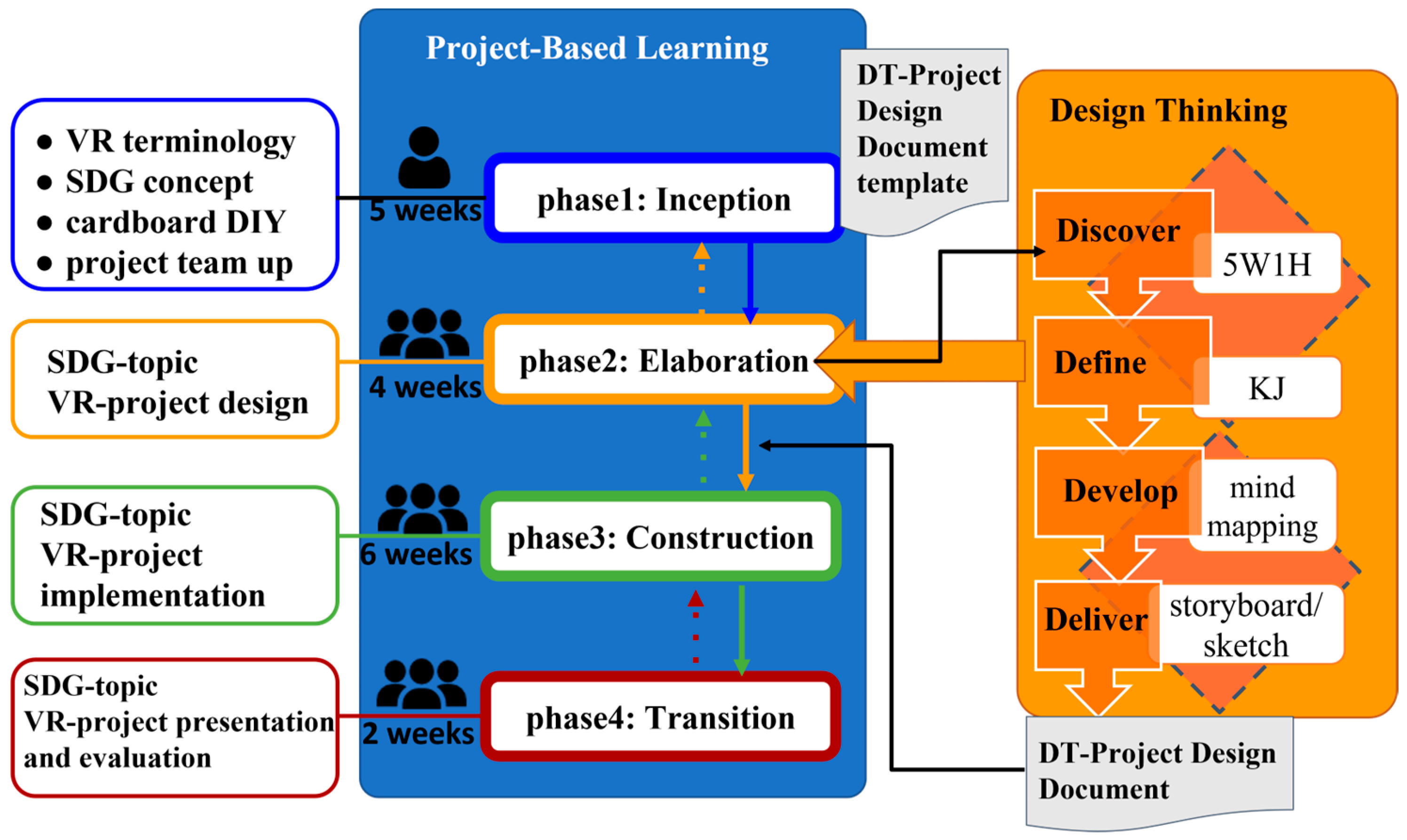
3.1. Phase 1: Inception
3.2. Phase 2: Elaboration
- Discover by using the 5W1H tool to enable groups to think about the SDGs problem to be solved in terms of who, why, what, where, when, and how, including the target user and the cause and location of the problem
- Define by using the KT tool [7] to enable the sub-groups to integrate, cluster, organize, and clarify the design ideas of each group member.
- Develop by using the mind mapping tool to organize the ideas collated by the KT tool into a tree-style mind mapping to fit the VR design.
- Deliver by using storyboard or sketch tools to design system prototypes.
3.3. Phase 3: Construction
3.4. Phase 4: Transition
4. Pedagogy Implementation
5. Data Collection, Analysis, and Results
5.1. Quantitative Analysis
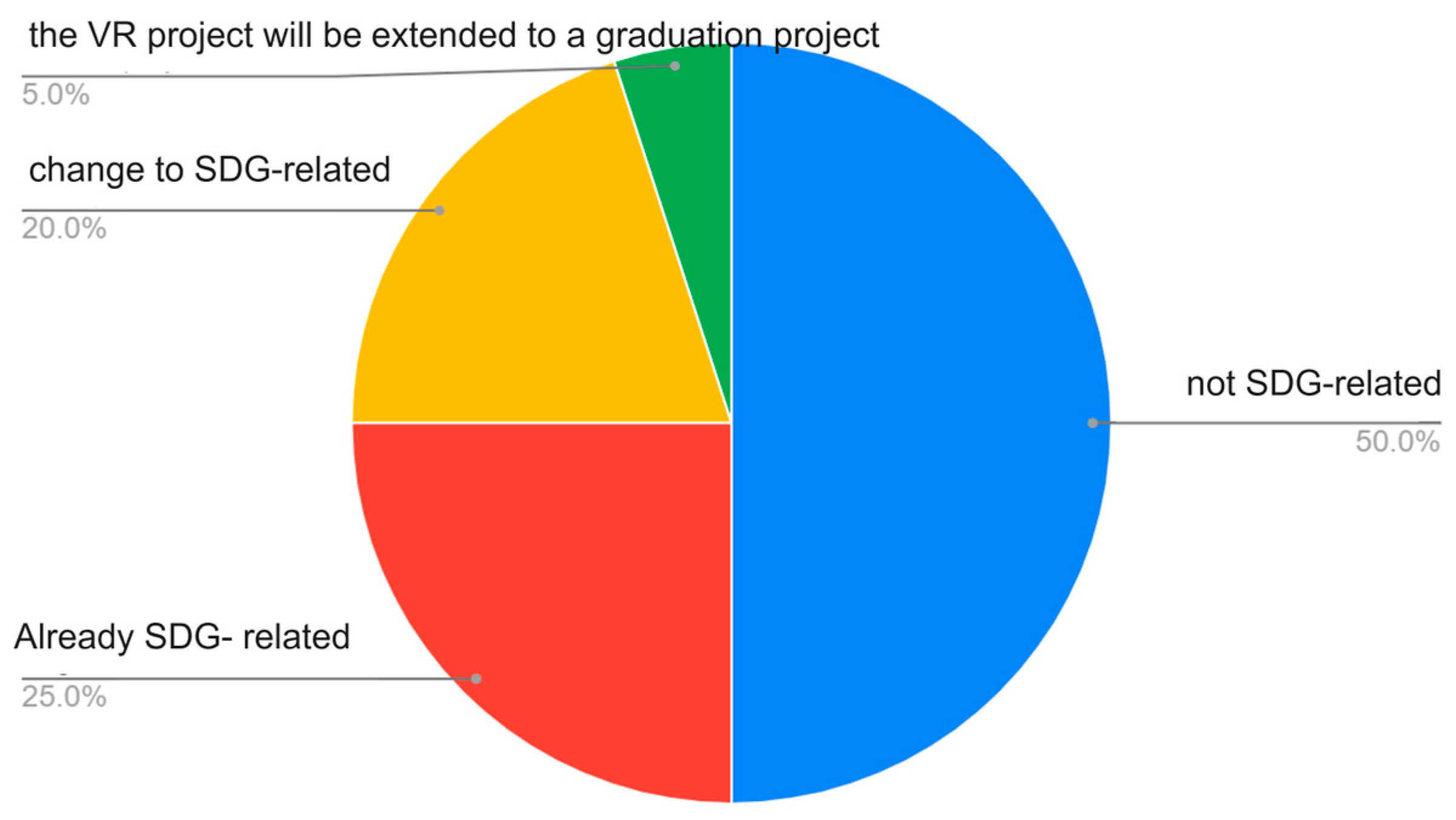
5.1.1. Impact of SDG Topics
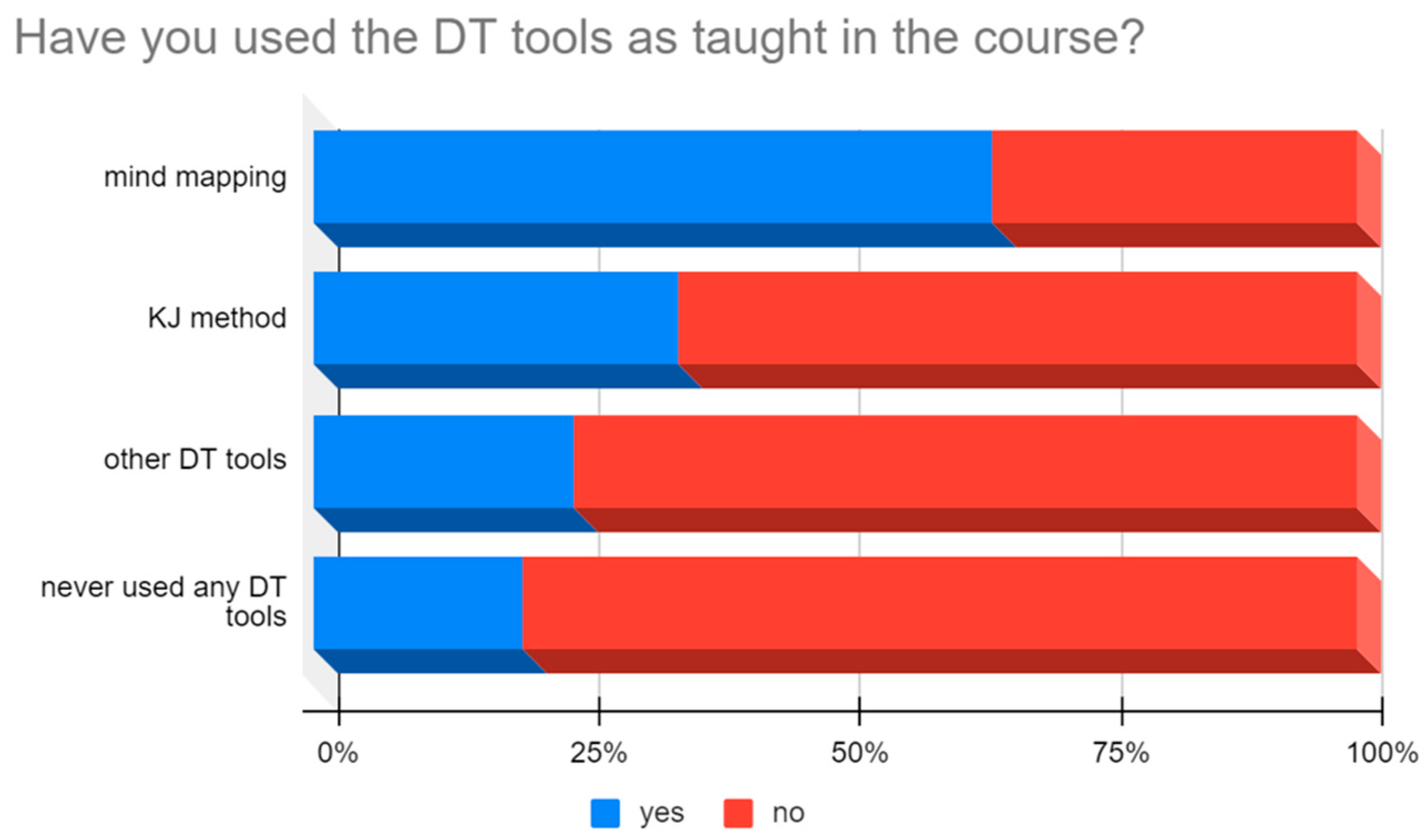
5.1.2. DT Tools
5.1.3. Survey Result
5.2. Qualitative Result
- Feedback from Student 1: “It is difficult to imagine how to use VR technology for the SDG topics for developing a VR project at first. Can you give more examples?”
- Feedback from Student 2: “The SDG topics were effective in helping us to find useful directions for our topics, and the SDGs project planning from the design thinking tools was interesting and informative, but the project results really depended on the group members’ abilities and cooperations.”
- Feedback from Student 3: “It is better to really talk to the target users to really understand their thoughts and needs.”
5.3. Reflections on Curriculum Design
- Although the first stage of the flipped classroom on VR terminology had to be carried out online because of COVID-19 and the video was given before the class, interaction and the reinforcement of concepts still occurred during the class.
- Based on classroom conversations with students, there was still a gap in translating the data generated from design thinking tools into a practical VR interactive project. Therefore, it was a challenge in curriculum design and research direction.
- It was worth noting that the DIY for Google Cardboard was still difficult. Although the students were provided with a Google Cardboard paper template and a live demonstration of the whole process, some still wanted to be provided with a video to watch again at home.
- The course lecturer had to have more training on applying DT in courses even if the lecturer attended more than five DT workshops. Continuous participation in DT workshops was essential to refine teaching.
6. Conclusions
Funding
Informed Consent Statement
Data Availability Statement
Conflicts of Interest
References
- General, A. United Nations Transforming Our World: The 2030 Agenda for Sustainable Development; Division for Sustainable Development Goals: New York, NY, USA, 2015. [Google Scholar]
- Condliffe, B.; Quint, J.; Visher, M.G.; Bangser, M.R.; Drohojowska, S.; Saco, L.; Nelson, E. Project-Based Learning: A Literature Review. MDRC: Working Paper. 2017. Available online: https://www.mdrc.org/publication/project-based-learning (accessed on 31 May 2021).
- Loyens, S.M.; Magda, J.; Rikers, R.M. Self-directed learning in problem-based learning and its relationships with self-regulated learning. Educ. Psychol. Rev. 2008, 20, 411–427. [Google Scholar] [CrossRef] [Scilit]
- Dorst, K. The core of ‘design thinking’and its application. Des. Stud. 2011, 32, 521–532. [Google Scholar] [CrossRef] [Scilit]
- Plattner, H.; Meinel, C.; Leifer, L. (Eds.) Design Thinking Research: Making Distinctions: Collaboration versus Cooperation. Springer. The Design Process: What Is the Double Diamond. 2017. Available online: http://www.designcouncil.org.uk/news-opinion/design-process-what-double-diamond (accessed on 26 October 2019).
- Kruchten, P. The Rational Unified Process: An Introduction; Addison-Wesley Professional: London, UK, 2004. [Google Scholar]
- Scupin, R. The KJ method: A technique for analyzing data derived from Japanese ethnology. Hum. Organ. 1997, 56, 233–237. [Google Scholar] [CrossRef] [Scilit]


| Items | Mean |
|---|---|
| The SDG topics allowed me to think more about using practical project work to do something to make the world a better place or to solve its problems. | 3.9 |
| I understood that the SDG topics would be implemented in the teamwork of the course project. I think it would be useful for me to have project planning and implement practical works rather than merely knowing the concepts or practice techniques. | 4.1 |
| We had no direction and no idea what to do for the course project until the teacher suggested the SDG topics for the VR course project. | 3.05 |
| The SDG topics provided us with more possibilities for the VR course project. | 3.75 |
| I think various DT tools and different creative thinking methods are helpful in formulating project designs. | 4.1 |
| I understood the use of the KJ method after the lecturer discussed the topic and provided a template. | 3.55 |
| I understood the use of the mind mapping method after the lecturer explained the concept and provided a template. | 3.9 |
| I understood that working in groups is more conducive to a collaborative working environment, where consensus and results are achieved through coordination, discussion and division of labor, and where I can learn more about cross-disciplinary practices. | 4.3 |
| I think PBL is helpful in bridging the workplace because of problem-solving, team discussions, teamwork and practical work. | 4.4 |
| PBL has helped me enhance my ability to think in multiple ways, as it is not just practical work. | 4.5 |
| Because PBL is a set application goal rather than a direct teaching of a bunch of program or function instructions, it stimulated my interest in learning. | 4.25 |
| In PBL, we had our own application goals, which helped me find solutions to achieve the goals I wanted to do. | 4.31 |
Disclaimer/Publisher’s Note: The statements, opinions and data contained in all publications are solely those of the individual author(s) and contributor(s) and not of MDPI and/or the editor(s). MDPI and/or the editor(s) disclaim responsibility for any injury to people or property resulting from any ideas, methods, instructions or products referred to in the content. |
© 2023 by the author. Licensee MDPI, Basel, Switzerland. This article is an open access article distributed under the terms and conditions of the Creative Commons Attribution (CC BY) license (https://creativecommons.org/licenses/by/4.0/).
Share and Cite
Chen, P.-H. Integrating Sustainable Development Goals into Project-Based Learning and Design Thinking for the Instructional Design of a Virtual Reality Course. Eng. Proc. 2023, 55, 78. https://doi.org/10.3390/engproc2023055078
Chen P-H. Integrating Sustainable Development Goals into Project-Based Learning and Design Thinking for the Instructional Design of a Virtual Reality Course. Engineering Proceedings. 2023; 55(1):78. https://doi.org/10.3390/engproc2023055078
Chicago/Turabian StyleChen, Pai-Hsun. 2023. "Integrating Sustainable Development Goals into Project-Based Learning and Design Thinking for the Instructional Design of a Virtual Reality Course" Engineering Proceedings 55, no. 1: 78. https://doi.org/10.3390/engproc2023055078
APA StyleChen, P.-H. (2023). Integrating Sustainable Development Goals into Project-Based Learning and Design Thinking for the Instructional Design of a Virtual Reality Course. Engineering Proceedings, 55(1), 78. https://doi.org/10.3390/engproc2023055078