


Abstract
This research presents two innovative base isolators known as the Scrap Tire Rubber Pad with Steel Rods (STRP-SR) isolator and the Magnetic Levitated (Maglev) isolator. The STRP-SR isolator offers a cost-effective solution for low-rise buildings, while the Maglev isolator provides an ideal bearing with zero horizontal stiffness. In this study, both the STRP-SR and Maglev isolators were analyzed numerically, and the experimental specimen of the Maglev isolator was tested on a shaking table. It can be concluded numerically that both isolators have the ability to significantly reduce absolute acceleration and displacement values, with average reductions of 53.24% and 100%, respectively.
1. Introduction
Conventional base isolators are associated with two primary concerns: firstly, a high cost of production and, secondly, the presence of a certain degree of horizontal lateral stiffness. In order to address these issues, this research introduces two innovative base isolators, namely the Scrap Tire Rubber Pad with Steel Rods (STRP-SR) isolator and the Magnetic Levitated (Maglev) isolator. A comprehensive study on the STRP isolator was previously conducted by Mishra [1]; however, it has been observed that the amount of energy dissipation is limited, and there is a shortcoming in terms of over-turning. Therefore, it is necessary to address the aforementioned issues by enhancing the seismic performance of STRP isolators. The Maglev isolator is introduced to provide an ideal bearing with zero horizontal lateral stiffness. The concept of the Maglev isolator is inspired by magnetic levitation technology [2].
2. Materials and Methods
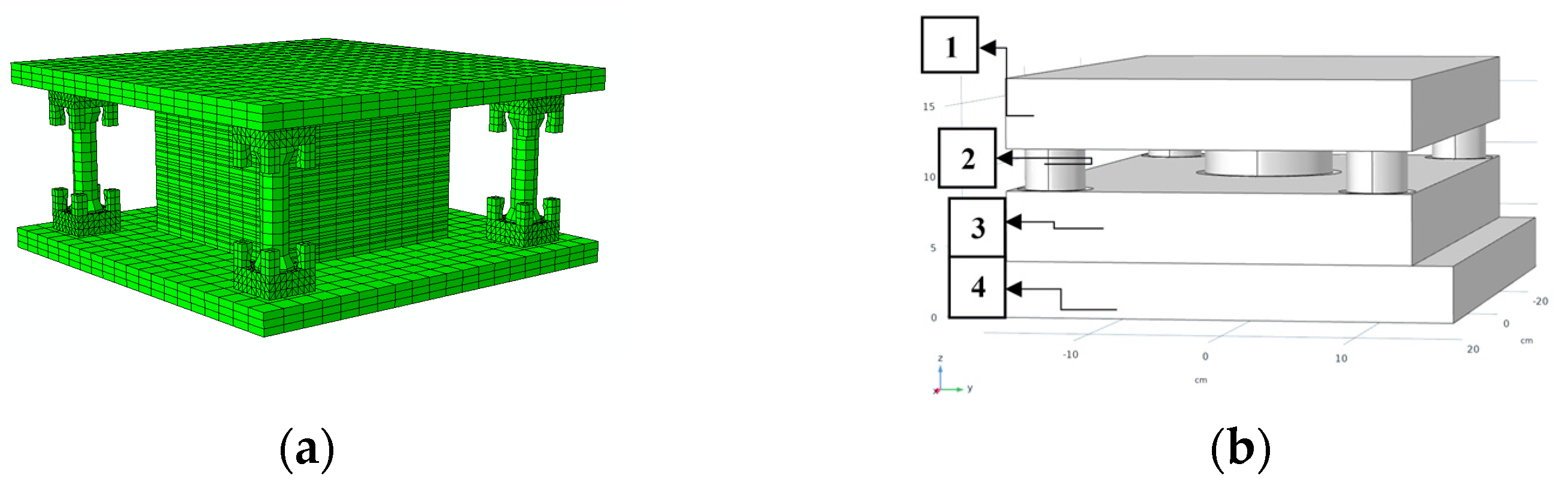
As depicted in Figure 1a, the STRP-SR isolator is introduced as a means to reduce production costs. This isolator consists of bonded piled-up scrap tire pads accompanied by four steel rods. It is specifically designed for implementation in light buildings of low importance. On the other hand, the Maglev isolator (Figure 1b) utilizes magnetic levitation technology to suspend the building with no physical contact with the ground, thereby eliminating horizontal lateral stiffness. In this research, the STRP-SR bearing was subjected to numerical analysis under compressive and cyclic shear loadings. The effectiveness of the STRP-SR bearing was evaluated for a model of a two-story isolated building using ABAQUS software (https://www.3ds.com/products-services/simulia/products/abaqus/, accessed on 1 October 2023). Furthermore, the Maglev bearing was examined numerically using COMSOL software (https://www.comsol.com/, accessed on 1 October 2023), with dynamic sinusoidal loadings at frequencies of 2 Hz and 4 Hz. Additionally, an experimental specimen of the Maglev bearing was tested on a shaking table.
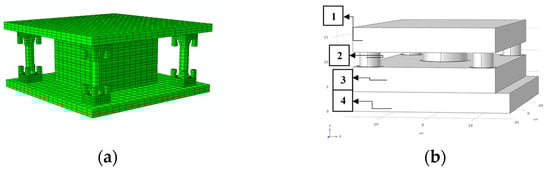
Figure 1.
(a) The STRP-SR model and (b) the Maglev model.
3. Results and Discussion
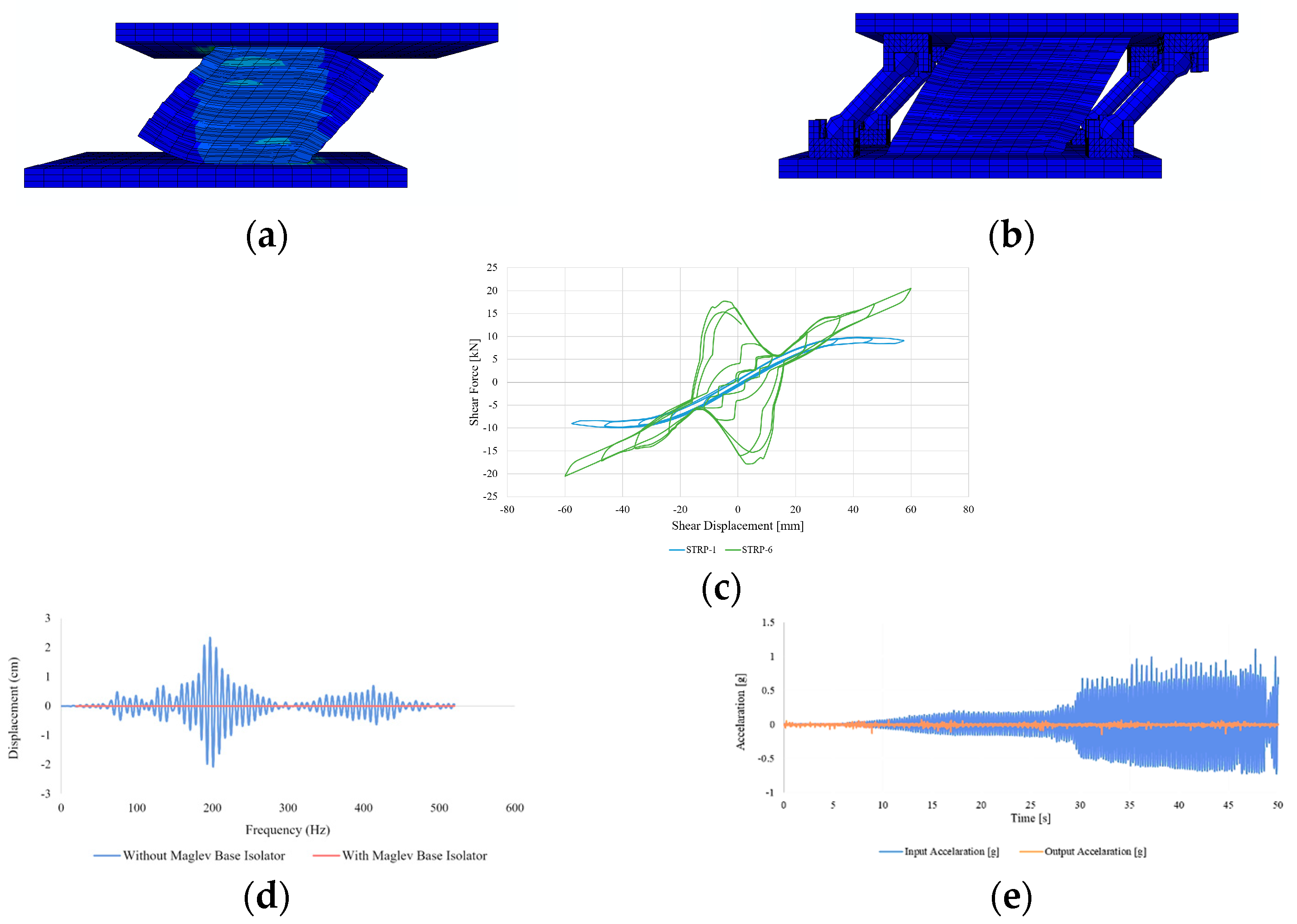
With regard to the results obtained, it is evident that the conventional unbonded STRP isolator (Figure 2a) experienced over-turning, resulting in an unstable hysteretic curve with a degradation in strength and stiffness (Figure 2c). Conversely, the use of bonded scrap tire layers in the novel STRP-SR isolator produced a stable hysteretic curve with a doubled strength value and eliminated the detachment of rubber corners (Figure 2c). The STRP-SR isolator, which was subjected to a constant compressive axial pressure of 6 MPa, dissipated the induced energy through the built-in steel rods, which generated friction between the spherical part of the rods and the inner surface of the bowl-shaped parts located above and below them (Figure 2b). Consequently, the energy dissipation capacity of the STRP-SR was significantly increased. Upon comparing the displacement variation obtained from the fixed-base and isolated finite element models in the frequency domain, it can be concluded that the introduced Maglev isolator achieved the primary objective of zero lateral stiffness and the complete separation of the building from the ground, thereby ensuring the safety of the building during severe earthquakes. However, upon testing an experimental specimen of the Maglev isolator, it was observed that while the acceleration was significantly reduced, it was not completely eliminated.
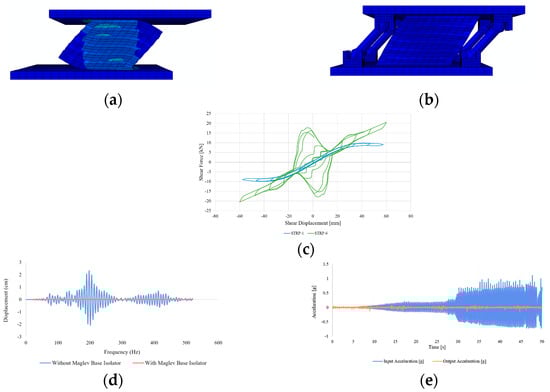
Figure 2.
(a) The deformation status of an unbonded STRP; (b) the deformation status of the STRP-SR; (c) comparison of the hysteretic curves obtained for unbonded STRP (STRP 1) and STRP-SR (STRP6) isolators; (d) the numerical variation of displacement for the Maglev isolator in the frequency domain; (e) the acceleration time-history for the experimental specimen of Maglev isolator.
4. Conclusions
Based on the acquired numerical findings, it has been deduced that the STRP-SR and Maglev bearings possess the ability to diminish the absolute acceleration and displacement values by mean percentages of 53.24% and 100%, respectively. This underscores their efficacy in ensuring the safety of isolated structures. The experimental outcomes for the Maglev isolator indicated that the aforementioned reduction percentage was lowered to an average of 74.67%, which remains an acceptable value in terms of the practical bearing’s efficiency.
Supplementary Materials
The presentation materials can be downloaded at: https://www.mdpi.com/article/10.3390/IOCBD2023-15194/s1.
Author Contributions
A.A.H.: Conceptualization, Methodology, Software, Validation, Formal analysis, Investigation, Resources, Data Curation, Writing—Original Draft, Writing—Review and Editing, Visualization, Supervision. M.S.: Methodology, Software, Validation, Formal analysis, Investigation, Resources, Data Curation, Writing—Original Draft, Writing—Review and Editing, Visualization, Supervision. H.R.H.G.: Methodology, Software, Validation, Formal analysis, Investigation, Resources, Data Curation, Writing—Original Draft, Writing—Review and Editing, Visualization. F.O.M.: Methodology, Software, Validation, Formal analysis, Investigation, Resources, Data Curation, Writing—Original Draft, Writing—Review and Editing, Visualization. All authors have read and agreed to the published version of the manuscript.
Funding
The section of this project pertaining to the STRP-SR base isolator is based upon research funded by the Iran National Science Foundation (INSF) under project No. 4021667, which is gratefully acknowledged.
Institutional Review Board Statement
Not applicable.
Informed Consent Statement
Not applicable.
Data Availability Statement
Data are available upon request from the authors.
Conflicts of Interest
The authors declare no conflict of interest.
References
- Mishra, H.K. Experimental and Analytical Studies on Scrap Tire Rubber Pads for Application to Seismic Isolation of Structures. Ph.D. Dissertation, Kyoto University, Kyoto, Japan, 2012. [Google Scholar]
- Dolga, V.; Dolga, L. Modeling and simulation of a magnetic levitation system. Fascicle Manag. Technol. Eng. 2007, 6, 1118–1124. [Google Scholar]
Disclaimer/Publisher’s Note: The statements, opinions and data contained in all publications are solely those of the individual author(s) and contributor(s) and not of MDPI and/or the editor(s). MDPI and/or the editor(s) disclaim responsibility for any injury to people or property resulting from any ideas, methods, instructions or products referred to in the content. |
© 2023 by the authors. Licensee MDPI, Basel, Switzerland. This article is an open access article distributed under the terms and conditions of the Creative Commons Attribution (CC BY) license (https://creativecommons.org/licenses/by/4.0/).