


Abstract
This study examines the ability of infrared thermography (IRT) to distinguish vasculopathy patients (VP) from healthy controls (HC) during post-occlusive reactive hyperemia (PORH). Three VP and three HC participated in the study. The experimental procedure included a 3-min baseline, a 5-min occlusion at 50 mmHg above the systolic pressure, and a 3-min reperfusion. During PORH, HC had a larger temperature fluctuation of the fingertips from the baseline (1.22 ± 0.97 °C) compared to VP (0.53 ± 0.57 °C). Accordingly, color Doppler ultrasound assessed differences in the arterial resistivity index between the two groups. These findings, albeit preliminary, could facilitate IRT employment during POHR.
1. Introduction
Vasculopathy encompasses various pathological conditions of the blood vessels, and it is typically characterized by the altered structure and function of blood vessels, leading to disturbances in circulation [1]. The diagnostic standard for vasculopathy often involves measuring the arterial resistivity index (RI) using color Doppler ultrasound (CDUS) during post-occlusive reactive hyperemia (PORH) [2]. This technique provides valuable insight into vascular reactivity and endothelial function, with the potential to diagnose vascular abnormalities. However, this method has its limitations, particularly concerning invasiveness and discomfort for the patient, as well as the need for specialized personnel and equipment. Infrared thermography (IRT) has emerged as a promising candidate with which to overcome these limitations. IRT is already extensively used to assess peripheral vascular disease thanks to its ability to detect skin temperature modulations [3,4,5,6]. In fact, IRT’s non-contact and non-invasive nature, coupled with its potential for real-time imaging, represents an attractive method for screening procedures. Despite these advantages, the use of IRT to evaluate vasculopathy, specifically in the context of RI measured during PORH, remains underexplored. This study aims to investigate the applicability of IRT as a potential diagnostic tool for vasculopathy, in comparison with traditional CDUS measures. Particularly, healthy controls and patients affected by vasculopathy were monitored through CDUS and IRT during PORH to assess the agreement of the two procedures.
2. Materials and Methods
2.1. Experimental Procedure and Data Acquisition
Seven VP and seven HC participated in the study (age: 62.36 years; 4 M in the VP groups and 5 M in the HC group). The experimental procedure included a 3-min baseline, a 5-min occlusion at 50 mmHg above the systolic pressure, and a 3-min reperfusion. The acquisitions were carried out in accordance with prescribed thermal measurement protocols [7]. The FLIR A500-EST digital thermal infrared camera (FLIR, Wilsonville, OR, USA) was employed to record temperature oscillations in the upper limbs. The device is equipped with a bolometer focal plane array (FPA) that has a resolution of 640 × 480. Additionally, it has a sensitivity/noise equivalent temperature difference of less than 30 mK at a temperature of 30 °C. The thermal camera was placed at a distance of 60 cm from the upper limb. The temperature was recorded with a sampling frequency of 10 Hz.
2.2. Data Processing and Statistical Analysis
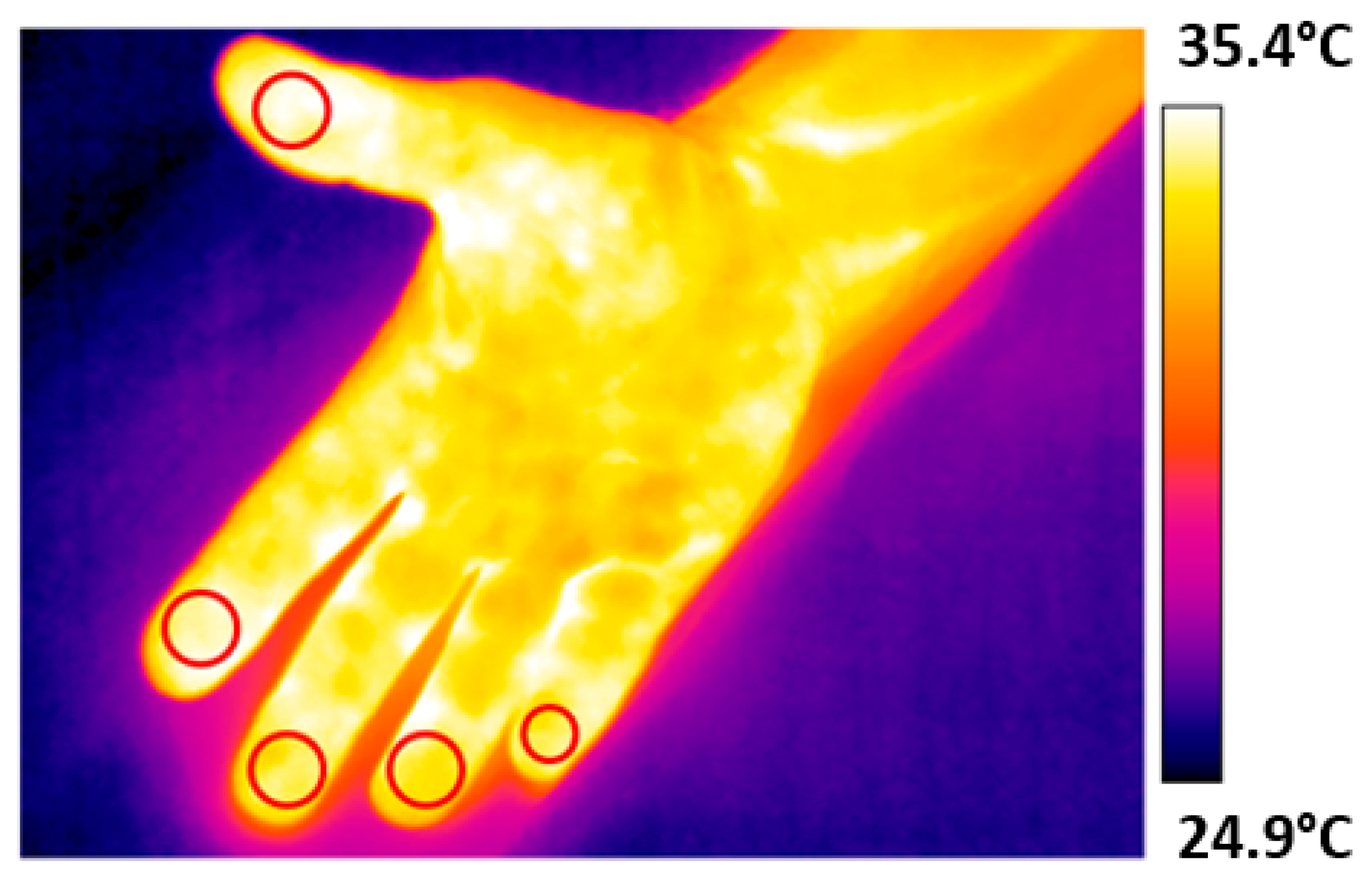
Five regions of interest (ROIs) were placed on the fingertips, as shown in Figure 1. The variation of the average temperature of each ROI from the ischemic phase during the reperfusion was computed, and the mean value across them was evaluated (ΔT). Moreover, RI was computed via CDUS during the reperfusion phase. The differences between the two groups were assessed for both IRT- and CDUS-derived metrics through a t-test for independent samples.

Figure 1.
Thermogram of a representative participant with the ROIs’ placement on the fingertips.
3. Results
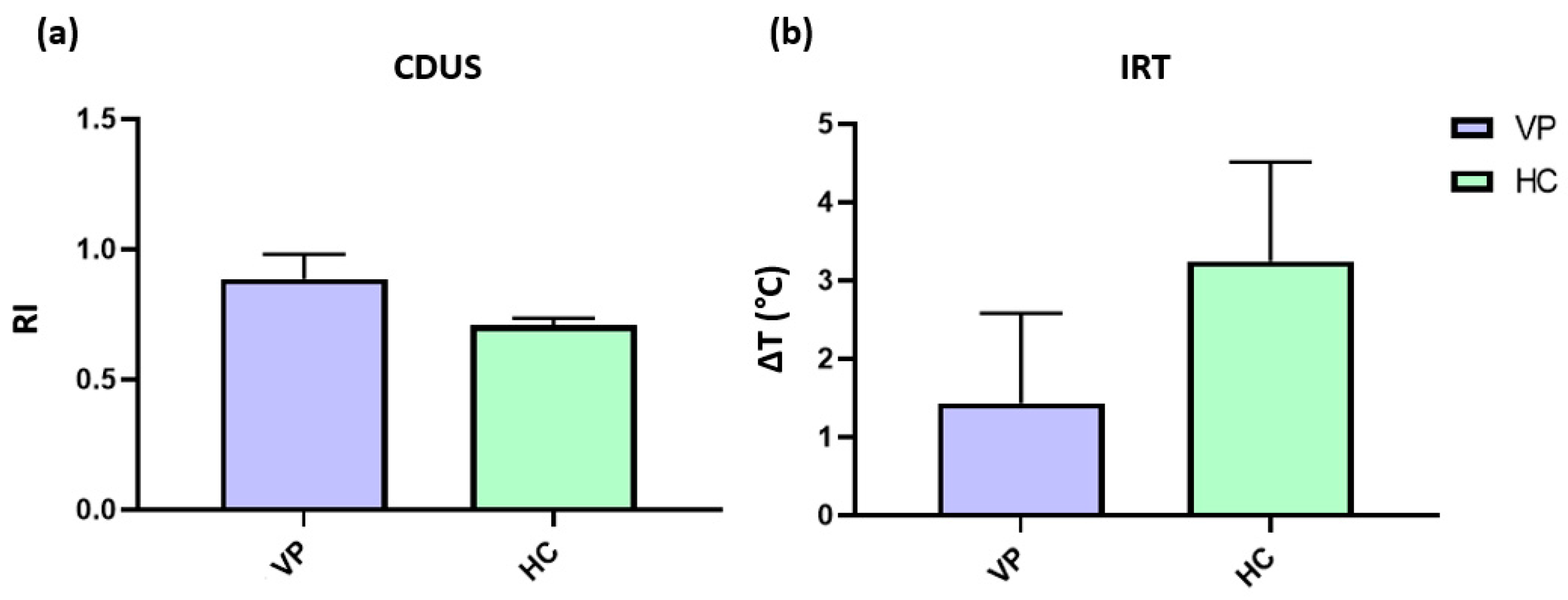
During PORH, HC had a larger temperature fluctuation of the fingertips from the ischemic phase (3.22 ± 1.18 °C) compared to VP (1.43 ± 0.89 °C). Accordingly, CDUS showed in HC that the RI decreased from 0.78 ± 0.04 during the baseline to 0.71 ± 0.03 during the reperfusion, whereas VP exhibited no variations in RI (0.90 ± 0.03 during baseline; 0.89 ± 0.04 during reperfusion).
Figure 2a reports the boxplots of the RI obtained through CDUS, whereas Figure 2b shows the mean variation of the average temperature for both VP and HC.

Figure 2.
Distribution of the (a) RI evaluated through CDUS and (b) ΔT estimated through URT for both the VP and HC groups.
The statistical analysis highlighted the significant differences between the HC and VP groups for both the RI (t = 4.912; d.f. = 12; p = 4 × 10⁻⁴) and the ΔT (t = 3.491; d.f. = 12; p = 5 × 10⁻³).
4. Discussion
This study demonstrated the potential of IRT in the diagnosis and assessment of vasculopathy in comparison with the traditional CDUS. Both methods revealed significant differences between VP and HC, indicating the possibility of a comprehensive diagnostic framework encompassing both tools. In detail, a larger temperature variation during PORH was found in HC compared to VP. This finding could be attributed to the physiological changes associated with vasculopathy, such as inflammation, impaired vascular reactivity, and abnormal endothelial function, which can all affect heat dissipation and thus surface temperature. This implies that IRT can provide a non-invasive measure of these pathological modifications, potentially enhancing early detection and assessment of vasculopathy. In agreement, CDUS showed increased RI in VP compared to HC. These results are in line with the existing literature, suggesting an increased RI as a hallmark of vasculopathy [8]. Importantly, the results from IRT and CDUS are not contradictory; rather, they are complementary. In fact, IRT provides a non-invasive way to detect and monitor surface temperature changes, which are indicative of underlying vascular alterations, while CDUS offers in-depth insights into blood flow dynamics and vascular resistance. Taken together, they could offer a more comprehensive view of the vascular state in patients with vasculopathy. One implication of these findings is the potential for integrating IRT into routine clinical assessments of vasculopathy in screening activities. In fact, it could be employed as an initial, non-invasive screening tool, followed by CDUS for more detailed evaluations when necessary. However, it is worth noting that while the results are promising, the study has a limited sample size; hence, further studies are necessary in order to increase the sample numerosity. Moreover, the diagnostic capabilities of IRT for vasculopathy, including sensitivity, specificity, and predictive values, should be determined in further investigations. Finally, standard protocols for the employment of IRT for this kind of application should be defined, including best practices for image capture, interpretation, and comparison to CDUS.
5. Conclusions
This study provides encouraging preliminary evidence supporting the use of IRT in the assessment of vasculopathy. This novel, non-invasive technique could represent a significant addition to the diagnostic procedures in clinical practice, enhancing the ability to detect, manage, and potentially prevent the progression of vascular disease.
Author Contributions
Conceptualization, D.P., M.T., D.C., G.G., A.S., M.N., F.N. and A.M.; methodology, D.P., M.T. and G.G.; software, D.P.; validation, D.P., M.T. and D.C.; formal analysis, D.P.; investigation, M.T., D.C., G.G., A.S., M.N. and F.N.; resources, A.M.; data curation, D.P.; writing—original draft preparation, D.P.; writing—review and editing, D.P., M.T., D.C., G.G., A.S., M.N., F.N. and A.M.; visualization, D.P.; supervision, A.M. and G.G.; project administration, A.M. All authors have read and agreed to the published version of the manuscript.
Funding
This research received no external funding.
Institutional Review Board Statement
The study was conducted in accordance with the Declaration of Helsinki and approved by the Institutional Review Board (or Ethics Committee) of Fondazione IRCCS “Casa Sollievo della Sofferenza”, Termo-FlirC3—V0.0_24Feb 22, 31 March 2022.
Informed Consent Statement
Informed consent was obtained from all subjects involved in the study.
Data Availability Statement
The data and images are available on request to the corresponding author.
Conflicts of Interest
The authors declare no conflict of interest.
References
- Emad, Y.; Al-Sherbeni, H.; Ragab, Y.; Abo-El-Youn, I.; El-Shaarawy, N.; Nassar, D.Y.; Fathy, A.; Al-Hanafi, H.; Rasker, J.J. Arterial Vasculopathy in Systemic Sclerosis: Computerized Tomography (CT) Angiographic Features of Macrovascular and Microvascular Upper Limbs Arteries. Jt. Bone Spine 2014, 81, 433–437. [Google Scholar] [CrossRef] [PubMed]
- Bopp, C.M.; Townsend, D.K.; Warren, S.; Barstow, T.J. Relationship between Brachial Artery Blood Flow and Total [Hemoglobin+myoglobin] during Post-Occlusive Reactive Hyperemia. Microvasc. Res. 2014, 91, 37–43. [Google Scholar] [CrossRef] [PubMed]
- Filippini, C.; Cardone, D.; Perpetuini, D.; Chiarelli, A.M.; Gualdi, G.; Amerio, P.; Merla, A. Convolutional Neural Networks for Differential Diagnosis of Raynaud’s Phenomenon Based on Hands Thermal Patterns. Appl. Sci. 2021, 11, 3614. [Google Scholar] [CrossRef]
- Perpetuini, D.; Filippini, C.; Zito, M.; Cardone, D.; Merla, A. Altered Microcirculation in Alzheimer’s Disease Assessed by Machine Learning Applied to Functional Thermal Imaging Data. Bioengineering 2022, 9, 492. [Google Scholar] [CrossRef] [PubMed]
- Vardasca, R.; Magalhaes, C.; Mendes, J. Biomedical Applications of Infrared Thermal Imaging: Current State of Machine Learning Classification. In Proceedings of the 15th International Workshop on Advanced Infrared Technology and Applications (AITA 2019), Florence, Italy, 17–19 September 2019; Volume 27, p. 46. [Google Scholar]
- Hernandez-Contreras, D.; Peregrina-Barreto, H.; Rangel-Magdaleno, J.; Gonzalez-Bernal, J. Narrative Review: Diabetic Foot and Infrared Thermography. Infrared Phys. Technol. 2016, 78, 105–117. [Google Scholar] [CrossRef]
- Diakides, M.; Bronzino, J.D.; Peterson, D.R. Medical Infrared Imaging: Principles and Practices; CRC Press: Boca Raton, FL, USA, 2012; ISBN 978-1-4398-7250-5. [Google Scholar]
- Gigante, A.; Navarini, L.; Margiotta, D.; Amoroso, A.; Barbano, B.; Cianci, R.; Afeltra, A.; Rosato, E. Angiogenic and Angiostatic Factors in Renal Scleroderma-Associated Vasculopathy. Microvasc. Res. 2017, 114, 41–45. [Google Scholar] [CrossRef] [PubMed][Green Version]
Disclaimer/Publisher’s Note: The statements, opinions and data contained in all publications are solely those of the individual author(s) and contributor(s) and not of MDPI and/or the editor(s). MDPI and/or the editor(s) disclaim responsibility for any injury to people or property resulting from any ideas, methods, instructions or products referred to in the content. |
© 2023 by the authors. Licensee MDPI, Basel, Switzerland. This article is an open access article distributed under the terms and conditions of the Creative Commons Attribution (CC BY) license (https://creativecommons.org/licenses/by/4.0/).