


Abstract
The degradation of Zinc Oxide Surge Arresters (ZnOSA) is commonly detected by the resistive component of its leakage current ‘Ir’. The methods previously employed to extract the resistive component of the leakage current were intricate and demanded a greater number of computational steps. The objective of this paper is to propose a new technique for the age detection and degradation analysis of ZnOSA, named the ‘Correlation Method’, which does not require the extraction of the resistive leakage current. The correlation coefficient is calculated between the power factor (pf) and total leakage current (It) on the MATLAB software (Version R2018a). The performance of this method is analyzed experimentally by changing the voltage, ranging from 70 to 120 kV, of surge arresters. The proposed research offers improved computational efficiency and provides valuable insights into the relationship between the power factor, leakage current, and the aging process of ZnOSA. Moreover, the results of the proposed methods are compared with those of existing techniques.
1. Introduction
Zinc Oxide Surge Arresters (ZnOSA) are utilized to protect the system against overpotential [1]. The working of ZnOSA is affected by aging and insulation breakdown inside the arrester. Therefore, it is necessary to protect the ZnOSA from further damage and deterioration, which may cause interruptions in electricity transmission and distribution [2]. Condition monitoring techniques are employed to determine the current health status of ZnOSA in terms of its aging and degradation. These conditions are implemented in two ways: (a) online and (b) offline [3]. Offline condition monitoring requires the disconnection of the surge arrester from the power system [4]. On the contrary, an online technique is capable of monitoring the condition of the arrester during its operation in the grid. Online condition monitoring techniques are most commonly based on the measurement of It, which comprises two components, capacitive and resistive currents [5]. The variations in environmental factors have a more noticeable effect on the aging of ZnOSA, particularly in the resistive component of the leakage current [6]. Therefore, it is adopted as the most reliable indicator of an arrester’s condition. Researchers have proposed many methods for the extraction of Ir [7,8]. These include the modified shifted current method, capacitive current shifted method, conventional method and others, as described in Table 1 [9,10,11]. However, a significant number of computation steps are required; moreover, the accuracy and results are inadequate, since it requires the separation of Ir from It [12,13]. To reduce the computational steps and improve the age detection process, a new technique is proposed, which is based on the correlation between the power factor and total leakage current at different voltages. It is essential to propose new techniques for the online condition monitoring of ZnOSA, independent of the extraction of Ir.

Table 1.
Existing methods for online condition monitoring of surge arresters.
This paper introduces a new aging indicator-based online condition assessment of ZnOSA, known as the correlation method. The proposed technique is based on the computation of the correlation between the pf and It of the arrester. The experimentation is conducted using three samples of ZnOSA by varying the applied voltage levels from 70 to 120 kV, as a prominent variation is observed in the leakage current level by varying the voltage level from 70 to 120 kV [14]. The obtained results are compared with existing methods that require the extraction of Ir from It. The results show that the proposed method can easily detect aging, without performing numerous computational steps, more effectively as compared to existing methods.
2. Methodology
The correlation method is proposed in this paper for the online health assessment of ZnOSA. Experiments are carried out in the high-voltage laboratory to measure the total leakage current of three samples of 120-kV rated arresters. All the tested samples of ZnOSA have the same voltage–current characteristics, current age and physical dimensions. The applied voltage is varied from 70 to 120 kV with a step of 10 kV for the classification of the arrester samples. After obtaining the leakage current signal, the modified shifted current method is used to extract the resistive current for the validation of the results, as shown in Figure 1. The obtained current parameters are substituted into Equation (1) to determine the angle of the current. Equation (2) is employed to determine the power factor of the arrester using the angle ‘θ’. The correlation coefficient ‘Q’ between the It and pf of each arrester sample is obtained on MATLAB to determine its condition within the voltage range of 70–120 kV.
where Ic = capacitive component of total leakage current.
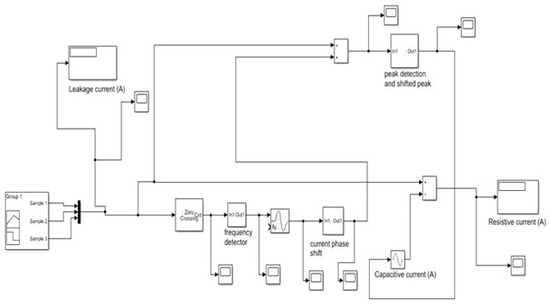
Figure 1.
Simulink model for the withdrawal of resistive current component of It.
The followed research methodology is shown in Figure 2.

Figure 2.
Research flow diagram.
3. Results and Analysis
The experimental results of It and Ir for each arrester sample, obtained by varying the voltage levels from 70 to 120 kV, are tabularized in Table 2.
Table 2.
Measured values of Ir and It for samples 1, 2 and 3.
Based on the information obtained from Table 2, it is observed that the resistive current increases as the voltage rises.
Similarly, the obtained results of angle ‘θ’ and pf are presented in Table 3. It is evident from Table 3 that the angle of the current varies inversely with respect to the applied voltage. This is due to the fact that the increase in It with the applied voltage in fact increases the resistive current more significantly as compared to the capacitive current [15].
Table 3.
Computed values of pf for samples 1, 2 and 3.
The results of correlation coefficients Q1, Q2 and Q3 of samples 1, 2 and 3, respectively, are shown in Table 4.
Table 4.
Results of correlation coefficients.
Table 4 shows that sample 2 has the highest correlation coefficient as compared to samples 1 and 3. Hence, Q2 indicates that sample 2 is highly aged amongst the studied samples. It is also inferred that the power factor has a direct relationship with the applied voltage. Furthermore, it is evident from Figure 3 that sample 2 has the highest value of correlation between pf and It as indicated by red line which shows that sample 2 is highly aged.
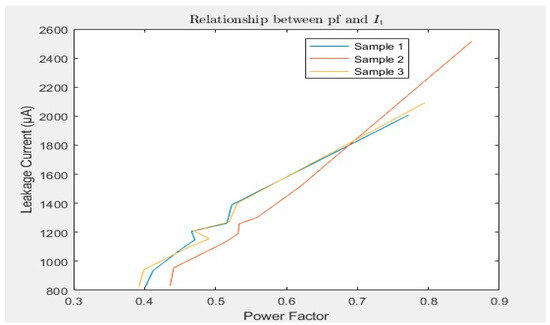
Figure 3.
Relationship between power factor and It.
The results are validated using the previously applied method that uses Ir as the aging indicator by extracting Ir from the samples. The extracted resistive leakage current components of samples 1, 2 and 3 are presented in Figure 4. The resistive current of sample 2 is more distorted, with a high magnitude as compared to other samples. This is due to the fact that sample 2 is the most aged sample among all arresters.
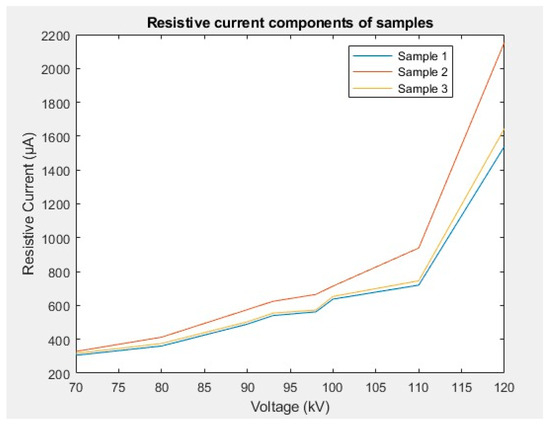
Figure 4.
Resistive current component Ir of samples 1, 2 and 3.
The correlation between pf and It is determined to be directly related to the aging of ZnOSA. Consequently, utilizing this relationship can serve as a simpler and more effective method to monitor the aging of ZnOSA and assess its overall health.
4. Conclusions
In this paper, a new technique based on the correlation coefficient method is proposed for the online condition monitoring (age detection) of ZnOSA. This technique is executed on the MATLAB software (Version R2018a) with the help of data extracted from a 120 kV rated ZnOSA. To validate the efficiency and accuracy of this proposed method, the Ir of samples 1, 2 and 3 were extracted from It, using a Simulink model. A significant reduction in computational steps was observed when employing the new technique compared to previously applied methods. It is concluded that when using the correlation-based technique, fewer computational steps are required as compared to previously used techniques. It is also concluded that the correlation between pf and It is directly proportional to the aging of the ZnOSA. Hence, this can be used as a more simple and efficient method to monitor the health of a ZnOSA by detecting its age.
Author Contributions
Conceptualization, A.M.; methodology, S.S.H., U.A. and H.A.; software, H.A., S.S.H. and S.K.S.; validation, H.A., U.A., S.S.H. and S.K.S.; formal analysis, A.M.; investigation, A.M.; resources, A.M.; data curation, A.M.; writing—original draft preparation, A.M.; writing—review and editing, S.S.H., H.A. and A.M.; abstract and references, U.A. and S.K.S.; supervision, A.M.; project administration, A.M. All authors have read and agreed to the published version of the manuscript.
Funding
This research received no external funding.
Institutional Review Board Statement
Not applicable.
Informed Consent Statement
Not applicable.
Data Availability Statement
Data obtained from the samples of 120 kV ZnOSA by Abdullah Munir.
Acknowledgments
The authors would like to express their gratitude to their supervisor, Abdullah Munir, for his cooperation, constant encouragement and support throughout the research.
Conflicts of Interest
The authors declare no conflict of interest.
References
- Munir, A.; Abdul-Malek, Z.; Arshad, R.N. Resistive component extraction of leakage current in metal oxide surge arrester: A hybrid method. Measurement 2021, 173, 108588. [Google Scholar] [CrossRef]
- Barbosa, V.R.N.; Lira, G.R.S.; Dias, M.B.B.; Costa, E.G. Estimation of Metal Oxide Surge Arresters’ Useful Life Based on Time Series Forecasts. IEEE Trans. Power Deliv. 2021, 37, 842–850. [Google Scholar] [CrossRef]
- Munir, A.; Abdul-Malek, Z.; Sultana, U.; Arshad, R.N. A novel technique for condition monitoring of metal oxide surge arrester based on fifth harmonic resistive current. Electr. Power Syst. Res. 2022, 202, 107576. [Google Scholar] [CrossRef]
- Das, A.K.; Dalai, S. Recent Development in Condition Monitoring Methodologies of MOSA Employing Leakage Current Signal: A Review. IEEE Sens. J. 2021, 21, 14559–14568. [Google Scholar] [CrossRef]
- Abdul-Malek, Z.; Khavari, A.H.; Wooi, C.L.; Moradi, M.; Naderipour, A. A review of modeling ageing behavior and condition monitoring of zinc Oxide Surge Arrester. In Proceedings of the 2015 IEEE Student Conference on Research and Development (SCOReD), Kuala Lumpur, Malaysia, 13–14 December 2015; IEEE: Piscataway, NJ, USA, 2015. [Google Scholar]
- Heinrich, C.; Hinrichsen, V. Diagnostics and monitoring of metal-oxide surge arresters in high-voltage networks-comparison of existing and newly developed procedures. IEEE Trans. Power Deliv. 2001, 16, 138–143. [Google Scholar] [CrossRef]
- Abdul-Malek, Z.; Yusoff, N.; Yousof, M.F.M. Field experience on surge arrester condition monitoring-Modified Shifted Current Method. In Proceedings of the 45th International Universities Power Engineering Conference UPEC2010, Cardiff, UK, 31 August–3 September 2010; IEEE: Piscataway, NJ, USA, 2010. [Google Scholar]
- Khodsuz, M.; Mirzaie, M.; Seyyedbarzegar, S. Metal oxide surge arrester condition monitoring based on analysis of leakage current components. Int. J. Electr. Power Energy Syst. 2015, 66, 188–193. [Google Scholar] [CrossRef]
- Munir, A.B.; Jawaid, O.W.; Qureshi, J.A. Power quality analysis of UPS using wavelet analysis. In Proceedings of the 45th IEP Convention, Karachi, Pakistan, 21–22 December 2012. [Google Scholar]
- Liu, S.; Popov, M.; Belda, N.A.; Smeets, R.P.P.; Liu, Z. Thermal FEM Analysis of Surge Arresters During HVdc Current Interruption Validated by Experiments. IEEE Trans. Power Deliv. 2021, 37, 1412–1422. [Google Scholar] [CrossRef]
- Metwally, I.A.; Eladawy, M.; Feilat, E.A. Online condition monitoring of surge arresters based on third-harmonic analysis of leakage current. IEEE Trans. Dielectr. Electr. Insul. 2017, 24, 2274–2281. [Google Scholar] [CrossRef]
- Munir, A.; Abdul-Malek, Z. Ageing Detection of Metal Oxide Surge Arrester using Fifth Harmonic Resistive Current. In Proceedings of the 2020 IEEE International Conference on Power and Energy (PECon), Penang, Malaysia, 7–8 December 2020; IEEE: Piscataway, NJ, USA, 2020. [Google Scholar]
- Zhang, Q.; Wang, S.; Dong, X.; Liu, M.; Ou, Q.; Lv, F. Research of ZnO Arrester Deterioration Mechanism Based on Electrical Performance and Micro Material Test. Electronics 2021, 10, 2624. [Google Scholar] [CrossRef]
- Munir, A.; Abdul-Malek, Z.; Arshad, R.N. Ageing Classification of Metal Oxide Surge Arrester Using Its Power Factor. In Proceedings of the 2021 IEEE International Conference on the Properties and Applications of Dielectric Materials (ICPADM), Johor Bahru, Malaysia, 12–14 July 2021; IEEE: Piscataway, NJ, USA, 2021. [Google Scholar]
- Papliński, P.; Wańkowicz, J.; Śmietanka, H.; Ranachowski, P.; Ranachowski, Z.; Kudela, S.J.; Aleksiejuk, M. Comparative Studies on Degradation of Varistors Subjected to Operation in Surge Arresters and Surge Arrester Counters. Arch. Met. Mater. 2020, 65, 367–374. [Google Scholar]
Disclaimer/Publisher’s Note: The statements, opinions and data contained in all publications are solely those of the individual author(s) and contributor(s) and not of MDPI and/or the editor(s). MDPI and/or the editor(s) disclaim responsibility for any injury to people or property resulting from any ideas, methods, instructions or products referred to in the content. |
© 2023 by the authors. Licensee MDPI, Basel, Switzerland. This article is an open access article distributed under the terms and conditions of the Creative Commons Attribution (CC BY) license (https://creativecommons.org/licenses/by/4.0/).