


Abstract
In this study, UTAUT2 is used to explore the use behavior by consumers regarding a self-ordering system. A total of 227 valid questionnaires were collected after being distributed with an effective recovery rate of 90.8%. Confirmatory factor analysis and a structural equation model were utilized via Smart PLS 2.0. The result shows that only several research hypotheses have significant effects. Among the adjustment variables, age and habits have a significant impact on user behavior. Experience and convenience conditions have a significant impact on use intention. Experience and habit have a significant impact on use intention. The overall model fit is excellent with high explanatory power. According to the research results, the public accepts self-service ordering technology systems in restaurants. The higher the level of pleasure after use, the higher the willingness to use the system in the future.
1. Introduction
With the advance of science and technology and the changes in the consumption pattern, technology has gradually been introduced into the workplace, and the mode of operation of the catering industry has gradually been oriented towards customer self-service in Taiwan. Operations through self-service technology (SST) can effectively reduce investment costs and improve quality service [1]. Ho et al. [2] pointed out that introducing self-service innovative technology provides customers with new services or transactions. Self-ordering service has gradually been introduced in the catering industry in Taiwan, and operating through SSTs allows customers to order foods and drinks from touch-screen menus [3]. Restaurants can effectively reduce labor and investment costs, increase revenue, and improve quality services [1,3]. Self-service technology is a service method in which the operators know the consumers’ needs through SSTs, and consumers do not need to interact with service staff or wait to access the service [3,4]. Operating SSTs by themselves reduces waiting times. The industry has introduced self-service technology, which is increasingly becoming a part of industry service.
SSTs refer to consumers interacting with the Internet or machines on their own without interacting with service staff [5]. The factors for customers to use self-service technology are ease of use, timesaving, convenience, privacy, correctness, improving order accuracy, reliability, and fun to increase guest satisfaction [3,6,7]. The customer’s perceived authenticity has impacted their behavior intentions [8]. The introduction of self-service innovation technology has provided customers with new channels for service or transaction. For shy customers, self-service technology can be used to avoid embarrassment through consumers’ new service options [2]. According to Cisco [9], 61% of consumers worldwide are willing to shop in self-service stores and 52% are willing to use self-service checkouts. Therefore, this study was conducted to explore the operation of self-service technology equipment by consumers in restaurants. In this study, self-service technology is defined as the replacement of human interaction services by consumers through technology system equipment. The UTAUT2 model is considered based on the consumer environment and is often used in technology.
2. Methodology
We took the self-service technology users in restaurants as the research objects in order to explore the behaviors of self-service users in restaurants through questionnaire surveys. The research tool was based on the UTAUT2 proposed by Venkatesh et al. [10], and dimension items were taken from Venkatesh et al. [10] for the creation of the questionnaire. The questionnaire was tested online, and snowball sampling was used as a study method. The period of time for the formal questionnaire test was from 6 April to 29 April 2019, and 305 copies were distributed in the form of network questions with 277 valid responses, at a return rate of 90.8%. Smart PLS2.0 was used to analyze the results of the formal questionnaires, including confirmatory factor analysis and structural equation model.
3. Result
The personal background variables of customers who used self-service ordering technology in restaurants included gender, age, and experience. There were 101 males (36.5%) and 176 females (63.5%) among the respondents. Out of 277 respondents, 14.4% were under 20 years old, 45.8% were 21–30 years old, 14.4% were 31–40 years old, 16.6% were 41–50 years old, and 8.7% were over 51 years old. A total of 23.1% had used self-service ordering technology within the last month, 32.5% in the last one to six months, 10.8% in the last six months to a year, and 33.6% had last used it over one year ago.
Smart PLS 2.0 was used to verify the research framework and research hypotheses, including the path coefficient and direct and indirect relationships. The significance t-value > 1.96 was regarded as a critical value. Table 1 shows that hedonic motivation affects use intention. Habit affects use intention and user behavior, while use intention affects use behavior. The estimated impacts were 0.149, 0.596, 0.321, and 0.505 at a significant p-value of <0.05.

Table 1.
Path Coefficient of Dimensions.
The t-value of each adjustment path > 1.96 is critical value, as shown as Table 2. The age adjustment of habit to use behavior, the experience adjustment of facilitating conditions to use intention, and the experience adjustment of habit to use intention reach had a significant level p-value of <0.05, and the adjustment coefficients are 0.108, 0.159, and −0.201, respectively. However, other adjustment paths were not significant.
Table 2.
Path Coefficient of Adjustment Variables.
The paths of this study are directly connected to the influence relationship. Among the path influences of the adjustment variables and external variables, only hedonic motivation and habit have positive effects on use intention. The coefficient values are 0.149 and 0.596 with indirect positive effects on user behavior with the coefficient values of 0.075 and 0.162. In addition, use intention has a direct positive effect on user behavior, and the coefficient values are 0.321 and 0.505. According to the results shown in Table 2 and Table 3, the hypotheses H6, H7, H8, H9, H13, H19, and H20 are supported, but the hypotheses H1, H2, H3, H4, H5, H10, H11, H12, H14, H15, H16, H17, H18, H21, and H22 are not supported. The path model diagram is shown in Figure 1.
Table 3.
Direct Influence Between Various Dimensions.
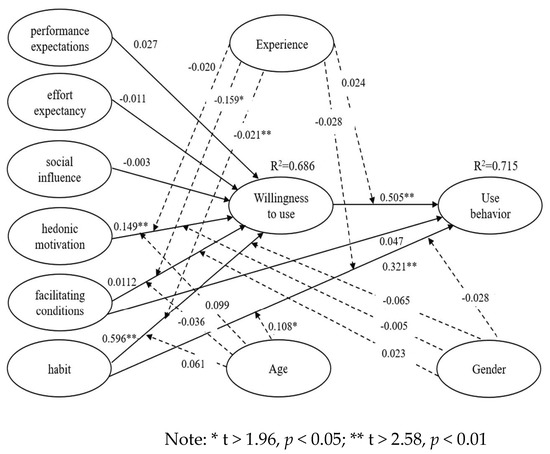
Figure 1.
Path model diagram.
According to the results of Table 4, the GOF of the model in this study is 0.758, which means that the model fits well [11]. The R2 of use intention and use behavior are 0.686 and 0.715, which means that the model has high explanatory power.
Table 4.
Overall Model Fit.
According to the results of each path in the research model, H6, H7, H8, and H9 are all supported, which is different from the results of Macedo [12]. First of all, performance expectations and effort expectancy have no significant impact on behavioral intentions. Although consumers are satisfied with the self-service ordering technology in restaurants, it is speculated that consumers may not feel that there is a significant difference between ordering through service staff and using self-service ordering technology. The traditional method of ordering meals is the transmission of information. Therefore, this is not affected in this study. In addition, social influence and facilitating conditions have no effects on behavioral intention. It has been speculated that the self-service ordering technology in restaurants has not yet been popularized in the catering industry in Taiwan. At present, the restaurant’s service staff still serves. Therefore, this has no effect in this study. Hedonic motivation and habits have impacts on behavioral intentions. Consumers have used 3C products in their daily lives, and the acceptance of using technology systems for self-service ordering in restaurants in the future is high. Using self-service ordering technology during meals can also have entertainment effects. Therefore, hedonic motivation and habits have positive impacts on consumers who use self-service ordering technology.
Of the adjustment variables, only H13, H19, and H20 are supported. The explanation of the adjustment variables is as follows.
- (1).
- H13: The age of self-service technology users in restaurants has a significant effect on H8.
The research results show the influence of age-adjusted habits on user behavior, as the younger age group is more influenced than the older age group. The habits of the younger age group and the older group have positive effects on user behavior, which means young people as opposed to middle aged individuals have positive opinions on using self-service ordering technology in restaurants.
- (2).
- H19: The experience of self-service technology users in restaurants has a significant effect on H4.
The results show the experience-adjusted facilitating conditions and facilitating conditions affect use intention in the less experienced group than the more experienced group. If the customers feel the restaurant operator’s ulterior motives for self-service ordering in restaurants, they will use this technology system continually the next time.
- (3).
- H20: The experience of self-service technology users in restaurants has a significant effect on H7.
The results show that in terms of experience-adjusted habits regarding behavioral intention, the less experienced group and the more experienced group have almost the same influence on habit. The less experienced group and the more experienced group have a positive effect on use intention. This means that customers who have a habit of using self-service technology when ordering in restaurants will continue to use this technology system at their next visit.
4. Conclusions and Suggestions
The research result is summarized as follows.
- (4).
- Current situation of self-service ordering technology in restaurants
In the UTAUT2 model, it was found that users consider self-service ordering technology to be convenient and easy to use in restaurants and using this type of system makes users feel that they are keeping up with the social era. However, using self-service ordering technology has not become a habit in modern life, and there is only a medium to high degree of willingness to continue using it in the future.
- (5).
- UTAUT2 model explores the verification of the user intention and user behavior of self-service ordering technology in restaurants
- (a)
- The hedonic motivation of self-service technology users in restaurants has a significant effect on behavior intention, which indicates that users feel interested and entertained by using self-service technology to order meals during the meal process. They want to continue using this self-service technology to order meals in the future.
- (b)
- The habits of self-service technology users in restaurants have a significant effect on behavior intention and user behavior, which indicates that customers use self-service technology more. They are willing to use it in the future.
- (c)
- The behavioral intention of self-service ordering technology users in restaurants has a positive and significant impact on user behavior. The stronger user desire to use self-service order technology in restaurants in the future also affects the use intensity.
- (6).
- UTAUT2 model explores the verification of adjustment variables of self-service ordering technology in restaurants.
The habit of using self-service ordering positively affects the younger group more intensively than the older group. In pursuing convenience, young people accept using self-service ordering technology in restaurants more. Users with more experience have a higher degree of acceptance. Therefore, the UTAUT2 model fits well with exploring self-service ordering technology in restaurants.
The recommendations and future research recommendations of this research are as follows:
- Self-service ordering technology in restaurants is acceptable to the general public. However, the convenience and ease of use of self-service ordering technology does not affect the willingness to use it in the future. If the restaurant industry intends to use these systems in the future, this system helps restaurant operations, and the industry may have to consider the gross profit for future operations. When modern technology has become more advanced, the use of self-service ordering technology in restaurants may also become a norm in the future.
- If users obtain a sense of pleasure from using self-service ordering technology in restaurants, their willingness to use these systems in the future will be high. In the future, if the industry continues to use self-service ordering technology systems, the industry needs to improve the ability of users to interact with these systems. It was found that young people are more likely to continue using this technology in the future, so the operators should design activities such as minigames, guessing games, and lotteries on the system for customers to interact with.
Author Contributions
Conceptualization, K.-C.T. and C.-Y.H.; methodology, C.-H.C. and M.-F.K.; writing—original draft preparation, K.-C.T. and M.-F.K.; writing—review and editing, J.-J.Y. and C.-Y.H. All authors have read and agreed to the published version of the manuscript.
Funding
This research received no external funding.
Institutional Review Board Statement
Not applicable.
Informed Consent Statement
Dear respondents: Good day! Greatly appreciate that you take time to fill out this questionnaire. This academic study is “Exploring Use Behavior of Self-Service Ordering at Restaurants with Application Unified Theory of Acceptance and Use of Technology Model” The purpose of this study is to explore the factors that impact Switch’s users’ behavior. This is an anonymous questionnaire; all information is strictly confidential and for research purposes only. Please do not fill out this questionnaire if you disagree with this statement. Thanks for your cooperation with sincere appreciation.
Data Availability Statement
Not applicable.
Conflicts of Interest
The authors declare no conflict of interest.
References
- Yang, Y.C.; Yang, C.C.; Yang, Y.Y.; Lin, S.C. Reduction in resistance to self-service technology adoption. Chung Chou J. Manag. Humanit. Sci. 2012, 1, 149–165. [Google Scholar]
- Ho, S.H.; Ko, Y.Y.; Huang, C.H. Effects of self-service technology innovations on customer value: The case of Internet banking. Electron. Commer. Stud. 2007, 5, 463–484. [Google Scholar]
- Lord, E. Is Now the Right Time for a Self-Service Ordering System? Lightspeed. Self-Service Technology for Restaurants|Light Speed POS 2017. Available online: http://lightspeedhq.com (accessed on 21 April 2021).
- Beatson, A.; Coote, L.V.; Rudd, J. Determining consumer satisfaction and commitment through self-service technology and personal service usage. J. Mark. Manag. 2006, 22, 853–882. [Google Scholar] [CrossRef]
- Wang, H.J.; Cheng, C.C.; Hsu, J.L. A study on the acceptance and operating performance of self-service electronic ordering service for catering industry-integrating views of the customers and operators. J. Perform. Strategy Res. 2012, 9, 63–83. [Google Scholar]
- Zhu, F.X.; Wymer, W.; Chen, I. IT-based services and service quality in consumer banking. Int. J. Serv. Ind. Manag. 2002, 13, 69–90. [Google Scholar] [CrossRef]
- Chiu, Y.T.H.; Hofer, K.M. Service innovation and usage intention: A cross-market analysis. J. Serv. Manag. 2015, 26, 516–538. [Google Scholar] [CrossRef]
- Chen, Q.; Huang, R.; Hou, B. Perceived authenticity of traditional branded restaurants (China): Impacts on perceived quality, perceived value, and behavioral intentions. Curr. Issues Tour. 2020, 23, 2950–2971. [Google Scholar] [CrossRef]
- Cisco. Self-Service Shopping Grows in Popularity, According to Cisco Study. 2013. Available online: http://itersnews.com (accessed on 21 April 2010).
- Venkatesh, V.; Thong, J.Y.; Xu, X. Consumer acceptance and use of information technology: Extending the unified theory of acceptance and use of technology. MIS Q. 2012, 36, 157–178. [Google Scholar] [CrossRef]
- Wetzels, M.; Odekerken-Schroder, G.; van Oppen, C. Using PLS path modeling for assessing hierarchical construct models: Guidelines and empirical illustration. MIS Q. 2009, 33, 177–196. [Google Scholar] [CrossRef]
- Macedo, I.M. Predicting the acceptance and use of information and communication technology by older adults: An empirical examination of the revised UTAUT2. Comput. Hum. Behav. 2017, 75, 935–948. [Google Scholar] [CrossRef]
Disclaimer/Publisher’s Note: The statements, opinions and data contained in all publications are solely those of the individual author(s) and contributor(s) and not of MDPI and/or the editor(s). MDPI and/or the editor(s) disclaim responsibility for any injury to people or property resulting from any ideas, methods, instructions or products referred to in the content. |
© 2023 by the authors. Licensee MDPI, Basel, Switzerland. This article is an open access article distributed under the terms and conditions of the Creative Commons Attribution (CC BY) license (https://creativecommons.org/licenses/by/4.0/).