


Abstract
Controller–pilot data link communications (CPDLC) is a digital protocol and part of air navigation systems where Air Traffic Control (ATC) can text an aircraft instead of engaging in voice communications. This research used a CPDLC receiver at the airport of a European capital -EETN and captured all the CPDLC messages for one year. The total number of messages, more than 4.7 million might not be directly relevant since the COVID-19 pandemic affected the number of flights during that period. Still, the classification of the captured messages reveals the usage of this communication channel. Some characterisation analysis of the data traffic shows that only 2% of the 4.7 million messages are Connection-Oriented Transport Protocol (COTP) messages. If we do not consider the messages necessary to connect and establish a connection (e.g., next data authority, release request), there were, in the downlink, from aircraft to ATC, 4626 “wilco” messages, 74 free text messages, and 225 other messages. We found 6357 instruction messages and 9991 free text messages in the uplink. Therefore, only 0.3% of all VDL-2 messages have an operational added value. This enormous overhead, the limited available bandwith and the predicted increase of users of CPDLC, such as unmanned aircraft and recreative flights will saturate this completely this communication channel.
1. Introduction
Around 80% of the eligible aircraft nowadays possess the requisite CPDLC avionics. Within Europe, the CPDLC messages use the VHF Data Link-Mode 2 (VDL-2) protocol [1] on a very high frequency (VHF) ground network infrastructure. The shared signalling channel for initial link establishment is 136.975 MHz worldwide. There is an option to change the frequency after initial contact. The industry believes it is not a question of if but when those communication channels will become congested [2], and Eurocontrol publishes monthly reports on the increasing use of the CPDLC protocol [3].
2. Terminology and Communication Stack Used by CPDLC
Although all the information about the whole communication stack is over-engineered and not (publicly available) well documented, here are some basic principles.
Data Link Initiation Capability (DLIC)—this service provides the information to make data link communications possible between an Air Traffic Services Unit (ATSU) and an aircraft. The DLIC service executes before using any other data link application.
ATC Communications Management (ACM)—this service provides automated assistance to flight crew and controllers to transfer ATC communications (voice and CPDLC).
ATC Clearances (ACL)—this service allows flight crews and controllers to conduct operational exchanges—flight crews can send requests and reports, and controllers can issue clearances, instructions and notifications.
ATC Microphone Check (AMC)—this service allows controllers to send an instruction to all CPDLC-capable aircraft on a given frequency (at the same time) to verify that their voice communication equipment is not blocking a given voice channel.
Departure Clearance (DCL)—this service provides automated assistance for requesting and delivering departure clearances to aircraft.
Downstream Clearance (DSC)—this service allows the flight crew to request and obtain clearances from ATS units that are not yet in control of the aircraft when they cannot obtain the clearance information via the current ATS unit through unit-to-unit coordination.
Eurocontrol relies on air navigation service provides (Sita and Arinc) to provide the CPDLC services. The protocol stack that supports the transmission of the CPDLC messages is shown in Table 1. This table shows the complexity by using a lot of layers and the use of rather old protocols such as X.25.

Table 1.
Protocol stack for CPDLC messages on VHF terrestrial infrastructure.
3. Methodology
We used a basic setup with a Raspberry Pi, an antenna and an interface for the computing unit with the wireless environment. This interface with the wireless environment was a RTL-SDR (Realtek’s cheap software defined radio dongle) or a HackRf One (software defined radio from Great Scott Gadgets). Both interfaces work equally well. See Figure 1 for components of the test setup.
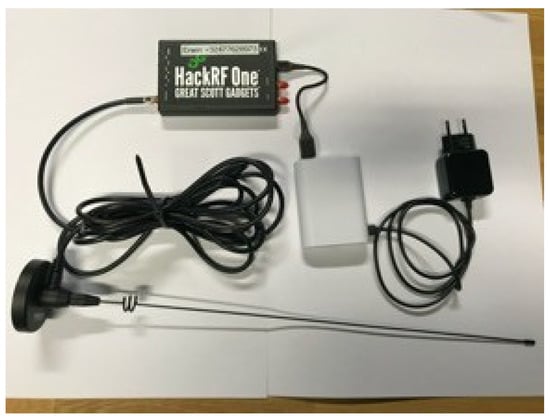
Figure 1.
Test setup for catching ATN—VDL2 messages.
The RaspberryPi obtained, next to the Raspberry Pi OS, the Unix-like operating system based on Debian Linux, the freeware Dumpvdl-2 made and maintained by Tomasz Liemiech (https://github.com/szpajder/dumpvdl2, accessed on 20 February 2020).
A 3G data card sends the messages to a data storage infrastructure every 24 h. Python scripts filter out the messages into categories and convert the data to one Structured Query Language (SQL) data file. Due to the flexibility of the Tallinn airport, we could install this equipment very close to the ATC control tower and capture messages for a whole year.
Figure 2 shows an example of an aircraft passing through Estonian airspace and requesting a login at Tallinn ATC services.
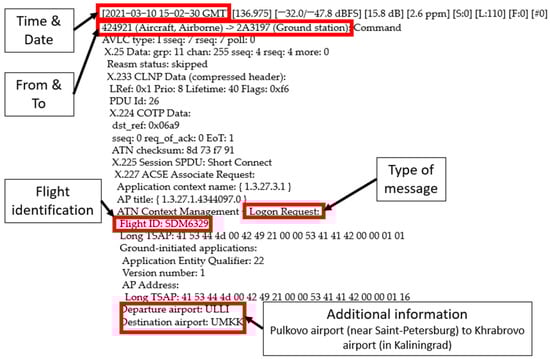
Figure 2.
Example of captured CPDLC message.
Figure 3 shows a simplified version of the SQL database fields to analyse the data.
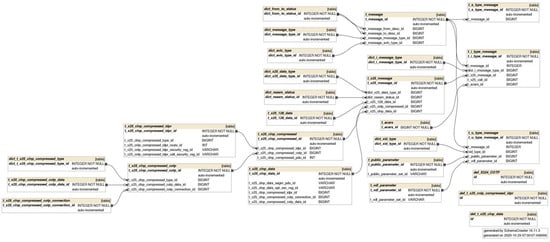
Figure 3.
SQL table interconnections.
Figure 4 provides a list of tables in SQL. Some tables contain only limited and fixed data, such as dictionaries, while others have millions of records.
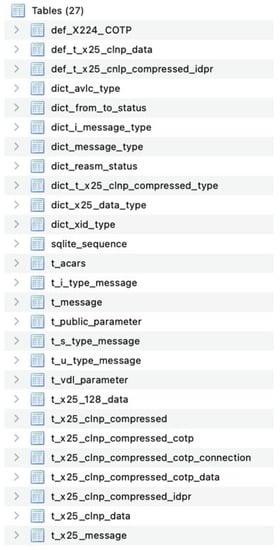
Figure 4.
List of SQL tables.
4. Qualitative Analysis
The total amount of messages received, uplinked and downlinked together during one year was over 4.5 million decodable Aviation Layer Link Control (AVLC) bursts. The timeframe was 15 July 2020 to 14 July 2021.
The absolute number of messages is irrelevant since the Tallinn airport is small and does not have many passengers or aircraft flying over this area. We found three types of AVLC (Aviation VHF Link Control) messages.
We divided the messages into different categories on the AVLC level. Table 2 shows the total number of messages received. For CPDLC messages, only the CLNP messages are relevant.
Table 2.
AVLC messages captured at EETN.
Table 3 shows the CLNP messages in more detail. Many messages are overhead and do not contain helpful CPDLC information. Exciting messages for this research are in COTP data, data-ack and data extended. The remainder of the messages is housekeeping of the channel.
Table 3.
CLNP data captured at EETN.
Table 4 shows the number of different CPDLC messages received. Remarkable is the number of messages transmitted on layer two versus the actual transmission of helpful content.
Table 4.
CPDLC messages at EETN.
After analysis of the “free text” messages, which ATC uses more often in the uplink than the preformatted messages, the vast majority of the messages were administrative messages such as “current ATC unit”, “Controller terminated CPDLC”, “use voice”, and “ATC timeout—repeat request”. There were ultimately 12 useful uplink-free text messages and eight valuable operational messages for which a predefined message exists.
Of the hundreds of predefined messages for CPDLC [4], ATC uses only a handful. For the downlink, this is almost exclusively limited to “wilco” and some free text messages. For the uplink, next to the often misuse of the free text messages, the operational messages captured were “squawk” (2365), “proceed” (1534), “contact” (1221), “climb” (664), “descend” (462), “unable” (121), “standby (79), “heading” (17), and “maintain” (10).
5. Quantitative Analysis
The test setup in Tallinn, Estonia, did not aim at quantitative aspects such as bandwidth occupation. MUAC is one of the most active users of CPDLC in Europe. However, they consider CPDLC as a secondary communication channel, while analogue voice communication is still the primary communication method. This situation is workable for the moment. Still, with the appearance of uncrewed aircraft and the potential use of CPDLC for more than upper airspace control, with the functionalities explained in Section 2, there will be saturation of the channels in the future.
In [5], “DPMF VDL2 monitoring flight report”, the statistics of the congestion level and wireless collisions are discussed. Although the occupation level might not look that high, this paper shows that the collisions that occur with the AVLC bursts are quite common. The article, from 2018, indicates that, even with the current occupation of the different channels (one channel for initial access CSC and different frequencies for the two services providers SITA and ARINC as well as ground as for airborne) there is saturation of the channel. The report states that with the use of different frequencies, the collision rate on the Common Signalling Channel (CSC) has dropped from 50% in July 2017 to 37% in August 2018. The paper also indicates that there is a general increase in CPDLC traffic. The COVID-19 pandemic has temporarily slowed down the growth of flights. Still, estimations are that the traditional aviation industry will continue to grow. The expected new users of CPDLC communications, such as uncrewed aircraft, general aviation and the potentially compulsory use of CPDLC by airlines and air cargo suppliers at lower altitudes will saturate the occupied bandwidth even more.
6. Conclusions and Further Work
These statistics indicate that ATC and pilots do not rely too much on CPDLC for upper airspace traffic handling, and ATC does not use CPDLC for lower altitudes, taxiing, take-off, or landings. The administrative aspects of CPDLC and the underlying VDL-2, such as setting up, maintaining, and closing a data channel, consume, by far, most of the bandwidth.
Integrating the logs of CPDLC messages, including the underlying protocol stack for VHF as satellite communications, into the OpenSky Network and therefore integrating more sensors that can collect data over multiple years will provide more insights into how ATC uses CPDLC.
Fundamental changes or even the creation of a new protocol stack might create an opportunity to reduce the current overhead and the potential saturation of the reserved frequencies. Those aspects of performance will become essential when the uncrewed aircraft enter controlled airspace and possibly use a protocol such as CPDLC to interact with ATC.
Author Contributions
Conceptualization, E.O. and O.M.; methodology, E.O.; software, G.V.; validation, E.O.; data analysis and interpretation, E.O.; resources, G.V.; data collection: G.V.; writing—original draft preparation, and editing, E.O.; writing—review, E.O., O.M.; supervision, O.M. All authors have read and agreed to the published version of the manuscript.
Funding
This research received no external funding.
Data Availability Statement
Data set available on request.
Conflicts of Interest
The authors declare no conflict of interest.
References
- Lundström, S. Technical Details of VDL Mode 2; Linköping University: Linköping, Sweden, 2016. [Google Scholar]
- Turner, A. CPDLC Coming of Age. Syria Studies. 2022. Available online: https://www.aerospacetechreview.com/cpdlc-coming-of-age/ (accessed on 6 September 2022).
- Eurocontrol. Regular Performance Reports. 2022. Available online: https://ext.eurocontrol.int/WikiLink/index.php/Regular_performance_reports (accessed on 7 September 2022).
- ICAO. Working Draft ‘Global Operational Data Link Document (GOLD)’. 2013. Available online: https://www.icao.int/APAC/Meetings/2013_FIT_Asia2_RASMAG18/4.%20GOLD_Part%201%20[Compatibility%20Mode].pdf (accessed on 6 September 2022).
- Eurocontrol. DPMF vdl2 Monitoring Flight Report. 2018. Available online: https://ext.eurocontrol.int/WikiLink/images/7/72/DPMF_Monitoring_Flight_190806_v1.0_release.pdf (accessed on 6 September 2022).
Disclaimer/Publisher’s Note: The statements, opinions and data contained in all publications are solely those of the individual author(s) and contributor(s) and not of MDPI and/or the editor(s). MDPI and/or the editor(s) disclaim responsibility for any injury to people or property resulting from any ideas, methods, instructions or products referred to in the content. |
© 2023 by the authors. Licensee MDPI, Basel, Switzerland. This article is an open access article distributed under the terms and conditions of the Creative Commons Attribution (CC BY) license (https://creativecommons.org/licenses/by/4.0/).