


Abstract
This study aims to analyze the existing market status of lighting technologies in Pakistan, the existing policy and regulatory framework, and the key driving factors which have led to the market growth of LED technology in both rural and urban areas. The results obtained from an extensive survey backed by the literature on the policy landscape of energy efficiency showed that LED technology has penetrated approximately 95% of the existing market. With a low payback period and high return rates, the entire transition toward LED lighting can lower mercury pollution by 700 kg, lower carbon dioxide by 33,000 kt, and save USD 6.5 billion in the form of electricity bills. This transition has been mainly driven by the low cost of technology resulting from regulatory support in the form of the Minimum Energy Performance Standards (MEPs), labeling schemes, and reduced taxation on both sales and manufacturing.
1. Introduction
The major challenges for developing countries in their SDG pathways are the limited energy resources and resulting GHG emissions from their inefficient use [1]. Considering the rapid growth in population, urbanization, and industrialization, the role of electricity in running the whole ecosystem is extremely significant, and its irrational use could create major hurdles in achieving the targets of the sustainable development goals (SDG-7), i.e., access to reliable and affordable energy [2]. Over the past two decades, Asian countries have shown the highest growth in their energy consumption; however, at the same time, the highest share of energy wastage comes from the same countries due to their low technology development index [2].
Among the key demand sectors, lighting constitutes a significant portion of total electricity consumption in buildings. According to the Global Lighting Challenge (GCL), 15% of global electricity is consumed by the residential sector [3]. This is even greater than the total electricity produced by the entire global nuclear industry. Until 2010, the technology commonly used for lighting purposes in Pakistan was fluorescent lamps and tubes. In recent decades, most countries have made significant progress by shifting from conventional to solid-state lighting through the use of LEDs [4]. Statistics have indicated that if all existing lights were instantaneously converted to LEDs, it could save over 800 Mt of emissions globally. Another study on ASEAN countries indicated that a transition toward LEDs would result in cost savings of USD 3500 million per year while saving 35 TWh of electricity and 20 Mt of CO2 emissions [5].
Over the product life cycle, the economic prospects of increased efficiency have been directly linked to its higher efficiency, better performance, longer lifespan, low emissions, and most importantly, cost savings in the form of reduced electricity bills [3]. Research has indicated that by 2030, Pakistan can save around 1.2 TWh by promoting energy efficiency in the lighting sector. This could further result in economic savings of around USD 120 million [2]. NEECA (MoE, Power Division) in Pakistan conducted research in collaboration with United for Energy (U4E), which indicated that a complete transition from conventional to LED lighting could save 4 TWh of annual electricity and reduce consumer bills by around USD 408 million [6].
Although the penetration of LEDs provides a more positive energy and economic outlook, it also helps achieve the targets of both energy and climate commitments. This includes Pakistan’s recent support of the African Lighting Amendment (ALA), which was recently approved at the Conference of Parties of Minamata Convention on Mercury [7]. As per the convention, all parties that are signatories to the convention must phase out mercury-containing lighting products (mainly indoor) by 2024–2025. Further energy efficiency improvements aid Pakistan in achieving the targets of SDG-7 and the resulting reduced environmental emissions provide a way forward for fulfilling the commitments mentioned under Pakistan’s Nationally Determined Contributions (NDCs) [8]. Therefore, this study critically analyzes the status quo of the lighting sector in Pakistan while analyzing the policy and regulatory support that was provided to LEDs, leading to its high-rate penetration.
2. Methodology and Data Collection
The methodological approach in this section consists of two data categories. Primary data were collected through a market survey of 135 shops at seven different locations in Pakistan (Islamabad, Rawalpindi, Taxila, Wah Cantt, Gujranwala, Hassanabdal, and Lahore). This survey data was used to collect the most insightful data on the lighting products available in the different categories. Table 1 indicates the sample data collection.

Table 1.
Parameters for data collection (single entry mentioned here for LED bulbs).
The data collection based on the parameters defined in Table 1 was initially analyzed for identifying the market penetration of the different categories, and then it was arithmetically analyzed to calculate the energy savings, environmental savings, mercury reduction, and the payback period. Secondary data were collected through existing energy sector policies, power policies, climate change policies, and the recently published Draft National Energy Efficiency and Conservation Policy of Pakistan 2022. Furthermore, regulatory reforms, such as the Introduction of Minimum Energy Performance Standards along with the labeling scheme, were also critically analyzed and a comparison of lighting and other similar household products was also made.
3. Results and Discussion
Survey Results and Data Insights
The market analysis indicated that the low cost of LED technology has driven a rapid transition toward LED lighting in Pakistan. Figure 1a indicates the frequency with which the different categories of products were available in the market, whereas Figure 1b indicates the number of models that currently exist in the market.
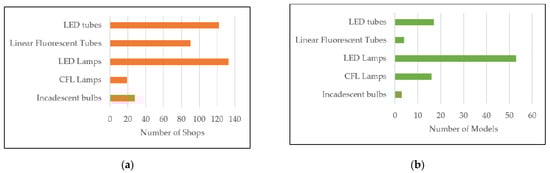
Figure 1.
(a) Availability of different models in retail stores (b) Numbers of different models available.
Based on Figure 1, LEDs have the highest share in both market presence as well as the number of models present within the market. Driven by the economic analysis of the survey data, LEDs are the most feasible choice for customers.
Based on Table 2 and further analysis of the data, LED bulbs have an instantaneous payback, whereas linear tubes have a payback period of 5 months. This means that an additional investment of PKR 440 on a single product can save PKR 6900 over the life cycle of a product. Furthermore, considering the fixed quantity of light generated from different sources, LEDs can increase the rated lifetime by 12,000 h, reduce annual electricity consumption from a single bulb by 60 kWh, and reduce CO2 emissions by around 187 kg. Through a complete transition, Pakistan can reduce mercury pollution by 700 kg, lower carbon dioxide by 33,000 kt, and reduce electricity bills by almost USD 6.5 billion. Compared to other Asian countries (India, Bangladesh, Philippines, Sri Lanka, and Vietnam), Pakistan has the lowest payback period and highest power-saving potential. These results very clearly highlight that LEDs are by far the most suitable technology for the lighting sector in Pakistan.
Table 2.
Economic incentives and paybacks for the transition toward linear LEDs.
The statistics highlighted in the results section indicate that LEDs have deeply penetrated the lighting market owing to the efforts of NEECA [9] and FBR. Customs duty for LEDs is only 3% as opposed to 20% for all other categories. Similarly, to ensure local production, the sales tax on LED products is zero, whereas it is 17% for other imported products. These interventions have led to the availability of a strong indigenous market for all available LED products. Even the larger number of LED models encountered during the survey were local products available at a much cheaper price than imported products. This has significantly driven the cost of lighting products to well below their fluorescent counterparts.
4. Conclusions
This study highlights the current market status and key drivers that have led to the country-wide adoption of LED lighting technology in Pakistan. Through a survey conducted in seven different areas in Pakistan, this study identified that LED bulbs have a sale share of 98.5% in Pakistan’s retail market. CFL lamps (known previously as energy savers) despite being introduced after ICs have a lower share of sales owing to their higher cost (20.7% for ICs and 14% for CFLs). Florescent linear tubes are however still available in approximately 90% of the relevant market due to the high cost of the LED linear tubes that come with a structure intact. However, the payback analysis identified that although LED bulbs have an instantaneous payback, LED linear tubes have a payback of 5 months. Thus, spending an additional PKR 440 today can save approximately PKR 6900 over the product lifecycle. Through a complete transition from fluorescent lighting to LEDs, Pakistan can cumulatively reduce mercury pollution by 700 kg, lower carbon dioxide by 33,000 kt, and reduce electricity bills by almost USD 6.5 billion. On a regulatory and policy front, this study identified the key roles played by FBR and NEECA in reducing taxation and producing MEPs and labeling schemes for a rapid transition.
Author Contributions
Conceptualization, U.Z. and S.Q.; methodology, U.Z. and H.A.; software, U.Z. and S.Q.; validation, U.Z. and S.Q.; formal analysis, U.Z. and M.Z.; investigation, U.Z. and H.A.; data curation, M.Z.; writing—original draft preparation, U.Z.; writing—review and editing, U.Z. and H.A.; supervision, H.A.; project administration, U.Z. All authors have read and agreed to the published version of the manuscript.
Funding
This research received no external funding.
Institutional Review Board Statement
Not applicable.
Informed Consent Statement
Not applicable.
Data Availability Statement
Please refer to data available at: https://bit.ly/3aHQ0tm (accessed on: 21 March 2021).
Conflicts of Interest
The authors declare no conflict of interest.
References
- Galvin, R. Net-Zero-Energy Buildings or Zero-Carbon Energy Systems? How Best to Decarbonize Germany’s Thermally Inefficient 1950s-1970s-Era Apartments. J. Build. Eng. 2022, 54, 104671. [Google Scholar] [CrossRef]
- Islam, N.U.; Usman, M.; Jamil, T. Energy-Savings Using Solid-State Lighting: A Case Study of India, Pakistan, and Bangladesh. Energy Policy 2022, 160, 112676. [Google Scholar] [CrossRef]
- Aslam, H.; Ur, U.; Zia, R.; Qureshi, S. Market Transition to LED Lighting: A Case for Energy Efficiency and Conservation In Pakistan; Sustainable Development Policy Institute: Islamabad, Pakistan, 2022. [Google Scholar]
- Maxson, P.; Bender, M.; Culver, A. Mercury in Fluorescent Lighting. Clean Light. Coalit. 2022. Available online: https://www.clasp.ngo/wp-content/uploads/2021/10/Mercury-in-Fluorescent-Lighting_FINAL.pdf (accessed on 2 February 2022).
- UNEP. ASEAN Commits to Switch to Efficient Lighting; UNEP: Nairobi, Kenya, 2015. [Google Scholar]
- United Nations Environment Programme. Accelerating the global adoption of energy-efficient lighting. United Nations Environ. Program. 2017, 132, 409–423. Available online: http://hdl.handle.net/20.500.11822/20406 (accessed on 10 September 2021).
- CLiC. Convention on Mercury Agrees to Phase out Major Category of Fluorescent Light Bulbs, but Last-Minute Interventions Delay Action on Another. 2022. Available online: https://cleanlightingcoalition.org/news/convention-on-mercury-agrees-to-phase-out-major-category-of-fluorescent-light-bulbs-but-last-minute-interventions-delay-action-on-another/ (accessed on 10 May 2022).
- MoCC. Pakistan Updated NDC 2021; Government of Pakistan: Islamabad, Pakistan, 2021. [Google Scholar]
- NEECA. Launching of MEPs and Energy Labeling Scheme; NEECA: Islamabad, Pakistan, 2020. [Google Scholar]
Publisher’s Note: MDPI stays neutral with regard to jurisdictional claims in published maps and institutional affiliations. |
© 2022 by the authors. Licensee MDPI, Basel, Switzerland. This article is an open access article distributed under the terms and conditions of the Creative Commons Attribution (CC BY) license (https://creativecommons.org/licenses/by/4.0/).