


Abstract
In this article, a novel quad-band fractal PIFA antenna design for DCS, PCS, UMTS, and WiMAX wireless communications systems is presented. The proposed antenna is a PIFA antenna where a slot having a Hilbert fractal shape at the third iteration has been inserted at the center of the radiating patch. The fractal shape of the implanted slot on the PIFA antenna was used in order to make the antenna operational at four frequency bands, according the required applications. The proposed antenna with the fractal shape of the slot offers quad-band operation with a miniaturized size compared to the initial PIFA antenna, such that the dimensions of the radiating patch become equal to 28 mm × 28 mm. This structure is operational in the following frequency bands: (1.73–2.08) GHz, (2.46–2.59) GHz, (3.39–3.47) GHz, and the band (4.56–5.02) GHz covering DCS, PCS, UMTS, and WiMAX mobile communications systems, respectively, with a gain ranging from 2 dB to 6 dB at the desired frequency bands. The fractal PIFA antenna design was carried out under CST MWs software with validation of the results made using HFSS software. There is good agreement between the obtained results by the two simulation software.
1. Introduction
Currently, most wireless communications devices operate in several frequency bands and provide different services. Additionally, because of the limited available space in these devices [1], in recent years, researchers have focused their work on the realization of miniature and multiband antennas. Usually, the planar inverted-F antenna (PIFA) is the most desirable design in many applications because of its low cost, simplicity of design, and low profile [2].
However, it is difficult to realize multiband applications from conventional PIFAs antenna. To meet these constraints, several techniques are reported in the literature, notably the use of different feeding techniques by coupling [3], the use of different slots forms [4,5,6,7], and also by the adding of parasitic elements at the antenna radiating patch [8]. Several antenna designs have been based on the use of different fractal shapes to achieve multiband antennas, due to their self-similarity and space-filling properties. The space-filling property of the Peano and Minkowski fractals [9,10] has been exploited to miniaturize the antennas., while the self-similarity property of the Hilbert, Koch, and Sierpinski curves can be used to have multiband behavior [11,12].
In this work, a novel Fractal PIFA antenna design was proposed. Parametric studies were made in order to well understand the effect of the implanted fractal shape at the radiating patch on the radio characteristics of the proposed antenna. The PIFA antenna with the fractal shape at the third iteration demonstrates many advantages where the clutter of the structure is very weak and the multiband operating serves to integrate it into the various mobile and wireless devices.
2. Design of the Proposed Antenna
2.1. Initial PIFA antenna Design
The initial antenna is a PIFA antenna with a radiating patch of dimensions Wp × Lp = 34 mm × 28 mm. The antenna is designed on an FR-4 type substrate with a permittivity εr = 4.4 and a thickness hs = 1.6 mm. The radiating element is located above the substrate with a height of H = 5.3 mm, and shorted to the ground plane with a tab of a width s = 4 mm. The initial antenna having overall dimensions of 38 mm × 60 mm and is fed by a 50 Ω microstrip line, as shown in Figure 1.
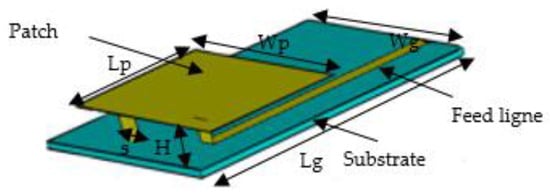
Figure 1.
Structure of the initial PIFA antenna.
The resonant frequency fr of the initial antenna was determined from the following equation:
where: C is the speed of light in the void, Lp and Wp are the length and width of the radiating patch
2.2. Quad-Band PIFA Antenna
Fractals have been widely used in the design and realization of multiband antennas due to the significant improvements in their performance. To improve the electromagnetic characteristics of the initial PIFA antenna, the Hilbert shaped fractal slot at the third iteration was implanted in the initial antenna radiating patch. The proposed antenna structure and the first four iterations of Hilbert’s fractal form are shown in Figure 2.
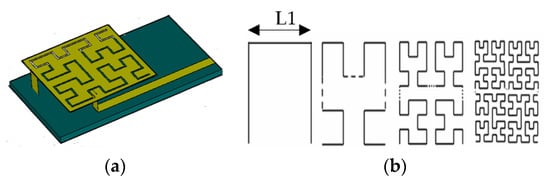
Figure 2.
(a) Proposed antenna structure, (b) the first four iterations of Hilbert’s fractal form.
The Figure 3 shows the return loss S11 of the initial antenna and the proposed antenna.
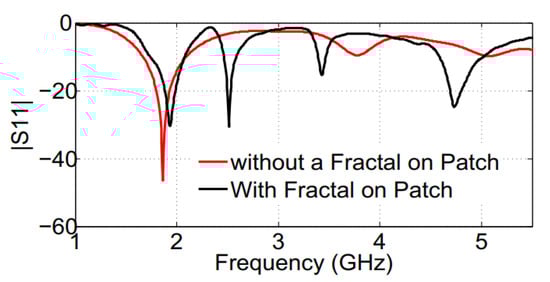
Figure 3.
Return loss of the initial antenna and the proposed antenna.
3. Parametric Studies
In this part, parametric studies have been carried out to illustrate the effect of the fractal slot dimension on the radio electric characteristics of the proposed antenna.
Figure 4 and Figure 5 represent the variation of the return loss S11 according to the frequency for different lengths (Ls) and widths (Ws) of the fractal slot.
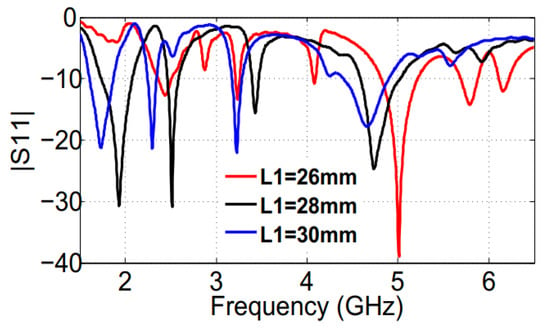
Figure 4.
Return loss S11 of the proposed antenna for different lengths (Ls) of the fractal slot.
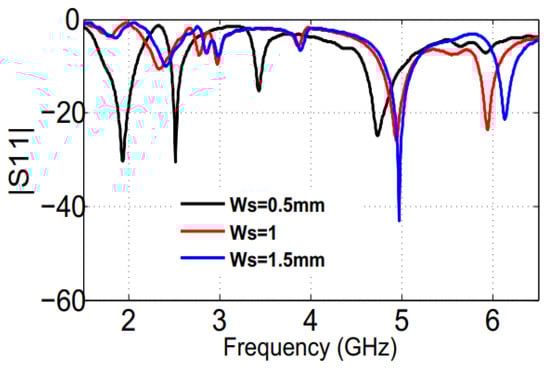
Figure 5.
Return loss S11 of the proposed antenna for different widths (Ws) of the fractal slot.
Figure 6 shows variation of the return loss of the proposed antenna with different values of the height H between the radiating patch and the substrate.
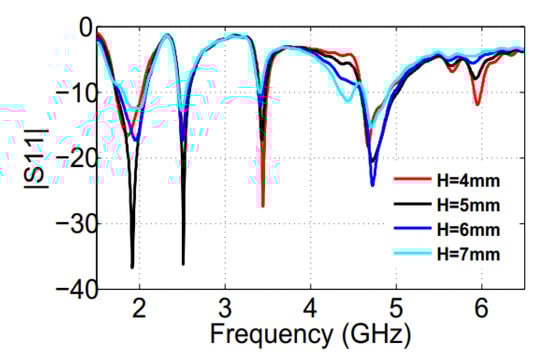
Figure 6.
Variation of the return loss of the proposed antenna with different values of the height (H).
From the results obtained in Figure 4, Figure 5 and Figure 6, we can see that the width (Ws), the length (Ls) of the fractal shape, and the height (H) have remarkable influences on the radio electric characteristics of the proposed antenna. As a result, the antenna present a good performance with fractal slot width and length: Ws = 0.5 mm; Ls = 28 mm; and optimal height: H = 5 mm.
4. Discussion of Results
The parametric studies and the optimization of the geometric parameters of the proposed model were executed by CST Microwave Studio.
To validate the obtained result after the parametric study, we used the HFSS Ansys software, as shown in Figure 7.
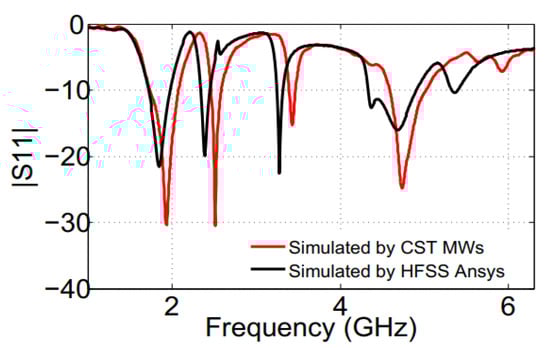
Figure 7.
Return loss |S11| of the proposed antenna simulated under CST MWs and HFSS Ansys.
The Figure 8 shows the variation of the standing wave ratio (VSWR) of the proposed antenna according to the resonant frequency.
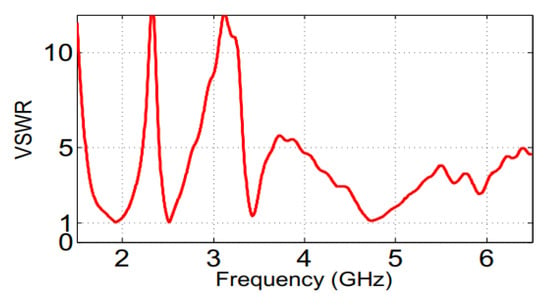
Figure 8.
Variation of the VSWR of the proposed antenna according the resonant frequency.
Figure 8 shows that the standing wave ratio is between 1 and 1.4 at the four resonance frequencies. This gives a very good adaptation to the desired frequencies.
The radiation patterns in 2D (polar) of the proposed antenna on the two planes E and H are plotted at the four resonant frequencies 1.93 GHz, 2.51 GHz, 3.43 GHz, and 4.73 GHz, as shown in Figure 9.
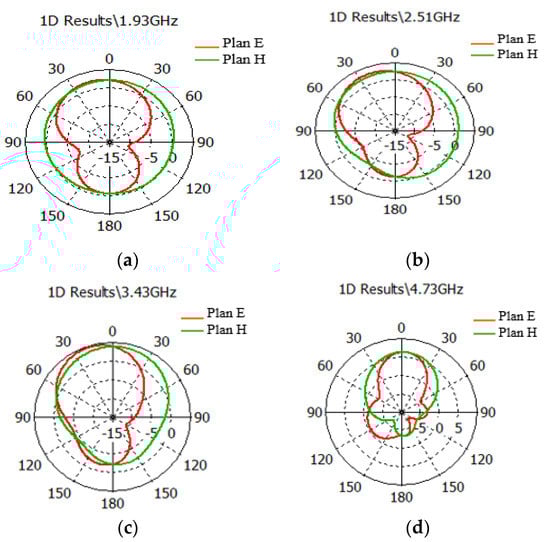
Figure 9.
Radiation patterns in 2D of the proposed antenna on the two planes E and H plotted at the four resonant frequencies: (a) at 1.93 GHz, (b) at 2.51 GHz, (c) at 3.43 GHz and (d) at 4.73 GHz.
To clearly see the radiation behavior of the designed antenna, we have plotted the 3D radiation patterns at the four chosen resonant frequencies, as shown in Figure 10.
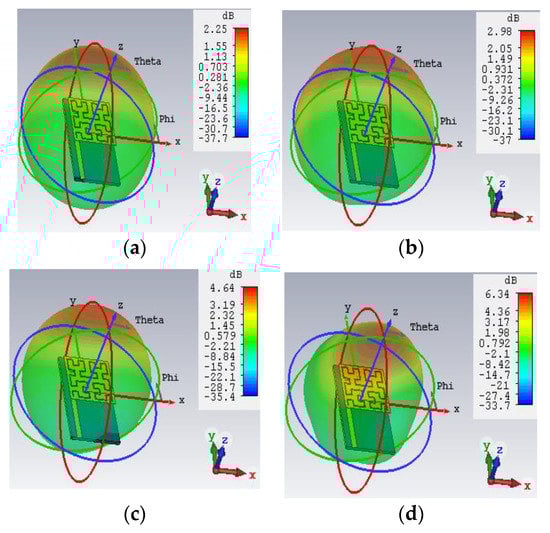
Figure 10.
Three-dimensional radiation patterns of the proposed antenna at the four resonance frequencies: (a) at 1.93 GHz, (b) at 2.51 GHz, (c) at 3.43 GHz and (d) at 4.73 GHz.
From the polar radiation patterns, we notice that the proposed antenna present a gain ranging from 2 dB to 6 dB at the four resonant frequencies. The results found show well that the antenna is suitable at the four wireless communications systems: DCS, PCS, UMTS, and WiMAX, respectively.
5. Conclusions
In this paper, a fractal PIFA antenna for DCS, PCS, UMTS, and WiMAX wireless communications systems is studied.
The integration of the fractal slot at the center of the initial antenna radiating patch is a technique which was used to have multiband operating and also to miniaturize the proposed antenna. The Hilbert fractal slot at the third iteration, which was inserted at the center of the radiating element, allowed to allocate a multi-band operating of the proposed antenna and also contributed to reduce their size compared to the initial antenna with a miniaturization rate equal to 46.15%.
The proposed antenna simulation results with the two software CST and HFSS show a good agreement in terms of return loss S11. These obtained results was allowed to prove that the proposed antenna has good radiating characteristics and able to covering the frequency bands corresponding to the following four wireless communications systems: DCS, PCS, UMTS (1.73–2.08) GHz, WiMAX (2.46–2.59) GHz, WiMAX (3.39–3.47) GHz, and the WiMAX (4.56–5.02) GHz band, with compact dimensions occupy less space in wireless communications devices.
Author Contributions
All authors contributed to this proceeding paper article and All authors have read and agreed to the published version of the manuscript.
Funding
This research received no external funding.
Institutional Review Board Statement
Not applicable.
Informed Consent Statement
Informed consent was obtained from all subjects involved in the study.
Data Availability Statement
Not applicable.
Conflicts of Interest
The authors declare no conflict of interest.
References
- Yadav, S.; Jain, P.; Choudhary, R. A novel approach of triangular-circular fractal antenna. In Proceedings of the 2014 International Conference on Advances in Computing, Communications and Informatics (ICACCI), Delhi, India, 24–27 September 2014; pp. 708–711. [Google Scholar]
- Hang, W.; Kwai-Man, L.; Chi Hou, C.; Quan, X.; Kwok Kan, S.; HauWah, L. Small antennas in Wireless Communications. Proc. IEEE J. 2012, 100, 2109–2121. [Google Scholar] [CrossRef]
- Kang, D.-G.; Sung, Y. Coupled-fed planar printed shorted monopole antenna for LTE/WWAN mobile handset applications. IET Microwaves, Antennas Propag. 2012, 6, 1007–1016. [Google Scholar] [CrossRef]
- Guo, Y.-X.; Tan, H.S. New compact six-band internal antenna. IEEE Antennas Wirel. Propag. Lett. 2004, 3, 295–297. [Google Scholar] [CrossRef]
- Manteghi, M.; Rahmat-Samii, Y. A novel miniaturized triband PIFA for MIMO applications. Microw. Opt. Technol. Lett. 2007, 49, 724–731. [Google Scholar] [CrossRef]
- Naji, D.K.; Abdul-kareem, A. A dual-band U-slot PIFA antenna with ground slit for RFID applications. J. Emerg. Trends Comput. Inf. Sci. 2013, 4, 213–220. [Google Scholar]
- Keerthika, M.A.; Balachandar, P.; Jaisree, S.; Silamboli, J. Design of Dual Tshaped PIFA antenna for multiband Wireless Applications. Int. J. Eng. Sci. Res. Technol. 2015, 4, 3. [Google Scholar]
- Redzwan FN, M.; Ali, M.T.; Tan, M.M.; Miswadi, N.F. Dual-band Planar Inverted F Antenna with parasitic element for LTE and WiMAX mobile communication. In Proceedings of the 2014 International Symposium on Technology Management and Emerging Technologies, Bandung, Indonesia, 27–29 May 2014; pp. 62–67. [Google Scholar]
- Sharma, N.; Singh, G.P.; Sharma, V. Miniaturization of fractal antenna using novel Giuseppe peano geometry for wireless applications. In Proceedings of the 2016 IEEE 1st International Conference on Power Electronics, Intelligent Control and Energy Systems (ICPEICES), Delhi, India, 4–6 July 2016; pp. 1–4. [Google Scholar]
- Costanzo, S.; Qureshi, A.M. Miniaturized Planar Inverted-F Antenna Using Minkowski Pre-Fractal Structure. In Proceedings of the 2020 14th European Conference on Antennas and Propagation (EuCAP), Copenhagen, Denmark, 15–20 March 2020; pp. 1–4. [Google Scholar]
- Tarbouch, M.; El Amri, A.; Terchoune, H.; Barrou, O. Compact PIFA Antenna with H-Tree Fractal for Mobile Handset Applications. In Proceedings of the 2nd International Conference on Computing and Wireless Communication Systems (ICCWCS’17), Larache, Morocco, 14–16 November 2017; pp. 1–6. [Google Scholar]
- Sabban, A. Wearable Compact Fractal Antennas for 5G and Medical Systems. In Wearable Systems and Antennas Technologies for 5G, IOT and Medical Systems; CRC Press: Boca Raton, FL, USA, 2020; pp. 349–380. [Google Scholar]
Publisher’s Note: MDPI stays neutral with regard to jurisdictional claims in published maps and institutional affiliations. |
© 2022 by the authors. Licensee MDPI, Basel, Switzerland. This article is an open access article distributed under the terms and conditions of the Creative Commons Attribution (CC BY) license (https://creativecommons.org/licenses/by/4.0/).