


Abstract
The objective of the study was to determine and assess the noise levels in the workshop during various activities, specifically those performed by mechanics, locksmiths, and turners. The highest mean noise level (LAeq) was observed among locksmiths at 70.02 dB(A), followed by turners at 68.26 dB(A), and mechanics at 64.45 dB(A). It was established that the average noise level did not exceed the exposure limit value of 87 dB(A). However, during certain activities—such as tractor disassembly and autogenous welding—peak noise levels exceeding 83 dB(A) were recorded, surpassing the lower action value. It is therefore recommended that personal hearing protection be used during these specific activities to prevent potential long-term auditory damage.
1. Introduction
The tractor and combine harvester are fundamental units without which modern agricultural production is not possible [1]. As they are developed and become more complex, their maintenance and repair also become increasingly complicated. According to the research by Chen et al. [2], “the complexity of modern agricultural machinery requires specialized knowledge and skills to keep them in proper working condition.” The complexity of modern agricultural machinery significantly impacts their maintenance in several key aspects. Advanced technologies, such as electronic systems and automation, require specialized knowledge from technicians for diagnosing and repairing faults, which can complicate problem identification and prolong repair times. Maintenance often involves detailed analyses, affecting the availability of machines for operation. Furthermore, continuous education for technicians is essential to keep pace with new technologies, and this complexity can increase maintenance costs due to the need for specialized equipment and expertise. All these factors render the maintenance of such machinery challenging yet crucial for ensuring their efficiency and longevity in production. Furthermore, Ašonja et al. [3] tell that “In self-propelled agricultural machinery such as tractors, the biggest noise problems are caused by engines due to inadequate maintenance. In addition to creating excessive noise, they also cause difficulty in moving the tractor, slow starting, oil leakage at the seals, etc.”. Repairs can sometimes be time-consuming and generate a certain level of noise in agricultural machinery repair workshops. As Loupa [4] points out, the intensity of noise can significantly affect working conditions, further complicating the repair process. Several different professions are typically required—approximately three core ones—which were selected for this study: mechanic, turner, and locksmith.
The ear is the organ responsible for hearing and balance and consists of the outer, middle, and inner ear. The outer ear is designed to “receive” sound waves, which are converted into mechanical energy in the middle ear. The inner ear then transforms this mechanical energy into nerve impulses that travel to the brain. Additionally, the inner ear contributes to balance maintenance [5]. Noise is any unwanted and unpleasant sound that poses risks to human health and hearing in several ways and to which the human body cannot adapt. It is defined as any undesirable sound in the environment where people live and work, which causes discomfort and may impact health. The adverse health effects of noise can be direct—such as hearing loss and deafness—or indirect, leading to fatigue, reduced work performance, and interference with communication, concentration, rest, and sleep. It can also worsen existing health conditions. The main outdoor sources of noise include traffic, construction, public works, industry, recreation, sports, and entertainment. In indoor residential areas, noise sources are usually service equipment related to buildings, household appliances, and noise from neighbors. Noise results from irregular and periodic vibrations of air particles. The human ear can register vibrations between 16 Hz and 20,000 Hz [6]. To protect hearing in workplaces where noise cannot be technically reduced below legally prescribed levels, personal protective equipment (PPE) must be provided to employees.
The Ordinance on the Protection of Workers from Exposure to Noise at Work stipulates the following exposure limit values and warning thresholds for an eight-hour working day, as well as peak sound pressure levels [7]: (a) Exposure limit value: L(EX,8h) = 87 dB and p(peak) = 200 Pa (140 dB(C), relative to a reference sound pressure of 20 µPa); (b) Upper exposure action value: L(EX,8h) = 85 dB and p(peak) = 140 Pa (137 dB(C), relative to a reference sound pressure of 20 µPa); (c) Lower exposure action value: L(EX,8h) = 80 dB and p(peak) = 112 Pa (135 dB(C), relative to a reference sound pressure of 20 µPa).
According to Depczynski et al. [8] agriculture is among the occupations with the highest risk of hearing loss, primarily due to the limited use of hearing protection. It is evident that hearing loss is prevalent among adults in agricultural communities. Suchomel et al. [9] conducted a study of the noise levels produced during the operation of a wood chipper and found that recorded noise levels did not exceed regulatory limits. Their study involved a Valtra T 191 tractor with a Borb 80 S wood chipper and a Kesla Forester C 4560 LF. The highest measured noise level with the Borb 80 S was 77.70 dB(A), and with the Kesla Forester C 4560 LF, it was 76.70 dB(A). According to Bilski [10] noise levels during various tractor-related work tasks, with power ranging from 96 to 227 kW, ranged from 62.1 to 87.4 dB(A), remaining below the legal noise limit of 90 dB(A). The research and measurement of the noise level was carried out at the position of the operator of the agricultural tractor when moving on different agrotechnical surfaces, speeds of movement and air pressure in the tires. It was determined that the noise value is not higher than the permitted limit value of 87 dB(A) [11]. The future of this research was conducted with the aim of predicting the accuracy of noise levels in the aforementioned study using machine learning methods. It was found that the values generally give exceptional accuracy using machine learning methods, but measurements on certain areas may need to be repeated several times to further improve the accuracy. Furthermore, this example could also be used in this future research regarding the noise of workers in an agricultural machinery repair shop [12].
The objective of this research is to determine noise levels in a central overhaul workshop across different occupational roles.
2. Materials and Methods
Measurements were conducted in the central mechanical workshop of the company Novi Agrar, located in Čepin which is located in the Republic of Croatia. The study involved three workers representing different occupations: a mechanic, a locksmith, and a turner. The purpose of these noise measurements was to obtain reliable data on noise levels across different job roles. During the measurements, noise signals originating from other workstations located in the same workshop during regular operating hours were detected. The Ordinance prescribes the metrics used to describe noise and the methods and conditions for measurement, as defined by the following standards: HRN ISO 1996-1-2-3: [13] Acoustics—Description, measurement, and assessment of environmental noise; HRN EN ISO 9612: [14] Acoustics—Guidelines for measuring and assessing occupational noise exposure; HRN EN 60804: [15] Integrating-averaging sound level meters.
Noise measurements were taken across three 8 h shifts using a Kimo DS 300 dosimeter (Kimo Instruments, Montpon-Ménestérol, France). The microphone was positioned on the worker’s collar, approximately 20 cm from the ear. Simultaneously, the workers’ activities were timed. During the measurement, each worker was at their designated workplace in the workshop, with tools that covered their activity, which is visible in the pictures (Figure 1) provided. During the measurement, each worker was at their designated workplace in the workshop, with tools that covered their activity, which is visible in the given pictures. Each measured data was obtained after every second of working time and the average value was calculated from the sum with the observed chronometry.
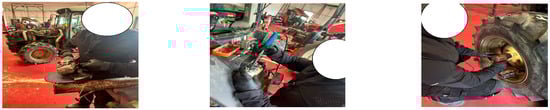
Figure 1.
Noise measurement in a workshop for the repair and maintenance of agricultural machinery during various activities.
The processed data in the following section are labeled as follows: (a) LApk—Maximum sound pressure level (Pa), or noise (dB(A)); (b) LAeq—Equivalent continuous sound level, measured across both channels. This is the most relevant and commonly used metric and represents the average sound level over the measurement period (dB(A)).
3. Results
The measured and processed noise level data for various occupations are presented in the following graphs and tables. In some instances, the recorded noise levels exceeded the permissible limit of 87 dB(A) as prescribed by the relevant ordinance.
Table 1 indicates that during the operation of draining water from the compressor, the noise level exceeded the lower exposure action value. Moreover, during the task of disassembling the tractor, the recorded noise level significantly surpassed the exposure limit.

Table 1.
Mean Noise Level Values—Occupation: Turner, Day 1.
The average equivalent continuous sound level (LAeq) over the entire work shift did not exceed the lower exposure action value. However, several high noise peaks were recorded during the shift. Notably, during the dismantling of machine uncoupling feet, a noise level of 135.8 dB(A) was measured, as shown in Table 2.
Table 2.
Mean Noise Level Values—Occupation: Turner, Day 2.
According to Table 3, the average LAeq values remained below the lower exposure action value. Additionally, the maximum sound pressure level of 128.8 dB(A) was not exceeded throughout the shift.
Table 3.
Mean Noise Level Values—Occupation: Turner, Day 3.
Table 4 reveals that the average LAeq values during the operations of traveling to the field, and dismantling and installing the rail valve, exceeded the lower exposure action value. The maximum sound pressure level recorded during the same operation (LApk) was 138.8 dB(A).
Table 4.
Mean Noise Level Values—Occupation: Mechanic, Day 1.
As shown in Table 5, the averaged LAeq values during all work operations remained below the lower exposure action value. The highest recorded peak level occurred during the dismantling and reassembly of the plumb bob and spanner, reaching 120.7 dB(A) (LApk).
Table 5.
Mean Noise Level Values—Occupation: Mechanic, Day 2.
According to Table 6, the average LAeq values exceeded the lower exposure action value during the operation involving the dismantling, assembling, and adjustment of the knives for the Jaguar forage harvester.
Table 6.
Mean Noise Level Values—Occupation: Mechanic, Day 3.
Table 7 shows that during autogenous welding, the average LAeq reached 83.6 dB(A), thus exceeding the lower exposure action value. The maximum sound pressure level was recorded during the dismantling of the trailer drawbar, amounting to 134.8 dB(A).
Table 7.
Mean Noise Level Values—Occupation: Locksmith, Day 1.
The results in Table 8 show that the average LAeq values throughout the shift did not exceed the lower exposure action value. However, the values remained close to this threshold during most of the shift.
Table 8.
Mean Noise Level Values—Occupation: Locksmith, Day 2.
During autogenous welding, the average LAeq exceeded the lower exposure action value. The maximum recorded sound pressure level for the same operation was 120.1 dB(A), as presented in Table 9.
Table 9.
Mean Noise Level Values—Occupation: Locksmith, Day 3.
Based on analyzes measurements conducted across three 8 h shifts for each individual worker, it is established that the highest average noise level was recorded for the lock-smith (70.02 dB(A)), followed by the turner (68.26 dB(A)), and the lowest for the mechanic (64.45 dB(A)).
4. Discussion
A study was conducted to measure the noise level of a 55 kW tractor aggregated with a disc plow, rotavator, and cultivator. The average values determined exceed the upper warning value of 85 dB(A), which is contrary to this study [16]. The research was carried out with the aim of determining the noise level of three tractors during the agrotechnical operation of plowing and land leveling. It was found that most of the mean values exceed 90 dB(A), which is contrary to this research [17]. The noise level was measured on 6 models of tractors that were connected with 5 different tillage implements. It was determined that the mean values were in the range of 91.7–97.5 dB(A), which is contrary to this research [18]. A noise level measurement study was conducted on wheeled and tracked tractors, with and without a cab. It was determined that the instantaneous or peak noise impacts were 140 dB(A), which was confirmed in this study [19].Kumar-Prasanna et al. [20] conducted a study measuring noise levels in oil mill workspaces. Approximately 26% of workers were exposed to noise levels above 85 dB(A). Surveys revealed that 63% believed noise interfered with their work; 16% associated it with both work disruption and hearing damage, and 5% reported headaches due to noise—similar to observations in this study, where audibility issues were noted. In some operations, including those performed by locksmiths, turners, and mechanics, noise levels exceeded 85 dB(A), consistent with our findings. Calvo et al. [21] noted that farmers use various tools with different noise outputs, sometimes exceeding legal limits for more than 8 h a day. Three out of four operators in their study were exposed to excessive noise due to environmental variability—similar to the results of this study.
Thiery i Meyer [22] observed that noise exposure levels between 87 and 90 dB(A) can lead to hearing loss. Audiometric testing revealed hearing thresholds around 25 dB(A) at frequencies of 1–3 kHz, with ear drum and cardiovascular health assessments performed beforehand. Similar inaudibility patterns were observed among certain occupations in this study. Bauer et al. [23] found that age has the most significant influence on hearing thresholds, but other factors—such as gender, noise exposure level (Nil), ear conditions, tinnitus, and ear protector use—also played a role. Their findings support the assumption in this study that prolonged exposure to high noise levels may result in hearing loss. Kirin i Lauš [24] highlighted that noise is a major issue of modern civilization. Their study of five sewing machine-equipped workplaces found equivalent noise levels between 71 and 77 dB(A), within permissible limits. Weekly exposure did not exceed 80 dB(A), comparable to this study’s findings of 64–70 dB(A). However, long-term exposure at such levels may still lead to hearing damage. In addition to the impact on human health, noise is a good indicator of the reliability of agricultural machinery and its parts such as engines, cardan shafts, bearings, etc., according to authors [25,26]. Furthermore, authors [27] improvement of repair methods and the implementation of IoT sensor systems in cardan shafts enhance reliability and operator safety by reducing the need for high-risk maintenance interventions. The use of higher-quality materials and simplified maintenance solutions further extends component service life while reducing costs and the likelihood of accidents.
5. Conclusions
The highest noise level was recorded on the first day for the turner, during tractor disassembly, reaching a peak of 140 dB(A), with an average of 103.8 dB(A) for the operation. The lowest average noise level was recorded for the mechanic on the first day, during bearing disassembly and assembly, at 59.2 dB(A).
Timing showed that more intensive tasks, such as tractor disassembly, produced higher noise levels compared to less intensive tasks like bearing assembly.
The average noise levels over three 8 h shifts were 70.02 dB(A) for the locksmith, 64.45 dB(A) for the turner, and 64.45 dB(A) for the mechanic. Although these averages do not exceed the lower exposure action value, occasional peaks at 140 dB(A) may lead to long-term hearing impairment. Thus, it is recommended that workers use personal protective equipment.
Future research could also include a medical aspect by looking at blood pressure in relation to different activities and the use of earplugs and earplugs, i.e., ear protection devices.
Author Contributions
Conceptualization, Ž.B. and I.P.; methodology, Ž.B. and I.P.; software, Ž.B. and I.P.; validation, Ž.B., I.P., T.J., D.R., M.J. and P.A.; formal analysis, Ž.B.; investigation, Ž.B.; resources, Ž.B.; data curation, Ž.B.; writing—original draft preparation, Ž.B., and I.P.; writing—review and editing, Ž.B., I.P., T.J., D.R., M.J. and P.A.; visualization, Ž.B.; supervision, T.J.; project administration, I.P.; funding acquisition, Ž.B., I.P., T.J., D.R., M.J. and P.A. All authors have read and agreed to the published version of the manuscript.
Funding
This research received no external funding.
Institutional Review Board Statement
Not applicable.
Informed Consent Statement
Not applicable.
Data Availability Statement
The data presented in this study are available upon request from the corresponding author.
Conflicts of Interest
The authors declare no conflicts of interest.
References
- Kumar, N.; Tewari, V.K.; kumar, S. Development of Combined Resistance Muffler for Reduced Noise of Farm Tractor. Mater. Today Proc. 2022, 66, 3756–3761. [Google Scholar] [CrossRef]
- Chen, L.; Zhang, Z.; Li, H.; Zhang, X. Maintenance Skill Training Gives Agricultural Socialized Service Providers More Advantages. Agriculture 2023, 13, 135. [Google Scholar] [CrossRef]
- Asonja, A.; Mikic, D.; Stojanovic, B.; Gligoric, R.; Savin, L.; Tomic, M. Examination of Motor Oils in Exploitation of Agricultural Tractors in Process of Basic Treatment of Plot. J. Balk. Tribol. Assoc. 2013, 19, 314–322. [Google Scholar]
- Loupa, G. Case Study: Health Hazards of Automotive Repair Mechanics: Thermal and Lighting Comfort, Particulate Matter and Noise. J. Occup. Environ. Hyg. 2013, 10, 135–146. [Google Scholar] [CrossRef]
- Bajek, S.; Bobinac, D.; Jerković, R.; Malnar, D.; Marić, I. Systematic Human Anatomy Script; Faculty of Health Studies in Rijeka: Rijeka, Croatia, 2007. [Google Scholar]
- Trbojević, N. Basics of Protection against Noise and Vibration; Karlovac University of Applied Sciences: Karlovac, Croatia, 2011. [Google Scholar]
- Regulations on the Protection of Workers from Exposure to Noise at Work. Available online: https://narodne-novine.nn.hr/clanci/sluzbeni/2023_12_148_2096.html (accessed on 26 June 2025).
- Depczynski, J.; Challinor, K.; Fragar, L. Changes in the Hearing Status and Noise Injury Prevention Practices of Australian Farmers from 1994 to 2008. J. Agromedicine 2011, 16, 127–142. [Google Scholar] [CrossRef] [PubMed]
- Suchomel, J.; Belanová, K.; Štollmann, V. Analysis of Occupational Diseases Occurring in Forestry and Wood Processing Industry in Slovakia. Drv. Ind. 2011, 62, 219–228. [Google Scholar] [CrossRef]
- Bilski, B. Audible and Infrasonic Noise Levels in the Cabins of Modern Agricultural Tractors—Does the Risk of Adverse, Exposure-Dependent Effects Still Exist? Int. J. Occup. Med. Environ. Health 2013, 26, 488–493. [Google Scholar] [CrossRef]
- Barač, Ž.; Plaščak, I.; Radočaj, D.; Jurišić, M. The Impact of Noise on Agricultural Tractor Operator in Relation to Certain Operational Parameters: An Analytical Hierarchy Process (AHP) Approach. Agriculture 2025, 15, 466. [Google Scholar] [CrossRef]
- Barač, Ž.; Radočaj, D.; Plaščak, I.; Jurišić, M.; Marković, M. Prediction of Noise Levels According to Some Exploitation Parameters of an Agricultural Tractor: A Machine Learning Approach. AgriEngineering 2024, 6, 995–1007. [Google Scholar] [CrossRef]
- HRN ISO 1996-1:2016; Acoustics—Description, Measurement and Assessment of Environmental Noise—Part 1: Basic Quantities and Assessment Procedures. Croatian Department for Standard: Zagreb, Croatia, 2016.
- HRN EN ISO 9612:2025; Acoustics—Determination of Occupational Noise Exposure—Methodology. Croatian Department for Standard: Zagreb, Croatia, 2025.
- HRN EN 60804:2000; Integrating-Averaging Sound Level Meters. Croatian Department for Standard: Zagreb, Croatia, 2000.
- Aadil, M.S.; Aqib, G.; Jagvir, D. Occupational Health Impacts of Tractor Noise and its Attenuation Through Ergonomic Interventions. J. Biosyst. Eng. 2025, 50, 225–239. [Google Scholar] [CrossRef]
- Egela, M.; Hamed, A. Tractor Noise Levels Impact on Operator Safety. J. Soil Sci. Agric. Eng. 2017, 8, 355–362. [Google Scholar] [CrossRef]
- Dewangan, K.N.; Patel, T.; Lalremruata. Noise Exposure and Hearing Loss among Tractor Drivers in India. WORK 2023, 74, 167–181. [Google Scholar] [CrossRef]
- Di Stefano, V.; Cecchini, M.; Riccioni, S.; Di Domenico, G.; Bianchini, L. Exposure to Noise from Agricultural Machinery: Risk Assessment of Agricultural Workers in Italy. AgriEngineering 2025, 7, 87. [Google Scholar] [CrossRef]
- Prasanna Kumar, G.V.; Dewangan, K.N.; Sarkar, A. Noise Exposure in Oil Mills. Indian J. Occup. Environ. Med. 2008, 12, 23. [Google Scholar] [CrossRef] [PubMed]
- Calvo, A.; Deboli, R.; Preti, C. Operators’ Exposure to Noise and Vibration in the Grass Cut Tasks: Comparison between Private and Public Yards. Agric. Eng. Int. CIGR J. 2016, 18, 213–225. [Google Scholar]
- Thiery, L.; Meyer-Bisch, C. Hearing Loss Due to Partly Impulsive Industrial Noise Exposure at Levels between 87 and 90 dB(A). J. Acoust. Soc. Am. 1988, 84, 651–659. [Google Scholar] [CrossRef] [PubMed]
- Bauer, P.; Körpert, K.; Neuberger, M.; Raber, A.; Schwetz, F. Risk Factors for Hearing Loss at Different Frequencies in a Population of 47,388 Noise-Exposed Workers. J. Acoust. Soc. Am. 1991, 90, 3086–3098. [Google Scholar] [CrossRef]
- Kirin, S.; Lauš, K. A study of noise levels in the sewing process. Safety 2011, 53, 243–250. [Google Scholar]
- Asonja, A.; Desnica, E. Reliability of Agriculture Universal Joint Shafts Based on Temperature Measuring in Universal Joint Bearing Assemblies. Span. J. Agric. Res. 2015, 13, e0201. [Google Scholar] [CrossRef]
- Pastukhov, A.; Timashov, E. Procedure for simulation of stable thermal conductivity of bearing assemblies. Adv. Eng. Lett. 2023, 2, 58–63. [Google Scholar] [CrossRef]
- Desnica, E.; Ašonja, A.; Kljajin, M.; Glavaš, H.; Pastukhov, A. Analysis of Bearing Assemblies Refit in Agricultural PTO Shafts. Teh. Vjesn. 2023, 30, 872–881. [Google Scholar] [CrossRef]
Disclaimer/Publisher’s Note: The statements, opinions and data contained in all publications are solely those of the individual author(s) and contributor(s) and not of MDPI and/or the editor(s). MDPI and/or the editor(s) disclaim responsibility for any injury to people or property resulting from any ideas, methods, instructions or products referred to in the content. |
© 2026 by the authors. Licensee MDPI, Basel, Switzerland. This article is an open access article distributed under the terms and conditions of the Creative Commons Attribution (CC BY) license.