


Abstract
The global built environment accounts for a substantial share of greenhouse gas emissions, driven by energy-intensive operations, carbon-heavy construction materials, and ageing building stock. Achieving the climate commitments under the Paris Agreement and South Africa’s Nationally Determined Contributions (NDCs) demands an urgent transition toward net-zero carbon buildings. This paper explores strategic interventions that can fast-track decarbonisation across residential, commercial, and public infrastructure, combining technological innovation with enabling policies and market mechanisms. A structured, closed-ended questionnaire survey was administered to registered and practising construction professionals in the South African construction industry. The retrieved data were subjected to exploratory factor analysis (EFA). Findings from the EFA revealed five clusters: sustainable building advancement, policy and investment, building energy optimisation, comprehensive support, and sustainable design and technology integration strategies. The study concludes that achieving net-zero buildings at scale requires a coordinated “whole-system” approach, such as stringent regulatory frameworks, innovative financing, skilled human capital, and a cultural shift among stakeholders. South Africa’s experience can provide a template for other emerging economies, showing that rapid decarbonisation of buildings is technically feasible and economically advantageous when immediate and collaborative action is taken.
1. Introduction
Buildings play a critical role in global energy use and emissions. Globally, buildings are considered a significant contributor to energy consumption and greenhouse gas (GHG) emissions. They account for a substantial portion of global energy use, with estimates ranging from 30% to 47% of total energy consumption [1,2,3,4]. This includes energy used for heating, cooling, lighting, and powering equipment, among others. While much focus has been on reducing operational energy use (energy consumed during the building’s use phase), recent studies emphasise the importance of addressing embodied energy (energy used in the production of building materials and construction) [5,6,7,8]. As operational energy efficiency improves, the relative significance of embodied energy increases. Also, the building sector is responsible for a significant share of global GHG emissions, contributing approximately 25% to 40% of total emissions [1,2,9,10]. This includes both direct emissions from on-site fossil fuel use and indirect emissions from electricity consumption.
It is important to note that the impact of buildings on energy use and emissions varies by region, driven by differences in climate, building standards, and energy sources. For example, in the United States, buildings consume over 40% of total energy and contribute nearly 38% of GHG emissions [9]. In China, urban residential buildings have significant life-cycle energy consumption and CO2 emissions, with materials such as steel and concrete being major contributors [11]. In understanding the major source of carbon emissions in buildings, construction/building materials are found to significantly influence carbon emissions throughout both the construction and operational phases of a building’s life-cycle.
While embodied carbon refers to the carbon emissions associated with the production, transportation, and assembly of building materials, studies have shown that materials such as reinforced concrete, steel, and masonry are major contributors to embodied carbon [12,13]. For instance, in residential buildings, reinforced concrete and metal structural systems account for up to 97% of total construction-related carbon emissions [12]. Therefore, choosing low-carbon materials can significantly reduce embodied carbon. For example, using recycled materials such as recycled steel and concrete can mitigate emissions [14]. Additionally, bio-based materials such as timber, straw, and hemp have lower embodied GHG emissions than conventional materials such as brick and concrete [15]. Life-cycle Assessment (LCA) is another critical tool for evaluating the environmental impacts of building materials and helps identify the stages with the highest emissions. For example, using low-carbon materials such as rammed earth and recycled steel can significantly reduce total carbon emissions [16,17,18].
On the other hand, operational carbon emissions involve emissions from heating, cooling, and other energy uses. Energy-efficient building designs and materials with better insulation properties can reduce these emissions. However, it’s important to balance this with the embodied carbon of the materials used. For instance, materials with lower heat transfer coefficients might increase embodied carbon due to their production processes [19]. Similarly, the choice of HVAC systems also impacts operational carbon emissions. Systems utilising renewable energy sources, such as solar energy, can significantly reduce these emissions [19]. Therefore, selecting low-carbon, eco-friendly materials, optimising design, and employing efficient HVAC systems can achieve significant reductions in both embodied and operational carbon emissions. Hence, this study aims to explore strategic interventions to fast-track decarbonisation across residential, commercial, and public infrastructure in South Africa.
Global literature extensively documents technological, policy, and design-based pathways for decarbonising the built environment; however, empirical evidence from emerging economies systematically prioritising these strategies based on practitioner perspectives remains limited. In the South African context, existing studies predominantly adopt normative or technology-led approaches, providing limited insight into which interventions are considered most critical given institutional, regulatory, and capacity constraints. This research addresses this gap by applying exploratory factor analysis (EFA) to data from construction professionals to empirically identify and prioritise decarbonisation strategy clusters specific to the South African built environment.
Although the literature on building decarbonisation strategies is expanding, most research emphasises technological solutions such as energy efficiency, renewable energy integration, and low-carbon materials. Empirical evidence on the relative importance and clustering of decarbonisation drivers in emerging economies, especially in Sub-Saharan Africa, remains limited. This study fills this gap by employing exploratory factor analysis to examine how construction professionals in South Africa prioritise decarbonisation levers. The key contribution of this study is the identification of institutional capacity, professional development, governance coherence, and policy–investment alignment as the most influential pathways, exceeding the impact of purely technical interventions. This systemic, evidence-based prioritisation offers novel insights into net-zero building transitions in carbon-intensive and capacity-constrained contexts.
2. Decarbonisation Levers in the Built Environment
Several drivers play a crucial role in achieving global building decarbonisation. These drivers can be broadly categorised into technological (energy efficiency and demand reduction, low-carbon energy systems, and low-carbon materials and construction practices), policy and regulatory (building codes and standards, public procurement and government leadership, and urban and planning instruments), and market and financial (economic incentives and carbon pricing, green finance and investment instruments, and industry and consumer-driven mechanisms).
2.1. Technological Levers of Building Decarbonisation
A technological focus on energy efficiency and demand reduction is key to achieving decarbonisation. Implementing passive design principles, high-performance building envelopes, and efficient HVAC and lighting systems are essential for reducing energy consumption in buildings [20]. The use of digital technologies for predictive and adaptive building operations can significantly enhance energy efficiency [20]. Similarly, smart meters, sensors, and building management systems can monitor and optimise energy use, leading to substantial energy savings [21]. However, non-technological strategies such as adaptation and behavioural changes can complement technological solutions, offering significant environmental benefits for building decarbonisation [22].
Low-carbon energy systems and technological solutions are another driver of building decarbonisation. Incorporating renewable energy sources like solar, wind, geothermal, and biomass into building energy systems is critical for reducing carbon emissions [23,24]. Hybrid renewable energy systems and energy storage solutions further enhance the efficiency and reliability of these systems [24]. Transitioning to electrified systems and clean heating solutions, such as heat pumps, can also further reduce reliance on fossil fuels and lower carbon emissions [25,26]. Although still facing challenges, green hydrogen produced through renewable energy-powered electrolysis is emerging as a key solution for sustainable energy transitions [27,28].
Embracing low-carbon materials and construction practices is another important lever of building decarbonisation. Using low-carbon materials, such as Portland limestone cement, supplementary cementitious materials, and low-carbon concrete masonry units, can significantly reduce embodied carbon in buildings [29]. Wood-based building materials also offer a sustainable alternative to conventional materials like concrete and steel [30]. Similarly, green construction technologies such as 3D printing and recycled materials can further reduce the carbon footprint of construction processes [31]. Also, performing a life-cycle assessment of buildings and their components is another strategy with potential impact. Evaluating the environmental impact of materials and construction practices throughout their life-cycle is essential for identifying and implementing the most effective low-carbon strategies [22,32].
2.2. Policy and Regulatory Levers of Building Decarbonisation
To effectively drive building decarbonisation, a range of policy and regulatory frameworks is essential. Building energy codes and certification schemes are critical for setting minimum energy-use requirements in buildings, which directly impact decarbonisation efforts. Innovative designs in building energy codes, such as those seen in Denmark, France, and Switzerland, focus on increasing energy efficiency, integrating renewable energies, and closing the performance gap [33]. These codes are effective in driving decarbonisation but face implementation challenges, such as stringent compliance checks and overcoming technical barriers [33,34]. The adoption of high-performance building envelopes, efficient HVAC systems, and renewable energy integration are essential technological pathway supported by robust policy frameworks [20,25]. These technologies are often underutilised due to fragmented policies and limited retrofit rates [20].
A two-pronged approach combining stringent government regulations with market-facilitation interventions can effectively align stakeholder interests and drive decarbonisation [35]. For example, the EU’s stringent building energy codes and financial incentives have significantly advanced building decarbonisation [34]. Also, financial incentives, such as subsidies and tax breaks, play a crucial role in promoting green building practices. These incentives help offset the initial costs of adopting low-carbon technologies and encourage broader participation from construction enterprises and financial institutions [35,36]. However, the sustainability of these incentives is a concern, as they can strain public budgets [34].
Effective decarbonisation requires multilevel governance and coordination between federal, state, and local governments. The US experience highlights the importance of synergic efforts and coordination across different governance levels to implement stringent policies and standards [37]. This multilevel governance approach ensures that decarbonisation efforts are comprehensive and well-coordinated. Engaging urban planning instruments that incorporate decarbonisation goals are also essential for creating low-carbon buildings. The integration of the Smart Readiness Indicator into public procurement codes in Italy is an example of how urban planning can support decarbonisation by providing standardised criteria and monitoring protocols for public buildings [38].
2.3. Market and Financial Levers of Building Decarbonisation
Several key areas are worth addressing to understand the market and financial drivers of building decarbonisation. Implementing carbon pricing, such as carbon taxes and cap-and-trade systems, is critical for driving decarbonisation. These mechanisms create financial incentives for reducing emissions by making it more costly to emit carbon dioxide [39]. Similarly, stringent government regulations can incentivise financial institutions to invest in carbon-emission-reduction (CER) initiatives. However, construction enterprises may resist if the costs outweigh the economic benefits, suggesting a need for balanced regulatory and market-facilitation interventions [35].
Green finance also plays a pivotal role in driving decarbonisation by promoting economic growth, technological innovation, industrial upgrading, and the transition to renewable energy. It is particularly effective in areas with high carbon intensity and is supported by factors such as internet availability, financial level, and higher education [40]. In the same vein, green bonds and carbon credits are innovative financial instruments that facilitate the mobilisation of capital for green investments. These instruments have shown significant growth, indicating their potential to support large-scale decarbonisation efforts [41]. Also, financial development and renewable energy consumption are robust mechanisms toward green growth. Investments in renewable energy and energy efficiency are essential for decarbonising the economy [42].
Industry and consumer-driven mechanisms are also significant in driving the building decarbonisation agenda. The interaction between governments, construction enterprises, and financial institutions is crucial. A three-party evolutionary game model suggests that aligning stakeholder interests through both regulatory and market-based incentives can effectively promote sustainable construction practices [35]. Also, adopting green technologies, such as energy-efficient appliances and renewable energy systems, is vital. For instance, electrification and energy efficiency improvements in buildings can significantly reduce operational carbon emissions [43,44]. Likewise, Environmental, Social, and Governance (ESG) principles are increasingly influencing investment decisions. Therefore, a robust ESG rating system can direct capital flows toward low-carbon enterprises, although discrepancies in ESG ratings can affect market efficiency [45,46].
3. Research Methodology
A quantitative research approach was utilised to determine the strategic interventions that can fast-track building decarbonisation in South Africa. A structured questionnaire was administered to respondents to collect data. The questionnaire survey consists of a section on respondents’ demographics and another on the 36 building decarbonisation factors derived from a literature synthesis. Respondents for the study were duly registered and practising construction professionals in the Gauteng province of South Africa. Although focusing on Gauteng Province limits the ability to generalise findings nationwide, the province’s leading role in construction activity and policy experimentation renders it a strategically suitable case for investigating building decarbonisation pathways in South Africa. The respondents include architects, engineers, health and safety officers, construction managers, quantity surveyors and project managers. Also, Gauteng province was selected as the study area because it is regarded as South Africa’s economic hub [47] and has the highest concentration of ongoing construction projects. One hundred and fifty-four (154) duly completed questionnaires were returned and used for the analysis. Using the Statistical Package for the Social Sciences (SPSS) version 25, an exploratory factor analysis (EFA) was conducted to analyse the collected data. EFA was chosen as the methodological approach due to the absence of an established, context-specific theoretical framework for prioritising decarbonisation strategies in the South African construction sector. EFA facilitates the identification of latent dimensions underlying interrelated strategic interventions based on practitioner perceptions, rendering it particularly suitable for exploratory, policy-relevant research in emerging-economy contexts. Instead of testing predefined models derived from developed-country settings, this approach permits empirically grounded strategy groupings to emerge from the data. To appraise the internal consistency, reliability, and validity of the research instrument, Cronbach’s alpha was used. A value of 0.977 was achieved, indicating that the data collection instrument is reliable and that the responses obtained from it are valid.
4. Results and Discussions
4.1. Biographical Background of the Respondents
Regarding the demographic breakdown of respondents, 7.14% are architects, 13.64% are quantity surveyors, 39.61% are engineers (civil, structural, mechanical, and electrical), 19.48% are project managers, 15.58% are construction managers, and 4.55% are health and safety officers. The respondents’ years of experience show that 39.61% have 1–5 years of experience in the construction sector, 26.62% have 6–10 years of experience, 17.53% of the respondents have 11–15 years of experience, 10.39% of the respondents have 16–20 years of experience, and 5.84% have 20 years and above of experience. According to the respondents’ current employers, 25.97% work in the public sector, 44.81% in the private sector, and 29.22% in both sectors. According to the number of projects currently handled by the respondents, 3.25% are not handling any construction projects. Respondents amounting to 22.73% are involved in 1–2 projects, 28.57% in 3–4 projects, 22.08% in 5–6 projects and only 9.74% and 13.64% of the respondents have been involved in 7–8 projects and more than 8 projects, respectively.
4.2. Exploratory Factor Analysis of Building Decarbonisation Levers
This section presents the EFA findings on the levers for building decarbonisation strategies in South Africa. The results of the building decarbonisation levers in South Africa are presented in Table 1. To evaluate the relationship between the 36 decarbonisation drivers and their five primary components, factor loadings were calculated and are displayed in Table 1. These values indicate how closely each lever aligns with its respective factor, with higher coefficients indicating a stronger correlation. Data adequacy was confirmed prior to the Principal Component Analysis (PCA); specifically, the 154-participant dataset provided a sufficient subject-to-item ratio for Exploratory Factor Analysis (EFA), supported by communalities exceeding 0.50 and correlation matrix coefficients exceeding 0.3. The dataset proved highly compatible with factor analysis, evidenced by a Kaiser–Meyer–Olkin (KMO) measure of sampling adequacy value of 0.909 and a statistically significant Bartlett’s Test of Sphericity (p < 0.05). These metrics ensure that the sampling is adequate and the variables are sufficiently interrelated. Using PCA with varimax rotation, the study extracted five (5) factors that met the standard eigenvalue cutoff of 1.0. The scree plot in Figure 1 provides further justification for this five-factor structure, highlighting the “elbow” point where additional factors cease to contribute significant explanatory power. Factor retention was determined using the Kaiser eigenvalue criterion (eigenvalues greater than 1.0) and supported by visual inspection of the scree plot. Although these methods are commonly employed in EFA, complementary techniques such as parallel analysis and minimum average partial (MAP) testing were not utilised in this study. As shown in Table 2, the total variance explained by the five (5) extracted factors is: Factor 1 (55.876%), Factor 2 (6.204%), Factor 3 (4.312%), Factor 4 (3.572%), and Factor 5 (2.865%). The final PCA results show that the retained components collectively account for approximately 73% of the cumulative variance. Analysis of the factor loadings indicates that each component is defined by a distinct set of strongly associated variables, reflecting coherent groupings of building decarbonisation levers/drivers. These groupings provide important insight into the most influential intervention points through which building decarbonisation strategies can be effectively advanced within the South African built environment. The overall Cronbach’s alpha for the full set of 36 items was high (α = 0.977). To prevent potential inflation from item overlapping, a reliability analysis was conducted at the factor level. The factor-specific Cronbach’s alpha coefficients demonstrate strong internal consistency across all extracted components.

Table 1.
Exploratory Factor Analysis Result.
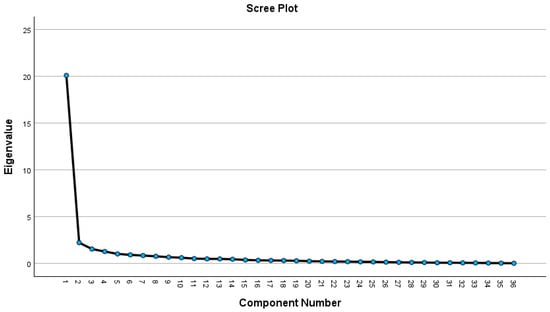
Figure 1.
Scree plot for building decarbonisation levers.
Table 2.
Total variance explained.
Factor 1 is named Sustainable Building Advancement Strategies. As shown in Table 1, ten (10) variables were loaded into this cluster. The ten (10) extracted drivers/levers for Factor 1 include providing professional development and training (85.0%), developing industry standards and protocols (70.4%), promoting multidisciplinary cooperation (68.5%), promoting knowledge-sharing platforms (66.9%), promoting the use of green rating tools (65.6%), embracing sustainable procurement policies (60.2%), improving stakeholder partnerships (55.0%), encouraging green leasing initiatives (51.1%), ensuring easy access to green financing options (46.5%), and showcasing successful pilot projects (38.4%). These variables encompass efforts to advance professional development, create standards, promote collaboration, exchange knowledge, and support various green initiatives and funding sources. This cluster accounts for 55.876% of the total variance, indicating significant opportunities to promote the implementation of building decarbonisation strategies. The prominence of this factor indicates that, within the South African context, successful building decarbonisation depends less on technology availability and more on the preparedness of institutions, skills ecosystems, and collaborative governance structures for effective implementation. The development of new technologies for building decarbonisation necessitates the upskilling and reskilling of professionals. Integrated and transnational educational approaches aim to equip professionals and learners/students with the necessary skills for sustainable, energy-efficient (decarbonised) buildings [48]. Also, the International Cost Management Standard (ICMS) provides a taxonomy for classifying and comparing life cycle costs and carbon emissions, supporting sustainable investment strategies and transparency [49]. A holistic, collaborative approach is essential to achieving Net-Zero Carbon (NZC) targets. This includes integrating design across building systems and ensuring coordinated implementation across technology, governance, and user engagement [20]. Technologies such as Building Information Modelling (BIM) and Digital Twin (DT) also facilitate knowledge representation and informed decision-making, which are crucial for reducing carbon footprints [50]. Similarly, tools like the Green Pyramids Rating System (GPRS) and EDGE (Excellence in Design for Greater Efficiencies) help identify and implement decarbonisation measures in the building sector [51]. These strategies align closely with the findings of this study and collectively contribute to the decarbonisation of the building sector, addressing both technological and policy-related challenges. The prominence of institutional and capacity-related strategies reflects systemic implementation constraints within the South African construction sector. Although decarbonisation technologies are available, deficiencies in skills development, regulatory coordination, and institutional capacity hinder effective adoption. These findings indicate that, contrary to technology-led narratives prevalent in global literature, governance readiness and professional capacity constitute prerequisite conditions for decarbonisation progress in this context.
Factor 2 is named Policy and Investment Strategies. Table 1 presents the eight (8) variables loaded into the cluster. The eight (8) extracted drivers/levers for Factor 2 include enacting and enforcing support policies (83.5%), promoting public–private partnerships (81.9%), offering financial incentives (80.4%), investing in decarbonisation research and development (77.5%), creating public awareness (74.3%), utilising building information modelling (68.5%), fostering industry collaboration (56.8%), and offering capacity building and training (54.7%). These variables highlight support policies, partnerships and collaboration, investments, and capacity-building geared towards achieving decarbonisation of the built environment in South Africa. With a total variance of 6.204%, this cluster showcases policy and investment strategies that promote building decarbonisation. Diverse policies, such as building energy codes, information disclosure, and financial incentives, are crucial to decarbonising buildings. The EU and China have established comprehensive policy instruments, while India is still developing its framework [34]. Stringent building codes and energy performance benchmarks are essential for effective decarbonisation [52]. Public–private partnerships, such as the Science-Based Targets initiative (SBTi) and the Task Force on Climate-related Financial Disclosures (TCFD), align stakeholders and foster industry collaboration, playing a significant role in driving decarbonisation efforts [53,54]. Financial incentives, predominantly in the form of subsidies, are widely used, and carbon pricing mechanisms can also attract private investment to support building decarbonisation [34,55]. Decarbonising the building sector in South Africa requires a multifaceted approach, as this study and other scholars find. Effective implementation of these strategies can therefore significantly reduce carbon emissions and help achieve global climate goals.
Factor 3 is titled Building Energy Optimisation Strategies. As presented in Table 1, six (6) variables are loaded into this cluster. The six (6) extracted drivers/levers for Factor 3 include implementing energy efficiency upgrades (84.4%), improving building insulation (81.6%), renewable energy integration (78.6%), using low-emission HVAC systems (67.3%), addressing the building envelope (66.4%), and installing green roofs and walls (51.3%). All these variables represent efforts to enhance a building’s energy performance through various upgrades and improvements, with a focus on efficiency and renewable energy integration. This cluster accounts for a total variance of 4.312%, as a measure to promote the implementation of building decarbonisation. Upgrading the energy efficiency of buildings is crucial. This includes retrofitting older buildings, which often have poor-performing envelopes and obsolete HVAC systems, to improve their energy performance [20,56]. Energy efficiency measures can lead to significant energy savings and reductions in emissions [56,57]. Enhancing the building envelope through better insulation and airtight construction can significantly reduce energy consumption for heating and cooling [56,57,58]. Also, integrating renewable energy sources such as solar, wind, geothermal, and biomass into buildings can help achieve net-zero energy consumption, thereby aiding building decarbonisation [23,24,59]. Transitioning to low-emission HVAC systems, such as electric heat pumps, can drastically reduce greenhouse gas emissions. Heat pumps are particularly effective in regions with low-carbon electricity and can achieve emission reductions of 90% or more [56,57]. Another strategy is installing green roofs and walls, which can contribute to building decarbonisation by providing additional insulation, reducing urban heat island effects, and supporting biodiversity. These measures align with the broader goals of improving building sustainability and energy efficiency [20,23]. The strategies highlighted above align with the findings of this study, providing credence to the building decarbonisation levers identified by the respondents for South Africa. By implementing these strategies, buildings can significantly reduce their energy consumption and carbon emissions, contributing to global climate goals and improving overall sustainability.
Factor 4 is named Comprehensive Support Strategies. Table 1 presents the eight (8) variables loaded into the cluster. The eight (8) extracted drivers/levers for Factor 4 include supporting decarbonisation supply chains (91.3%), promoting energy management systems (73.0%), implementing decarbonisation certification programmes (61.7%), tax breaks for decarbonisation projects (59.7%), promoting whole-building life-cycle assessment (55.8%), retrofitting for energy efficiency (54.8%), increasing public demand for decarbonisation (41.2%), and prioritising sustainable infrastructure development (41.0%). All these variables highlight how governments, industry stakeholders, and building owners can work together to reduce greenhouse gas emissions from buildings. This cluster accounts for 3.572% of the total variance, as a measure to promote the implementation of building decarbonisation in South Africa. To effectively decarbonise the building sector, several strategic levers can be employed as found in this study and in alignment with findings from other studies. Successful decarbonisation of supply chains involves improving material efficiency, ensuring the circularity of material flows, and reducing CO2 emissions from the production of basic materials. This requires overcoming organisational constraints, enhancing communication, and adopting innovative policies [60]. Implementing energy management systems is also crucial for reducing energy consumption and emissions. Digital solutions such as Building Information Modelling (BIM) and Digital Twin (DT) can enhance energy efficiency and minimise embedded carbon throughout the construction life-cycle [50]. Similarly, environmental certification schemes such as Leadership in Energy and Environmental Design (LEED) and Building Research Establishment Environmental Assessment Method (BREEAM), when correlated with the Smart Readiness Indicator, provide a holistic approach to evaluating and improving building energy efficiency and decarbonisation [61]. Life-Cycle Assessment (LCA) is also pivotal in identifying carbon hotspots and decarbonisation pathways in urban planning and building construction. It helps in assessing the environmental impact of materials, construction processes, and energy technologies [62,63]. Prioritising the development of sustainable infrastructure involves integrating LCA with digital technologies to optimise energy use and reduce carbon footprints. This approach is also essential for achieving net-zero construction practices [50]. Therefore, the findings of this study are consistent with those of other studies on building decarbonisation levers.
Lastly, Factor 5 is named Sustainable Design and Technology Integration Strategies. As shown in Table 1, four (4) variables were loaded into this cluster. The four (4) extracted drivers/levers for Factor 5 include embracing passive design principles (72.2%), utilising low-carbon materials (68.9%), employing energy-efficient glazing and windows (59.4%), and implementing building automation and smart controls (54.4%). To enhance sustainability and efficiency, these variables incorporate techniques that utilise passive design principles, low-carbon materials, energy-efficient glass, and advanced building automation. This cluster, ranked lowest among the factors, accounted for 2.865% of the total variance. Passive design strategies are crucial for reducing energy consumption and enhancing thermal comfort without relying on mechanical systems. Strategies such as proper building orientation and shading can significantly reduce heating and cooling loads [64,65]. Utilising natural ventilation can improve indoor air quality and reduce energy use for cooling [66]. Effective use of thermal mass and insulation can stabilise indoor temperatures and reduce energy demand [67]. Maximising natural light also reduces the need for artificial lighting, thereby saving energy [68]. Using low-carbon materials in construction can also significantly reduce the embodied carbon of buildings. Materials like recycled steel, low-carbon concrete, and sustainable timber have been shown to reduce carbon emissions and energy consumption during construction [69]. Similarly, building automation and smart controls are found to optimise energy use and improve building performance. Smart switchable glazing systems (SSGS) can dynamically adjust to environmental conditions, reducing cooling loads and enhancing energy efficiency [70]. Integrating Building Energy Management Systems (BEMS) with building information modelling (BIM) and energy modelling tools can optimise energy use and improve operational efficiency [71,72]. By integrating these strategies, buildings can achieve significant reductions in both operational and embodied carbon, contributing to overall decarbonisation goals.
5. Conclusions and Recommendations
This study set out to investigate the strategic interventions capable of accelerating building decarbonisation across residential, commercial, and public infrastructure within the South African context. Drawing on empirical evidence from construction professionals and applying exploratory factor analysis, the research provides a structured and data-driven understanding of the multidimensional levers that underpin progress toward net-zero buildings. The results demonstrate that decarbonising buildings is not governed solely by technological upgrades or policy mandates but by an interdependent system of professional capacity, regulatory coherence, energy optimisation measures, financial and institutional support, and integrative design strategies. The five-factor structure extracted from the analysis offers a robust framework for interpreting how these levers cluster and interact, revealing that the most influential pathways combine human capital development, institutional alignment, and coordinated action across the building life cycle. In this regard, the study advances existing discourse by empirically validating that rapid decarbonisation of the built environment requires a systemic transformation rather than incremental or fragmented interventions. This study empirically demonstrates that, within the South African built environment, institutional and capacity-related strategies constitute the primary leverage point for accelerating building decarbonisation, surpassing design- and technology-focused interventions commonly emphasised in global literature.
The dominance of Sustainable Building Advancement Strategies as the primary factor underscores the foundational role of professional development, knowledge exchange, and collaborative governance in enabling decarbonisation outcomes. The findings suggest that even the most advanced technologies and policy instruments will have limited impact if the construction workforce, industry institutions, and procurement systems are not adequately equipped to adopt and operationalise them. Closely aligned with this, identifying Policy and Investment Strategies as a critical factor underscores the need for stable regulatory frameworks, public–private partnerships, and sustained financial commitments to derisk innovation and stimulate market uptake. Together, these two factors reveal that institutional readiness and investment confidence form the enabling conditions upon which technical decarbonisation measures depend. This aligns with international evidence indicating that countries making the fastest progress toward net-zero buildings are those that synchronise regulation, finance, and capacity-building, thereby reducing uncertainty and accelerating diffusion across the construction sector.
Beyond institutional and policy considerations, the study confirms the central importance of Building Energy Optimisation, Comprehensive Support, and Sustainable Design and Technology Integration strategies in delivering measurable reductions in emissions. Energy efficiency upgrades, renewable energy integration, low-emission HVAC systems, and envelope improvements remain indispensable for reducing operational carbon emissions, particularly within South Africa’s ageing building stock. However, the relatively lower variance explained by design- and technology-focused strategies does not diminish their significance; rather, it reflects their dependence on upstream enablers such as financing mechanisms, certification systems, supply-chain readiness, and public demand. Importantly, the results reinforce the argument that operational and embodied carbon must be addressed concurrently through life-cycle thinking, low-carbon materials, and digital tools such as BIM-enabled energy management systems. When viewed collectively, the five factors articulate a “whole-system” decarbonisation pathway, integrating policy, people, technology, and markets into a coherent transition strategy capable of delivering net-zero buildings at scale.
From a practical and policy perspective, the implications of this study are substantial. For policymakers, the findings emphasise the need to move beyond aspirational targets toward enforceable, well-coordinated regulatory instruments supported by fiscal incentives and long-term investment signals. For industry practitioners and professional bodies, the results point to an urgent need for structured upskilling, interdisciplinary collaboration, and the mainstreaming of decarbonisation competencies across the construction value chain. For financial institutions and investors, the identified drivers provide clarity on where capital can be deployed to generate both climate and economic returns, particularly through green finance, retrofit programmes, and performance-based incentives. While the study is contextualised within South Africa, its insights hold broader relevance for other emerging economies facing similar constraints of institutional capacity, infrastructure backlogs, and carbon-intensive building practices. Future research should extend this work by integrating longitudinal data, comparative cross-country analyses, and mixed-method approaches to refine decarbonisation pathways further. Ultimately, this study affirms that achieving net-zero buildings is not only technically feasible but also strategically attainable, provided that immediate, coordinated, and system-oriented action is taken across all levels of the built environment ecosystem.
This study has limitations. Data were collected solely from construction professionals in Gauteng Province, which may restrict the statistical generalisability of the findings to other South African provinces with differing economic structures and construction profiles. However, given Gauteng’s role as the country’s primary construction and economic hub, the results provide analytically generalisable insights into decarbonisation dynamics in highly urbanised and construction-intensive contexts. An additional methodological limitation concerns the factor-retention decisions. The number of factors was determined solely by eigenvalues and the scree plot, without employing supplementary validation techniques such as parallel analysis. Future research should incorporate multiple factor-retention criteria to improve the robustness and confirmatory validity of the identified decarbonisation strategy clusters. Future research should expand this analysis to multiple provinces and employ comparative or longitudinal designs to validate and refine the identified decarbonisation pathways.
Author Contributions
Conceptualisation, O.O. and T.M.; methodology, O.O. and T.M.; software, O.O. and T.M.; validation, O.O. and T.M.; formal analysis, T.M.; investigation, O.O. and T.M.; resources, O.O., T.M. and C.A.; data curation, O.O. and T.M.; writing—original draft preparation, O.O. and T.M.; writing—review and editing, O.O., T.M. and C.A.; visualisation, O.O. and T.M.; supervision, O.O. and C.A.; project administration, O.O., T.M. and C.A.; funding acquisition, O.O., T.M. and C.A. All authors have read and agreed to the published version of the manuscript.
Funding
This research received no external funding.
Institutional Review Board Statement
The study was conducted in accordance with the Declaration of Helsinki and the protocol was reviewed and approved by the Faculty Ethics and Plagiarism Committee (FEPC) of the Faculty of Engineering and the Built Environment at the University of Johannesburg, with approval number UJ_FEBE_FEPC_01133.
Informed Consent Statement
Informed consent was obtained from all subjects involved in the study.
Data Availability Statement
The raw data supporting the conclusions of this article will be made available by the authors on request.
Acknowledgments
The researchers appreciate the valuable time and insight the respondents committed to the survey. The cidb Centre of Excellence at the University of Johannesburg and the cidb Centre of Excellence at Walter Sisulu University, South Africa, are both acknowledged.
Conflicts of Interest
The authors declare no conflicts of interest.
References
- Ghedamsi, R.; Messaoudi, D.; Saifi, N.; Settou, N.; Recioui, B.; Rahmouni, S.; Mokhbi, Y. Technical and economic assessment of hydrogen-based electricity generation from PV sources in tertiary buildings: A case study of a hospital building in Algeria. Environ. Sci. Pollut. Res. 2024, 31, 57275–57286. [Google Scholar] [CrossRef] [PubMed]
- Mirabella, N.; Roeck, M.; Ruschi Mendes Saade, M.; Spirinckx, C.; Bosmans, M.; Allacker, K.; Passer, A. Strategies to improve the energy performance of buildings: A review of their life cycle impact. Buildings 2018, 8, 105. [Google Scholar] [CrossRef]
- Ntuli, N.; Annegarn, H.; Eltrop, L. Barriers of implementing clean development mechanism in South Africa: Building energy efficiency projects. In 2011 Southern African Energy Efficiency Convention; IEEE: Piscataway, NJ, USA, 2011; pp. 1–7. [Google Scholar]
- Ahmed, W.; Asif, M. Energy conservation and management in buildings. In The 4Ds of Energy Transition: Decarbonisation, Decentralisation, Decreasing Use and Digitalization; Wiley: Hoboken, NJ, USA, 2022; pp. 247–266. [Google Scholar]
- Skillington, K.; Crawford, R.H.; Warren-Myers, G.; Davidson, K. A review of existing policy for reducing embodied energy and greenhouse gas emissions of buildings. Energy Policy 2022, 168, 112920. [Google Scholar] [CrossRef]
- Vijayan, D.S.; Devarajan, P.; Mohanavel, V.; Sankaran, N.; Kannan, S.; Ahsan, M.S. A Review of Sustainable Implications of Energy-Efficient Buildings in the Environment. Adv. Civ. Eng. 2025, 2025, 9584777. [Google Scholar] [CrossRef]
- Felton, D.; Fuller, R.; Crawford, R.H. The potential for renewable materials to reduce the embodied energy and associated greenhouse gas emissions of medium-rise buildings. Archit. Sci. Rev. 2014, 57, 31–38. [Google Scholar] [CrossRef]
- Li, Y.L.; Han, M.Y.; Liu, S.Y.; Chen, G.Q. Energy consumption and greenhouse gas emissions by buildings: A multi-scale perspective. Build. Environ. 2019, 151, 240–250. [Google Scholar] [CrossRef]
- Katipamula, S.; Haack, J.; Hernandez, G.; Akyol, B.; Hagerman, J. VOLTTRON: An open-source software platform of the future. IEEE Electrif. Mag. 2016, 4, 15–22. [Google Scholar] [CrossRef]
- Abam, F.I.; Nwachukwu, C.O.; Emodi, N.V.; Okereke, C.; Diemuodeke, O.E.; Owolabi, A.B.; Owebor, K.; Suh, D.; Huh, J.S. A systematic literature review on the decarbonisation of the building sector—A case for Nigeria. Front. Energy Res. 2023, 11, 1253825. [Google Scholar] [CrossRef]
- Zhan, J.; Liu, W.; Wu, F.; Li, Z.; Wang, C. Life cycle energy consumption and greenhouse gas emissions of urban residential buildings in Guangzhou city. J. Clean. Prod. 2018, 194, 318–326. [Google Scholar] [CrossRef]
- Li, X.; Fan, Y.; Guo, Y.; McCarthy, J. Case study of carbon footprint of residential building construction. Mater. Res. Innov. 2014, 18, S4-72–S4-76. [Google Scholar] [CrossRef]
- Xu, H.; Kim, J.I.; Chen, J. Improved framework for estimating carbon emissions from prefabricated buildings during the construction stage: Life cycle assessment and case study. Build. Environ. 2025, 272, 112599. [Google Scholar] [CrossRef]
- Sudarsan, J.S.; Vaishampayan, S.; Parija, P. Making a case for sustainable building materials to promote carbon neutrality in Indian scenario. Clean Technol. Environ. Policy 2022, 24, 1609–1617. [Google Scholar] [CrossRef]
- Mouton, L.; Allacker, K.; Röck, M. Bio-based building material solutions for environmental benefits over conventional construction products—Life cycle assessment of regenerative design strategies (1/2). Energy Build. 2023, 282, 112767. [Google Scholar] [CrossRef]
- Najjar, M.; Figueiredo, K.; Palumbo, M.; Haddad, A. Integration of BIM and LCA: Evaluating the environmental impacts of building materials at an early stage of designing a typical office building. J. Build. Eng. 2017, 14, 115–126. [Google Scholar] [CrossRef]
- Dai, S. A state-of-the-art review of the life cycle assessment of rammed earth building construction. Energy Build. 2025, 350, 116643. [Google Scholar] [CrossRef]
- Hao, H.; Wu, H.; Wei, F.; Xu, Z.; Xu, Y. Scrap Steel Recycling: A Carbon Emission Reduction Index for China. Sustainability 2024, 16, 4250. [Google Scholar] [CrossRef]
- Teng, J.; Yin, H. Carbon emission reduction in public buildings of extreme cold regions: A study on enclosure structure and HVAC system parameter optimisation. Energy Sci. Eng. 2024, 12, 2676–2686. [Google Scholar] [CrossRef]
- Jørgensen, B.N.; Ma, Z.G. Energy efficiency and decarbonisation strategies in buildings: A review of technologies, policies, and future directions. Appl. Sci. 2025, 15, 11660. [Google Scholar] [CrossRef]
- Manfren, M.; Nastasi, B.; Tronchin, L.; Groppi, D.; Garcia, D.A. Techno-economic analysis and energy modelling as a key enablers for smart energy services and technologies in buildings. Renew. Sustain. Energy Rev. 2021, 150, 111490. [Google Scholar] [CrossRef]
- Shahmohammadi, S.; Pedinotti-Castelle, M.; Amor, B. Unveiling the potential for decarbonisation of the building sector: A comparative study of technological and non-technological low-carbon strategies. Sustain. Prod. Consum. 2024, 52, 268–282. [Google Scholar] [CrossRef]
- Qiu, L.; Li, H.; Wang, Z.; Yang, Y.; Lazarus, G.A.; Chen, Y.; Feng, Y. Pathways to decarbonising buildings: Harnessing energy efficiency and sustainable technologies. Therm. Sci. Eng. Prog. 2025, 66, 103991. [Google Scholar] [CrossRef]
- Reddy, V.J.; Hariram, N.P.; Ghazali, M.F.; Kumarasamy, S. Pathway to sustainability: An overview of renewable energy integration in building systems. Sustainability 2024, 16, 638. [Google Scholar] [CrossRef]
- Xiong, J.; Guo, S.Y.; Zhang, X.; Yao, R.M.; Zhu, P.Y.; Peng, X.T.; Yang, N.; Zhang, Y.T.; Shi, M.; Lu, X. Technology pathway to decarbonisation in the building sector based on a policy review of major economies. Adv. Clim. Change Res. 2025, 16, 183–198. [Google Scholar] [CrossRef]
- Tantau, A.; Goia, S.I.; Dincă, V.M.; Păunescu, C.; Stamule, S.; Stamule, T.; Bogdan, A. Exploring the Generation Z Attitude towards Energy Efficiency Improvement and Decarbonization through Heat Pumps: An Empirical Study in Romania. Sustainability 2024, 16, 1250. [Google Scholar] [CrossRef]
- Osman, S.H.; Yatim, N.S.M.; Elham, O.S.J.; Shaari, N.; Zakaria, Z. Three decades of hydrogen energy research: A bibliometric analysis on the evolution of green hydrogen technologies. Sustain. Energy Fuels 2025, 9, 3182–3202. [Google Scholar] [CrossRef]
- Elegbeleye, I.; Oguntona, O.; Elegbeleye, F. Green Hydrogen: Pathway to Net Zero Green House Gas Emission and Global Climate Change Mitigation. Hydrogen 2025, 6, 29. [Google Scholar] [CrossRef]
- Dara, C. Decarbonizing Conventional Building Materials for Net-Zero Emissions: A Feasibility Study in Canada. In The International Conference on Net-Zero Civil Infrastructures: Innovations in Materials, Structures, and Management Practices (NTZR); Springer Nature: Cham, Switzerland, 2024; pp. 855–866. [Google Scholar]
- Niknafs, P.; Johansson, M.; Rohdin, P. Decarbonisation of the construction sector in Sweden: Exploring barriers to and drivers for increased use of wood-based materials in the construction industry. In Proceedings of the ECEEE 2024 Summer Study on Energy Efficiency: Sustainable, Safe and Secure Through Demand Reduction, Chamouille, France, 10–15 June 2024; European Council for an Energy Efficient Economy (ECEEE): Stockholm, Sweden, 2024; pp. 969–978. [Google Scholar]
- Huang, J.; Zhao, D.; Zhao, P. Review on technical pathways and assessment for carbon peaking and carbon neutrality in China’s building materials industry. Discov. Sustain. 2025, 6, 1188. [Google Scholar] [CrossRef]
- Lai, X.; Liu, J.; Georgiev, G. Low carbon technology integration innovation assessment index review based on rough set theory–an evidence from construction industry in China. J. Clean. Prod. 2016, 126, 88–96. [Google Scholar] [CrossRef]
- Schwarz, M.; Nakhle, C.; Knoeri, C. Innovative designs of building energy codes for building decarbonisation and their implementation challenges. J. Clean. Prod. 2020, 248, 119260. [Google Scholar] [CrossRef]
- Xia-Bauer, C.; Gokarakonda, S.; Guo, S.; Filippidou, F.; Thomas, S.; Maheshwari, J.R.; Vishwanathan, S.S. Comparative analysis of residential building decarbonisation policies in major economies: Insights from the EU, China, and India. Energy Effic. 2024, 17, 46. [Google Scholar] [CrossRef]
- Wang, W.; Hao, S.; Zhong, H.; Sun, Z. How to promote carbon emission reduction in buildings? Evolutionary analysis of government regulation and financial investment. J. Build. Eng. 2024, 89, 109279. [Google Scholar] [CrossRef]
- Zhao, Y.; Ma, Y.; Zhong, F. Sustaining Green Building Incentives: A Tripartite Evolutionary Game Analysis and the Synergistic “Technology–Reputation–Policy” Pathway. Buildings 2025, 15, 1537. [Google Scholar] [CrossRef]
- Yu, F.; Feng, W.; Leng, J.; Wang, Y.; Bai, Y. Review of the US policies, codes, and standards of zero-carbon buildings. Buildings 2022, 12, 2060. [Google Scholar] [CrossRef]
- Lauria, M.; Azzalin, M.; Giglio, F.; La Face, G.M. Energy efficiency and smart buildings in public environmental policies. AGATHÓN|Int. J. Archit. Art Des. 2025, 18, 264–275. [Google Scholar]
- Fu, L.; Wang, C. Performance of the combination of decarbonisation policy instruments and implications for carbon neutrality in China. Adv. Clim. Change Res. 2022, 13, 923–937. [Google Scholar] [CrossRef]
- Lee, C.C.; Wang, F.; Lou, R.; Wang, K. How does green finance drive the decarbonisation of the economy? Empirical evidence from China. Renew. Energy 2023, 204, 671–684. [Google Scholar] [CrossRef]
- Upadhyay, K.; Tirumala, R.D. Creativity in sustainable finance: Growth of green instruments. In Routledge Companion to Creativity and the Built Environment; Routledge: London, UK, 2024; pp. 93–106. [Google Scholar]
- Tiwari, A.K.; Trinh, H.H.; Vo, D.T.H.; Sharma, G.D. How do economies decarbonise growth under finance-energy inequality? Global evidence. Energy Econ. 2025, 142, 108172. [Google Scholar] [CrossRef]
- Liang, Y.; Yu, C.; Pan, W. Energy efficiency, renewables, and electrification contribute to decarbonising the operation of residential building stock in Hong Kong. Energy Build. 2025, 349, 116520. [Google Scholar] [CrossRef]
- Jin, X.; Zhang, J.; Zhang, C.; Li, A.; Xu, K.; Han, B.; Xiao, F.; Wang, S. Mitigating building carbon emissions in high-density cities considering energy sufficiency. Appl. Energy 2025, 400, 126586. [Google Scholar] [CrossRef]
- Zhong, J.; Zhang, Y.; Wang, L.; Liu, W. The asymmetric impact of ESG rating disagreement on stock mispricing: Implications for green investment and corporate sustainability. J. Environ. Manag. 2025, 394, 127555. [Google Scholar] [CrossRef] [PubMed]
- Olisaeva, A.; Galazova, M.; Magomayeva, L.; Ledovskaya, A. ESG Criteria at the Present Stage of Society Development. Reliab. Theory Appl. 2023, 18, 360–368. [Google Scholar]
- Jacobs, S.; David, O.O.; Stiglingh-Van Wyk, A. The impact of urbanisation on economic growth in Gauteng Province, South Africa. Int. J. Econ. Financ. Issues 2023, 13, 1–11. [Google Scholar]
- Koukou, M.K.; Lucas, S.; Justino, J.; Rafael, S.; Livieratos, A.D.; Carriço, N.; Konstantaras, J.; Vrachopoulos, M.G.; Benedetti, A.C.; Aleksiejuk-Gawron, J.; et al. Training for Sustainable and Healthy Building for 2050: New Methodologies for an Integrated and Transnational Education Approach Targeting Skills Development for the Transition Toward ZEB and PEB Buildings. Buildings 2024, 15, 67. [Google Scholar] [CrossRef]
- Ballesty, S.; Sawhney, A. Decarbonisation of the Built Environment: Using integrated life cycle and carbon emissions reporting. In IOP Conference Series: Earth and Environmental Science; IOP Publishing: Bristol, UK, 2023; Volume 1176, p. 012046. [Google Scholar]
- Liew, E.F.; Ong, D.E.; Peerun, M.I. Mapping the future of sustainable construction: Review on digitalisation and life cycle assessment trends in Asia-Pacific. Energy Build. 2025, 350, 116547. [Google Scholar] [CrossRef]
- Mohamed, N.A.; EL-Dash, K.M.; Attia, T.M.; Abdel-Monem, M.S. A conceptual checklist of decarbonising elements for the building sector in Egypt. HBRC J. 2024, 20, 767–784. [Google Scholar] [CrossRef]
- Al-Mohammed, R.; Ouahrani, D. Decarbonisation strategies for the building sector: A comparative study of Qatar and global case studies. Energy Strategy Rev. 2025, 62, 101940. [Google Scholar] [CrossRef]
- Sawamura, N. Promotion of Decarbonization by Private Sector’s Approaches. In Handbook of Energy Transitions; CRC Press: Boca Raton, FL, USA, 2022; pp. 379–389. [Google Scholar]
- Pozzer, A.E.; Seo, W.; Rausch, C.; Leite, F. Decarbonising capital projects: Industry-wide insights on drivers, goals, strategies, and barriers. Build. Environ. 2025, 289, 114033. [Google Scholar] [CrossRef]
- Oh, S.; Al-Juaied, M. Decarbonising industrial hubs and clusters: Towards an integrated framework of green industrial policies. Energy Res. Soc. Sci. 2024, 118, 103777. [Google Scholar] [CrossRef]
- McDiarmid, H.; Parker, P. Accelerating the 1.5 C energy transition for Canadian residential buildings through selective direct electrification with heat pumps. Can. Geogr. Le Géogr. Can. 2022, 66, 756–768. [Google Scholar] [CrossRef]
- McDiarmid, H.; Septien, A.B.; Parker, P. Achieving rapid decarbonisation of Canada’s residential sector requires a strategic approach. Energy Build. 2024, 308, 113999. [Google Scholar] [CrossRef]
- Arasteh, H.; Kalivogui, S.; Merabtine, A.; Maref, W.; Zhang, K.; Durand, S.; Turcotte, P.; Rousse, D.; Ilinca, A.; Izquierdo, R.; et al. Decarbonisation strategies for Northern Quebec: Enhancing building efficiency and integrating renewable energy in off-grid indigenous communities. Energies 2025, 18, 4234. [Google Scholar] [CrossRef]
- Zhao, Z.; Li, K. Toward Next-Generation Buildings: A Review of Renewable Energy Integration and Intelligent Building Energy Management Technologies. In International Conference on Life System Modeling and Simulation; Springer Nature: Singapore, 2024; pp. 37–51. [Google Scholar]
- Rootzén, J.; Karlsson, I.; Johnsson, F.; Kadefors, A.; Uppenberg, S. Supply-chain collective action towards zero CO2 emissions in infrastructure construction: Mapping barriers and opportunities. In IOP Conference Series: Earth and Environmental Science; IOP Publishing: Bristol, UK, 2020; Volume 588, p. 042064. [Google Scholar]
- Giama, E.; Chatzikonstantinidis, K.; Chantzis, G.; Manataki, M.; Fokaides, P.; Papadopoulos, A. Smart Readiness, A Tool for Green Building Certification Schemes Towards Carbon Neutrality in the Built Environment. In Proceedings of the 2024 9th International Conference on Smart and Sustainable Technologies (SpliTech), Split, Croatia, 25–28 June 2024; IEEE: Piscataway, NJ, USA, 2024; pp. 1–5. [Google Scholar]
- Biswas, W.K.; Ingram, G.D.; John, M. Achieving a Net Zero Built Environment: The Need to Focus on Urban Green Footprint. In The International Conference on Net-Zero Civil Infrastructures: Innovations in Materials, Structures, and Management Practices (NTZR); Springer Nature: Cham, Switzerland, 2024; pp. 1075–1087. [Google Scholar]
- Tadeu, S.; Rodrigues, C.; Marques, P.; Freire, F. Eco-efficiency to support selection of energy conservation measures for buildings: A life-cycle approach. J. Build. Eng. 2022, 61, 105142. [Google Scholar] [CrossRef]
- Tushar, Q.; Bhuiyan, M.A.; Zhang, G.; Maqsood, T. An integrated approach of BIM-enabled LCA and energy simulation: The optimised solution towards sustainable development. J. Clean. Prod. 2021, 289, 125622. [Google Scholar] [CrossRef]
- Rana, K. Towards passive design strategies for improving thermal comfort performance in a naturally ventilated residence. J. Sustain. Archit. Civ. Eng. 2021, 29, 150–174. [Google Scholar] [CrossRef]
- Muhamad, J.; Ismail, A.A.; Ahmad, H.; Abdul, A. User perception of natural ventilation strategy at inpatient ward, Kuala Kangsar Hospital. J. Malays. Inst. Plan. 2022, 20, 333–345. [Google Scholar] [CrossRef]
- Amine, L.; Rachid, S.; Miloud, R. Improving energy efficiency of Moroccan buildings through energy efficient envelope design: A case study. Int. J. Energy Environ. Econ. 2018, 26, 115–141. [Google Scholar]
- Obrecht, T.P.; Leskovar, V.Ž.; Premrov, M.; Košir, M.; Dovjak, M.; Legat, A.; Kunič, R. Different aspects of windows in buildings. WIT Trans. Ecol. Environ. 2017, 224, 167–174. [Google Scholar]
- Aldersoni, A.A.; Ibrahim, A.O.; Aldamady, A.A.H.; Bashir, F.M.; Babatunde, O.E.; Dodo, Y.A.; Ibrahim, W. Investigating the impact of low-carbon building materials on energy consumption and carbon emissions in construction projects. Int. J. Low-Carbon Technol. 2025, 20, 1581–1592. [Google Scholar] [CrossRef]
- Hafnaoui, R.; Kandar, M.Z.; Ghosh, A.; Mesloub, A. Smart switchable glazing systems in Saudi Arabia: A review. Energy Build. 2024, 319, 114555. [Google Scholar] [CrossRef]
- Truong, N.S.; Luong, D.L.; Ngo, N.T.; Nguyen, Q.T. Optimising envelope design and window performance for energy-efficient buildings through integration of building information and energy modeling (BIM-BEM). In The International Conference on Sustainable Civil Engineering and Architecture; Springer Nature: Singapore, 2023; pp. 584–595. [Google Scholar]
- Yang, X.; Hu, M.; Wu, J.; Zhao, B. Building-information-modeling enabled life cycle assessment, a case study on carbon footprint accounting for a residential building in China. J. Clean. Prod. 2018, 183, 729–743. [Google Scholar] [CrossRef]
Disclaimer/Publisher’s Note: The statements, opinions and data contained in all publications are solely those of the individual author(s) and contributor(s) and not of MDPI and/or the editor(s). MDPI and/or the editor(s) disclaim responsibility for any injury to people or property resulting from any ideas, methods, instructions or products referred to in the content. |
© 2026 by the authors. Licensee MDPI, Basel, Switzerland. This article is an open access article distributed under the terms and conditions of the Creative Commons Attribution (CC BY) license.