1. Introduction
The accurate and continuous tracking of athletes is a critical requirement for ensuring the health, safety, and overall experience of participants in major marathon events. Beyond safety, real-time tracking also meets the growing infotainment demands of spectators, who increasingly expect live updates and interactive features to enhance their engagement with the event. However, existing tracking solutions face significant limitations. Traditional RFID-based timing systems, while widely used, provide only intermittent updates at checkpoints, relying on heuristic and interpolation algorithms to estimate runner positions between measurement points. This lack of resolution in continuous tracking hinders both operational efficiency and the spectator experience.
Alternative IoT-based solutions, such as Low-Power Wide-Area Networks (LPWAN), have been explored for athlete tracking [
1]. However, these systems are constrained by range limitations, the need for dedicated infrastructure, and regulatory challenges, making them less practical for large-scale urban marathon events. In contrast, smartwatches offer a promising solution due to their lightweight design, widespread availability, and integrated GPS and connectivity features. These consumer devices have the potential to provide accurate, real-time tracking without the need for extensive additional infrastructure.
This study investigates the feasibility of using smartwatches as continuous tracking devices for marathon runners. By analyzing key performance metrics such as battery consumption during tracking and standby modes, GPS accuracy, and data transfer update rates in urban environments, we aim to evaluate the practicality of this approach. The focus is on three questions. What achievable duration can be expected given the impact of battery drain? What level of continuous tracking quality can be achieved despite connection and uplink issues? And finally, what level of tracking accuracy is provided? Our empirical evaluation, conducted at the Frankfurt, Athens, and Vienna marathons using three different smartwatch platforms, demonstrates the potential of this solution while highlighting necessary trade-offs in tracking settings. This work lays the foundation for integrating consumer-grade smartwatches with existing timing and tracking infrastructures, offering a scalable and efficient alternative for mass sporting events.
The remainder of this paper is organized as follows.
Section 2 presents some related work. Our evaluated solution and the hardware used are explained in
Section 3.
Section 4 describes the experiments and the results obtained. Finally,
Section 5 presents the discussion, the conclusions, and future work.
2. Related Work
The accurate and continuous tracking of athletes during marathon events has long been a challenge due to the limitations of existing technologies. Traditional solutions, such as RFID-based timing systems, are widely used but provide only intermittent updates. Passive RFID trackers [
2] are small, lightweight, and integrated into race bibs. These trackers rely on electromagnetic energy transmitted by RFID readers placed at the start and finish lines, as well as at a few scattered checkpoints along the course. While effective for timing purposes, this approach lacks the resolution needed for continuous tracking, as it depends on heuristic and interpolation algorithms to estimate runner positions between measurement points.
Recent studies have used Long-Range (LoRa) Wide-Area Network GPS tracker technology to monitor the positions of runners in cross-country races and marathons [
1,
3]. In these studies, the evaluation setup uses stationary or mobile LoRa gateways. However, this technology is limited by the circumstances of a mass event in a city, due to issues of scalability and radio coverage. For instance, deterministic monitoring and real-time operation cannot be guaranteed, and maximum duty cycle regulations impose additional constraints [
4].
The need for continuous tracking is further emphasized by the health and safety requirements of marathon events [
5]. Marathon runners often push themselves to their physical limits, which can lead to dehydration, heat exhaustion, or cardiac events. Real-time location monitoring with wearable technology [
6] allows race organizers to quickly identify and assist runners in distress, potentially preventing serious injuries or fatalities.
From an infotainment perspective, continuous tracking also enhances the spectator experience. Real-time updates and interactive features allow fans to follow their favorite runners throughout the race, boosting engagement [
7]. This demand for live tracking has grown in recent years, as spectators increasingly expect immersive experiences during large-scale sporting events.
In long-distance events such as cross-country or marathon championships, achieving continuous tracking of runners’ pace profiles and tactical behaviors requires high-resolution observation. This level of detail allows athletes to evaluate their decisions and refine their strategies, ultimately leading to better performance [
8]. Experimental solutions, such as drone systems equipped with depth cameras, have been explored [
9], but they are impractical for large-scale events and recreational runners.
Pandey et al. [
10] highlighted the challenges faced by recreational athletes, who are often unable to monitor sport-specific techniques due to the limitations of existing tracking technologies. They expressed a need for improved tracking solutions. Similarly, Venek et al. [
11] noted in their review that, although sensor technologies have been used to assess movement quality, their application in recreational and professional sports outside of controlled laboratory settings remains in its early stages.
While traditional RFID systems have been the standard for marathon tracking, the emergence of consumer-grade wearable devices, such as smartwatches, offers a promising alternative [
12]. Smartwatches are lightweight, widely available, and equipped with integrated GPS and connectivity features, making them suitable for real-time tracking without the need for extensive additional infrastructure. Studies of the accuracy of GPS sports watches in measuring distance covered show a median error of less than 2% [
13,
14].
3. Materials and Methods
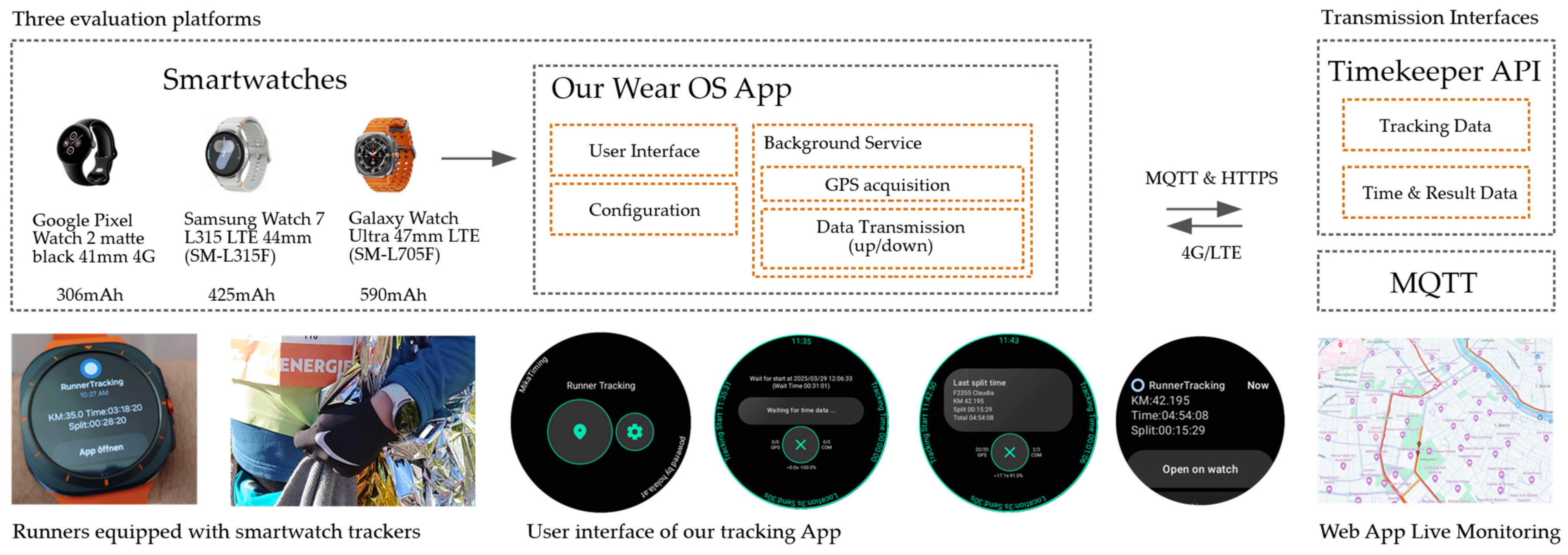
The proposed method for runner tracking at marathon events uses smartwatch platforms and a programmed tracking application, which offers a set of configuration options, to assess different modalities for continuous runner monitoring. The smartwatch trackers were worn by the runners and transmitted their positions continuously. This information was stored in a database and visualized in near real-time on web interfaces. Our architecture is shown in
Figure 1.
3.1. Hardware
We installed our tracking application on three different smartwatch hardware platforms. All three devices were equipped with a Global Navigation Satellite System (GNSS) receiver and supported either 4G LTE or 3G UMTS. The Google Pixel Watch 2 has a 306 mAh battery and is powered by a Qualcomm Snapdragon W5 Gen 1 chipset [
15] that only provides a single-frequency L1 GPS signal. The Samsung Galaxy Watch 7 L315 LTE (SM-L315F) and the Galaxy Watch Ultra LTE (SM-L705F) both have a Samsung Exynos W1000 processor [
16] and dual-frequency GPS that supports L1 and L5 signals. The Watch 7 L315 LTE has a 425 mAh battery, while the Galaxy Watch Ultra LTE has a 590 mAh battery.
Wear OS, an Android [
17] distribution designed for smartwatches, was the operating system deployed on all platforms. During our data collection, version 5 of Wear OS was active. In order to provide mobile internet connectivity, we setup all of the devices with an eSIM for 3G or 4G uplink access. We monitored the current active connection.
3.2. Tracking Application
To evaluate different tracking settings, we developed a Wear OS application that included a user interface (UI) for runtime interaction, a configuration module for pre-settings and runners’ data, and a background service that handled GPS acquisition, battery monitoring, and network communication with the transmission interfaces (see
Figure 1).
We added a configuration component for our various study settings. This component stores participants’ event-related information, tracking settings, and other options. The configuration is stored in an XML file and can be transferred remotely via the included WebDAV feature. Each app installed on a smartwatch generates a unique ID that must be associated with a Participation ID and an Event ID in the time-keeping interface. Tracking settings include the GPS position update rate, minimum movement filter, start time trigger, remote start by SMS, send rate, and send queue enablement. The send queue handles send errors and provides collections of GPS positions in case of slower send rates. Various app settings can also be controlled, such as wake locks, which keep the CPU running constantly, and the ability to enable the high-accuracy GPS setting from the Android API. Both were enabled by default.
The core component of our tracking application is an Android background service. It requires various execution permissions on the smartwatch, including foreground service rights. These permissions enable continuous access to location data. The service can be started directly from the app’s user interface (UI) or scheduled to start tracking at a specific time from the configuration file. While running, the service collects GPS positioning data and uploads it to the transmission interfaces according to the selected configuration. The service also downloads time split information for the app’s integrated UI time notification service for runners. The uploaded data includes the following: position (longitude, latitude, and altitude), estimated accuracy, timestamp, current mobile carrier, connection type, battery level, and information about the associated runner. The connection interface is HTTPS or MQTT, and the message format used is JSON.
On the receiving end, the collected data is stored in a relational database. The timekeeping company provides real-time information via a web API interface. This data is used by web-based live visualization to show runners’ progress on different types of maps and in list components.
The background tracking service monitors battery consumption as a percentage and records the current value every minute. An integrated descriptive statistics component collects data about the data transmission process, GPS collection, and battery usage. This statistical data is stored in a JSON file and uploaded via the integrated WebDAV component for post-event analysis. This data is used in the results section. For debugging, detailed logging is available, and, if necessary, remote SMS-based control is integrated into the service component.
The UI component displays continuous tracking statistics and includes a subcomponent for adjusting settings on-site, if necessary. It provides time-split notifications from the timing service for the runner and uses vibrotactile and audio notifications for this purpose. The app was developed using Kotlin and is compatible with the Android SDK and Wear OS [
18]. The target build platform requirement is Wear OS 4.0 or higher.
3.3. Marathon Tracking Study Setup
We employed this runner-tracking approach at three big city marathon events: Frankfurt (2024), Athens (2024), and Vienna (2025), in that chronological order. At each event, we provided runners with our smartwatch trackers. The Frankfurt marathon was our first setup and part of our preliminary studies to determine the proper settings. Five watches were used, and the update rate was 10 s without message queuing. In Athens, we handed out sixteen watches for the 10 K and full marathon distances. We used the collected geo-position data of nine marathon runners wearing the watches for our post-event GPS accuracy analysis. In Vienna, we deployed seven watches to observe tracking quality. Two study participants did not appear, so we gave the watches to two people to move along the track and mimic runners.
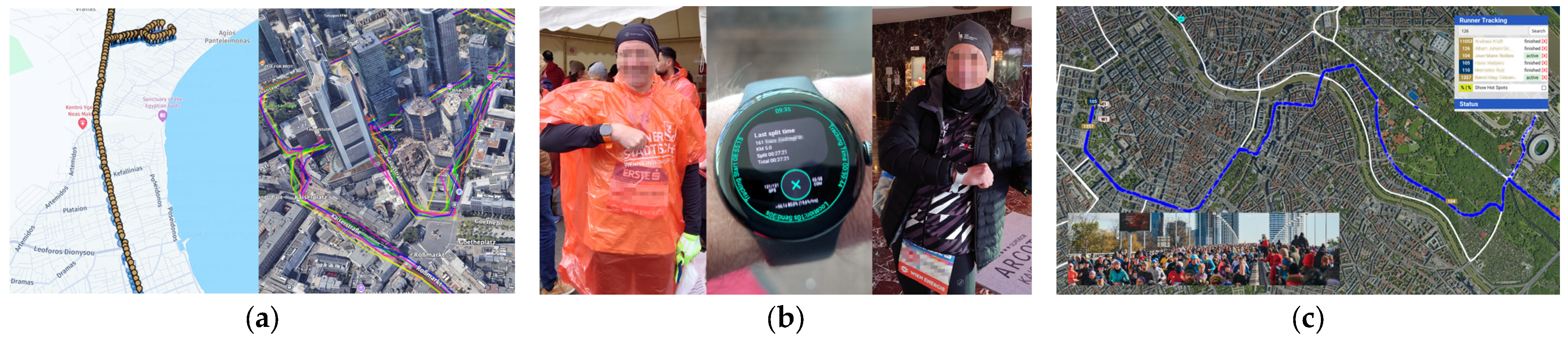
Figure 2a shows the recorded tracks of the runners in Frankfurt and Athens.
The volunteer runners were recreational and hobby athletes of varying ability levels. Each athlete wore the tracker on their wrist, as depicted in
Figure 2b, which shows two athletes in Vienna.
Figure 2c shows our live visualization with two runners still on track, represented by golden labels.
In our post-analysis of the GPS tracking data, we compared the GPS points recorded by our runners’ smartwatches with the nearest points on the track, disregarding time. We used the Python (3.14) module Shapely [
19] for geospatial calculations and coordinate transformations. The track was available in KML format for the events.
The observed battery drain is measured as a percentage per hour and varies by model and battery capacity. The current battery percentage is the value provided by the Android Wear OS API. Using this percentage and the known capacity of different devices’ internal lithium-ion (Li-ion) batteries, one can calculate ongoing power usage and drain in milliwatts (mW) or milliamps (mA), as well as possible runtime.
4. Results
This section describes the results obtained in terms of performance measures and data distribution. For all marathon tracking studies, we ensured that LTE connectivity was the only active connection and that Wi-Fi, Bluetooth, and NFC were deactivated. The background tracking service was pre-configured to activate five minutes before the official start of each event.
We used our nearest-point implementation to determine the offset in GPS accuracy during the Athens event.
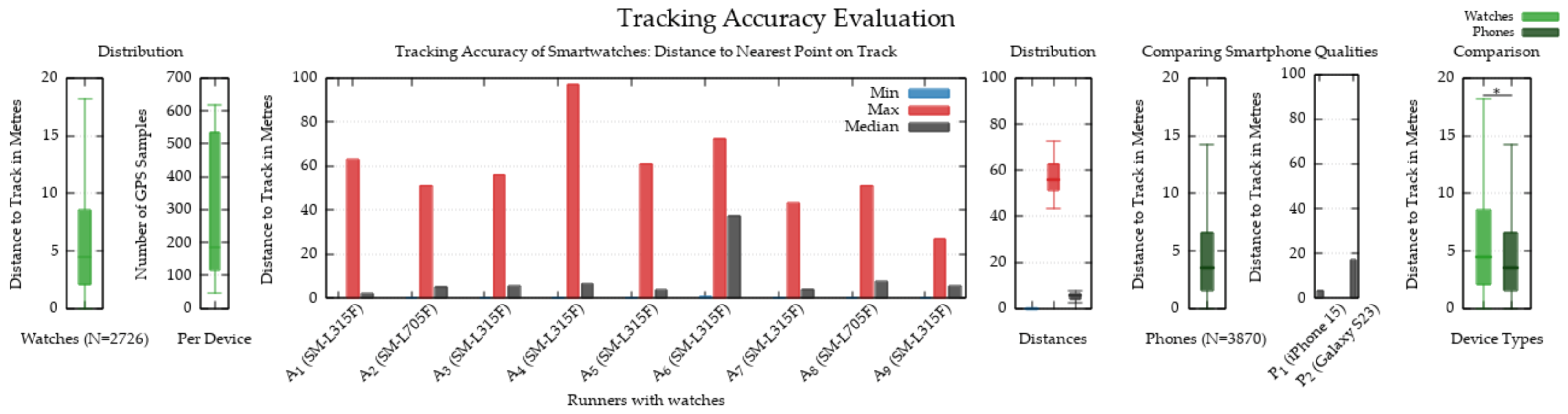
Figure 3 shows the results for nine marathon runners (A
1…A
9). The runners’ devices were configured with a start-time trigger and a GPS update rate of 12 s. The devices also had a minimum movement filter of three meters. For comparison purposes only, we applied a minimum move-distance filter of 0 m to devices A
2 and A
3. We handed out the devices to the runners the day before to analyze battery drains in standby mode. However, the drain was too severe for some devices, so not all of them were operational by the time the runners reached the finish line. We collected 2726 samples. To demonstrate the difference in accuracy, we compared our results with those of two athletes who used a smartphone for tracking.
Our results demonstrate the quality that can be achieved in dense urban areas, where the median GPS offset distribution across all devices is below 10 m (details in
Figure 3). Overall, the median offset of the collected samples was 4.47 (σ 8.67) meters. Comparing these results with those from smartphones (3870 samples), which had an offset of 3.53 (σ 10.99) meters, revealed slightly worse but comparable quality (right
Figure 3).
At the Vienna event, we used an improved version of the app that included time service notifications for the runner and a send queue. Seven watches were on track (VN). The watches V2, V6, and V7 used a send interval of 15 s; the remaining watches used a send interval of 30 s. All watches used a 10 s GPS acquisition interval and had the minimum movement filter set to three meters. Time service updates for the runner’s notification occurred every minute. The mimicking participants used V1 and V7 watches.
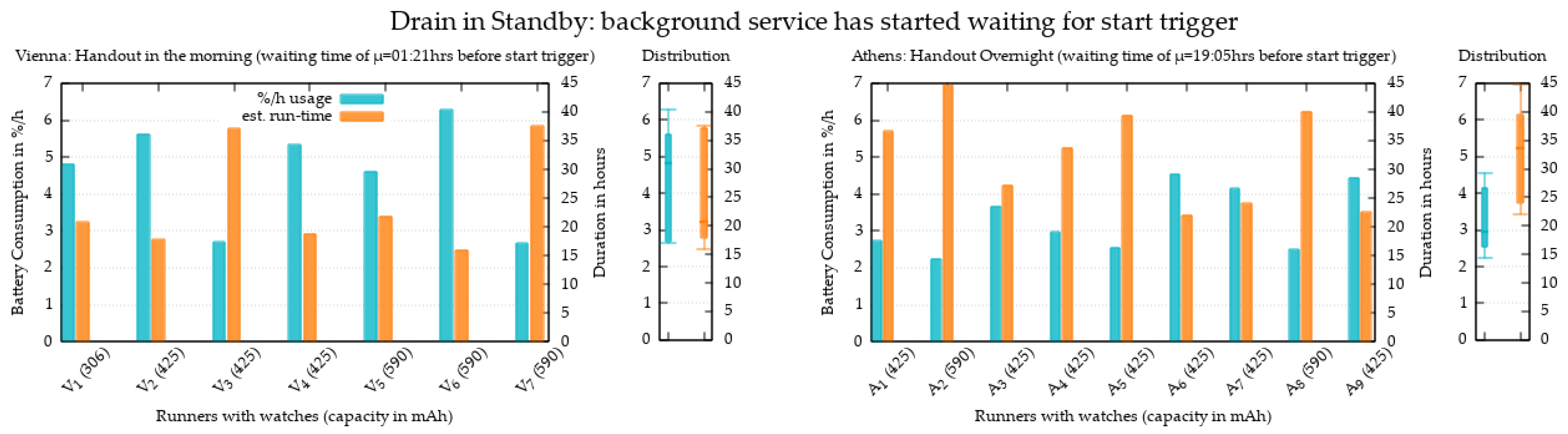
Figure 4 compares the standby power consumption of devices waiting for the start trigger in background services. The median power consumption across all devices was 4.8% (σ 1.4%) per hour in Vienna, where the standby period was shorter, and 3% (σ 0.9%) per hour overnight in Athens. Without V
1 and V
7, the median drain was 5.3% (σ 1.5%) per hour. The median standby runtime ranges from 22 to 33 h, depending on the setting.
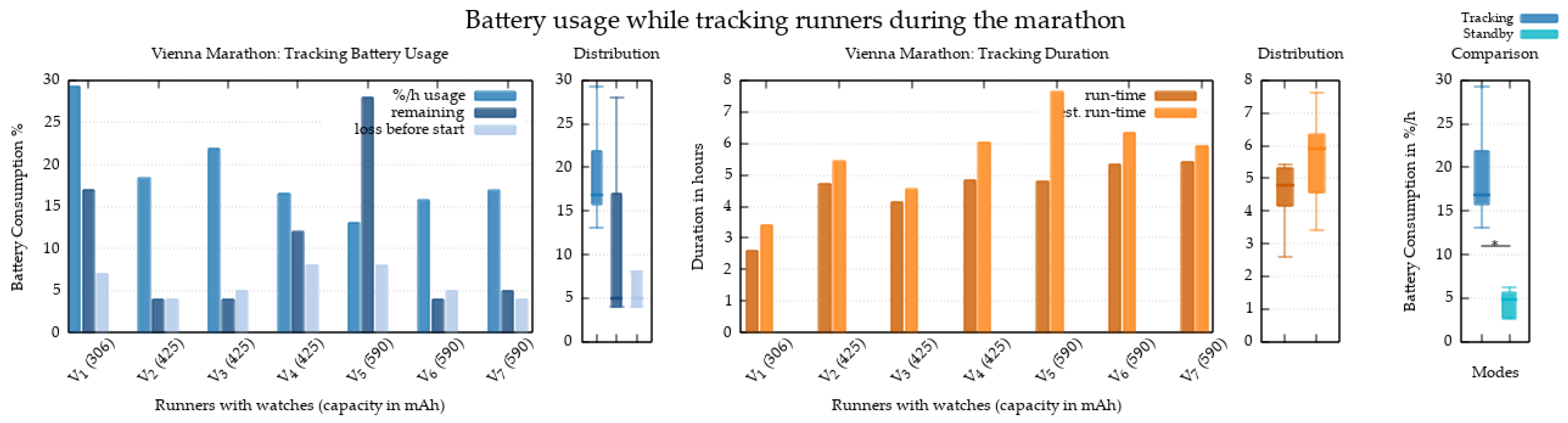
Figure 5 shows consumption during the race, including the estimated runtime. The median drain is 16.9% (σ 5.3%) per hour. Assuming an internal nominal voltage of 3.8 V and a battery capacity of 425 mAh for the SM-L315F device, consumption equates to 64 mW during the race and 20 mW in standby mode.
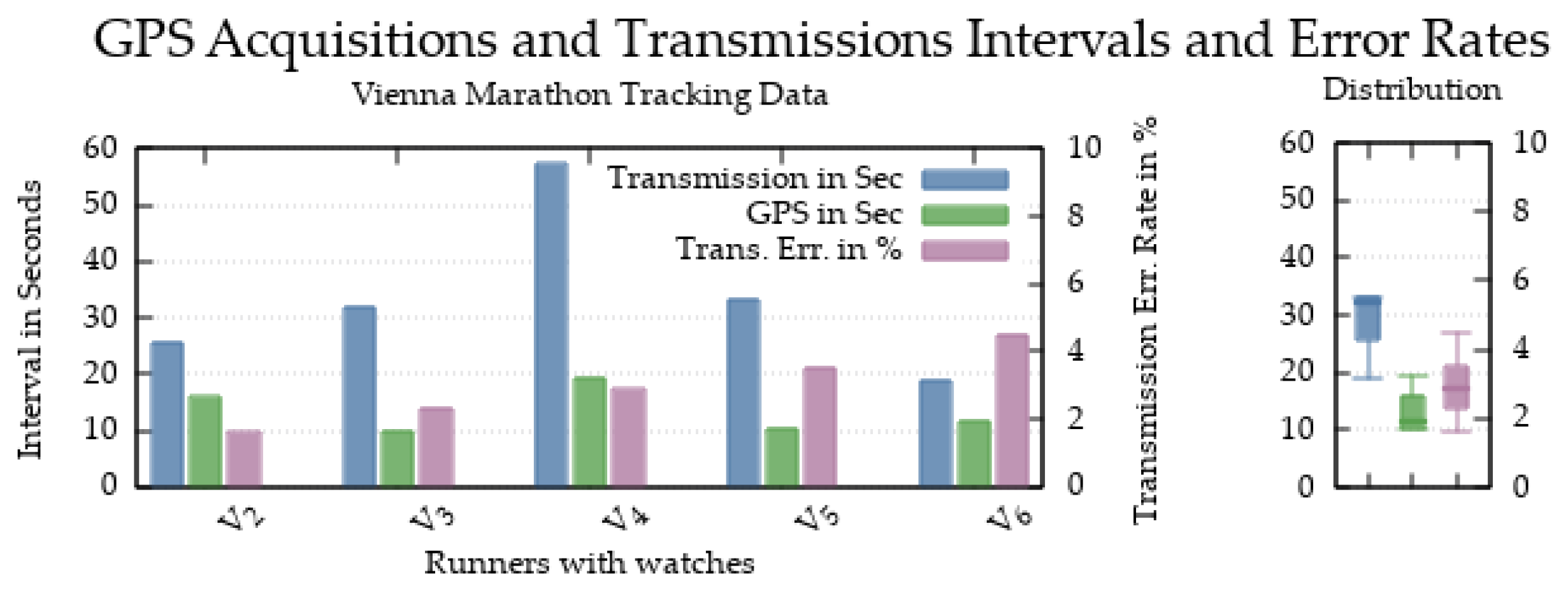
To answer our initial question about the quality of continuous tracking, we evaluated the GPS acquisition and data transmission intervals, as illustrated in
Figure 6.
Table 1 shows all the collected data. The transmission interval differs from the configured setting, resulting in a median error ratio of 2.9%. The detailed values are shown in
Table 1, and the distribution is shown in
Figure 6.
We analyzed the differences in tracking accuracy between smartwatches and smartphones, as shown in
Figure 3, and compared battery usage in standby mode when the background service is waiting for the start trigger and the tracking mode, as shown in
Figure 4. To determine whether there was a significant difference between the observations collected, we performed a two-tailed independent
t-test with an alpha significance level of 0.05 on our marathon tracking data. We performed the statistical analysis using the implementations from the Python SciPy module. For the GPS accuracy comparison (
Figure 3) of the nearest point to the racetrack between smartwatches and smartphones, we can reject the null hypothesis (there is a significant difference, with a
p-value of 0.0004). As expected, we found a significant difference in battery consumption (
Figure 5) between the standby and tracking modes (
p-value of 0.0003).
5. Discussion and Conclusions
Our evaluation shows that recent smartwatch platforms provide a feasible approach for continuous runner tracking with certain constraints. Regarding our three initial questions, we can draw the following conclusions: First, in terms of energy, we found that certain groups of runners require a minimum battery capacity for tracking. For elite runners, a capacity of around 300 mAh is sufficient. Hobby runners require a larger battery, at around 400–600 mAh. Recreational runners may need an even larger battery for runs up to six hours long. Considering standby consumption, participating hardware platforms may be insufficient for the latter group.
Data transmission and the activation of LTE connectivity are the main energy consumers. In a preliminary study, we compared energy consumption with and without LTE connectivity. With LTE disabled in standby mode, the Google Pixel Watch 2 consumed only 3.3 mW (0.9%/h). The different GPS acquisition rate settings and minimum movement distance filter had a less noticeable effect on battery drain.
As for our second question, we noticed some transmission errors, though there were no significant gaps in the data. Continuous tracking is possible, and unsuccessful attempts can be retransmitted via a send queue.
Regarding the final question of tracking accuracy in urban areas, there were significant differences among the smartphones we selected. However, for continuous runner monitoring with a median offset of less than five meters, this accuracy is sufficient for potential applications, such as live TV broadcasting.
In the future, smartwatch devices may allow system-level permissions that control mobile connectivity, such as LTE, within the app. This could improve standby mode durability. A next-generation device with 5G capabilities, extended discontinuous reception, and power-saving modes could further ease constraints. Future work must focus on integrating these consumer devices with existing time and tracking infrastructure.