


Abstract
Hydroponic agriculture based on the Internet of Things (IoT) is an innovative solution to face the challenges of land limitations and climate uncertainty. This study aims to analyze the role of IoT in accelerating the growth of hydroponic plants through monitoring and automation of the planting environment, as well as evaluating its impact on productivity, especially for the planting process in land with minimal sunlight. The system integrates sensors to monitor environmental parameters such as pH, temperature, and humidity, which are then processed in real-time to optimize nutrient delivery and irrigation. The results show that the use of IoT in hydroponic systems is able to significantly improve the quality and quantity of crop yields compared to conventional methods. However, there are several challenges in implementation, such as high initial costs, limited infrastructure in certain areas, and potential cybersecurity threats. Nonetheless, innovation and collaboration opportunities between the public and private sectors can accelerate the adoption of these technologies in sustainable agriculture.
1. Introduction
The world’s growing population demands innovation in the agricultural sector to ensure adequate food availability [1]. One of the farming methods that has become increasingly popular in recent decades is hydroponics, which is a farming technique without using soil as a growing medium [2]. Hydroponics offers advantages like water use efficiency, reduced land use, and better environmental control, but also faces challenges like high setup costs and energy requirements [3]. However, to achieve optimal results, various supporting factors are needed, including appropriate lighting to accelerate plant growth [4]. Ultraviolet (UV) light is one of the light spectrums that has an important role in plant physiological processes [5]. Although excessive exposure to UV rays can have negative effects such as damaging plant DNA structure and inhibiting growth, recent research shows that in controlled doses, UV rays can provide benefits, such as promoting growth and accelerating photosynthesis, as well as stimulating the production of secondary metabolite compounds that are useful for plant defenses [6]. Therefore, optimizing UV exposure is one of the strategies that can be used to increase productivity in hydroponic systems [7]. In the modern agricultural era, the application of Internet of Things (IoT)-based technology is increasingly being used to optimize various aspects of the agricultural system, including hydroponics [8]. IoT enables automatic and real-time monitoring and control of the plant growth environment through sensors and actuators connected to network-based systems. By utilizing this technology, important parameters such as UV light intensity, air humidity, temperature, and nutrients in the water can be controlled more precisely, thus creating ideal conditions for plant growth [9]. “Smart Urban Farming Application: UV Light in Hydroponic Installations” discusses how the application of UV light in hydroponic systems can increase plant growth in a closed environment [10]. This study shows that the use of UV rays allows plant growth up to 30–50% faster than traditional methods [11]. Additionally, the application of IoT-based systems in hydroponics can help monitor various environmental parameters such as pH, temperature, humidity, and water nutrient levels more accurately [12]. With this system, efficiency in the use of agricultural resources can be increased, and crop production can be more optimal even in limited space [13]. On the other hand, “Ultraviolet Radiation Management in Greenhouse to Improve Red Lettuce Quality and Yield” discusses how the management of UV rays in the greenhouse can affect the quality and yield of red lettuce plants [14]. The results show that the use of a greenhouse with UV-block plastic can increase plant growth, while higher exposure to UV light can increase antioxidant levels in plants [15]. In addition, experiments with supplemental UV light before harvest showed that this strategy could improve crop quality without significantly inhibiting its growth [16]. The study also highlights that although plants grown in UV-block greenhouses have greater weight, their antioxidant and phenolic content is lower compared to plants that are exposed to more UV light [17]. Therefore, a balanced approach is needed in the management of UV rays to achieve optimal growth while maintaining the quality of plant nutrients [18]. In addition, this study reveals that UV light management can be performed by providing additional UV light exposure before harvest; this allows plants to benefit from UV light without having to experience stress due to excessive exposure during the entire growth cycle [19]. Thus, this strategy offers a balance between optimal crop growth and improved yield quality [20]. Proper management of UV rays in IoT-based hydroponic systems can be an effective solution in increasing crop yields while maintaining plant quality [21]. This article aims to comprehensively examine how UV rays affect the growth of hydroponic plants and how IoT technology can be used to optimize lighting to improve the efficiency and productivity of sustainable agriculture. This study aims to comprehensively examine how exposure to ultraviolet (UV) light affects the growth and quality of plants in hydroponic systems, as well as explore how Internet of Things (IoT) technology can be utilized to optimize the management of UV lighting. This study is focused on identifying the effectiveness of integrating UV rays and IoT systems in creating an ideal growing environment in order to improve resource use efficiency, accelerate plant growth, and produce high-quality horticultural products in a sustainable manner. This research has a high urgency considering the increasingly complex global challenges in agriculture, especially in the context of population growth, land limitations, and climate change that affect the stability of food production. In the modern era, dependence on conventional agricultural systems has become less relevant because it is unable to answer the need for efficiency and sustainability. Technology-based hydroponic systems are a promising alternative because they can be applied in narrow plots and urban environments and have high flexibility in controlling plant growth conditions. However, to obtain optimal results, a careful strategy is needed in the management of the growing environment, especially lighting. UV rays used in a controlled manner have been proven to provide positive benefits for plant growth and quality. On the other hand, integration with IoT systems allows for automatic and precise adjustment of the intensity and duration of UV exposure to UV rays, thus significantly increasing the efficiency of agricultural systems. If this research is not conducted, the great potential of the application of UV and IoT rays in hydroponics risks not being utilized to the fullest, and the opportunity to increase food production sustainably can be missed. Therefore, this research is important to support the development of smart agricultural systems that are adaptive to the challenges of the times and contribute to future food security.
2. Materials and Methods
The method used in this study is Systematic Literature Review (SLR) with the PRISMA protocol (Preferred Reporting Items for Systematic Reviews) [22]. SLR is a research method that aims to identify, evaluate, and interpret all study results relevant to a particular topic to answer research questions comprehensively [23]. Researchers formulate research questions clearly to ensure the literature review is directed and systematic. These questions were designed to identify important aspects of IoT-based UV lighting management in hydroponic systems, as well as evaluate the effectiveness, advantages, and challenges in its application [24,25].
- (a)
- RQ1: How does ultraviolet (UV) light affect plant growth parameters in hydroponic systems?
- (b)
- RQ2: To what extent can the utilization of the Internet of Things (IoT) improve the precision and effectiveness of UV light intensity management in hydroponic systems?
- (c)
- RQ3: What are the challenges and solutions in the implementation of IoT-based UV light technology for sustainable plant growth acceleration?
Through this analysis, it is expected that a more optimal strategy can be found in managing UV light exposure with the support of IoT technology to increase plant productivity and quality in a sustainable modern agricultural system.
In the literature search process, researchers collected articles using the keywords (“UV light” OR “ultraviolet”) AND (“hydroponic” OR “controlled environment agriculture”) in the Scopus database. Prior to screening, duplication removal was performed, resulting in 13 articles for the initial selection stage. Next, screening was performed by limiting the publication year range between 2018 and 2025, resulting in 6 articles relevant to the latest technological developments. Next, screening was performed based on relevant fields of study, such as agricultural engineering, computer science, and environmental science. After that, articles that did not provide the full text or only discussed UV light without the implementation of IoT in hydroponic systems resulted in 3 articles, so only articles that already had a stronger academic influence and had been cited by other studies were considered. Of the 6 filtered articles, only 2 articles met the final criteria for further analysis. Through this approach, it is hoped that the research can provide a deep insight into the optimal UV light management strategy in IoT-based hydroponic systems so that it can serve as a foundation for the development of sustainable agricultural technology in the future. The literature selection process in this study was carried out using the PRISMA method, where records were identified, screened, assessed for eligibility, and included in the final review, as illustrated in Figure 1.
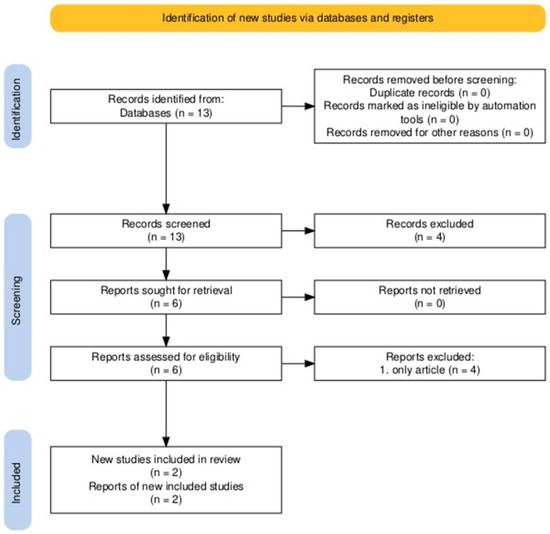
Figure 1.
PRISMA Flow diagram for the literature selection.
3. Results
The results of this study were compiled to answer the research questions that had been formulated previously. The article selection process uses the PRISMA method, resulting in two articles that were selected as the main reference. These articles are presented in Table 1 to facilitate data analysis and interpretation.

Table 1.
Review Results.
4. Discussion
The following section presents a comprehensive discussion of the findings derived from the selected articles, structured based on the three research questions (RQ1, RQ2, and RQ3). To facilitate a clearer comparison and synthesis of insights, the results are summarized in Table 2, which outlines how each study addresses the role of UV application, IoT integration, and the associated challenges in smart agricultural and hydroponic systems.
Table 2.
Comparative analysis of UV and IoT implementation in smart agriculture based on research questions (RQ1–RQ3).
5. Conclusions
This study shows that the application of ultraviolet (UV) light in an Internet of Things (IoT)-based hydroponic system can significantly accelerate plant growth, up to 30–50% faster than conventional methods. UV light, specifically UV-A, can replace sunlight in the process of photosynthesis, which supports plant development by improving the visual structure and quality of the crop, such as wider leaves and taller stems. The use of IoT technology in this system allows real-time monitoring of various important environmental parameters such as temperature, humidity, pH, and nutrient content, as well as high-precision regulation of UV light intensity. This makes the hydroponic system more efficient in regulating the ideal growing environment for plants. However, there are several challenges in the application of this technology, including the stability of environmental parameters, the risk of disease spread through nutrient solutions, and high initial costs. To overcome these challenges, the use of energy-efficient LED UV lights with the right wavelength and IoT-based automatic control systems is highly recommended. This system can adjust the intensity of UV rays according to the growth phase of the plant, thus minimizing the risk of overexposure that can damage the plant. Overall, this study shows the great potential of the application of UV light and IoT technology in increasing the productivity of hydroponic agriculture that is more efficient and sustainable. The integration of this technology can accelerate the adoption of environmentally friendly smart agriculture, support food security, and optimize the use of limited agricultural resources.
Author Contributions
Conceptualization, R. and T.D.H.; methodology, I.T.K.; software, M.I.F.; validation, T.D.H.; formal analysis, R.; investigation, I.T.K. and M.I.F.; resources, T.D.H.; data curation, M.I.F.; writing original draft preparation, R. and I.T.K.; writing review and editing, T.D.H.; visualization, M.I.F.; supervision, T.D.H.; project administration, T.D.H. All authors have read and agreed to the published version of the manuscript.
Funding
This research received no external funding.
Data Availability Statement
No new data were created or analyzed in this study. Data sharing is not applicable to this article.
Conflicts of Interest
The authors declare no conflict of interest.
References
- Sonnino, A. Food security, sustainability and agricultural innovation. Geotema 2016, 20, 27–30. [Google Scholar]
- Ballabh, J.; Nautiyal, M.; Joshi, R.; Singh, M.; Jain, G.; Saini, N. Hydroponics: An Overview of Advanced Growing Approaches. J. Surv. Fish. Sci. 2022, 8, 306–310. [Google Scholar] [CrossRef]
- Khatri, L.; Kunwar, A.; Bist, D.R. Hydroponics: Advantages and Challenges in Soilless Farming. Big Data Agric. 2024, 6, 98–105. [Google Scholar] [CrossRef]
- Ahmed, H.A.; Yu-Xin, T.; Qi-Chang, Y. Optimal control of environmental conditions affecting lettuce plant growth in a controlled environment with artificial lighting: A review. S. Afr. J. Bot. 2020, 130, 75–89. [Google Scholar] [CrossRef]
- Loconsole, D.; Santamaria, P. UV lighting in horticulture: A sustainable tool for improving production quality and food safety. Horticulturae 2021, 7, 9. [Google Scholar] [CrossRef]
- Idris, M.; Rahmadhani, S.; Biologi, D.; Matematika, F.; Alam, P.; Andalas, U. Tanggap Pertumbuhan dan Pengakumulasian Metabolit Sekunder pada Tumbuhan Heliofitik Karamunting (Rhodomyrtus tomentosa) terhadap Paparan Ultraviolet. Vegetalika 2024, 13, 348–364. [Google Scholar] [CrossRef]
- Perez, S.L.; Ferro, R.B.; Corrêa, B.; Casarin, R.; Corrêa, T.Q.; Blanco, K.C.; Bagnato, V.S. Enhanced vegetable production in hydroponic systems using decontamination of closed circulating fluid. Sci. Rep. 2024, 14, 602. [Google Scholar] [CrossRef] [PubMed]
- Febriana, R.K.; Thakur, R.; Roy, S. Enhancing Hydroponic Farming Productivity Through IoT-Based Multi-Sensor Monitoring System. In Proceedings of the 9th International Conference on Internet of Things, Big Data and Security (IoTBDS 2024), Angers, France, 28–30 April 2024; pp. 351–357. [Google Scholar] [CrossRef]
- Bersani, C.; Ruggiero, C.; Sacile, R.; Soussi, A.; Zero, E. Internet of Things Approaches for Monitoring and Control of Smart Greenhouses in Industry 4.0. Energies 2022, 15, 3834. [Google Scholar] [CrossRef]
- Saputra, H.; Sumitra, I.D.; Hirawan, D.; Lesmana, R.; Soegoto, E.S. Smart Urban Farming Application: UV Light in Hydroponic Installations. J. Eng. Sci. Technol. 2023, 18, 1007–1018. [Google Scholar]
- Sonjaroon, W.; Tepkaew, T.; Kupia, M.; Tongkok, P.; Boonkorkaew, P.; Thussagunpanit, J. Pre-Harvest UV-A Supplementation in Plant Factory with Artificial Lighting Improves Growth, Photosynthesis, and Phytonutrients in Kale. Horticulturae 2024, 10, 701. [Google Scholar] [CrossRef]
- Sappa, A.D.; Dornaika, F. An Edge-Based Approach to Motion Detection Conference. Int. Conf. Comput. 2019, 11538, 648–657. [Google Scholar] [CrossRef]
- Majdalawi, M.I.; Ghanayem, A.A.; Alassaf, A.A.; Schlüter, S.; Tabieh, M.A.; Salman, A.Z.; Akash, M.W.; Pedroso, R.C. Economic efficient use of soilless techniques to maximize benefits for farmers. AIMS Agric. Food 2023, 8, 1038–1051. [Google Scholar] [CrossRef]
- Lycoskoufis, I.; Kavga, A.; Koubouris, G.; Karamousantas, D. Ultraviolet Radiation Management in Greenhouse to Improve Red Lettuce Quality and Yield. Agriculture. 2022, 12, 1620. [Google Scholar] [CrossRef]
- Quintero-Arias, D.G.; Acuña-Caita, J.F.; Asensio, C.; Valenzuela, J.L. Ultraviolet transparency of plastic films determines the quality of lettuce (Lactuca sativa L.) grown in a greenhouse. Agronomy 2021, 11, 358. [Google Scholar] [CrossRef]
- Peng, H.; Pang, Y.; Liao, Q.; Wang, F.; Qian, C. The Effect of Preharvest UV Light Irradiation on Berries Quality: A Review. Horticulturae 2022, 8, 1171. [Google Scholar] [CrossRef]
- Pacak, I.; Trojak, M.; Skowron, E. The use of UV-A radiation for biofortification of lettuce and basil plants with antioxidant phenolic and flavonoid compounds. Folia Biol. Oecologica 2024, 18, 110–121. [Google Scholar] [CrossRef]
- Hutagalung, F.; Timotiwu, P.B.; Ginting, Y.C.; Manik, T.K.B. Pengaruh Pengurangan Intensitas Radiasi Matahari terhadap Pertumbuhan dan Kualitas Selada Romaine (Lactuca sativa var. Longifolia). J. Agrotek Trop. 2021, 9, 453. [Google Scholar] [CrossRef]
- Kim, Y.L.; Yeom, M.S.; Sim, H.S.; Lee, G.O.; Kang, I.J.; Yang, G.S.; Yun, J.G.; Son, K.-H. Effect of Pre-Harvest Intermittent UV-B Exposure on Growth and Secondary Metabolites in Achyranthes japonica Nakai Microgreens in a Vertical Farm. Horticulturae 2024, 10, 1040. [Google Scholar] [CrossRef]
- Xu, H.; Liu, M.; Tang, Y.; Zhao, F.; Cao, W.; He, M.; Peng, D.; Dai, X. Optimized management strategy increased grain yield, promoted nitrogen balance, and improved water productivity in winter wheat. Front. Plant Sci. 2023, 14, 1–14. [Google Scholar] [CrossRef] [PubMed]
- Wibowo, S.A.; Widodo, K.A.; Rudhistiar, D. Smart Farming System untuk Tanaman Hidroponik Berbasis Internet of Things. J. Bumigora Inf. Technol. 2023, 5, 17–30. [Google Scholar] [CrossRef]
- Zahra, N.; Sulastiana, M.; Fitriana, E. Exploring the Impact of Work-Life Balance on Employees: A Systematic Literature Review. Int. J. Psychol. Stud. 2024, 16, 86. [Google Scholar] [CrossRef]
- Akbar, J.U.M.; Kamarulzaman, S.F.; Muzahid, A.J.M.; Rahman, M.A.; Uddin, M. A Comprehensive Review on Deep Learning Assisted Computer Vision Techniques for Smart Greenhouse Agriculture. IEEE Access 2024, 12, 4485–4522. [Google Scholar] [CrossRef]
- Shareef, U.; Rehman, A.U.; Ahmad, R. A Systematic Literature Review on Parameters Optimization for Smart Hydroponic Systems. Ai 2024, 5, 1517–1533. [Google Scholar] [CrossRef]
- Ramsari, N.; Hidayat, T. Monitoring System and Hydroponic Plant Automation Using Microcontroller Internet of Things Based (IoT). Compiler 2022, 11, 59–74. [Google Scholar] [CrossRef]
Disclaimer/Publisher’s Note: The statements, opinions and data contained in all publications are solely those of the individual author(s) and contributor(s) and not of MDPI and/or the editor(s). MDPI and/or the editor(s) disclaim responsibility for any injury to people or property resulting from any ideas, methods, instructions or products referred to in the content. |
© 2025 by the authors. Licensee MDPI, Basel, Switzerland. This article is an open access article distributed under the terms and conditions of the Creative Commons Attribution (CC BY) license (https://creativecommons.org/licenses/by/4.0/).