
Molecular Docking/Dynamic Simulations and ADME-TOX-Based Analysis of Phthalimido-1,3-Thiazole Derivatives as BCR-ABL Inhibitors †

Abstract
1. Introduction
2. Materials and Methods
3. Results
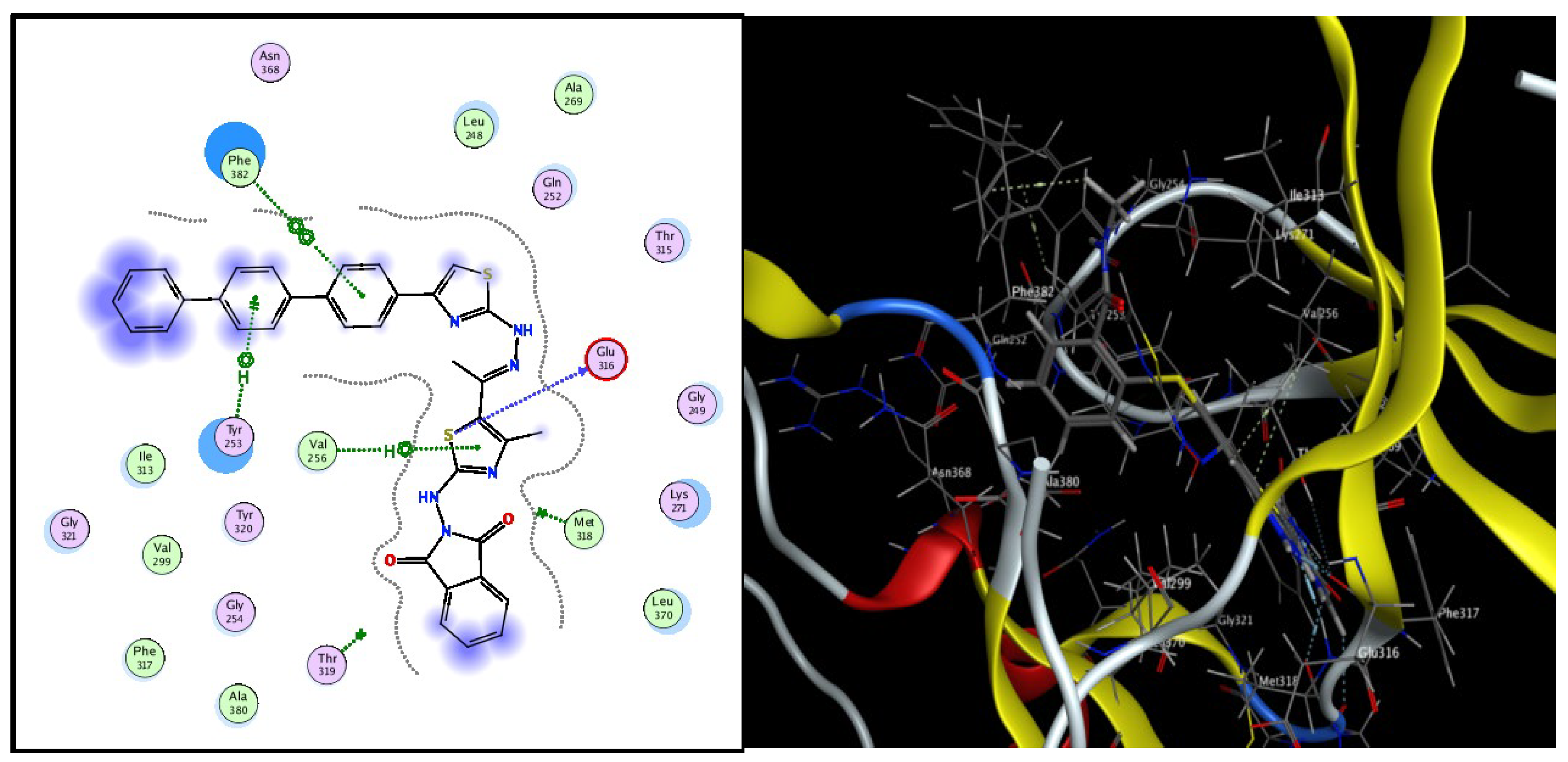
3.1. Molecular Docking
3.2. Molecular Dynamic Simulation
3.2.1. Ligand-Active Site Interactions
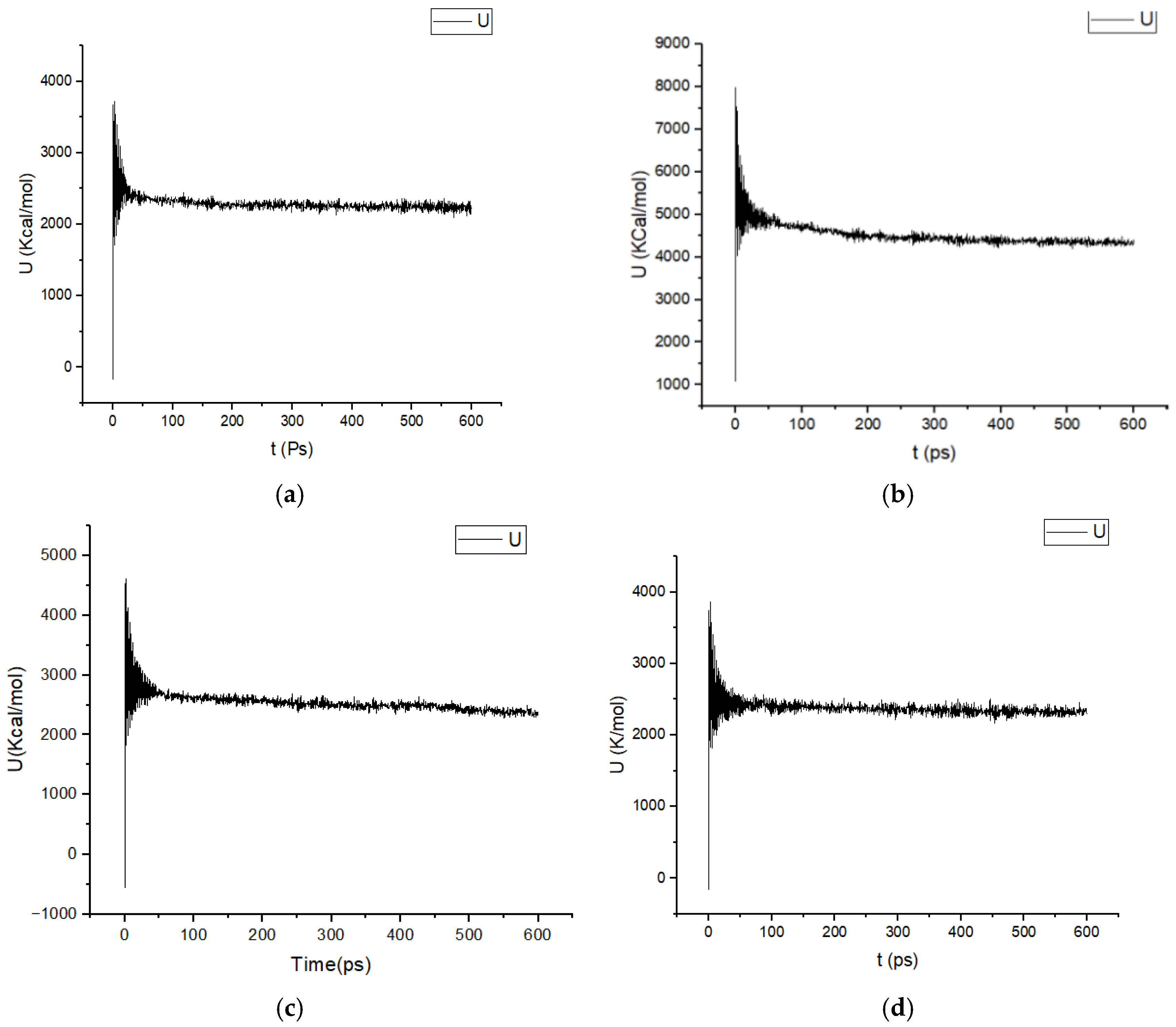
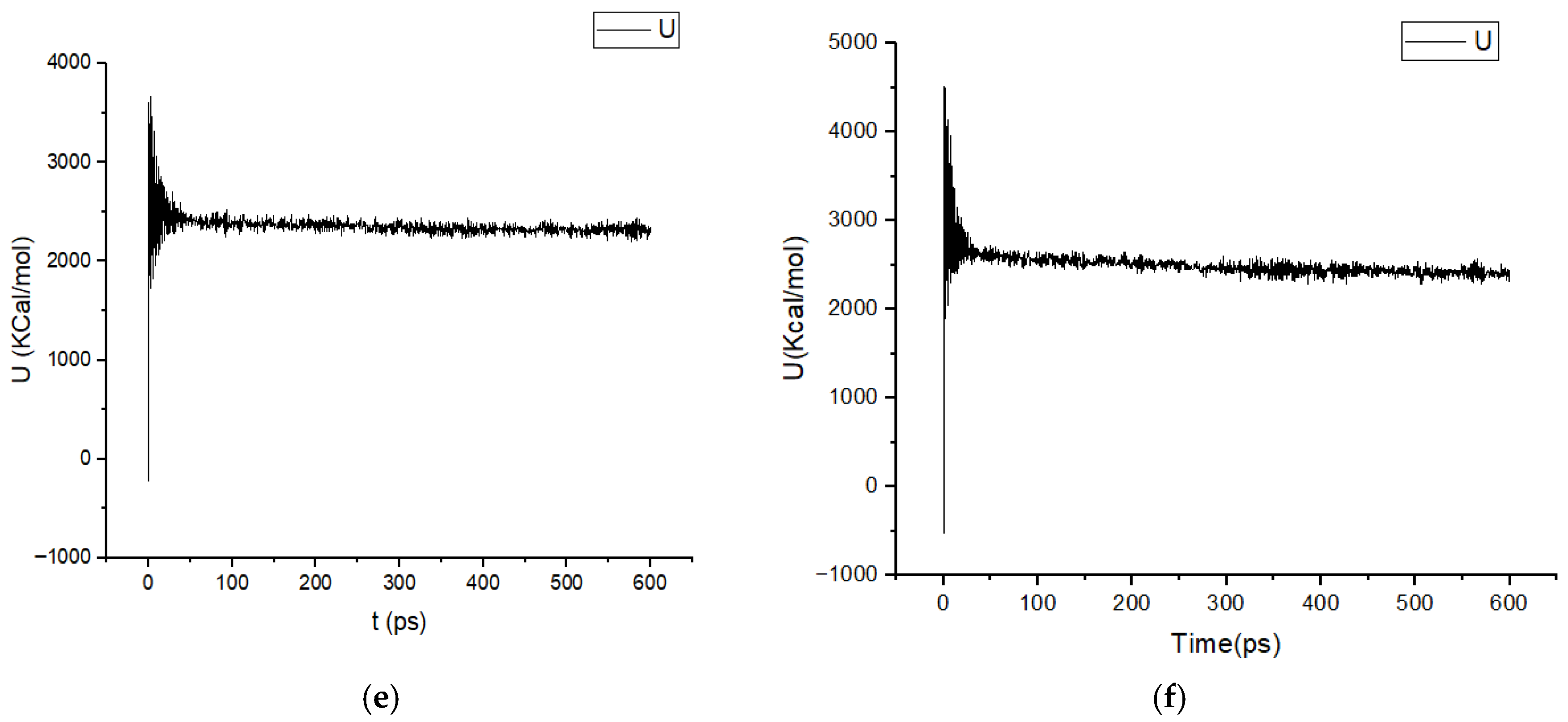
3.2.2. Potential Energy During Simulation Time
Author Contributions
Funding
Institutional Review Board Statement
Informed Consent Statement
Data Availability Statement
Conflicts of Interest
References
- Axitinib Effectively Inhibits BCR-ABL1 (T315I) with a Distinct Binding Conformation. Nature. Available online: https://www.nature.com/articles/nature14119 (accessed on 21 June 2024).
- Peppas, I.; Ford, A.M.; Furness, C.L.; Greaves, M.F. Gut microbiome immaturity and childhood acute lymphoblastic leukaemia. Nat. Rev. Cancer 2023, 23, 565–576. [Google Scholar] [CrossRef] [Scilit] [PubMed]
- Philadelphia Chromosome-Positive Leukemia in the Lymphoid Lineage—Similarities and Differences with the Myeloid Lineage and Specific Vulnerabilities—PMC. Available online: https://www.ncbi.nlm.nih.gov/pmc/articles/PMC7460962/ (accessed on 21 June 2024).
- Cario, G.; Leoni, V.; Conter, V.; Baruchel, A.; Schrappe, M.; Biondi, A. BCR-ABL1-like acute lymphoblastic leukemia in childhood and targeted therapy. Haematologica 2020, 105, 2200–2204. [Google Scholar] [CrossRef] [Scilit] [PubMed]
- Oliveira, A.R.; Dos Santos, F.A.; Ferreira, L.P.d.L.; Pitta, M.G.d.R.; Silva, M.V.d.O.; Cardoso, M.V.d.O.; Pinto, A.F.; Marchand, P.; de Melo Rêgo, M.J.B.; Leite, A.C.L. Synthesis, anticancer activity and mechanism of action of new phthalimido-1,3-thiazole derivatives. Chem. Biol. Interact. 2021, 347, 109597. [Google Scholar] [CrossRef] [Scilit] [PubMed]
- Saghiri, K.; Daoud, I.; Melkemi, N.; Mesli, F. Molecular docking/dynamics simulations, MEP analysis, and pharmacokinetics prediction of some withangulatin A derivatives as allosteric glutaminase C inhibitors in breast cancer. Chem. Data Collect. 2023, 46, 101044. [Google Scholar] [CrossRef] [Scilit]
- Mettai, M.; Daoud, I.; Mesli, F.; Kenouche, S.; Melkemi, N.; Kherachi, R.; Belkadi, A. Molecular docking/dynamics simulations, MEP analysis, bioisosteric replacement and ADME/T prediction for identification of dual targets inhibitors of Parkinson’s disease with novel scaffold. In Silico Pharmacol. 2023, 11, 3. [Google Scholar] [CrossRef] [Scilit] [PubMed]
- HyperChem(TM) Professional, Version 7.51; Hypercube, Inc.: Gainesville, FL, USA, 2019.
- Molecular Operating Environment (MOE) 2014. Chemical Computing Group Inc.: Montreal, Quebec, Canada, 2014. Available online: https://www.chemcomp.com/ (accessed on 21 June 2024).



| Complex | E Score kcal/mol | RMSD | Bonds Between Compound Atoms and Active Site Residues | |||||
|---|---|---|---|---|---|---|---|---|
| Compound Atom | The Atoms Involved at the Receptor | Residues Involved at the Receptor | Type of Interactions | Distance (Å) | E (kcal/mol) | |||
| Doxo 1 | −7.7475 | 1.7921 | O 23 | N | GLY 254 [A] | H-acceptor | 3.04 | −1.8 |
| 6-ring | CG2 | ILE 313 [A] | Pi-H | 4.49 | −0.5 | |||
| L17 | −8.4152 | 2.8512 | S 31 | O | GLU 316 [A] | H-donor | 3.94 | − 0.9 |
| 5-ring | 6-ring | PHE382 [A] | Pi-Pi | 3.60 | − 0.0 | |||
| L18 | −8.3629 | 2.0503 | N 26 | 6-ring | GLU 316 [A] | H-donor | 2.93 | −0.6 |
| 5-ring | CB | ASP 381 [A] | Pi-H | 3.74 | −0.6 | |||
| L19 | −8.5473 | 1.3127 | 5-ring | CD | LYS 271 [A] | Pi-H | 3.84 | −0.5 |
| 5-ring | CB | PHE 382 [A] | Pi-H | 3.78 | −0.7 | |||
| L20 | −9.1532 | 1.7784 | 6-ring | CA | LGL250 [A] | Pi-H | 4.30 | −0.5 |
| 5-Ring | 6-ring | PHE 382 [A] | Pi-H | 3.61 | −0.0 | |||
| L21 | −9.2920 | 2.5193 | S 3 | O | GLU 316 [A] | H-Donor | 3.93 | −1.0 |
| 6-ring | CA | TRY 253 [A] | Pi-H | 3.81 | −1.0 | |||
| 5-ring | CG2 | VAL 256 [A] | Pi-H | 4.42 | −0.5 | |||
| 6-ring | PHE | PHR 382 [A] | Pi-Pi | 3.92 | −0.0 | |||
| L22 | −9.0292 | 1.9701 | 5-ring | CD | LYS 271 [A] | Pi-H | 4.15 | −0.6 |
| N 22 | 6-ring | TRY 253 [A] | H-Pi | 3.91 | −1.5 | |||
| 5-ring | CG2 | VAL 256 [A] | Pi-H | 4.36 | −0.5 | |||
| 6-ring | CD2 | LEU 301 [A] | Pi-H | 4.52 | −0.5 | |||
| 5-ring | CB | PHE382 [A] | Pi-H | 4.15 | −0.5 | |||
| Complex | Bonds Between Compound Atoms and Active Site Residues | |||||
|---|---|---|---|---|---|---|
| Compound Atom | The Atoms Involved at the Receptor | Residues Involved at the Receptor | Type of Interactions | Distance (Å) | E (Kcal/mol) | |
| 4wa9-L 17 | 5-ring | CA | GLY 321 | Pi-H | 3.49 | −0.8 |
| 4wa9-L 18 | N 25 | OG1 | THR 315 | H-donor | 2.76 | −2.7 |
| S 35 | O | GLU 316 | H-donor | 3.60 | −0.7 | |
| N 50 | O | GLY 250 | H-donor | 2.51 | −3.8 | |
| O 52 | CA | GLY 321 | H-acceptor | 3.44 | −0.9 | |
| O 52 | N | ASN 322 | H-acceptor | 3.23 | −1.9 | |
| O 52 | ND2 | ASN 322 | H-acceptor | 2.68 | −6.6 | |
| 4wa9-L 19 | N 15 | OD1 | ASP 381 | H-donor | 2.66 | −7.8 |
| C 36 | O | MET 318 | H-donor | 3.38 | −0.8 | |
| O 13 | OG1 | THR 315 | H-acceptor | 2.75 | −2.0 | |
| N 37 | OH | TYR 253 | H-acceptor | 3.00 | −1.0 | |
| 4wa9-L 20 | N 15 | OG1 | THR 315 | H-donor | 2.82 | −4.0 |
| S 21 | OG1 | THR 315 | H-donor | 3.55 | −1.3 | |
| O 14 | N | NME 272 | H-acceptor | 2.73 | −3.0 | |
| N 37 | OH | TYR 253 | H-acceptor | 2.64 | −2.2 | |
| 6-ring | CD1 | LEU 248 | Pi-H | 4.52 | −0.6 | |
| 5-ring | CG1 | VAL 256 | Pi-H | 4.65 | −0.6 | |
| 6-ring | CA | GLY 321 | Pi-H | 4.49 | −1.1 | |
| 4wa9-L 21 | S 5 | OG1 | THR 315 | H-donor | 4.05 | −0.6 |
| 5-ring | CD1 | LEU 301 | Pi-H | 4.31 | −0.6 | |
| 6-ring | CB | ASN 322 | Pi-H | 4.00 | −1.2 | |
| 6-ring | ND2 | ASN 322 | Pi-H | 3.97 | −0.8 | |
| 4wa9-L 22 | 5-ring | CG | LYS 271 | Pi-H | 3.90 | −1.2 |
| 6-ring | CA | GLY 321 | Pi-H | 3.97 | −0.9 | |
Disclaimer/Publisher’s Note: The statements, opinions and data contained in all publications are solely those of the individual author(s) and contributor(s) and not of MDPI and/or the editor(s). MDPI and/or the editor(s) disclaim responsibility for any injury to people or property resulting from any ideas, methods, instructions or products referred to in the content. |
© 2025 by the authors. Licensee MDPI, Basel, Switzerland. This article is an open access article distributed under the terms and conditions of the Creative Commons Attribution (CC BY) license (https://creativecommons.org/licenses/by/4.0/).
Share and Cite
Bensahbane, I.; Melkemi, N.; Daoud, I.; Faiza, A. Molecular Docking/Dynamic Simulations and ADME-TOX-Based Analysis of Phthalimido-1,3-Thiazole Derivatives as BCR-ABL Inhibitors. Chem. Proc. 2025, 18, 90. https://doi.org/10.3390/ecsoc-29-26903
Bensahbane I, Melkemi N, Daoud I, Faiza A. Molecular Docking/Dynamic Simulations and ADME-TOX-Based Analysis of Phthalimido-1,3-Thiazole Derivatives as BCR-ABL Inhibitors. Chemistry Proceedings. 2025; 18(1):90. https://doi.org/10.3390/ecsoc-29-26903
Chicago/Turabian StyleBensahbane, Imane, Nadjib Melkemi, Ismail Daoud, and Asli Faiza. 2025. "Molecular Docking/Dynamic Simulations and ADME-TOX-Based Analysis of Phthalimido-1,3-Thiazole Derivatives as BCR-ABL Inhibitors" Chemistry Proceedings 18, no. 1: 90. https://doi.org/10.3390/ecsoc-29-26903
APA StyleBensahbane, I., Melkemi, N., Daoud, I., & Faiza, A. (2025). Molecular Docking/Dynamic Simulations and ADME-TOX-Based Analysis of Phthalimido-1,3-Thiazole Derivatives as BCR-ABL Inhibitors. Chemistry Proceedings, 18(1), 90. https://doi.org/10.3390/ecsoc-29-26903