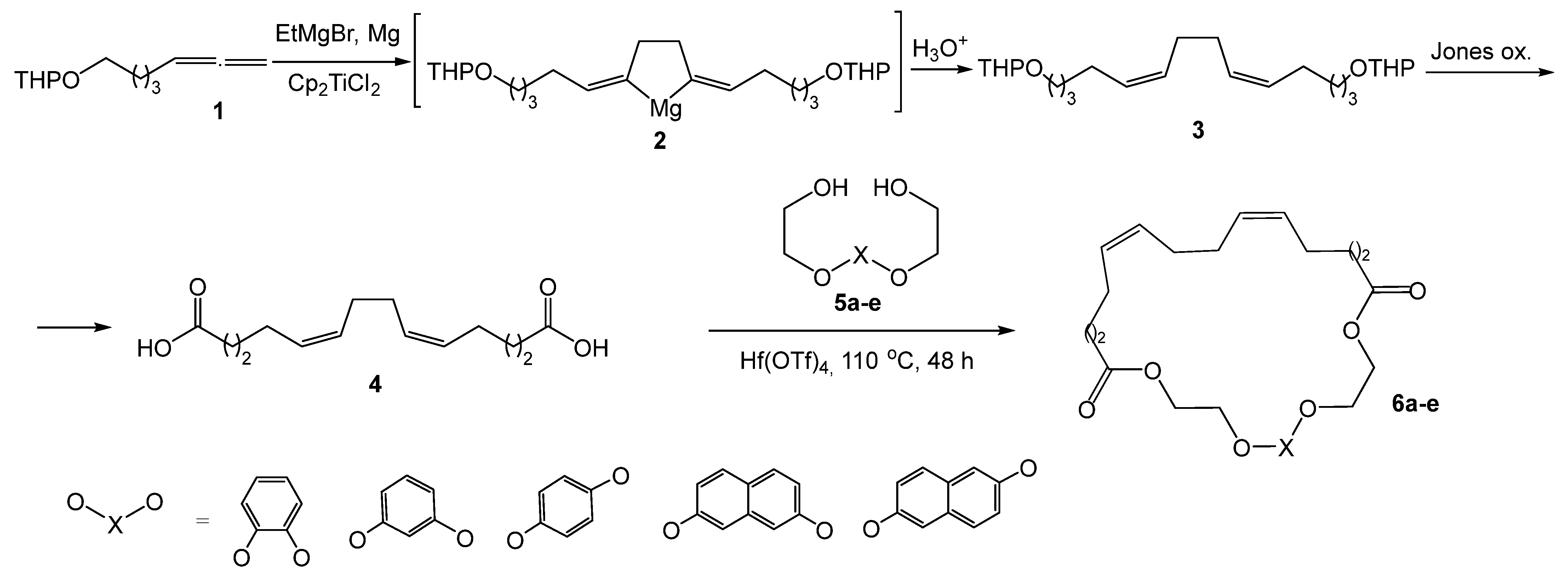

Synthesis of New 1Z,5Z-Dienoic Macrodiolides with Benzenyl and Naphthyl Moieties †

Abstract
1. Introduction
2. Results and Discussion
3. Materials and Methods
Chemistry
4. Conclusions
Author Contributions
Funding
Institutional Review Board Statement
Informed Consent Statement
Data Availability Statement
Acknowledgments
Conflicts of Interest
References
- Caldarelli, S.; Fangour, S.E.; Wein, S.; Tran Van Ba, C.; Périgaud, C.; Pellet, A.; Vial, H.; Peyrottes, S. New Bis-thiazolium Analogues as Potential Antimalarial Agents: Design, Synthesis, and Biological Evaluation. J. Med. Chem. 2013, 56, 496–509. [Google Scholar] [CrossRef] [PubMed]
- Peyrottes, S.; Caldarelli, S.; Wein, S.; Périgaud, C.; Pellet, A.; Vial, H. Choline analogues in malaria chemotherapy. Curr. Pharm. Des. 2012, 18, 3454–3466. [Google Scholar] [CrossRef] [PubMed][Green Version]
- Abozeid, M.A.; El-Sawi, A.A.; Abdelmoteleb, M.; Awad, H.; Abdel-Aziz, M.M.; Abdel-Rahman, A.R.H.; El-Desoky, E.S.I. Synthesis of novel naphthalene-heterocycle hybrids with potent antitumor, anti-inflammatory and antituberculosis activities. RSC Adv. 2020, 10, 42998–43009. [Google Scholar] [CrossRef] [PubMed]
- Mahesha, P.; Shetty, N.S. Naphthyl-Based Chalcone Derivatives: A Multifaceted Player in Medicinal Chemistry. ChemistrySelect 2024, 9, e202400522. [Google Scholar] [CrossRef]
- Wang, G.; Liu, W.; Peng, Z.; Huang, Y.; Gong, Z.; Li, Y. Design, synthesis, molecular modeling, and biological evaluation of pyrazole-naphthalene derivatives as potential anticancer agents on MCF-7 breast cancer cells by inhibiting tubulin polymerization. Bioorg. Chem. 2020, 103, 104141. [Google Scholar] [CrossRef] [PubMed]
- Luo, L.; Jia, J.J.; Zhong, Q.; Zhong, X.; Zheng, S.; Wang, G.; He, L. Synthesis and anticancer activity evaluation of naphthalene-substituted triazole spirodienones. Eur. J. Med. Chem. 2021, 213, 113039. [Google Scholar] [CrossRef] [PubMed]
- Makar, S.; Saha, T.; Singh, S.K. Naphthalene, a versatile platform in medicinal chemistry: Sky-high perspective. Eur. J. Med. Chem. 2019, 161, 252–276. [Google Scholar] [CrossRef] [PubMed]
- Di Pietro, M.E.; Aroulanda, C.; Celebre, G.; Merlet, D.; De Luca, G. The conformational behaviour of naproxen and flurbiprofen in solution by NMR spectroscopy. New J. Chem. 2015, 39, 9086–9097. [Google Scholar] [CrossRef]
- Wang, X.; Xing, Y.; Su, J.; Wang, C.; Wang, Z.; Yu, Y.; Xu, H.; Ma, D. Synthesis of two new naphthalene-containing compounds and their bindings to human serum albumin. J. Biomol. Struct. Dyn. 2021, 39, 3435–3448. [Google Scholar] [CrossRef] [PubMed]
- Elrayess, R.A.; Elshihawy, H. Naphthalene: An overview. Rec. Pharm. Biomed. Sci. 2023, 7, 145–153. [Google Scholar] [CrossRef]
- Frolov, N.A.; Seferyan, M.A.; Detusheva, E.V.; Son, E.; Kolmakov, I.G.; Kartseva, A.S.; Firstova, V.V.; Vereshchagin, A.N.; Elinson, M.N. Development of Naphthalene-Derivative Bis-QACs as Potent Antimicrobials: Unraveling Structure–Activity Relationship and Microbiological Properties. Molecules 2024, 29, 5526. [Google Scholar] [CrossRef]
- Mishra, P.; Sethi, P.; Kumar, S.; Rathi, P.; Umar, A.; Kumar, R.; Baskoutas, S. Synthesis and Biomedical Applications of Macrocyclic Complexes. J. Mol. Struct. 2024, 1317, 139098. [Google Scholar] [CrossRef]
- D’yakonov, V.A.; Dzhemileva, L.U.; Dzhemilev, U.M. Natural compounds with bis-methylene-interrupted Z-double bonds: Plant sources, strategies of total synthesis, biological activity, and perspectives. Phytochem. Rev. 2021, 20, 325–342. [Google Scholar] [CrossRef]
- Dzhemileva, L.U.; D’yakonov, V.A.; Islamov, I.I.; Yunusbaeva, M.M.; Dzhemilev, U.M. New 1Z,5Z-diene macrodiolides: Catalytic synthesis, anticancer activity, induction of mitochondrial apoptosis, and effect on the cell cycle. Bioorg. Chem. 2020, 99, 103832. [Google Scholar] [CrossRef] [PubMed]
- Islamov, I.I.; Yusupova, A.V.; D’yakonov, V.A.; Dzhemilev, U.M. Synthesis of polyether macrodiolides based on acetylenic derivatives of (5Z, 9Z)-tetradeca-5, 9-diene-1, 14-dioic acid. Russ. Chem. Bull. 2023, 72, 2473–2483. [Google Scholar] [CrossRef]
- Islamov, I.I.; Makarov, A.A.; Makarova, E.K.; Yusupova, A.V.; D’yakonov, V.A.; Dzhemilev, U.M. Synthesis of macrocyclic and linear compounds with 1 Z, 5 Z-diene and alkynylcarbinol fragments based on (5 Z, 9 Z)-tetradeca-5, 9-diene-1, 14-diol. Russ. Chem. Bull. 2023, 72, 925–931. [Google Scholar] [CrossRef]
- Islamov, I.I.; Gaisin, I.V.; Dzhemilev, U.M.; D’yakonov, V.A. Synthesis of macrocyclic mono-and diolides based on new ω-hydroxyalkadienoic acids with (Z, Z)-1, 5-diene moiety. Russ. Chem. Bull. 2024, 73, 1623–1630. [Google Scholar] [CrossRef]
- D’yakonov, V.A.; Islamov, I.I.; Dzhemileva, L.U.; Makarova, E.K.; Dzhemilev, U.M. Direct synthesis of polyaromatic cyclophanes containing bis-methylene-interrupted Z-double bonds and study of their antitumor activity in vitro. Int. J. Mol. Sci. 2021, 22, 8787. [Google Scholar] [CrossRef] [PubMed]
- Islamov, I.I.; Dzhemileva, L.U.; Gaisin, I.V.; Dzhemilev, U.M.; D′yakonov, V.A. New Polyether Macrocycles as Promising Antitumor Agents─ Targeted Synthesis and Induction of Mitochondrial Apoptosis. ACS Omega 2024, 9, 19923–19931. [Google Scholar] [CrossRef]
- Matsumoto, C.; Yasutake, K.J.; Nishino, H. Synthesis of naphthalenophane-type macrocyclic compounds using Mn (III)-based dihydrofuran-clipping reaction. Tetrahedron 2016, 72, 6963–6971. [Google Scholar] [CrossRef]

Disclaimer/Publisher’s Note: The statements, opinions and data contained in all publications are solely those of the individual author(s) and contributor(s) and not of MDPI and/or the editor(s). MDPI and/or the editor(s) disclaim responsibility for any injury to people or property resulting from any ideas, methods, instructions or products referred to in the content. |
© 2024 by the authors. Licensee MDPI, Basel, Switzerland. This article is an open access article distributed under the terms and conditions of the Creative Commons Attribution (CC BY) license (https://creativecommons.org/licenses/by/4.0/).
Share and Cite
Gaisin, I.; Islamov, I. Synthesis of New 1Z,5Z-Dienoic Macrodiolides with Benzenyl and Naphthyl Moieties. Chem. Proc. 2024, 16, 30. https://doi.org/10.3390/ecsoc-28-20111
Gaisin I, Islamov I. Synthesis of New 1Z,5Z-Dienoic Macrodiolides with Benzenyl and Naphthyl Moieties. Chemistry Proceedings. 2024; 16(1):30. https://doi.org/10.3390/ecsoc-28-20111
Chicago/Turabian StyleGaisin, Ilgam, and Ilgiz Islamov. 2024. "Synthesis of New 1Z,5Z-Dienoic Macrodiolides with Benzenyl and Naphthyl Moieties" Chemistry Proceedings 16, no. 1: 30. https://doi.org/10.3390/ecsoc-28-20111
APA StyleGaisin, I., & Islamov, I. (2024). Synthesis of New 1Z,5Z-Dienoic Macrodiolides with Benzenyl and Naphthyl Moieties. Chemistry Proceedings, 16(1), 30. https://doi.org/10.3390/ecsoc-28-20111