


Abstract
Background: Lip aging is a heterogeneous and visually complex process, yet a standardized morphological classification applicable to clinical practice is still lacking. Current approaches mainly focus on volumetric loss or perioral rhytids, while the geometric features of the lips, including borders, projection, and eversion, remain poorly codified. Methods: Fifty anonymized lip images acquired under standardized conditions using digital facial imaging were independently evaluated by five physicians experienced in esthetic medicine. Images were classified according to three predefined morphotypes representing distinct patterns of lip aging. Inter-rater reliability was assessed using Fleiss’s kappa statistic. Results: Three recurrent morphotypes were consistently identified: devolumized lips, central lips, and chapped lips. Overall, 87% of images were assigned to one of the three morphotypes by at least four of five evaluators, while 13% were classified as undefined due to mixed features. Inter-rater agreement was substantial (κ = 0.89; 95% CI 0.79–0.99), confirming high reproducibility of the proposed classification. Conclusions: This study proposes a simple and reproducible image-based morphotypic classification of lip aging that captures recurrent visual patterns within this cohort. The framework may facilitate standardized clinical communication, support personalized rejuvenation strategies, and provide a foundation for future quantitative imaging studies and AI-based phenotype recognition in esthetic and reconstructive practice.
1. Introduction
Lip aging is a complex and heterogeneous process influenced by anatomical, functional, and chronological factors. Despite growing attention to the perioral region in esthetic medicine, a shared descriptive language capable of capturing the global visual geometry of the lips remains limited. Most existing studies focus on isolated quantitative features such as volume loss, perioral rhytids, or surface texture changes, often assessed through two- or three-dimensional morphometric approaches, while holistic visual pattern recognition has been less systematically explored [1,2,3].
Previous studies have predominantly employed feature-specific quantitative metrics, such as vermilion height, lip projection, and perioral rhytid scoring using 2D/3D imaging [2,3]. While these methods provide objective measurements, they may not capture the global visual gestalt used in clinical esthetic assessment. The present approach differs by exploring whether holistic pattern recognition can identify recurrent configurations prior to biometric definition, serving as a hypothesis-generating step toward future quantitative validation.
In this preliminary, hypothesis-generating study, we investigate whether a limited number of recurrent visual patterns of lip aging can be consistently recognized within a homogeneous cohort using standardized digital images. The proposed morphotypes are intended solely as descriptive visual categories applicable to the studied population and do not represent an exhaustive or universally generalizable classification of lip aging.
A total of 50 anonymized lip images were retrospectively analyzed. Images were acquired under standardized conditions using a single digital imaging platform (VISIACR5, Canfield Scientific, Parsippany, NJ, USA). All images were obtained from female subjects. Five physicians with experience in esthetic medicine independently evaluated each image and classified it according to three predefined morphotypes based on overall visual appearance rather than predefined quantitative thresholds.
An additional “undefined” category was included for images exhibiting mixed, transitional, or atypical visual features that could not be reliably assigned to a single morphotype without forced classification, consistent with the known heterogeneity of perioral aging processes [4,5]. The three morphotypes were defined descriptively based on recurring visual features consistently recognized by evaluators.
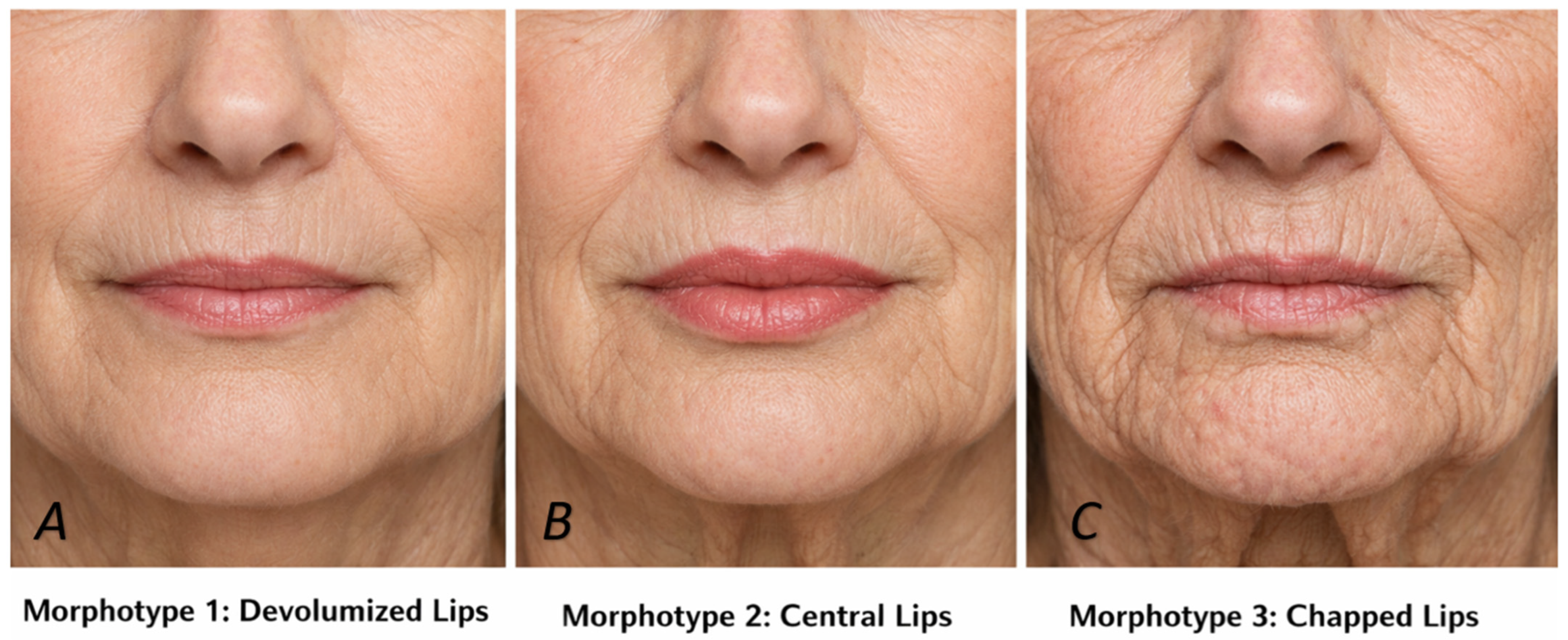
Morphotype 1 (Devolumized lips) is characterized by a generalized reduction in lip volume and eversion, with relatively preserved and clearly identifiable vermilion borders. Volume distribution appears globally uniform despite age-related deflation, and the perioral area typically shows mild to moderate aging changes without marked structural collapse (Figure 1A).
Figure 1.
Representative lip aging morphotypes derived from digital image analysis. (A) Morphotype 1—Devolumized lips: reduced eversion with preserved vermilion borders and globally uniform volume distribution. (B) Morphotype 2—Central lips: volume predominance in the central vermilion with lateral thinning, blurred margins, and reduced eversion. (C) Morphotype 3—Chapped lips: marked loss of anatomical definition, minimal projection and eversion, and advanced perioral aging.
Morphotype 2 (Central lips) presents with relative preservation of the vermilion borders and volume predominantly concentrated in the central portion of the lips. The lateral vermilion appears reduced, with partial blurring of margins and decreased eversion. This pattern is frequently associated with more evident perioral aging features, including rhytids and skin laxity (Figure 1B).
Morphotype 3 (Chapped lips) is characterized by advanced loss of anatomical definition, minimal projection and eversion, and marked perioral aging with pronounced structural depletion and contour disorganization (Figure 1C).
These morphotypes should be regarded as descriptive visual labels rather than objectively defined anatomical or biometric entities. At present, their quantitative morphometric correlates are unknown and remain to be established through future studies integrating objective measurement techniques [2,3,6].
Overall, 87% of images were consistently assigned to one of the three morphotypes by at least four of the five evaluators. Thirteen percent of cases were classified as “undefined” by at least two evaluators. These images commonly displayed overlapping or transitional features, suggesting that lip aging may not always conform to discrete categorical boundaries. Undefined cases were more frequently associated with overlapping features of morphotypes 2 and 3 (qualitative observation), supporting the hypothesis of transitional patterns.
Inter-rater reliability was assessed using Fleiss’ κ, treating the three morphotypes and the undefined category as nominal classes. Substantial agreement was observed (κ = 0.89; 95% CI 0.79–0.99). The inclusion of the undefined category may have influenced κ by capturing consistent non-assignment behavior in visually ambiguous cases. Therefore, κ should be interpreted as reflecting shared visual decision-making among trained observers rather than categorical robustness or objective validity [7]. Future studies should compute κ both including and excluding the undefined category to assess its effect on agreement metrics. Intra-rater reliability was not assessed in this exploratory analysis.
The present findings demonstrate that trained observers can consistently recognize recurrent visual patterns of lip aging within a homogeneous female cohort using standardized digital images. However, high inter-rater agreement does not imply objective validity, and the proposed morphotypes remain descriptive constructs without established biometric definitions or clinical correlates.
The existence of an undefined category represents a central observation rather than a methodological weakness. It highlights the intrinsic heterogeneity of lip aging and supports the hypothesis that aging-related changes in the lips may exist along a continuous visual spectrum rather than within strictly discrete categories. Alternatively, it may indicate that additional categories or multidimensional descriptors are required in future classification models [1,3].
At this stage, the clinical relevance of the proposed framework is limited to standardized documentation and interdisciplinary communication. Any implication for treatment selection, prognostic assessment, or outcome prediction is speculative and cannot be inferred from the present data. Clinical utility should therefore be considered hypothetical and requires validation through studies integrating objective morphometric parameters and clinical endpoints [6,8].
2. Limitations
This study has several fundamental limitations. The exclusively female, single-center cohort limits external validity and precludes generalization to other populations. The small sample size further limits statistical robustness. The reliance on subjective visual assessment without objective morphometric validation restricts the framework to a descriptive level. Intra-rater reliability was not assessed, limiting reproducibility. No correlation with clinical outcomes or therapeutic response was performed. Collectively, these constraints indicate that the present results cannot guide clinical decision-making and should be interpreted strictly as preliminary and hypothesis-generating.
3. Conclusions
This exploratory image-based study demonstrates that a small number of recurrent visual patterns of lip aging can be consistently recognized by expert evaluators within a homogeneous cohort. The proposed morphotypes represent descriptive visual constructs rather than definitive or exhaustive categories. The presence of an undefined group underscores the heterogeneity and possible continuity of lip aging presentations. Further research incorporating objective biometric measurements, reproducibility testing, larger and more diverse populations, and clinical outcome correlation is required before any clinical relevance can be established.
Author Contributions
Conceptualization, G.V. and F.T.; methodology, G.V., S.M. and F.T.; formal analysis, G.V. and A.D.G.; investigation, G.V., S.M., F.T. and A.D.G.; data curation, G.V. and L.C.; writing—original draft preparation, G.V.; writing—review and editing, F.T., S.M., G.P. and S.G.; visualization, G.V. and L.C.; supervision, G.P.; project administration, G.V. All authors have read and agreed to the published version of the manuscript.
Funding
This research received no external funding.
Institutional Review Board Statement
The present study is a retrospective observational analysis based on previously collected clinical and imaging data. No experimental procedures or interventions were performed for research purposes. According to national regulations and institutional policies, Ethics Committee or Institutional Review Board approval is not required for retrospective studies using anonymized data. All procedures were conducted in accordance with the principles of the Declaration of Helsinki (1975, revised in 2013). Patient confidentiality and data protection were strictly maintained throughout the study.
Informed Consent Statement
Informed consent was obtained from all subjects involved in the study.
Data Availability Statement
The data supporting the findings of this study cannot be made publicly available due to privacy and confidentiality restrictions, as they include sensitive patient information. However, anonymized data can be made available by the corresponding author upon reasonable request and after institutional approval, in compliance with data protection regulations.
Conflicts of Interest
The authors declare no conflicts of interest.
References
- Sun, F.; Liu, Y.; Zhang, T. Aging of the human lip: Current knowledge and clinical implications. J. Cosmet. Dermatol. 2025, 24, e70310. [Google Scholar] [CrossRef] [Scilit] [PubMed]
- Di Lorenzo, R.; Ricci, L.; Vardaro, E.; Di Serio, T.; Morelli, E.; Laneri, S. Advancing lip augmentation: State-of-the-art 2D and 3D analysis for assessing volume enhancement and lip line redefinition. Cosmetics 2024, 11, 70. [Google Scholar] [CrossRef] [Scilit]
- Seo, J.Y.; Leem, S.; Kim, H.; You, S.W.; Kim, Y.; Kang, N.G. Image-based investigation of lip aging features in a large number of Korean women. Skin Res. Technol. 2024, 30, e13563. [Google Scholar] [CrossRef] [Scilit] [PubMed] [PubMed Central]
- Kwon, S.H.; Choi, J.W.; Kim, H.J.; Lee, W.S.; Kim, M.; Shin, J.W.; Na, J.I.; Park, K.C.; Huh, C.H. Three-dimensional photogrammetric study on age-related facial characteristics in korean females. Ann. Dermatol. 2021, 33, 52–60. [Google Scholar] [CrossRef] [Scilit] [PubMed]
- Schenck, T.L.; Koban, K.C.; Schlattau, A.; Frank, K.; Sclafani, A.P.; Giunta, R.E.; Roth, M.Z.; Gaggl, A.; Gotkin, R.H.; Cotofana, S. Updated anatomy of the buccal space and its implications for plastic, reconstructive and aesthetic procedures. J. Plast Reconstr. Aesthetic Surg. 2018, 71, 162–170. [Google Scholar] [CrossRef] [Scilit] [PubMed]
- Goodman, G.J.; Halstead, M.B. Injectables in the perioral region: An evidence-based anatomical approach. J. Cosmet. Dermatol. 2021, 20, 1109–1117. [Google Scholar] [CrossRef] [Scilit]
- Fleiss, J.L. Measuring nominal scale agreement among many raters. Psychol. Bull. 1971, 76, 378–382. [Google Scholar] [CrossRef] [Scilit]
- Sundaram, H.; Liew, S.; Signorini, M.; Braz, A.V.; Fagien, S.; Swift, A.; De Boulle, K.L.; Raspaldo, H.; de Almeida, A.R.T.; Monheit, G. Global aesthetics consensus: Hyaluronic acid fillers and botulinum toxin type A—Recommendations for combined treatment and optimizing outcomes in diverse patient populations. Plast. Reconstr. Surg. 2016, 137, 1410–1423. [Google Scholar] [CrossRef] [Scilit] [PubMed]

Disclaimer/Publisher’s Note: The statements, opinions and data contained in all publications are solely those of the individual author(s) and contributor(s) and not of MDPI and/or the editor(s). MDPI and/or the editor(s) disclaim responsibility for any injury to people or property resulting from any ideas, methods, instructions or products referred to in the content. |
© 2026 by the authors. Licensee MDPI, Basel, Switzerland. This article is an open access article distributed under the terms and conditions of the Creative Commons Attribution (CC BY) license.