1. Introduction
Hybrid satellite–terrestrial relay
schemes have emerged as a promising solution to overcome the inherent limitations of conventional satellite and terrestrial systems [
1,
2,
3], where terrestrial relay stations are used to support the communication link between the satellite and ground users. The
models can enhance the system throughput and reliability, and they are considered as a key enabler for beyond-5G and 6G networks. In recent years, research on the
systems have advanced in several closely related directions, including system reliability improvement, physical-layer security, spectrum sharing, and advanced multiple-access schemes. For example, the authors in ref. [
4] presented a space–air–ground free-space optical network that employs a high-altitude relay to improve the robustness of satellite communication links. Beyond reliability enhancement, security has become a critical concern in the
systems due to the broadcast nature of satellite transmissions. In refs. [
5,
6], the authors investigated the secrecy performance of the
schemes in the presence of eavesdroppers. Specifically, ref. [
5] focused on the secure
scenarios with multiple eavesdroppers, whereas reference [
6] introduced relay station selection methods to enhance secrecy outage probability. The authors in ref. [
7] analyzed the relationship between intercept probability
at the eavesdropper and outage probability
at the legitimate receiver for the secure
models. In addition, reference [
7] introduced both full relay selection
and partial relay selection
to improve the security–reliability trade-off, under the impact of co-channel interference. These works collectively indicate that relay selection plays a pivotal role in balancing reliability and security in the
networks.
Another important research direction considers spectrum efficiency through cognitive radio techniques. Published work [
8] proposed the
schemes operating in a cognitive radio environment, where the satellite and the relay station are secondary transmitters, and they are allowed to use the licensed spectrum if their transmissions do not degrade performance of the primary users. Meanwhile, full-duplex relaying has been explored as an effective means to further enhance spectral efficiency in the
systems. In ref. [
9], full-duplex relaying techniques were applied into the
scheme, allowing the terrestrial stations to transmit and receive data at the same time. Moreover, the
technique was applied to select the best terrestrial station to improve the throughput and the
performance, under the impact of co-channel interference. More recently, intelligent reconfigurable environments have been incorporated into the
models. Reference [
10] presented the
scenario assisted by reconfigurable intelligent surfaces
. In contrast to the traditional relaying schemes, where the relay nodes actively process the received signals,
-aided relaying models rely on passive reflective elements that reflect the incoming signals toward the desired ground users in an optimized way. Compared with conventional active relays, RIS-assisted relaying offers a low-power and hardware-efficient alternative, making it attractive for satellite–terrestrial integration.
In parallel, non-orthogonal multiple access
has been introduced into the
systems to improve connectivity and spectral efficiency. In refs. [
11,
12,
13],
is applied into the
systems, enabling the satellite to transmit different data to multiple ground users at the same time. In addition, the ground users have to use successive interference cancelation
to extract their desired data from the received signals. In ref. [
11], the authors derived expressions of
for the
scheme, where the direct links between the satellite and the ground users are assumed to exist. The authors of ref. [
12] studied the
and
performance for the secondary users in the secure cognitive
scenarios. Reference [
13] evaluated the
performance of multi-relay
models. These studies demonstrate that
is an effective multiple-access technique for
, but they mainly focus on fixed-rate transmissions.
Unlike the aforementioned published works, this paper considers the
scheme using Fountain codes
.
[
14,
15,
16] have proven to be effective in wireless networks due to the simple implementation and adaptability to varying environmental conditions.
are particularly well-suited for multi-user broadcast networks since the transmitter can generate encoded packets from its original data, and continuously send them to the intended receivers. In addition,
allow the receivers to recover the original data once a sufficient number of encoded packets
have been collected, even in the presence of packet losses. In refs. [
17,
18], the authors considered the
schemes employing
. The authors of ref. [
17] evaluated the
and
performance for the secure
scheme, with the presence of a passive eavesdropper. Moreover, reference [
17] employs a cooperative jammer that not only disrupts the eavesdropper with jamming signals but also works with the ground user to eliminate the noises from the received signals. Published work [
18] studied the
trade-off for the
multicast schemes using
and PRS. Unlike refs. [
17,
18], this paper studies two-way
models, while refs. [
17,
18] only consider the one-way
ones. However, these works do not address two-way information exchange, which is essential for bidirectional satellite–ground communications.
Two-way relaying
(refs. [
19,
20]) has attracted significant attention due to its capability to improve spectral efficiency and throughput by allowing two sources to communicate simultaneously in both directions through one or multiple intermediate relays. In a conventional
model [
21], during the first two phases, the first source transmits its data to the intermediate relay, which then forwards the data to the second source. Similarly, the next two phases are used to relay data from the second source to the first source via the relay node. As a result, the conventional
model uses 04 phases, and it achieves a throughput of only 2 data over the four phases. To enhance throughput for the
models, the relays in ref. [
22] perform an
operation on the data received from two sources at two first phases, and then transmit the
packet to both the sources in the third phase. As a result, the
models in ref. [
22] only use three phases, and they are called a Digital Network Coding
-based
. Published work [
23] introduced two-phase
scenarios using Analog Network Coding
, where the relays amplify the signals received from two sources in the first phase, and then transmit the amplified signals to both the sources in the second phase. In refs. [
24,
25], the
and
techniques are jointly employed at the relays in the
models so that only two phases are used. Indeed, in refs. [
24,
25,
26], two sources at the same time send their packets to the relays which will perform the
technique to extract the received packets. Next, the relays perform the
operation over two packets before broadcasting the
packet to two sources in the second phase. Hence, both the
schemes using
and the
schemes using
and DNC only use two phases for the data exchange.
Until now, there have been several reports related to
models [
27,
28,
29,
30]. The authors of ref. [
27] examined the
system integrating simultaneous wireless information and power transfer. Reference [
28] analyzed the
performance and the throughput for the
system using
and considering the effects of hardware impairments. Also, the impact of hardware imperfection on performance of the
networks was investigated in ref. [
29], emphasizing the practical constraints introduced by non-ideal transceivers. Reference [
30] proposed adaptive relay selection for TWR-HSTRNs, confirming that dynamic selection significantly improves throughput and spectral reuse efficiency. These studies confirm that the
networks can significantly improve spectral efficiency and throughput, yet their integration with Fountain coding and cooperative jamming remains largely unexplored.
Despite these extensive studies, the joint consideration of
, Fountain-coded transmissions, and cooperative jamming for physical-layer security has not yet been adequately addressed. Different from the related works [
27,
28,
29,
30], this paper proposes the
scheme using
and the cooperative jamming technique. In the proposed scheme, a satellite and a ground user exchange data via the help of terrestrial relay stations, with the presence of an eavesdropper. Using
, the satellite and the ground user generate
, and exchange them with each other. In the first phase, the satellite and the ground user at the same time transmit their
to all relay stations. The relay stations then apply
to extract the received packets. In addition, to degrade the quality of the eavesdropping links, a cooperative jammer is employed to transmit interference toward the eavesdropper during the first phase. In the second phase, one of the relay stations which can successfully decode the packets from both the satellite and the ground user is selected for data forwarding, using the
approach. The chosen relay performs the
operation on two received
, and subsequently broadcasts the
packet to both the satellite and the user in the second phase. Before the data transmission ends, the satellite, the ground user, and the eavesdropper attempt to collect enough
so that they can recover the desired data.
Now, the main contributions of this paper are summarized as follows:
- -
First, we propose the novel scheme that integrates , , relay station selection, and cooperative jamming. The proposed scheme enhances system throughput through the use of and enables simple implementation and reduced delay by employing , improves communication reliability via and ensures secure communication through cooperative jamming.
- -
Second, under practical fading conditions, we derive exact closed-form expressions of , system outage probability , , and system intercept probability , and validate these formulas through simulations. In addition, all derived formulas are expressed in closed form, which makes them highly useful for system design and performance optimization.
- -
Finally, based on the analytical framework, we provide comprehensive performance insights that reveal the fundamental security–reliability tradeoff in the proposed scheme and demonstrate how critical system parameters influence both reliability and security performance.
The remaining structure of this paper is presented as follows.
Section 2 presents the system model of the proposed model.
Section 3 analyzes the exact and asymptotic
and
performance for the proposed scheme by deriving closed-form expressions.
Section 4 performs computer simulations to validate the derived expressions. Finally,
Section 5 provides conclusions.
2. System Model
In
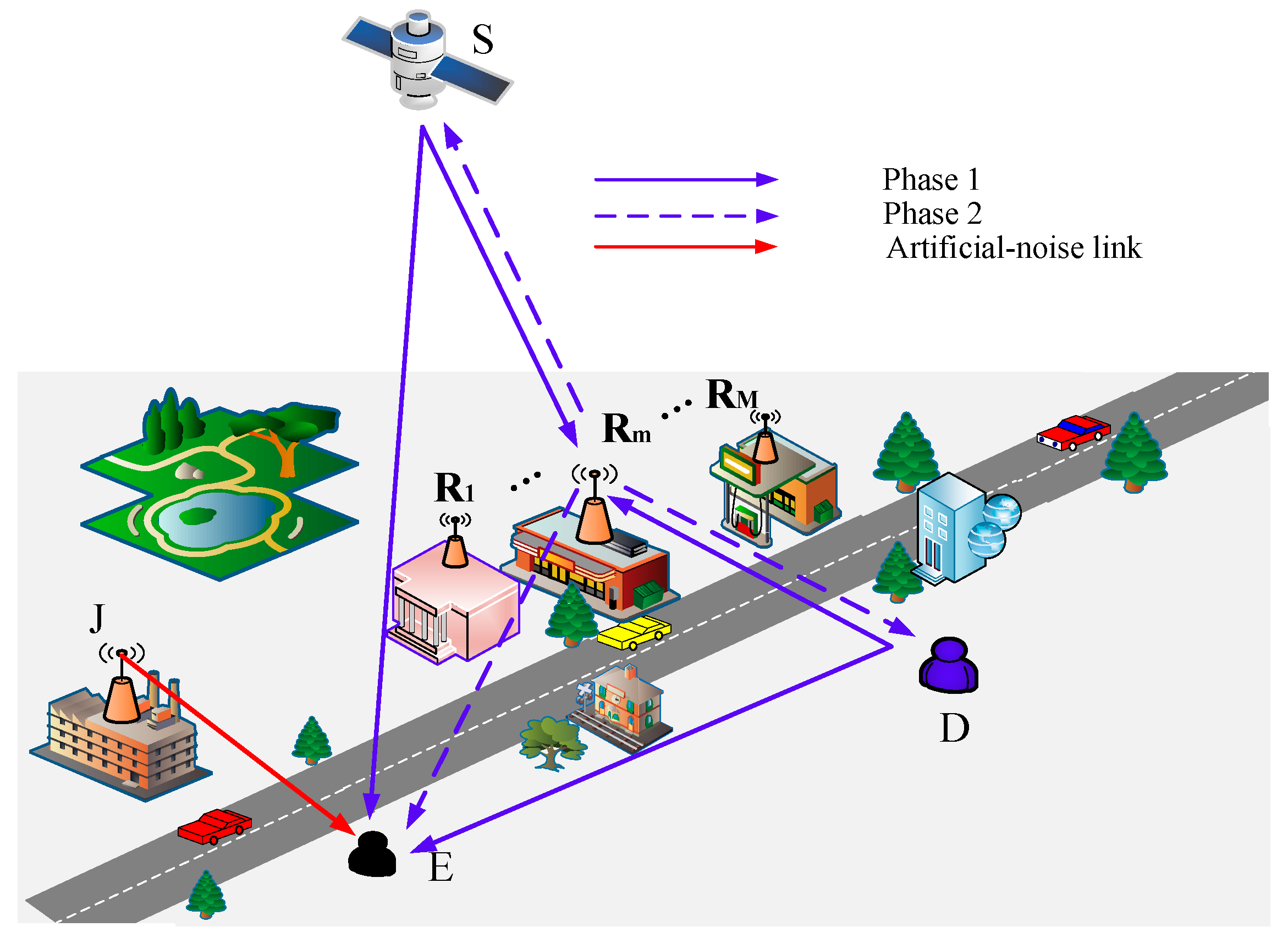
Figure 1, we present a system model of the proposed
scheme, where the satellite
and the ground user
attempt to exchange their data via the help of
terrestrial relay stations denoted by
. We assume that there is no direct link between
and
due to being obscured. Let
and
denote the data of
and
, respectively. Using
the
node creates the
from the original data
. Then,
and
exchange their
via the help of the terrestrial relay stations. In order to successfully reconstruct the desired data
,
must gather at least
. In addition, due to delay constraints, the maximum number of
exchange rounds is limited by
[
18], where
It is worth noting that, in this paper, a generic
framework is considered without restricting to a specific implementation (e.g., LT or Raptor codes), since the analysis is performed at the packet level and depends only on the number of successfully received
.
Due to the presence of the eavesdropper
, the transmitters
,
, and
employ the randomize-and-forward strategy [
31] by randomly using code-books. Moreover, the cooperative jammer
is employed to generate the jamming noises over
, as well as to cooperate with the relays
for removing these noises from their received signals. We assume that the
and
nodes can securely exchange information about the jamming signals, enabling
to cancel them before decoding the desired data, while the
node is unable to do this [
17]. Similarly,
attempts to collect at least
packets
to reconstruct the original data
. Finally, all the nodes including
,
,
, and
are assumed to be single-antenna wireless devices.
We denote as channel coefficient of the link, where is a transmitter and is a receiver, i.e., Then, the corresponding channel gain is denoted by , i.e., Assume that all channels are block and flat, i.e., remains unchanged during one phase, and varies independently after each phase.
As given in ref. [
18], the satellite links (i.e.,
,
and
) are Shadowed-Rician channels, and
has the following probability density function
:
where
and
are the expected power of the multi-path and Line of Sight
components, respectively,
is a fading parameter, and
is a confluent hypergeometric function of the first kind [
18].
For ease of presentation and analysis, we can assume that the channel gains
and
are identical and independent, i.e.,
and
for all
Using [
18], cumulative distribution function
of
in (1) can be expressed under the following form:
where
For the terrestrial links, we assume that all the channels are Rayleigh fading. Hence, the channel gain
is an exponential random variable whose
and
can be expressed, respectively, as
where
,
, and
is a fading parameter of the
link. We also assume that the channel gains
and
are identical and independent, i.e.,
and
for all
and for all the
and
nodes.
We now describe the exchange of
in
Figure 1, which is carried out over two time slots. At the first time slot,
and
at the same time transmits
and
to all the relay stations, while
generates the jamming noises. Therefore, the received signals at
and
can be expressed, respectively, as
where
,
and
are transmit power of the
,
, and
, respectively,
and
are modulated signals of the packets
and
, respectively,
is transmitted signal of
,
and
are Gaussian noises at
and
, respectively.
Since the node
can cooperate with the jammer
to remove the jamming noise (the component
), Equation (5) can be rewritten as
Remark 1. Since the satellite is the well-equipped device, it is reasonable to assume that the transmit power of is higher than that of the ground user , i.e., . In addition, the channels between and the relay station exhibit the component. Moreover, the terrestrial link between and experience Rayleigh fading which does not contain . Therefore, it is reasonable to assume that the link is better than the link. Similarly, we can assume that the link is better than the link. Therefore, the and nodes will decode the packet first. If the decoding of is successful, and will remove out from their received signals and will then decode [18]. It is noted that, if and cannot decode correctly, then they cannot also decode correctly because they cannot perform the operation. Finally, it is assumed that the Gaussian noises at all the receivers have zero mean and variance of .
From (7), we can express the signal-to-noise ratio
obtained at
for decoding
and
, respectively, as
where
and
Since the eavesdropper
cannot remove the jamming noises
out from the received signals, from (6), the
obtained at
for decoding
and
can be formulated, respectively, as
Considering the terrestrial relay stations which can decode both and successfully. Without loss of generality, we can denote the set of successful relay stations as , where and is the number of successful relay stations.
If
, then
, and, in this case, no operation takes place during the second phase. Let us consider the case where
; one of the relay stations belonging to the set
is selected by using the
method as
In (10), the selected relay station is denoted by , which is the relay providing the highest channel gain to the ground user .
Remark 2. In (10), the relay selection is based on the channel state information of the links, which can be easily performed through the exchange of local among the nodes. It is worth noting that this relay selection is difficult to implement between the relay stations and the satellite , because they are located far apart and hence the selection process would introduce a significant delay.
Next,
performs the
operation as follows:
and it will transmit the
packet
to
and
in the second phase, which is also overheard by
. Then, the
obtained at the node
can be expressed as
where
is transmitted power of all the relay stations, and
.
Remark 3. Firstly, we note that no cooperative jamming technique is performed in the second phase. Secondly, if the node can decode correctly, will obtain the desired packet by performing the operation as For the eavesdropper , it can only obtain successfully in the first time slot. Finally, can successfully obtain in two possible ways: (i) correctly decodes both and in the first phase; (ii) correctly decodes (but ) in the first phase, and from in the second phase, and then performs the operation between and to obtain .
Because the
exchange is realized into two phases, the channel capacity of the
link is calculated as
where
and
.
4. Simulation Results
In this section, we realize Monte Carlo simulations
to validate the formulas of
,
,
, and
given in
Section 3. We denote the exact theoretical results by
and the asymptotic theoretical results by
. To ensure that the
results converge to the
results (with the deviation between them ranging from 0.001 to 0.01), we perform from
trials to
trials for each Monte Carlo simulation. For analyzing the performance trends and evaluating the influence of the key parameters on the system performance, several parameters are fixed as follows:
, and
. The transmit power of the transmitters is set up as follows:
and
.
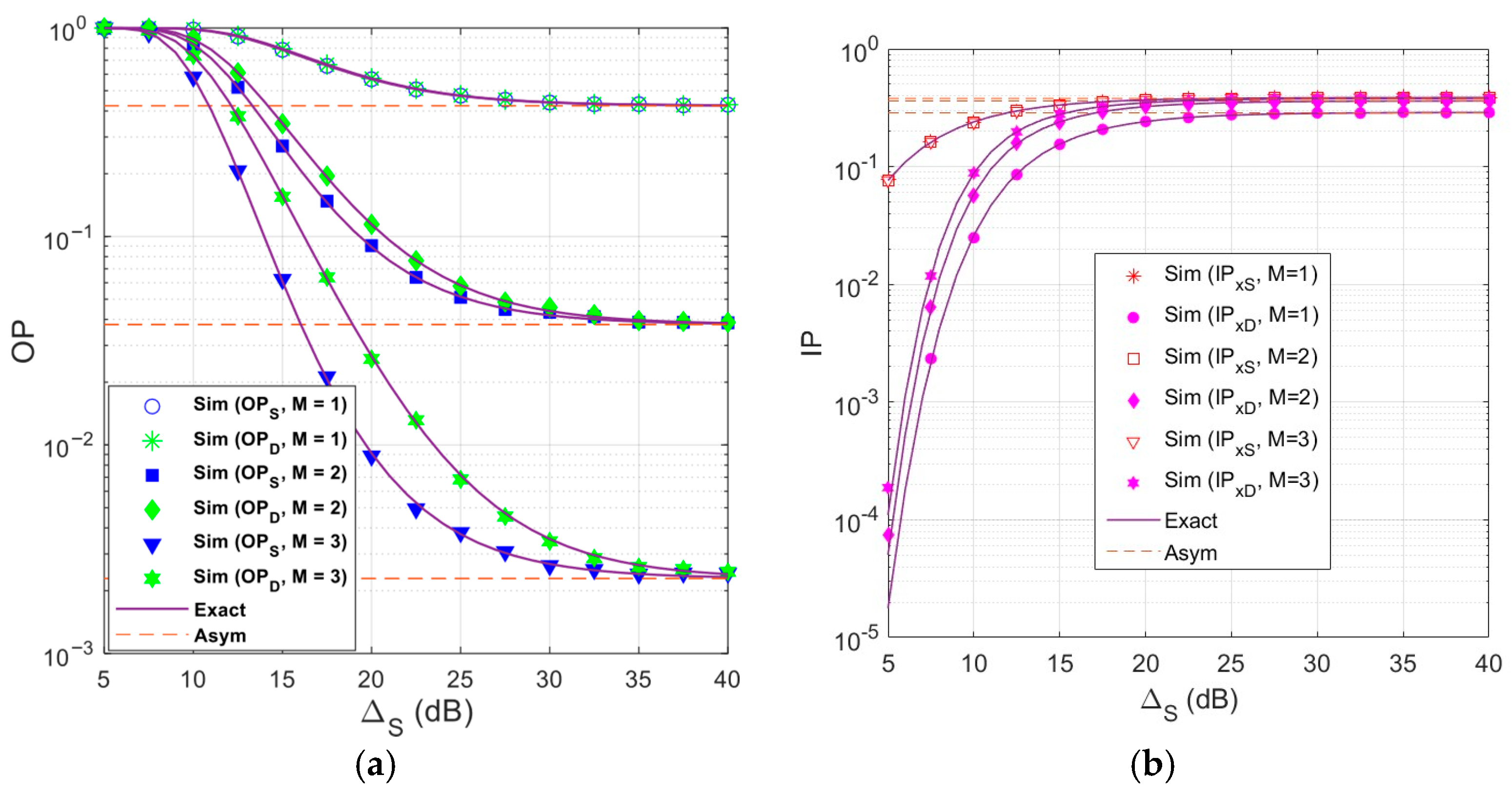
Figure 2 illustrates
(
Figure 2a) and
(
Figure 2b) as a function of
in dB with different number of relay stations
and with
. As observed in
Figure 2a,
at
and
decreases as
increases (or the transmit power of all the transmitters increases). However, at high
values, the values of
and
converge to the same outage floors, as proved in
Section 3. It is also seen that
at
is lower than that at
, and the
performance at both
and
improves substantially with increasing
. It is due to the fact that increasing
improves the probability that at least one relay station can successfully decode both
and
in the first phase, and it also enhances the channel quality of the
links. However, when
, the OP performance of S and D is quite identical because there is no relay selection at the second phase, and the system is hence symmetric for
and
. It is worth noting that the scheme with
corresponds to the random relay selection scheme. Hence,
Figure 2a shows that the proposed scheme achieves significantly better
performance than the random relay selection scheme.
In
Figure 2b, we can observe that
and
increase as
increases. As proved in
Section 3, we can see that
and
converge to statured values at high
regime. It is also seen from
Figure 2b that
is higher
, and
increases with the increasing of
. It is worth noting that
does not depend on the number of relays because
only decodes
directly from the satellite (See
Remark 3). On the other hand,
can decode
indirectly via the relay stations, so
depends on the number of relays. In particular, the more relays there are, the greater the opportunity that E will successfully decode
.
From
Figure 2a,b, we can see that the
results confirm the correction of the theoretical results. In addition, we can observe that there exists the trade-off between reliability and security. Indeed, as
increases, the
and
values decrease, but while the
and
values increase. Furthermore, the proposed scheme obtains better outage performance as increasing
; however, the
performance is worse with high value of
. Finally, we can see that
and
which means that the reliability of transmitting the data
is better than that of
, but the security of
is lower.
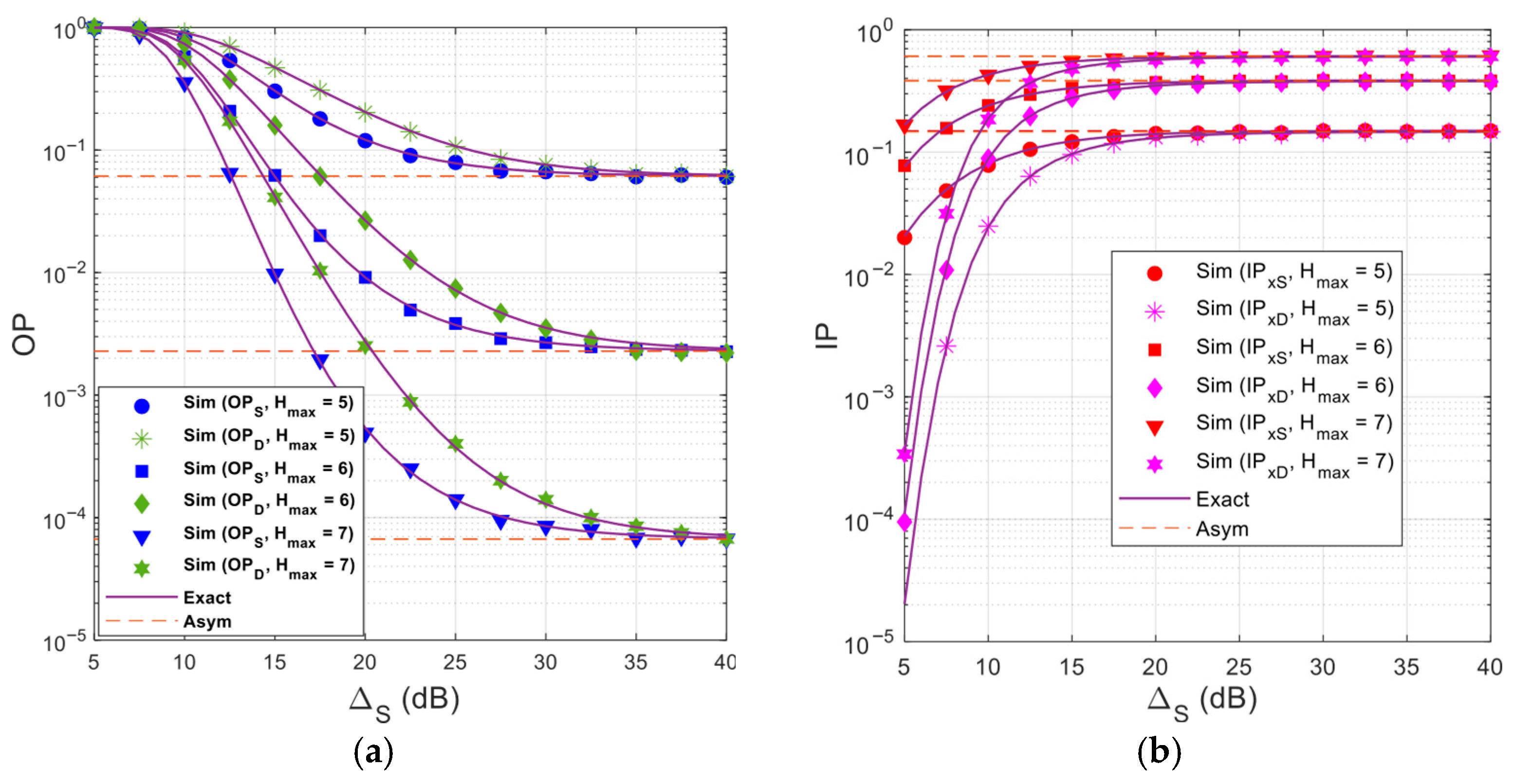
Figure 3 presents
(
Figure 3a) and
(
Figure 3b) as a function of
in dB with different values of
and with
. As presented in
Figure 3a,
at
and
significantly decreases as
increases. This is because increasing
raises the probability that
and
can receive enough
encoded packets
and
, respectively, thereby reducing outage probability at both
and
.
In contrast to
,
Figure 3b shows that the
values increase with increasing
, because a larger
also enhances the probability that the
node receives sufficiently the encoded packets.
From
Figure 3a,b, we can see that the
results again validate the theoretical results. We also observe that there exists the trade-off between
and
, as
changes from 5 to 7.
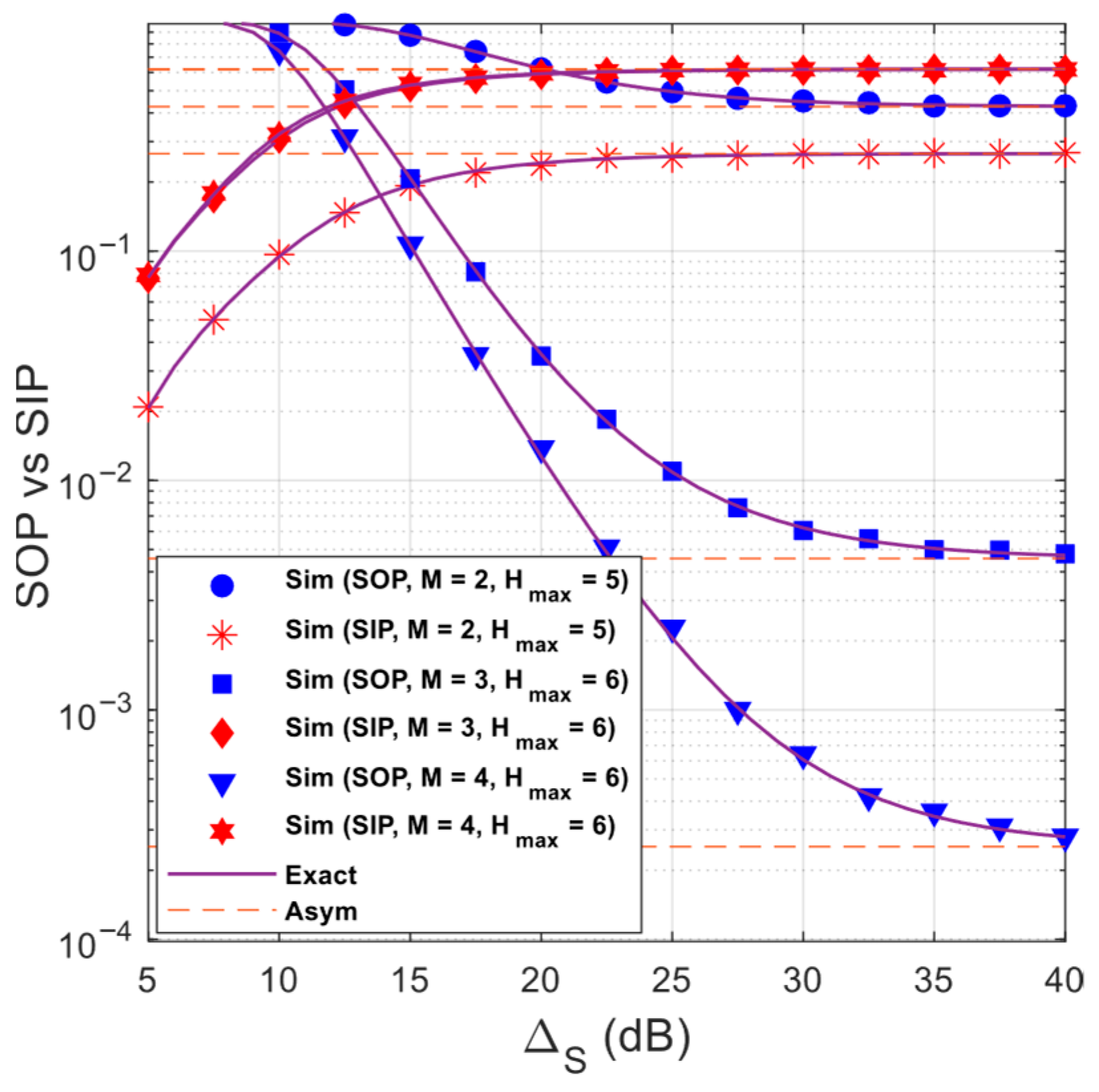
In
Figure 4, we present both
and
as a function of
in dB with various values of
and
. Since the IP and OP values converge to their saturated levels at high
values, the SIP and SOP values also converge to their saturated levels. Similarly to the
performance, the
performance also improves as
and
increase. Conversely, the SIP performance is worse as
and
increase. However, it is seen that the SIP values in the cases of
and
are quite similar. This means that, as
increases from 3 to 4, the SOP performance improves significantly, while the SIP performance changes only slightly.
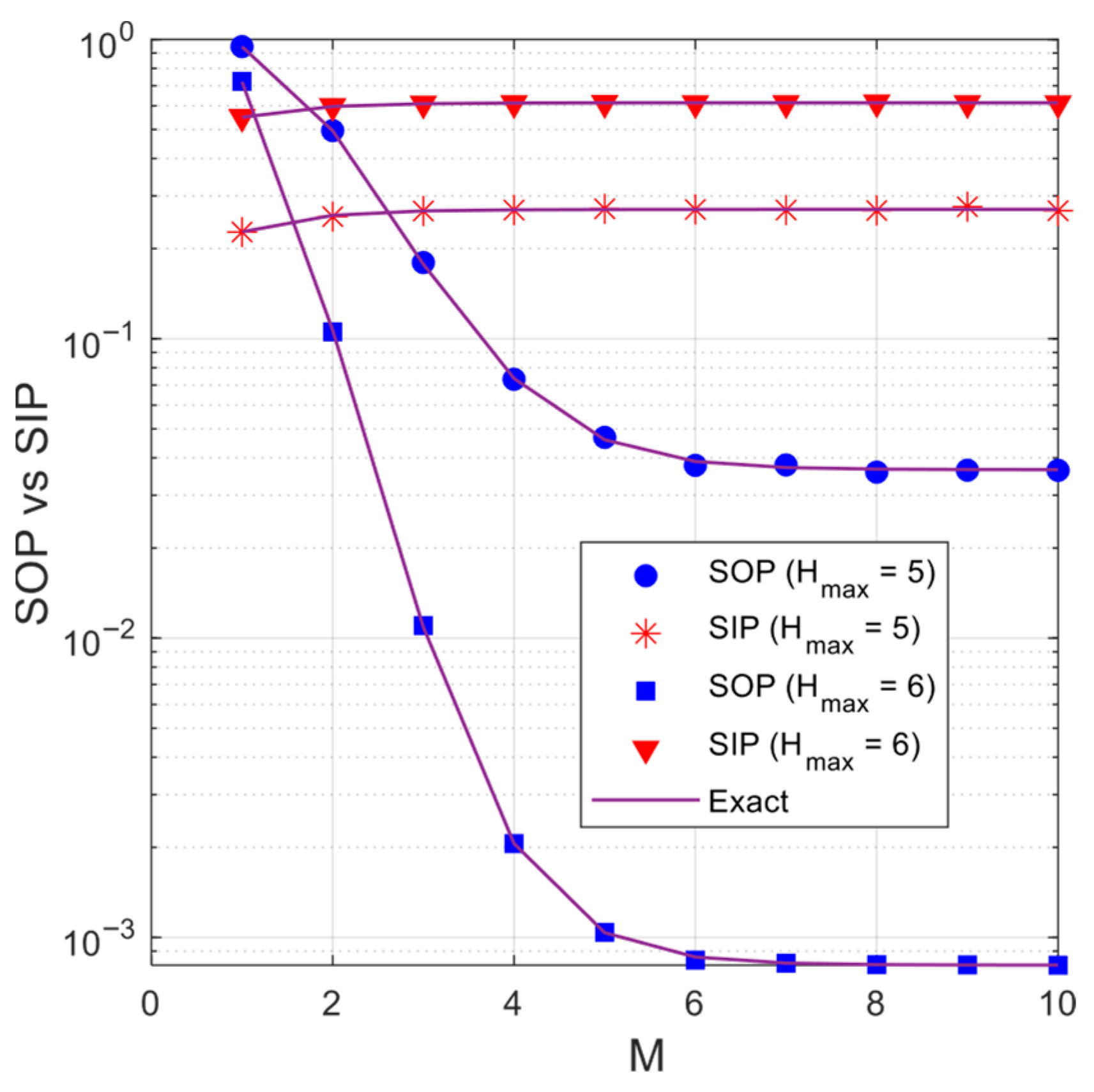
Figure 5 investigates the impact of the number of relay stations on the
and
performance with
(dB). As observed, the
values decrease rapidly as
increases. However, when
becomes sufficiently large, the
values no longer decrease. This behavior is due to the
method, i.e., at high
values, the quality of the
link is good, and hence, the quality of the
link dominates the
performance. For the
performance, we can see that the
values rapidly increase as
changes from 1 to 3. As
, the SIP performance varies only slightly, as also seen in
Figure 4 above. Similarly to
Figure 2a,b,
Figure 5 shows that the proposed scheme achieves significantly better
performance than the random relay selection scheme (
). In return, the proposed scheme incurs a slightly higher
.
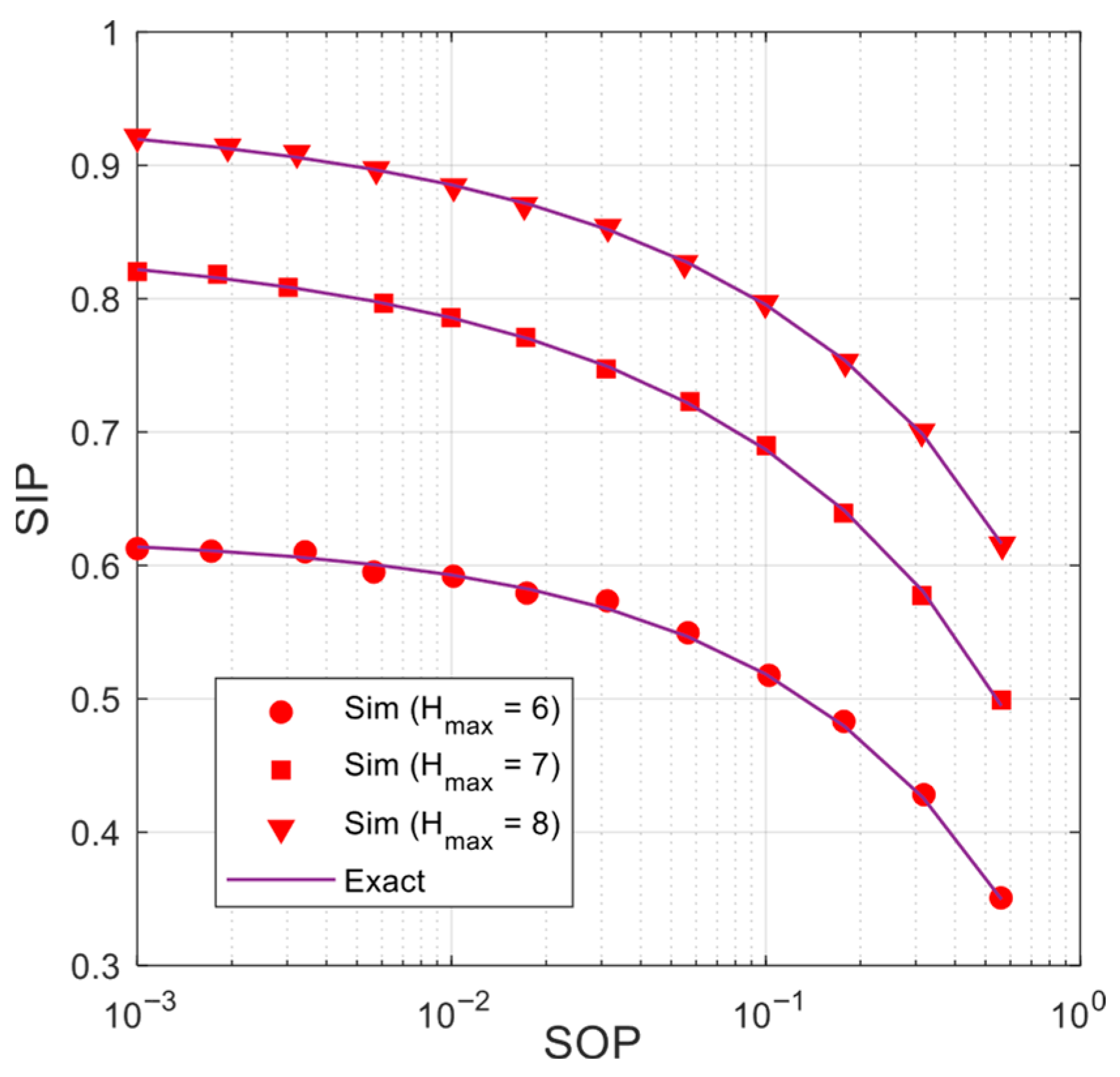
To more clearly analyze the impact of
and
on the security–reliability tradeoff,
Figure 6 and
Figure 7 present
as a function of
. To realize this, we first determine the target
values, e.g.,
where
changes from
to
, as presented in
Figure 6 and
Figure 7. Then, we use the
formula derived in
Section 3 to find the corresponding transmit power
. Next, we use the obtained values of
to calculate the corresponding values of
. Finally, we plot SIP as a function of SOP.
Figure 6 presents the trade-off between
and
with various values of
and with
. In particular, achieving better
performance in the proposed scheme comes at the cost of worse
performance. For example, with
, if the target
value is 0.1, then the
value is 0.6869. However, if the required SOP performance is 0.01 then the corresponding
performance is 0.7857.
Figure 6 also shows that increasing
decreases the trade-off between
and
. For example, with
, the value of
with
are 0.5185; 0.6869 and 0.7955, respectively.
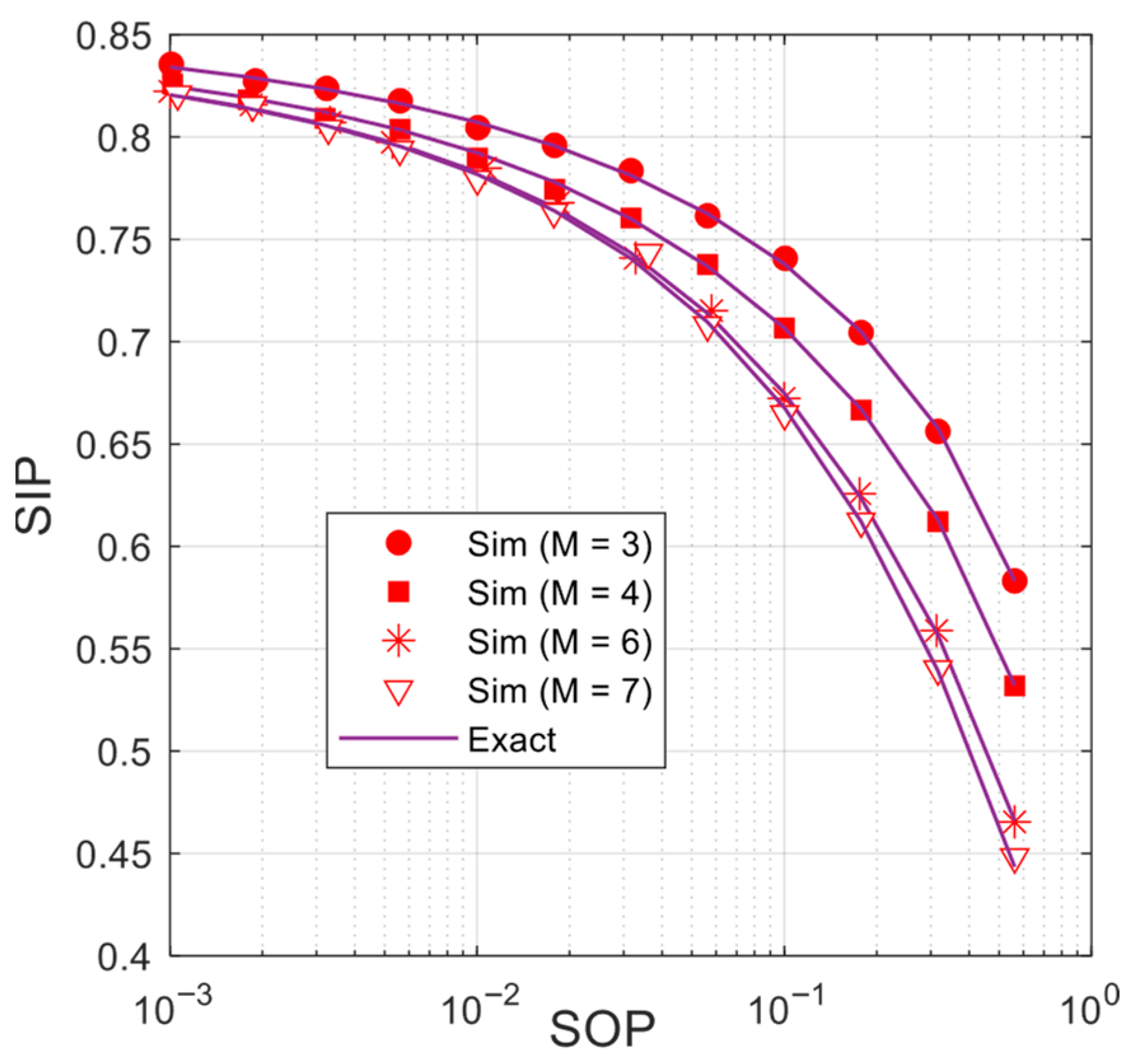
Figure 7 presents the trade-off between
and
with various values of
and with
. As we can observe, the trade-off between SOP and SIP is better as increasing
. However, as mentioned in
Figure 5, as
is high enough, both the
and
performance do not change any more. Indeed, as seen from
Figure 7, the SIP performance only changes slightly as
and
.