


Abstract
India is greatly afflicted by sinusitis, which is a condition that involves inflaming sinuses (the air cavities in the nasal passage) in your nose, according to the National Institute of Allergy and Infectious Diseases (NIAID). The study’s objective was to evaluate the prevalence and risk factors of sinus and nasal allergies among tannery workers of Kanpur city. The study has used primary datasets obtained from a cross-sectional household study of tannery workers from the Jajmau area of Kanpur in northern India, which was conducted during January–June 2015 as part of a doctoral program. The study covered 286 tannery workers from the study area. Bivariate and logistic regression analysis was used to study the association between outcome variables (self-reported prevalence of sinus and nasal allergies) and predictor variables (socioeconomic and work-related characteristics). Results portray that a higher proportion of the tannery workers belong to economically and socially backward classes. Overall, 13.4 and 12.3% of sinus and nasal allergy prevalence have been reported by tannery workers, whereas tannery workers from the oldest age group were those who mainly suffered. A study found that the severity of nasal and sinus allergies increases with the increasing age and work duration in the tannery. Workers with low exposure to airborne dust were significantly more likely to develop sinus problems (OR = 4.16; p < 0.05) than those without exposure. Those tannery workers suffering from nasal allergy were more prone to develop sinus problems than those who were not suffering from nasal allergy. The risk factors responsible for these health hazards can be eliminated by improving the overall working conditions and ensuring necessary protective regulations for the tannery workers.
1. Introduction
India is greatly afflicted by sinusitis, which is a condition that involves the inflaming of sinuses (the air cavities in the nasal passage) in your nose according to National Institute of Allergy and Infectious Diseases (NIAID). An estimated 134 million Indians suffer from chronic sinusitis, the symptoms of which include but are not limited to debilitating headaches, fever, and nasal congestion and obstruction [1]. Among Indians, this disease is more widespread than diabetes, asthma, or coronary heart disease. One in eight Indians suffer from chronic sinusitis caused by the inflammation of the nasal and throat lining, which results in the accumulation of mucus in the sinus cavity and pressure build-up in the face, eyes, and brain [2,3].
In the leather tanning process, during skin contact, chromium has the potential to bind with the skin proteins of the workers, producing complex antigen, which leads to hypersensitivity and dermatitis. Chromium leather in industries can cause carcinoma of the larynx and lung parenchyma and paranasal sinuses in workers [4,5,6]. In addition to these, scores of other chemicals and organic solvents such as chromate and bichromate salts, aniline, buty acetate, ethanol, benzene, toluene, sulfuric acid, and ammonium hydrogen sulfide are used in the tannery industry. An important health risk factor for the tannery workers is occupational exposure to chromium, mainly in the organic Cr (III) form or in the protein bound form (leather dust). Chromium may enter the body by inhalation, ingestion, and by direct cutaneous contact. Professional exposure to Cr (III) increases the risk of dermatitis, ulcers, and perforation of the nasal septum and respiratory illnesses as well as increased lung and nasal cancers. Work within the tannery itself is fraught with danger. When inhaled, chromium acts as a lung irritant and carcinogen, affecting the upper respiratory tract, obstructing airways, and increasing the chances of developing lung, nasal, or sinus cancer [7,8,9,10,11,12,13,14]. Limited studies have reported associations between occupational exposure, particularly the exposure of airborne dust and chemicals in the air, to tannery chemicals with sinus and nasal allergy among the tannery workers, and none have been conducted to study the occupational exposures with the sinus and nasal allergies in India. Even the most recent study based on tannery workers conducted in Bangladesh has not investigated the sinus and nasal allergy issue [15]. With this backdrop, this study has attempted to study the association between outcome variables (self-reported prevalence of sinus and nasal allergies) and predictor variables (socioeconomic and work-related characteristics). The specific objective was to estimate the prevalence and risk factors of Sinus and nasal allergies among tannery workers of Kanpur city, India.
2. Methods and Material
2.1. Data
A study has utilized the data from the cross-sectional household study of tannery and non-tannery workers from the Jajmau area of Kanpur. The study was conducted during January–June 2015, and all data were collected by the first author from the field. The first author of the study has interviewed 284 tannery and 289 non-tannery workers.
2.2. Study Area
The city Kanpur has conventionally been an industrial city and a major commercial center in Uttar Pradesh. There are currently 402 registered leather tanneries located in the eastern part of the city, with an estimated 20,000 tannery workers [7]. More than 20,000 people worked in the leather industry, and a substantial proportion of tannery workers were living in the Jajmau Area. From the significant concentrations of the tannery industry in and around Kanpur, Jajmau was selected for the study. It is known as the Leather City, as it contains some of the largest and finest tanneries in India. This study focused on leather tannery workers, i.e., those engaged in tanning work in the leather industry (Figure 1).
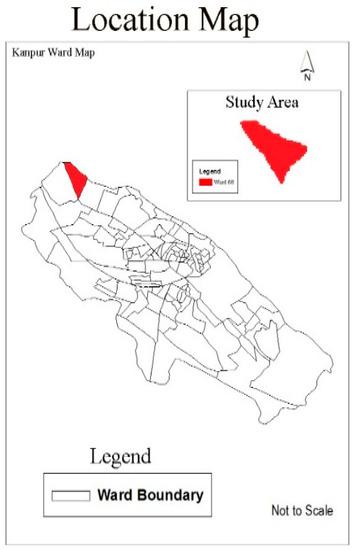
Figure 1.
Location map for the study area.
2.3. Sampling Design
A three-stage sampling design was used in this study. At the primary stage, seven localities in the Jajmau area, namely Tadbagiya, Kailash Nagar, J.K. colony, Asharfabad, Motinagar, Chabeelepurwa, and Budhiyaghat, were selected based on a higher concentration of leather tannery workers’ households in these areas as informed by several stakeholders in the city. In the second stage, three out of the seven localities, namely Budhiyaghat, Tadbagiya, and Asharfabad, were chosen using the probability proportional to size (PPS) sampling technique after positioning them in growing order of assessed number of HHs of leather tannery workers. Afterward, an inclusive household listing and mapping was finished in each of the three localities. Moreover, all the listed households were classified into three groups: households having at least one tannery worker, irrespective of having any non-tannery worker, households with non-tannery worker(s), and households having no workers.
The first two groups were included in the sampling frame in each of the three selected localities; the third group was excluded for the study. Afterwards, a circular systematic random sampling was used to select households. If more than one worker belongs to a household, the target respondent was selected using the KISH table [16]. A hundred households were chosen in each of the three areas for each of the two categories, i.e., tannery and non-tannery workers, by the circular systematic random sampling technique. Out of 600 households, a total of 284 households of tannery workers and 289 HHs of non-tannery worker(s) were interviewed successively (Figure 2).
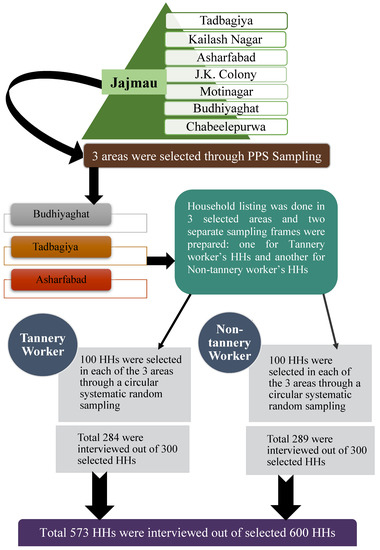
Figure 2.
Sampling design for the study.
The study is a part of the Ph.D. thesis research work; we have received ethical clearance from the Student Research Ethics Committee of the International Institute for Population Sciences Mumbai, India. We have also obtained consent to participate from each of the respondents before starting the interview.
2.4. Participants and Occupational Categories
The study has covered 284 male tannery and 289 non-tannery age group workers 18–70 years old from the Jajmau area of Kanpur. We have inquired about the respondent’s occupation and classified them into two categories: tannery and non-tannery workers.
2.4.1. Dependent Variable
The tannery and non-tannery workers reported symptoms-based prevalence of sinus and nasal allergies. We have considered the following symptoms for nasal allergy (nose full of phlegm and runny, spastic, itchy problems) and sinus (problems such as swelling in your nose, watery nose, phlegm, nose closure) to understand the severity of the health issues.
2.4.2. Independent Variables
Independent variables utilized in this study can be broadly grouped into two categories as socio-economic characteristics or background characteristics and their work- related characteristics. Background characteristics of tannery and non-tannery workers included their age in three category (16–24 years, 25–35 years, and 36+), education in to four category (no education, up to primary, middle school, and higher secondary and above), marital status (currently married, never married, and widowed/widower), religion namely Hindu and Muslim, media exposure (low, medium, high) and their standard of living Index (low, medium, high). The second group of independent variables utilized work-related characteristics of tannery workers, which includes type of job contact (temporary job (daily wages) and permanent job), type of work engagement of tannery workers (beam house work, wet finishing work, dry finishing work, and miscellaneous work), type of work engagement of non-tannery workers (industrial work, manual work, construction work, clerical work, business and shop, and others), work experience in current and previous tannery, and average working in a day and days in a week. Additionally, exposure of chemical in the air (no exposure, low exposure, and moderate/high exposure), airborne dust exposure (no exposure, low exposure, and moderate/high exposure) and headache problems (no headache, up to 10 times, more than 10 times but not every day, and almost every day) have been included in the study.
The qualitative rating of exposure assessment of variables airborne dust and chemical in the air was estimated as follows. The variable airborne dust (no exposure, low exposure, moderate exposure, high exposure, very high exposure) was based on the following qualitative rating of exposure assessment: (0) No exposure: clear visibility. (1) Low exposure: visibility more than 10 m. (2) Moderate exposure: visibility between 5 to 10 m. (3) High exposure: visibility between 1 to 5 m. (4) Very high exposure: visibility less than 1 m. Another important variable, chemicals in the air (no exposure, low exposure, moderate exposure, high exposure, very high exposure), was based on a qualitative rating of exposure assessment as (0) No exposure: no contact with agent; agent is used in workplace but is very unlikely to result in exposure to workers involved. (1) Low exposure: infrequent contact with agent at low concentrations; agent is used in a closed/controlled system; there are no specific activities that enhance exposure; exposure takes place because of presence at the shop floor. (2) Moderate exposure: frequent contact with agent at low concentrations, agent is used throughout the closed/controlled process and exposure mainly occurs by passive contact; infrequent contact is needed with the agent. (3) High exposure: frequent contact with the agent at high concentrations, the nature of the production process and associated manual activities makes regular contact necessary; the agent causes exposure during manual activities and around particular sources such as presses, drums. (4) Very high exposure: frequent contact with the agent at very high concentrations, the agent is used in manual activities that introduce frequent peak exposures such as cleaning, opening a press, spraying paint.
2.5. Data Analysis
Univariate, bivariate, chi-square test, and logistics regression analysis was used to assess the associations between the sinus and nasal allergy with the predictor variables. The odds ratio from the logistic regression analysis was performed by considering the outcome variable as dichotomous (i.e., binary or 0–1), and the predictor variable (work-related characteristics and socio-economic variables) was considered a categorical or a mixture of the two. Results of logistics regression were explained with the help of two different models. Model-1 deals with the socio-economic variables, including (age, education, religion, caste, media exposure, and standard of living index). Moreover, Model-II included work-related variables additional to socio-economic variables. The data entry was done in the CSPro.06 software, and for the data analysis, STATA (Version 13.1) was used.
3. Results
3.1. Demographic and Socio-Economic Characteristics of Tannery and Non-Tannery Workers
Table 1 presents the percentage distribution of selected socio-economic and demographic characteristics. The overall sample of tannery workers and non-tannery workers was 284 and 289, respectively. More than half (54%) of the tannery workers and over three-fifths (63%) of non-tannery workers were age 36 years and above. The majority of the study participants were illiterate, tannery workers (66%), and non-tannery workers (62%). Only 12% of the tannery workers and 20% of non-tannery workers had studied up to high school and more. Two-thirds of tannery workers (66%) are Muslim, and the remaining are Hindus. Furthermore, two-thirds of the tannery workers (66%) belong to the scheduled castes. It indicates that mostly the people from disadvantaged caste groups are engaged in tannery work. Nearby one-fifth of the tannery workers, as well as non-tannery workers, had low levels of media exposure. Further, poverty often reflects a low standard of living and a lack of economic resources.

Table 1.
Percent distribution of tannery and non-tannery workers by some selected background characteristics in Kanpur, India, 2015.
3.2. Work-Related Characteristics of Tannery and Non-Tannery Workers
The work-related characteristics of tannery and non-tannery workers has been presented in Table 2. The mean age of male tannery workers was 38 years (SD = 1.4). The vast majority of male tannery workers (89%) are working on temporary job contracts, and the rest (11%) are engaged in this occupation on a permanent basis. The respondents work in various tannery processes. A little over 8% are involved in beam house work, 24% are involved in wet finishing, 50% are involved in dry finishing, and 17% are involved in miscellaneous kinds of work. In addition to that, non-tannery workers worked in numerous job categories that are broadly classified into six domains. Around 12% of the non-tannery workers engage in industrial work, while 27% engage in manual work, 20% engage in construction work, 10% engage in clerical work, 25% engage have their own business and shop, and 7% engage in other job categories. The mean duration of their job was 10 (SD = 0.9) years. The average work experience of male tannery workers was 18 years. The male tannery workers also reported that they work almost every day of the week with a 9-h working day as the norm. On average, they worked 6.5 days (SD = 0.6) a week and 9.5 h (SD = 0.2) a day, which is a violation of the labor law according to the factory act in India.
Table 2.
Work-related characteristics of tannery workers in Kanpur, India, 2015.
3.3. Prevalence of Reported Sinus and Nasal Allergies
The prevalence of reported sinus and nasal allergies by some selected background characteristics is presented in Table 3. It was found to be higher among tannery workers aged 36 years and more (15%), while it was 11% among workers in the age group 25–35 years. No significant association of education level with sinus and nasal allergies was observed. About 10% of the workers with a low standard of living index had sinus problems, while it was 14% among those with a high standard of living. Similarly, while looking at nasal allergy, it has been observed that the prevalence of nasal allergy was higher among tannery workers aged 36 years and above (15%) than those in the age group of 16–24 years (6.9%). Prevalence of nasal allergy was higher among workers who had no education (16%) as compared to workers with a middle-school education (8%). A significant difference was found in the prevalence of nasal allergy in Muslim tannery workers (15%) and Hindu ones (7.3%). There was a higher prevalence of nasal allergy among Schedule caste /Schedule tribes (SC/ST) (13%) than others (8.7%). The odds of sinus problems among tannery workers 12 months prior to the survey are presented in Table 4. The model is adjusted for age, education, religion, caste, and standard of living. The results suggest that workers working in tanneries for 6 to 10 years were significantly more likely to develop sinus problems (Odds Ratio (OR)= 3.17; p < 0.05) as compared to workers with 5 or less years of engagement in tannery works. Workers with low exposure to airborne dust were significantly more likely to develop sinus problems (OR = 4.16; p < 0.05) than those without exposure. When the model is adjusted for age, education, religion, caste and standard of living, years of engagement, type of work and type of job contract, the results suggest that the headaches are significantly more likely to develop nasal problems if they occur almost daily (OR = 1.5; p < 0.05) compared to those who had no headaches. Similarly, workers are more likely to develop sinus problem than those suffering from nasal allergy (OR = 20.6; p < 0.01) compared to those who were not suffered from nasal allergy.
Table 3.
Prevalence of sinus and nasal allergies reported by the tannery and non-tannery workers in Kanpur, India, 2015.
Table 4.
Odds ratio showing risk factors of sinus problems among tannery workers (12 months preceding the survey) in Kanpur, India, 2015.
4. Discussion
In this study, the self-reported prevalence of nasal allergy and sinus among the tannery workers was considered to understand the severity of the health issues. The primary data were collected and analyzed from one of the major leather tanning industries situated in Kanpur. Tannery workers are exposed to different harmful exposures that include leather dust, chromium dust, and many injurious chemicals [17,18]. The tannery workers frequently come across the dust, which leads to nasal allergy (nose full of phlegm and runny, spastic, itchy problems) and sinus (problems such as swelling in your nose, watery nose, phlegm, nose closure). This study has utilized the qualitative rating of exposure assessment for the two variables airborne dust and chemical in the air to understand its severity.
Results portrays that a large number of people engaged in tannery work are illiterate. A vast majority of the tannery workers were from economically weaker and marginalized sections (schedule caste) of the society. According to Section 38 of Indian Constitution, the principle of the welfare state is accepted to improve the socio-economic conditions of the depressed class of the society. Workers from an unorganized sector are an example of a depressed class in the society, and leather workers are among them. Most of the tannery workers belong to economically and socially backward classes. This class of workers apparently lives a life of poverty, insecurity, and social isolation. The respondents work in various tannery processes such as beam house work, wet finishing, dry finishing, and miscellaneous kinds of work and results cumulate that half of the proportion of the workers is involved in dry finishing.
The male tannery workers reported that they work almost every day of the week with a more than 9-h working day as the norm, and they have been working for a long time, as the average work experience of tannery workers was 18 years. Findings from the study conducted among leather tannery workers in Kanpur reported that the mean age for tannery workers was 34.05 ± 8.96 years and that for non-tannery workers was 32.97 ± 10.59 years (p = 0.14), while the tannery workers had a mean duration of work at tanneries for 6.99 ± 4.86 years [19].
Overall, 13.4 and 12.3% prevalence of sinus and nasal allergy has been reported by tannery workers, and higher age group of tannery workers suffered largely. Nasal and sinus allergies are a significantly prevalent occupational hazard among tannery workers, and this study found that the severity increases with the age and the duration of work in the tannery. The other study revealed a significantly higher prevalence of morbidity among the exposed tannery workers in contrast to that observed in the non-tannery (40.1% vs. 19.6%). The respiratory diseases were mainly responsible for a higher morbidity among the exposed workers, whereas the gastrointestinal tract problems were predominant in the control group. The high morbidity among the tannery workers may be due to elevated levels of urinary and blood chromium levels resulting from increased air levels of chromium at the work place. Professional exposure to Cr (III) increases the risk of dermatitis, ulcers, and perforation of the nasal septum and respiratory illnesses as well as increased lung and nasal cancers [7,8,9,10,11,12,13,14].
Workers with low exposure to airborne dust were significantly more likely to develop sinus problem (OR = 4.16; p < 0.05) than those without exposure. Dust is produced during several processes in tanning operations: chemical dust can be produced during the loading of hide-tanning drums; and leather dust impregnated with chemicals is produced during some mechanical operations, including buffing [20]. An important health risk factor for the tannery workers is occupational exposure to chromium, which is used as a basic tanning pigment. The workers on exposure to leather dust, which contains chromium in the protein-bound form, exhibited a higher mean concentration of urinary and blood chromium than the reference values [7]. Another study among tannery workers in Bangladesh stated that the prevalence of diseases among the tannery workers is very high and is extremely associated with different working areas of leather processing and the lack of proper PPE (personal protective equipment) use [21].
The results of the study portray that the headaches are significantly more likely to develop nasal problems if they occur almost daily in comparison to those who had no headaches. Similarly, those tannery workers who were suffering from nasal allergy were more prone to develop sinus problem compared to those who did not suffer from nasal allergy. Allergy can cause chronic inflammation of the sinus and mucus linings. Sinusitis is an inflammation of the nasal sinuses, which is commonly caused by bacterial infection following a viral infection such as the common cold. Other risk factors for developing sinusitis include untreated allergies, crooked nasal anatomy, smoking, nasal polyps, and overuse of decongestant nasal sprays. The signs and symptoms of sinusitis vary depending on the level of severity of the inflammation and which sinuses are involved. Headache is one of the primary symptoms of developing nasal allergies to sinus [22].
5. Conclusions
Due to the prolonged exposure to harmful chemicals in tanneries, the workers are prone to nasal allergies, which affect a higher proportion of tannery workers than non-tannery workers. Sinusitis is experienced by a greater proportion of tannery workers than non-tannery ones. Nasal allergies are more prevalent among Muslim and SC/ST tannery workers than their Hindu counterparts. Similarly, a higher prevalence of nasal allergy has been noted for SC/ST workers compared to others. To prevent the many health issues that tannery workers usually experience, we suggest that medical observation, including pre-employment and periodic medical controls, should be performed and must include pulmonary function tests. Improving the overall working condition and ensuring necessary protective regulations for the tannery workers can eliminate many of the environmental exposures that are responsible for these health hazards.
6. Limitations of the Study
- ✓
- The use of a cross-sectional survey to collect data may have underestimated the true prevalence of morbidities.
- ✓
- The results of self-reported morbidities could be biased due to subjectivity in responses as the severity was not quantified.
- ✓
- Recall bias may also have affected the estimated prevalence of morbidities.
Author Contributions
Conceptualization, G.C.K.; Software, S.K.S.; Writing—Original draft, D.V. All authors have read and agreed to the published version of the manuscript.
Funding
This research received no external funding.
Institutional Review Board Statement
The Student Research Ethics Committee (SERC) of International Institute for Population Sciences, Mumbai, India has approved the PhD research.
Informed Consent Statement
Informed consent was obtained from all subjects involved in the study.
Data Availability Statement
This study is based on primary data.
Conflicts of Interest
The authors declare no conflict of interest.
References
- Heggannavar, A.B.; Harugop, A.S.; Madhale, D.M.; Walavalkar, L.S. A randomised controlled study to evaluate the effectiveness of shortwave diathermy in acute sinusitis. Int. J. Physiother. Res. 2017, 5, 2066–2072. [Google Scholar] [CrossRef]
- Pratibha, M. 1 in 8 Indians Hit by Chronic Sinusitis: Study, TNN, Updated: 11 April 2012. Available online: http://timesofindia.indiatimes.com/articleshow/12615317.cms?utm_source=contentofinterest&utm_medium=text&utm_campaign=cppst (accessed on 16 December 2020).
- Rosheena, Z. Prone to Sinusitis? Air Pollution in Your City Is Making It Worse. 2018. Available online: https://fit.thequint.com/fit/sinusitis-and-pollution-in-india#gs.X5Jft29n (accessed on 16 December 2020).
- Ateeq, M.; Hameed, U.; Rehman, S.Z.; Ullah, F.; Khan, A.R.; Zahoor, B.; Akbar, N.U.; Saeed, K. Evaluation of health risks among the workers employed in tannery industry in Pakistan. J. Entomol. Zool Study 2016, 4, 244–246. [Google Scholar]
- Browning, E. Toxicity of Industrial Metals, 2nd ed.; Butterworth: London, UK, 1975; Volume 119, pp. 249–260. [Google Scholar]
- Walsh, E.N. Chromate hazards in industry. J. Am. Med. Assoc. 1953, 153, 1305–1308. [Google Scholar] [PubMed]
- Rastogi, S.K.; Pandey, A.; Tripathi, S. Occupational health risks among the workers employed in leather tanneries at Kanpur. Indian J. Occup. Environ. Med. 2008, 12, 132. [Google Scholar] [CrossRef] [PubMed]
- Stern, R.M.; Berlin, A.; Fletcher, A. International conference on health hazards and biological effects of welding fumes and gases. Int. Arch. Occup. Environ. Health 1986, 57, 237–246. [Google Scholar] [CrossRef]
- Angerer, J.; Amin, W.; Heinnrich-Ramm, R. Occupational chronic exposure to metals. Arch. Occup. Environ. Health 1987, 59, 503–512. [Google Scholar] [CrossRef] [PubMed]
- Lin, S.C.; Tai, C.C. Nasal septum lesion caused by chromium among chromium electroplating workers. Am. J. Ind. Med. 1994, 26, 221–228. [Google Scholar] [CrossRef]
- Stern, A.H.; Bragt, P.C. Risk assessment of the allergic dermatitis: Potential of environmental exposure to hexavalent chromium. J. Toxicol. Environ. Health 1993, 40, 613–641. [Google Scholar] [CrossRef] [PubMed]
- Mikoczy, Z.; Hagmar, L. Cancer incidence in the Swedish leather tanning industry: Updated findings 1958–99. Occup. Environ. Med. 2005, 62, 461–464. [Google Scholar] [CrossRef] [PubMed]
- Veyalkin, L.V.; Milyutin, A.A. Proportionate cancer mortality among workers in the Belarussian tanning industry. Am. J. Ind. Med. 2003, 44, 637–642. [Google Scholar] [CrossRef] [PubMed]
- Basketter, D.; Horev, L.; Slodovnik, D.; Merimes, S.; Trattner, A.; Ingber, A. Investigation of the threshold for allergic reactivity to chromium. Contact Dermat. 2001, 44, 70–74. [Google Scholar] [CrossRef] [PubMed]
- Rabbani, G.; Billah, B.; Giri, A.; Hossain, S.M.; Mahmud, A.I.; Banu, B.; Ara, U.; Alif, S.M. Factors Associated with Health Complaints Among Leather Tannery Workers in Bangladesh. Workplace Health Saf. 2020, 2165079920936222. [Google Scholar] [CrossRef] [PubMed]
- Kish, L. A procedure for objective respondent selection within the household. J. Am. Stat. Assoc. 1949, 44, 380–387. [Google Scholar] [CrossRef]
- Stern, F.B. Mortality among chrome leather tannery workers: An update. Am. J. Ind. Med. 2003, 44, 197–206. [Google Scholar] [CrossRef] [PubMed]
- Kornhauser, C.; Katarzyna, W.; Kazimierz, W.; Malacara, J.M.; Laura, E.N.; Gomez, L.; González, R. Possible adverse effect of chromium in occupational exposure of tannery workers. Ind. Health 2002, 40, 207–213. [Google Scholar] [CrossRef] [PubMed]
- Gupta, R.C.; Ranjan, R.; Kushwaha, R.N.; Khan, P.; Mohan, S. A questionnaire-based survey of dry eye disease among leather tannery workers in Kanpur, India: A case-control study. Cutan. Ocul. Toxicol. 2014, 33, 265–269. [Google Scholar] [CrossRef] [PubMed]
- IARC. Wood, leather and some associated industries. Lyon, 3–10 June 1980. In IARC Monographs on the Evaluation of the Carcinogenic Risk of Chemicals to Humans; Distributed for IARC by WHO: Geneva, Switzerland, 1981; Volume 25, pp. 1–379. [Google Scholar]
- Hasan, M.; Hosain, S.; Asaduzzaman, A.M.; Haque, M.A.; Roy, U.K. Prevalence of Health Diseases among Bangladeshi Tannery Workers and associated Risk factors with Workplace Investigation. J. Pollut. Eff. Control. 2016, 1–3. [Google Scholar] [CrossRef]
- ASCIA (Australian Society of Clinical Emmunology and Allergy). Sinusitis and Allergy. 2015. Available online: https://www.allergy.org.au/patients/allergic-rhinitis-hay-fever-and-sinusitis/sinusitis-and-allergy (accessed on 16 December 2020).
Publisher’s Note: MDPI stays neutral with regard to jurisdictional claims in published maps and institutional affiliations. |
© 2021 by the authors. Licensee MDPI, Basel, Switzerland. This article is an open access article distributed under the terms and conditions of the Creative Commons Attribution (CC BY) license (http://creativecommons.org/licenses/by/4.0/).