Effects of Geometry, Joint Properties, and Deterioration Scenarios on the Hydromechanical Response of Gravity Dams




Abstract
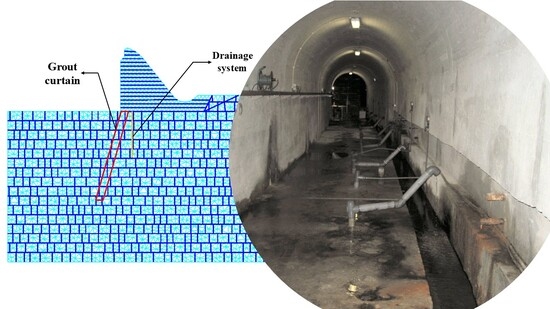
1. Introduction
2. Hydromechanical Discontinuum Coupled Model
2.1. Mechanical Model
2.2. Hydraulic Model
2.3. Hydromechanical Coupling
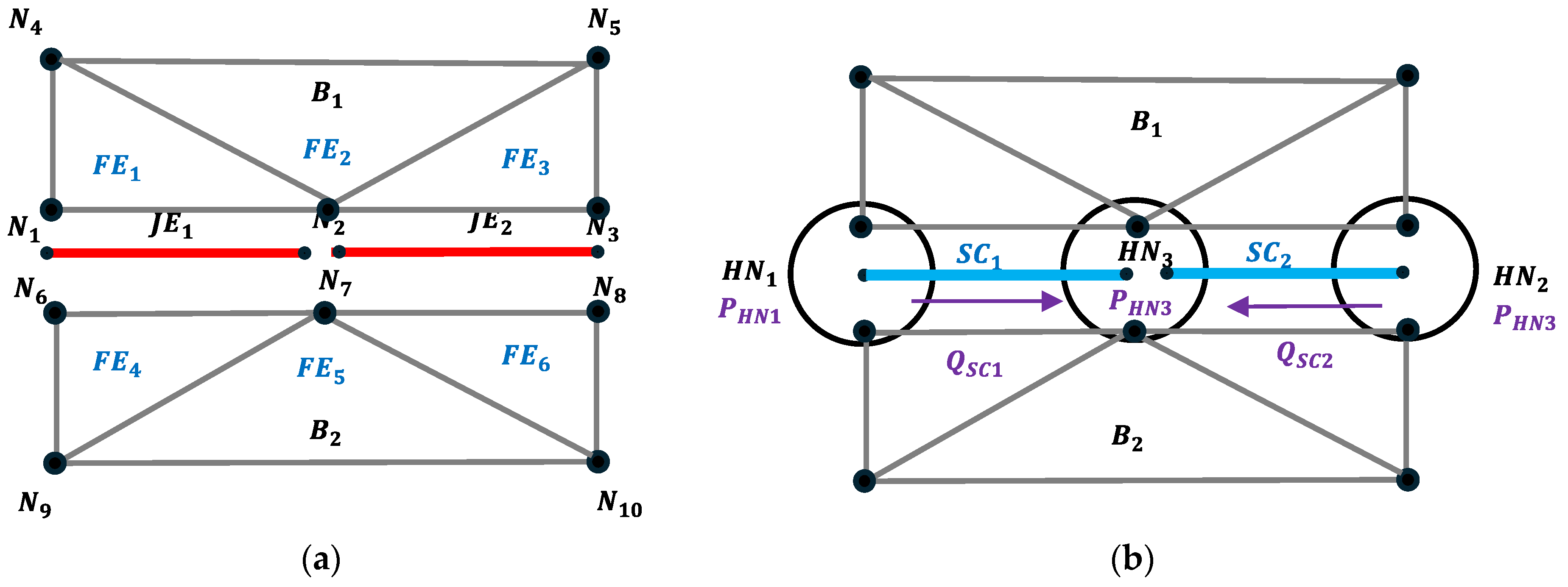
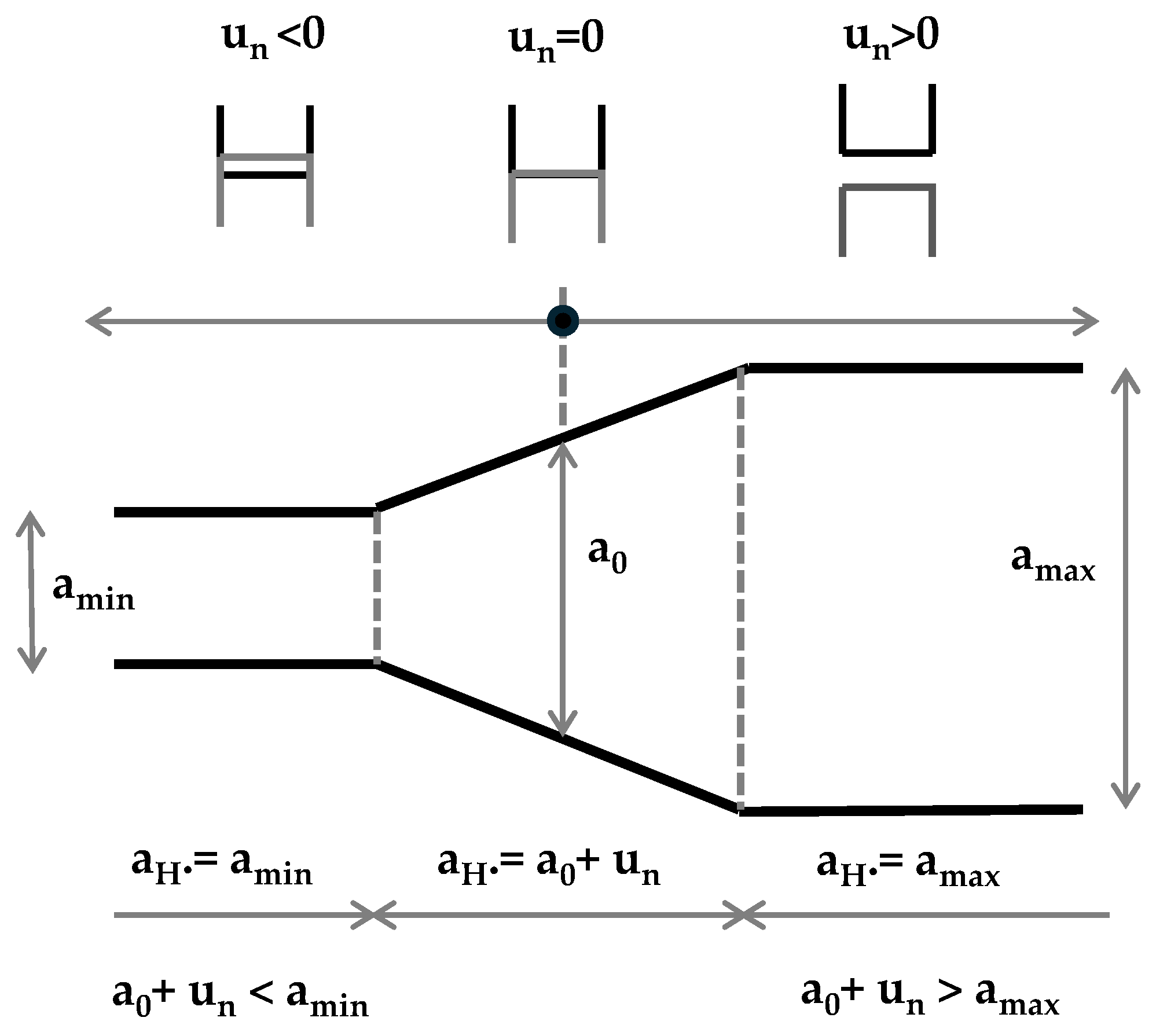
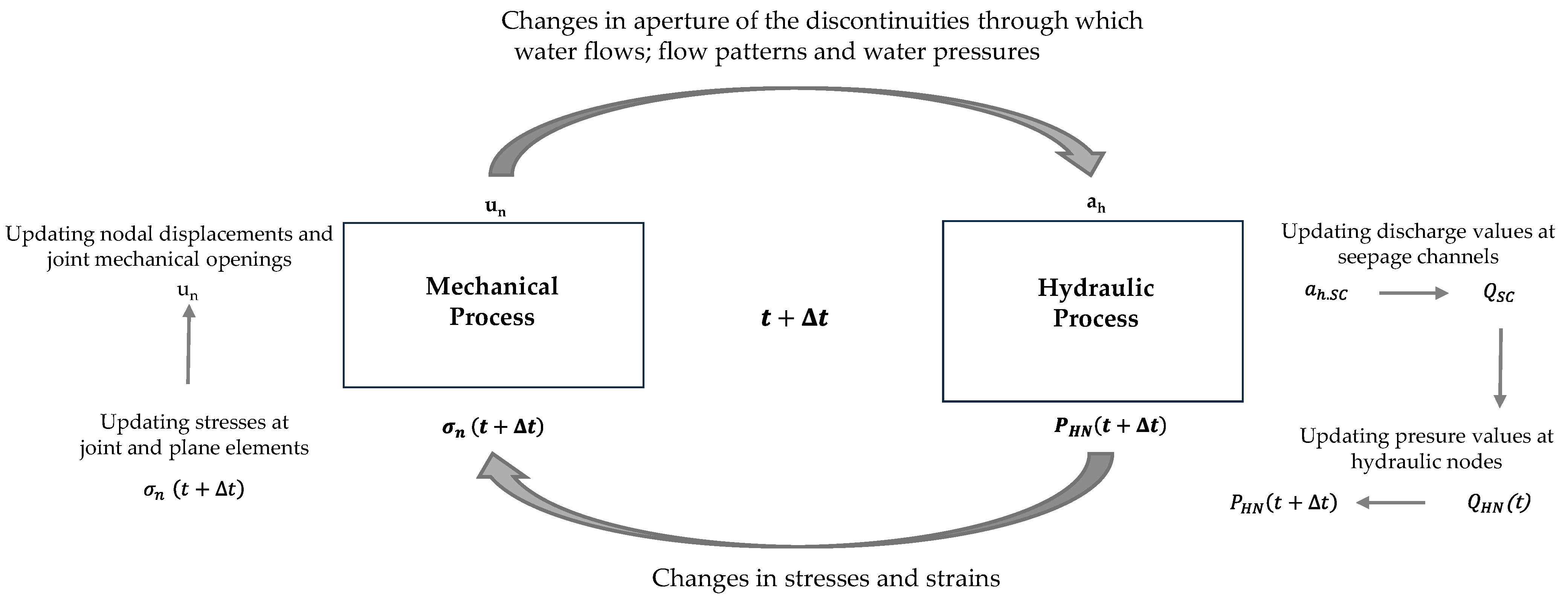
- The mechanical model normal displacements that are defined at the JEs are transferred to the associated SCs, allowing the calculation of the hydraulic apertures in the hydraulic model;
- The hydraulic model water pressures that are defined at the HNs are transferred to the mechanical model and considered in the calculation of internal forces in the associated JEs (effective stresses).
3. Objectives, Scope, and Limitations
- Evaluation of the influence of key parameters, which needs to be fully understood to enable the application of advanced hydromechanical modelling to operating dams for monitoring and safety assessment.
- Demonstration that the proposed model can be effectively applied to the hydromechanical analysis of operating dams, provided that the suggested calibration methodology is followed.
- Numerical assessment of scenarios involving progressive degradation of the concrete–rock interface and grout curtain permeability using the HM model, showing that such degradations can be readily detected through hydraulic measurements but are difficult to identify from dam displacement responses.
- Dam and foundation mechanical parameters, constitutive behaviour, and possible degradations;
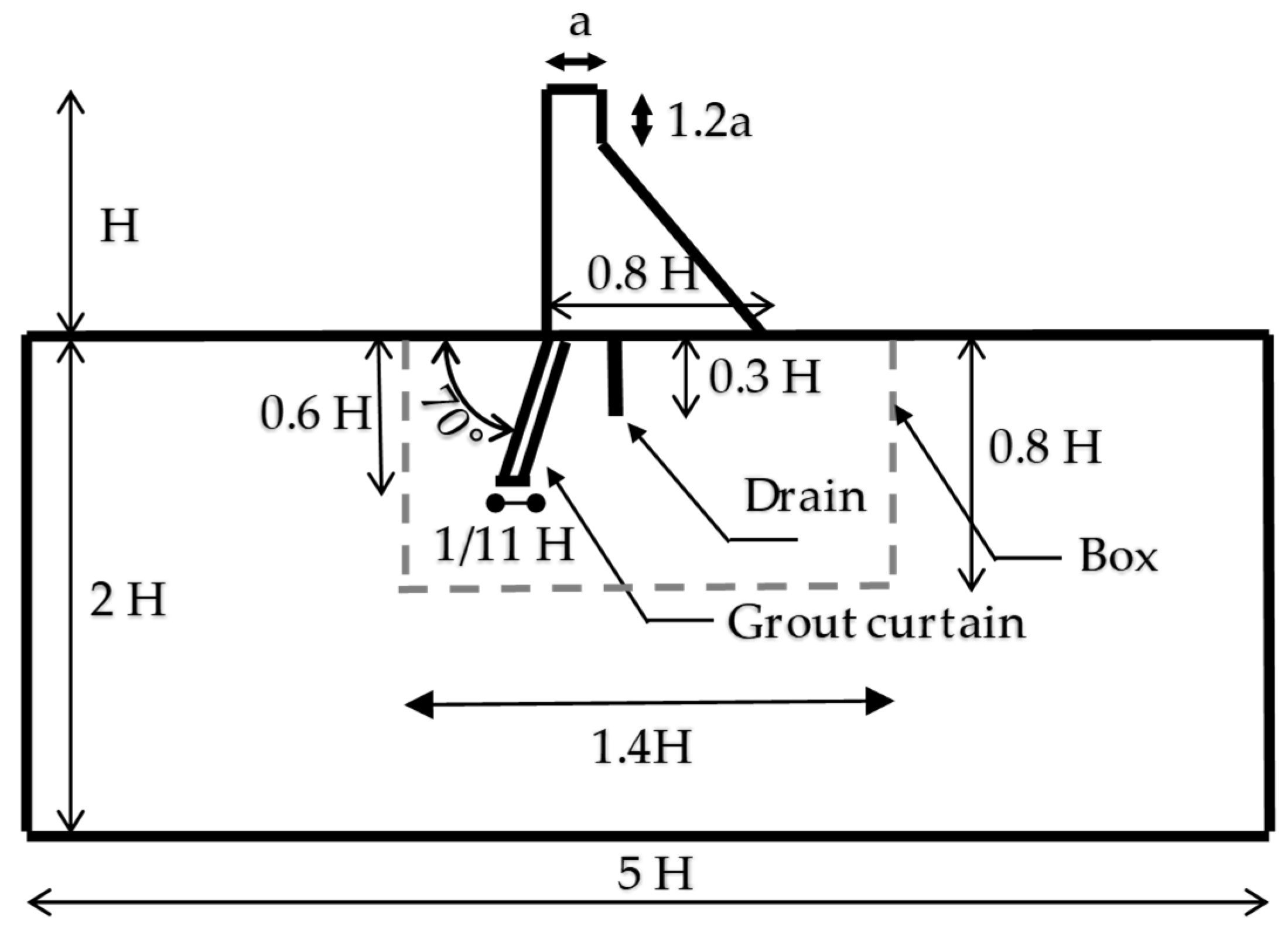
- Dam and foundation geometries, including the consideration of the main foundation discontinuities;
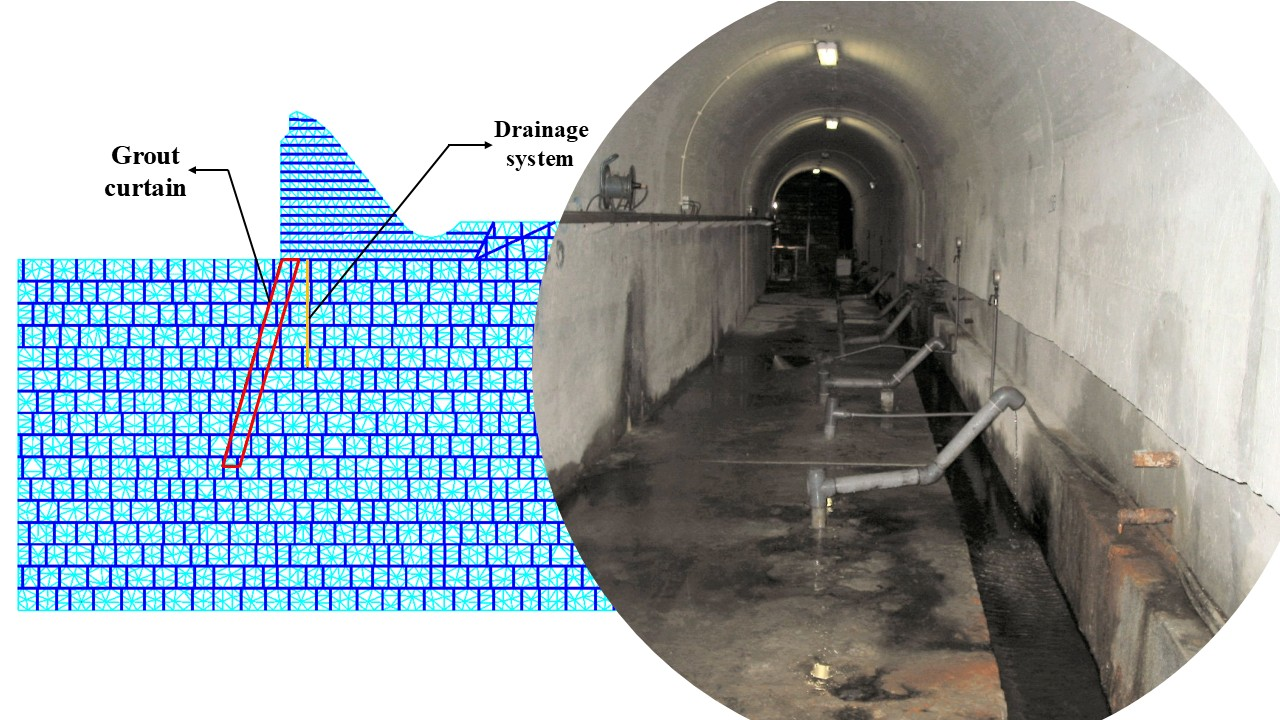
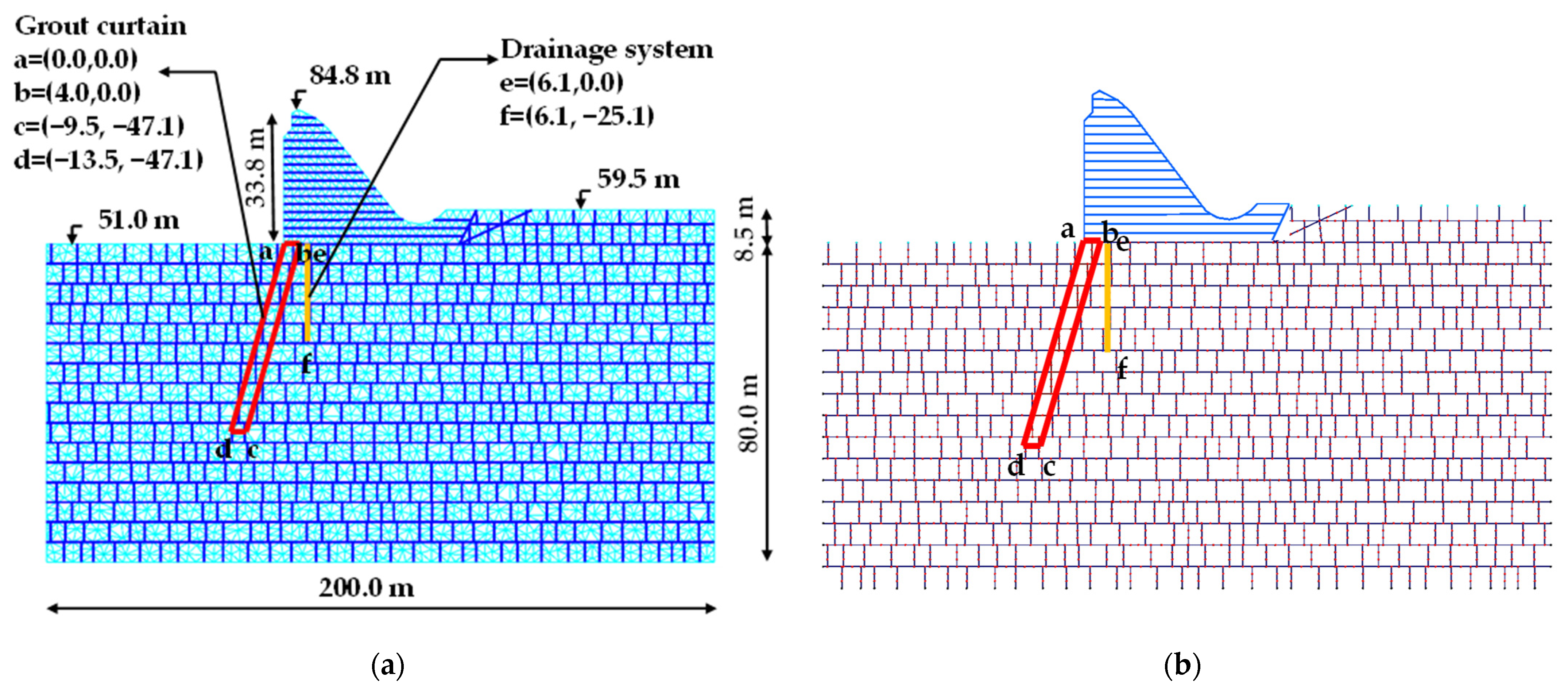
- Grout curtain and drainage system positions and conditions;
- Recorded in situ drain discharges.
4. Case Studies
4.1. Four Gravity Dams of Different Heights
4.1.1. Numerical Models and Geometry
- (i)
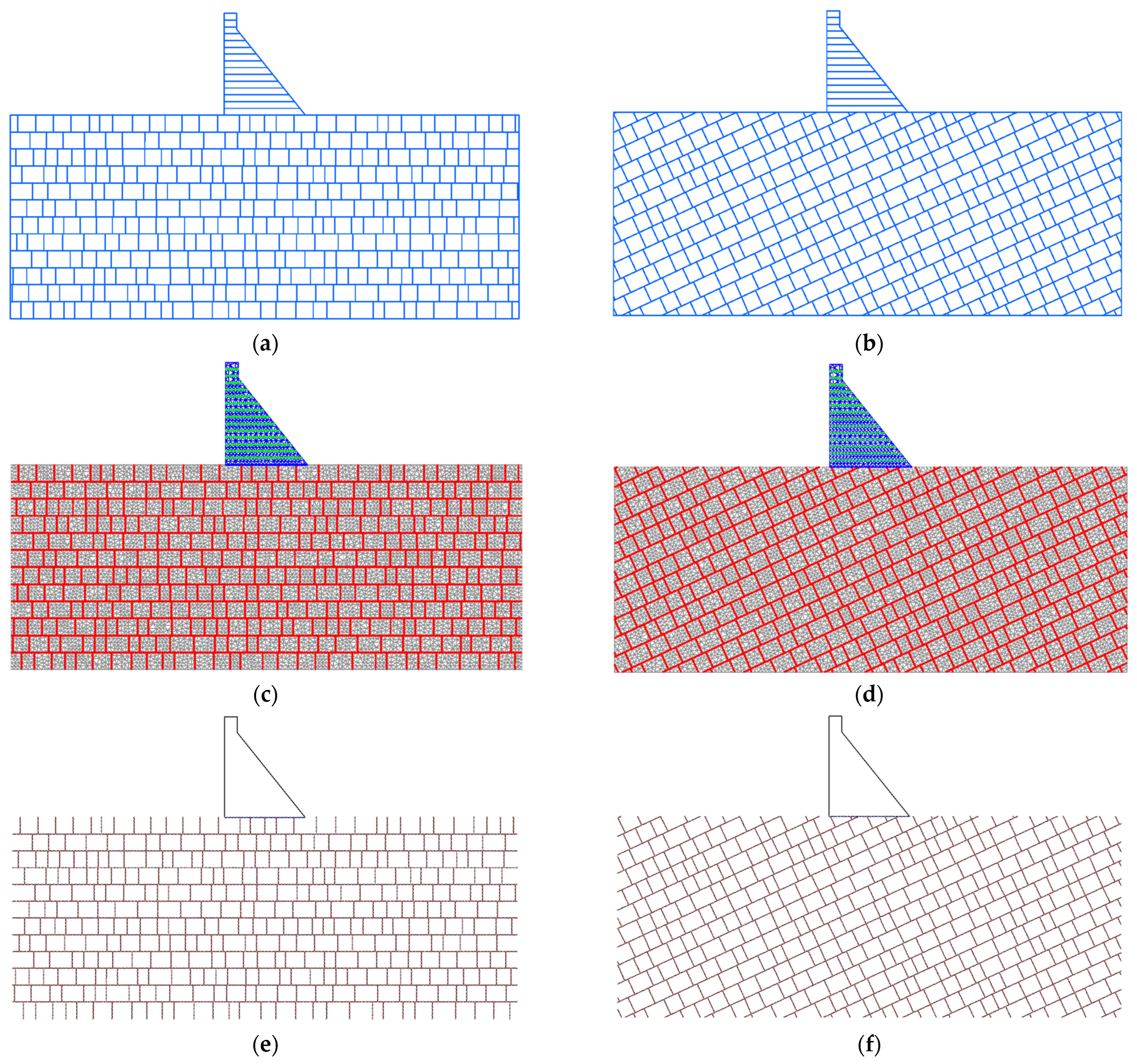
- Continuous horizontal discontinuities with a spacing of 2.5 m in the 15 m high dam models, 5.0 m in the 30 m high dam models, 10.0 m in the 60 m high dam models, and 20.0 m in the 120 m high dam models.
- (ii)
- Vertical discontinuities with an average spacing of (a) 2.5 m and a standard deviation of 1.0 m in the 15 m high dam models; (b) 5.0 m and a standard deviation of 2.0 m in the 30 m high dam models; (c) 10.0 m and a standard deviation of 4.0 m in the 60 m high dam models; and (d) 20.0 m and a standard deviation of 8.0 m in the 120 m high dam models.
- 0.5 m in the 15 m high concrete dam models (D15 and D15i);
- 1.0 m in the 30 m high concrete dam models (D30 and D30i);
- 2.0 m in the 60 m high concrete dam models (D60 and D60i);
- 4.0 m in the 120 m high concrete dam models (D120 and D120i).
4.1.2. Model Parameters
4.1.3. Hydromechanical Model Boundary Conditions and Analysis Sequence
4.2. Pedrógão Dam
4.2.1. Numerical Model and Geometry
4.2.2. Model Parameters
4.2.3. Hydromechanical Model Boundary Conditions and Analysis Sequence
5. Results and Discussion
5.1. Four Gravity Dams of Different Heights
5.1.1. Reference Hydromechanical Properties
5.1.2. Influence of the Joint Normal Stiffness
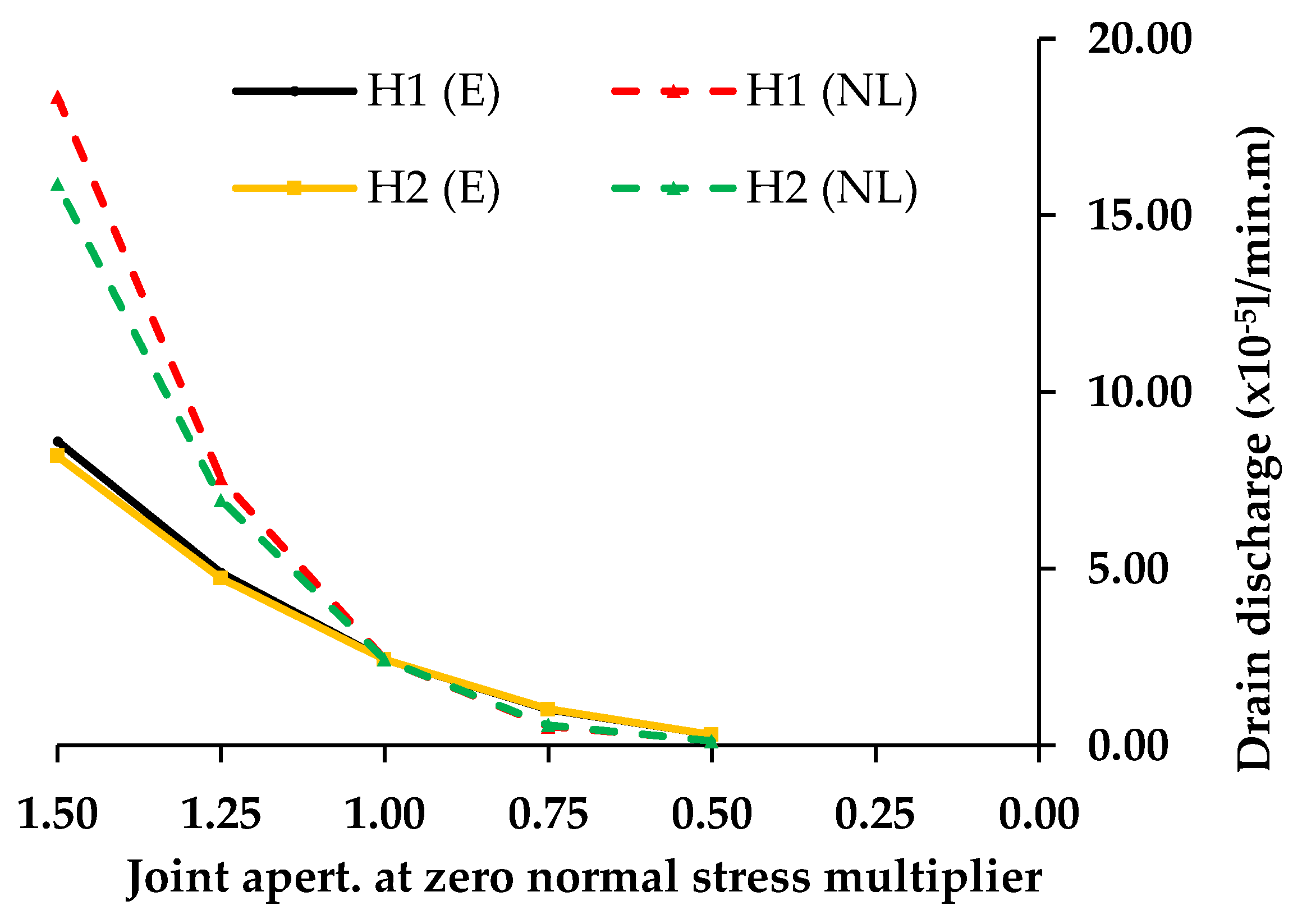
5.1.3. Influence of Joint Aperture at Nominal Zero Normal Stress
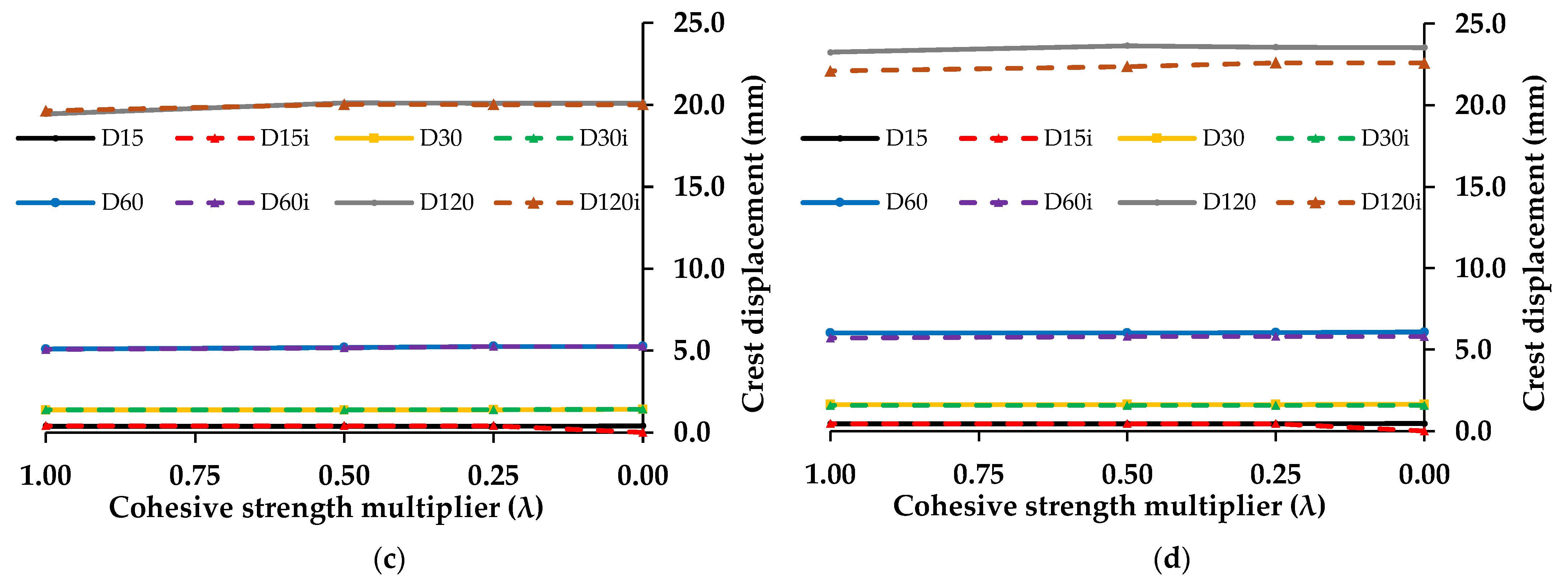
5.1.4. Influence of the Dam–Foundation Joint Strength
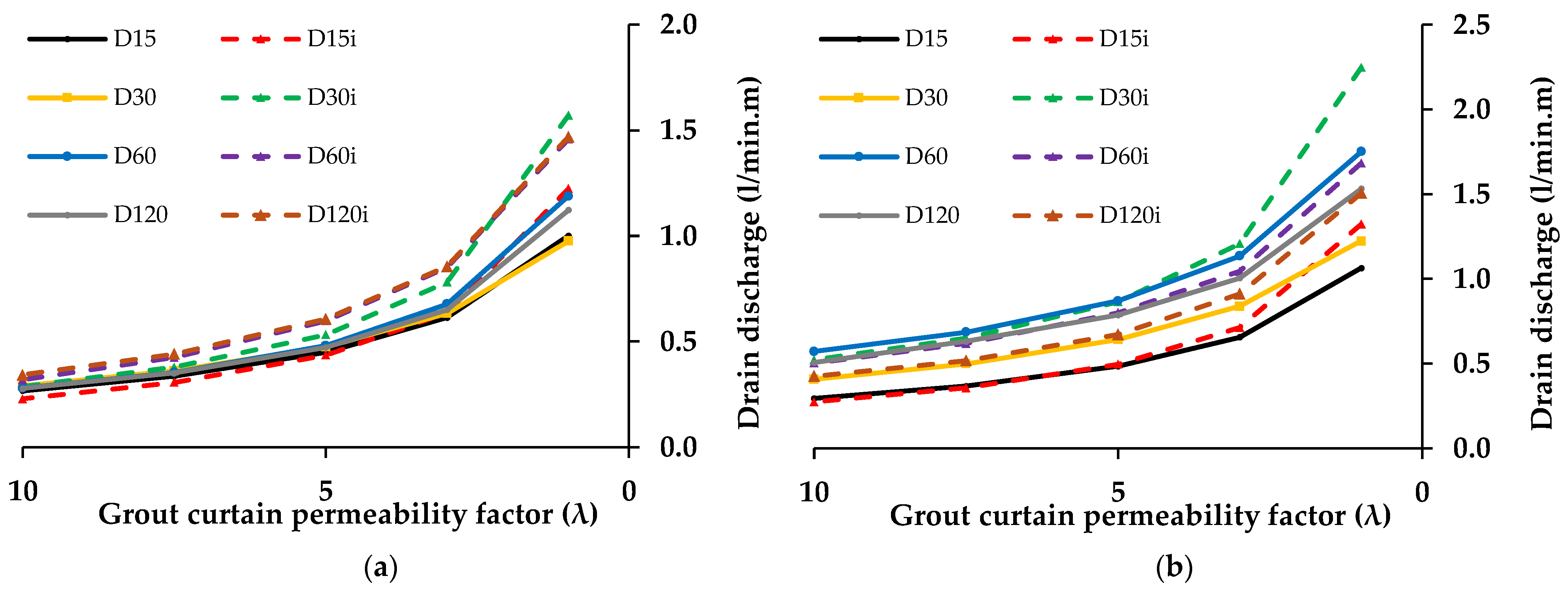
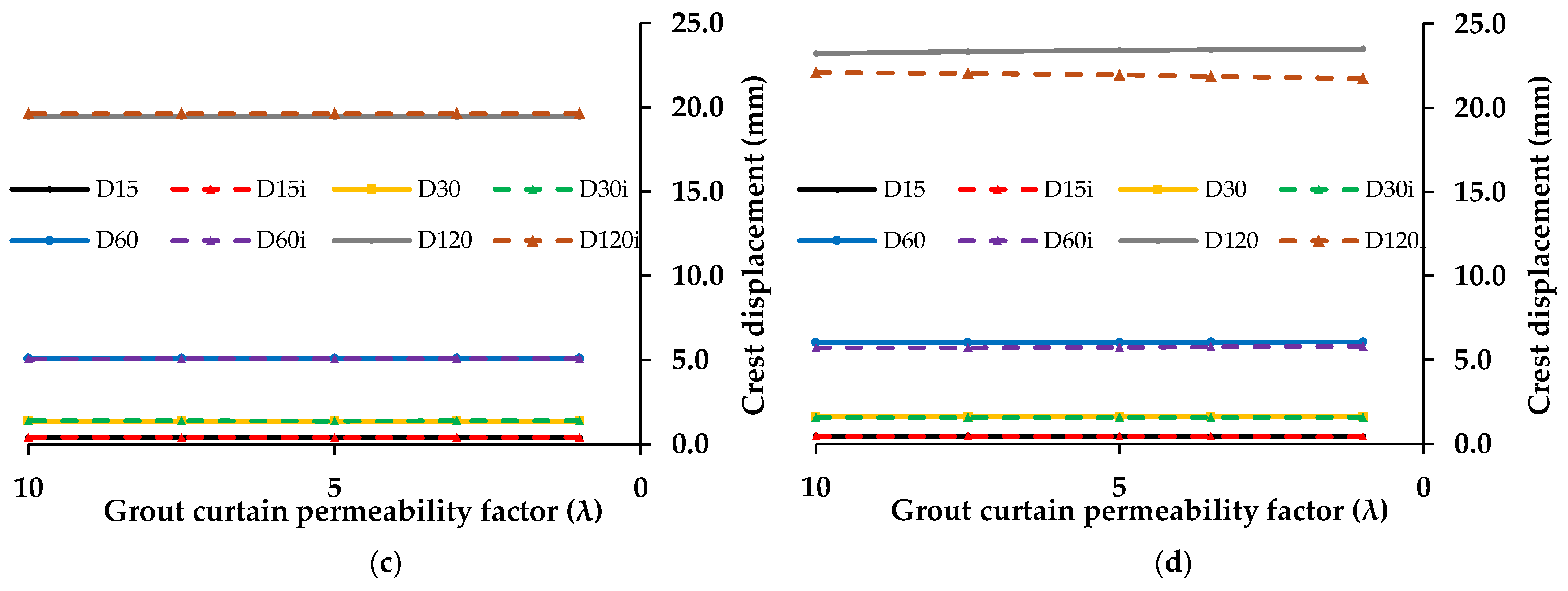
5.1.5. Influence of the Grout Curtain Permeability
5.2. Pedrógão Dam
6. Conclusions
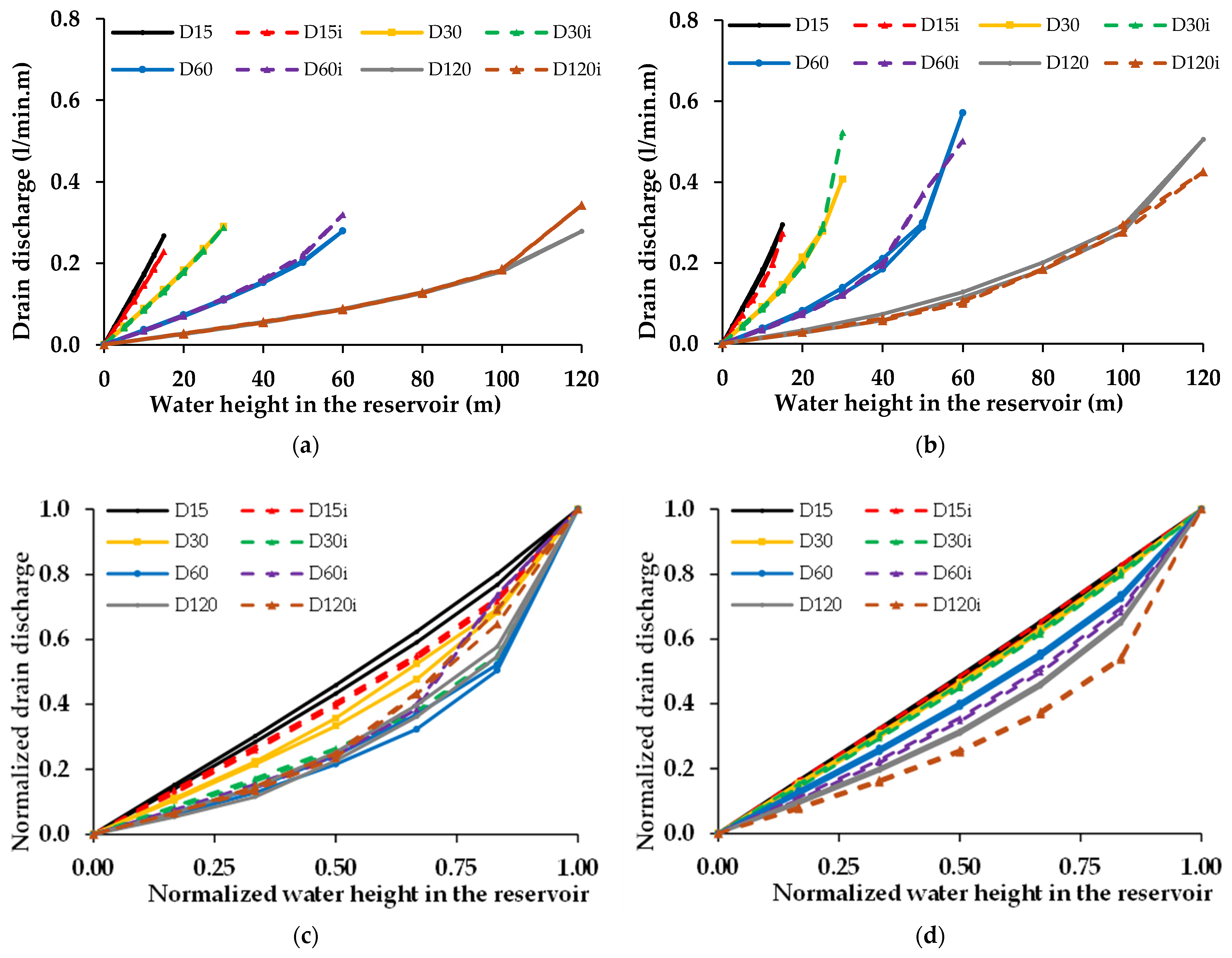
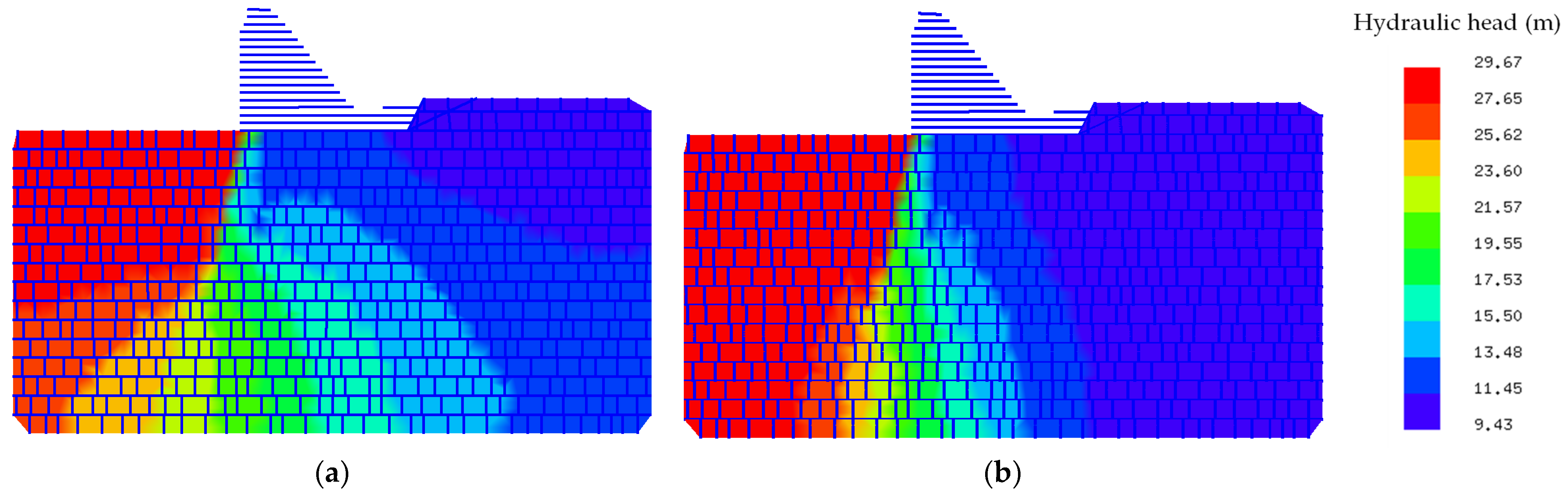
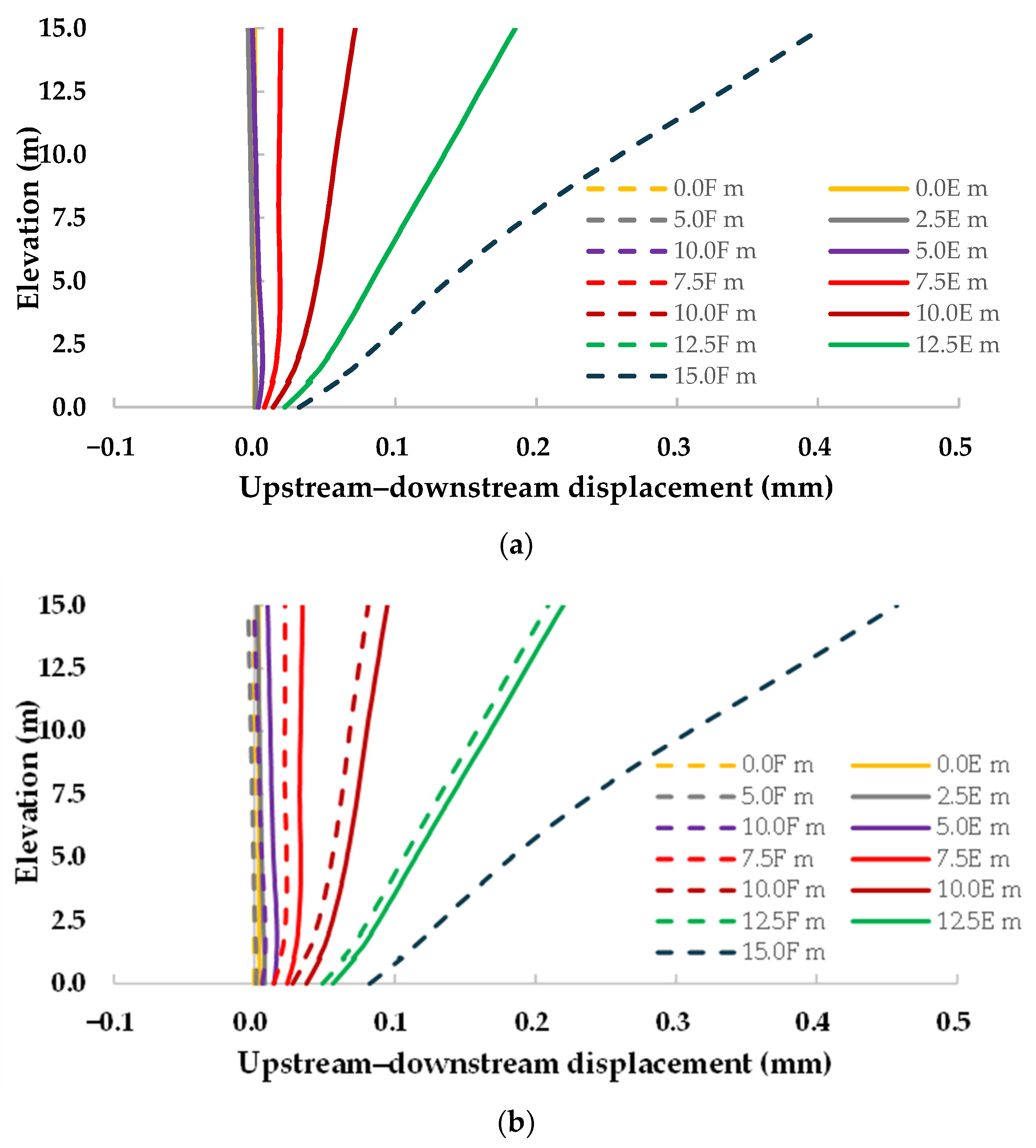
- The foundation behaviour and the joint pattern influence the HM behaviour. While under an elastic hypothesis, the drain discharges calculated during reservoir filling are very similar to those calculated in the emptying phase, under a nonlinear brittle foundation, and especially for an inclined joint pattern, the differences in the obtained drain discharges during the filling and the emptying of the reservoir are more noticeable, particularly for the higher dams.
- As the dam height increases, the relationship of the obtained normalized drain discharges to the normalized water level tends to have a higher curvature. The dam height influence on the hydromechanical response is mostly relevant to the development of accurate SEMs, which are used for the safety control of operating dams.
- The rock–concrete strength properties influence the hydromechanical response. The predicted drain discharges are similar up to the reservoir water level, which causes cracking in the rock–concrete interface at the dam heel, which leads to a sudden increase in the calculated drain discharges. The strength properties are more relevant for an elastic foundation and for higher dams. The results presented highlight the relevance of properly characterizing the dam foundation strength values through in situ testing.
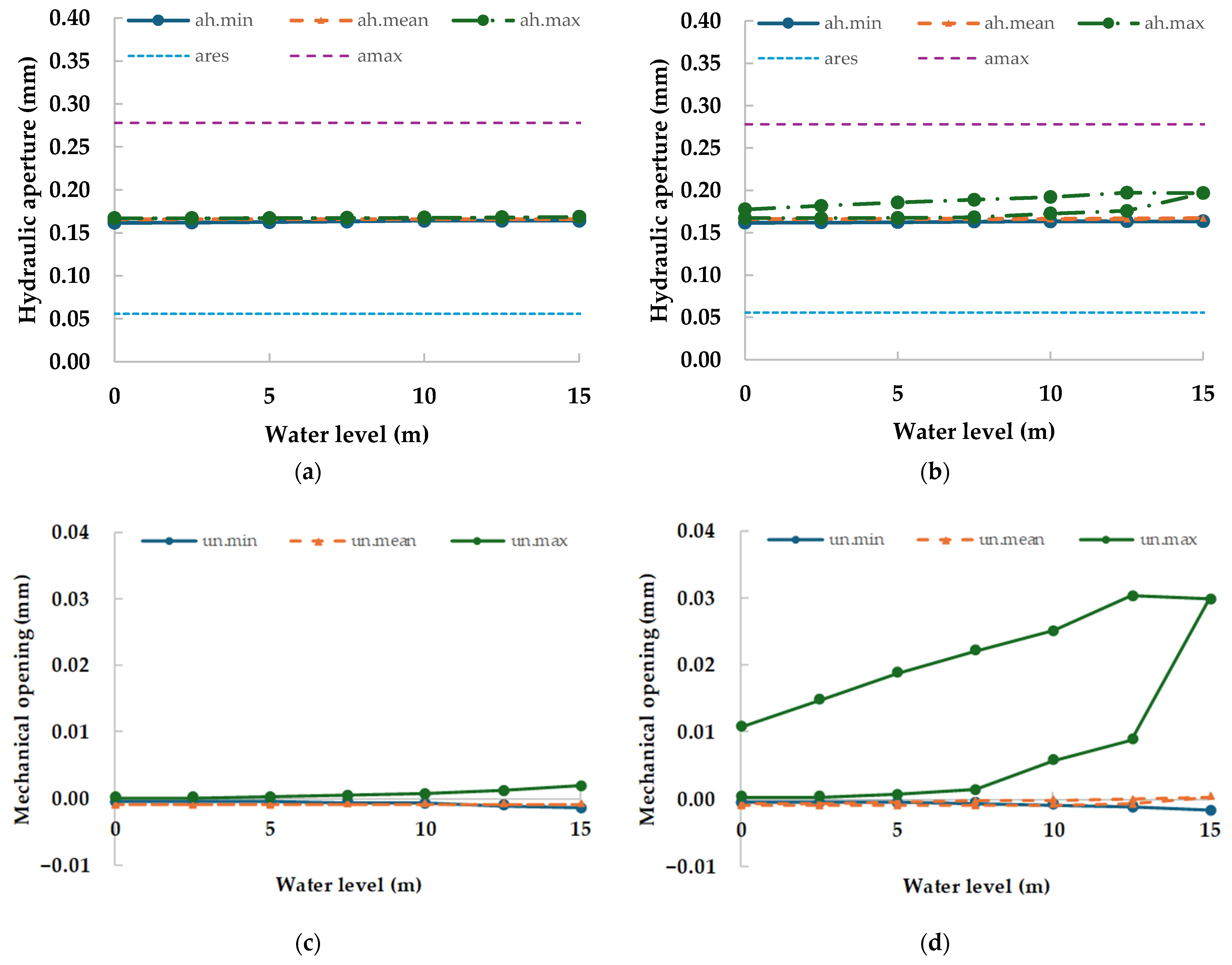
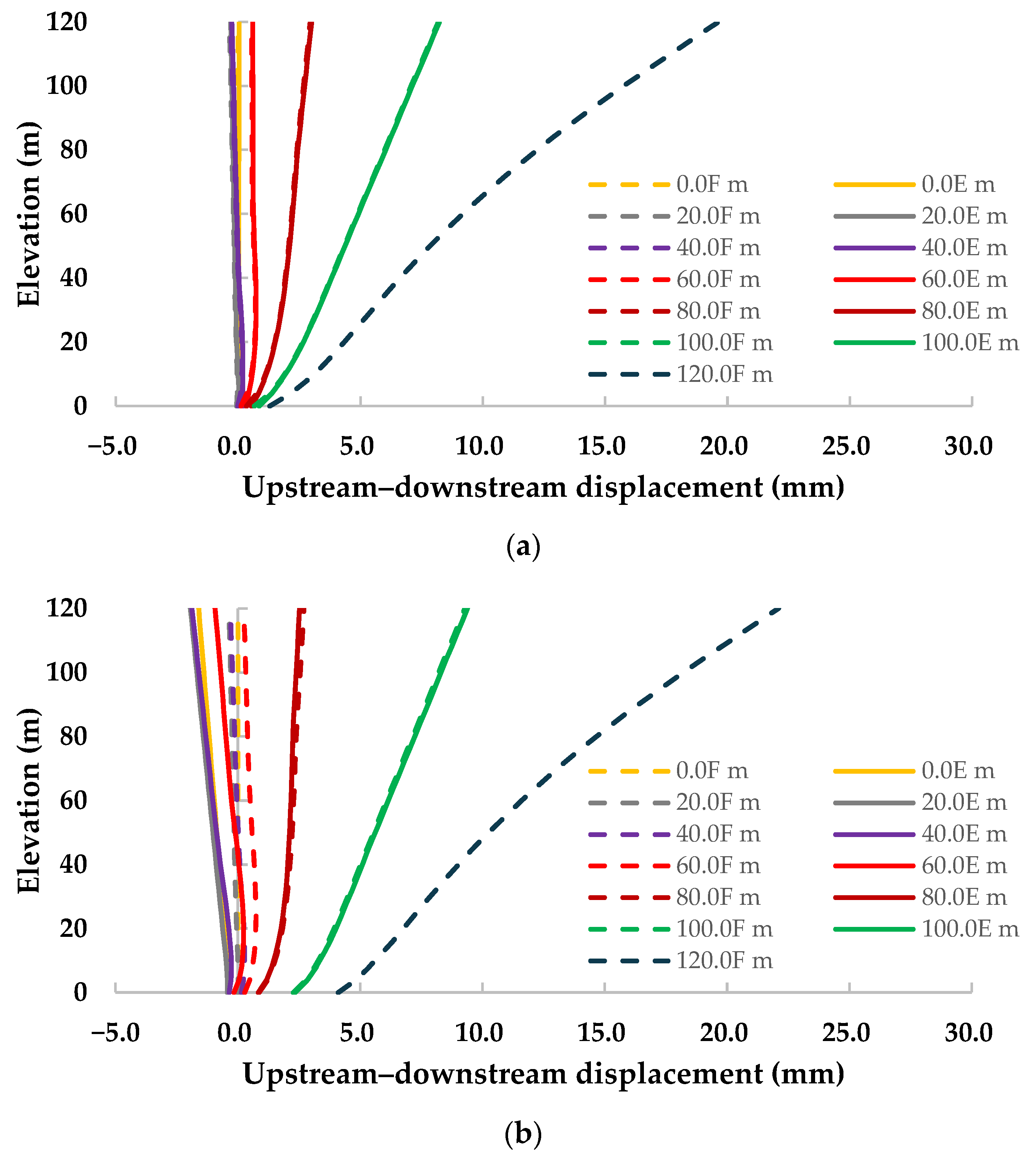
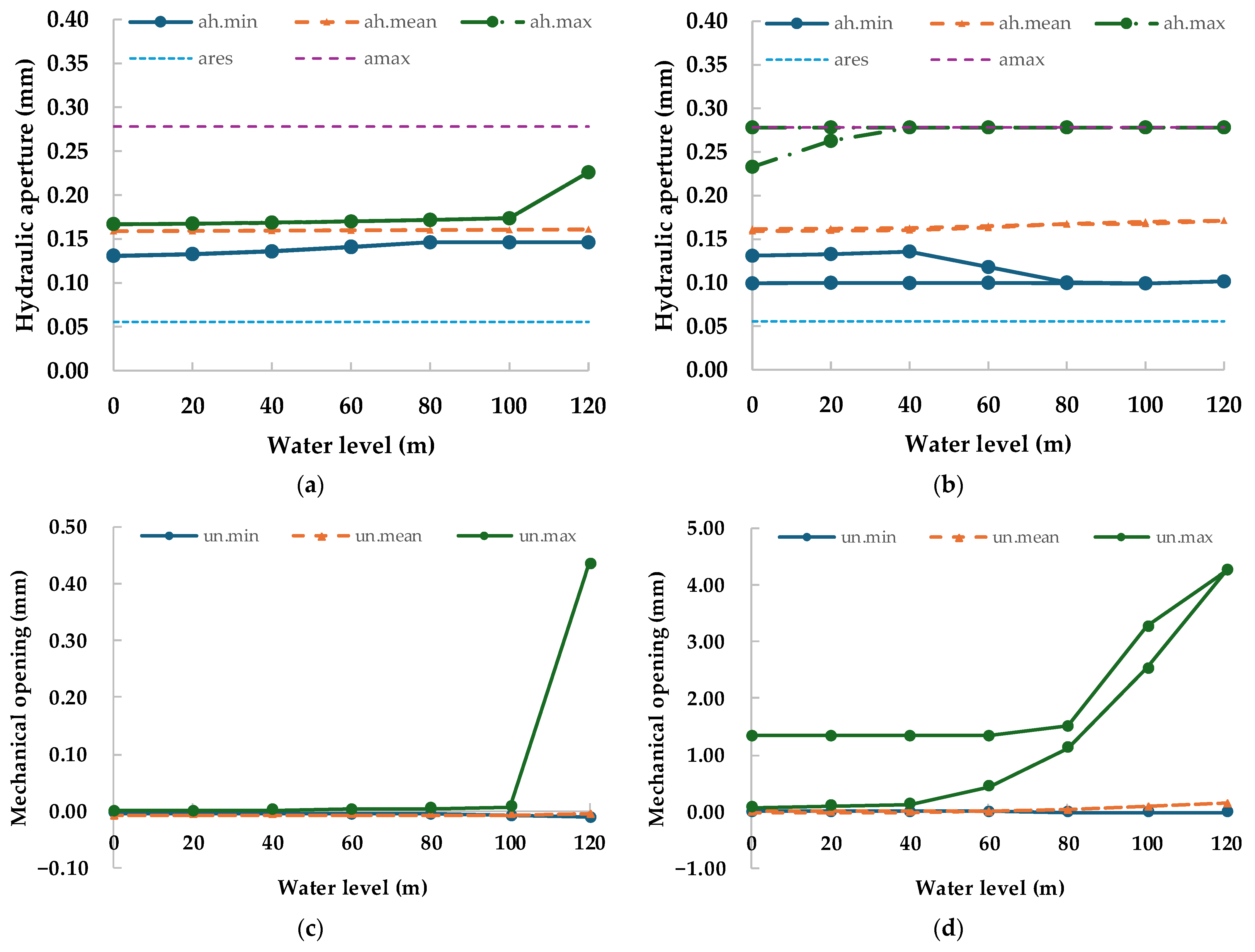
- Cracking at the rock–concrete interface and nonlinear effects, in general, are easier to identify in the hydraulic parameters, such as drain discharges or hydraulic apertures, than in the predicted displacement field.
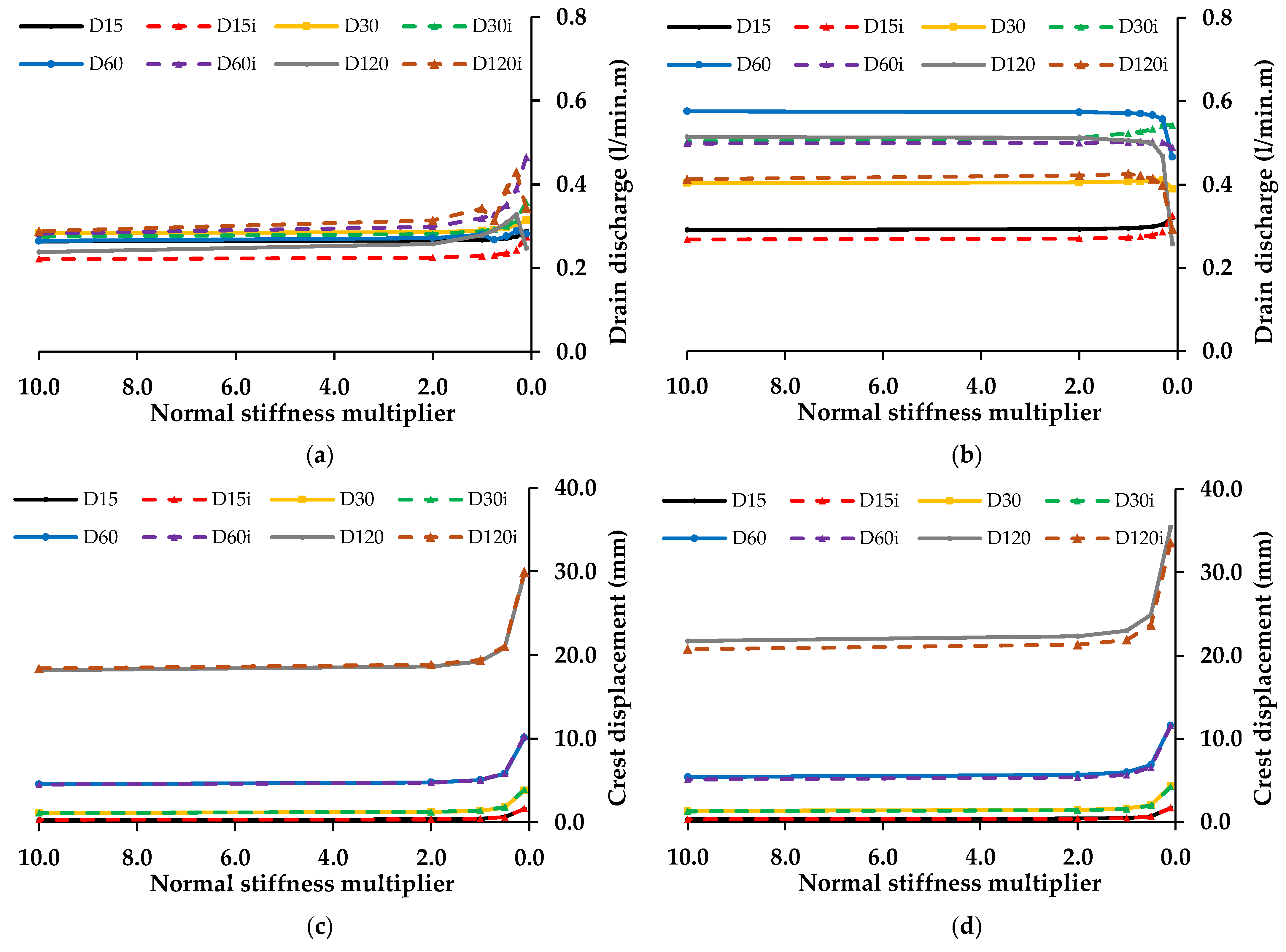
- For the ranges of normal stiffness values that were assessed, it was shown that, only for the smallest values (), there is a noticeable difference in both hydraulic and hydromechanical response.
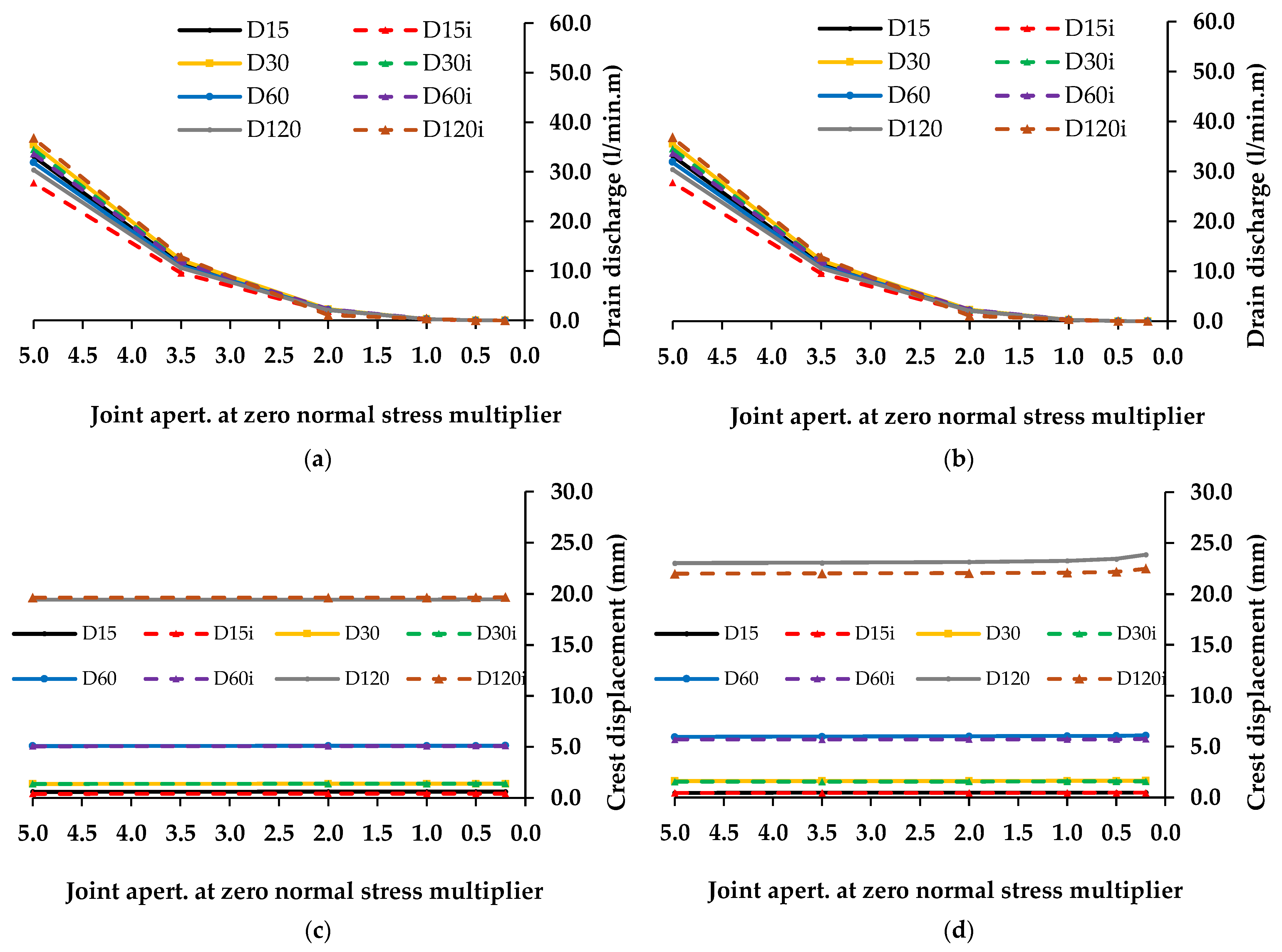
- For the ranges of joint aperture at nominal zero stress that were evaluated, it was found that this parameter has a meaningful effect mainly on the hydraulic model, e.g., drain discharges. It is shown that this hydraulic parameter is critical to ensure accurate hydromechanical modelling results.
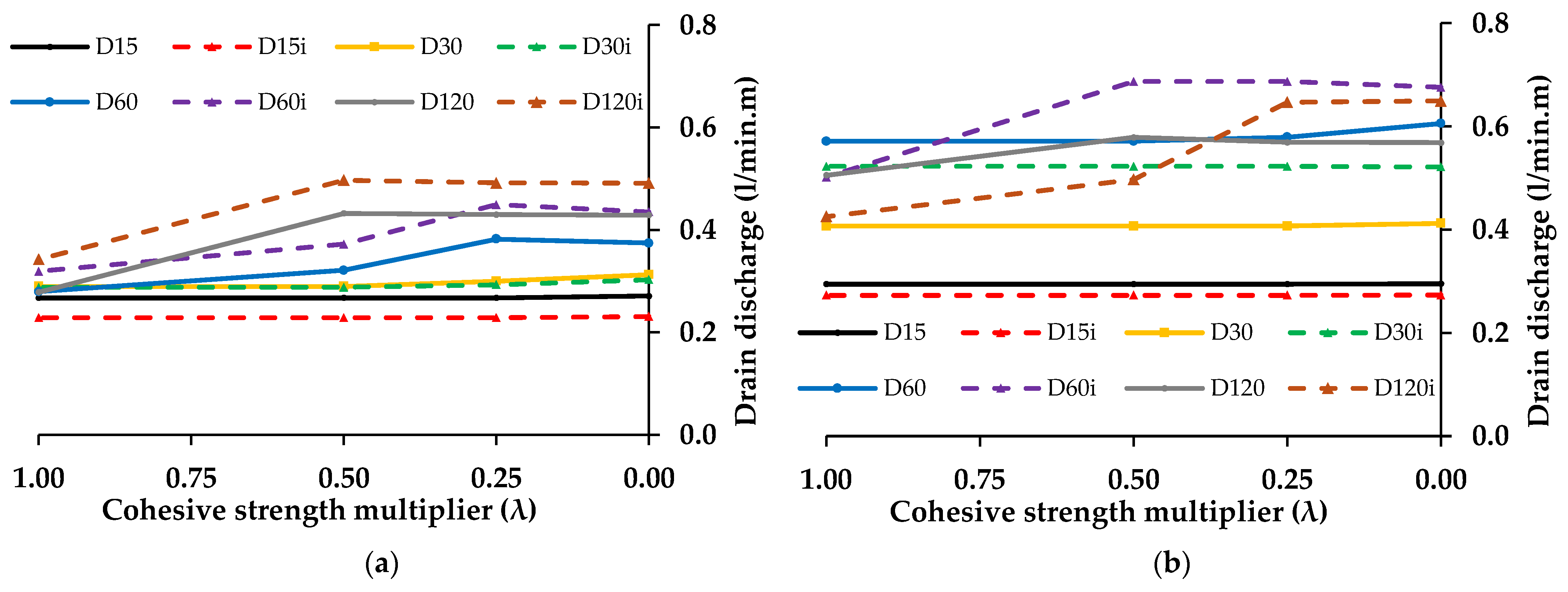
- The variation in the adopted strength parameters, which simulated a progressive degradation scenario of the concrete–rock interface, shows that a degradation of the concrete–rock strength properties has a larger effect on measured drain discharges than on measured displacements, highlighting the relevance of assessing hydraulic measurements in operating dams as a fundamental warning sign for proper control and safety operation.
- For the ranges of grout curtain permeability penalty values evaluated, it was shown that a potential degradation of the grout curtain permeability has a larger and immediate effect on measured drain discharges than on measured displacements. Like in the strength degradation scenario, this study concerning grout curtain permeability highlights the importance of assessing hydraulic measurements in operating dams for the control and safety of dams. In the long term, the degradation of the grout curtain may be associated with higher discharge rates that will deteriorate the elastic and strength properties of the jointed media.
Author Contributions
Funding
Institutional Review Board Statement
Informed Consent Statement
Data Availability Statement
Acknowledgments
Conflicts of Interest
Abbreviations
| BL | Bilinear vectorial softening contact model |
| DDA | Discontinuous deformation analysis |
| DEM | Discrete element method |
| EL | Elastic behaviour |
| FDEM | Combined finite–discrete element method |
| FEM | Finite element method |
| HM | Hydromechanical |
| HMM | Hydromechanical model |
| HN | Hydraulic node |
| JE | Joint finite elements |
| ML | Machine learning |
| NL | Nonlinear brittle behaviour |
| P | Pressure on the HNs |
| Q | Discharge in SCs |
| SC | Seepage channel |
| SEM | Separation of effects model |
| XFEM | Extended finite element method |
References
- ASDSO. Dam Failure and Incident Investigation Guide, Version 2.0; Association of State Dam Safety Officials: Lexington, Kentucky, 2021. [Google Scholar]
- Malm, R. Guideline for FE Analyses of Concrete Dams, Stockholm, Sweden, 2016. Available online: www.energiforsk.se (accessed on 14 February 2025).
- Hellgren, R.; Malm, R.; Ansell, A. Progressive failure analysis of a concrete dam anchored with passive rock bolts. Infrastructures 2020, 5, 28. [Google Scholar] [CrossRef] [Scilit]
- Vulliet, F.; Ftima, M.B.; Léger, P. Stability of cracked concrete hydraulic structures by nonlinear quasi-static explicit finite element and 3D limit equilibrium methods. Comput. Struct. 2017, 184, 25–35. [Google Scholar] [CrossRef] [Scilit]
- Enzell, J.; Ulfberg, A.; Sas, G.; Malm, R. Post-Peak Behavior of Concrete Dams Based on Nonlinear Finite Element Analyses. Eng. Fail. Anal. 2021, 130, 105778. [Google Scholar] [CrossRef] [Scilit]
- Li, W.; Wu, W.; Zhang, J. Numerical stability analysis of the dam foundation under complex geological conditions at great depth: A case study of Kala Hydropower Station, China. Front. Phys. 2021, 9, 808840. [Google Scholar] [CrossRef] [Scilit]
- Wang, D.; Lu, X.; Zheng, C.; Gong, K.; Pan, L.; Pei, L.; Zhao, Z. Influence Analysis of Material Parameter Uncertainties on the Stability Safety Factor of Concrete Gravity Dams: A Probabilistic Method. Buildings 2024, 14, 2435. [Google Scholar] [CrossRef] [Scilit]
- Câmara, R.C. A method for coupled arch dam-foundation-reservoir seismic behavior analysis. Earthq. Eng. Struct. Dyn. 2000, 29, 441–460. [Google Scholar] [CrossRef]
- Lokke, A.; Chopra, A.K. Direct Finite Element Method for Nonlinear Earthquake Analysis of 3-Dimensional Semi-Unbounded Dam–Water-Foundation Rock Systems. Earthq. Eng. Struct. Dyn. 2018, 47, 1309–1328. [Google Scholar]
- Robbe, E.; Kashiwayanagi, M.; Yamane, Y. Seismic Analyses of Concrete Dam, Comparison between Finite-Element Analyses and Seismic Records. In Proceedings of the 16th World Conference on Earthquake Engineering, Santiago, Chile, 9–17 January 2017. [Google Scholar]
- Salazar, F.; Vicente, D.J.; Irazábal, J.; De-Pouplana, I.; San Mauro, J. A Review on Thermo-mechanical Modelling of Arch Dams during Construction and Operation: Effect of the Reference Temperature on the Stress Field. Arch. Computat. Methods Eng. 2020, 27, 1681–1707. [Google Scholar]
- Leitão, N.S.; Castilho, E. Chemo-Thermo-Mechanical FEA as a Support Tool for Damage Diagnostic of a Cracked Concrete Arch Dam: A Case Study. Eng 2023, 4, 1265–1289. [Google Scholar] [CrossRef] [Scilit]
- Electric Power Research Institute. Uplift Pressures, Shear Strengths, and Tensile Strengths for Stability Analysis of Concrete Gravity Dams; Electric Power Research Institute: Palo Alto, CA, USA, 1992. [Google Scholar]
- Liu, Y.; Huang, D.; Zhao, B.; Wang, C.; Cen, D. Nonlinear creep behavior and viscoelastic-plastic constitutive model of rock-concrete composite mass. Adv. Civ. Eng. 2020, 2020, 9059682. [Google Scholar] [CrossRef] [Scilit]
- Dong, W.; Wu, Z.; Zhou, X. Fracture Mechanisms of Rock-Concrete Interface: Experimental and Numerical. J. Eng. Mech. 2016, 142, 04016040. [Google Scholar] [CrossRef] [Scilit]
- Dong, W.; Wu, Z.; Zhou, X.; Wang, N.; Kastiukas, G. An experimental study on crack propagation at rock-concrete interface using digital image correlation technique. Eng. Fract. Mech. 2017, 171, 50–63. [Google Scholar] [CrossRef] [Scilit]
- Dong, Z.; Lin, T.; Tang, S.; Lang, Y.; Yuan, R.; Heng, S. Mechanical properties and failure mechanism of concrete-granite composite specimens under compression load. Constr. Build. Mater. 2024, 435, 136768. [Google Scholar] [CrossRef] [Scilit]
- Lopez, P.; Thoraval, A.; Buzzi, O.; Rahmani, I.; Boulon, M. Advances in constitutive modelling of jointed rock hydro mechanical interactions at laboratory scale. In Proceedings of the 18. Congrès Français de Mécanique—14. Colloque Franco-Polonais “Mécanique des Sols et des Roches”, Grenoble, France, 27–31 August 2007. [Google Scholar]
- Alonso, E.E.; Zandarín, M.T.; Olivella, S. Joints in unsaturated rocks: Thermo-hydro-mechanical formulation and constitutive behaviour. J. Rock Mech. Geotech. Eng. 2013, 5, 200–213. [Google Scholar] [CrossRef] [Scilit]
- Zandarin, M.T.; Alonso, E.; Olivella, S. A constitutive law for rock joints considering the effects of suction and roughness on strength parameters. Int. J. Rock Mech. Min. 2013, 60, 333–344. [Google Scholar] [CrossRef] [Scilit]
- Li, Y.; Oh, J.; Mitra, R.; Hebblewhite, B. A constitutive model for a laboratory rock joint with multi-scale asperity degradation. Comput. Geotech. 2016, 72, 143–151. [Google Scholar] [CrossRef] [Scilit]
- Valente, S.; Barpi, F. On singular points in mixed-mode cohesive crack propagation. Trans. Eng. Sci. 1994, 6, 167–174. [Google Scholar]
- Barpi, F.; Valente, S. Numerical simulation of prenotched gravity dam models. J. Eng. Mech. 2000, 126, 611–619. [Google Scholar] [CrossRef] [Scilit]
- Shi, Z.; Suzuki, M.; Nakano, M. Numerical analysis of multiple discrete cracks in concrete dams using Extended Fictitious Crack Model. J. Struct. Eng. 2003, 129, 324–336. [Google Scholar] [CrossRef] [Scilit]
- Hariri-Ardebili, M.A.; Seyed-Kolbadi, S.M.; Mirzabozorg, H. A smeared crack model for seismic failure analysis of concrete gravity dams considering fracture energy effects. Struct. Eng. Mech. 2013, 48, 17–39. [Google Scholar] [CrossRef] [Scilit]
- Carpinteri, A.; Valente, S.; Ferrara, G.; Imperato, L. Experimental and numerical fracture modelling of a gravity dam. In Fracture Mechanics of Concrete Structures, 1st ed.; Science, E.A., Ed.; CRC Press: London, UK, 1992; pp. 351–360. [Google Scholar]
- Zhu, H.-H.; Yin, J.-H.; Dong, J.-H.; Zhang, L. Physical modelling of sliding failure of concrete gravity dam under overloading condition. Geomech. Eng. 2010, 2, 89–106. Available online: http://www.paper.edu.cn (accessed on 4 September 2025). [CrossRef] [Scilit]
- Ribeiro, P.M.V.; Léger, P. On a Benchmark Problem for Modeling and Simulation of Concrete Dams Cracking Response. Infrastructures 2023, 8, 50. [Google Scholar] [CrossRef] [Scilit]
- Enzell, J.; Nordström, E.; Sjölander, A.; Ansell, A.; Malm, R. Physical model tests of concrete buttress dams with failure imposed by hydrostatic water pressure. Water 2023, 15, 3627. [Google Scholar] [CrossRef] [Scilit]
- Willm, G.; Beaujoint, N. Les Methods de Surveillance des Barrages au Service de la Production Hydraulique d’Eléctricité de France. Problèms Anciens et Solutions Nouvelles. In Proceedings of the 9th International Congress on Large Dams, Istanbul, Turkey, 4–8 September 1967. [Google Scholar]
- Salazar, F.; Morán, R.; Toledo, M.A.; Oñate, E. Data-Based Models for the Prediction of Dam Behaviour: A Review and Some Methodological Considerations. Arch. Comput. Methods Eng. 2017, 24, 1–21. [Google Scholar] [CrossRef] [Scilit]
- Li, S.; Zhang, B.; Yang, M.; Li, S.; Liu, Z. A New Prediction Model of Dam Deformation and Successful Application. Buildings 2025, 15, 818. [Google Scholar] [CrossRef] [Scilit]
- Santillán, D.; Fraile-Ardanuy, J.; Toledo, M. Dam seepage analysis based on artificial neural networks: The hysteresis phenomenon. In Proceedings of the International Joint Conference on Neural Networks, Dallas, TX, USA, 4–9 August 2013; pp. 1–8. [Google Scholar] [CrossRef] [Scilit]
- Callari, C.; Fois, N.; Cicivelli, R. The role of hydro-mechanical coupling in the behaviour of dam-foundation system. In Proceedings of the Computational Mechanics in conjunction with the Second Asian-Pacific Congress on Computational Mechanics, Beijing, China, 5–10 September 2004. [Google Scholar]
- Zhang, W.; Li, H.; Shi, D.; Shen, Z.; Zhao, S.; Guo, C. Determination of Safety Monitoring Indices for Roller-Compacted Concrete Dams Considering Seepage–Stress Coupling Effects. Mathematics 2023, 11, 3224. [Google Scholar] [CrossRef] [Scilit]
- Rampal, A.; Halder, P.; Manna, B.; Sharma, K.G. Static and Coupled Hydro-mechanical Analyses of Concrete Gravity Dam Resting on Jointed Rock Foundation. Geotech. Geol. Eng. 2020, 38, 4111–4127. [Google Scholar] [CrossRef] [Scilit]
- Farinha, M.L.B.; Lemos, J.; Neves, E.M. Analysis of foundation sliding of an arch dam considering the hydromechanical behavior. Front. Struct. Civ. Eng. 2012, 6, 35–43. [Google Scholar] [CrossRef] [Scilit]
- Farinha, M.L.B.; Lemos, J.; Neves, E.M. Numerical modelling of borehole water-inflow tests in the foundation of the Alqueva arch dam. Can. Geotech. J. 2010, 48, 72–88. [Google Scholar] [CrossRef] [Scilit]
- Farinha, M.L.B.; Azevedo, N.M.; Candeias, M. Small Displacement Coupled Analysis of Concrete Gravity Dam Foundations: Static and Dynamic Conditions. Rock Mech. Rock Eng. 2017, 50, 439–464. [Google Scholar] [CrossRef] [Scilit]
- Farinha, M.L.B.; Azevedo, N.M.; Schclar Leitão, N.A.; Rocha de Almeida, J.; Oliveira, S. Sliding Stability Assessment of Concrete Dams Using a 3D Discontinuum Hydromechanical Model Following a Discrete Crack Approach. Geotechnics 2022, 2, 133–157. [Google Scholar] [CrossRef] [Scilit]
- Cammarata, G.; Fidelibus, C.; Cravero, M.; Barla, G. The hydro-mechanically coupled response of rock fractures. Rock Mech. Rock Eng. 2007, 40, 41–61. [Google Scholar] [CrossRef] [Scilit]
- Yan, C.; Zheng, H. A two-dimensional coupled hydro-mechanical finite-discrete model considering porous media flow for simulating hydraulic fracturing. Int. J. Rock Mech. Min. 2016, 88, 115–128. [Google Scholar] [CrossRef] [Scilit]
- Yan, C.; Jiao, Y.Y.; Zheng, H. A fully coupled three-dimensional hydro-mechanical finite discrete element approach with real porous seepage for simulating 3D hydraulic fracturing. Comput. Geotech. 2018, 96, 73–89. [Google Scholar] [CrossRef] [Scilit]
- Yan, C.; Xie, X.; Ren, Y.; Ke, W.; Wang, G. A FDEM-based 2D coupled thermal-hydro-mechanical model for multiphysical simulation of rock fracturing. Int. J. Rock Mech. Min. 2022, 149, 104964. [Google Scholar] [CrossRef] [Scilit]
- Yan, C.; Zhao, Z.; Yang, Y.; Zheng, H. A three-dimensional thermal-hydro-mechanical coupling model for simulation of fracturing driven by multiphysics. Comput. Geotech. 2023, 155, 105162. [Google Scholar] [CrossRef] [Scilit]
- Zhang, Q.-H.; Shi, G.-H. Verification of a DDA-based hydro-mechanical model and its application to dam foundation stability analysis. Int. J. Rock Mech. Min. 2021, 138, 104627. [Google Scholar] [CrossRef] [Scilit]
- Deng, Y.; Wang, D.; Jin, Y.; Xia, Y. A fully coupled hydro-mechanical approach for multi-fracture propagation simulations. Energies 2023, 16, 1601. [Google Scholar] [CrossRef] [Scilit]
- ITASCA. UDEC—Universal Distinct Element Code, version 4.0; ITASCA: Minneapolis, MN, USA, 2004. [Google Scholar]
- Goodman, R.; Taylor, R.; Brekke, T. A model for the mechanics of jointed rock. J. Soil Mech. Found. Div. ASCE 1968, 94, 637–659. [Google Scholar] [CrossRef] [Scilit]
- Hohberg, J. A Joint Element for the Nonlinear Dynamic Analysis of Arch Dams; ETH, Institute of Structural Engineering: Zurich, Switzerland, 1992. [Google Scholar]
- Farinha, M.L.B.; Azevedo, N.M.; Oliveira, S. Safety assessment of concrete gravity dams: Hydromechanical coupling and fracture propagation. Geosciences 2025, 15, 149. [Google Scholar] [CrossRef] [Scilit]
- Azevedo, N.M.; Pinho, F.F.S.; Cismasiu, I.; Souza, B. Prediction of Rubble-Stone Masonry Walls Response under Axial Compression Using 2D Particle Modelling. Buildings 2022, 12, 1283. [Google Scholar] [CrossRef] [Scilit]
- Caballero, A.; William, K.J.; Carol, I. Consistent tangent formulation for 3D interface modelling of cracking/fracture in quasi-brittle materials. Comput. Methods Appl. Mech. Eng. 2008, 197, 2804–2822. [Google Scholar] [CrossRef] [Scilit]
- Caballero, A.; Carol, C.; López, Z. A meso-level approach to the 3D numerical analysis of cracking and fracture of concrete materials. Fatigue Fract. Eng. Mater. Struct. 2006, 29, 979–991. [Google Scholar] [CrossRef] [Scilit]
- Louis, C.A. Study of Groundwater Flow in Jointed Rock and Its Influence on the Stability of Rock Masses. Ph.D. Thesis, Imperial College London, London, UK, 1969. [Google Scholar]
- Louis, C.; Maini, Y.N. Determination of in situ hydraulic parameters in jointed rock. In Proceedings of the 2nd International Congress on Rock Mechanics, Belgrade, Serbia, 21–26 September 1970; pp. 235–245. [Google Scholar]
- Snow, D.T. A Parallel Plate Model of Fractured Permeable Media. Ph.D. Thesis, University of California, Berkeley, CA, USA, 1965. [Google Scholar]
- Bear, J. Dynamics of Fluids in Porous Media; Dover Publications Inc.: New York, NY, USA, 1988. [Google Scholar]
- Lemos, J.V. Representation of rock discontinuities in safety analysis of large dams. In Proceedings of the 2014 ISRM European Rock Mechanics Symposium (EUROCK 2014), Vigo, Spain, 27–29 May 2014; Taylor and Francis Group: London, UK, 2014. [Google Scholar]
- Zhong, H.; Ooi, E.T.; Song, C.; Ding, T.; Lin, G.; Li, H. Experimental and numerical study of the dependency of interface fracture in concrete–rock specimens on mode mixity. Eng. Fract. Mech. 2014, 124, 287–309. [Google Scholar] [CrossRef] [Scilit]
- Dong, W.; Yang, D.; Zhang, B.; Wu, Z. Rock-Concrete Interfacial Crack Propagation under Mixed Mode I–II Fracture. J. Eng. Mech. 2018, 144, 04018039. [Google Scholar] [CrossRef] [Scilit]
- Kafritsas, J.C. Coupled Flow/Deformation Analysis of Jointed Rock with the Distinct Element Method. Ph.D. Thesis, Massachusetts Institute of Technology, Cambridge, MA, USA, 1987. [Google Scholar]











| Dam Model | H (m) | a (m) |
|---|---|---|
| Dam 15 | 15 | 4.0 |
| Dam 30 | 30 | 6.0 |
| Dam 60 | 60 | 7.5 |
| Dam 120 | 120 | 10.0 |
| Dam Model | Mechanical Model | Hydraulic Model | ||||
|---|---|---|---|---|---|---|
| Blocks | Nodes | FE Triangular Elements | FE Joint Elements | Hydraulic Nodes | Seepage Channels | |
| D15 | 383 | 11,989 | 15,549 | 3595 | 3122 | 3411 |
| D15i | 411 | 11,999 | 15,184 | 3757 | 3251 | 3573 |
| D30 | 386 | 11,963 | 15,428 | 3625 | 3159 | 3449 |
| D30i | 424 | 12,039 | 15,187 | 3784 | 3294 | 3608 |
| D60 | 389 | 11,963 | 15,389 | 3644 | 3179 | 3473 |
| D60i | 435 | 11,964 | 15,091 | 3764 | 3267 | 3579 |
| D120 | 390 | 12,084 | 15,543 | 3687 | 3223 | 3518 |
| D120i | 431 | 11,970 | 15,079 | 3765 | 3283 | 3596 |
| (a) | ||||||||||
| Material | (GPa) | (-) | (kg/m3) | |||||||
| Dam Concrete | 30.3 | 0.24 | 2.4 | |||||||
| Rock Mass | 64.4 | 0.20 | 2.7 | |||||||
| (b) | ||||||||||
| Interface | (GPa/m) | (GPa/m) | (MPa) | (MPa) | (-) | (Nm/m2) | Nm/m2) | |||
| Concrete–Concrete | 60.6 | 24.2 | 2.88 | 5.76 | 1.0 | 87.0 | 435.0 | |||
| Concrete–Rock | 128.8 | 51.5 | 1.37 | 2.74 | 1.0 | 24.7 | 123.3 | |||
| Rock–Rock | 128.8 | 51.5 | 0.0 | 0.0 | - | - | - | |||
| Foundation Behaviour | ||||||||
|---|---|---|---|---|---|---|---|---|
| EL | 0.267 | 0.228 | 0.290 | 0.288 | 0.279 | 0.319 | 0.278 | 0.342 |
| NL | 0.295 | 0.273 | 0.407 | 0.522 | 0.571 | 0.502 | 0.505 | 0.425 |
| % Increase | 10.2 | 19.4 | 40.5 | 81.5 | 104.5 | 57.3 | 81.6 | 24.2 |
| Joint Normal Stiffness | Equivalent Deformability (GPa/m) | |||
|---|---|---|---|---|
| (GPa/m) | D15 and D15i | D30 and D30i | D60 and D60i | D120 and D120i |
| 21.5 (−60.0) | 32.2 (−45.0) | 42.9 (−30.0) | 51.5 (−18.0) | |
| 38.6 (−34.0) | 48.3 (−21.3) | 55.2 (−12.1) | 59.4 (−6.5) | |
| 46.0 (−14.3) | 53.7 (−8.3) | 58.5 (−4.5) | 61.3 (−2.4) | |
| 50.8 (10.5) | 56.8 (5.9) | 60.4 (3.1) | 62.3 (1.6) | |
| 53.7 (-) | 58.5 (-) | 61.3 (-) | 62.8 (-) | |
| 58.5 (9.1) | 61.3 (4.8) | 62.8 (2.4) | 63.6 (1.2) | |
| 63.8 (18.8) | 64.1 (9.5) | 64.2 (4.7) | 64.3 (2.4) | |
| (a) | ||||||||
Multiplier | ||||||||
| 0.2 | −99.1 (0.3) | −99.1 (0.1) | −99.1 (0.2) | −99.1 (0.2) | −99.1 (0.2) | −98.9 (0.2) | −99.1 (0.2) | −99.3 (0.2) |
| 0.5 | −87.0 (0.0) | −87.1 (0.0) | −87.2 (0.0) | −86.9 (0.0) | −86.9 (0.1) | −85.8 (0.1) | −86.2 (0.1) | −92.3 (0.0) |
| 1.0 | 0.0 (0.0) | 0.0 (0.0) | 0.0 (0.0) | 0.0 (0.0) | 0.0 (0.0) | 0.0 (0.0) | 0.0 (0.0) | 0.0 (0.0) |
| 2.0 | 699.7 (−0.2) | 686.2 (0.0) | 690.3 (0.0) | 679.9 (0.0) | 664.3 (0.0) | 624.3 (0.0) | 640.1 (0.0) | 216.4 (0.0) |
| 3.5 | 4160.7 (−0.2) | 4081.7 (0.0) | 4112.4 (0.0) | 4032.6 (0.0) | 3869.8 (0.0) | 3595.7 (−0.1) | 3709.4 (0.0) | 3654.7 (0.0) |
| 5.0 | 12,291.6 (−0.2) | 12,054.3 (0.0) | 12,153.6 (0.0) | 11,892.8 (0.0) | 11,311.6 (0.0) | 10,450.5 (−0.1) | 10,813.6 (0.0) | 10,644.3 (0.0) |
| (b) | ||||||||
Multiplier | ||||||||
| 0.2 | −99.0 (1.4) | −98.8 (1.2) | −99.0 (0.7) | −99.0 (0.5) | −99.2 (1.0) | −99.2 (0.7) | −99.3 (2.6) | −99.3 (1.8) |
| 0.5 | −86.3 (0.5) | −85.2 (0.4) | −86.2 (0.3) | −85.0 (0.3) | −86.9 (0.3) | −87.4 (0.0) | −87.2 (0.8) | −87.8 (0.4) |
| 1.0 | 0.0 (0.0) | 0.0 (0.0) | 0.0 (0.0) | 0.0 (0.0) | 0.0 (0.0) | 0.0 (0.0) | 0.0 (0.0) | 0.0 (0.0) |
| 2.0 | 658.1 (−0.3) | 623.7 (−0.2) | 599.2 (−0.6) | 536.0 (−0.5) | 571.2 (−0.5) | 672.8 (−0.1) | 621.8 (−0.5) | 664.9 (−0.2) |
| 3.5 | 3865.1 (−0.4) | 3601.6 (−0.3) | 3320.5 (−1.0) | 2744.7 (−1.3) | 2919.0 (−0.9) | 3839.9 (−0.3) | 3483.8 (−0.8) | 3800.0 (−0.3) |
| 5.0 | 11,345.6 (−0.5) | 10,485.5 (−0.4) | 9485.1 (−1.2) | 7609.1 (−1.6) | 7802.6 (−1.3) | 10,721.0 (−0.4) | 9715.8 (−1.0) | 10,791.7 (−0.4) |
| (a) | ||||||||
| Strength Multiplier | ||||||||
| 0.0 | 1.4 (1.8) | 101.1 (0.1) | 7.9 (2.9) | 5.1 (2.8) | 33.9 (3.2) | 36.4 (3.7) | 54.0 (3.4) | 43.5 (1.9) |
| 0.25 | 0.0 (0.0) | 0.0 (0.0) | 3.5 (1.2) | 1.9 (1.0) | 36.8 (3.2) | 40.9 (3.8) | 54.4 (3.4) | 43.6 (1.9) |
| 0.50 | 0.0 (0.0) | 0.0 (0.0) | 0.0 (0.0) | 0.0 (0.0) | 14.9 (1.8) | 16.6 (1.8) | 55.3 (3.4) | 45.2 (2.0) |
| 1.00 | 0.0 (0.0) | 0.0 (0.0) | 0.0 (0.0) | 0.0 (0.0) | 0.0 (0.0) | 0.0 (0.0) | 0.0 (0.0) | 0.0 (0.0) |
| (b) | ||||||||
| Strength Multiplier | ||||||||
| 0.0 | 0.1 (0.2) | 100.1 (0.1) | 1.3 (0.4) | −0.2 (0.0) | 6.0 (0.8) | 34.7 (1.6) | 12.5 (1.3) | 52.6 (2.3) |
| 0.25 | 0.0 (0.0) | 0.0 (0.0) | 0.0 (0.0) | 0.0 (0.0) | 1.4 (0.3) | 36.9 (1.6) | 12.6 (1.4) | 52.0 (2.3) |
| 0.50 | 0.0 (0.0) | 0.0 (0.0) | 0.0 (0.0) | 0.0 (0.0) | 0.0 (0.0) | 36.9 (1.6) | 14.5 (1.7) | 16.8 (1.2) |
| 1.00 | 0.0 (0.0) | 0.0 (0.0) | 0.0 (0.0) | 0.0 (0.0) | 0.0 (0.0) | 0.0 (0.0) | 0.0 (0.0) | 0.0 (0.0) |
| (a) | ||||||||
| Grout Curtain Multiplier | ||||||||
| 1.0 | 274.2 (0.0) | 435.6 (0.0) | 237.0 (0.0) | 445.8 (0.0) | 325.4 (0.0) | 357.1 (0.1) | 303.3 (0.0) | 328.9 (0.0) |
| 3.5 | 129.7 (0.0) | 178.8 (0.0) | 118.8 (0.0) | 171.7 (0.0) | 142.5 (0.0) | 167.1 (0.0) | 133.6 (0.0) | 150.0 (0.0) |
| 5.0 | 68.0 (0.0) | 90.8 (0.0) | 64.3 (0.0) | 85.2 (0.0) | 72.2 (0.0) | 87.4 (0.0) | 69.5 (0.0) | 77.4 (0.0) |
| 7.5 | 25.7 (0.0) | 33.8 (0.0) | 24.9 (0.0) | 31.6 (0.0) | 26.6 (0.0) | 33.0 (0.0) | 26.3 (0.0) | 28.8 (0.0) |
| 10.0 | 0.0 (0.0) | 0.0 (0.0) | 0.0 (0.0) | 0.0 (0.0) | 0.0 (0.0) | 0.0 (0.0) | 0.0 (0.0) | 0.0 (0.0) |
| (b) | ||||||||
| Grout Curtain Multiplier | ||||||||
| 1.0 | 260.8 (−1.1) | 384.7 (−0.8) | 200.5 (−0.6) | 330.0 (0.8) | 206.4 (0.5) | 235.3 (1.7) | 202.8 (1.1) | 253.8 (−1.6) |
| 3.5 | 122.6 (−0.8) | 160.8 (−0.5) | 105.9 (−0.2) | 131.0 (−0.2) | 98.7 (0.3) | 108.1 (1.0) | 98.8 (0.9) | 114.2 (−1.0) |
| 5.0 | 64.3 (−0.5) | 81.9 (−0.3) | 57.6 (−0.1) | 65.5 (−0.2) | 52.2 (0.2) | 59.6 (0.6) | 55.7 (0.7) | 57.8 (−0.6) |
| 7.5 | 24.3 (−0.2) | 30.5 (−0.1) | 22.3 (−0.1) | 24.4 (−0.1) | 19.9 (0.1) | 23.2 (0.2) | 24.9 (0.4) | 21.6 (−0.2) |
| 10.0 | 0.0 (0.0) | 0.0 (0.0) | 0.0 (0.0) | 0.0 (0.0) | 0.0 (0.0) | 0.0 (0.0) | 0.0 (0.0) | 0.0 (0.0) |
| Foundation Behaviour | Normal Stiffness Hypothesis | |
|---|---|---|
| H1 | H2 | |
| E | 1.454 | 1.399 |
| NL | 1.040 | 0.998 |
Disclaimer/Publisher’s Note: The statements, opinions and data contained in all publications are solely those of the individual author(s) and contributor(s) and not of MDPI and/or the editor(s). MDPI and/or the editor(s) disclaim responsibility for any injury to people or property resulting from any ideas, methods, instructions or products referred to in the content. |
© 2026 by the authors. Licensee MDPI, Basel, Switzerland. This article is an open access article distributed under the terms and conditions of the Creative Commons Attribution (CC BY) license.
Share and Cite
Farinha, M.L.B.; Azevedo, N.M.; Oliveira, S. Effects of Geometry, Joint Properties, and Deterioration Scenarios on the Hydromechanical Response of Gravity Dams. Appl. Mech. 2026, 7, 8. https://doi.org/10.3390/applmech7010008
Farinha MLB, Azevedo NM, Oliveira S. Effects of Geometry, Joint Properties, and Deterioration Scenarios on the Hydromechanical Response of Gravity Dams. Applied Mechanics. 2026; 7(1):8. https://doi.org/10.3390/applmech7010008
Chicago/Turabian StyleFarinha, Maria Luísa Braga, Nuno Monteiro Azevedo, and Sérgio Oliveira. 2026. "Effects of Geometry, Joint Properties, and Deterioration Scenarios on the Hydromechanical Response of Gravity Dams" Applied Mechanics 7, no. 1: 8. https://doi.org/10.3390/applmech7010008
APA StyleFarinha, M. L. B., Azevedo, N. M., & Oliveira, S. (2026). Effects of Geometry, Joint Properties, and Deterioration Scenarios on the Hydromechanical Response of Gravity Dams. Applied Mechanics, 7(1), 8. https://doi.org/10.3390/applmech7010008