


There is a plea for more video documentation in articles about polymer prints of 3D-computer-aided-design (CAD)-(re-)constructed prosthetics. Our journal, Prosthesis, provides a platform for this that could lead to a better understanding of mechanisms of action and identify the pros and cons of the presented prototype.
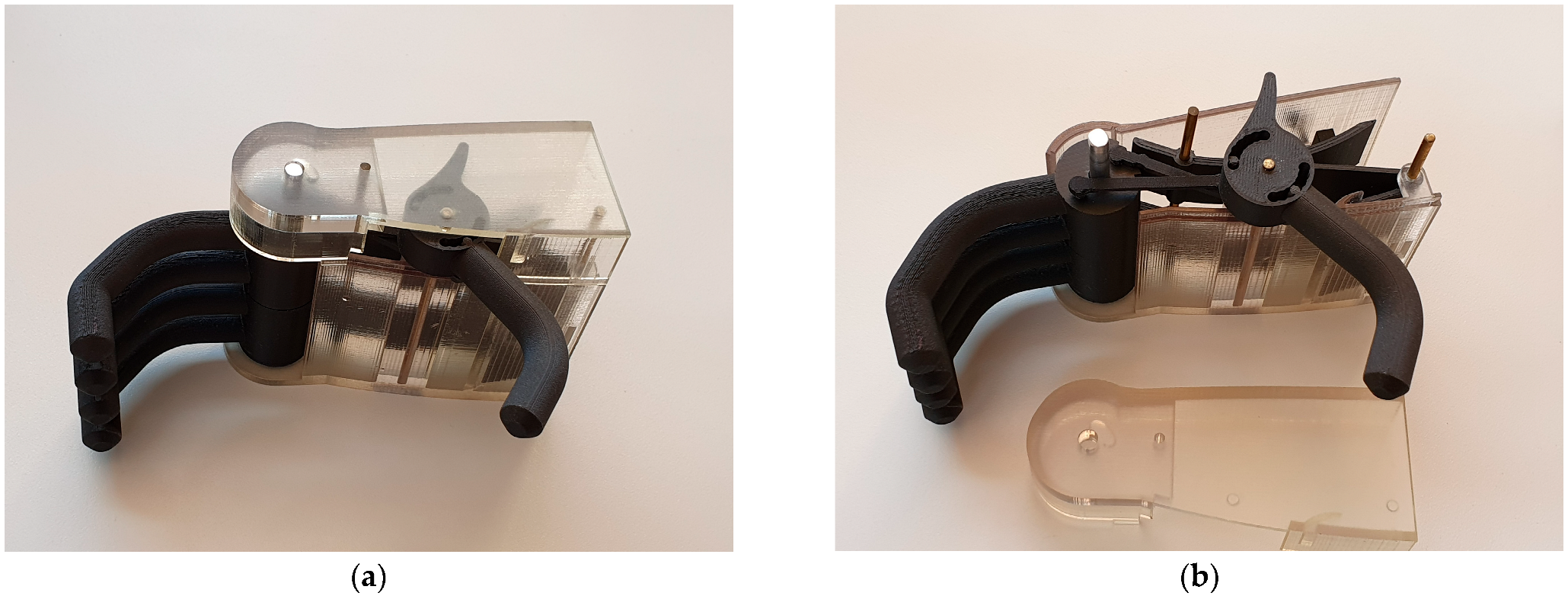
Given the hype that has been evoked over the last 500 years by the two different, mechanically interesting artificial “Iron Hands” from knight Götz von Berlichingen (1480–1562) [1,2,3,4,5,6,7,8,9,10], who lost his right hand during the Landshut War of Succession in 1504, a video demonstration of the recently reconstructed and 3D-printed polymer replica (Figure 1) could shed some more light on how craftsmen of former times developed valuable aids for everyday use by persons with disabilities.
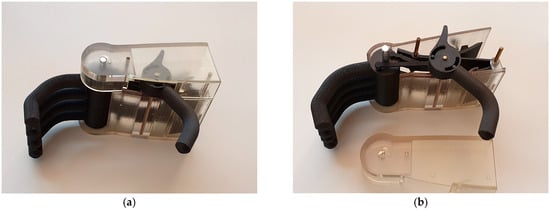
Figure 1.
A 3D-printed polymer replica of the first “Iron Hand” of Götz von Berlichingen. From [10], © 2020 by A. Otte. Licensee MDPI, Basel, Switzerland, distributed under the terms and conditions of the Creative Commons Attribution (CC BY) license (http://creativecommons.org/licenses/by/4.0/, Accessed on 12 May 2025). (a) General view of the artificial prosthetic hand; (b) view after the removal of the lateral chassis cover with insight into the mechanics.
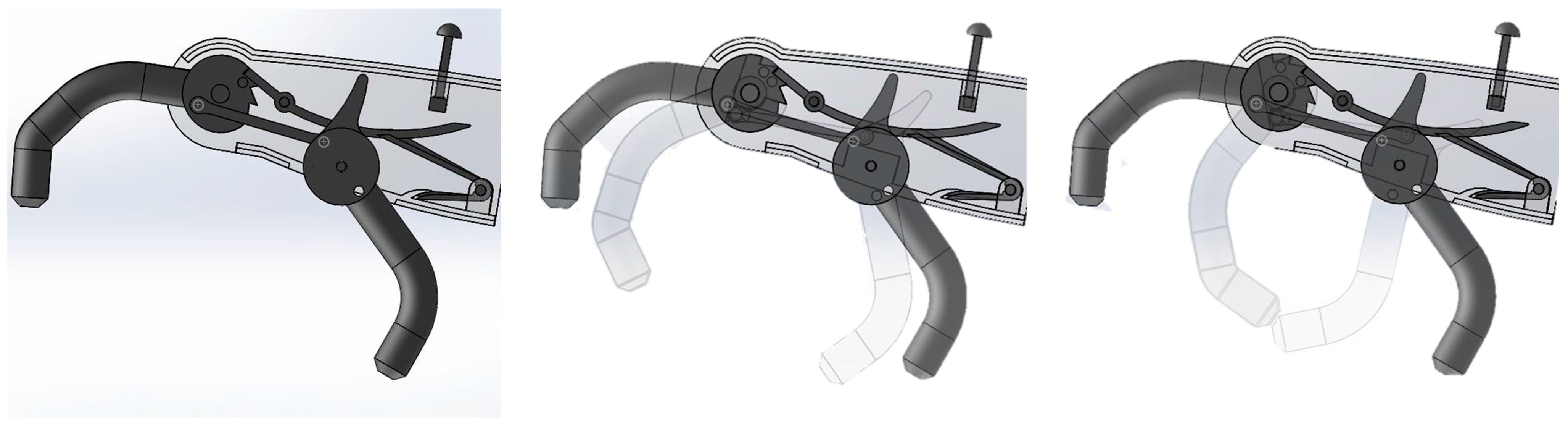
During his time in his sickbed, Götz was already thinking about replacing his hand artificially and commissioned a gunsmith to build the first “Iron Hand”. In this prosthesis, the artificial thumb and two finger blocks (index and middle finger or ring finger and little finger) could be moved in their basic joints by a spring-loaded mechanism and released by a push button; thereby, the thumb moves synchronously in the opposing direction to the movement of the first finger block (Figure 2) [10].
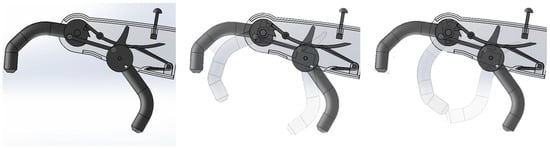
Figure 2.
Mechanism of the first “Iron Hand” with the opposing thumb: CAD simulation; Autodesk Inventor (Autodesk Inc., Dublin, Ireland).
Despite the figures shown, at this stage of the present article, it is only vaguely possible to foresee what opportunities the prosthesis in question offers to the user. In a previous review of the 3D-printed polymer replica of the first “Iron Hand”, some photographs were shown in everyday situations (Figure 3). However, in our opinion, valuable information remains missing that can only be understood from a video demonstration, which is added available via the link in the Supplementary Materials (Video S1).

Figure 3.
Photographs of the replica in different everyday situations, from left to right: holding a handle of a barbecue, a handle of a garden hose, a branch of a peach tree, and a peach. From [10], © 2020 by A. Otte. Licensee MDPI, Basel, Switzerland, distributed under the terms and conditions of the Creative Commons Attribution (CC BY) license (http://creativecommons.org/licenses/by/4.0/).
It is up to the reader to now decide the value that such a video demonstration may provide.
Supplementary Materials
The following supporting information can be downloaded at: https://www.mdpi.com/article/10.3390/prosthesis7030054/s1, Video S1: video demonstration of the mechanism of the replica (sequence 1), video demonstration of the replica in different everyday situations (sequences 2 and 3).
Funding
This research received no external funding.
Institutional Review Board Statement
Not applicable.
Informed Consent Statement
Not applicable.
Conflicts of Interest
The authors declare no conflict of interest.
References
- von Berlichingen, G. Biography of the Knight Götz von Berlichingen; Reclam: Stuttgart, Germany, 2014. (In German) [Google Scholar]
- von Mechel, C. The Iron Hand of the Brave German Knight Götz von Berlichingen; Georg Decker: Berlin, Germany, 1815. (In German) [Google Scholar]
- Quasigroch, G. The hand prostheses of the Franconian imperial knight Götz von Berlichingen–The Landshut accident. Z. Ges. Hist. Waffen- Kostümkunde 1980, 24, 108–112. (In German) [Google Scholar]
- Quasigroch, G. The hand prostheses of the Franconian imperial knight Götz von Berlichingen. 1st continuation: The first hand. Z. Ges. Hist. Waffen- Kostümkunde 1982, 24, 17–33. (In German) [Google Scholar]
- Quasigroch, G. The hand prostheses of the Franconian imperial knight Götz von Berlichingen. 2nd continuation: The second hand. Z. Ges. Hist. Waffen- Kostümkunde 1983, 25, 103–120. (In German) [Google Scholar]
- Löffler, L. The Replacement of the Upper Extremity: The Development from the First Testimonies Until Today; Enke: Stuttgart, Germany, 1984. (In German) [Google Scholar]
- Otte, A. Lessons Learnt from Götz of the Iron Hand. Prosthesis 2022, 4, 444–446. [Google Scholar] [CrossRef]
- Otte, A.; Hazubski, S. Reconstructing the First “Iron Hand” of Knight Götz von Berlichingen and Its Derived Modern Developments: Back to the Future. Prosthesis 2024, 6, 274–276. [Google Scholar] [CrossRef]
- Otte, A. Johann Wolfgang von Goethe, Götz von Berlichingen, and the “Iron Hands”. Prosthesis 2024, 6, 506–508. [Google Scholar] [CrossRef]
- Otte, A. 3D Computer-Aided Design Reconstructions and 3D Multi-Material Polymer Replica Printings of the First “Iron Hand” of Franconian Knight Gottfried (Götz) von Berlichingen (1480–1562): An overview. Prosthesis 2020, 2, 304–312. [Google Scholar] [CrossRef]

Disclaimer/Publisher’s Note: The statements, opinions and data contained in all publications are solely those of the individual author(s) and contributor(s) and not of MDPI and/or the editor(s). MDPI and/or the editor(s) disclaim responsibility for any injury to people or property resulting from any ideas, methods, instructions or products referred to in the content. |
© 2025 by the authors. Licensee MDPI, Basel, Switzerland. This article is an open access article distributed under the terms and conditions of the Creative Commons Attribution (CC BY) license (https://creativecommons.org/licenses/by/4.0/).