Article

Impact of Feeding Pattern on the Structure and the Economic Performance of Dairy Cow Sector


by
Athanasios Ragkos
1,
Georgia Koutouzidou
2 and
Alexandros Theodoridis
3,*
1
Agricultural Economics Research Institute, Hellenic Agricultural Organization—DIMITRA, 11528 Athens, Greece
2
Department of Applied Informatics, University of Macedonia, Egnatia 156, 54006 Thessaloniki, Greece
3
School of Veterinary Medicine, Aristotle University of Thessaloniki, 54006 Thessaloniki, Greece
*
Author to whom correspondence should be addressed.
Dairy 2021, 2(1), 122-134; https://doi.org/10.3390/dairy2010012
Submission received: 25 December 2020 / Revised: 20 February 2021 / Accepted: 26 February 2021 / Published: 3 March 2021

Abstract

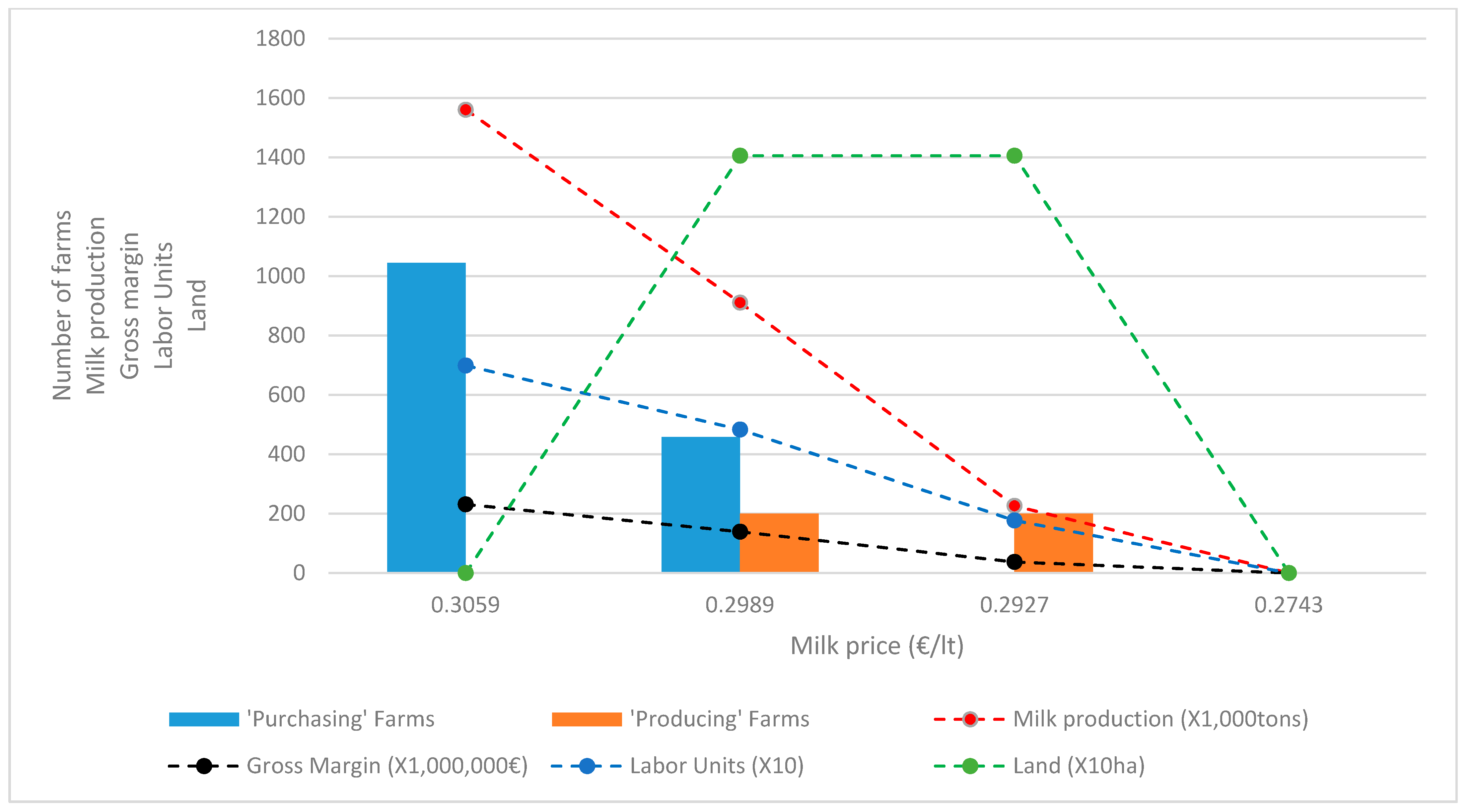
In dairy farms, the feeding cost, which includes the expenses for purchased feed but also the expenses for feed production, constitutes a very large part of production cost (more than 60%), which indicates the economic importance of the feeding strategy. This study discerns three different feeding strategies: landless farms only purchasing feed from markets (“Purchasing”), farms for which home-grown feeds stand for more than 10% of feeding costs (“Producing”) and farms with less than 10% home-grown feeds (“Multi-purpose”). Based on technical and economic data from 47 dairy cow farms in Greece, alternative scenarios of development of the dairy sector are determined taking into account the dependence on on-farm feed production. Through a parametric programming model, the study provides insights regarding the optimal structure of the system under different scenarios (changing availability of variable capital, changes in milk prices). The results indicate that “Purchasing” farms are the preferred option when variable capital is abundant and milk prices are satisfactory, while “Producing” are the ones surviving with milk prices significantly lower than the actual ones in Greece and European Union. “Multi-purpose” farms perform worse than the other two and are sidelined in both scenarios, as they do not seem to be able to specialize in the dairy enterprise or in crop production and thus to minimize costs.
Keywords: dairy farms; feedstuff production; parametric programming dairy farms; feedstuff production; parametric programming