


Interventional Studies on Nurses’ Mental Health in the COVID-19 Pandemic: A Systematic Review
Abstract
1. Introduction
- What are the interventional studies to protect and improve the mental health of nurses during the COVID-19 pandemic?
2. Materials and Methods
2.1. Research’s Aim and Design
2.2. Search Method
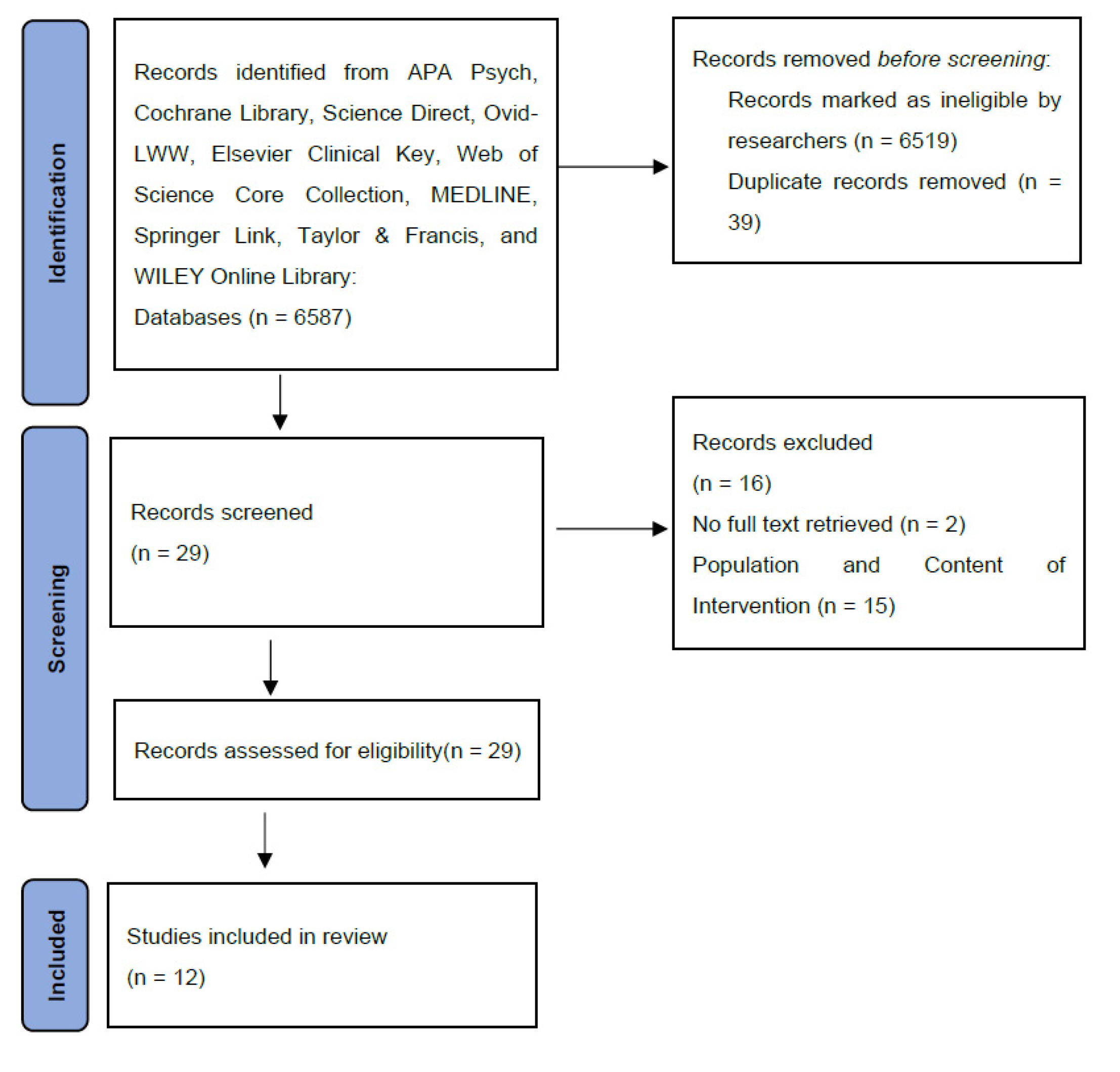
2.3. Research Selection and Evaluation
- Conducted during the COVID-19 pandemic
- Sample: Only nurses who cared for patients diagnosed with COVID-19
- Intervention studies aimed at protecting and improving the mental health of nurses
- The research design: pre-test/post-test studies, quasi-experimental studies (non-randomized controlled trials), or randomized controlled trials
- Original and quantitative quality with full text available online
- Written in English
- Studies published in an international peer-reviewed journal between 1 January 2020–30 June 2022
3. Results
Results from Studies
4. Discussion
Limitations
5. Conclusions
Author Contributions
Funding
Institutional Review Board Statement
Informed Consent Statement
Data Availability Statement
Conflicts of Interest
References
- Jain, V.K.; Iyengar, K.; Vaish, A.; Vaishya, R. Differential mortality in COVID-19 patients from India and western countries. Diabetes Metab. Syndr. 2020, 14, 1037–1041. [Google Scholar] [CrossRef] [Scilit] [PubMed]
- Tsamakis, K.; Rizos, E.; Manolis, A.J.; Chaidou, S.; Kympouropoulos, S.; Spartalis, E.; Spandidos, D.A.; Tsiptsios, D.; Triantafyllis, A.S. COVID-19 pandemic and its impact on mental health of healthcare professionals. Exp. Ther. Med. 2020, 19, 3451–3453. [Google Scholar] [CrossRef] [Scilit] [PubMed]
- Braquehais, M.D.; Vargas-Cáceres, S.; Gómez-Durán, E.; Nieva, G.; Valero, S.; Casas, M.; Bruguera, E. The impact of the COVID-19 pandemic on the mental health of healthcare professionals. QJM 2020, 113, 613–617. [Google Scholar] [CrossRef] [Scilit] [PubMed]
- Chidiebere Okechukwu, E.; Tibaldi, L.; La Torre, G. The impact of COVID-19 pandemic on mental health of Nurses. Clin. Ter. 2020, 171, e399–e400. [Google Scholar] [CrossRef] [Scilit]
- Di Tella, M.; Romeo, A.; Benfante, A.; Castelli, L. Mental health of healthcare workers during the COVID-19 pandemic in Italy. J. Eval. Clin. Pract. 2020, 26, 1583–1587. [Google Scholar] [CrossRef] [Scilit]
- Murat, M.; Köse, S.; Savaşer, S. Determination of stress, depression and burnout levels of front-line nurses during the COVID-19 pandemic. Int. J. Ment. Health Nurs. 2021, 30, 533–543. [Google Scholar] [CrossRef] [Scilit]
- Arnetz, J.E.; Goetz, C.M.; Sudan, S.; Arble, E.; Janisse, J.; Arnetz, B.B. Personal protective equipment and mental health symptoms among nurses during the COVID-19 pandemic. J. Occup. Environ. Med. 2020, 62, 892–897. [Google Scholar] [CrossRef] [Scilit]
- Campos, J.A.D.B.; Martins, B.G.; Campos, L.A.; de Fátima Valadão-Dias, F.; Marôco, J. Symptoms related to mental disorder in healthcare workers during the COVID-19 pandemic in Brazil. Int. Arch. Occup. Environ. Health 2021, 94, 1023–1032. [Google Scholar] [CrossRef] [Scilit]
- Sampaio, F.; Sequeira, C.; Teixeira, L. Impact of COVID-19 outbreak on nurses’ mental health: A prospective cohort study. Environ. Res. 2021, 194, 110620. [Google Scholar] [CrossRef] [Scilit]
- Simonetti, V.; Durante, A.; Ambrosca, R.; Arcadi, P.; Graziano, G.; Pucciarelli, G.; Simeone, S.; Vellone, E.; Alvaro, R.; Cicolini, G. Anxiety, sleep disorders and self-efficacy among nurses during COVID-19 pandemic: A large cross-sectional study. J. Clin. Nurs. 2021, 30, 1360–1371. [Google Scholar] [CrossRef] [Scilit]
- Tokay Argan, M.; Mersin, S. Life satisfaction, life quality, and leisure satisfaction in health professionals. Perspect. Psychiatr. Care 2021, 57, 660–666. [Google Scholar] [CrossRef] [Scilit] [PubMed]
- Liu, Y.; Jiang, T.T.; Shi, T.Y.; Liu, Y.N.; Liu, X.M.; Xu, G.J.; Li, F.L.; Wang, Y.L.; Wu, X.Y. The effectiveness of diaphragmatic breathing relaxation training for improving sleep quality among nursing staff during the COVID-19 outbreak: A before and after study. Sleep Med. 2021, 78, 8–14. [Google Scholar] [CrossRef] [Scilit]
- Dincer, B.; Inangil, D. The effect of Emotional Freedom Techniques on nurses’ stress, anxiety, and burnout levels during the COVID-19 pandemic: A randomized controlled trial. Explore 2021, 17, 109–114. [Google Scholar] [CrossRef] [Scilit] [PubMed]
- Köse, S.; Gezginci, E.; Göktaş, S.; Murat, M. The effectiveness of motivational messages to intensive care unit nurses during the COVID-19 pandemic. Intensive Crit. Care Nurs. 2022, 69, 103161. [Google Scholar] [CrossRef] [Scilit] [PubMed]
- Goktas, S.; Gezginci, E.; Kartal, H. The effects of motivational messages sent to emergency nurses during the COVID-19 pandemic on job satisfaction, compassion fatigue, and communication skills: A randomized controlled trial. J. Emerg. Nurs. 2022, in press. [Google Scholar] [CrossRef] [Scilit] [PubMed]
- Han, J.; Zhang, L.; Liu, Y.; Zhang, C.; Zhang, Y.; Tang, R.; Bi, L. Effect of a group-based acceptance and commitment therapy programme on the mental health of clinical nurses during the COVID-19 sporadic outbreak period. J. Nurs. Manag. 2022. ahead of print. [Google Scholar] [CrossRef] [Scilit] [PubMed]
- Hausswirth, C.; Nesi, X.; Dubois, A.; Duforez, F.; Rougier, Y.; Slattery, K. Four weeks of a Neuro-Meditation program improves sleep quality and reduces hypertension in nursing staff during the COVID-19 pandemic: A parallel randomized controlled trial. Front. Psychol. 2022, 13, 854474. [Google Scholar] [CrossRef] [Scilit]
- Ha, Y.; Lee, S.H.; Lee, D.H.; Kang, Y.H.; Choi, W.; An, J. Effectiveness of a Mobile Wellness Program for nurses with rotating shifts during COVID-19 pandemic: A pilot cluster-randomized trial. Int. J. Environ. Res. Public Health 2022, 19, 1014. [Google Scholar] [CrossRef] [Scilit]
- Yıldırım, D.; Çiriş Yıldız, C. The effect of Mindfulness-Based Breathing and Music Therapy Practice on nurses’ stress, work-related strain, and psychological well-being during the COVID-19 pandemic: A randomized controlled trial. Holist. Nurs. Pract. 2022, 36, 156–165. [Google Scholar] [CrossRef] [Scilit]
- Sis Çelik, A.; Kılınç, T. The effect of laughter yoga on perceived stress, burnout, and life satisfaction in nurses during the pandemic: A randomized controlled trial. Complementary Ther. Clin. Pract. 2022, 49, 101637. [Google Scholar] [CrossRef] [Scilit]
- Hsieh, H.F.; Huang, Y.T.; Ma, S.C.; Wang, Y.W. Occupational burnout and stress of nurses in Taiwan regarding COVID-19: An intervention with gong medication. J. Nurs. Manag. 2022. ahead of print. [Google Scholar] [CrossRef] [Scilit] [PubMed]
- Bektaş Akpınar, N.; Özcan Yüce, U.; Yurtsever, S. The Effect of Distant Reiki on the stress and fatigue levels of nurses working in COVID-19 clinics: A randomized-controlled, single-blind study. Holist. Nurs. Pract. 2022. ahead of print. [Google Scholar] [CrossRef] [Scilit] [PubMed]
- Zhou, K.; Kong, J.; Wan, Y.; Zhang, X.; Liu, X.; Qu, B.; Wang, B.; Xue, R. Positive impacts of e-aid cognitive behavioural therapy on the sleep quality and mood of nurses on site during the COVID-19 pandemic. Sleep Breath 2022. ahead of print. [Google Scholar] [CrossRef] [Scilit] [PubMed]
- Page, M.J.; McKenzie, J.E.; Bossuyt, P.M.; Boutron, I.; Hoffmann, T.C.; Mulrow, C.D.; Shamseer, L.; Tetzlaff, J.M.; Akl, E.A.; Brennan, S.E.; et al. The PRISMA 2020 statement: An updated guideline for reporting systematic reviews. BMJ 2021, 372, n71. [Google Scholar] [CrossRef] [Scilit]
- Higgins, J.P.T.; Green, S. Cochrane Handbook for Systematic Reviews of Interventions; Version, 6.3; Higgins, J.P.T., Thomas, J., Chandler, J., Cumpston, M., Li, T., Page, M.J., Welch, V.A., Eds.; John Wiley & Sons: Hoboken, NJ, USA, 2022. [Google Scholar]
- Labrague, L.J. Psychological resilience, coping behaviours and social support among health care workers during the COVID-19 pandemic: A systematic review of quantitative studies. J. Nurs. Manag. 2021, 29, 1893–1905. [Google Scholar] [CrossRef] [Scilit]
- Baskin, R.G.; Bartlett, R. Healthcare worker resilience during the COVID-19 pandemic: An integrative review. J. Nurs. Manag. 2021, 29, 2329–2342. [Google Scholar] [CrossRef] [Scilit]
- Fino, E.; Bonfrate, I.; Fino, V.; Bocus, P.; Russo, P.M.; Mazzetti, M. Harnessing distress to boost growth in frontline healthcare workers during COVID-19 pandemic: The protective role of resilience, emotion regulation and social support. Psychol. Med. 2021, 1–3. [Google Scholar] [CrossRef] [Scilit]

| (COVID-19 OR COVID-19 pandemic) AND (Nurses OR Nurse OR Nursing) AND (Mental Health OR Psychological Well-being) AND (Intervention OR Interventional Studies) |
| Article No: 1 Author(s): Liu, Y.; Jiang, T.T.; Shi, T.Y., Liu, Y.N.; Liu, X.M.; Xu, G.J.; Li, F.L.; Wang, Y.L.; Wu, X.Y. Publication year: 2021 Reference No: 12 | Aim: to investigate the effects of diaphragmatic breathing relaxation training on sleep quality, anxiety, and depression of nurses. Intervention: Diaphragmatic breathing relaxation training (DBRT):
The 30-min DBRT demonstration video was sent online, and participants were asked to practice at least once per day for four weeks. The session had a 5 min beginning, 20 min of relaxation, and a 5 min ending. | Population: Experimental group: 140 first-line nurses working during the pandemic in China. Nurses’ mean age: 32.39 ± 5.92 Nurses’ mean working years: 10.47 ± 5.86. Study Design: Quasi-experimental (before and after) intervention method. | Data Collection and Tools:
|
| Article No: 2 Author(s): Dincer, B.; Inangil, D. Publication year: 2021 Reference No: 13 | Aim: to investigate the efficacy of emotional freedom techniques in the prevention of stress, anxiety, and burnout. Intervention: The intervention group received a 20-min guided online emotional freedom techniques group session by a certified emotional freedom techniques researcher. Before the session, nurses were informed about the EFT process and acupuncture points. | Population: Intervention group: 35 Control group: 37 Nurses working in a university hospital during the pandemic in Turkey. Nurses’ mean age: intervention group 33.54 ± 9.83, and control group 33.37 ± 9.58. Study Design: Randomized controlled trial method. | Data Collection and Tools:
|
| Article No: 3 Author(s): Köse, S.; Gezginci, E.; Göktaş, S.; Murat M. Publication year: 2022 Reference No: 14 | Aim: to examine the effect of motivational messages on optimism, hopelessness, and life satisfaction. Intervention: Motivational messages were sent four times a day via SMS to the nurses in the motivational group for 21 days; those in the control group received no motivational messages. | Population: Motivational group: 41 Control group: 46 ICU nurses working during the pandemic in Turkey. Nurses’ mean age: motivational group 28.4 ± 7.6, and control group 26.9 ± 3.7. Study Design: Randomized controlled study. | Data Collection and Tools:
|
| Article No: 4 Author(s): Goktas, S.; Gezginci, E.; Kartal, H. Publication year: 2022 Reference No: 15 | Aim: to examine the effect of motivational messages on their levels of job satisfaction, compassion fatigue, and communication skills. Intervention: Nurses in the intervention group received motivational messages three times a day on their mobile phones for 21 days; those in the control group received no motivational messages. | Population: Intervention group: 30 Control group: 30 Emergency room nurses working in the COVID-19 pandemic in Turkey. Nurses’ mean age: intervention group: 29.8 ± 7.5, and control group: 28.7 ± 6.9. Study Design: Randomized controlled trial. | Data Collection and Tools:
|
| Article No: 5 Author(s): Han, J.; Zhang, L.; Liu. Y.; Zhang, C.; Zhang, Y.; Tang, R.; Bi, L. Publication year: 2022 Reference No: 16 | Aim: to develop and implement a group-based acceptance and commitment therapy program to reduce mental health problems. Intervention: Two main modules of the group-based acceptance and commitment therapy program were applied for five months. These modules deal with nurses’ work life and daily life, and they were conducted in five 40-min sessions. | Population: Intervention group: 226 from four hospitals Nurses working in the COVID-19 pandemic in China. 61.9% of the nurses were under the age of 30, 95.1% were women, 96.1% had a Bachelor’s degree, and 5.9% had 6–10 years of working experience. Study Design: Quasi-experimental design. | Data Collection and Tools:
|
| Article No: 6 Author(s): Hausswirth, C.; Nesi, X.; Dubois, A.; Duforez, F.; Rougier, Y.; Slattery, K. Publication year: 2022 Reference No: 17 | Aim: to evaluate the influence of mindfulness-based interventions on sleep and other stress-related parameters in nurses under increased work-related stress due to the COVID-19 pandemic. Intervention: Ten sessions of neuro-meditation were applied to nurses for four weeks in a laboratory room (called Rebalance© Impulse) in Sophia Antipolis, France. This intervention includes mindfulness training, sound therapy associated with light stimulation, and coach-led meditation. | Population: Normotensive group: 16 Hypertensive group: 13 Control group: 16 Nurses working in the COVID-19 pandemic in France. Nurses’ mean age: Normotensive group 43.8 ± 11.0, Hypertensive group 45.2 ± 10.,7 and Control group 44.9 ± 10.6. Study Design: Parallel randomized controlled trial. | Data Collection and Tools:
|
| Article No: 7 Author(s): Ha, Y.; Lee, S.H.; Lee, D.H.; Kang, Y.H.; Choi, W. An J. Publication year: 2022 Reference No: 18 | Aim: to develop and examine the effectiveness of a mobile wellness program on daily steps, sleep quality, exercise self-efficacy, intrinsic motivation for exercise, self-rated fatigue, and wellness. Intervention: The intervention group received a 12-week mobile wellness program to improve their physical activity and sleep quality via online platforms like Zoom, Kakao Talk, Fitbit, etc. Online group exercises were conducted every Tuesday and Thursday for one hour. The control group was only given a Fitbit to self-monitor their health behaviors. | Population: Intervention group: 30 Control group: 27 Surgical and internal medicine nurses working in the COVID-19 pandemic in Korea. Nurses’ mean age: intervention group 27.63 ± 3.05, and control group 27.03 ± 3.69. Most of the nurses in both groups had less than 10 years of professional experience and had 6 or fewer night shifts per month. Study Design: Cluster-randomized controlled trial. | Data Collection and Tools:
|
| Article No: 8 Author(s): Yıldırım, D.; Çiriş Yıldız, C. Publication year: 2022 Reference No: 19 | Aim: to investigate the effect of mindfulness-based breathing and music therapy practice on stress, work-related strain, and psychological well-being levels. Intervention: In a single session, 30 min of mindfulness-based breathing and music therapy were applied to the nurses via Zoom. At the beginning of the session, the nurses were informed, and then therapy was applied. | Population: Intervention group: 52 Control group: 52 Nurses working in the COVID-19 pandemic in Turkey. Nurses’ mean age: intervention group 27.55 ± 5.24, and control group 29.11 ± 6.57. Most of both groups worked in the pandemic wards and were not satisfied with the wards they worked in. Study Design: Randomized controlled study. | Data Collection and Tools:
|
| Article No: 9 Author(s): Sis Çelik, A.; Kılınç, T. Publication year: 2022 Reference No: 20 | Aim: to examine the effect of motivational messages sent to emergency nurses during the COVID-19 pandemic on their levels of job satisfaction, compassion fatigue, and communication skills. Intervention: A total of eight online (via Zoom) sessions of laughter yoga were applied to the nurses in the experimental group for four weeks, twice a week. Laughter yoga consists of laughter, deep-breathing exercises, and stretching–relaxation techniques. A 40-min session consists of four parts: deep-breathing exercises (5 min), warm-up exercises (10 min), childish games (10 min), and laughter exercises (15 min). | Population: Experimental group: 51 Control group: 50 Nurses working in the COVID-19 pandemic in Turkey. Nurses’ mean age: experimental group 28.86 ± 6.79, and control group 28.86 ± 56.06. It was seen that the number of nurses with 1–5 years of professional experience, those who were diagnosed with COVID-19, and those who received a COVID-19 vaccine was higher in both groups. Study Design: Experimental randomized controlled trial method. | Data Collection and Tools:
|
| Article No: 10 Author(s): Hsieh, H.F.; Huang, Y.T.; Ma, S.C.; Wang, Y.W. Publication year: 2022 Reference No: 21 | Aim: to explore the effectiveness of gong meditation on perceived stress and occupational burnout. Intervention: In the experimental group, participants were guided into meditation face-to-face by the qualified gong therapist, who struck the gong with a real-time adjusted rhythm, which depended on the sense of emotional resonance among the participants and the gong therapist. Participants underwent seven sessions (50–60 min) of gong intervention on two consecutive days. A one-hour rest session was planned between the two sessions. | Population: Experimental group: 40 Control group: 39 Nurses working in the COVID-19 pandemic in Taiwan. Nurses’ mean age: experimental group 42.30 ± 8.49, and control group 32.51 ± 8.24. Study Design: Experimental randomized controlled trial method. | Data Collection and Tools:
|
| Article No: 11 Author(s): Bektaş Akpınar, N.; Özcan Yüce, U.; Yurtsever, S. Publication year: 2022 Reference No: 22 | Aim: to determine the effect of distant Reiki on the stress and fatigue levels of nurses working during the COVID-19 pandemic. Intervention: Reiki energy according to the Usui method is sent from a distance for a total of 20 min over 4 consecutive days. | Population: Reiki group: 30 Control group: 32 Nurses working in the COVID-19 pandemic in Turkey. Study Design: Pre/post-test, randomized controlled, single-blind trial method. | Data Collection and Tools:
|
| Article No: 12 Author(s): Zhou, K.; Kong, J.; Wan, Y.; Zhang, X.; Liu, X.; Qu, B.; Wang, B.; Xue, R. Publication year: 2022 Reference No: 23 | Aim: to observe the effects of the e-aid cognitive behavioral therapy (eCBT-I) on the sleep quality, anxiety, and depression of nurses on site with chronic insomnia, and to provide more clinical evidence for the application of eCBT-I in nurses with different degrees of insomnia. Intervention: eCBT-I treatment course was 6 weeks. The specific program contents included: Week 1—understanding sleep Week 2— learning sleep restriction methods Week 3—enhancing the association between bed and sleep Week 4—identifying insomnia and managing bad moods before sleep Week 5—learning how to control anxiety and minimize worries before bed Week 6—preventing relapse and learning to cope with acute insomnia The treatment plan was shared through the online platform at least once per week for communication and interaction, thus enabling a dynamic understanding of the treatment status of each subject. | Population: eCBT-I group: 60 Control group: 58 Nurses working in the COVID-19 pandemic and suffering from chronic insomnia in China. Nurses’ mean age: eCBT-I group 31.0 ± 4.4, and control group 29.6 ± 4.5. Study Design: Randomized controlled method. | Data Collection and Tools:
|
Publisher’s Note: MDPI stays neutral with regard to jurisdictional claims in published maps and institutional affiliations. |
© 2022 by the authors. Licensee MDPI, Basel, Switzerland. This article is an open access article distributed under the terms and conditions of the Creative Commons Attribution (CC BY) license (https://creativecommons.org/licenses/by/4.0/).
Share and Cite
Köse, S.; Murat, M. Interventional Studies on Nurses’ Mental Health in the COVID-19 Pandemic: A Systematic Review. Psych 2022, 4, 525-536. https://doi.org/10.3390/psych4030040
Köse S, Murat M. Interventional Studies on Nurses’ Mental Health in the COVID-19 Pandemic: A Systematic Review. Psych. 2022; 4(3):525-536. https://doi.org/10.3390/psych4030040
Chicago/Turabian StyleKöse, Selmin, and Merve Murat. 2022. "Interventional Studies on Nurses’ Mental Health in the COVID-19 Pandemic: A Systematic Review" Psych 4, no. 3: 525-536. https://doi.org/10.3390/psych4030040
APA StyleKöse, S., & Murat, M. (2022). Interventional Studies on Nurses’ Mental Health in the COVID-19 Pandemic: A Systematic Review. Psych, 4(3), 525-536. https://doi.org/10.3390/psych4030040

