


Abstract
The environmental pollution caused by emerging organic contaminants—such as ibuprofen—is becoming increasingly a cause for alarm. New treatments for their removal are currently being developed, but the nature and toxicity of the transformation products (TPs) formed during the processes cannot be readily assessed experimentally. Atomistic simulations are thus of high interest in predicting the chemical structure of these TPs. In this paper, we demonstrate that the transformation of a contaminant molecule under irradiation can be studied using the threshold algorithm combined with the density functional-based tight-binding (DFTB) method. The fragmentation pathways of an ibuprofen molecule under irradiation are studied as a function of the energy added to the system. Specifically, the chemical structures of ibuprofen’s TPs, the paths between them, their stabilities, probabilities of occurrence, and the related mass spectra were obtained as a function of the amount of energy absorbed. We also simulated the evolution of the ibuprofen molecule as a function of the number of pulses, i.e., for a sequence of energy depositions. A dominant fragmentation scheme is identified, where first the OH group is released, followed by the loss of the CO group. The photon energy and the number of pulses are found to be key parameters for the selection of this degradation route among all identified fragmentation pathways.
1. Introduction
A major source of environmental pollution is the so-called emerging organic contaminants (EOCs) [1,2,3,4], which encompass a large variety of chemical compounds, including, for example, pharmaceuticals, hormones, endocrine disruptors, industrial chemicals, pesticides, personal care products, surfactants, or plasticizers. A number of these compounds are not properly removed in conventional waste water treatments and are thus released into the environment, leading to environmental and health issues, prioritizing the development of highly controlled water treatment methods [5,6,7,8,9]. One of the major EOCs is the ibuprofen molecule (C15H18O2, 2-(4-isobutylphenyl) propionic acid), which ranks third on the list of the world’s most widely consumed drugs [10,11,12]. This drug is often prescribed for pain relief, arthritis, non-rheumatic inflammation, fever and dysmenorrhea [13]. Its accumulation in soils and waste waters is of considerable concern because of its significant toxicity, particularly with respect to reproduction and other physiological implications [11,12,14]. Its removal or degradation has thus become a high priority.
Various strategies for ibuprofen removal based on physical, chemical or biological methods are available or under development [10]. Among them, molecular degradation schemes appear to be appealing alternatives. However, this approach presents a major risk, linked to the lack of knowledge about the nature of degradation products (often called transformation products—TPs), which can be even more toxic than ibuprofen [15]. It is therefore crucial to determine which TPs are generated, depending on the method and the degradation environment.
Ibuprofen’s degradation has been extensively studied in water environments via, for example, photon absorption-based processes [16,17,18,19,20], possibly assisted by metal-based catalytic surfaces or nanoparticles [18,21,22], thermal treatments [23,24], bacteria-based biodegradation [11] or electro-oxidation [25]. Note that various environmental parameters can affect the degradation; examples are the pH value, the ion concentration, the presence of other organic materials or humus and the level of dissolved oxygen [26]. Some studies have been devoted to the investigation of the behavior at the water–atmosphere interface of semi-volatile ibuprofen TPs, such as 4-Isobutylacetophenone (IbaP) [27], or the degradation of ibuprofen in the gas phase [28]. In most existing studies, the TPs are identified in experiments through mass spectrometry, and their structures as well as the transformation paths among them are inferred from chemical intuition. However, due to the size of the molecule, the number of TPs that may be formed as well as the various fragmentation and recombination routes can be enormous, and there is a need for support from quantum chemical theoretical methods.
In the case of a limited number of competitive dissociation paths, ab initio calculations, employing, for example, wave function-based methods, can be used to provide energetic dissociation profiles along cuts in the potential energy surfaces. Minimum Energy Paths (MEPs) including the identification of transition states can be obtained from methods like the nudged elastic band approach [29,30]; these require the computation of energy gradients, which is mostly performed at the Density Functional Theory (DFT) level [31]. Beyond the identification of the MEPs, entropic contributions can be deduced from biased dynamical simulations, like umbrella sampling [32] or metadynamics [33].
Identifying the dominant dissociation routes for extended molecules presents additional challenges due to the large number of degrees of freedom and consequently of possible fragmentation channels, highly complicating or ruling out the use of chemical intuition to identify and select the relevant ones. To address this challenge, unbiased exploration schemes are most suitable, often relying on molecular dynamics or Monte Carlo-based approaches to move on the energy landscape of the system [34]. Among them, the threshold algorithm [35,36,37,38,39] has become a popular tool as it makes it possible to obtain a detailed map of the dominant isomerization and dissociation processes available below a given energy, incorporating entropic contributions to the probability of the various dissociation pathways. The broad and statistically relevant overview over the accessible region of the landscape provided by such unbiased exploration schemes is obtained at the price of a large number (typically millions) of single-point energy/force calculations, preventing the use of wave function and DFT schemes. Thus, the use of semi-empirical schemes is appealing since these schemes are several orders of magnitude faster than ab initio calculations. In particular, the density functional-based tight-binding (DFTB) scheme [40,41] can be highly appealing. The DFTB scheme inherits, from tight-binding models, a computationally efficient mathematical formalism, whereas it inherits from DFT the ability to address chemical reactivity, i.e., the breaking and forming of bonds, and therefore can provide a valid description of dissociation processes. Applications of the DFTB method range from clusters, solid-state physics, and nanomaterials, to environmentally relevant biological molecules [42,43,44,45,46,47]. We have recently combined the threshold algorithm with the DFTB energy function, and we have reported its ability to map the competitive isomerization processes within a gold cluster [48] or within a naphthalene molecule [49].
In the present paper, we report, for the first time, the use of the coupled DFTB–threshold algorithm to investigate the competition between dissociation pathways for an ibuprofen molecule at various molecular internal energies. This scheme is also used to simulate the evolution of ibuprofen undergoing successive photon absorptions. This exploration was performed in the absence of a water environment as a proof of concept of the general approach, allowing us to directly compare our TPs with those observed in vacuum in the studies reported in ref. [28]. The identification of the main TPs is expected to contribute to unraveling the structures and dissociation pathways of the experimentally observed TPs, regardless of the specific ibuprofen degradation method and the medium where the degradation occurs.
In Section 2, computational details regarding the threshold exploration and the DFTB energy function are given, as well as the strategy followed to simulate the evolution of a population of ibuprofen molecules as a function of their internal energy. The results are presented in Section 3, including a detailed description of the TPs, a mapping of the dominant degradation fluxes and the simulation of the evolution of the mass spectra induced by sequential energy deposition. Finally, the results are compared with the literature and critically discussed.
2. Methods
2.1. The DFTB Potential Energy
The potential energy calculations were conducted with the DFTB method. In this approximated DFT scheme, all integrals are tabulated and the molecular orbitals are expressed on a minimal valence atomic basis. This results in computational costs hundreds to thousand times lower than those of its DFT equivalent. More information about the method and its approximations can be found in the original papers or recent reviews [40,41,42,43,44]. In the present study, we make use of the original formulation of DFTB which is derived from DFT through a first-order expansion of the electronic density with respect to a reference density, also known as DFTB0. Higher-order DFTB has not been used, in order to avoid issues during the fragmentation (self-consistent loop convergence and partial charges on fragments). This approximation is expected to have quite a minor impact on both relative energies and barrier heights, as chemical bond energy is reasonably well-described at the DFTB0 level. All calculations were performed with the developer version of the deMonNano code [50] with the DFTB parameters developed in ref. [51].
2.2. The Threshold Algorithm
The threshold algorithm [35,36,39] has been developed to explore the relevant low-energy regions of the energy landscape of complex systems with continuous state spaces such as molecules, clusters or periodic approximants to crystalline and amorphous solids. Starting from a microstate of interest of the system—typically a low-energy minimum corresponding to a stable isomer of the molecule being studied—the region of the landscape accessible from below a given jth energy threshold is explored using a random walk; in the case of chemical systems, the moveclass used to select the next microstate corresponds to random small changes in the atom positions. During this random walk, every move from an ith microstate to a neighbor state is accepted as long as the state lies below the energy threshold, i.e., . Along this path, the walker samples the local density of states of the landscape pocket accessible from below lid . Furthermore, periodically, the walker stops along its trajectory, and one or more stochastic quenches, followed by local gradient optimization, are performed from these stopping points into the accessible local minima, which can eventually be a fragmented system made of two or several TPs, and the frequency of occurrence of various local minima is registered as a function of time along the trajectory.
This procedure is repeated for an increasing sequence of energy lids (), and from all relevant local minima obtained during the exploration. Analyzing these data yields the likelihood of reaching the neighbor minima as a function of energy, and thus not only the height of the energy barriers between the low-energy minima can be ascertained but also the entropic barriers separating them. For more details, we refer to the study reported in ref. [39].
In the specific study presented here, the lid energy can be seen as the energy of a photon absorbed by either the ibuprofen molecule or by a given TP. Analyzing the accessible minima associated with the TPs and the frequency of their occurrence when starting from the ibuprofen molecule or one of the other TPs provides both the possible degradation pathways and their probability, as a function of photon energy. In order to establish sufficiently high statistics, a large enough number of threshold runs were performed for every starting point and lid value.
2.3. Computational Details
2.3.1. Lid Energy Range for Fragmentation
In a preliminary set of threshold runs, the lid range of interest was established. As the lowest lid value of interest, a value of 0.20 Ha was chosen, because for the test runs at lower energies (0.01 to 0.10 Ha) no ibuprofen fragmentation was observed. Since for a lid of 0.5 Ha the ibuprofen molecule immediately splits into many small fragments, making any chemical fragmentation path analysis impossible, only lids below 0.5 Ha were suitable. Thus, six lid energies, namely 0.20, 0.25, 0.30, 0.35, 0.40 and 0.45 Ha, were employed in order to evaluate the effect of the energy given to the system on the various fragmentation pathways.
2.3.2. Scheme of Investigation
For each lid value, the following exploration scheme was used: A total of thirty six threshold runs were performed starting from the most stable ibuprofen isomer. Each individual threshold run consisted of MC steps, with 100 stopping points separated by MC steps along the trajectory. A MC step consisted of a random displacement of a single atom with a maximum amplitude of 0.1 Å. At each stopping point, one stochastic quench of MC steps was performed, followed by a gradient minimization. The structures of the resulting minimum atomic configurations were compared with the starting structure and other minima observed earlier.
Two types of transformations have been observed: the fragmentation of the starting molecule into fragments of smaller molar masses, and its isomerization leading to a different molecule with the same molar mass. A fragmentation test was carried out throughout the simulations, and each run was stopped as soon as fragmentation was detected. In the absence of fragmentation, the possibility of isomerization was tested by analyzing the final geometry. Each individual TP, arising from either fragmentation or isomerization, was stored in a TP structure library. For each stored TP j, its probability of occurrence was calculated by averaging over the results of each set of thirty six threshold calculations starting from the structure i, as well as its stability , i.e., its probability to either stay in or return to its starting configuration. The values were used to build a cumulative probability of occurrence (), defined as the product of the probabilities p leading to the TP j from the initial ibuprofen molecule (labeled as 206 according to its molar mass in atomic units), for example, = for three intermediary TPs k, and . If several paths lead to the same TP, the values obtained for the different routes are summed. The stability of all significant TPs was also investigated by relaunching a set of thirty six threshold runs from these fragments, and the process was repeated until only non-significant TPs were obtained. In practice, we have considered that a TP is non-significant (hereafter called negligible TP) at a given lid energy if its cumulative probability is below a critical significance threshold . In practice, we used for lids up to 0.35 Ha and for lids of 0.35 Ha and above, due to the higher complexity of the accessible region of the energy landscape at high lid values. Analyzing the threshold runs performed at each lid yields (i) the chemical structure of the TPs encountered, (ii) the probability flows between them, i.e., () and () represented in the form of a transition graph structure with ibuprofen as the root, and (iii) the simulation of mass spectra of ibuprofen exposed to successive absorption of photons with similar energies, as encountered during a sequence of laser pulses [19]. To compute the latter, the probability flows are gathered in a transition matrix P with . We define as the probability distribution of the TPs once the ibuprofen has been exposed to n laser pulses. is computed by the repeated application of the transition matrix P: , where corresponds to the initial state of the system; in particular, as we start with ibuprofen only, we have . A mass spectrum for the pulse can then be derived from . We emphasize that with this approach, only one-step fragmentation processes are considered for each pulse; fragmentations that consist of a sequence of several separate fragmentation processes, which are induced by a single pulse, are neglected. Indeed, we assume that most of the absorbed energy is dissipated during the first fragmentation via the breaking of the chemical bonds and acquisition of the kinetic energy by the fragments, leaving insufficient intramolecular energy in the TPs for a secondary fragmentation.
2.3.3. Transformation Tests and Library Construction: Technical Details
An atom–atom bond-based connectivity matrix representing the bond connectivity graph was built for each optimized structure. Its comparison to the connectivity matrix of the initial structure allows transformations to be detected. A bond between two atoms was considered to be present if the distance d between them did not exceed the typical DFTB equilibrium distance d0 for these two atoms by more than 5% ( = 1.55 Å, = 1.39 Å, = 1.12 Å and = 0.98 Å). Otherwise, the bond between the two atoms was considered to be broken or non-existent. If a fragmentation was detected, i.e., the bond graph consisted of two or more disconnected pieces, the smallest fragments were disregarded in the further analysis of the fragments, since the experimental studies mostly focus on the identification of TPs exhibiting large masses (typically above a hundred a.u.). Note that in the protocol used the fragments have the lowest multiplicity compatible with their number of electrons, allowing for the consideration of the radical character of some of them. If the connectivity matrix was modified but did not exhibit fragmentation, we visually checked whether the structure had remained chemically the same (with permutation of atoms of the same types) or had isomerized. This made it possible to compute the stability probability of the TPs identified. In order to avoid redundancy when adding a new TP to the library, it was visually compared to all the previously identified ones.
3. Results
3.1. Main Transformation Products
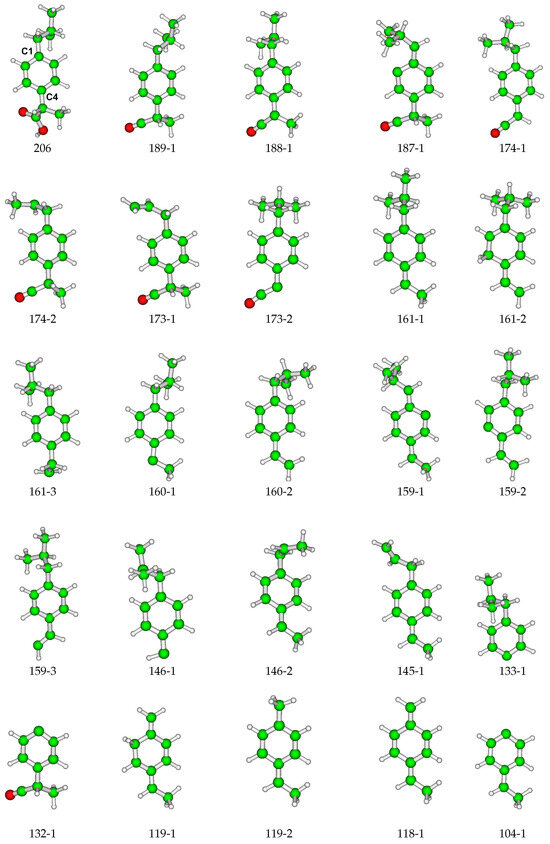
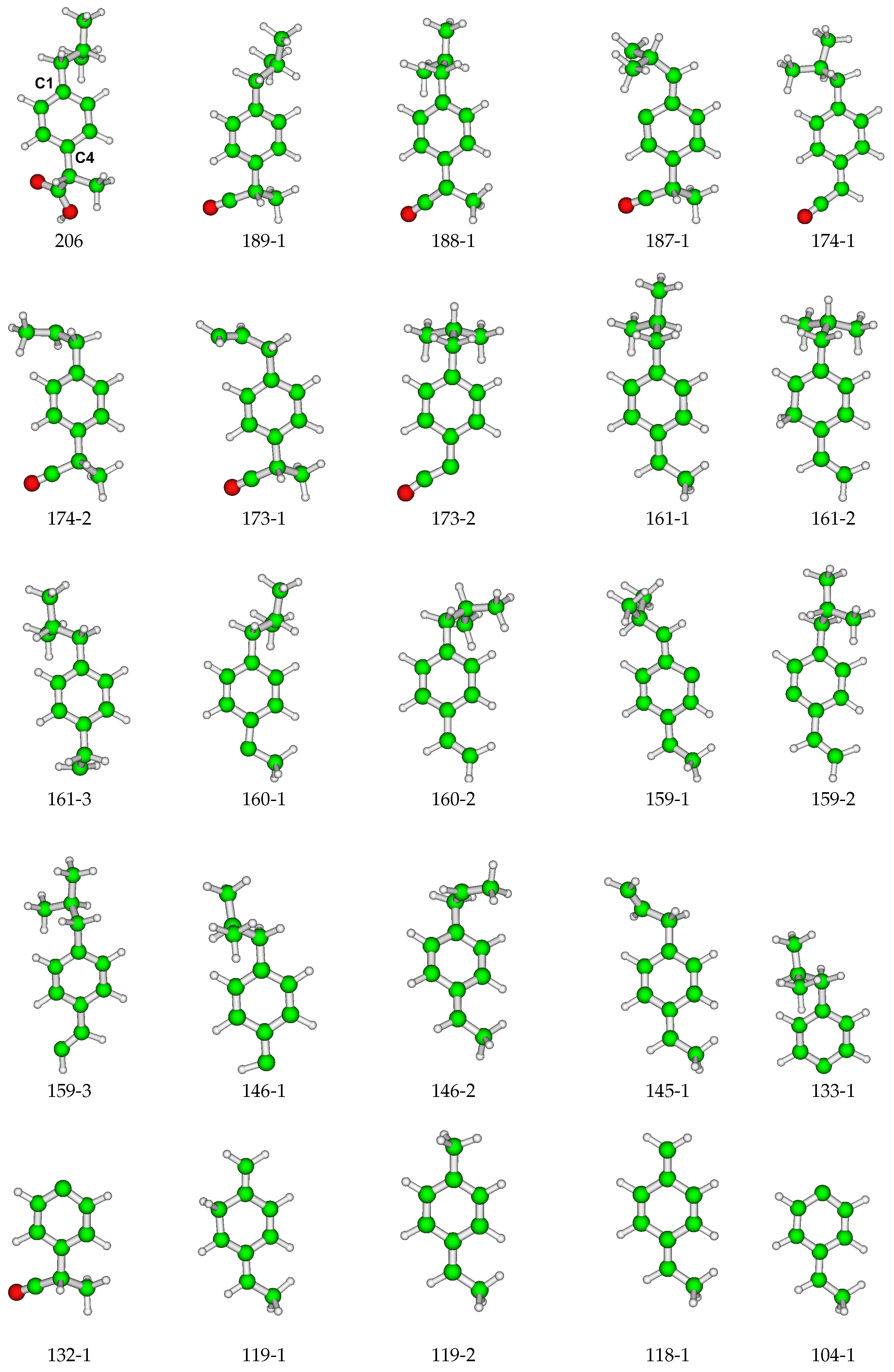
The twenty four significant (i.e., non-negligible) TPs identified during the explorations at the different lids are depicted in Figure 1. The TPs are arranged in decreasing order of molar mass, starting with the parent ibuprofen molecule which has a molar mass of 206 a.u. The name of a TP is a combination of its molar mass and of a second number to discriminate molecules presenting the same mass but different structures. For simplicity, we label C1 the ring carbon atom attached to the isobutyl group in the ibuprofen molecule and C4 the ring carbon atom attached to the propionic acid group (see Figure 1 for illustration). Note that in all TPs of Figure 1, we have kept the C1 atom at the top and the C4 atom at the bottom of the central ring. For sake of simplicity, the chains associated with these carbon atoms are referred to as C1 and C4 chains.
Figure 1.
Molecular structure of ibuprofen and the twenty four identified significant TPs. The naming of each TP is a combination of its molar mass and of a second number to distinguish molecules with the same mass but different structures. The TPs are sorted by decreasing molar mass (in a.u.). Oxygen, carbon and hydrogen atoms are depicted as red, green and white circles, respectively. C1 and C4 atoms—on the top and on the bottom of the central ring as shown in the structure of molar mass 206 (top left)—identify the ring carbon atoms attached to the isobutyl group and to the propionic acid group, respectively.
It appears that the ring remains unbroken in the twenty four significant TPs. We mention, however, that the breaking of the ring was observed in the benchmark simulations at the lid energy of 0.5 Ha. We first note that (a) for all twenty four TPs, the OH hydroxyl has disappeared, and that (b) for thirteen of the TPs, the isobutyl chain remains unchanged. The heaviest TP is therefore TP 189-1, which differs from ibuprofen only by the absence of the OH group, leading to a propan-1-one group (O=C-CHR-CH3) attached to C4. All the TPs can be classified into two groups, depending on whether these TPs do or do not contain an oxygen atom:
- The eight TPs containing an oxygen atom exhibit a carbonyl group (189-1, 188-1, 187-1, 174-1, 174-2, 173-1, 173-2 and 132-1) and these TPs correspond to the heaviest TPs, except for the TP 132-1. In five of them, the C4 atom is attached to a propan-1-one group (189-1, 187-1, 174-2, 173-1 and 132-1). In the three other TPs, the C4 chain differs from the propan-1-one group by the loss of a hydrogen atom (188-1), a methyl group (174-1) or both (173-2). In the C1 chain, the isobutyl group is retained in four TPs (189-1, 188-1, 174-1 and 173-2 ) and modified in the others (187-1, 174-2, 173-1, 132-1). Note that 187-1 also presents the loss of a hydrogen atom on the ring.
- The sixteen other TPs are oxygen-free. The isobutyl group is retained in the C1 chain for nine of them (161-1, 161-2, 161-3, 160-1, 160-2, 159-2, 159-3, 146-1, 133-1) and is modified in the seven other TPs (159-1, 146-2, 145-1, 119-1, 119-2, 118-1 and 104-1). One notices that four oxygen-free TPs exhibit either an addition (161-2 and 119-1) or a removal (159-1 and 159-2) of a hydrogen atom on the ring.
3.2. Transition Graphs
3.2.1. Transition Graph Description
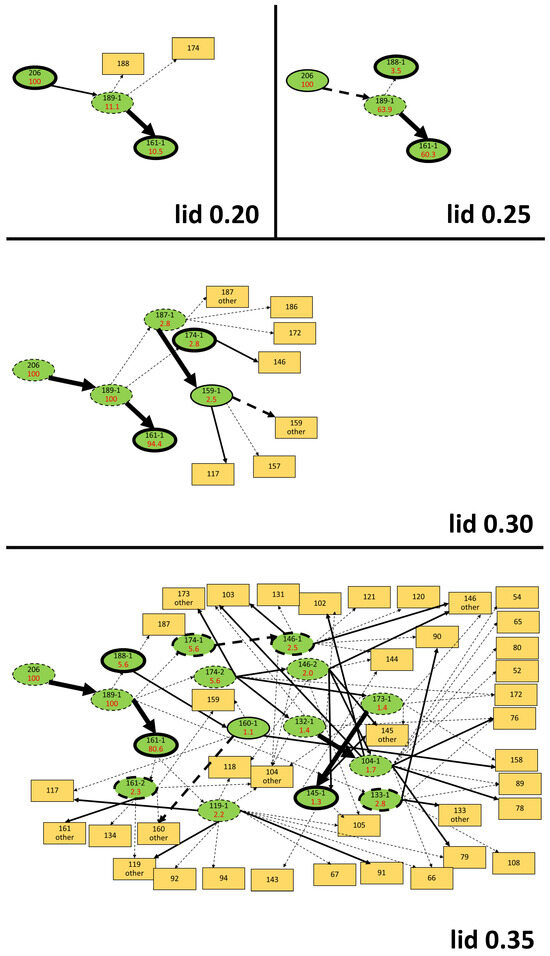
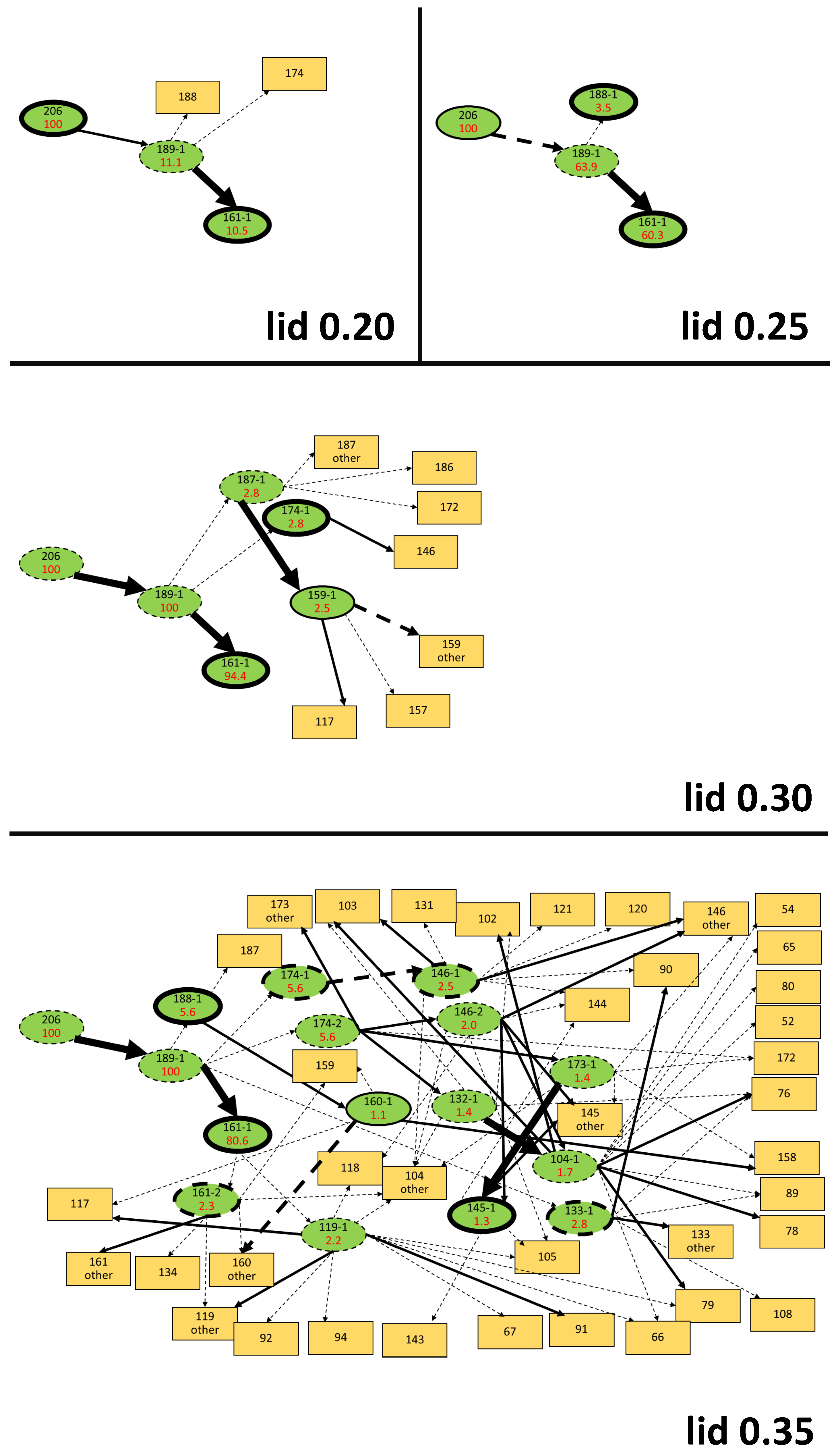
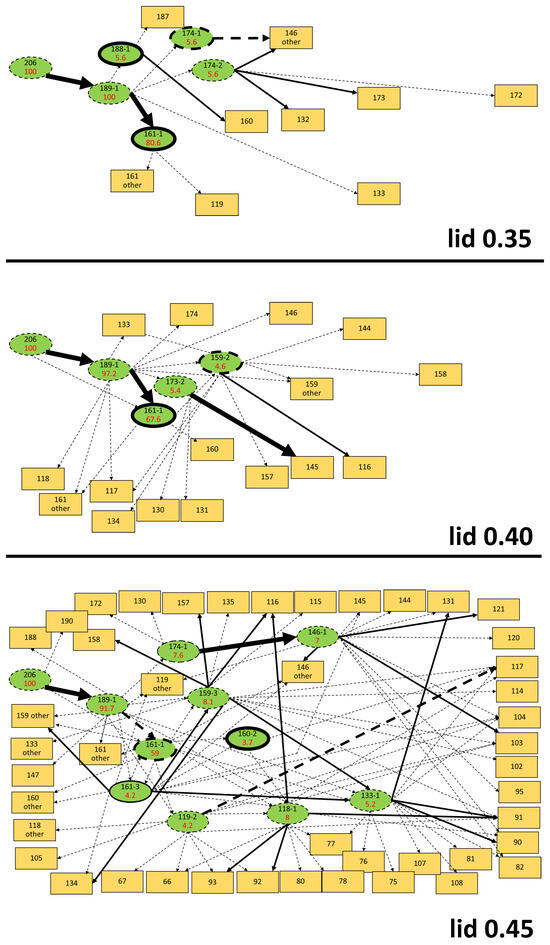
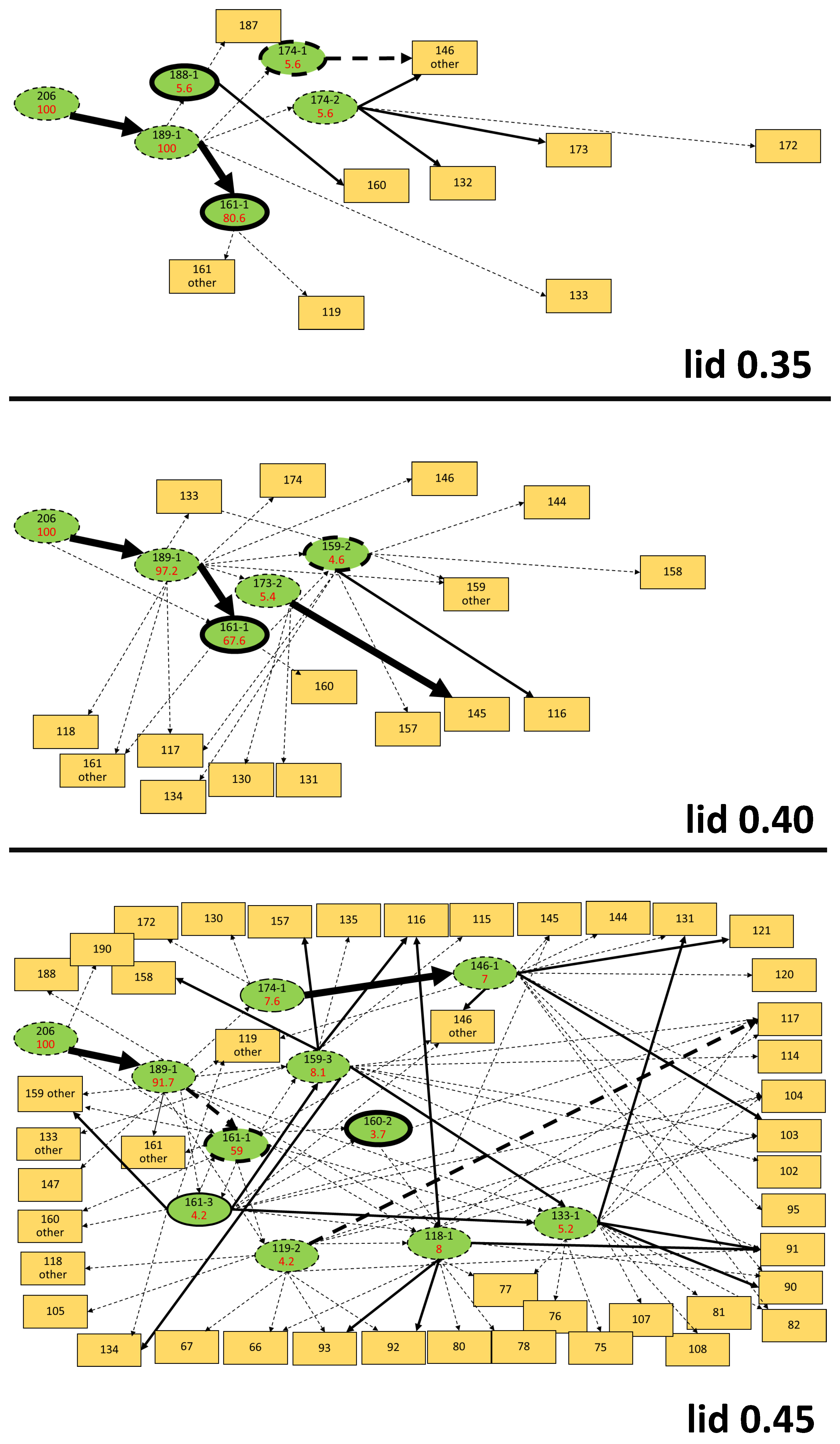
The ibuprofen fragmentation pathways are represented through their transition graphs in Figure 2 and Figure 3. On these graphs, the significant TPs, i.e., those matching the criterion of cumulative probability to be above 1% for lids 0.35 Ha in Figure 2 and 3% for lids 0.35 Ha in Figure 3, respectively, appear as green ellipses while the negligible ones appear as yellow rectangles. The green ellipse contains the identifier of the corresponding TP, and the value of the cumulative probability of reaching this TP from ibuprofen is indicated in red. The yellow rectangles represent all the negligible TPs with a given molar mass, and are labelled with “other” when at least one significant TP has the same mass. The stability probability () of each significant TP is indicated by the thickness and the type of the contour of the ellipse. The solid bold lines correspond to , the dashed thick lines to , the solid thin lines to and, finally, the dashed thin lines to . Let us note that, as the negligible TPs have not been used as starting geometries for threshold explorations, the corresponding cannot be computed and the corresponding rectangles contours have thus no meaning. The value of the transition probability from TP i to TP j is indicated by four possible arrow types using the same visual code. The corresponding intervals from the bold to the thinnest arrows are ( solid bold lines), ( dashed thick lines), ( solid thin lines) and (dashed thin lines).
Figure 2.
Transition graphs for ibuprofen degradation for lids 0.20, 0.30 and 0.35 Ha. Significant TPs, i.e., those matching the criterion of cumulative probability
, are depicted in green ellipses and negligible TPs are shown in yellow rectangles. The stability probability (pi→i) of each significant TP is shown by its ellipse contour type and the value of the transition probability pi→j from ith TP to jth TP is indicated by the corresponding arrow type. The four probability intervals for arrows and ellipse contours correspond to: [0%, 11%] (dashed thin), [11%, 42%] (solid thin), [42%, 70%] (dashed thick) and [70%, 100%] (solid bold).
Figure 3.
Transition graphs for lids 0.35, 0.40 and 0.45 Ha. Significant TPs, i.e., those matching the criterion of cumulative probability , are depicted in green ellipses and negligible TPs are shown in yellow rectangles. For notations, see Figure 2.
3.2.2. Main Degradation Channel: 206 → TP 189-1 → TP 161-1
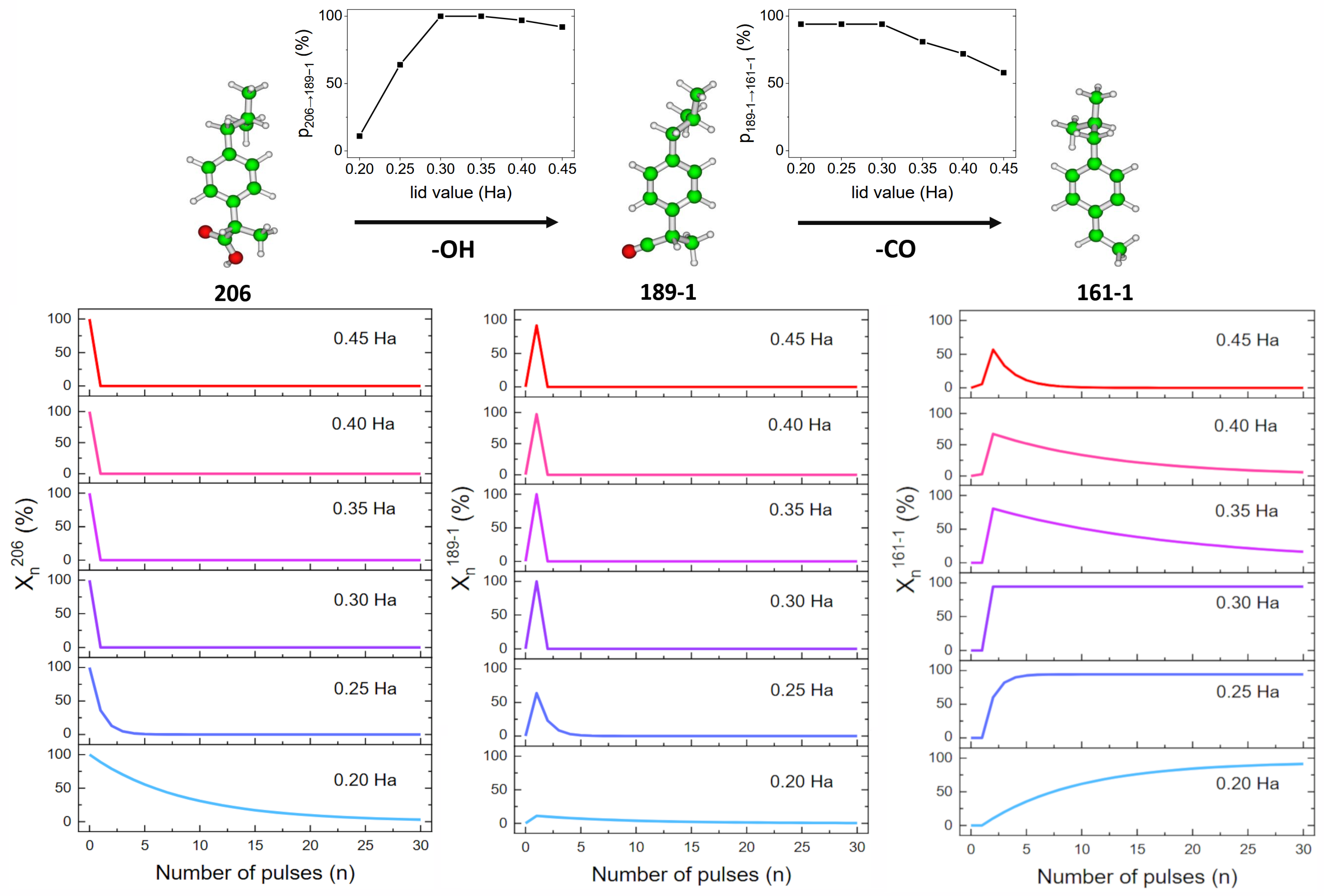
The probability of ibuprofen fragmentation increases with the energy given to the system, from 11% at lid 0.20 Ha to 64% at lid 0.25 Ha and 100% at and above lid 0.30 Ha. The dominant fragmentation channel starting from the ibuprofen molecule is the loss of the hydroxyl group leading to TP 189-1 (206 → TP 189-1). As can be seen from Figure 2, up to lid 0.35 Ha, it is the only possible dissociation channel. TP 189-1 is unstable () for all the lids investigated. It mainly transforms into TP 161-1 via the loss of a carbonyl function (TP 189-1 → TP 161-1) with = 95% for lids 0.20/0.25/0.30 Ha, 81% for lid 0.35 Ha, 72% for lid 0.40 Ha and 58% for lid 0.45 Ha. The main degradation channel is thus 206 → TP 189-1 → TP 161-1.
Interestingly, the creation of TP 161-1 must involve TP 189-1 as an intermediary fragment only up to lid 0.35 Ha. For higher lids, it can also come from the direct degradation of ibuprofen (206 → TP 161-1). One might question that at such a high lid energy, the molecule fragmentation might first have reached TP 189-1 and then continued to TP 161-1. But we recall that the protocol of the exploration stops at the first detected fragmentation; thus, at this higher energy lid, there is either a direct degradation of ibuprofen to TP 161-1 (i.e., the loss of the carboxyl group does not follow a sequential scheme but involves a single, possibly concerted, reaction coordinate) or a considerably fast, stepwise process that the algorithm does not resolve, i.e., an evolution of the system so rapid that the walker has already passed “through” the TP 189-1 state before even the first stopping point of the exploration has been reached. But that is only possible if the walker never enters the intermediary local minimum region and stays above it on the landscape, which precisely means that the transformation pathway avoids this intermediary TP 189-1 region and proceeds directly to TP 161-1.
The quite high cumulative probability of TP 161-1 being obtained from 0.25 Ha to 0.45 Ha (with 59% < < 94.4%) and its high enough stability makes it the main TP observed in our study. We finally note that, at lid 0.45 Ha, ibuprofen can also directly degrade into TP 190, but with a low transformation probability (). Moreover, the stability of TP 161-1 drops at this lid and it can produce numerous transformation products, opening routes toward new significant TPs (TP 161-1 → TPs 161-3/160-2/159-3/119-2/118-1/133-1).
3.2.3. Secondary Degradation Channels
Let us now address the secondary degradation paths by analyzing the routes between the significant TPs as a function of the lid values. These channels always present small cumulative probabilities ( < 8.1%) and are therefore quite minor routes with respect to the main channel. Although the corresponding transition probabilities are relatively small, and consequently more subject to statistical convergency issues, it makes sense to analyze the possible degradation routes and their significant TPs. In particular, the TPs presenting quite a high stability criterion are of interest, since they might be observed despite their relatively low formation probabilities. Four secondary degradation channels can be identified, for which, as in the main degradation channel, the first step consists of the ibuprofen → TP 189-1 transition.
A first secondary channel appears from lid 0.25 Ha with the release of one or two H atoms leading to TPs 188-1 and 187-1, respectively. TP 188-1, which exhibits an unchanged C1 group and a ketene function in its C4 chain, appears to be quite stable with at lid 0.25 Ha and 78% at lid 0.35 Ha. In contrast, TP 187-1 is only observed at lid 0.30 Ha and turns out to be highly unstable (). From lid 0.30 Ha, this degradation can be followed by a CO release (leading to TPs 160-1 and 159-1). Furthermore, from lid 0.30 Ha, a second secondary channel opens, with the release of a CH3 group from the C4 chain (TP 174-1), which is followed by a CO release at lid 0.35 Ha (TP 146-1). The third and fourth secondary channels appear only for lids 0.35 Ha. The third channel consists of the loss of the whole C4 chain (TP 133-1). Interestingly, one can note that all the significant TPs in the already discussed degradation routes maintained an intact carbon skeleton for the C1 chain. The fourth secondary channel consists of a degradation path involving the C1 chain breaking with the loss of a CH3 group leading to TP 174-2 followed by (i) the sequential removal of one hydrogen atom (TP 173-1) and a CO group (TP 145-1), (ii) the sequential removal of the remaining atoms from the C1 chain (TP 132-1) and a CO group (TP 104-1) or (iii) the sequential removal of a CO group (TP 146-2) followed by removal of one hydrogen atom (TP-145-1) or the remaining C1 chain (TP 104-1).
At the highest lids, the number of possible degradation pathways strongly increases, leading to plenty of TPs and the multiplication of accessible routes. The dominance of the main dissociation channel decreases, as can be seen, by considering that decreases from 94.4 to 59% between lids 0.30 and 0.45 Ha.
Finally, let us notice some general trends regarding the patterns associated with low or high stability (i.e., those shown with thin or thick ellipse contours in Figure 2 and Figure 3). All the structures presenting a C4 chain with a RR’-CH-CO pattern (TPs 189-1, 187-1 and 173-1) exhibit quite a low stability, as they can all readily lose the CO group. In addition, TP 189-1 can also lose a hydrogen atom (TP 189-1 → TP 188-1) to recover a ketene function. Moreover, it is worthy noticing that, apart from TP 145-1 in which the C1 chain turned into a vinylidene form, all the highly stable structures possess an unchanged C1 chain.
3.3. Multiple-Pulse-Induced Degradation Product Mass Spectra
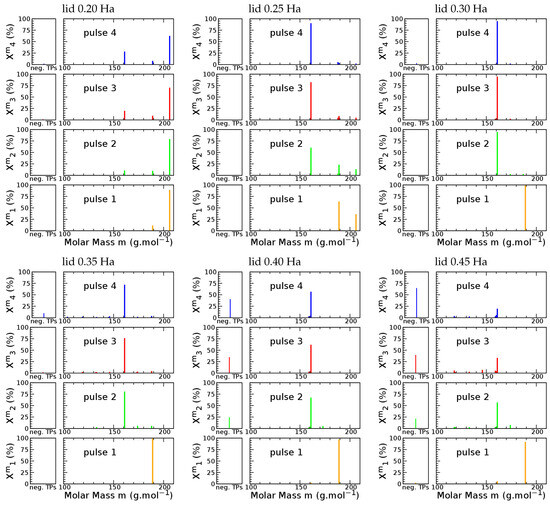
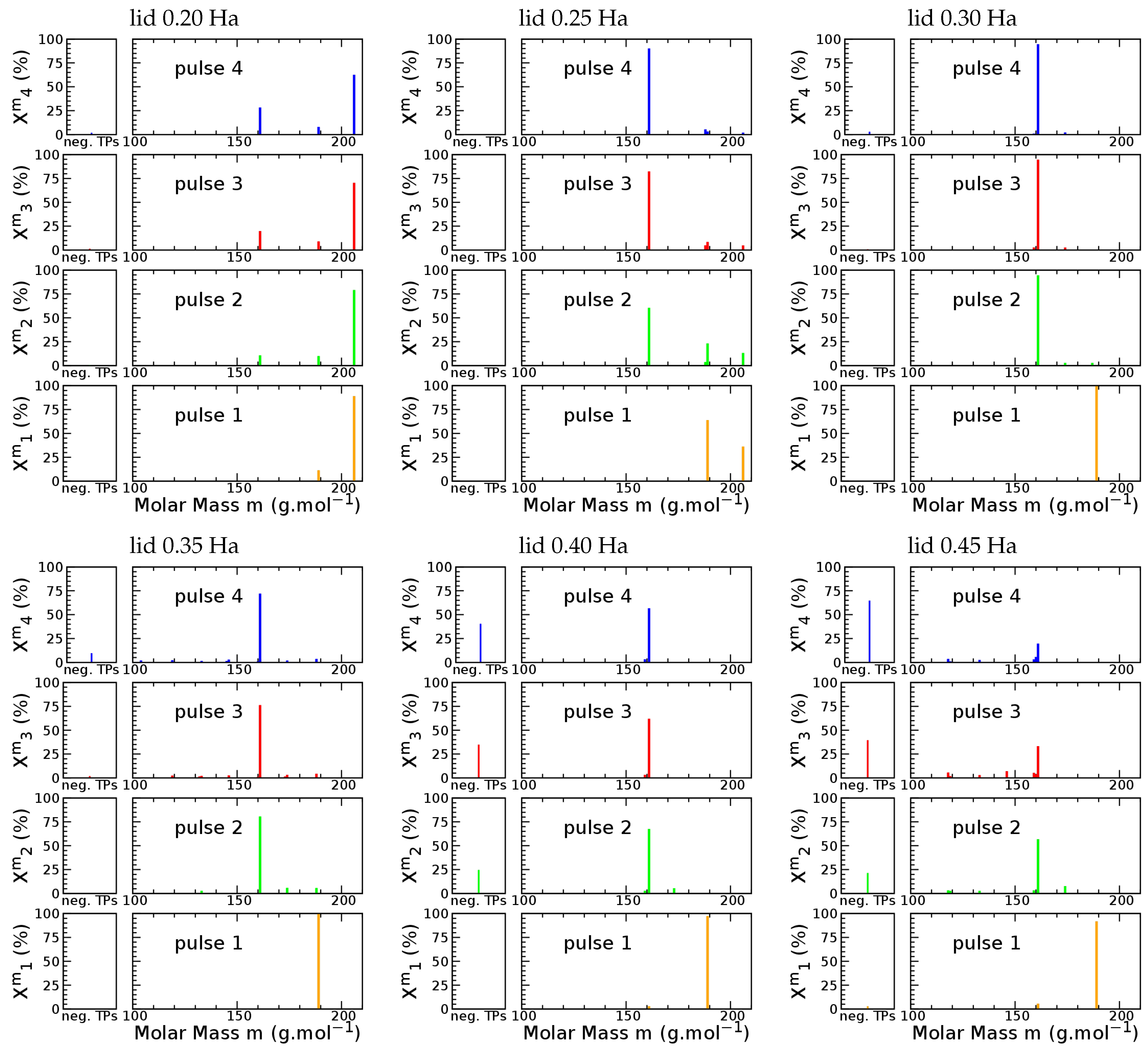
The evolution of mass spectra computed as outlined in Section 2.3.2 is shown for the first four pulses in Figure 4. In addition to the main TP spectra, Figure 4 (the boxes on the left) collects the number of negligible TPs. A first look at this figure shows that a significant fraction of ibuprofen molecules remains unbroken even after four pulses at lid 0.20 Ha, whereas at lid 0.30 Ha and above, ibuprofen completely disappears at the first pulse. In all spectra, significant contributions are only found for molar masses 206, 189 and 161, highlighting the already identified main degradation channel (see Section 3.2.2). The evolution of the TPs associated with the main channel is represented in Figure 5 for a larger number of pulses. It can be seen that at lid 0.20 Ha, the ibuprofen transformation is quite slow, requiring at least twenty pulses before being fully eliminated (mostly transformed into TP 161-1). In contrast, this transition takes about four pulses at lid 0.25 Ha. From lid 0.30 Ha onwards, ibuprofen is converted to TP 189-1 at the first pulse and to TP 161-1 at the second pulse. At lids below 0.35 Ha, 161-1 is a dead end for this channel with an efficiency above 90 %. At lid 0.35 Ha, negligible TPs start to appear (this observation is not due to the change of from 1% to 3%, as shown in Figure S1 in the Supplementary Materials). At and above an energy of 0.40 Ha, we obtain mixtures of numerous TPs, as shown by the increase in the amplitude of the peak corresponding to negligible TPs in Figure 4. This is in agreement with the degradation of TP 161-1 at such high lid energies, and also with the appearance of secondary channels with increasing lid energies as already discussed in Section 3.2.3. Let us finally note that the analysis of the evolution of the mass spectra of significant TPs, for all secondary channels, shows that none of the channels exceeds a 7% probability of existence, except for considerably short time, as these TPs disappear during subsequent pulses. Furthermore, at such high lid energies, sequential fragmentation induced by a single pulse may start to occur, possibly leading to the appearance of several new fragments, reinforcing the present observation that numerous fragmentation channels coexist, leading to a exceptionally complex mixture.
Figure 4.
Mass spectra of the TPs as a function of the number of pulses at various lid energies. The cumulative probability of reaching negligible (denoted as “neg.”) TPs is depicted in the boxes on the left for each mass spectrum. The selection criterion for significant versus negligible TPs is 1% up to lid 0.35 Ha and 3% above (see text for details).
Figure 5.
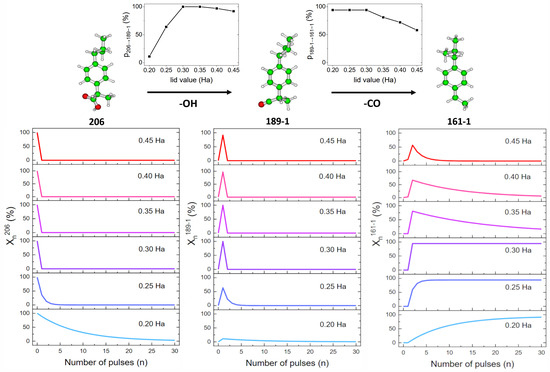
Main degradation scheme proposed for ibuprofen 206 → TP 189-1 → TP 161-1. (Upper) the corresponding probability flows as a function of the lid energy are given above each transition from one shown structure to another indicated by an arrow. (Lower) graphs depicting for the structures shown the dependence of its probability of existence as a function of the number of pulses for the various lid energies.
In terms of degradation efficiency, one can thus conclude that the degradation of all ibuprofen molecules requires a large number of pulses at low lids, i.e., photon energies, while at high photon energies a considerably wide variety of TPs is observed, starting already at the second pulse. At intermediate lids, i.e., for energies in the range of 0.30/0.35 Ha, a total degradation of most ibuprofen is obtained already at the first pulse and the degradation products are relatively clean, i.e., we obtain mainly TP 189-1 after one pulse and TP 161-1 after the second pulse.
These results suggest that an appropriate choice of photon energy would allow the complete degradation of ibuprofen after a few pulses, leading to a limited number of TPs, with the number of pulses providing a means to control the major degradation product(s).
4. Discussion
Most of the studies available in the literature have investigated the fragmentation of ibuprofen in water. A direct comparison with our pathways and degradation products, investigated in the context of the gas phase, is of limited value as fragment recombination and reactivity with ionized solvent molecules are expected to occur in water. The experimental results of ref. [28] can be directly compared with our simulations, since this study reports unimolecular fragmentation pathways investigated either through electron ionization mass spectrometry (EI-MS) in vacuum or through thermal analysis (TA) in an inert argon atmosphere.
The mass spectrum resulting from TA is dominated by a peak at 161 a.u. and the thermal fragmentation pathway proposed in ref. [28] is 206 → TP 161 → TP 119 → TP 92. This is in agreement with the feature that TP 161-1 is the terminus of the main degradation channel in our explorations for lids up to 0.30 Ha. Furthermore, TP 189-1 is found to be a highly unstable intermediate in our simulations, which explains why it is not observed experimentally. Note that the subsequent degradation paths suggested in ref. [28], leading to TP 92 via TP 119 as an intermediary product, are also present in our simulations at energies higher than in ref. [28].
The mass spectra resulting from EI-MS (shown in Figure 2 in ref. [28] ) can also be compared with the results obtained here. Here, one has to keep in mind that the experiment involves the degradation of ionized ibuprofen instead of the neutral ibuprofen molecule in our study, and as detailed theoretical studies of similarly sized organic molecules such as sucrose and trehalose have shown, the presence of such charges can lead to massive changes in the stability of a molecule against dissociation processes [52]. Masses at 161 and 119 a.u. are clearly in agreement with the degradation pathway suggested by the TA experiments. Four other features at 91, 107, 117 and 163 a.u. are also noticeable in the measurements. In our explorations at high lids, we find that TPs 91 and 117 can be reached via several pathways. Concerning TP 107, it was only obtained in our simulations at the highest lid of 0.45 Ha via the degradation of TP 133-1, which can be reached along several degradation routes starting from TP 161-1, TP 161-3, TP 189-1 or TP 159-3. Only the fragment with mass 163 a.u. was not observed in our simulations. However, let us note that, in the experiment, each dominant peak in the mass spectrum is surrounded by smaller peaks differing by a few mass units, suggesting that a number of fragments can be present with a lack or excess of hydrogen atoms. This even applies to the ibuprofen parent peak at mass 206, where a relatively small contribution of under- and overhydrogenated ibuprofen is visible. Such a variability in the composition of the fragments regarding their number of hydrogen atoms is also present in our calculations: quite a number of TPs with closely similar masses only differ in the number of hydrogen atoms or their organization on a given carbon skeleton. This also holds for the TPs 159, 160 and 161, suggesting that the peak at 163 a.u. can be interpreted as an overhydrogenated variation of the main degradation channel, possibly favored by the feature that fragments in the EI-MS experiment are ionized.
We finally recall that our exploration protocol probes only the fragmentation channels in the electronic ground state for various lid energies, as defined in the threshold algorithm, and the multiple-pulse-induced degradation process only describes an arbitrary evolution scheme (all fragmentation simulations for the various TPs performed with the same lid energy). Certainly, it does not exactly map the energy deposition and relaxation of a real experiment. For instance, in EI-MS, the total energy is deposited in a single initial step, and in photofragmentation experiments, one must also consider the absorption cross-section for each fragment. Moreover, for both methods, dissociation might happen in electronic excited states. Furthermore, in TA, the thermalization has to be represented by an energy distribution rather than a fixed lid energy. Nevertheless, the agreement between our predictions and the experimental observations suggests that our simulation protocol is a powerful tool for identifying the dominant degradation pathways.
5. Conclusions
In this study, we have demonstrated that the transformation of a contaminant molecule under irradiation can be studied using the threshold algorithm to explore a potential energy landscape provided by the density functional-based tight-binding method. This approach allowed us to investigate the possible degradation pathways of an ibuprofen molecule exposed to a sequence of laser pulses in the gas phase and to compare the simulated mass spectra with their experimental counterparts. The six chosen threshold energies, ranging from 0.20 to 0.45 Ha, correspond to the energies of the photons absorbed by the system. We have identified the main degradation route of gas-phase ibuprofen as 206 → TP 189-1 → TP 161-1, corresponding to a sequential loss of the hydroxyl and carboxyl groups. This sequence of transformation products was found to be the dominant one for all lids investigated, and the main transformation product observed is TP 161-1. Our theoretical results agree with the available experimental data, explaining the main peaks observed in the mass spectrometry analyses. Investigating the toxicity of the main transformation product TP 161-1 would allow to determine the benefit–risk balance associated with the appearance of this contaminant during the degradation process of ibuprofen.
The agreement with experimental data, and the unraveling of the degradation process leading to the experimental mass spectra peaks, not only validates our method for investigating molecular degradation as a function of the energy given to the system, but also paves the way for its use to reveal the fragmentation products of all types of molecular environmental contaminants. Our approach provides essential information, namely the molecular structure(s) that can be associated with each mass, helping toxicologists to assess the toxic or non-toxic nature of the degradation products of a given pathway. Extracting data regarding the dependence of the TP nature on the energy and pulse number is also believed to help in establishing a proper decontamination strategy. In particular, the information obtained via the threshold exploration runs can be used to model the multi-pulse degradation process as a stochastic Markov process. Such a model can serve as the basis for an optimal control analysis of the degradation of the contaminant molecule, similarly to studies of the controlled evolution of phases in solids [53]. Specifically, by varying the energy and number of laser pulses, it is possible to optimize the degradation process, not only with regard to the types of molecular fragments produced, but also the quantitative distribution of the fragments and the amount of total energy required to achieve a degradation of the contaminant to a non-toxic set of transformation products, which might serve as possible inputs in future chemical applications. Such an optimized procedure may be an efficient and sustainable way to deal with environmental contaminants not only from the point of view of the removal of contaminants from the environment but also with respect to opening possible avenues towards an energy-efficient combination of degradation with the recycling of the material.
Supplementary Materials
The following supporting information can be downloaded at https://www.mdpi.com/article/10.3390/physics8010004/s1: (1) Figure S1: Mass spectra of the TPs as a function of the number of pulses for lid 0.35 Ha; (2) archive containing the Cartesian coordinates of the ibuprofen molecule and of the twenty four significant TPs.
Author Contributions
Conceptualisation, G.S., M.R., J.C.S. and N.T.; methodology, G.S., M.R., J.C.S. and N.T.; investigation, G.S., M.R., J.C.S. and N.T.; formal analysis, G.S., M.R., J.C.S. and N.T.; data curation, G.S., M.R., J.C.S. and N.T.; software, G.S., M.R., J.C.S. and N.T.; validation, G.S., M.R., J.C.S. and N.T.; visualization, G.S., M.R., J.C.S. and N.T.; writing—original draft, G.S., M.R., J.C.S. and N.T.; writing—review and editing, G.S., M.R., J.C.S. and N.T.; supervision, M.R., J.C.S. and N.T.; resources, G.S., M.R., J.C.S. and N.T. All authors have read and agreed to the published version of the manuscript.
Funding
This research received no external funding.
Data Availability Statement
The data supporting this article have been included as part of the Supplementary Information.
Acknowledgments
The authors thank Germán Francisco de la Fuente for fruitful discussion and Louise Rapacioli for drawing the graphical abstract. This work was granted access to the High Performance Computing (HPC) resources of CALMIP (Calcul en Midi Pyrénées) supercomputing center under the allocation p18009.
Conflicts of Interest
The authors declare no conflicts of interest.
References
- Li, X.; Shen, X.; Jiang, W.; Xi, Y.; Li, S. Comprehensive review of emerging contaminants: Detection technologies, environmental impact, and management strategies. Ecotoxicol. Environ. Saf. 2024, 278, 116420. [Google Scholar] [CrossRef] [Scilit] [PubMed]
- Feng, W.; Deng, Y.; Yang, F.; Miao, Q.; Ngien, S.K. Systematic review of contaminants of emerging concern (CECs): Distribution, risks, and implications for water quality and health. Water 2023, 15, 3922. [Google Scholar] [CrossRef] [Scilit]
- García, J.; García-Galán, M.J.; Day, J.W.; Boopathy, R.; White, J.R.; Wallace, S.; Hunter, R.G. A review of emerging organic contaminants (EOCs), antibiotic resistant bacteria (ARB), and antibiotic resistance genes (ARGs) in the environment: Increasing removal with wetlands and reducing environmental impacts. Bioresour. Technol. 2020, 307, 123228. [Google Scholar] [CrossRef] [Scilit] [PubMed]
- Rivera-Utrilla, J.; Sánchez-Polo, M.; Ferro-García, M.Á.; Prados-Joya, G.; Ocampo-Pérez, R. Pharmaceuticals as emerging contaminants and their removal from water. A review. Chemosphere 2013, 93, 1268–1287. [Google Scholar] [CrossRef] [Scilit]
- Reid, E.; Igou, T.; Zhao, Y.; Crittenden, J.; Huang, C.H.; Westerhoff, P.; Rittmann, B.; Drewes, J.E.; Chen, Y. The minus approach can redefine the standard of practice of drinking water tyreatment. Environ. Sci. Technol. 2023, 57, 7150–7161. [Google Scholar] [CrossRef] [Scilit]
- Garcia, C.; Pérez-Sánchez, M.; Ramos, H.M.; López-Jiménez, P.A.; Sánchez-Romero, F.J. New strategies in wastewater treatment plants to evaluate the achievement of sustainable development goals: A case study. Urban Water J. 2024, 21, 1201–1212. [Google Scholar] [CrossRef] [Scilit]
- Teng, J.; Zhang, Y.; Li, P.; Liu, G. Hydroxyl radical in anodic oxidation-based electrochemical advanced oxidation processes: Critical understanding and a new perspective. Sustain. Horiz. 2025, 16, 100156. [Google Scholar] [CrossRef] [Scilit]
- Wang, M.; Liu, M.; Zou, H.; Liu, G. Efficient removal of Ni–EDTA complexes utilizing 3D Ni–RM electro-fenton system. Separ. Purific. Technol. 2025, 369, 133067. [Google Scholar] [CrossRef] [Scilit]
- Sun, W.; Liu, G.; Zou, H.; Wang, S.; Duan, X. Site-designed dual-active-center catalysts for co-catalysis in advanced oxidation processes. npj Mater. Sustain. 2025, 3, 2. [Google Scholar] [CrossRef] [Scilit]
- Chopra, S.; Kumar, D. Ibuprofen as an emerging organic contaminant in environment, distribution and remediation. Heliyon 2020, 6, e04087. [Google Scholar] [CrossRef] [Scilit]
- Jan-Roblero, J.; Cruz-Maya, J.A. Ibuprofen: Toxicology and biodegradation of an emerging contaminant. Molecules 2023, 28, 2097. [Google Scholar] [CrossRef] [Scilit]
- Rastogi, A.; Tiwari, M.K.; Ghangrekar, M.M. A review on environmental occurrence, toxicity and microbial degradation of Non-Steroidal Anti-Inflammatory Drugs (NSAIDs). J. Environ. Manag. 2021, 300, 113694. [Google Scholar] [CrossRef] [Scilit] [PubMed]
- Martindale, W. The Extra Pharmacopoeia; Reynolds, J.E.F., Ed.; Royal Pharmaceutical Society: London, UK, 1996; Available online: https://archive.org/details/martindaleextrap00will (accessed on 10 November 2025).
- Kristensen, D.M.; Desdoits-Lethimonier, C.; Mackey, A.L.; Dalgaard, M.D.; Masi, F.D.; Munkbøl, C.H.; Styrishave, B.; Antignac, J.P.; Bizec, B.L.; Platel, C.; et al. Ibuprofen alters human testicular physiology to produce a state of compensated hypogonadism. Proc. Natl. Acad. Sci. USA 2018, 115, E715–E724. [Google Scholar] [CrossRef] [Scilit] [PubMed]
- Wu, J.; Zhang, Y.; Zhou, Y. Multi-strategy study of environmental degradation of ibuprofen: From chemical catalysis to biological treatment. E3S Web Conf. 2024, 553, 03012. [Google Scholar] [CrossRef] [Scilit]
- Adityosulindro, S.; Julcour, C.; Riboul, D.; Barthe, L. Degradation of ibuprofen by photo-based advanced oxidation processes: Exploring methods of activation and related reaction routes. Int. J. Environ. Sci. Technol. 2022, 19, 3247–3260. [Google Scholar] [CrossRef] [Scilit]
- Ellepola, N.; Ogas, T.; Turner, D.N.; Gurung, R.; Maldonado-Torres, S.; Tello-Aburto, R.; Patidar, P.L.; Rogelj, S.; Piyasena, M.E.; Rubasinghege, G. A toxicological study on photo-degradation products of environmental ibuprofen: Ecological and human health implications. Ecotoxicol. Environ. Saf. 2020, 188, 109892. [Google Scholar] [CrossRef] [Scilit]
- Pesik, S.; Jobiliong, E.; Steven, E. Comparative analysis of photodegradation of ibuprofen and clotrimazole water pollutant using UVC rays in presence and absence of ZnO photocatalyst. Environ. Sci. Proc. 2023, 25, 49. [Google Scholar] [CrossRef] [Scilit]
- Rey-García, F.; Sieira, B.J.; Bao-Varela, C.; Leis, J.R.; Angurel, L.A.; Quintana, J.B.; Rodil, R.; De La Fuente, G.F. Can UV-C laser pulsed irradiation be used for the removal of organic micropollutants from water? Case study with ibuprofen. Sci. Total Environ. 2020, 742, 140507. [Google Scholar] [CrossRef] [Scilit]
- Jakimska, A.; Śliwka Kaszyńska, M.; Reszczyńska, J.; Namieśnik, J.; Kot-Wasik, A. Elucidation of transformation pathway of ketoprofen, ibuprofen, and furosemide in surface water and their occurrence in the aqueous environment using UHPLC–QTOF–MS. Anal. Bioanal. Chem. 2014, 406, 3667–3680. [Google Scholar] [CrossRef] [Scilit]
- Miranda, M.O.; Cabral Cavalcanti, W.E.; Barbosa, F.F.; Antonio De Sousa, J.; Ivan Da Silva, F.; Pergher, S.B.C.; Braga, T.P. Photocatalytic degradation of ibuprofen using titanium oxide: Insights into the mechanism and preferential attack of radicals. RSC Adv. 2021, 11, 27720–27733. [Google Scholar] [CrossRef] [Scilit]
- Wang, Z.; Srivastava, V.; Ambat, I.; Safaei, Z.; Sillanpää, M. Degradation of ibuprofen by UV-LED/catalytic advanced oxidation process. J. Water Process Eng. 2019, 31, 100808. [Google Scholar] [CrossRef] [Scilit]
- Akay, S.; Öztürk, S.; Kalderis, D.; Kayan, B. Degradation, solubility and chromatographic studies of ibuprofen under high temperature water conditions. Chemosphere 2021, 277, 130307. [Google Scholar] [CrossRef] [Scilit] [PubMed]
- Caviglioli, G.; Valeria, P.; Brunella, P.; Sergio, C.; Attilia, A.; Gaetano, B. Identification of degradation products of ibuprofen arising from oxidative and thermal treatments. J. Pharm. Biomed. Anal. 2002, 30, 499–509. [Google Scholar] [CrossRef] [Scilit] [PubMed]
- Qiu, N.; Shen, C.; Liu, Y.; Li, X.; Jia, G.; Qin, J.; Wang, X. Degradation of ibuprofen by the electro/Fe3+/peroxydisulfate process: Reactive kinetics, degradation products and mechanism. Catalysts 2022, 12, 329. [Google Scholar] [CrossRef] [Scilit]
- Nurmi, T.M.A.; Kiljunen, T.K.; Knuutinen, J.S. A fugacity model assessment of ibuprofen, diclofenac, carbamazepine, and their transformation product concentrations in an aquatic environment. Environ. Sci. Pollut. Res. 2019, 26, 328–341. [Google Scholar] [CrossRef] [Scilit]
- Arsene, C.; Bejan, I.G.; Roman, C.; Olariu, R.I.; Minella, M.; Passananti, M.; Carena, L.; Vione, D. Evaluation of the environmental fate of a semivolatile transformation product of ibuprofen based on a simple two-media fate model. Environ. Sci. Technol. 2022, 56, 15650–15660. [Google Scholar] [CrossRef] [Scilit]
- Zayed, M.A.; Hawash, M.F.; Fahmey, M.A.; El-Gizouli, A.M.M. Investigation of ibuprofen drug using mass spectrometry, thermal analyses, and semi-empirical molecular orbital calculation. J. Therm. Anal. Calorim. 2012, 108, 315–322. [Google Scholar] [CrossRef] [Scilit]
- Henkelman, G.; Jónsson, H. Improved tangent estimate in the nudged elastic band method for finding minimum energy paths and saddle points. J. Chem. Phys. 2000, 113, 9978–9985. [Google Scholar] [CrossRef] [Scilit]
- Henkelman, G.; Jónsson, H. A dimer method for finding saddle points on high dimensional potential surfaces using only first derivatives. J. Chem. Phys. 1999, 111, 7010–7022. [Google Scholar] [CrossRef] [Scilit]
- Jones, R.O. Density functional theory: Its origins, rise to prominence, and future. Rev. Mod. Phys. 2015, 87, 897–923. [Google Scholar] [CrossRef] [Scilit]
- Torrie, G.M.; Valleau, J.P. Nonphysical sampling distributions in Monte Carlo free-energy estimation: Umbrella sampling. J. Comput. Phys. 1977, 23, 187–199. [Google Scholar] [CrossRef] [Scilit]
- Laio, A.; Rodriguez-Fortea, A.; Gervasio, F.L.; Ceccarelli, M.; Parrinello, M. assessing the accuracy of metadynamics. J. Phys. Chem. B 2005, 109, 6714–6721. [Google Scholar] [CrossRef] [Scilit] [PubMed]
- Metropolis, N.; Rosenbluth, A.W.; Rosenbluth, M.N.; Teller, A.H.; Teller, E. Equation of state calculations by fast computing machines. J. Chem. Phys. 1953, 21, 1087–1092. [Google Scholar] [CrossRef] [Scilit]
- Schön, J.C. Studying the energy hypersurface of multi-minima systems—The threshold and the lid algorithm. Ber. Bunsenges. Phys. Chem. 1996, 100, 1388–1391. [Google Scholar] [CrossRef] [Scilit]
- Schön, J.C.; Putz, H.; Jansen, M. Studying the energy landscape of continuous systems—The threshold algorithm. J. Phys. Cond. Matter 1996, 8, 143–156. [Google Scholar] [CrossRef] [Scilit]
- Neelamraju, S.; Schön, J.C.; Doll, K.; Jansen, M. Ab initio and empirical energy landscapes of (MgF2)n clusters (n = 3, 4). Phys. Chem. Chem. Phys. 2012, 14, 1223–1234. [Google Scholar] [CrossRef] [Scilit]
- Neelamraju, S.; Johnston, R.; Schön, J.C. A threshold-minimization scheme for exploring the energy landscape of biomolecules: Application to a cyclic peptide and a disaccharide. J. Chem. Theory Comp. 2016, 12, 2471–2479. [Google Scholar] [CrossRef] [Scilit]
- Neelamraju, S.; Oligschleger, C.; Schön, J.C. The threshold algorithm: Description of the methodology and new developments. J. Chem. Phys. 2017, 147, 152713. [Google Scholar] [CrossRef] [Scilit]
- Porezag, D.; Frauenheim, T.; Köhler, T.; Seifert, G.; Kaschner, R. Construction of tight-binding-like potentials on the basis of density-functional theory: Application to carbon. Phys. Rev. B 1995, 51, 12947–12957. [Google Scholar] [CrossRef] [Scilit]
- Seifert, G.; Porezag, D.; Frauenheim, T. Calculations of molecules, clusters, and solids with a simplified LCAO–DFT–LDA scheme. Int. J. Quant. Chem. 1996, 58, 185–192. [Google Scholar] [CrossRef]
- Spiegelman, F.; Tarrat, N.; Cuny, J.; Dontot, L.; Posenitskiy, E.; Martí, C.; Simon, A.; Rapacioli, M. Density-functional tight-binding: Basic concepts and applications to molecules and clusters. Adv. Phys. X 2020, 5, 1710252. [Google Scholar] [CrossRef] [Scilit] [PubMed]
- Oliveira, A.; Seifert, G.; Heine, T.; Duarte, H. Density-functional based tight-binding: An approximate DFT method. J. Braz. Chem. Soc. 2009, 20, 1193–1205. [Google Scholar] [CrossRef] [Scilit]
- Koskinen, P.; Makinen, V. Density-functional tight-binding for beginners. Comput. Mater. Sci. 2009, 47, 237–253. [Google Scholar] [CrossRef] [Scilit]
- Elstner, M.; Frauenheim, T.; Kaxiras, E.; Seifert, G.; Suhai, S. A self-consistent charge density-functional based tight-binding scheme for large biomolecules. Phys. Stat. Sol. (b) 2000, 217, 357–376. [Google Scholar] [CrossRef]
- Frauenheim, T.; Seifert, G.; Elsterner, M.; Hajnal, Z.; Jungnickel, G.; Porezag, D.; Suhai, S.; Scholz, R. A Self-consistent charge density-functional based tight-binding method for predictive materials simulations in physics, chemistry and biology. Phys. Stat. Sol. (b) 2000, 217, 41–62. [Google Scholar] [CrossRef] [Scilit]
- Frauenheim, T.; Seifert, G.; Elstner, M.; Niehaus, T.; Köhler, C.; Amkreutz, M.; Sternberg, M.; Hajnal, Z.; Carlo, A.D.; Suhai, S. Atomistic simulations of complex materials: Ground-state and excited-state properties. J. Phys. Cond. Mat. 2002, 14, 3015–3047. [Google Scholar] [CrossRef] [Scilit]
- Rapacioli, M.; Schön, J.C.; Tarrat, N. Exploring energy landscapes at the DFTB quantum level using the threshold algorithm: The case of the anionic metal cluster . Theor. Chem. Acc. 2021, 140, 85. [Google Scholar] [CrossRef] [Scilit]
- Salomon, G.; Tarrat, N.; Schön, J.C.; Rapacioli, M. Low-energy transformation pathways between naphthalene isomers. Molecules 2023, 28, 5778. [Google Scholar] [CrossRef] [Scilit]
- Rapacioli, M.; Heine, T.; Dontot, L.; Buey, M.Y.; Posenitskiy, E.; Tarrat, N.; Spiegelman, F.; Louisnard, F.; Cuny, J.; Morinière, M.; et al. deMonNano. Available online: http://demon-nano.ups-tlse.fr/ (accessed on 10 November 2025).
- Density Functional Based Tight Binding (DFTB). Parameters. Available online: https://www.dftb.org/parameters.html (accessed on 10 November 2025).
- Andriyevsky, B.; Tarrat, N.; Cortes, J.; Schön, J.C. Dehydrogenation versus deprotonation of disaccharide molecules in vacuum: A throrough theoretical investigation. R. Soc. Open Sci. 2022, 9, 220436. [Google Scholar] [CrossRef] [Scilit]
- Hoffmann, K.H.; Fischer, A.; Schön, J.C. Controlled dynamics and preferential trapping on energy landscapes. In Energy Landscapes of Nanoscale Systems; Wales, D.J., Ed.; Elsevier Inc.: Cambridge, MA, USA, 2022; pp. 211–245. [Google Scholar] [CrossRef] [Scilit]
Disclaimer/Publisher’s Note: The statements, opinions and data contained in all publications are solely those of the individual author(s) and contributor(s) and not of MDPI and/or the editor(s). MDPI and/or the editor(s) disclaim responsibility for any injury to people or property resulting from any ideas, methods, instructions or products referred to in the content. |
© 2025 by the authors. Licensee MDPI, Basel, Switzerland. This article is an open access article distributed under the terms and conditions of the Creative Commons Attribution (CC BY) license.