
On Data Leakage Prevention Maturity: Adapting the C2M2 Framework


Abstract
1. Introduction
- It highlights the importance of a holistic approach to DLP.
- It introduces a novel DLP Maturity Model, meticulously adapted from the C2M2.
- It details the application of this model within the financial sector, providing a comprehensive case study on its implementation in a banking scenario.
2. Materials and Methods
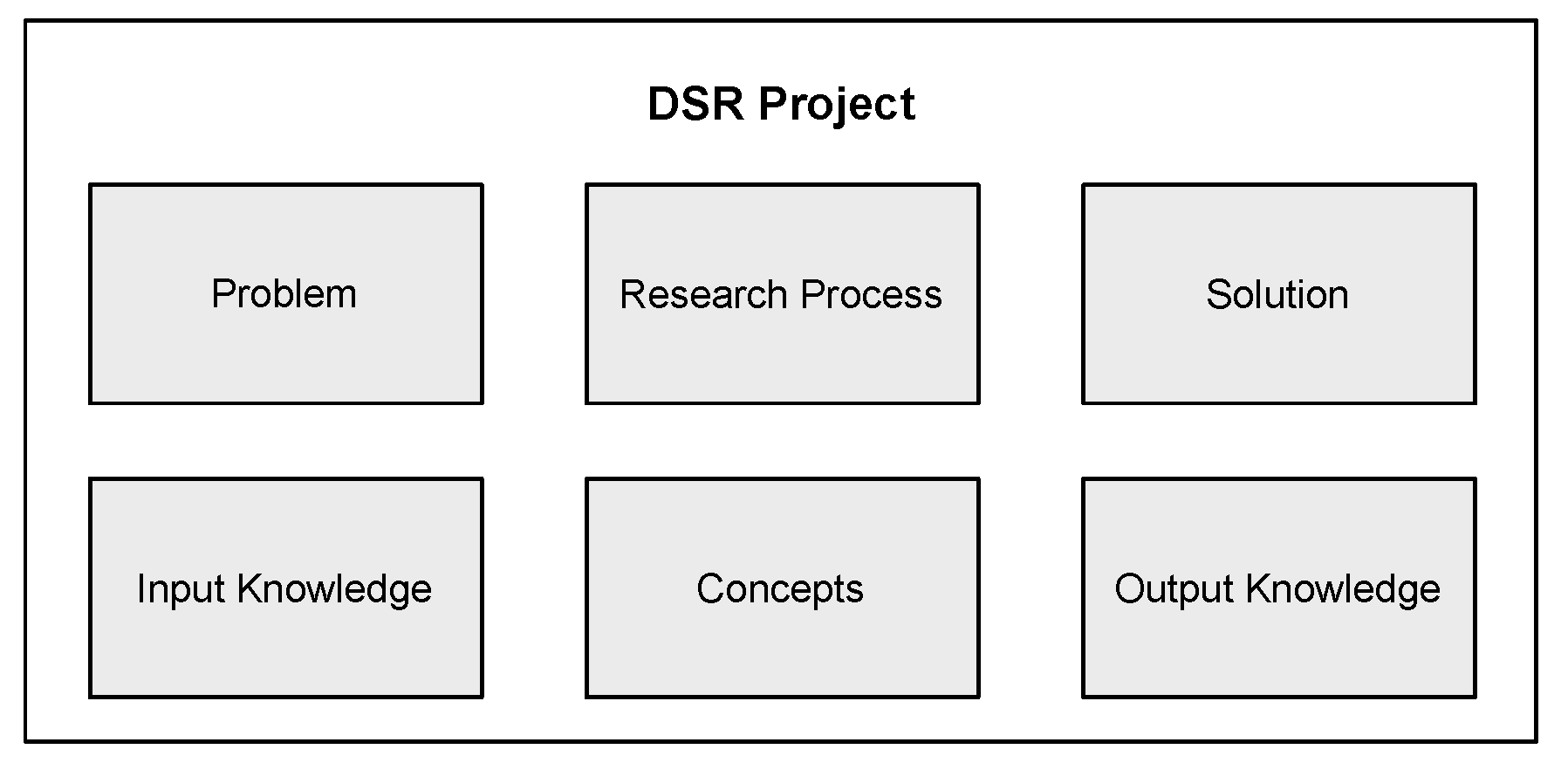
2.1. Problem
2.2. Input Knowledge
2.2.1. DLP Definition
2.2.2. DLP Solutions
2.2.3. Persistent Challenges in DLP
2.2.4. Impact of Large Language Models on DLP and Future Trends
2.3. Literature Research
2.3.1. DLP Literature Review
2.3.2. Selection of an Appropriate Maturity Model
2.4. Concepts
2.4.1. Selection of a Suitable Maturity Framework
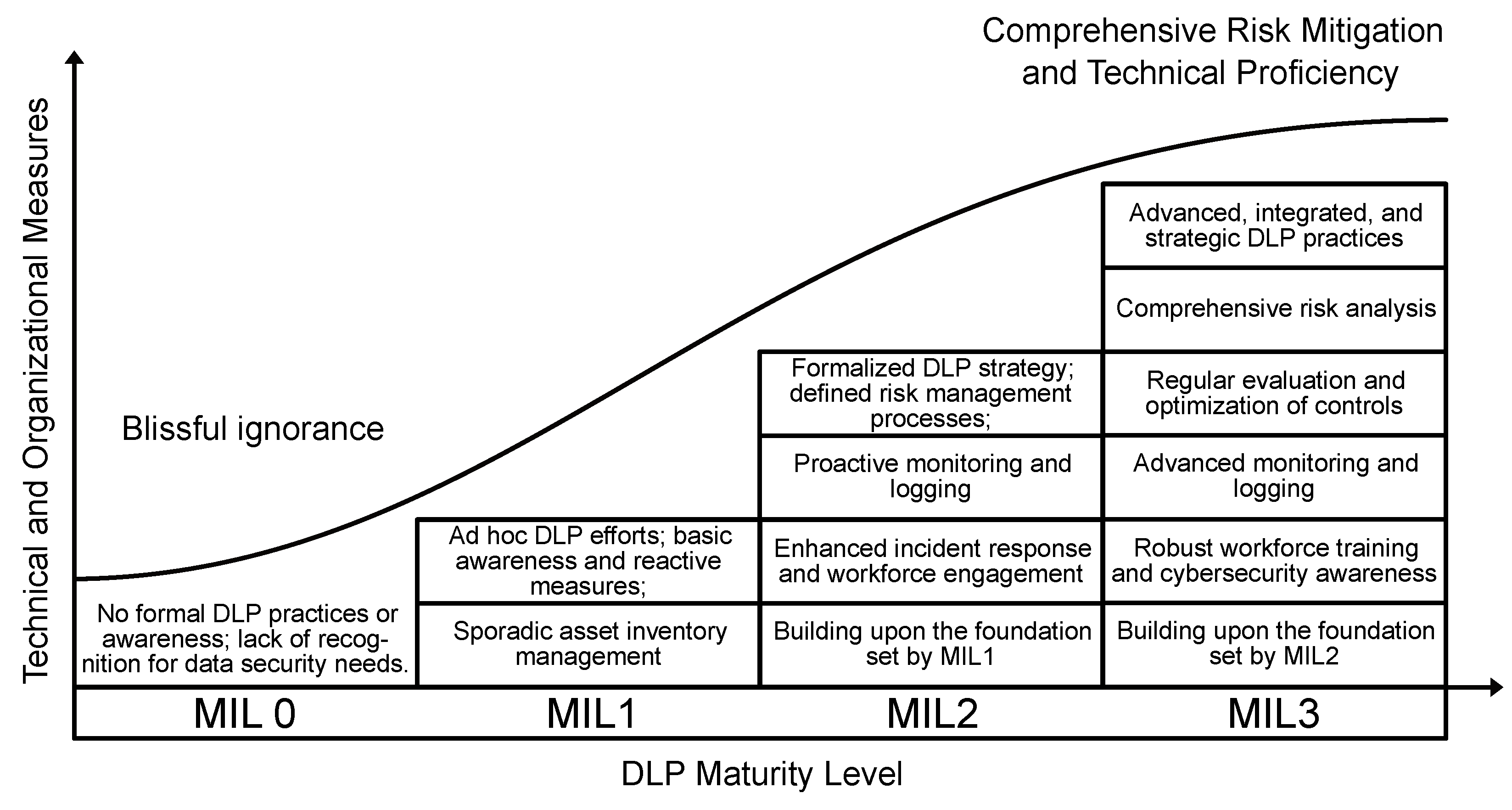
2.4.2. Adopting the C2M2
- Define the organization’s current state of DLP maturity.
- Determine the future, more mature state the organization aspires to reach, effectively guiding a gap analysis between the current and target cybersecurity postures.
- Identify specific capabilities and improvements needed to advance to that future state, providing a roadmap of actionable steps for progression.
2.5. Output Knowledge
3. Results
3.1. Practical Implementation and Evaluation: Performing a Self-Evaluation
3.1.1. Case Study: Implementing the Self-Evaluation in the SITUATION Domain
- Perform DLP Logging;
- Perform DLP Monitoring;
- Establish and Maintain Situational Awareness for DLP;
- Management of Activities in the SITUATION Domain.
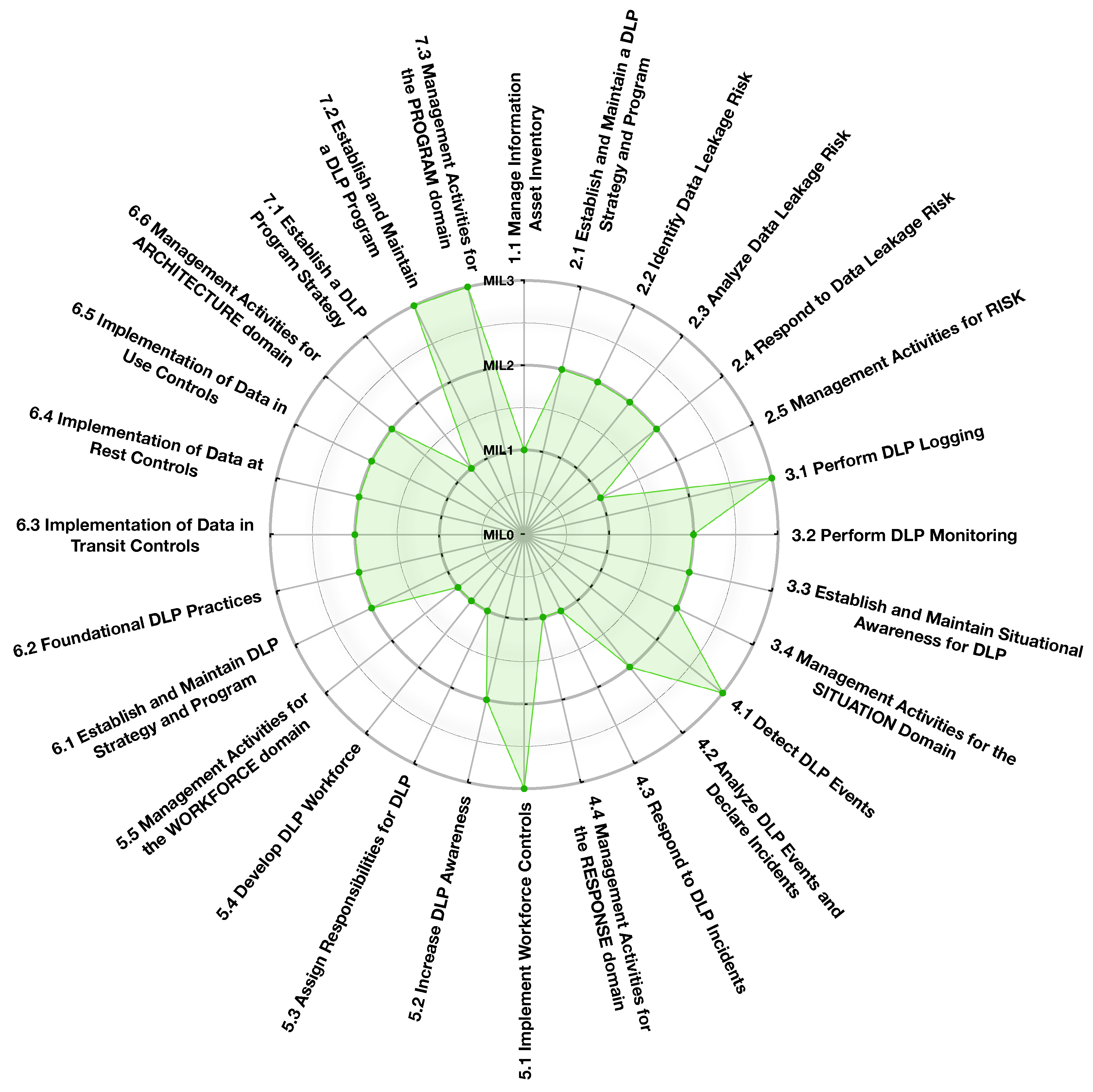
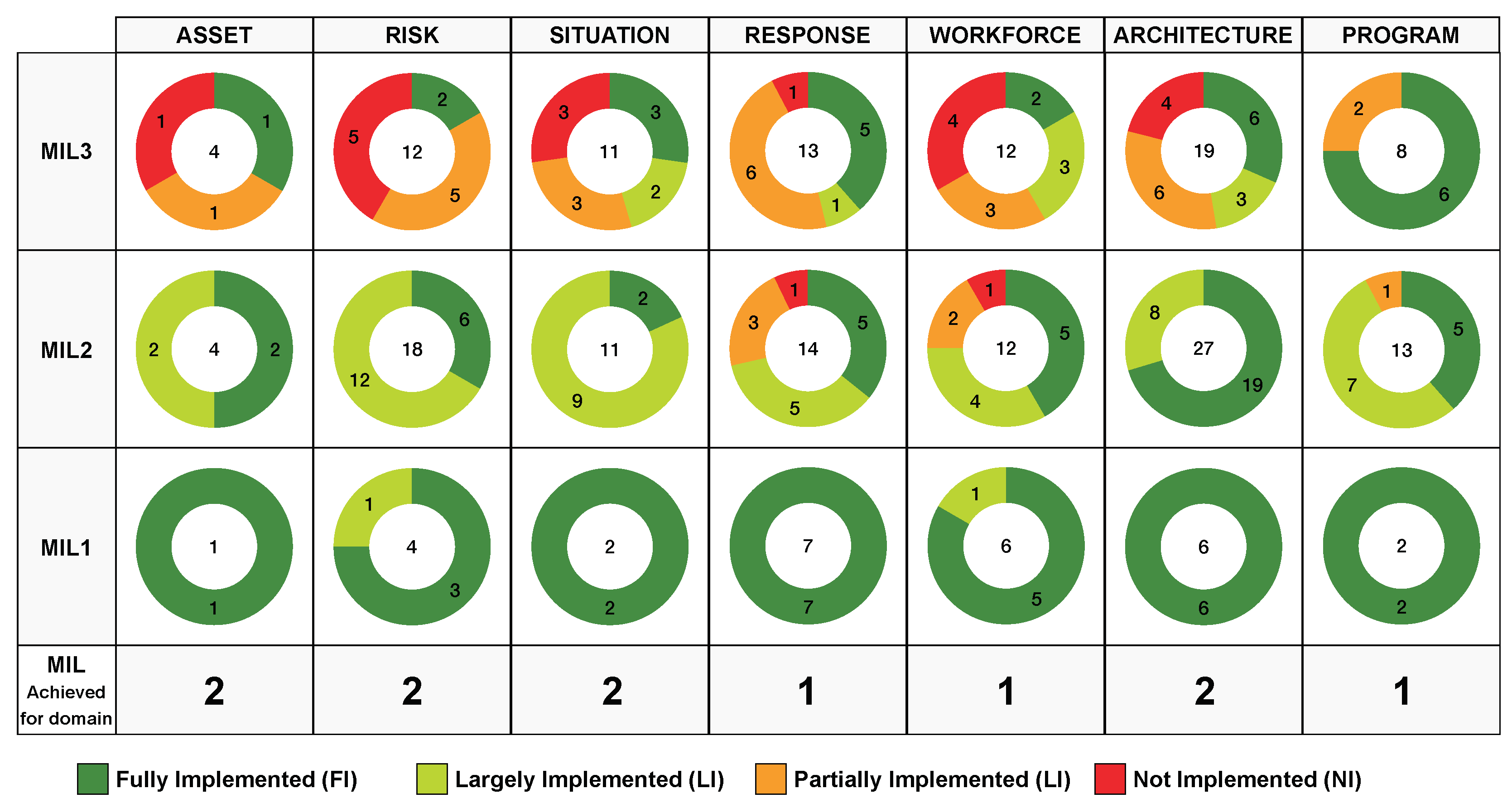
3.1.2. Synthesizing Outcomes across Domains
3.2. Analyze Results
3.3. Prioritize, Plan, and Implement
3.4. Continuous Improvement
4. Discussion
4.1. Limitations
4.2. Further Work
Author Contributions
Funding
Data Availability Statement
Conflicts of Interest
Abbreviations
| C2M2 | Cybersecurity Capability Maturity Model |
| DORA | Digital Operational Resilience Act |
| DLP | Data Leakage Prevention |
| EBA | European Banking Authority |
| FI | Fully Implemented |
| ICT | Information and Communications Technology |
| LI | Largely Implemented |
| LLM | Large Language Model |
| MIL | Maturity Indicator Level |
| NI | Not Implemented |
| NIST | National Institute of Standards and Technology |
| PI | Partially Implemented |
| SIEM | Security Incident and Event Management |
| SOC | Security Operation Center |
Appendix A
Appendix A.1. C2M2
Appendix A.1.1. Domain 1: Asset, Change, and Configuration Management (ASSET)

| MIL | Description | |
|---|---|---|
| MIL1 | a | Information assets that contain sensitive information are inventoried, at least in an ad hoc manner. |
| MIL2 | b | The inventory encompasses information assets that may be susceptible to unauthorized access and compromise in incidents of data breaches. |
| c | Each information asset is classified based on its sensitivity. There is a documented classification scheme in place. | |
| d | The criteria for categorization take into account the extent to which an asset could potentially be utilized to facilitate a data leakage incident. | |
| e | Information assets are sanitized or destroyed as per policies at end of life. | |
| MIL3 | f | The information asset inventory includes attributes that support DLP (e.g., asset category, backup locations, storage locations, asset owner, etc.). |
| g | The information asset inventory is complete. | |
| h | The information asset inventory is current, that is, it is updated periodically and according to defined triggers, such as system changes. |
Appendix A.1.2. Domain 2: Risk Management (RISK)
| MIL | Description | |
|---|---|---|
| MIL1 | a | The organization has a strategy for DLP, potentially managed in an ad hoc manner. |
| MIL2 | b | A data leakage prevention strategy is established and aligned with the organization’s cybersecurity strategy. |
| c | The DLP strategy is maintained to perform activities according to the cyber risk management strategy. | |
| d | Information related to data leakage risks is communicated to relevant stakeholders. | |
| e | Governance for the DLP strategy is established and maintained. | |
| f | Senior management demonstrates visible and active sponsorship for the DLP strategy. | |
| MIL3 | g | The DLP strategy aligns with the organization’s mission and objectives. |
| h | The DLP strategy is coordinated with the organization’s wider risk management efforts. |
| MIL | Description | |
|---|---|---|
| MIL1 | a | Data leakage risks are identified, at least in an ad hoc manner. |
| MIL2 | b | A defined method is used to identify data leakage risks. |
| c | Stakeholders from appropriate operations and business areas participate in the identification of data leakage risks. | |
| d | Risks regarding data leakage are documented in a risk register or other artifact. | |
| e | Data leakage risks are assigned to risk owners. | |
| f | Risk identification activities are performed periodically and according to defined triggers, such as system changes, new projects, or external events. | |
| MIL3 | g | Risk identification activities prioritize sensitive data, as identified in the ASSET domain. |
| h | Information pertaining to non-compliance, especially in systems that do not adhere to policies related to the handling of sensitive information, is utilized. |
| MIL | Description | |
|---|---|---|
| MIL1 | a | Data leakage risks are prioritized based on estimated impact, at least in an ad hoc manner. |
| MIL2 | b | Defined criteria are used to prioritize data leakage risks (e.g., organizational impact, likelihood, risk appetite). |
| c | A method is used to estimate impact for high data leakage risks. | |
| d | Defined methods are used to analyze potentially high data leakage risks. | |
| e | Stakeholders from relevant operations and business functions participate in the analysis of data leakage risks. | |
| f | Data leakage risks are removed from the risk register when no longer requiring tracking or response. | |
| MIL3 | g | Analyses of data leakage risks are updated periodically and in response to defined triggers, such as system changes, new projects, or external events. |
| MIL | Description | |
|---|---|---|
| MIL1 | a | Responses (such as mitigate, accept, avoid, transfer) are implemented to address data leakage risks, at least in an ad hoc manner. |
| MIL2 | b | A method is used to select and implement responses to data leakage risks based on analysis and prioritization. |
| MIL3 | c | DLP controls are evaluated to ensure they are effective in mitigating identified risks. |
| d | KPIs from DLP activities are regularly reviewed by the leadership of the organization. | |
| e | Responses to data leakage risks (such as mitigate, accept, avoid, transfer) are periodically reviewed by leadership to determine whether they are still appropriate. |
| MIL | Description | |
|---|---|---|
| MIL1 | a | No practice at MIL1. |
| MIL2 | b | Documented procedures for activities are established and maintained. |
| c | Adequate resources are allocated for activities. | |
| MIL3 | d | Policies or directives define requirements for activities. |
| e | Responsibility and accountability for activities are clearly assigned. | |
| f | Personnel involved in DLP-related risk management possess necessary skills and knowledge. | |
| g | The effectiveness of activities is regularly evaluated and tracked. |
Appendix A.1.3. Domain 3: Situational Awareness (SITUATION)
| MIL | Description | |
|---|---|---|
| MIL1 | a | Logging occurs for sensitive data, at least in an ad hoc manner. |
| MIL2 | b | Logging is implemented for assets that contain sensitive data. |
| c | Logging requirements are established. | |
| d | Logging requirements are set for network and host monitoring (e.g., web proxies, e-mail gateways, print-monitoring on endpoint clients). | |
| e | Log data are aggregated and accessible for DLP analysts. | |
| MIL3 | f | Logging is enforced for assets with higher data leakage risk priorities (e.g., for data at rest and data in use). |
| MIL | Description | |
|---|---|---|
| MIL1 | a | Log data or alerts from the monitoring infrastructure are reviewed, at least in an ad hoc manner. |
| MIL2 | b | Requirements for DLP monitoring are established and maintained. |
| c | Enhanced rule sets are configured to trigger alerts when a potential data leakage attempt is discovered. | |
| d | Monitoring activities are aligned with the organization’s risk-based security approach. | |
| MIL3 | e | Enhanced monitoring is enforced for assets with higher data leakage risk priorities. |
| f | The DLP rule set undergoes periodic evaluation and updates, integrating insights from incident responses and false-positive alert assessments. | |
| g | Adjustments to the DLP rule set can be executed on short notice if required. |
| MIL | Description | |
|---|---|---|
| MIL1 | No practice at MIL1. | |
| MIL2 | a | Methods for communicating the current state of DLP are established and maintained. |
| b | KPIs relevant to DLP are collected for operational state awareness. | |
| MIL3 | c | KPIs and thresholds for the rule sets are established and harmonized with leadership and stakeholder requirements. |
| d | Internal data crucial for DLP activities (e.g., employee terminations) are methodically collected and processed, leading to (ad hoc) modifications in the rule set as necessary. | |
| e | Predefined operational states, such as Triage and Incident Escalation, are meticulously documented and activated in response to incoming alerts. |
| MIL | Description | |
|---|---|---|
| MIL1 | No practice at MIL1. | |
| MIL2 | a | Documented procedures are established, followed, and maintained for activities in the SITUATION domain. |
| b | Adequate resources (people, funding, and tools) are provided to support activities from the SITUATION domain. | |
| MIL3 | c | Up-to-date policies define requirements for activities from the SITUATION domain. |
| d | Responsibility, accountability, and authority for the performance of activities in the SITUATION domain are assigned to personnel. | |
| e | Personnel performing activities in the SITUATION domain have skills and knowledge needed to perform their assigned responsibilities. | |
| f | The effectiveness of activities in the SITUATION domain is regularly evaluated and tracked. |
Appendix A.1.4. Event and Incident Response, Continuity of Operations (RESPONSE)
| MIL | Description | |
|---|---|---|
| MIL1 | a | Detected DLP events are reported to a specified person or role and documented, at least in an ad hoc manner. |
| b | Employees can report DLP events, at least in an ad hoc manner. | |
| MIL2 | c | Criteria are established to define and classify DLP events. |
| d | Employees can report DLP events through predefined and communicated rules and procedures. | |
| MIL3 | e | Event information can be correlated to support incident analysis by identifying patterns and trends. |
| f | DLP activities are adjusted based on identified risks and the organization’s DLP threat profile. | |
| g | Handling of events is documented. |
| MIL | Description | |
|---|---|---|
| MIL1 | a | Criteria for declaring DLP incidents are established, at least in an ad hoc manner. |
| b | DLP events are analyzed to support the declaration of DLP incidents, at least in an ad hoc manner. | |
| MIL2 | c | DLP incidents are classified and prioritized by an initial (and ongoing) impact assessment. |
| d | DLP events undergo triage and are subsequently classified as incidents based on predetermined criteria. | |
| e | DLP incident declaration criteria are updated periodically and according to defined triggers, such as organizational changes, lessons learned, or newly identified threats. | |
| f | DLP events and incidents are systematically tracked and documented before being closed. | |
| g | Stakeholders are notified of DLP incidents based on predefined procedures. | |
| MIL3 | h | Criteria for the impact assessment of DLP incidents is aligned with DLP risk prioritization. |
| i | DLP incidents are correlated to identify patterns and trends across incidents. |
| MIL | Description | |
|---|---|---|
| MIL1 | a | DLP incident response personnel are identified, and roles are assigned, at least in an ad hoc manner. |
| b | Responses to DLP incidents are executed to limit impact and restore normal operations, at least in an ad hoc manner. | |
| c | Reporting of DLP incidents is performed, as appropriate, in an ad hoc manner. | |
| MIL2 | d | DLP incident response plans that address all incident life cycle phases are established and maintained. |
| e | DLP incident response is executed according to defined plans and procedures. | |
| f | DLP incident response plans include a communications plan for stakeholders. | |
| g | DLP incident response plan exercises are conducted periodically. | |
| h | Lessons-learned activities from DLP incidents are performed, leading to corrective actions. | |
| MIL3 | i | Root-cause analysis of DLP incidents is performed, with corrective actions taken. |
| j | DLP incident responses are coordinated with internal or external entities, supporting evidence collection and preservation. | |
| k | DLP personnel engage in continuous dialogue with vendors and DLP analysts from other organizations to identify emerging trends and new technologies promptly. | |
| l | DLP incident responses leverage and trigger predefined operational states. |
| MIL | Description | |
|---|---|---|
| MIL1 | No practice at MIL1. | |
| MIL2 | a | Documented procedures for response activities are established, followed, and maintained. |
| b | Adequate resources are allocated to support activities from the RESPONSE domain. | |
| MIL3 | c | Up-to-date policies define requirements for activities from the RESPONSE domain. |
| d | Responsibility and accountability for activities in the RESPONSE domain are clearly assigned. | |
| e | Personnel performing activities in the RESPONSE domain have skills and knowledge needed to perform their assigned responsibilities. | |
| f | The effectiveness of activities is regularly evaluated and tracked. |
Appendix A.1.5. WORKFORCE
| MIL | Description | |
|---|---|---|
| MIL1 | a | Personnel identification is performed at hire. |
| MIL2 | b | Personnel vetting is performed for positions with access to sensitive data. |
| c | Disciplinary actions for non-compliance with DLP related policies are carried out in an ad hoc manner. | |
| d | Personnel are made aware of their responsibilities for protecting and using information assets. | |
| MIL3 | e | A formal accountability process, including disciplinary actions, is implemented for non-compliance with DLP related policies. |
| MIL | Description | |
|---|---|---|
| MIL1 | a | Cybersecurity awareness activities incorporate DLP topics in an ad hoc manner. |
| MIL2 | b | Cybersecurity awareness objectives, encompassing DLP topics, are established and maintained. |
| c | Cybersecurity awareness objectives are aligned with the DLP threat landscape. | |
| d | Cybersecurity awareness activities, incorporating DLP, are conducted periodically. | |
| MIL3 | e | Cybersecurity awareness activities are customized to different job roles, with particular emphasis on DLP-related topics. |
| f | Cybersecurity awareness activities specifically address DLP procedures pertinent to stakeholders, such as incident reporting and handling. | |
| g | The effectiveness of DLP-focused cybersecurity awareness activities is evaluated periodically, with improvements made as appropriate. |
| MIL | Description | |
|---|---|---|
| MIL1 | a | Cybersecurity responsibilities for DLP are identified, at least in an ad hoc manner. |
| b | Cybersecurity responsibilities for DLP are assigned to specific people, at least in an ad hoc manner. | |
| MIL2 | c | Cybersecurity responsibilities for DLP are assigned to specific roles, including external service providers. |
| d | Cybersecurity responsibilities for DLP are documented. | |
| MIL3 | e | Cybersecurity responsibilities and job requirements for DLP are reviewed and updated periodically based on system changes and organizational structure shifts. |
| f | Assigned responsibilities for DLP are managed to ensure adequacy and redundancy of coverage, including succession planning. |
| MIL | Description | |
|---|---|---|
| MIL1 | a | DLP-related content is available to personnel working with sensitive data, at least in an ad hoc manner. |
| b | Gaps for DLP-related topics are identified, at least in an ad hoc manner. | |
| MIL2 | c | Gaps for DLP-related topics are addressed through training. |
| d | Training for DLP-related topics is mandatory before granting access to critical information assets. | |
| MIL3 | e | The effectiveness of DLP-related training programs is evaluated periodically, with improvements made as appropriate. |
| f | DLP-related training programs include continuing education and professional development opportunities for personnel with significant cybersecurity responsibilities. |
| MIL | Description | |
|---|---|---|
| MIL1 | No practice at MIL1. | |
| MIL2 | a | Documented procedures for activities within the WORKFORCE domain are established and maintained. |
| b | Adequate resources are allocated to support activities in the WORKFORCE domain. | |
| MIL3 | c | Updated policies define requirements for activities within the WORKFORCE domain. |
| d | Responsibility and accountability for activities in the WORKFORCE domain are clearly assigned. | |
| e | Personnel involved within the WORKFORCE domain possess the necessary skills and knowledge. | |
| f | The effectiveness of activities in the WORKFORCE domain is regularly evaluated and tracked. |
Appendix A.1.6. Cybersecurity Architecture (ARCHITECTURE)
| MIL | Description | |
|---|---|---|
| MIL1 | a | The organization has a DLP strategy, potentially developed and managed in an ad hoc manner. |
| MIL2 | b | A DLP strategy is established and maintained in alignment with the organization’s cybersecurity and enterprise architecture strategies. |
| c | DLP processes and infrastructure are implemented, aligning with the classification of information assets. | |
| d | Governance for DLP is established, including periodic reviews and an exceptions process. | |
| e | Visible and active senior management sponsorship for the DLP processes and infrastructure. | |
| f | Requirements for the organization’s assets are established and maintained within the DLP processes and infrastructure. | |
| g | Controls for DLP are selected and implemented to meet these requirements. | |
| MIL3 | h | The DLP strategy is coherently aligned with the organization’s overarching cybersecurity strategy. |
| i | Conformance of the DLP controls to established DLP requirements is periodically assessed. | |
| j | DLP processes and infrastructure are guided by the organization’s risk analysis and threat profile. |
| MIL | Description | |
|---|---|---|
| MIL1 | a | No practice at MIL1. |
| MIL2 | b | Prioritization of data leakage events, with processing based on assigned priority levels. |
| c | Technical enforcement of DLP-related policies. | |
| d | Regular identification and mitigation of DLP-related vulnerabilities. | |
| MIL3 | e | Utilization of optical character recognition (OCR) to prevent leaks via screenshots or photographs containing sensitive data. |
| f | Proactive blocking of suspicious data leakage events. | |
| g | Round-the-clock technical support for resolving false positives in event blocking. |
| MIL | Description | |
|---|---|---|
| MIL1 | a | Implementation of basic DLP monitoring. |
| b | Activation of denylisting protocols. | |
| c | Policy prohibition of unsecured file transfers. | |
| MIL2 | d | Monitoring of all inbound and outbound file transfers, including web uploads and email. |
| e | Technical restriction or monitoring of USB ports for file storage. | |
| f | Technical restriction or monitoring of print systems. | |
| g | Requirement of risk exceptions for unmonitored data exchange methods. | |
| h | Technical prevention of unsecured file transfers. | |
| i | Application of network segmentation strategies to mitigate data breach impacts. | |
| MIL3 | j | Assurance of end-to-end encryption for sensitive data transfers. |
| k | Implementation of active allowlisting. | |
| l | Comprehensive tracking of large file transfers, including complete workflow documentation and senior management authorization. |
| MIL | Description | |
|---|---|---|
| MIL1 | a | No practices at MIL1. |
| MIL2 | b | Active use of present data classification by DLP tools to categorize files. |
| c | DLP tools enabled to scan across network shares, file servers, and user endpoints. | |
| d | Ability of DLP tools to scan files within cloud infrastructures. | |
| e | Implementation of data encryption to protect confidentiality of sensitive data and identification of unencrypted sensitive data. | |
| f | Enhancement of access controls to limit data access to authorized individuals. | |
| MIL3 | g | Regular execution of DAR scans. |
| h | Systematic evaluation of DAR scan results, with assignment and tracking of findings and escalation as needed. | |
| i | Periodic audits of access logs to detect unusual or unauthorized data access. |
| MIL | Description | |
|---|---|---|
| MIL1 | a | Logging of alarms during attempts of privilege escalation. |
| b | Application of mobile device management (MDM) for device oversight. | |
| MIL2 | c | Automatic notification to users when policy breaches are detected, issuing violation warnings. |
| d | Monitoring of files written to shares. | |
| e | Triggering alarms and analysis for attempted privilege escalations. | |
| f | Refinement of MDM to provide detailed control over app permissions and data access, especially in BYOD scenarios. | |
| g | Utilization of data masking in environments where sensitive data are accessed, to prevent unintentional exposure. | |
| MIL3 | h | Observation of user interactions with data. |
| i | Employment of user and entity behavior analytics (UEBA) for monitoring and analyzing anomalies in user data interactions. | |
| j | Implementation of measures to prevent physical data leakage, including controls to inhibit the taking of photos of sensitive information, such as the use of safe rooms or strict no-phone policies. |
| MIL | Description | |
|---|---|---|
| MIL1 | No practice at MIL1. | |
| MIL2 | a | Documented procedures for activities within the ARCHITECTURE domain are established and maintained. |
| b | Adequate resources are allocated to support activities in the ARCHITECTURE domain. | |
| MIL3 | c | Updated policies define requirements for activities within the ARCHITECTURE domain. |
| d | Responsibility and accountability for activities in the ARCHITECTURE domain are clearly assigned. | |
| e | Personnel involved within the ARCHITECTURE domain possess the necessary skills and knowledge. | |
| f | The effectiveness of activities in the ARCHITECTURE domain is regularly evaluated and tracked. |
Appendix A.1.7. Cybersecurity Program Management (PROGRAM)
| MIL | Description | |
|---|---|---|
| MIL1 | a | The organization has a DLP program, potentially developed and managed in an ad hoc manner. |
| MIL2 | b | The DLP program strategy defines goals and objectives for the organization’s DLP activities. |
| c | The DLP program strategy is documented and aligned with the organization’s mission, strategic objectives, and risk profile for sensitive data. | |
| d | The DLP program strategy delineates the organization’s approach to the oversight and governance of DLP activities. | |
| e | The DLP program strategy defines the structure and organization of the DLP program. | |
| f | The DLP program strategy identifies standards and guidelines relevant to DLP activities. | |
| g | The DLP program strategy addresses compliance requirements pertinent to DLP. | |
| MIL3 | h | The DLP program strategy is periodically revised in response to changes in business dynamics, shifts in the operating environment, and evolving threat landscapes. |
| MIL | Description | |
|---|---|---|
| MIL1 | a | Senior management provides support for the DLP program, potentially in an ad hoc manner. |
| MIL2 | b | The DLP program is developed in line with the overarching cybersecurity strategy. |
| c | Senior management sponsorship for the DLP program is evident and proactive. | |
| d | Senior management endorses the development, maintenance, and enforcement of the DLP program. | |
| e | A designated role with sufficient authority is responsible for the DLP program. | |
| f | Key stakeholders are identified and involved in the DLP program. | |
| MIL3 | g | DLP program activities are regularly reviewed for alignment with the cybersecurity program strategy. |
| h | DLP activities undergo independent evaluations to ensure adherence to cybersecurity policies and procedures. | |
| i | The DLP program addresses and supports compliance with legal and regulatory requirements, as appropriate. |
| MIL | Description | |
|---|---|---|
| MIL1 | No practice at MIL1. | |
| MIL2 | a | Documented procedures for activities within the PROGRAM domain are established and maintained. |
| b | Adequate resources are allocated to support activities in the PROGRAM domain. | |
| MIL3 | c | Updated policies define requirements for activities within the PROGRAM domain. |
| d | Responsibility and accountability for activities in the PROGRAM domain are clearly assigned. | |
| e | Personnel involved within the PROGRAM domain possess the necessary skills and knowledge. | |
| f | The effectiveness of DLP activities in the PROGRAM domain is regularly evaluated and tracked. |
References
- Alneyadi, S.; Sithirasenan, E.; Muthukkumarasamy, V. A Survey on Data Leakage Prevention Systems. J. Netw. Comput. Appl. 2016, 62, 137–152. [Google Scholar] [CrossRef]
- Stiennon, R. McAfee Acquires Onigma|ZDNET. 2006. Available online: https://www.zdnet.com/article/mcafee-acquires-onigma/ (accessed on 1 February 2024).
- Wilkens, A. McAfee Kauft Safeboot für 350 Millionen US-Dollar. 2007. Available online: https://www.heise.de/news/McAfee-kauft-Safeboot-fuer-350-Millionen-US-Dollar-183016.html (accessed on 1 February 2024).
- Check Point Software Technologies Ltd. Report of Foreign Private Issuer; Check Point Software Technologies Ltd.: Tel Aviv-Yafo, Israel, 2007. [Google Scholar]
- Wilson, T. Symantec Seals $350M Acquisition of Vontu. 2007. Available online: https://www.darkreading.com/cybersecurity-analytics/symantec-seals-350m-acquisition-of-vontu (accessed on 1 February 2024).
- RSA the Security Division of EMC to Acquire Tablus Further Advancing Information Security Leadership. 2007. Available online: https://www.dell.com/en-us/dt/corporate/newsroom/announcements/2007/08/08092007-5267.htm (accessed on 1 February 2024).
- Dumitru, A. No More Data Leaks!—Fidelis Pounds Hackers. 2007. Available online: https://news.softpedia.com/news/No-More-Data-Leaks-63521.shtml (accessed on 1 February 2024).
- European Banking Authority, EBA/GL/2019/04-Guidelines Compliance Table Report, 2023, Paris, FR, April 2023. Available online: https://www.eba.europa.eu/sites/default/documents/files/document_library/Publications/Guidelines/2020/GLs%20on%20ICT%20and%20security%20risk%20management/896720/EBA%20GL%202019%2004%20-%20CT%20GLs%20on%20ICT%20and%20security%20risk%20management.pdf (accessed on 1 February 2024).
- ISO/IEC 27001:2022; Information Security, Cybersecurity and Privacy Protection—Information Security Controls. ISO Central Secretary: Geneva, Switzerland, October 2022.
- ISO/IEC 27002:2022; Information Security, Cybersecurity and Privacy Protection—Information Security Controls. ISO Central Secretary: Geneva, Switzerland, February 2022.
- Consultation Paper on Draft Regulatory Technical Standards to Further Harmonise ICT Risk Management Tools, Methods, Processes and Policies as Mandated under Articles 15 and 16(3) of Regulation (EU) 2022/2554. Joint Committee of the European Supervisory: Paris, France, 13 June 2023. Available online: https://www.esma.europa.eu/sites/default/files/2023-06/CP_-_Draft_RTSs_ICT_risk_management_tools_methods_processes_and_policies.pdf (accessed on 1 February 2024).
- IBM Corporation. Cost of a Data Breach Report 2023. Report, Armonk, NY, USA, July 2023. Available online: https://www.ibm.com/reports/data-breach (accessed on 1 February 2024).
- Vom Brocke, J.; Hevner, A.; Maedche, A. (Eds.) Introduction to Design Science Research. In Design Science Research. Cases; Springer International Publishing: Cham, Switzerland, 2020; pp. 1–13. [Google Scholar] [CrossRef]
- Vom Brocke, J.; Maedche, A. The DSR Grid: Six Core Dimensions for Effectively Planning and Communicating Design Science Research Projects. Electron. Mark. 2019, 29, 379–385. [Google Scholar] [CrossRef]
- Rabii, A.; Assoul, S.; Ouazzani Touhami, K.; Roudies, O. Information and Cyber Security Maturity Models: A Systematic Literature Review. Inf. Comput. Secur. 2020, 28, 627–644. [Google Scholar] [CrossRef]
- European Central Bank. Number of Stand Alone Credit Institutions. 2024. Available online: https://data.ecb.europa.eu/data/datasets/CBD2/CBD2.Q.B0._Z.47._Z._Z.A.A.R0101._Z._Z._Z._Z.LE._Z.PN (accessed on 1 February 2024).
- Alsuwaie, M.A.; Habibnia, B.; Gladyshev, P. Data Leakage Prevention Adoption Model & DLP Maturity Level Assessment. In Proceedings of the 2021 International Symposium on Computer Science and Intelligent Controls (ISCSIC), Rome, Italy, 12–14 November 2021; pp. 396–405. [Google Scholar] [CrossRef]
- Dempsey, K.L.; Chawla, N.S.; Johnson, L.A.; Johnston, R.; Jones, A.C.; Orebaugh, A.D.; Scholl, M.A.; Stine, K.M. Information Security Continuous Monitoring (ISCM) for Federal Information Systems and Organizations; Technical Report NIST SP 800-137; National Institute of Standards and Technology: Gaithersburg, MD, USA, 2011. [CrossRef]
- Ouellet, E.; McMillan, R. Magic Quadrant for Content-Aware Data Loss Prevention Report of Foreign Private Issuer; Gartner Inc.: Stamford, CT, USA, August 2011; Available online: https://www.gartner.com/en/documents/1764118 (accessed on 1 February 2024).
- Broadcom. Symantec Data Loss Prevention—Drive Total Protection of your Sensitive Data. In Report of Foreign Private Issuer; Broadcom Inc.: San José, CA, USA, November 2023; Available online: https://docs.broadcom.com/doc/data-loss-prevention-family-en (accessed on 1 February 2024).
- McAfee. McAfee Total Protection for Data Loss Prevention. In Report of Foreign Private Issuer; McAffee, LLC.: Santa Clara, CA, USA, February 2019; Available online: https://www.trellix.com/enterprise/en-us/assets/solution-briefs/sb-total-protection-for-dlp.pdf (accessed on 1 February 2024).
- Cheng, L.; Liu, F.; Yao, D.D. Enterprise Data Breach: Causes, Challenges, Prevention, and Future Directions. WIREs Data Min. Knowl. Discov. 2017, 7, e1211. [Google Scholar] [CrossRef]
- Swain, D.; Pattnaik, P.K.; Gupta, P.K. (Eds.) Machine Learning and Information Processing: Proceedings of ICMLIP 2019; Advances in Intelligent Systems and Computing; Springer: Singapore, 2020; Volume 1101. [Google Scholar] [CrossRef]
- Gafny, M.; Shabtai, A.; Rokach, L.; Elovici, Y. Detecting Data Misuse by Applying Context-Based Data Linkage. In Proceedings of the 2010 ACM Workshop on Insider Threats, Chicago, IL, USA, 8 October 2010; pp. 3–12. [Google Scholar] [CrossRef]
- Rennie, J.D.M. An Application of Machine Learning to E-Mail Filtering. In Proceedings of the KDD-2000 Text Mining Workshop Boston, Boston, MA, USA, 20–23 August 2000. [Google Scholar]
- Faiz, M.F.; Arshad, J.; Alazab, M.; Shalaginov, A. Predicting Likelihood of Legitimate Data Loss in Email DLP. Future Gener. Comput. Syst. 2020, 110, 744–757. [Google Scholar] [CrossRef]
- Katz, G.; Elovici, Y.; Shapira, B. CoBAn: A Context Based Model for Data Leakage Prevention. Inf. Sci. 2014, 262, 137–158. [Google Scholar] [CrossRef]
- Costante, E.; Fauri, D.; Etalle, S.; Den Hartog, J.; Zannone, N. A Hybrid Framework for Data Loss Prevention and Detection. In Proceedings of the 2016 IEEE Security and Privacy Workshops (SPW), San Jose, CA, USA, 22–26 May 2016; pp. 324–333. [Google Scholar] [CrossRef]
- Alneyadi, S.; Sithirasenan, E.; Muthukkumarasamy, V. Adaptable N-gram Classification Model for Data Leakage Prevention. In Proceedings of the 2013 7th International Conference on Signal Processing and Communication Systems (ICSPCS), Carrara, Australia, 16–18 December 2013. [Google Scholar]
- Stouffer, K.; Zimmerman, T.; Tang, C.; Cichonski, J.; Pease, M.; Shah, N.; Downard, W. Cybersecurity Framework Manufacturing Profile Low Impact Level Example Implementations Guide: Volume 3 Discrete-Based Manufacturing System Use Case; Technical Report NIST IR 8183A-3; National Institute of Standards and Technology: Gaithersburg, MD, USA, 2019. [CrossRef]
- Van der Klerj, R.; Wijn, R.; Hof, T. An Application and Empirical Test of the Capability Opportunity Motivation-Behaviour Model to Data Leakage Prevention in Financial Organizations. Comput. Secur. 2020, 97, 101970. [Google Scholar] [CrossRef]
- Hauer, B. Data and Information Leakage Prevention Within the Scope of Information Security. IEEE Access 2015, 3, 2554–2565. [Google Scholar] [CrossRef]
- Axelsson, S. The Base-Rate Fallacy and the Difficulty of Intrusion Detection. ACM Trans. Inf. Syst. Secur. 2000, 3, 20. [Google Scholar] [CrossRef]
- Shabtai, A.; Elovici, Y.; Rokach, L. A Survey of Data Leakage Detection and Prevention Solutions; SpringerBriefs in Computer Science; Springer: Boston, MA, USA, 2012. [Google Scholar] [CrossRef]
- Alneyadi, S.; Sithirasenan, E.; Muthukkumarasamy, V. Detecting Data Semantic: A Data Leakage Prevention Approach. In Proceedings of the 2015 IEEE Trustcom/BigDataSE/ISPA, Helsinki, Finland, 20–22 August 2015; pp. 910–917. [Google Scholar] [CrossRef]
- Shvartzshnaider, Y.; Pavlinovic, Z.; Balashankar, A.; Wies, T.; Subramanian, L.; Nissenbaum, H.; Mittal, P. VACCINE: Using Contextual Integrity For Data Leakage Detection. In Proceedings of the WWW’19: The Web Conference, San Francisco, CA, USA, 13–17 May 2019; pp. 1702–1712. [Google Scholar] [CrossRef]
- Awad, A.; Kadry, S.; Maddodi, G.; Gill, S.; Lee, B. Data Leakage Detection Using System Call Provenance. In Proceedings of the 2016 International Conference on Intelligent Networking and Collaborative Systems (INCoS), Ostrawva, Czech Republic, 7–9 September 2016; pp. 486–491. [Google Scholar] [CrossRef]
- Shu, X.; Zhang, J.; Yao, D.D.; Feng, W. Fast Detection of Transformed Data Leaks. IEEE Trans. Inf. Forensics Secur. 2016, 11, 528–542. [Google Scholar] [CrossRef]
- Gomez-Hidalgo, J.M.; Martin-Abreu, J.M.; Nieves, J.; Santos, I.; Brezo, F.; Bringas, P.G. Data Leak Prevention through Named Entity Recognition. In Proceedings of the 2010 IEEE Second International Conference on Social Computing, Minneapolis, MN, USA, 20–22 August 2010; pp. 1129–1134. [Google Scholar] [CrossRef]
- Heiding, F.; Schneier, B.; Vishwanath, A.; Bernstein, J. Devising and Detecting Phishing: Large Language Models vs. Smaller Human Models. arXiv 2023, arXiv:2308.12287. [Google Scholar] [CrossRef]
- Webster, J.; Watson, R.T. Analyzing the Past to Prepare for the Future: Writing a Literature Review. MIS Q. 2002, 26, xiii–xxiii. [Google Scholar]
- Cooper, H.M. Organizing Knowledge Syntheses: A Taxonomy of Literature Reviews. Knowl. Soc. 1988, 1, 104–126. [Google Scholar] [CrossRef]
- Levy, Y.; Ellis, T.J. A Systems Approach to Conduct an Effective Literature Review in Support of Information Systems Research. Informing Sci. Int. J. Emerg. Transdiscipl. 2006, 9, 181–212. [Google Scholar] [CrossRef]
- Wolfswinkel, J.; Furtmueller, E.; Wilderom, C. Using grounded theory as a method for rigorously reviewing literature. Eur. J. Inf. Syst. 2013, 9, 45–55. [Google Scholar] [CrossRef]
- Watson, R.T.; Webster, J. Analysing the Past to Prepare for the Future: Writing a Literature Review a Roadmap for Release 2.0. J. Decis. Syst. 2020, 29, 129–147. [Google Scholar] [CrossRef]
- Vom Brocke, J.; Simons, A.; Riemer, K.; Niehaves, B.; Plattfaut, R.; Cleven, A. Standing on the Shoulders of Giants: Challenges and Recommendations of Literature Search in Information Systems Research. Commun. Assoc. Inf. Syst. 2015, 37, 9. [Google Scholar] [CrossRef]
- Almuhammadi, S.; Alsaleh, M. Information Security Maturity Model for Nist Cyber Security Framework. In Proceedings of the Computer Science & Information Technology (CS & IT); Academy & Industry Research Collaboration Center (AIRCC): Mogappair West, Chennai, Tamil Nadu, India, 2017; pp. 51–62. [Google Scholar] [CrossRef]
- Le, N.T.; Hoang, D.B. Can Maturity Models Support Cyber Security? In Proceedings of the 2016 IEEE 35th International Performance Computing and Communications Conference (IPCCC), Las Vegas, NV, USA, 9–11 December 2016; pp. 1–7. [Google Scholar] [CrossRef]
- Rea-Guaman, A.M.; Sanchez-Garcia, I.D.; Feliu, T.S.; Calvo-Manzano, J.A. Maturity models in cybersecurity: A systematic review. In Proceedings of the 2017 12th Iberian Conference on Information Systems and Technologies (CISTI), Lisbon, Portugal, 21–24 June 2017; pp. 1–6. [Google Scholar] [CrossRef]
- ISO/IEC 21827:2008; Information technology Security techniques—Systems Security Engineering Capability Maturity Model (SSE-CMM). ISO Central Secretary: Geneva, Switzerland, October 2008.
- Miloslavskaya, N.; Tolstaya, S. Information Security Management Maturity Models. Procedia Comput. Sci. 2022, 213, 49–57. [Google Scholar] [CrossRef]
- Wlosinski, L.G. Data Loss Prevention—Next Steps. In Issuer; ISACA: Schaumburg, IL, USA, 2018; Available online: https://www.isaca.org/-/media/files/isacadp/project/isaca/articles/journal/2018/volume-1/data-loss-prevention-next-steps_joa_eng_0218 (accessed on 1 February 2024).
- US DOE: Cybersecurity, Energy Security, and Emergency Response. C2M2 HTML-Based Tool. 2023. Available online: https://c2m2.doe.gov/c2m2-assessment (accessed on 1 February 2024).
- Böck, H. In Search of Evidence-Based IT-Security, 2016. In Proceedings of the 33C3 (33rd Chaos Communication Congress), 27–30 December 2016; Available online: https://media.ccc.de/v/33c3-8169-in_search_of_evidence-based_it-security (accessed on 1 February 2024).
- Guri, M.; Hasson, O.; Kedma, G.; Elovici, Y. An Optical Covert-Channel to Leak Data through an Air-Gap. In Proceedings of the 2016 14th Annual Conference on Privacy, Security and Trust (PST), Auckland, New Zealand, 12–14 December 2016; pp. 642–649. [Google Scholar] [CrossRef]
- Guri, M.; Zadov, B.; Elovici, Y. LED-it-GO: Leaking (A Lot of) Data from Air-Gapped Computers via the (Small) Hard Drive LED. In Detection of Intrusions and Malware, and Vulnerability Assessment; Polychronakis, M., Meier, M., Eds.; Springer International Publishing: Cham, Switzerland, 2017; Volume 10327, pp. 161–184. [Google Scholar] [CrossRef]
- Guri, M.; Zadov, B.; Bykhovsky, D.; Elovici, Y. CTRL-ALT-LED: Leaking Data from Air-Gapped Computers via Keyboard LEDs. In Proceedings of the 2019 IEEE 43rd Annual Computer Software and Applications Conference (COMPSAC), 15–19 July 2019; Volume 1, pp. 801–810. [Google Scholar] [CrossRef]



| Web of Science | IEEE Xplore | Science Direct | Wiley | |
|---|---|---|---|---|
| Search Term | “Data Leakage Prevention” OR “Data Loss Prevention” OR “Information Leakage Prevention” OR “Data Leakage Detection” | “Data Leakage Prevention” OR “Data Loss Prevention” OR “Information Leakage Prevention” OR “Data Leakage Detection” | (“Data Leakage Prevention”) OR (“Data Loss Prevention”) OR (“Information Leakage Prevention”) OR (“Data Leakage Detection”) | “Data Leakage Prevention”, “Data Loss Prevention”, “Information Leakage Prevention”, “Data Leakage Detection” |
| Search Fields/Topics | Topic Information Security, IT Security, Awareness | Information Leakage, Information Security, Data Leakage Prevention | Title, Abstract or Author-Specified Keywords | Title or Abstract |
| Additional Requirements | Articles, Proceeding Papers, Review Articles, Conference Papers | Conferences, Journals | Research Articles, Review Articles | - |
| Hits | 164 | 107 | 27 | 1 |
| Hits with >5 citations | 44 | 31 | 16 | 1 |
| C2M2 | ISO/IEC 21827 | CMMC | CMMI | |
|---|---|---|---|---|
| Update Frequency | Regular updates to align with evolving cybersecurity threats. | Last updated in 2008. | Regularly updated. | Regularly updated. |
| Industry Focus | Broad and adaptable to different sectors, making it suitable for a wide range of industries. | Broad and adaptable to different sectors, making it suitable for a wide range of industries. | Primarily for U.S. Department of Defense contractors, limiting broader applicability. | Broad but restricted due to accessibility. |
| Standards Compatibility | Highly compatible with NIST’s methodologies, ensuring a comprehensive and synergistic approach. | Compatible with the ISO ISMS approach. | Oriented towards suppliers and their cybersecurity maturity. | Unknown due to limited accessibility. |
| Proven Track Record | Well-established with a proven track record of reliability and effectiveness in various sectors. | Lacks extensive scientific implementation experiments due to its last update in 2008. | Track record for third-party security audits. | Maturity levels from this framework are well-established. The rest has restricted applicability due to limited accessibility. Further materials have a restricted applicability due to limited accessibility. |
| Domain | Analytical Justification for DLP Relevance | DLP Related |
|---|---|---|
| ASSET | Asset management’s crucial role in identifying and protecting sensitive data-bearing assets forms a foundational component of comprehensive DLP strategies. | Yes |
| THREAT | This domain, while pivotal in threat and vulnerability identification, does not engage directly with DLP’s specific operational methodologies. | No |
| RISK | Integral for establishing a risk mitigation framework, it indirectly supports DLP by identifying and assessing risks pertinent to data leakage. | Yes |
| ACCESS | In the context of policy breach via data exfiltration, the domain’s direct involvement in operational DLP processes is considered minimal. | No |
| SITUATION | This domain’s emphasis on operational security and threat intelligence monitoring is vital for the early detection of potential data exfiltration, aligning with DLP objectives. | Yes |
| RESPONSE | Its focus on responding to cybersecurity incidents, including data breaches, aligns this domain closely with the reactive component of DLP. | Yes |
| THIRD PARTIES | The management of third-party risk is essential for comprehensive data security but does not intrinsically involve the operational specifics of data leakage prevention. This premise is based on the assumption that policies of an organization are uniformly applicable to both internal and external systems. | No |
| WORKFORCE | The development of a cybersecurity-aware culture and skilled personnel supports DLP through enhanced adherence to data security protocols. | Yes |
| ARCHITECTURE | This domain is directly aligned with DLP, encompassing the implementation of specific controls, including data exfiltration prevention mechanisms. | Yes |
| PROGRAM | Provides strategic oversight and governance for cybersecurity initiatives, including DLP, ensuring comprehensive management of cybersecurity risks. | Yes |
| Objective 3.1: Perform DLP Logging | |||
|---|---|---|---|
| MIL | Description | Outcome | |
| MIL1 | a | Logging occurs for sensitive data, at least in an ad hoc manner. | FI |
| MIL2 | b | Logging is implemented for assets that contain sensitive data. | LI |
| c | Logging requirements are established. | LI | |
| d | Logging requirements are set for network and host monitoring (e.g., web proxies, e-mail gateways, print-monitoring on endpoint-clients). | LI | |
| e | Log data are aggregated and accessible for DLP analysts. | LI | |
| MIL3 | f | Logging is enforced for assets with higher data leakage risk priorities (e.g., for data at rest and data in use). | LI |
| Objective 3.2: Perform DLP Monitoring | |||
|---|---|---|---|
| MIL | Description | Outcome | |
| MIL1 | a | Log data or alerts from the monitoring infrastructure are reviewed, at least in an ad hoc manner. | FI |
| MIL2 | b | Requirements for DLP monitoring are established and maintained. | LI |
| c | Enhanced rule sets are configured to trigger alerts when a potential data leakage attempt is discovered. | LI | |
| d | Monitoring activities are aligned with the organization’s risk-based security approach. | LI | |
| MIL3 | e | Enhanced monitoring is enforced for assets with higher data leakage risk priorities. | LI |
| f | The DLP rule set undergoes periodic evaluation and updates, integrating insights from incident responses and false-positive alert assessments. | PI | |
| g | Adjustments to the DLP rule set can be executed on short notice if required. | NI | |
| Objective 3.3: Establish and Maintain Situational Awareness for DLP | |||
|---|---|---|---|
| MIL | Description | Outcome | |
| MIL1 | No practice at MIL1. | - | |
| MIL2 | a | Methods for communicating the current state of DLP are established and maintained. | FI |
| b | KPIs relevant to DLP are collected for operational state awareness. | LI | |
| MIL3 | c | KPIs and thresholds for the rule sets are established and harmonized with leadership and stakeholder requirements. | NI |
| d | Internal data crucial for DLP activities (e.g., employee terminations) are methodically collected and processed, leading to (ad hoc) modifications in the rule set as necessary. | NI | |
| e | Predefined operational states, such as Triage and Incident Escalation, are meticulously documented and activated in response to incoming alerts. | FI | |
| Objective 3.4: Management of Activities in the SITUATION Domain | |||
|---|---|---|---|
| MIL | Description | Outcome | |
| MIL1 | No practice at MIL1. | - | |
| MIL2 | a | Documented procedures are established, followed, and maintained for activities in the SITUATION domain. | FI |
| b | Adequate resources (people, funding, and tools) are provided to support activities from the SITUATION domain. | LI | |
| MIL3 | c | Up-to-date policies define requirements for activities from the SITUATION domain. | PI |
| d | Responsibility, accountability, and authority for the performance of activities in the SITUATION domain are assigned to personnel. | PI | |
| e | Personnel performing activities in the SITUATION domain have skills and knowledge needed to perform their assigned responsibilities. | FI | |
| f | The effectiveness of activities in the SITUATION domain is regularly evaluated and tracked. | FI | |
Disclaimer/Publisher’s Note: The statements, opinions and data contained in all publications are solely those of the individual author(s) and contributor(s) and not of MDPI and/or the editor(s). MDPI and/or the editor(s) disclaim responsibility for any injury to people or property resulting from any ideas, methods, instructions or products referred to in the content. |
© 2024 by the authors. Licensee MDPI, Basel, Switzerland. This article is an open access article distributed under the terms and conditions of the Creative Commons Attribution (CC BY) license (https://creativecommons.org/licenses/by/4.0/).
Share and Cite
Domnik, J.; Holland, A. On Data Leakage Prevention Maturity: Adapting the C2M2 Framework. J. Cybersecur. Priv. 2024, 4, 167-195. https://doi.org/10.3390/jcp4020009
Domnik J, Holland A. On Data Leakage Prevention Maturity: Adapting the C2M2 Framework. Journal of Cybersecurity and Privacy. 2024; 4(2):167-195. https://doi.org/10.3390/jcp4020009
Chicago/Turabian StyleDomnik, Jan, and Alexander Holland. 2024. "On Data Leakage Prevention Maturity: Adapting the C2M2 Framework" Journal of Cybersecurity and Privacy 4, no. 2: 167-195. https://doi.org/10.3390/jcp4020009
APA StyleDomnik, J., & Holland, A. (2024). On Data Leakage Prevention Maturity: Adapting the C2M2 Framework. Journal of Cybersecurity and Privacy, 4(2), 167-195. https://doi.org/10.3390/jcp4020009