


Abstract
Hollow electron beams are a promising tool for generating coherent radiation in various frequency ranges. Hollow beams have unique properties, including increased stability and the ability to achieve high current densities without significant deterioration of beam quality. This paper presents the results of a theoretical study on coherent grating transition radiation arising during the interaction between a relativistic hollow electron beam and a flat two-dimensional photonic crystal. The radiation field is calculated using the dipole approximation. Theoretical analysis has shown that, under certain conditions, a high degree of radiation coherence can be achieved. The results open up new possibilities for the creation of new sources of coherent terahertz radiation.
1. Introduction
Hollow electron beams (HEBs) occupy a special place in modern optics, plasma physics, and the physics of hadron accelerators. Their unique structure, characterized by the absence of particles in the central region and the presence of electrons in the ring region, opens up new opportunities for research in various fields of high-energy physics. The most well-known application of HEBs in plasma physics is charged particle acceleration. Being the driver for positrons, HEBs can accelerate them to high velocities in plasma [1,2]. In hadron accelerators, HEBs are known as hollow electron lenses, and they are used for proton beam collimation [3,4]. Sometimes, HEBs become side, but key, products of technology. Thus, one technique of generating attosecond electron beams based on using a nanofiber starts with the formation a HEB [5]. Another example is the generation of ring-shaped electron flow in a pyroelectric accelerator [6].
In radiation physics, HEBs are suggested to be used to increase the effectiveness of radiation sources in different frequency ranges. For example, they can be used to provide more effective interaction between electrons and targets in Smith–Purcell radiation [7,8]. In these studies, a periodic target is inserted into the cavity of the HEB. This idea has been theoretically justified and experimentally verified.
In this paper, we investigate the generation of grating transition radiation (GTR) by HEBs. Transition radiation (TR) arises when a charged particle crosses a boundary between two different media. This has been well-known since the early 1940s [9], and TR is now widely used for measuring electron beam sizes in collider and accelerators [10] or for tracking single particles [11]. Usually, TR from macroscopically thick metal plates is considered, although there are no restrictions on the form or material of the target. The same is true regarding the frequency range: TR can be generated and used over a wide range of frequencies, from x-rays to terahertz. Yet, recently, it has been shown [12] that TR is not a very useful tool for diagnostics of hollow beams, since the TR characteristics are not very sensitive to the internal structure of the beam and are mainly defined by its outer radius. One of the possible explanations for this is the homogeneity of the target within the transverse cross-section of an electron beam, leading to indistinguishability of radiation from each electron. Using a target that is inhomogeneous in the transverse direction may result in changing the radiation properties depending on the internal structure of the electron beam. Therefore, it can be expected that it is a grating transition radiation that may be a promising research object.
GTR is a specific case of conventional transition radiation for periodic targets [13,14]. It occurs when a charged particle crosses a target. The Coulomb field of the moving charge polarizes the target material, causing it to radiate. A target can be a conventional diffraction grating, a crystal, or even a periodic monolayer. GTR was first investigated experimentally for a conventional periodic target in [13]. A theory for a single electron and the first experimental data on completely coherent GTR from a flat photonic crystal (PC) were published in [14]. The comparison of theoretical and experimental energy distributions showed good agreement. Two-dimensional (2D) PCs are suitable for the generation of GTR because their small thickness means that absorption of radiation is negligible, while the generation of radiation is rather effective due to the many periodically arranged elements. This paper reports on the theory of coherent GTR from HEBs.
This paper is organized as follows. In Section 2.1, we present the key points of the theory of GTR from a single electron developed in [14]. Then, in Section 2.2, we describe how this theory changes when applied to hollow electron beams. Section 3 provides a qualitative analysis of the properties of GTR from HEB and discusses the coherence of the radiation.
2. Materials and Methods
2.1. Theory of GTR from a Single Electron
For a single electron, the theory for GTR generated from 2D PC was constructed in [14,15]. For completeness, we reproduce the main points of the theory below.
Let us consider a 2D PC as an array of identical small particles located in one plane. These particles can be any shape and made of any material, but what is important is that they are sub-wavelength, i.e., their characteristic size is much smaller than the wavelength of the radiation :
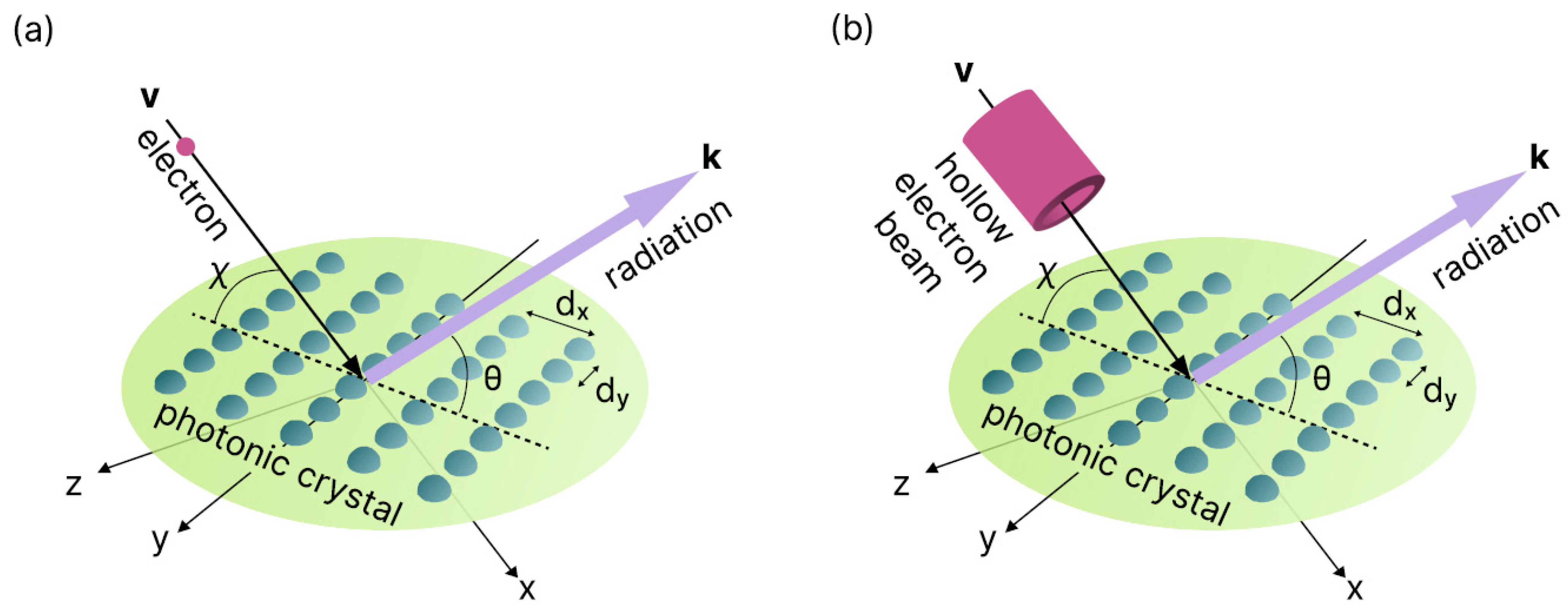
All the properties of the particles important for the considered problem are described by the function of polarizability , which describes how a particle reacts to an external field. Here, is the radiation frequency. The number of particles is finite and equal to . All particles are located in a plane, and the position of p-th particle is defined by the radius-vector . For a specific case when particles are at rectangular grating points in a chosen coordinate system (see Figure 1), one can write where are the grating periods in corresponding directions, and are integers counting particles (a pair of integers and define the p-th particle), and is the angle of incidence of the electron to the PC. The 0.5 addition in is chosen so that an electron does not cross any particle. This limitation arises due to the use of the dipole approximation and will not influence experimental results. Indeed, if an electron crosses a particle, it means that we are compelled to consider the Coulomb field acting at the point of its source, i.e., exactly where the electron is located. Mathematically, the Coulomb field is infinite at this point. This divergence is well-known in classical electrodynamics and can be avoided, for example, by shifting the particle. It cannot take place in an experiment, because an electron is always smaller in size than any “point-like” physical particle consisting of many atoms.
Figure 1.
Scheme of GTR generation (a) from a single electron and (b) from a hollow electron beam.
An electron with the charge moves along the x-axis with a constant velocity
The Fourier-transformed electric field is a solution of Maxwell’s equations at large distances, i.e., for with being the distance from the origin to the point of observation of radiation and being the wave number of radiation:
where is the wave-vector of radiation, is the current density induced in the PC by the Coulomb field of the electron . In dipole approximation, after putting here the explicit formula for dipole moment through the external field, this current density can be written as follows:
Equation (3) is obtained for noninteracting particles, i.e., when each particle practically does not “feel” the influence of radiation from all other particles [14]. This approximation works well away from the conditions of resonances [16,17], which occur in a single particle or in a pair of interacting particles. For example, in [14], very good agreement between the experimental data and the theory constructed using this approximation was demonstrated. This means that the approximation of noninteracting particles can be considered reliable for use in the analysis of GTR.
The Fourier-transformed Coulomb field of a moving electron at a point where the p-th particle is located is a solution of Maxwell’s equation for an electron moving uniformly in vacuum and has the following form:
where is the component of the vector perpendicular to the vector , i.e., and are the modified Bessel functions, and is the Lorentz factor of an electron.
For the specific rectangular grating, the sum over all particles in Equation (3) can be replaced by two sums over and :
where is a number of particles in a row along the x-axis, and is the number of particles in a row along the y-axis, meaning that . This choice of limits of summations in Equation (5) is not the only possible one, and it does not affect the results. For the considered PC, the field of radiation in Equation (2) reads
where
The measurable value is the distribution of radiated energy per unit frequency and solid angle:
with being the speed of light in vacuum.
2.2. Theory of GTR from a Hollow Electron Beam
It was shown earlier [18,19] that for coherent transition radiation from a beam consisting of electrons, the energy emitted per unit photon energy and per unit solid angle can be calculated using the following formula:
where is the Plank constant, and is the form factor of the electron beam, which depends on the form and sizes of the beam. The form factor is calculated by summing the radiation fields from all the electrons, taking into account the phase shift, and then averaging the squared total field over all the electron positions with some function distribution of electrons inside the beam.
The form factor of the beam of electrons, which are distributed inside the beam according to the function , can be calculated as follows:
Here, is a radius-vector of electrons relative to the center of the beam, and is normalized to unity. This factor describes the dependence of radiation properties on electron beam parameters such as the sizes and internal structure of the beam. The factor plays a crucial role in radiation: (i) it carries information about the beam’ shape, which allows for beam diagnostics; (ii) when not too small, it provides the enhancement of radiation up to times in comparison with incoherent regime of radiation. If the length of the beam is much smaller than the wavelength of radiation (), then the radiation is almost completely coherent. In this case, if the distributions of electrons inside the beam in the longitudinal and transverse directions are independent and, consequently, can be written as , then integrating over in Equation (9) yields a result close to unity. Then, Equation (9) reads
Here, the polar system was introduced: , , so . We consider HEBs to be axially symmetric, with where we denoted that is the radius of the beam, is half of the thickness of the beam’s ring, and the normalization factor is as follows:
is the error function. In this case, the result of integration in Equation (10) gives the following formula for the form factor [12]:
where
is the confluent hypergeometric function of the first kind [20], and is the gamma function. In order to perform further analysis of the radiation properties and to plot graphs according to the obtained formulas, it is necessary to cut off infinite series in Equation (12). This can be done, for example, based on the condition that the partial sum converges to some limit, or empirically, i.e., when adding the next summand does not lead to changes in the behavior of the graph plotted according to that partial sum anymore. It should be taken into account that a sufficient number of summands may depend on the size of the beam.
3. Results and Discussion
Now, we can analyze the radiation properties of HEBs. Due to the crystal structure of the target that produces GTR, a clear interference pattern arises in the spatial and spectral distributions of radiation. The maxima of intensity in these distributions obey conditions for positive interference of radiation from different rows of particles of the PC—see the oscillating exponents in Equation (6), and are roughly defined by the following system of dispersion relations:
Here, , are the respective components of the unit wave-vector of radiation:
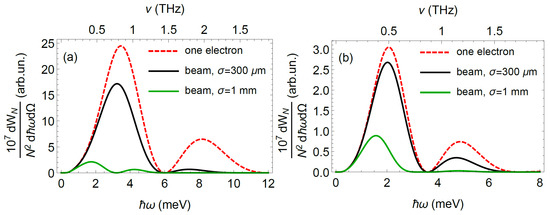
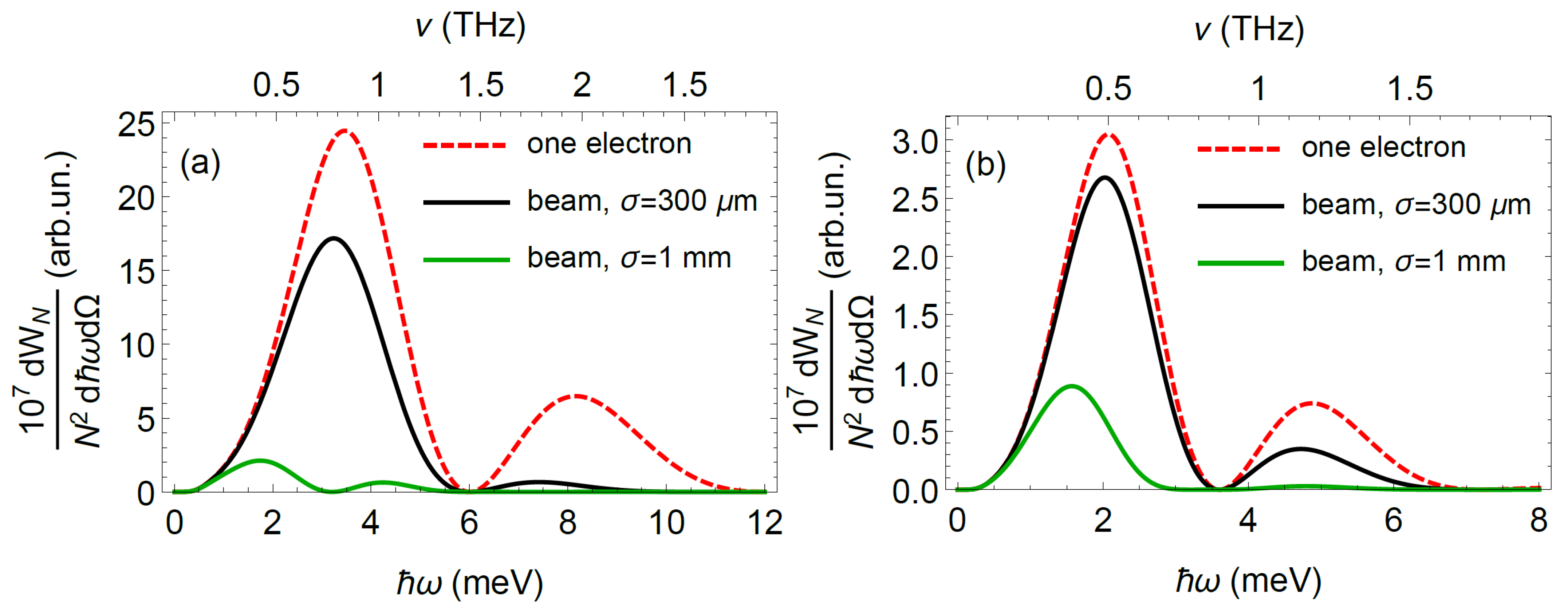
with and being the observation angles. For example, according to these dispersion relations for the PC with mm, which is suitable for THz radiation generation and can easily be fabricated using existing technology, and for an electron with and degrees, the peak of radiation intensity is expected to be at degrees and degrees, and meV ( 0.73 THz). The spectral distributions of the energy of GTR emitted per unit frequency and per unit solid angle by a single electron (red dashed curve) and from a hollow electron beam (black solid and green curves) normalized to , with being the number of electrons in a beam, are shown in Figure 2. The parameters of HEB are chosen so that the transverse beam spot is smaller than the space between particles of PC.
Figure 2.
Intensity of GTR from a single electron (red dashed curve) and normalized to intensity of GTR by a hollow electron beam (black and green solid curves) depending on the photons’ energy. Here, the PC is an array of sub-wavelength spherical particles with the 0.1 mm radius made of the material with the dielectric permittivity equal to 2.1, degree, degree, degree, and mm. (a) mm; (b) mm. For the black solid lines, and ; for the green solid lines, and . For plotting the graphs, 60 first summands were taken in the sum in Equation (12).
In Figure 2a, the spectrum is shown for the PC with two equal periods— mm—while in Figure 2b, the spectrum is shown the PC with two different periods: mm and mm. It can be seen that for all other fixed parameters, the shift in frequency at which the intensity of radiation is maximal occurs. Also, the radiation in general (for all curves) becomes less intensive. The dependence on the beam’s thickness remains the same, while the shape of the green line slightly changes.
If , then the radiation has complete spatial coherence. This means that the spectral or angular distributions of GTR from a HEB are approximately times more intense than that from a single electron and have similar structures. If is of the order of , then the radiation is not fully spatially coherent, even though it has complete temporal coherence. For example, in Figure 2a, this case corresponds to the photons’ energy meV for the black line. Therefore, the spatially coherent radiation from a hollow electron beam demonstrates a significant change in the spectral characteristics compared to radiation from a single electron, i.e., with incoherent radiation. For the larger transverse outer radius of the beam , the spectral distribution of radiated energy changes significantly and loses its intensity; see the green lines in Figure 2.
4. Conclusions
We considered the generation of grating transition radiation by a hollow electron beam from a two-dimensional photonic crystal. For an arbitrary angle of incidence of the electron on the PC surface, we have obtained the analytical formulae for the radiation field and the energy of radiation. Based on this, we also calculated the transverse form factor of the hollow electron beam for GTR under conditions of complete temporal coherence of radiation.
We obtained two dispersion relations that define the wavelength at which the GTR from 2D PC has maximal intensity at fixed angles of observation and . They are similar to relations for light scattered on the crystal but depend also on the electron speed. According to these dispersion relations, the wavelength and the direction of propagation of the radiation with maximal intensity (peaks of radiation intensity) are defined only by the periods of the PC , and the angle between the grating surface and the incident electron trajectory , and they do not depend on the parameters of the electron beam. That is why these peaks of radiation intensity can be called just diffraction orders of 2D PC or harmonics of 2D PC.
It follows from Equation (14) that, for most values of the angles , and , the following inequality should be satisfied in order to observe at least one diffraction order:
Considering the above, this means that if the transverse spot size of the electron beam is smaller than both periods of the grating, then it is possible to observe the diffraction orders of 2D PC enhanced by HEB due to complete spatial coherence. Otherwise, if the transverse spot size of the electron beam is larger than the grating periods, one can observe the diffraction orders of 2D PC only in the regime of spatial incoherence (while the radiation can be completely temporally coherent, which is accessible today in the THz range for experiments with very short electron bunches; see, e.g., [13,14]). In this case, it is not possible to observe the enhancement of the diffraction orders of PC by the factor , characteristic of coherent effects. On the other hand, even if the transverse spot size of the electron beam is larger than both periods of the grating, the effects of spatial coherence can be achieved, but not for the diffraction orders of PC. In this case, one should forget about the periodic structure of the considered 2D crystal and consider it as a macroscopically amorphous target.
Author Contributions
Conceptualization, D.Y.S. and A.A.T.; methodology, A.A.T.; analysis, D.Y.S.; investigation, D.Y.S. and A.A.T.; writing—original draft preparation, D.Y.S.; writing—review and editing, A.A.T. All authors have read and agreed to the published version of the manuscript.
Funding
This research was funded by the Foundation for the Advancement of Theoretical Physics and Mathematics “BASIS”, grant number 23-1-3-2-1.
Data Availability Statement
The original contributions presented in this study are included in the article. Further inquiries can be directed to the corresponding author.
Conflicts of Interest
The authors declare no conflicts of interest.
Abbreviations
The following abbreviations are used in this manuscript:
| 2D | Two-dimensional |
| GTR | Grating transition radiation |
| HEB | Hollow electron beam |
| PC | Photonic crystal |
| TR | Transition radiation |
References
- Cao, G.J.; Lindstrøm, C.A.; Adli, E.; Corde, S.; Gessner, S. Positron acceleration in plasma wakefields. Phys. Rev. Accel. Beams 2024, 27, 034801. [Google Scholar] [CrossRef] [Scilit]
- Jain, N. Evolution of ultra-relativistic hollow electron beams during their propagation in plasmas. Phys. Plasmas 2019, 26, 023107. [Google Scholar] [CrossRef] [Scilit]
- Redaelli, S.; Appleby, R.B.; Bruce, R.; Bruning, O.; Kolehmainen, A.; Ferlin, G.; Foussat, A.; Giovannozzi, M.; Hermes, P.; Mirarchi, D.; et al. Hollow electron lenses for beam collimation at the High-Luminosity Large Hadron Collider (HL-LHC). J. Instrum. 2024, 16, P03042. [Google Scholar] [CrossRef] [Scilit]
- Gu, X.; Fischer, W.; Altinbas, Z.; Drees, A.; Hock, J.; Hulsart, R.; Liu, C.; Marusic, A.; Miller, T.A.; Minty, M.; et al. Halo removal experiments with hollow electron lens in the BNL Relativistic Heavy Ion Collider. Phys. Rev. Accel. Beams 2020, 23, 031001. [Google Scholar] [CrossRef] [Scilit]
- Hu, L.-X.; Yu, T.-P.; Sheng, Z.-M.; Vieira, J.; Zou, D.-B.; Yin, Y.; McKenna, P.; Shao, F.-Q. Attosecond electron bunches from a nanofiber driven by Laguerre-Gaussian laser pulses. Sci. Rep. 2018, 8, 7282. [Google Scholar] [CrossRef] [Scilit] [PubMed]
- Shapovalov, P.G.; Oleinik, A.N.; Karataev, P.V. Computer simulations of the phase-space characteristics of electrons in a pyroelectric accelerator. J. Instrum. 2024, 19, C09001. [Google Scholar] [CrossRef] [Scilit]
- Rezaei, Z.; Farokhi, B. Start current and growth rate in Smith-Purcell free-electron laser with dielectric-loaded cylindrical grating. J. Theor. Appl. Phys. 2020, 14, 149–158. [Google Scholar] [CrossRef] [Scilit]
- Bluem, H.P.; Jackson, R.H.; Jarvis, J.D.; Todd, A.M.M.; Gardelle, J.; Modin, P.; Donohue, J.T. First Lasing From a High-Power Cylindrical Grating Smith–Purcell Device. IEEE Trans. Plasma Sci. 2015, 43, 3176–3184. [Google Scholar] [CrossRef] [Scilit]
- Ginzburg, V.L.; Frank, I.M. Radiation of a Uniformly Moving Electron Due to Its Transition from One Medium to Another. Zh. Eksp. Theor. Phys. 1945, 16, 15–28. [Google Scholar]
- Potylitsyn, A.; Sukhikh, L.; Gusvitskii, T.; Kube, G.; Novokshonov, A. Image of the transverse bunch profile via coherent optical transition radiation. Phys. Rev. Accel. Beams 2020, 23, 042804. [Google Scholar] [CrossRef] [Scilit]
- Mindur, B.; On behalf of the ATLAS Collaboration. ATLAS Transition Radiation Tracker (TRT): Straw tubes for tracking and particle identification at the Large Hadron Collider. Nucl. Instrum. Methods Phys. Res. Sect. B 2017, 845, 257–261. [Google Scholar] [CrossRef] [Scilit]
- Sergeeva, D.Y.; Tishchenko, A.A. Form Factor in Transition Radiation from Hollow Beams. JETP Lett. 2023, 117, 492–497. [Google Scholar] [CrossRef] [Scilit]
- Naumenko, G.; Aryshev, A.; Potylitsyn, A.; Shevelev, M.; Sukhikh, L.; Terunuma, N.; Urakawa, J. Monochromatic coherent grating transition radiation in sub-THz frequency range. Nucl. Instrum. Methods Phys. Res. Sect. B 2017, 402, 153–156. [Google Scholar] [CrossRef] [Scilit]
- Sergeeva, D.Y.; Aryshev, A.S.; Tishchenko, A.A.; Popov, K.E.; Terunuma, N.; Urakawa, J. THz Smith–Purcell and grating transition radiation from metasurface: Experiment and theory. Opt. Lett. 2021, 46, 544–547. [Google Scholar] [CrossRef] [Scilit] [PubMed]
- Sergeeva, D.Y.; Garaev, D.I.; Tishchenko, A.A. Polarized grating transition radiation from a 2D photonic crystal. J. Opt. Soc. Am. B 2022, 39, 3275–3282. [Google Scholar] [CrossRef] [Scilit]
- Tishchenko, A.A.; Sergeeva, D.Y. Near-field resonances in photon emission via interaction of electrons with coupled nanoparticles. Phys. Rev. B 2019, 100, 235421. [Google Scholar] [CrossRef] [Scilit]
- Tishchenko, A.A.; Sergeeva, D.Y. Enhanced Smith-Purcell radiation based on quasibound states in the continuum in dimers aligned in a chain. Phys. Rev. B 2023, 108, 155435. [Google Scholar]
- Garibian, G.M.; Yang, C. X-Ray Transition Radiation; SSR Press: Yerevan, Armenia, 1983. [Google Scholar]
- Sergeeva, D.Y.; Tishchenko, A.A.; Strikhanov, M.N. UV and X-ray diffraction and transition radiation from charged particles Bunches. Nucl. Instrum. Methods Phys. Res. Sect. B 2013, 309, 189–193. [Google Scholar] [CrossRef] [Scilit]
- Humbert, P. Sur les fonctions hypercylindriques. Comptes Rendus L’académie Sci. 1920, 171, 490–492. [Google Scholar]

Disclaimer/Publisher’s Note: The statements, opinions and data contained in all publications are solely those of the individual author(s) and contributor(s) and not of MDPI and/or the editor(s). MDPI and/or the editor(s) disclaim responsibility for any injury to people or property resulting from any ideas, methods, instructions or products referred to in the content. |
© 2025 by the authors. Licensee MDPI, Basel, Switzerland. This article is an open access article distributed under the terms and conditions of the Creative Commons Attribution (CC BY) license (https://creativecommons.org/licenses/by/4.0/).