
Assessment of the Self-Heating Potential of Fresh Wood Using the Pulse Flow Calorimetric Method

Abstract
1. Introduction
2. Materials and Methods
2.1. Samples
2.2. Pulse Flow Calorimetric Method, Oxidation Heat Measurements
3. Results and Discussion
3.1. Oxidation Heat of Wood Samples
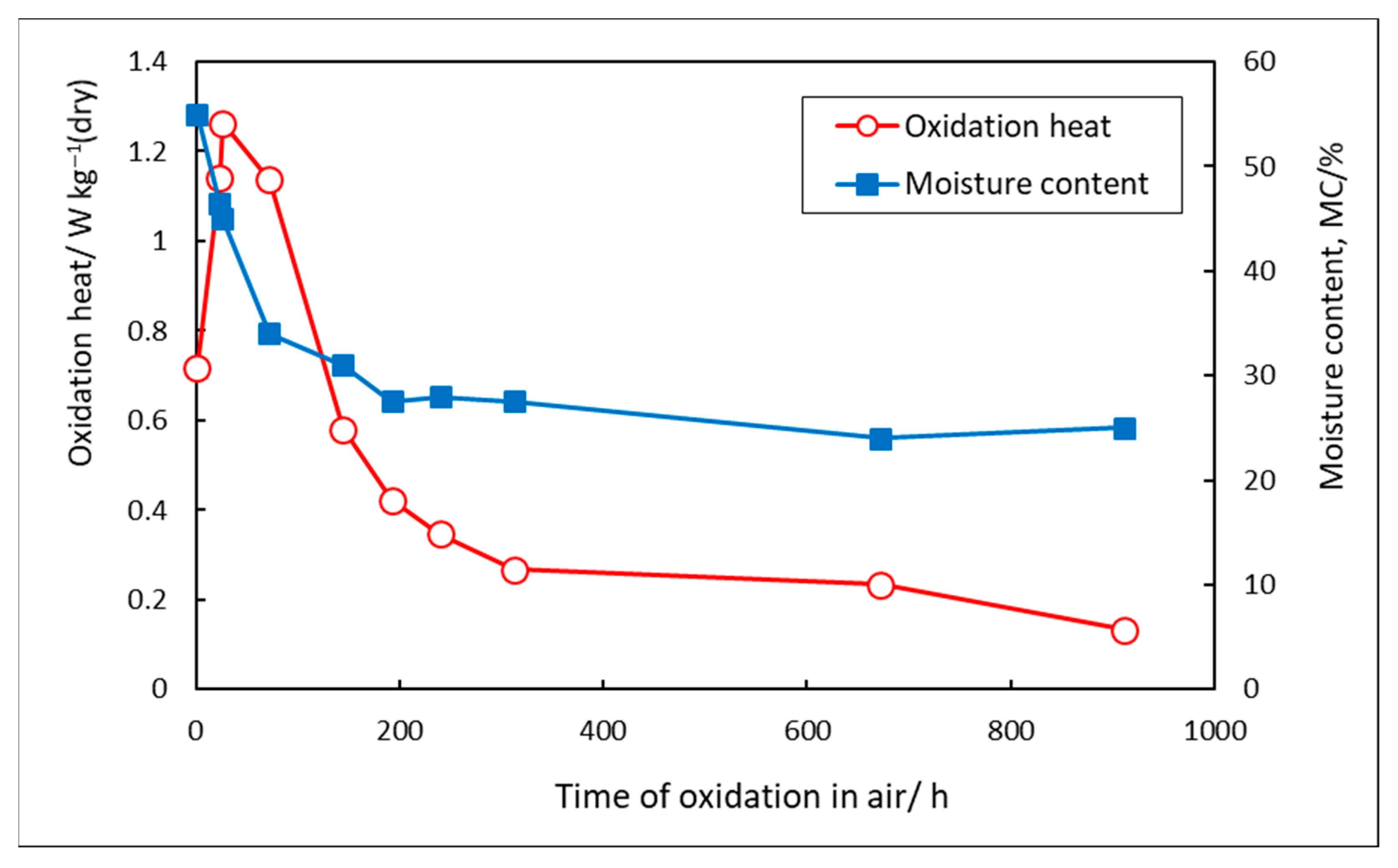
3.2. Effect of Moisture on Oxidation Heat of Wood
3.3. Towards Heat Generated by Microorganisms
4. Conclusions
- Oxidation heat q30 of fresh wood taken from ten tree types was found to vary between 0.45 W kg−1 (dry) and 1.1 W kg−1 (dry).
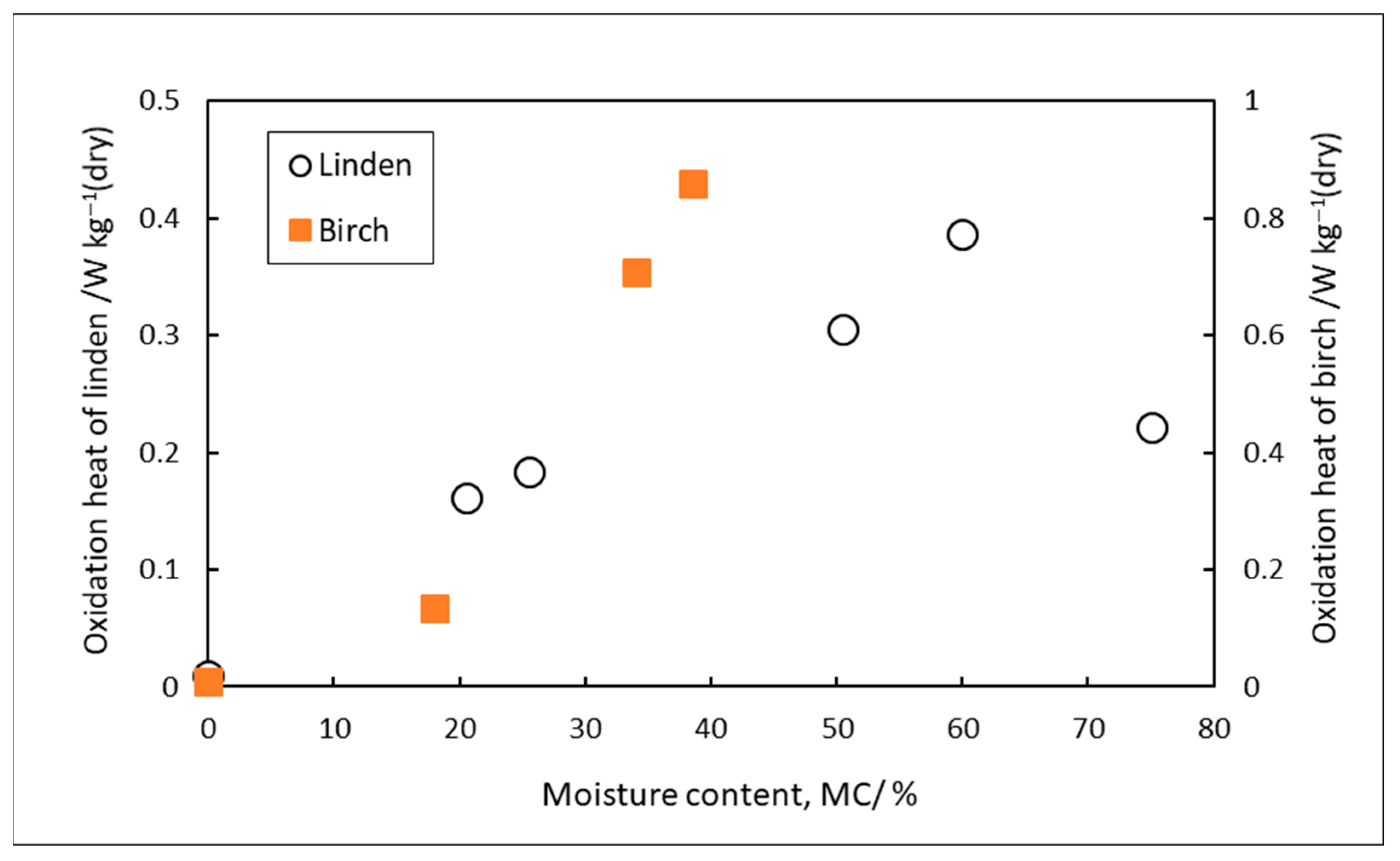
- Moisture in wood acts as an accelerator of oxidation heat production. For dried wood, virtually no measurable evolution of the oxidation heat was observed.
- In the global value of the oxidation heat of fresh wood, q30, a significant part can originate from the action of microorganisms. On the basis of experiments with debarked wood samples, it is estimated that the share is approximately 35–55%.
Supplementary Materials
Funding
Institutional Review Board Statement
Informed Consent Statement
Data Availability Statement
Acknowledgments
Conflicts of Interest
Appendix A
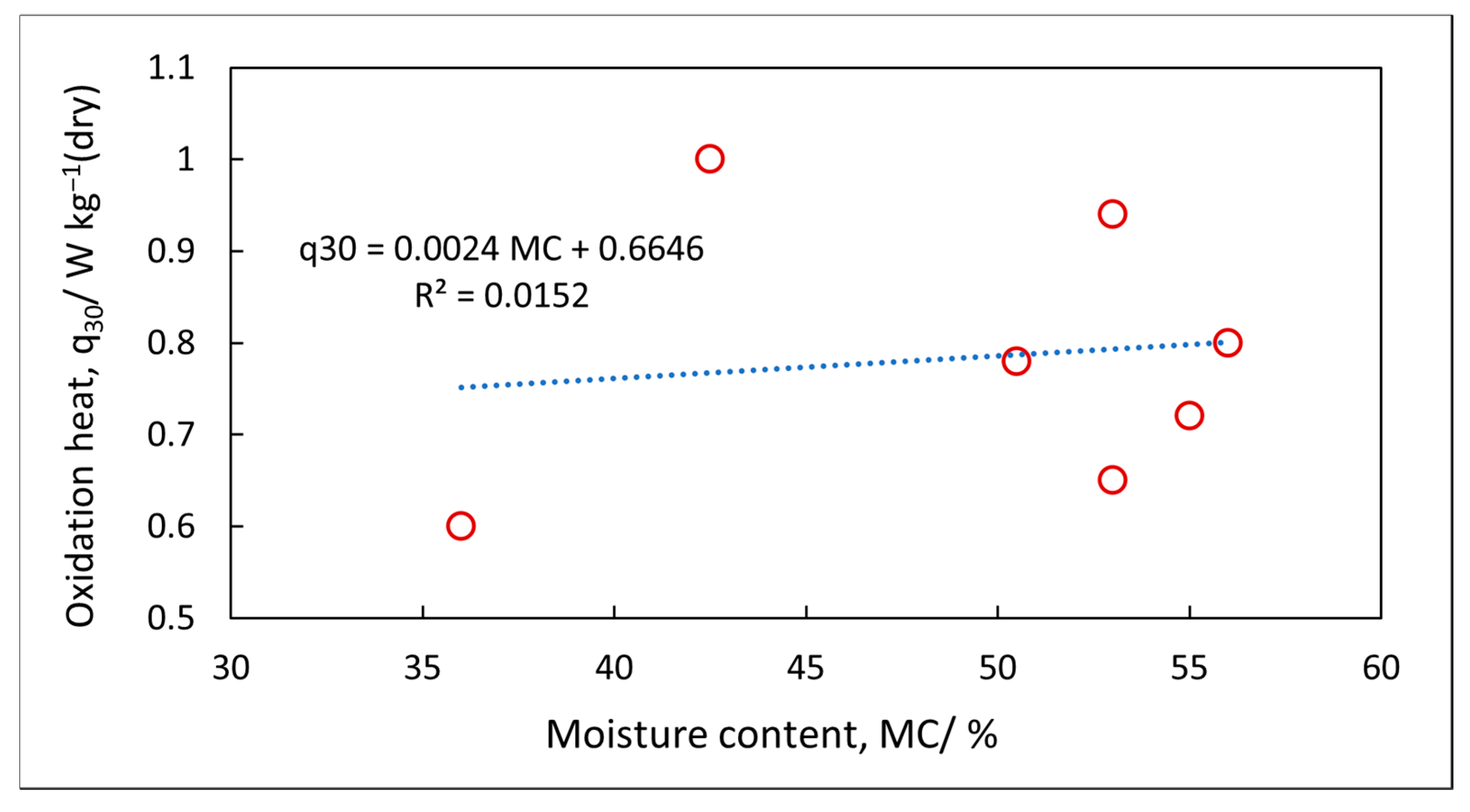
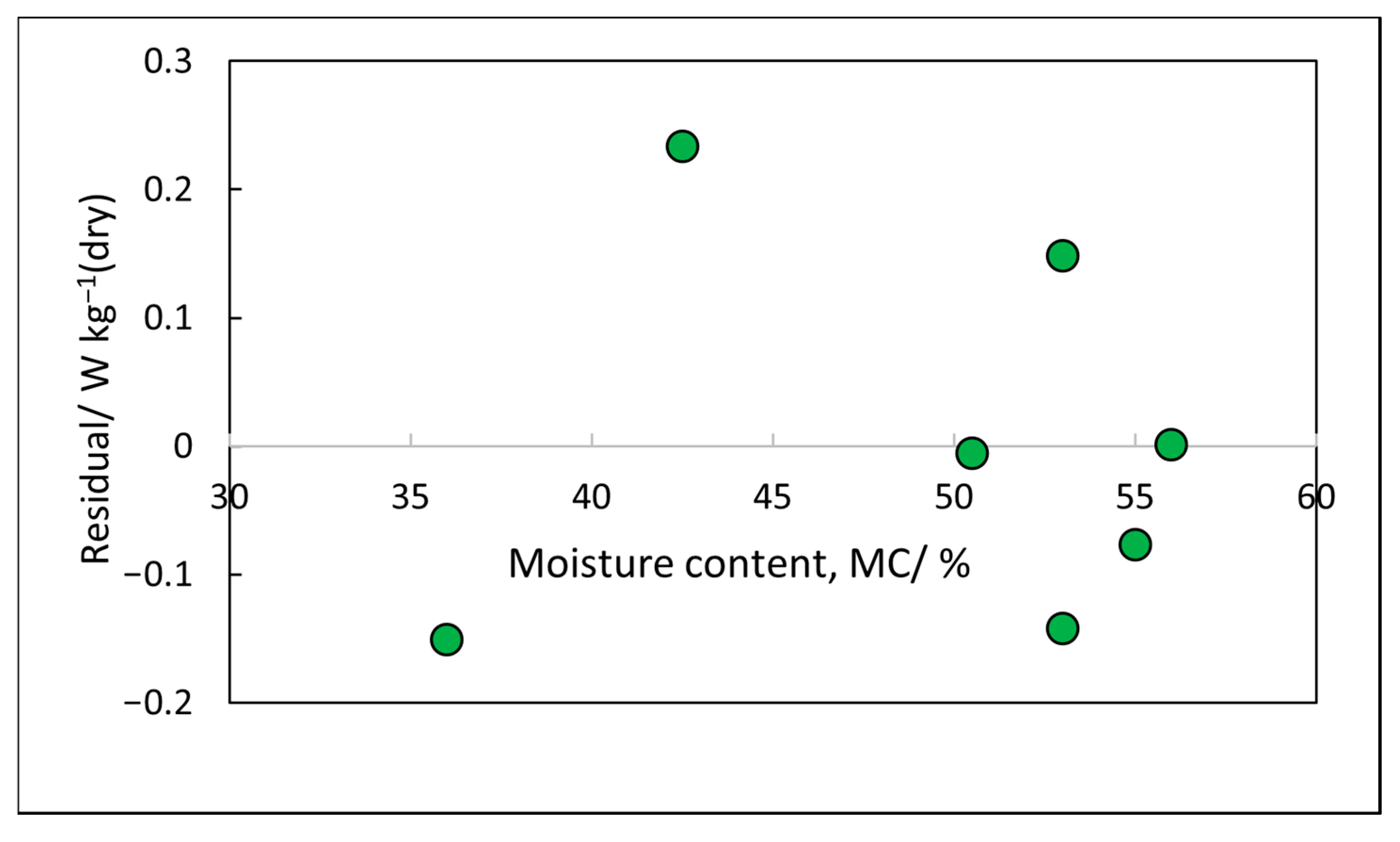
Statistical Assessment of Oxidation Heat Replicates for Linden Wood Samples

| Date of Analysis | Oxid. Heat, q30 (W kg−1 (dry)) | Moisture Content, MC (%) |
|---|---|---|
| 16 May 2024 | 0.60 | 36.0 |
| 30 October 2024 | 1.00 | 42.5 |
| 11 April 2025 | 0.80 | 56.0 |
| 29 May 2025 | 0.94 | 53.0 |
| 30 June 2025 | 0.78 | 50.5 |
| 29 July 2025 | 0.72 | 55.0 |
| 14 October 2025 | 0.65 | 53.0 |


References
- Liu, Y.; Wen, H.; Chen, C.; Guo, J.; Jin, Y.; Zheng, X.; Cheng, X.; Li, D. Research Status and Development Trend of Coal Spontaneous Combustion Fire and Prevention Technology in China: A Review. ACS Omega 2024, 9, 21727–21750. [Google Scholar] [CrossRef] [PubMed]
- Song, Z.; Kuenzer, C. Coal Fires in China over the Last Decade: A Comprehensive Review. Int. J. Coal Geol. 2014, 133, 72–99. [Google Scholar] [CrossRef]
- Sedlmayer, I.; Arshadi, M.; Haslinger, W.; Hofbauer, H.; Larsson, I.; Lönnermark, A.; Nilsson, C.; Pollex, A.; Schmidl, C.; Stelte, W.; et al. Determination of off-gassing and self-heating potential of wood pellets—Method comparison and correlation analysis. Fuel 2018, 234, 894–903. [Google Scholar] [CrossRef]
- Perdochová, M.; Derychová, K.; Věžniková, H.; Bernatík, A.; Pitt, M. The influence of oxygen concentration on the composition of gaseous products occurring duringthe self-heating of coal and wood sawdust. Process Saf. Environ. 2015, 94, 463–470. [Google Scholar] [CrossRef]
- Krigstin, S.; Wetzel, S. A review of mechanisms responsible for changes to stored woody biomass fuels. Fuel 2016, 175, 75–86. [Google Scholar] [CrossRef]
- Kalliola, A.; Kuitunen, S.; Liitia, T.; Rovio, S.; Ohra-aho, T.; Vuorinen, T.; Tamminen, T. Lignin oxidation mechanisms under oxygen delignification conditions. Part 1. Results from direct analyses. Holzforschung 2011, 65, 567–574. [Google Scholar] [CrossRef]
- Krigstina, S.; Helmeste, C.; Jia, H.; Johnson, K.E.; Wetzel, S.; Volpec, S.; Faizal, W.; Ferrero, F. Comparative analysis of bark and woodchip biomass piles for enhancing predictability of self-heating. Fuel 2019, 242, 699–709. [Google Scholar] [CrossRef]
- Taraba, B.; Podstawka, T.; Mucha, M. Towards indication gases of spontaneous heating of biomass. Fuel 2018, 222, 610–616. [Google Scholar] [CrossRef]
- Pei, Q.; Jia, Z.; Liu, J.; Wang, Y.; Wang, J.; Zhang, Y. Prediction of Coal Spontaneous Combustion Hazard Grades Based on Fuzzy Clustered Case-Based Reasoning. Fire 2024, 7, 107. [Google Scholar] [CrossRef]
- Sen, R.; Srivastava, S.; Singh, M. Aerial Oxidation of Coal-Analytical Methods, Instrumental Techniques and Test Methods: A Survey. Indian J. Chem. Technol. 2009, 16, 103–109. [Google Scholar]
- Beamish, B.B.; Hamilton, G.R. Effect of Moisture Content on the R70 Self-Heating Rate of Callide Coal. Int. J. Coal Geol. 2005, 64, 133–138. [Google Scholar] [CrossRef]
- Leslie, G.; Pollard, A.; Matovic, D. Calorimetric and Heat Transfer Studies of the Spontaneous Combustion of Two Low Carbon Fuels. J. Loss Prev. Process Ind. 2014, 32, 44–51. [Google Scholar] [CrossRef]
- Zarrouk, S.J.; O’Sullivan, M.J.; St George, J.D. Modelling the Spontaneous Combustion of Coal: The Adiabatic Testing Procedure. Combust. Theory Model. 2006, 10, 907–926. [Google Scholar] [CrossRef]
- Wadso, L. Measuring chemical heat production rates of biofuels by isothermal calorimetry for hazardous evaluation modelling. Fire Mater. 2007, 31, 241–255. [Google Scholar] [CrossRef]
- Guo, W.; Trischuk, K.; Bi, X.; Lim, C.J.; Sokhansanj, S. Measurements of wood pellets self-heating kinetic parameters using isothermal calorimetry. Biomass Bioenergy 2014, 63, 1–9. [Google Scholar] [CrossRef]
- Larsson, I.; Lönnermark, A.; Blomqvist, P.; Persson, H.; Bohlén, H. Development of a screening test based on isothermal calorimetry for determination of self-heating potential of biomass pellets. Fire Mater. 2017, 41, 940–952. [Google Scholar] [CrossRef]
- Larsson, I.; Lönnermark, A.; Blomqvist, P.; Persson, H. Measurement of self-heating potential of biomass pellets with isothermal calorimetry. Fire Mater. 2017, 41, 1007–1015. [Google Scholar] [CrossRef]
- Rupar-Gadd, K.; Forss, J. Self-heating properties of softwood samples investigated by using isothermal calorimetry. Biomass Bioenergy 2018, 111, 206–212. [Google Scholar] [CrossRef]
- Taraba, B.; Dobal, V.; Čáp, K.; Harašta, M. Differentiation in thermal effects during low temperature oxidation of coal. Fuel 1988, 67, 758–763. [Google Scholar] [CrossRef]
- Taraba, B.; Maršálek, R. Self-Heating Risk of Coals and Metal Powders: A Comparison. Fire 2024, 7, 378. [Google Scholar] [CrossRef]
- Li, X.-R.; Koseki, H.; Momota, M. Evaluation of danger from fermentation-induced spontaneous ignition of wood chips. J. Hazard. Mater. 2006, A135, 15–20. [Google Scholar] [CrossRef] [PubMed]
- Chen, X.D.; Stott, J.B. The effect of moisture content on the oxidation rate of coal during near-equilibrium drying and wetting at 50 °C. Fuel 1993, 72, 787–792. [Google Scholar] [CrossRef]
- Miyawaki, N.; Fukushima, T.; Mizuno, T.; Inoue, M.; Takisawa, K. Effect of wood biomass components on self-heating. Bioresour. Bioprocess 2021, 8, 21. [Google Scholar] [CrossRef]
- Gutierrez, E.; Noriega, M.; Fernandez, C.; Pantano, N.; Rodriguez, L.; Scaglia, G. Dynamic Optimization of Xylitol Production Using Legendre-Based Control Parameterization. Fermentation 2025, 11, 308. [Google Scholar] [CrossRef]
- Garnier, A.; Gaillet, B. Analytical solution of Luedeking-Piret equation for a batch fermentation obeying Monod growth kinetics. Biotechnol. Bioeng. 2015, 112, 2468–2474. [Google Scholar] [CrossRef] [PubMed]
- Freudenthal, J.; Dumack, K.; Schaffer, S.; Schlegel, M.; Bonkowski, M. Algae-fungi symbioses and bacteria-fungi co-exclusion drive tree species-specific differences in canopy bark microbiomes. ISME J. 2024, 18, wrae206. [Google Scholar] [CrossRef] [PubMed]
- Fan, S.; Yue Sun, Y.; ter Heijne, A.; Chen, W.-S.; Cees, J.N.; Buisman, C.J.N. Effect of nitrogen, phosphorus and pH on biological wood oxidation at 42 °C. Sci. Total Environ. 2020, 726, 138569. [Google Scholar] [CrossRef]
- Caizán Juanarena, L.; Ter Heijne, A.; Buisman, C.J.N.; van der Wal, A. Wood degradation by thermotolerant and thermophilic fungi for sustainable heat production. ACS Sustain. Chem. Eng. 2016, 4, 6355–6361. [Google Scholar] [CrossRef]


| Wood Sample | Oxidation Heat, q30, W kg−1 (dry) * | Moisture Content, MC, % ** | Coefficient of Variation, CV, % |
|---|---|---|---|
| Willow (Salix erythroflexuosa) | 1.1 | 47/58 | 8.0 |
| Birch (Betula pendula) | 0.80 | 47/51 | 10 |
| Linden (Tilia cordata) | 0.78 | 36–56 | 19 |
| Ash (Fraxinus excelsior) | 0.76 | 31/37 | 10 |
| Maple (Acer platanoides) | 0.71 | 41/57 | 12 |
| Hornbeam (Carpinus betulus) | 0.63 | 34/45 | 11 |
| Oak (Quercus robur) | 0.62 | 41/46 | 27 |
| Beech (Fagus sylvatica) | 0.48 | 37/46 | 13 |
| Spruce (Picea abies) | 0.47 | 34/38 | 3.0 |
| Pine (Pinus sylvestris) | 0.45 | 45/45 | 11 |
| Sample | Fresh Wood Sample (with Bark) | Fresh Wood Sample (Debarked) | ||
|---|---|---|---|---|
| Oxidation Heat q30, W kg−1 (dry) * | Moisture Content, MC, % ** | Oxidation Heat q30, W kg−1 (dry) | Moisture Content, MC, % | |
| Birch (Betula pendula) | 0.72–0.89 | 47/51 | 0.57 | 36 |
| Linden (Tilia cordata) | 0.60–1.00 | 36/43 | 0.45 | 53 |
| Oak (Quercus robur) | 0.46–0.79 | 41/46 | 0.48 | 34 |
Disclaimer/Publisher’s Note: The statements, opinions and data contained in all publications are solely those of the individual author(s) and contributor(s) and not of MDPI and/or the editor(s). MDPI and/or the editor(s) disclaim responsibility for any injury to people or property resulting from any ideas, methods, instructions or products referred to in the content. |
© 2025 by the author. Licensee MDPI, Basel, Switzerland. This article is an open access article distributed under the terms and conditions of the Creative Commons Attribution (CC BY) license.
Share and Cite
Taraba, B. Assessment of the Self-Heating Potential of Fresh Wood Using the Pulse Flow Calorimetric Method. Fire 2026, 9, 12. https://doi.org/10.3390/fire9010012
Taraba B. Assessment of the Self-Heating Potential of Fresh Wood Using the Pulse Flow Calorimetric Method. Fire. 2026; 9(1):12. https://doi.org/10.3390/fire9010012
Chicago/Turabian StyleTaraba, Boleslav. 2026. "Assessment of the Self-Heating Potential of Fresh Wood Using the Pulse Flow Calorimetric Method" Fire 9, no. 1: 12. https://doi.org/10.3390/fire9010012
APA StyleTaraba, B. (2026). Assessment of the Self-Heating Potential of Fresh Wood Using the Pulse Flow Calorimetric Method. Fire, 9(1), 12. https://doi.org/10.3390/fire9010012