



Machine Learning and Bagging to Predict Midterm Electricity Consumption in Saudi Arabia

Abstract
1. Introduction
2. Related Work
3. Materials and Methods
3.1. Technical Description of the K* Model
3.2. Bagging Ensemble
4. Experimental Results
4.1. Results of Using Optimized K* Model
4.2. Results of Using Bagging Technique
5. Discussion
6. Conclusions
Author Contributions
Funding
Data Availability Statement
Acknowledgments
Conflicts of Interest
References
- Weron, R. Electricity price forecasting: A review of the state-of-the-art with a look into the future. Int. J. Forecast. 2014, 30, 1030–1081. [Google Scholar] [CrossRef]
- Chen, B.-J.; Chang, M.-W.; Lin, C.-J. Load Forecasting Using Support Vector Machines: A Study on EUNITE Competition 2001. IEEE Trans. Power Syst. 2004, 19, 1821–1830. [Google Scholar] [CrossRef]
- Guo, H.; Chen, Q.; Xia, Q.; Kang, C.; Zhang, X. A monthly electricity consumption forecasting method based on vector error correction model and self-adaptive screening method. Int. J. Electr. Power Energy Syst. 2018, 95, 427–439. [Google Scholar] [CrossRef]
- Debnath, K.B.; Mourshed, M. Forecasting methods in energy planning models. Renew. Sustain. Energy Rev. 2018, 88, 297–325. [Google Scholar] [CrossRef]
- Kim, S.-G.; Jung, J.-Y.; Sim, M.K. A Two-Step Approach to Solar Power Generation Prediction Based on Weather Data Using Machine Learning. Sustainability 2019, 11, 1501. [Google Scholar] [CrossRef]
- Blumsack, S.; Fernandez, A. Ready or not, here comes the smart grid! Energy 2012, 37, 61–68. [Google Scholar] [CrossRef]
- Salam, M.A.; Khan, S.A. Transition towards sustainable energy production—A review of the progress for solar energy in Saudi Arabia. Energy Explor. Exploit. 2018, 36, 3–27. [Google Scholar] [CrossRef]
- Almaraashi, M. Short-term prediction of solar energy in Saudi Arabia using automated-design fuzzy logic systems. PLoS ONE 2017, 12, e0182429. [Google Scholar] [CrossRef]
- Zhu, X.; Dang, Y.; Ding, S. Using a self-adaptive grey fractional weighted model to forecast Jiangsu’s electricity consumption in China. Energy 2020, 190, 116417. [Google Scholar] [CrossRef]
- Jiang, W.; Wu, X.; Gong, Y.; Yu, W.; Zhong, X. Holt–Winters smoothing enhanced by fruit fly optimization algorithm to forecast monthly electricity consumption. Energy 2020, 193, 116779. [Google Scholar] [CrossRef]
- Mengying, H.; Jiandong, D.; Zequan, H.; Peng, W.; Shuai, F.; Peijia, H.; Chaoyuan, F. Monthly Electricity Forecast Based on Electricity Consumption Characteristics Analysis and Multiple Effect Factors. In Proceedings of the 2019 IEEE 8th International Conference on Advanced Power System Automation and Protection (APAP), Xi’an, China, 21–24 October 2019; pp. 1814–1818. [Google Scholar] [CrossRef]
- Oğcu, G.; Demirel, O.F.; Zaim, S. Forecasting Electricity Consumption with Neural Networks and Support Vector Regression. Procedia Soc. Behav. Sci. 2012, 58, 1576–1585. [Google Scholar] [CrossRef]
- Khan, A.; Chiroma, H.; Imran, M.; Khan, A.; Bangash, J.I.; Asim, M.; Hamza, M.F.; Aljuaid, H. Forecasting electricity consumption based on machine learning to improve performance: A case study for the organization of petroleum exporting countries (OPEC). Comput. Electr. Eng. 2020, 86, 106737. [Google Scholar] [CrossRef]
- Kaytez, F.; Taplamacioglu, M.C.; Cam, E.; Hardalac, F. Forecasting electricity consumption: A comparison of regression analysis, neural networks and least squares support vector machines. Int. J. Electr. Power Energy Syst. 2015, 67, 431–438. [Google Scholar] [CrossRef]
- Mohammed, A.; Alshibani, A.; Alshamrani, O.; Hassanain, M. A regression-based model for estimating the energy consumption of school facilities in Saudi Arabia. Energy Build. 2021, 237, 110809. [Google Scholar] [CrossRef]
- Al-Garni, A.Z.; Zubair, S.M.; Nizami, J.S. A regression model for electric-energy-consumption forecasting in Eastern Saudi Arabia. Energy 1994, 19, 1043–1049. [Google Scholar] [CrossRef]
- Alanbar, M.; Alfarraj, A.; Alghieth, M. Energy Consumption Prediction Using Deep Learning Technique case study of computer college. Int. J. Interact. Mob. Technol. 2020, 14, 166–177. [Google Scholar] [CrossRef]
- Abdel-Aal, R.; Al-Garni, A.; Al-Nassar, Y. Modelling and forecasting monthly electric energy consumption in eastern Saudi Arabia using abductive networks. Energy 1997, 22, 911–921. [Google Scholar] [CrossRef]
- Abdel-Aal, R.; Al-Garni, A. Forecasting monthly electric energy consumption in eastern Saudi Arabia using univariate time-series analysis. Energy 1997, 22, 1059–1069. [Google Scholar] [CrossRef]
- Mikayilov, J.I.; Darandary, A.; Alyamani, R.; Hasanov, F.J.; Alatawi, H. Regional heterogeneous drivers of electricity demand in Saudi Arabia: Modeling regional residential electricity demand. Energy Policy 2020, 146, 111796. [Google Scholar] [CrossRef]
- Alkhraijah, M.; Alowaifeer, M.; Alsaleh, M.; Alfaris, A.; Molzahn, D.K. The Effects of Social Distancing on Electricity Demand Considering Temperature Dependency. Energies 2021, 14, 473. [Google Scholar] [CrossRef]
- Alharbi, F.R.; Csala, D. A Seasonal Autoregressive Integrated Moving Average with Exogenous Factors (SARIMAX) Forecasting Model-Based Time Series Approach. Inventions 2022, 7, 94. [Google Scholar] [CrossRef]
- Fahmy, M.S.E.; Ahmed, F.; Durani, F.; Bojnec, Š.; Ghareeb, M.M. Predicting Electricity Consumption in the Kingdom of Saudi Arabia. Energies 2023, 16, 506. [Google Scholar] [CrossRef]
- Almuhaini, S.H.; Sultana, N. Forecasting Long-Term Electricity Consumption in Saudi Arabia Based on Statistical and Machine Learning Algorithms to Enhance Electric Power Supply Management. Energies 2023, 16, 2035. [Google Scholar] [CrossRef]
- Cleary, J.G.; Trigg, L.E. K*: An Instance-based Learner Using an Entropic Distance Measure. In Machine Learning Proceedings 1995, Proceedings of the Twelfth International Conference on Machine Learning, Tahoe City, CA, USA, 9–12 July 1995; Elsevier: Atlanta, GA, USA, 1995; pp. 108–114. [Google Scholar]
- Aljazzar, H.; Leue, S. K⁎: A heuristic search algorithm for finding the k shortest paths. Artif. Intell. 2011, 175, 2129–2154. [Google Scholar] [CrossRef]
- Breiman, L. Bagging predictors. Mach. Learn. 1996, 24, 123–140. [Google Scholar] [CrossRef]
- Bauer, E.; Kohavi, R. Empirical comparison of voting classification algorithms: Bagging, boosting, and variants. Mach. Learn. 1999, 36, 105–139. [Google Scholar] [CrossRef]
- Weka 3: Machine Learning Software in Java. 2019. Available online: https://www.cs.waikato.ac.nz/ml/weka/ (accessed on 1 November 2019).
- Al Metrik, M.A.; Musleh, D.A. Machine Learning Empowered Electricity Consumption Prediction. Comput. Mater. Contin. 2022, 72, 1427–1444. [Google Scholar] [CrossRef]
- Bissey, S.; Jacques, S.; Le Bunetel, J.-C. The Fuzzy Logic Method to Efficiently Optimize Electricity Consumption in Individual Housing. Energies 2017, 10, 1701. [Google Scholar] [CrossRef]
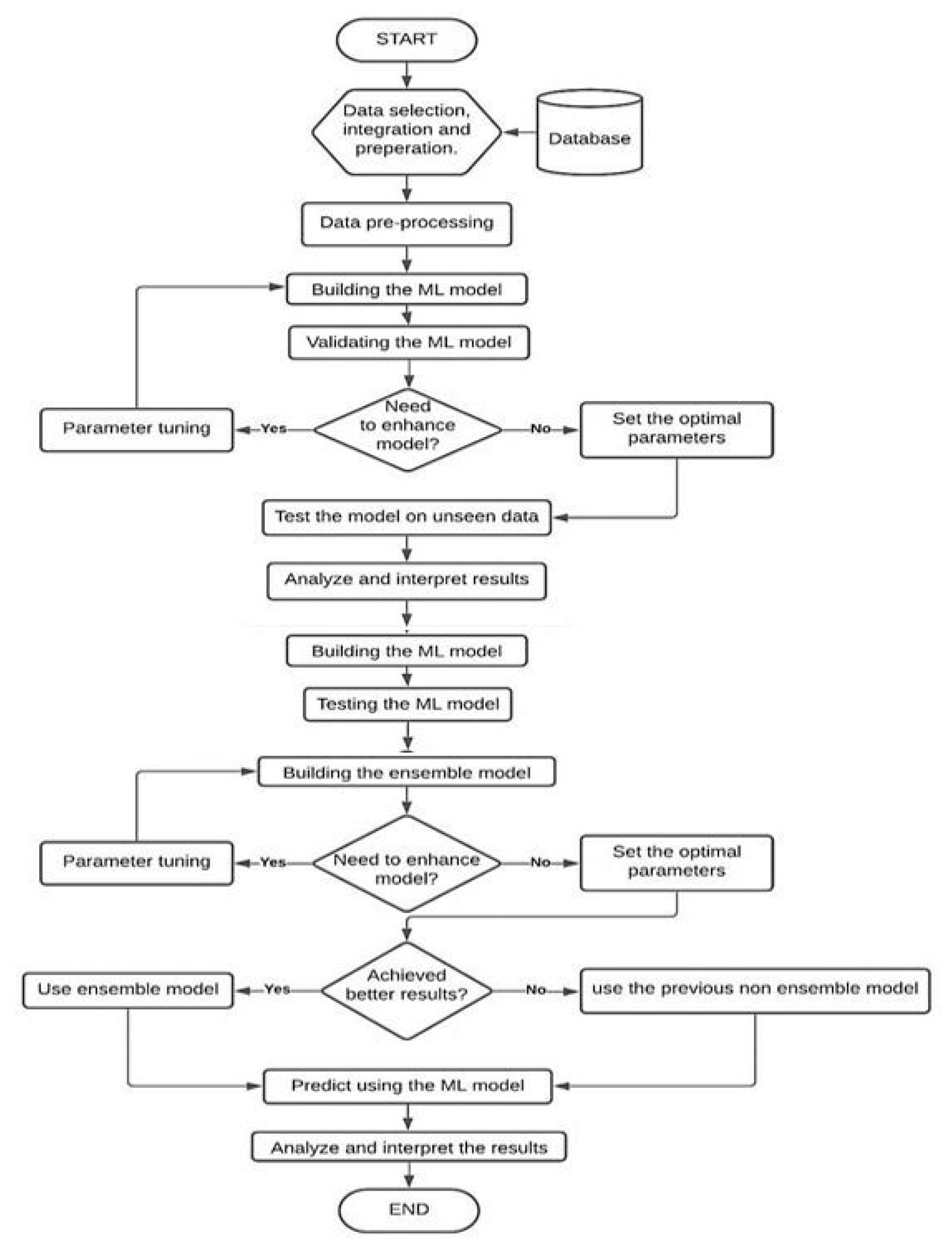
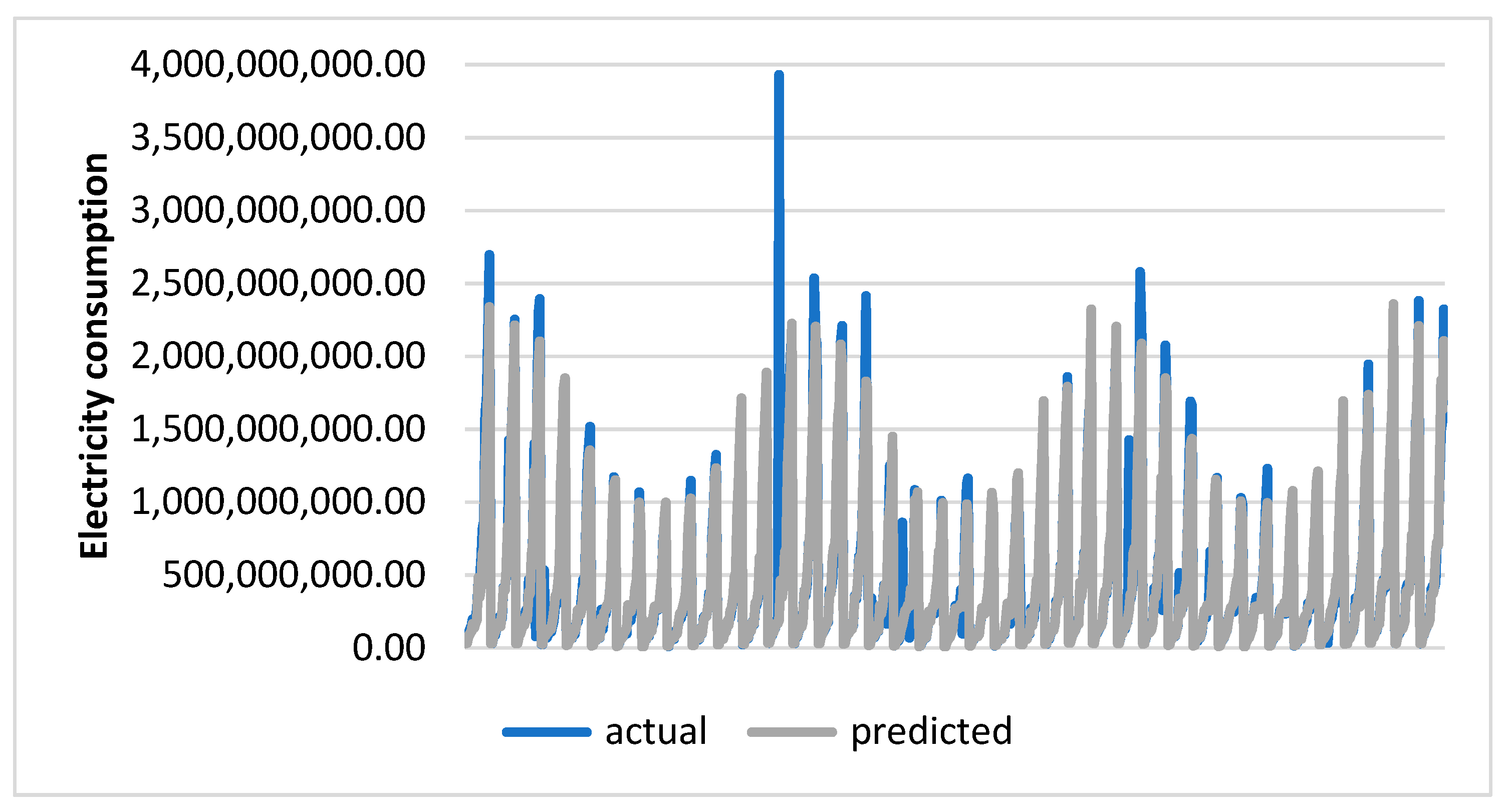

| Year Ref. | Aim | Location Time Frame | Dataset Source | Method | Results |
|---|---|---|---|---|---|
| 2017 [3] | Improving monthly and mid-term accuracy for electricity consumption forecasting | China 2000–2014 | China’s National Bureau of Statistics | Vector error correction model and self-adaptive screening | -The proposed model obtained 1.66% MAPE -High-complexity calculation |
| 2019 [9] | Predicting the electric consumption for Jiangsu | Jiangsu, China 2001–2017 | Statistical yearbook of Jiangsu Province | A self-adaptive grey fractional weighted model | The proposed model performs better with 120.83 for RMSE and 1.77 for MAPE |
| 2019 [10] | Using limited data to predict accurate electricity consumption | Chongqing, China 2010–2018 | Chinese energy supply company | Holt–Winters smoothing | 3.58% MAPE |
| 2019 [11] | A monthly electric consumption forecast method based on gross domestic product | A city in China 2015–2017 | Bureau of statistics website and temperature website | Elman ANN | 2.15% MAPE |
| 2012 [12] | Accurate future prediction of Turkey’s electricity consumption | Turkey 1970–2011 | Electricity Generation Company of Turkey | ANN and support vector regression | -ANN: 3.9% MAPE -Support vector regression: 3.3% MAPE |
| 2020 [13] | Forecasting electric energy consumption for Organization of Petroleum Exporting Countries nations | Organization of Petroleum Exporting Countries nations. 1980–2012 | Energy Information Administration | ANN using the Cuckoo Search Algorithm via Lévy flights | The proposed model proved efficient and reliable in modeling the electric consumption of the Organization of Petroleum Exporting Countries as it outperformed the other models |
| 2014 [14] | Predicting electricity energy consumption of Turkey | Turkey 1970–2011 | Various official Turkish companies and institutes | ANN and least-square support vector machine | The least-square support vector machine performed better with quick and accurate results |
| Saudi-Arabia-related research | |||||
| 2021 [15] | Predicting annual school electricity consumption | 351 schools in the Eastern Province | Data from the actual schools | Linear regression | More than 95% accurate |
| 1994 [16] | Developing a forecasting regression model for electricity consumption in the eastern region of Saudi Arabia | Eastern Region 1987–1992 | Saudi Consolidated Electric Company for the Eastern Province | Linear regression model | The regression model has been successful in producing a good forecast estimate of electricity consumption |
| 2020 [17] | Forecasting electricity consumption at the College of Computer Science at Qassim University | Qassim 13 years | Saudi Electricity Company, open-source weather data, and the College of Computer | Deep learning using recurrent neural networks long short-term memory | Mean squared error—0.002 0, RMSE—0.045, MAPE—4.163, coefficient of determination—94.31% |
| 1997 [18] | Modeling and forecasting the domestic consumption in the Eastern Province of Saudi Arabia | Eastern Region (Dharan). 1987–1993 | Saudi Consolidated Electric Company for the Eastern Province | Abductory induction mechanism | - The proposed model achieved 0.13, 0.02, and 5.6 for MAE, mean squared error, and mean percentage error, respectively |
| 1997 [19] | Predicting the monthly electric energy consumption in the eastern region of Saudi Arabia | Eastern Region 1987–1993 | Saudi Consolidated Electric Company for the Eastern Province | Auto regressive integrated moving average model based on univariate Box–Jenkin time-series | The proposed model outperformed the best past machine-learning and multivariate regression-analysis models with only one parameter: mean percentage error of 0.38 |
| [20] | Evaluates the effects of cost, income, and weather factors on residential electricity consumption | Saudi Arabia 1990–2018. | Population surveys of the General Authority for Statistics of Saudi Arabia | Structural time series modeling (STSM) | Results show that the correlation between hot weather and electricity consumption was substantial across all regions |
| [21] | Study the impact of social distancing policies on the relationship between electricity consumption and outside temperature | Riyadh, Jeddah and AlAhsa January 2016–June 2020. | Saudi Electricity Company | Linear correlation coefficient | Results show that social distance measurements have significantly altered the correlation between outside temperature and electricity demand |
| [22] | Saudi Arabia’s electricity consumption, generation, peak demand, and installed capacity will be forecasted for the next 30 years, from 2021 to 2050 | Saudi Arabia 1980–2020 | The King Abdullah Petroleum Studies and Research Center, the Saudi Water and Electricity Regulatory Authority, and the U.S. Energy Information Administration | Seasonal auto-regressive integrated moving average with exogenous factors (SARIMAX) | The experimental findings revealed that the SARIMAX model performs well with R2 = 0.99, MAPE = 0.30, MAE = 0.60 |
| [23] | Saudi Arabia’s energy consumption forecast for the years 2020 to 2030 | Saudi Arabia 1990–2020 | - | Second-order polynomial, autoregressive integrated moving average (ARIMA) model and compound model | The best results were achieved with a compound model (i.e., Second Order Polynomial and ARIMA) |
| [24] | Developing statistical and ML forecasting models for Saudi Arabia’s annual electricity consumption | Saudi Arabia 2005–2020 | Saudi Central Bank | Autoregressive integrated moving average with exogenous variables (ARIMAX), Bayesian optimization algorithm–support vector regression (BOA–SVR) and Bayesian optimization algorithm–nonlinear autoregressive networks with exogenous inputs (BOA– NARX) | The hybrid BOA–NARX model achieved the best performance with MAPE = 0.3219 and R2 = 99.6% |
| Attribute | Description |
|---|---|
| City | City name. |
| Year | The numeric year in which the consumption data were gathered. |
| Month (Sine) | The sine value of the numeric month. |
| Month (Cosine) | The cosine value of the numeric month. |
| Electricity consumption of current month | Monthly electricity consumption in Kilowatts. |
| (Target value) Electricity consumption of next month | Electricity consumption of the next month in Kilowatts. |
| Dataset | Model | CC | MAPE | RMSPE | MAE |
|---|---|---|---|---|---|
| Electricity consumption | K* | 0.9782 | 0.1847 | 0.4133 | 0.0125 |
| ANN | 0.9762 | 0.4973 | 1.0247 | 0.0157 | |
| Linear regression | 0.9603 | 0.6906 | 1.4609 | 0.0203 | |
| Support vector regression | 0.9572 | 0.3009 | 0.5757 | 0.0179 | |
| Random tree | 0.9663 | 0.2328 | 0.4212 | 0.0159 |
| Global Blend | CC | MAPE | RMSPE | MAE | RMSE |
|---|---|---|---|---|---|
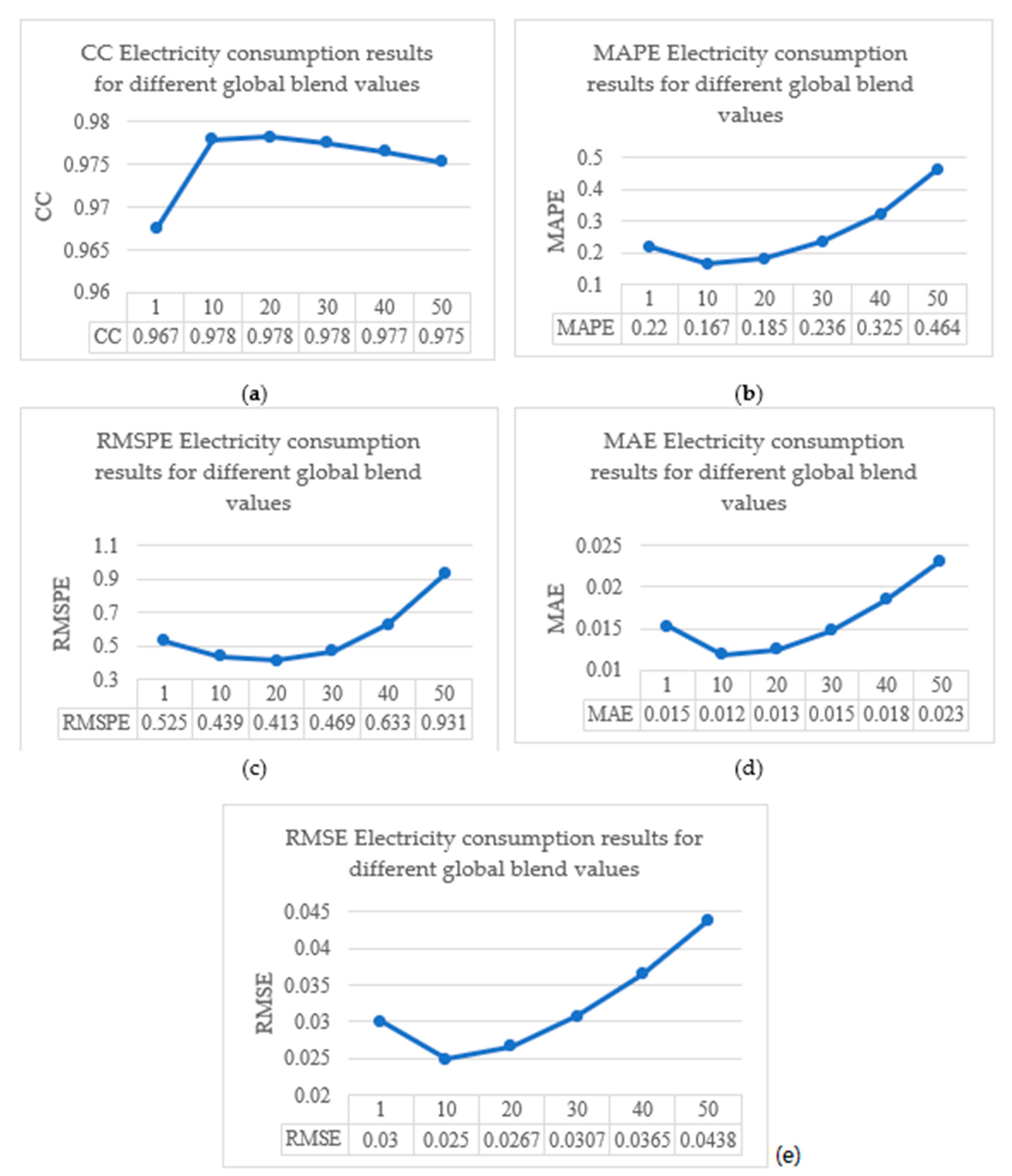
| 1 | 0.9674 | 0.2203 | 0.525 | 0.0154 | 0.03 |
| 10 | 0.9779 | 0.1668 | 0.4394 | 0.0118 | 0.025 |
| 20 | 0.9782 | 0.1847 | 0.4133 | 0.0125 | 0.0267 |
| 30 | 0.9775 | 0.2363 | 0.4689 | 0.0148 | 0.0307 |
| 40 | 0.9765 | 0.325 | 0.6325 | 0.0184 | 0.0365 |
| 50 | 0.9752 | 0.4642 | 0.9306 | 0.0231 | 0.0438 |
| Global Blend | CC | MAPE | RMSPE | MAE | RMSE |
|---|---|---|---|---|---|
| Training | 0.9779 | 0.1668 | 0.4394 | 0.0118 | 0.025 |
| Testing | 0.9373 | 0.1569 | 0.5636 | 0.016 | 0.0488 |
| Model | CC | MAPE | RMSPE | MAE | RMSE |
|---|---|---|---|---|---|
| Bagging with K* | 0.9383 | 0.1511 | 0.5333 | 0.0158 | 0.0484 |
| Experiment | CC | MAPE | RMSPE | MAE | RMSE | |
|---|---|---|---|---|---|---|
| ANN [30] | Training | 0.9815 | 0.2697 | 0.5548 | 0.0117 | 0.0227 |
| Testing | 0.9023 | 0.4424 | 0.6802 | 0.0353 | 0.0743 | |
| This research (K*) | Training | 0.9779 | 0.1668 | 0.4394 | 0.0118 | 0.025 |
| Testing | 0.9373 | 0.1569 | 0.5636 | 0.016 | 0.0488 | |
| Name of Experiment | Model | Key Notes | CC | MAPE | RMSPE | MAE | RMSE |
|---|---|---|---|---|---|---|---|
| Standalone model | ANN | Using hyperparameter tuning | 0.9023 | 0.4424 | 0.6802 | 0.0353 | 0.0743 |
| K* | Using hyperparameter tuning | 0.9373 | 0.1569 | 0.5636 | 0.016 | 0.0488 | |
| Bagging ensemble | ANN | Using the optimized model | 0.9116 | 0.2836 | 0.4578 | 0.0298 | 0.069 |
| K* | Using the optimized model | 0.9383 | 0.1511 | 0.5333 | 0.0158 | 0.0484 |
| This Study | [9] | [10] | [12] | [13] | [14] | [15] | [17] | [18] | [19] | |
|---|---|---|---|---|---|---|---|---|---|---|
| No. of cities | 18 cities throughout 11 regions in Saudi Arabia | The province of Jiangsu, China | Chongqing City, China | Turkey | The Organization of the Petroleum Exporting Countries as a whole | Turkey | Saudi Arabia, Schools in the eastern region | Saudi Arabia, College of Computer at Qassim University | Saudi Arabia, eastern region as a whole | Saudi Arabia, eastern region as a whole |
| Goal | Monthly | Yearly | Monthly | Monthly | Yearly | Yearly | Annual | Daily | Monthly (Domestic) | Monthly |
| Data span | January 2010–August 2020 | 2001–2017 | 2010–2018 | 1970–2011 | 1980–2012 | 1970–2011 | 351 schools for one year | 13 years | 1987–1993 | 1987–1994 |
| No. of features | 5 | 1 | 1 | 1 | 1 | 4 | 11 | 5 | 7 | 1 |
| Apply Normalization | Yes | No | No | Yes | Yes | Yes | Yes | No | No | No |
| Apply Ensemble | Yes (Bagging) | No | No | No | No | No | No | No | No | No |
| Technique | Bagging ensemble using optimized K* | Self-adaptive grey fractional weighted model | Holt–Winters smoothing | ANN and support vector regression | ANN using the Cuckoo Search Algorithm via Lévy flight. | ANN and least-square support vector machine | Linear regression | LSTM | Abductory induction mechanism | Autoregressive integrated moving average model based on univariate Box–Jenkin time-series |
| MAPE | 0.1511 | 1.77 | 3.58% | ANN: 3.9% SVR: 3.3% | - | LS-SVM: 1.004 | - | 4.163 | - | - |
| MAE | 0.0158 | - | - | - | - | - | - | - | 0.1308 | 0.0925 |
| RMSE | 0.0484 | - | - | - | - | LS-SVM: 1.435 | - | 0.45 | - | - |
Disclaimer/Publisher’s Note: The statements, opinions and data contained in all publications are solely those of the individual author(s) and contributor(s) and not of MDPI and/or the editor(s). MDPI and/or the editor(s) disclaim responsibility for any injury to people or property resulting from any ideas, methods, instructions or products referred to in the content. |
© 2023 by the authors. Licensee MDPI, Basel, Switzerland. This article is an open access article distributed under the terms and conditions of the Creative Commons Attribution (CC BY) license (https://creativecommons.org/licenses/by/4.0/).
Share and Cite
Musleh, D.A.; Al Metrik, M.A. Machine Learning and Bagging to Predict Midterm Electricity Consumption in Saudi Arabia. Appl. Syst. Innov. 2023, 6, 65. https://doi.org/10.3390/asi6040065
Musleh DA, Al Metrik MA. Machine Learning and Bagging to Predict Midterm Electricity Consumption in Saudi Arabia. Applied System Innovation. 2023; 6(4):65. https://doi.org/10.3390/asi6040065
Chicago/Turabian StyleMusleh, Dhiaa A., and Maissa A. Al Metrik. 2023. "Machine Learning and Bagging to Predict Midterm Electricity Consumption in Saudi Arabia" Applied System Innovation 6, no. 4: 65. https://doi.org/10.3390/asi6040065
APA StyleMusleh, D. A., & Al Metrik, M. A. (2023). Machine Learning and Bagging to Predict Midterm Electricity Consumption in Saudi Arabia. Applied System Innovation, 6(4), 65. https://doi.org/10.3390/asi6040065

