
You are currently viewing a new version of our website. To view the old version click .
Société Internationale d’Urologie Journal
  • Interesting Images
  • Open Access

16 April 2025

Duplicated Kidney: A New Variant
,
and
1
School of Medicine, St. George’s University School of Medicine, University Centre Grenada, True Blue, Grenada
2
Internal Medicine, University of Arkansas, Fayetteville, AR 72703, USA
3
Urology, University of Kentucky Pikesville, Pikesville, KY 41501, USA
*
Author to whom correspondence should be addressed.
Congenital urinary tract anomalies, including CAKUT (congenital anomalies of the kidneys and urinary tract), are common defects disrupting urinary system development. The system, comprising the kidneys, ureters, bladder, and urethra, functions to filter and excrete waste through urine. This complex developmental process involves over 40 cell types and multiple genetic signaling pathways [1].
CAKUT affects 3–6 per 1000 live births, ranging from undetected minor anomalies to severe malformations impairing kidney and urinary function [1]. Among these, duplicated ureters, where two ureters form for a single kidney, can present asymptomatically or cause complications like urinary tract infections, renal calculi, or ureteric obstruction. This report introduces a novel variant of duplicated ureter, contributing to understanding its diverse presentations and clinical significance.
Duplicated ureters are the most common upper urinary tract defect, occasionally involving three or more ureters. They are classified as complete (ureter duplex) or partial (ureter fissus bifidus). Proximal duplication (ureter fissus proximalis) involves branching at the renal pelvis, often causing stenosis or regurgitation, while distal duplication (ureter fissus distalis), where bifurcation occurs distally, is rarer [1].
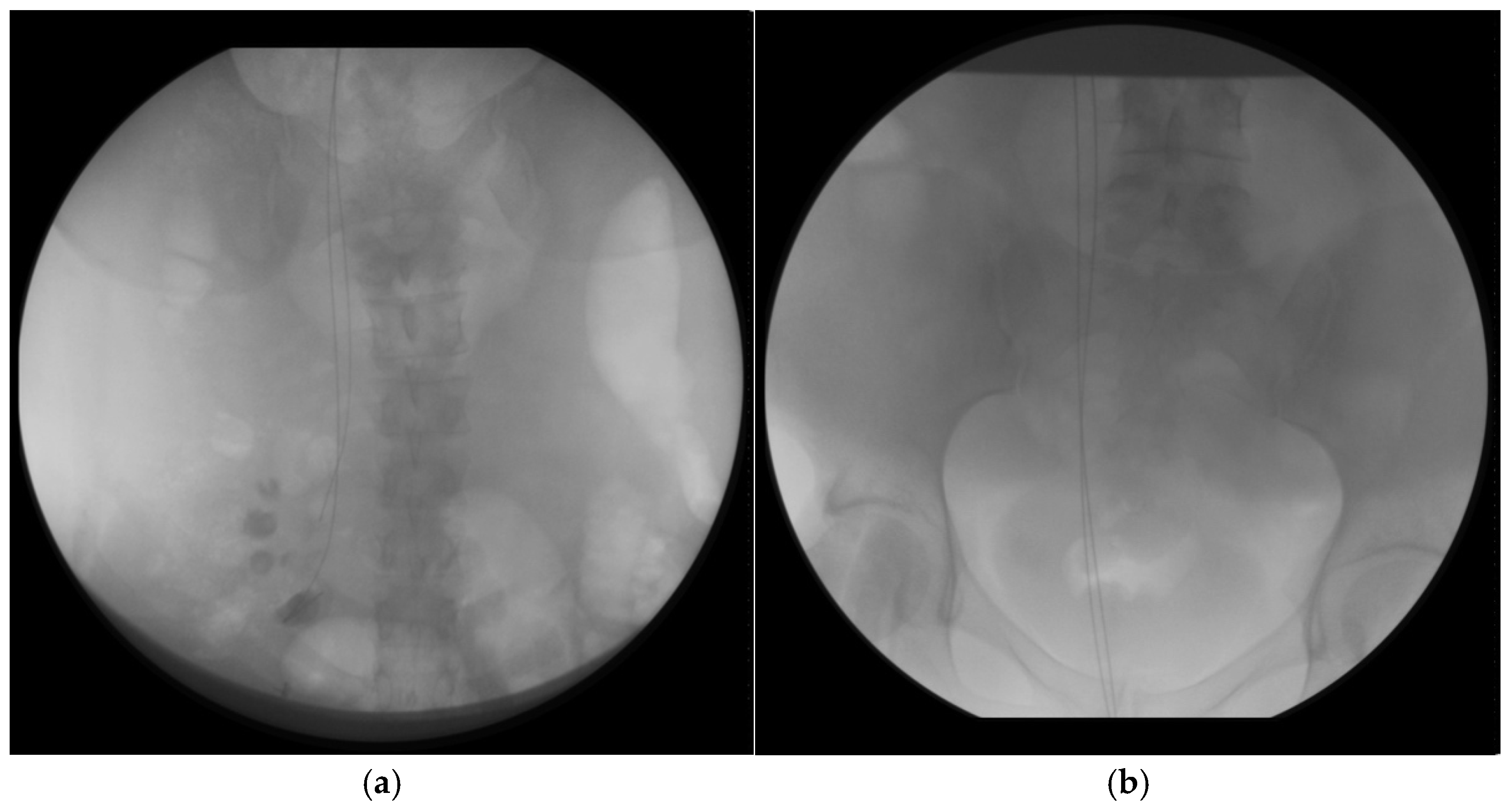
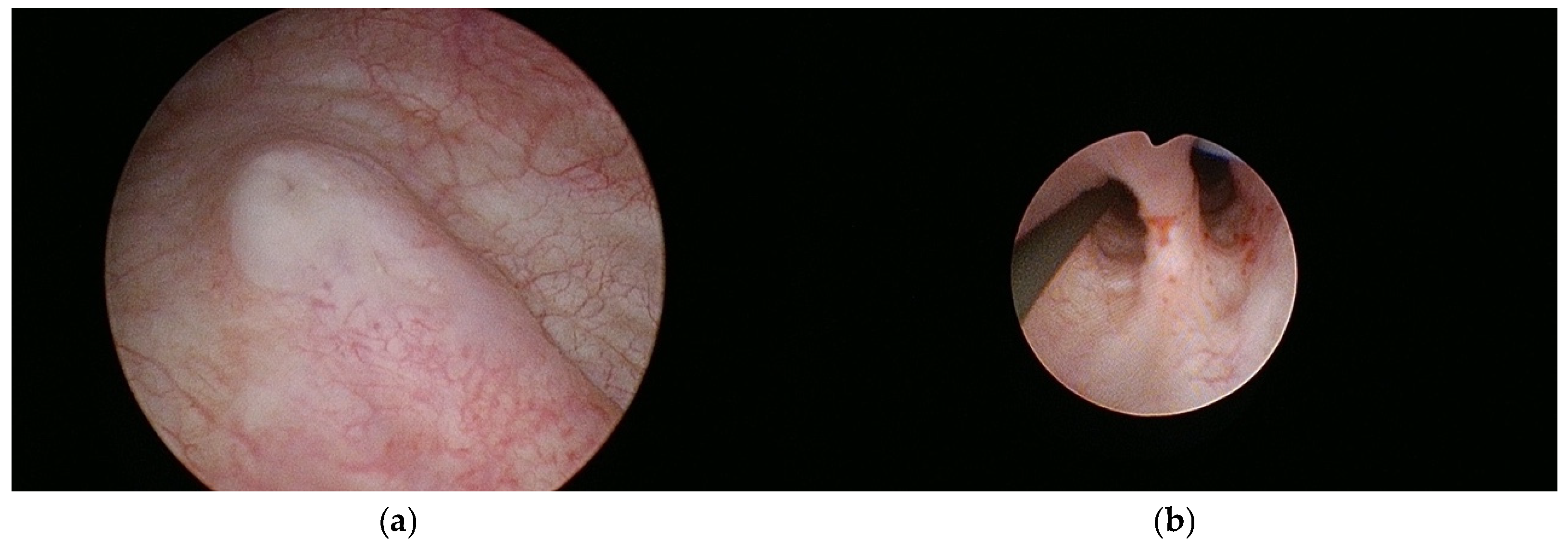
Building on Koxlov and Schedl’s 2020 classification, which includes incomplete duplication and inverted Y configurations [1], we report a novel variant combining ureter fissus proximalis and ureter fissus distalis. Here, two ureteral buds initially formed proximally, fused, and then bifurcated distally, creating an “X” shape. Radiographs (Figure 1) show proximal fusion, while cystoscopic images (Figure 2) confirm distal bifurcation.
Figure 1. Radiographic imaging of the novel duplicated ureter morphology. (a) Contrast-enhanced radiograph demonstrating two distinct ureteral branches emerging separately from the renal pelvis, consistent with ureter fissus proximalis. (b) Mid-ureteral view capturing the unique “X”-shaped configuration formed by the convergence of the proximal ureters, followed by distal bifurcation—hallmarks of a combined proximal and distal ureteral duplication pattern. This crossing and re-dividing trajectory has not been previously reported and represents a novel anatomical variant.
Figure 2. Cystoscopic visualization of the anomalous ureteral insertions. (a) Bladder endoscopy revealing two discrete ureteral orifices, confirming distal bifurcation consistent with ureter fissus distalis. (b) Intraoperative endoscopic view illustrating the bifurcation point of the joined ureter, reflecting retrograde tracing toward the two proximal segments seen radiographically. These findings further support the diagnosis of an “X”-shaped ureteral duplication with both proximal and distal elements.
We propose that early ureteric bud migration facilitated temporary fusion before separating again toward the bladder. This interplay between genetic signaling and mechanical factors may explain this unique presentation [2].
This novel variant expands current CAKUT classifications, emphasizing the need for further research into the mechanisms underlying complex ureteric anomalies. Integrating this understanding into diagnostic frameworks can improve clinical management [2].

Funding

This research received no external funding.

Conflicts of Interest

The authors declare no conflict of interest.

References

  1. Kozlov, V.M.; Schedl, A. Duplex Kidney Formation: Developmental mechanism and genetic. F1000Research 2020, 9, F1000 Faculty Rev-2. [Google Scholar] [CrossRef] [PubMed] [PubMed Central]
  2. Dorko, F.; Tokarčík, J.; Výborná, E. Congenital malformations of the ureter: Anatomical studies. Anat. Sci. Int. 2016, 91, 290–294. [Google Scholar] [CrossRef] [PubMed]
Disclaimer/Publisher’s Note: The statements, opinions and data contained in all publications are solely those of the individual author(s) and contributor(s) and not of MDPI and/or the editor(s). MDPI and/or the editor(s) disclaim responsibility for any injury to people or property resulting from any ideas, methods, instructions or products referred to in the content.

Article Metrics

Citations

Article Access Statistics

Multiple requests from the same IP address are counted as one view.