
Abstract
The recycling and reuse of thermoset composite materials present considerable challenges due to the cross-linked network formed during the curing process. The growing implementation of these materials in various industries, such as automotive and wind energy sectors, has generated significant research interest in this area. This paper presents a comprehensive review of different approaches for the recycling, focusing on two aspects: established methods with higher technological readiness levels (mechanical, thermal, and chemical) and emerging methods still under development (microwave-assisted recycling, enzymatic recycling, electrochemical recycling, superheated steam recycling and ultrasonic recycling). Furthermore, the reuse of thermoset composite materials by thermoforming, for example, is discussed, along with an overview of innovative resin systems specially designed for recyclability and reusability. Finally, the challenges and future prospects are briefly summarised.
1. Introduction
The use of thermoset composite materials is increasing across a growing number of industries, such as aviation/aerospace, automotive, and wind energy. These materials, which consist of a thermoset polymer matrix reinforced with fibre, are outstanding due to their ability to provide directional reinforcement, their high stiffness, and specific strength, in addition to their low density, low production cost, tailored mechanical properties, and corrosion resistance [1,2,3,4]. Despite all the aforementioned advantages, the main reason for their use in the referred sectors is based on its structural weight reduction capacity. In aircraft manufacturing, for example, a weight reduction of 20% has been achieved compared to traditional materials, resulting in an annual saving of 12 tons of CO2 [1].
Thermoset composite materials, as previously mentioned, are formed by a thermoset polymer matrix, such as epoxy, polyester, phenolic, or vinyl ester resins, which are chemically cross-linked through a curing process. Due to this cross-linked structure, thermoset polymer matrices cannot be melted or reprocessed, making them difficult to recycle. These matrices are combined with reinforcements, usually in the form of fibres, either continuous or discontinuous, resulting in high-performance materials. These reinforcements can be classified into two categories according to their origin: natural fibres, such as jute or flax fibre, and synthetic fibres, which include glass, carbon, or aramid fibres. The thermoset matrix provides load transfer, reinforcement protection, and geometric integrity, while the reinforcement mainly contributes to the strength and stiffness of the composite material [5]. The increasing trend in the use of thermoset composite materials is reflected in the global market, in which the volume grew from 13 million tonnes in 2023 to 14 million tonnes in 2024 [6,7]. In the wind energy sector, for example, the demand to generate more power has driven the market growth, with composite materials being used in blade laminates, reinforcements, and access structures. The annual growth rate for composite materials in the wind energy market is expected to be 10% between 2023 and 2028 [1,8]. In the automotive industry, conversely, fuel saving is significantly linked to weight saving, which translates into greater autonomy and lower emissions. The implementation of composite materials, capable of achieving up to 40% weight saving, is expected to reach 16.4 billion euros in 2032 compared to 7.4 billion euros in 2022 in this industry [9].
In this context Europe is expected to generate 683 million tonnes of new composite waste in 2025, while the annual global recycling capacity is only 100 million tonnes, which is no more than 15% of the generated waste [10,11]. The energy sector accounts for 14% of the composite industry, where it is essential for the development of wind turbine blades. This sector is the main driver behind the development of reuse and recycling processes, owing to the significant volume of waste generated. In 2024, a total of 1.3 GW of wind power capacity was decommissioned in Europe, with Germany, Spain, and Italy accounting for over 90% of this capacity [12]. Additionally, a significant portion of Europe’s installed onshore wind power capacity is approaching its end-of-life (approximately 20 years). By 2030, it is expected that 57 GW of installed capacity will exceed this period, resulting in an estimated 684 tonnes of waste (1 MW = 12 tonne scenario).
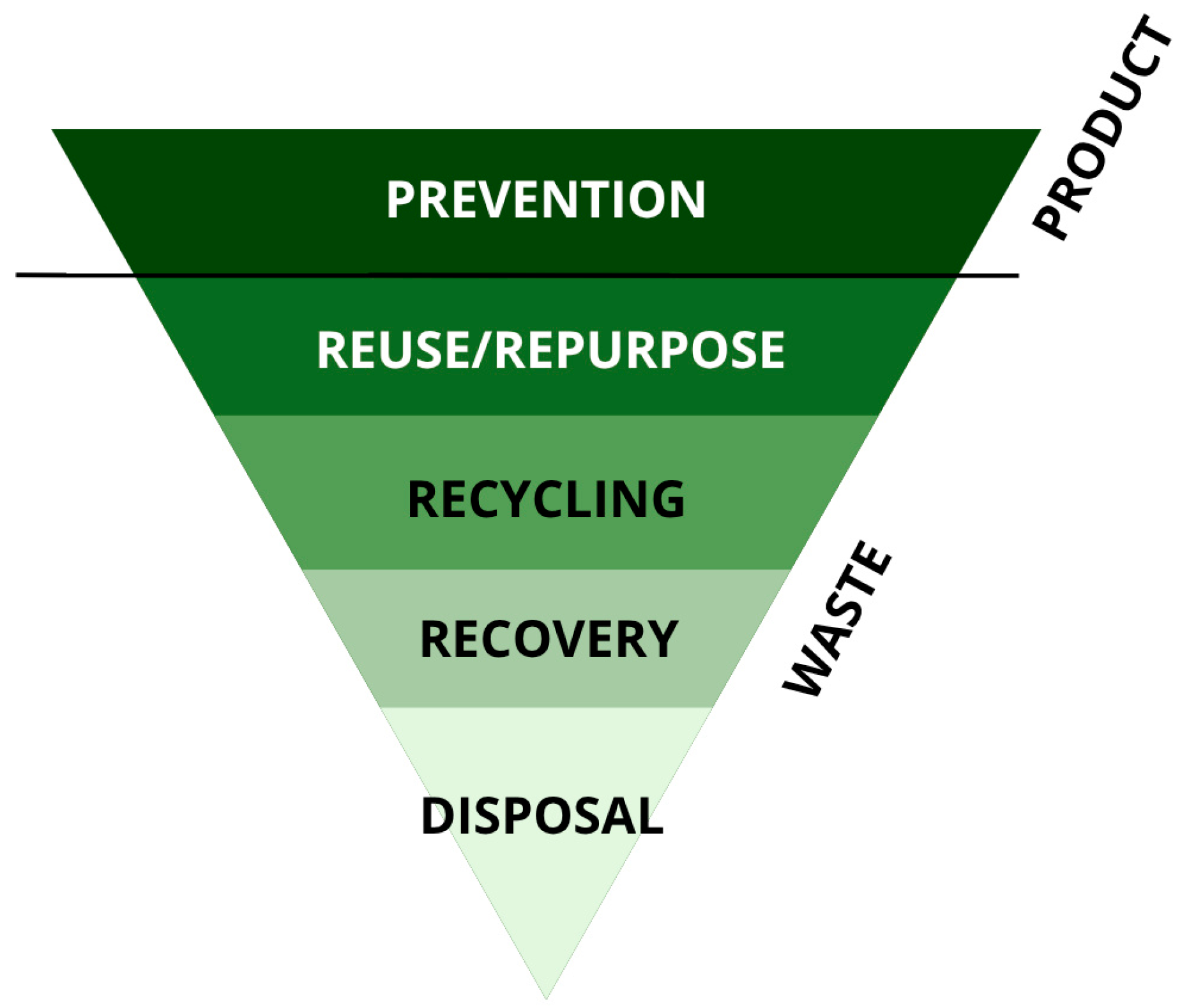
Therefore, in view of the increasing waste generation, its management is becoming a major concern. According to the European Waste Framework Directive (2018/851) waste management is structured following the waste hierarchy diagram (Figure 1) [13,14,15], which prioritises prevention as the most preferred alternative while disposal represents, the least desired option.
Figure 1.
Waste management hierarchy.
The following section address each level of the waste hierarchy in detail, starting with prevention:
- Prevention. Several strategies have been used to increase the prevention of composite waste generation [16,17,18]. These include the design of composites with a longer service life by decreasing the failure rate, using components that facilitate recycling, improving the separation of components and materials or even optimising and reducing the amount of material required, resulting in less material to recycle [8,19].
- Reuse/Repurpose. Reuse or repurposing is based on using the end-of-life composite waste for an application with fewer requirements through reconditioning [20]. Different methods of composite waste reuse are presented in Section 3.
- Recycling. There are several techniques proposed and currently used for the recycling of composite materials. These techniques are typically categorised into three main groups: mechanical recycling, chemical recycling, and thermal recycling. A more detailed overview of these methods can be found in Section 2.
- Recovery. Heat or energy recovery is one way to manage composite waste. There are different recovery methods, such as heat recovery by incineration or the use of the recovered polymer fraction in co-processing as fuel.
- Disposal. In this category, the lowest in the hierarchy diagram, landfilling and incineration without heat recovery are considered.
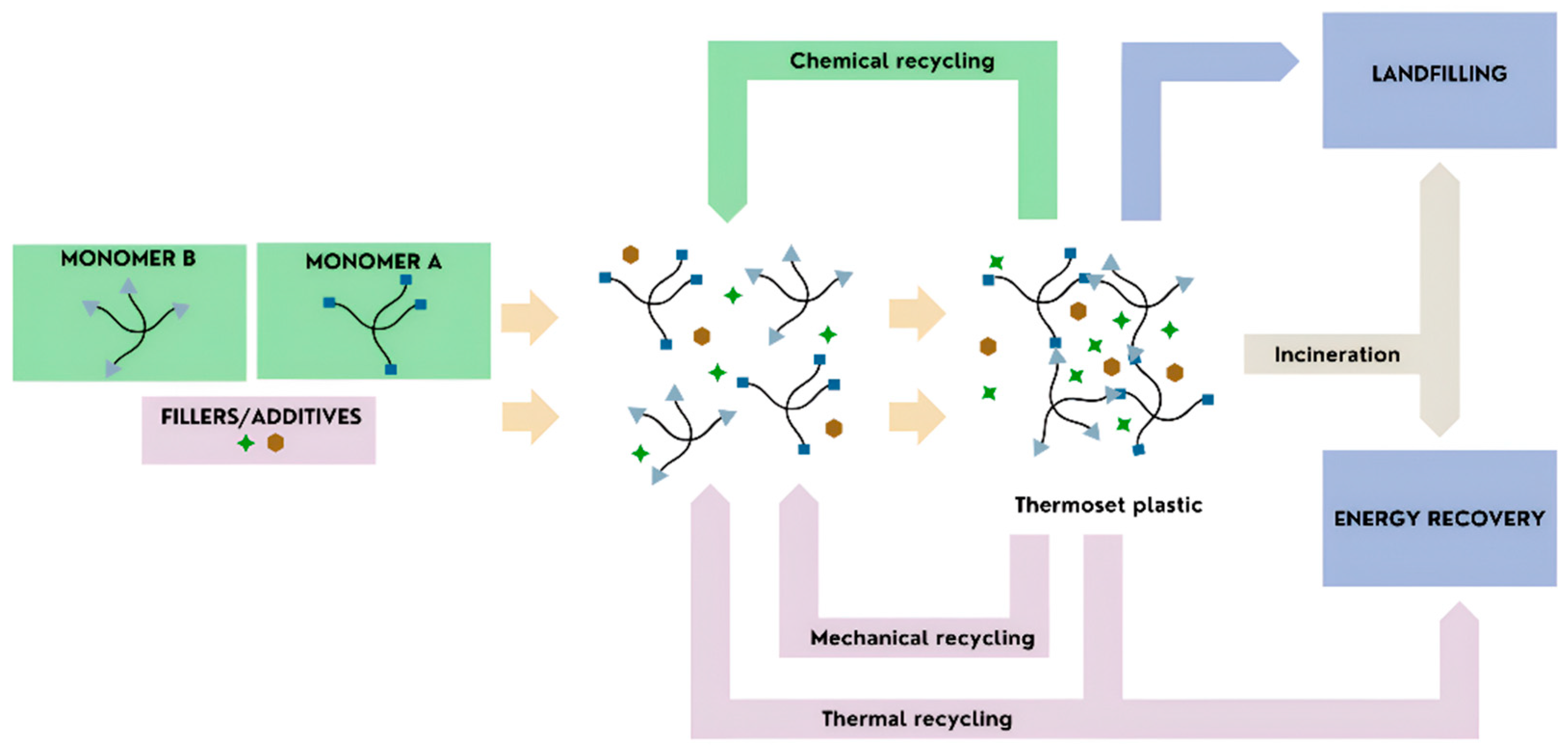
Despite the efforts of the European Commission to promote sustainability and the circular economy through the different options of the waste hierarchy, in practice, the three main routes currently applied to composite waste are: landfilling, incineration, and recycling (see Figure 2) [21]. The European Composite Industry Association (EuCIA) estimates, for example, that up to 70% of composite waste is currently landfilled or incinerated without energy recovery [22].
Figure 2.
End-of-life scenarios.
Landfilling is the cheapest and most common technique despite its large negative impact on the environment [21,23]. Landfilling is progressively restricted in the EU, with some countries already implementing bans and Directive 2018/850 setting a limit of 10% of municipal waste by 2035 [19,24]. Incineration can partially offset disposal by enabling energy recovery, although a significant fraction of ash still ends up in landfills [25,26,27,28]. In contrast, recycling remains the most desirable option, yet it faces major challenges due to the difficulty of separating the reinforcement from the matrix in cross-linked composites.
Therefore, the review first examines the most developed recycling methods (mechanical, chemical, and thermal), followed by incipient strategies still in the research phase but with exciting potential for the future. Subsequently, the review explores the concept of composite material repurposing, highlighting the different approaches that contribute to the circularity. Finally, it examines innovations in the formulation of resins specifically designed to facilitate recycling, as well as the potential of thermoforming as a method of reusing composite material.
2. Recycling Methods
There are several recycling methods currently proposed, researched, and developed for the recycling of thermoset matrix composites and which are considered feasible alternatives to incineration and landfilling [3]. The most developed recycling methods can be divided into three main groups: mechanical comminution techniques, chemical processes, and thermal processes (see Figure 2) [4,21,29].
2.1. Chemical Recycling
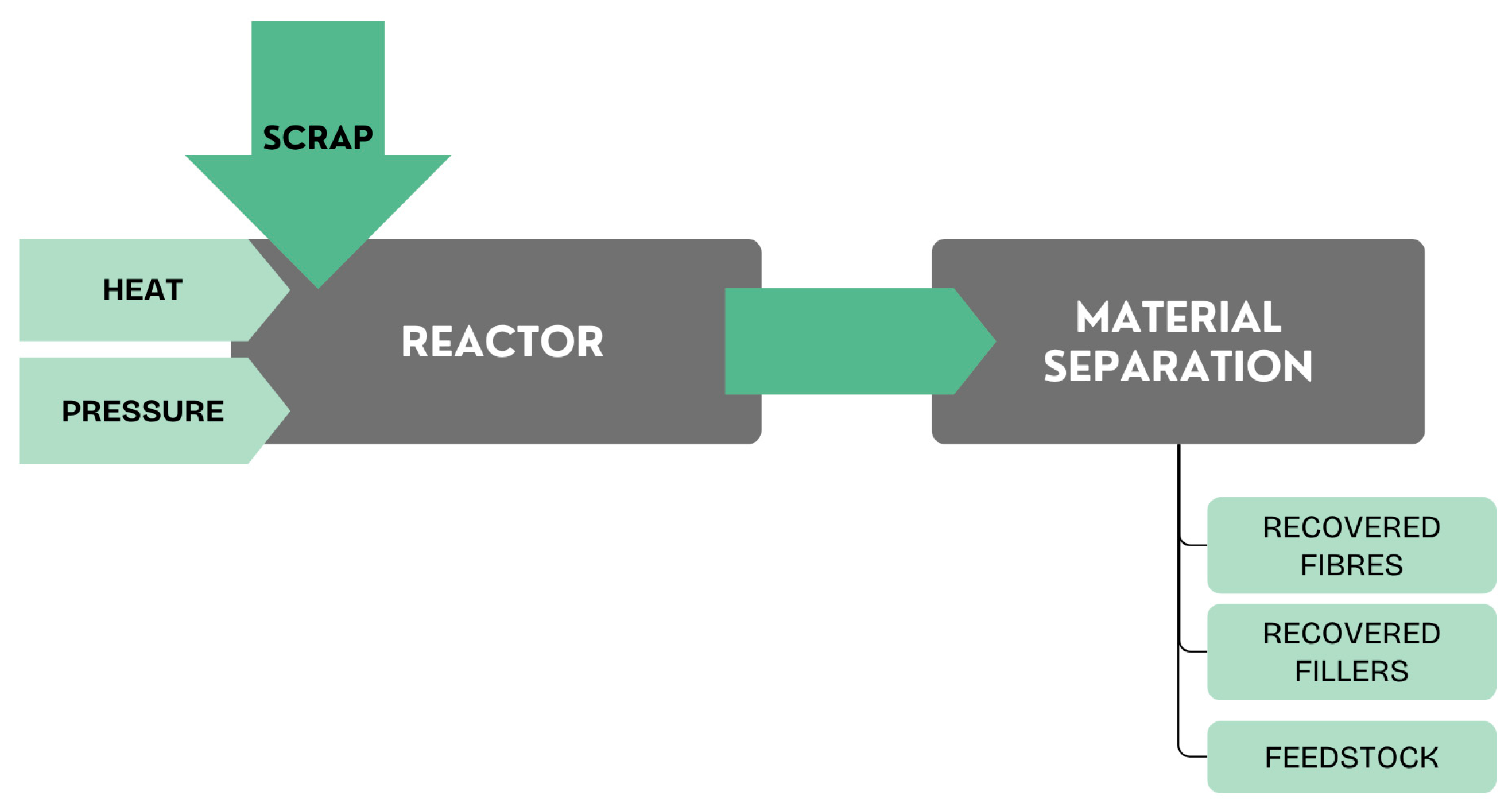
In the chemical recycling process (see Figure 3), the matrix and reinforcement are separated by decomposing the matrix in a chemical solution [30]. The selected solution depends on the nature of the polymeric structure. In the matrix decomposition, the cross-linked network is decomposed by chemical methods, resulting in a complex mixture of monomers, oligomers, and other low molecular weight compounds [23,31]. These products can subsequently be processed to recover valuable chemicals or used as building blocks for the synthesis of new materials. In some cases, the recovered compounds can even be reused for the preparation of the starting material, thus closing the cycle [31,32]. After depolymerising the matrix, the fibres are cleaned to remove possible small residues, resulting in long fibres with high mechanical properties [8]. The energy demand for the chemical recycling method is approximately 21–91 MJ/kg [21].
Figure 3.
Generic chemical recycling diagram.
For thermoset composites, chemical recycling is predominantly based on solvolysis [18]. There are two main types of solvolysis: low-temperature solvolysis and sub-supercritical solvolysis. Low-temperature solvolysis is usually performed at temperatures below 200 °C and at atmospheric pressure, providing greater control over the chemical reaction and avoiding the occurrence of a secondary chemical reaction [23,33]. It is usually carried out with an acid medium or solvents including water, alcohol, ammonia, or nitric acid. The work of Guadagno et al. [34], for example, focuses on the chemical recycling of a bio-based epoxy resin by a mixture of sustainable solvents composed of acetic acid and hydrogen peroxide. Among the studied temperatures, the most efficient was 90 °C, with a depolymerisation yield of 81.3%. The temperature of 90 °C corresponds to the glass transition temperature (Tg) of the resin system. Spectroscopic tests indicated that the chemical bonds were broken by selectively breaking the C-N bonds in the cross-linked matrix structure, allowing the reinforcement to be recovered along with the oligomers/monomers in the matrix. The research highlights the ability to recycle thermoset composites using low-impact solvents and the need to investigate environmentally friendly and efficient recycling processes.
On the other hand, sub-supercritical solvolysis is based on the use of supercritical fluids. This recycling method has gained popularity due to the properties and being more environmentally friendly [23,33]. The use of supercritical fluids provides optimal conditions for the decomposition of polymers resulting in a considerably fast chemical response. Temperature and pressure requirement can be reduced by using alternative solvents such as methanol, ethanol, propanol, and acetone together with water [23]. Souza et al. [35] proposed a green technology for GF-reinforced polyester composites with short reaction times (45–60 min) using D-limonene at sub-supercritical or supercritical conditions in the absence of catalysts. Almost 100% of the GF is recovered maintaining its tensile strength at 64–85% compared to virgin fibres. These results present an innovative eco-friendly technology for this kind of material.
2.2. Mechanical Recycling
Mechanical recycling is considered the most widespread method because it does not require complex process temperatures or chemical agents. The process leads to the fragmentation of the composite material into small pieces, in some cases even reaching the dimensions of powder, where the average length of the recovered fibres ranges is between approximately 2 mm and 5 mm [26,36,37]. It is also commonly used as a pre-treatment process for other recycling/reusing techniques such as thermal recycling or repurposing in cementitious material [33].
2.2.1. Mechanical Grinding
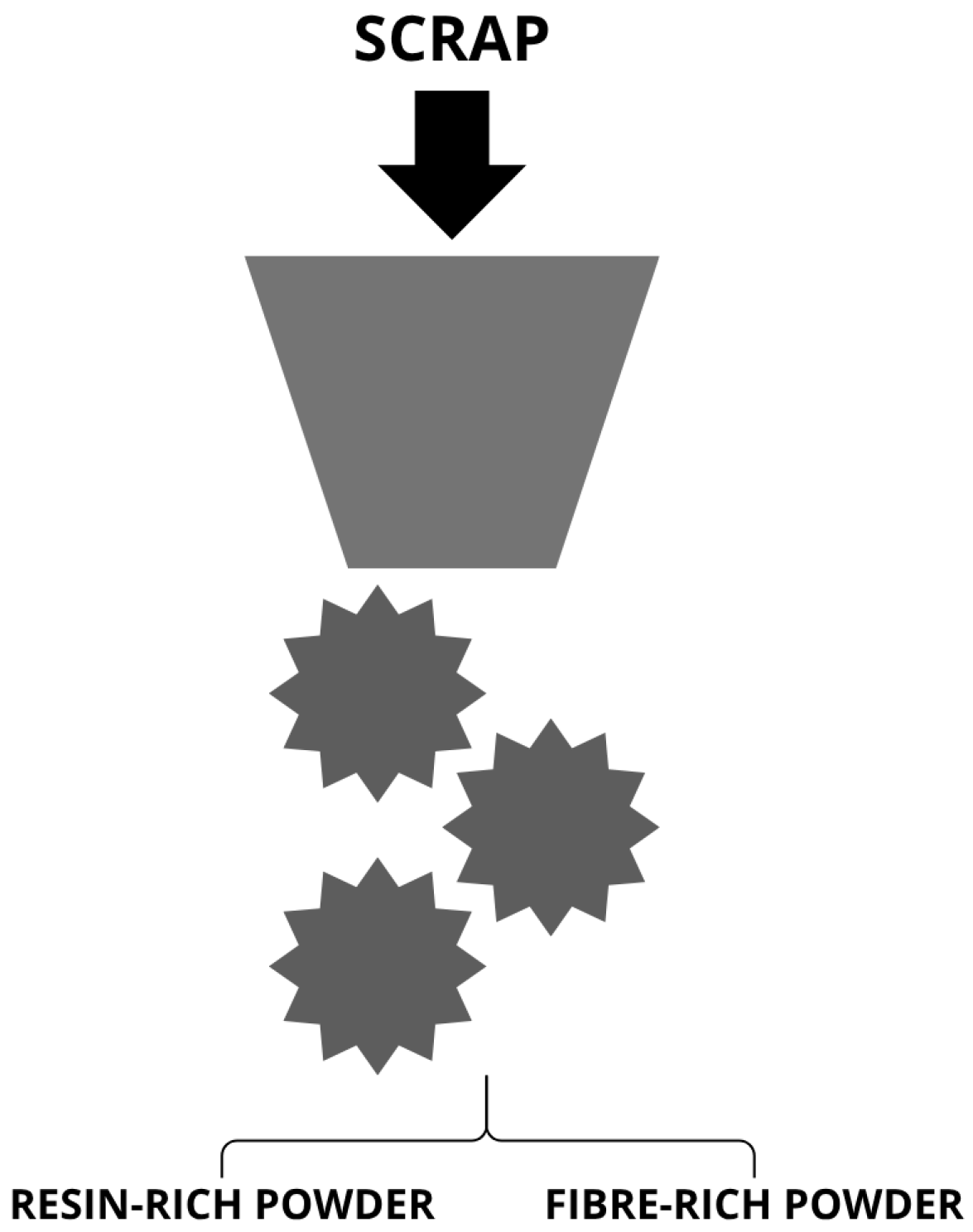
This process is based on the use of one or more pairs of counter-rotating shafts equipped with blades causing the material to pass through the overlapping blades (see Figure 4) [38]. In an initial phase, the residue is shredded into 50–100 mm pieces to facilitate the removal of embedded inserts. Once the invalid part has been removed, the volume is reduced to 10 mm–50 μm fragments by means of grinders. There are different types of grinders, each with its own specific properties; cutting grinders achieve a more uniform length distribution while hammer mills do not require sharpening of the blades, which increase productivity. In the last step, the fragments are separated according to size and content [26]. This recycling method does not require high energy input, with energy consumption ranging between 0.1 and 4.8 MJ/kg [21].
Figure 4.
Generic mechanical grinding diagram.
In this recycling process, the entire waste product is reduced in size, resulting in small fragments consisting of a mixture of polymer, fibre, and fillers. Despite the significant loss of mechanical properties of the reinforcement due to its size reduction, several companies have focused their efforts on the industrialisation of mechanical grinding. The proposed solutions for the utilisation of the material obtained after the mechanical grinding have been based on bulk moulding compound (BMC) and sheet moulding compound (SMC). These compounds typically consist of thermoset resins combined with proportions of filler, commonly calcium carbonate or fire-retardant alumina trihydrate. The recycled material is incorporated to substitute the calcium carbonate, which has a higher density, thus obtaining a lighter material than using only calcium carbonate. However, more than 10% of recycled material is not recommended due to the reduction in mechanical properties, in addition to processing problems [39].
2.2.2. Electrofragmentation
Electrofragmentation was initially applied in the mining field to disintegrate rock into parts in order to extract valuable minerals and crystals using repetitive discharge of electrical pulses in a dielectric environment [26,40]. This high voltage (100–200 kV) electrical discharge causes the tensile strength of the material introduced into the dielectric fluid to become lower than the breaking strength of the dielectric fluid (see Figure 5). The discharge generates a spark channel that adheres to internal boundaries and external interfaces. As this channel propagates, it generates a high-pressure and high-temperature shock wave. These shocks generate internal stresses which, as they exceed the tensile strength of the material, cause fragmentation of the material.
Figure 5.
Generic electrofragmentation diagram.
This technique has been examined in several studies [41,42,43]. Diani et al. [44], for example, demonstrated the feasibility of recycling EoL wind blades using High-Voltage Fragmentation (HVF). In their experimental tests, they successfully obtained clean fibres and separated impurities, confirming the potential of this technology as a pre-treatment step. However, monitoring the energy consumption is crucial, as the main drawback of electrofragmentation lies in its high energy demand, with values of 17.1 MJ/kg, 35.6 MJ/kg, 60 MJ/kg, and 89.1 MJ/kg for 500, 100, 1500, and 2000 electrical pulses, respectively [26].
2.3. Thermal Recycling
Thermal recycling methods mainly include pyrolysis and fluidized bed pyrolysis [45,46].
2.3.1. Pyrolysis
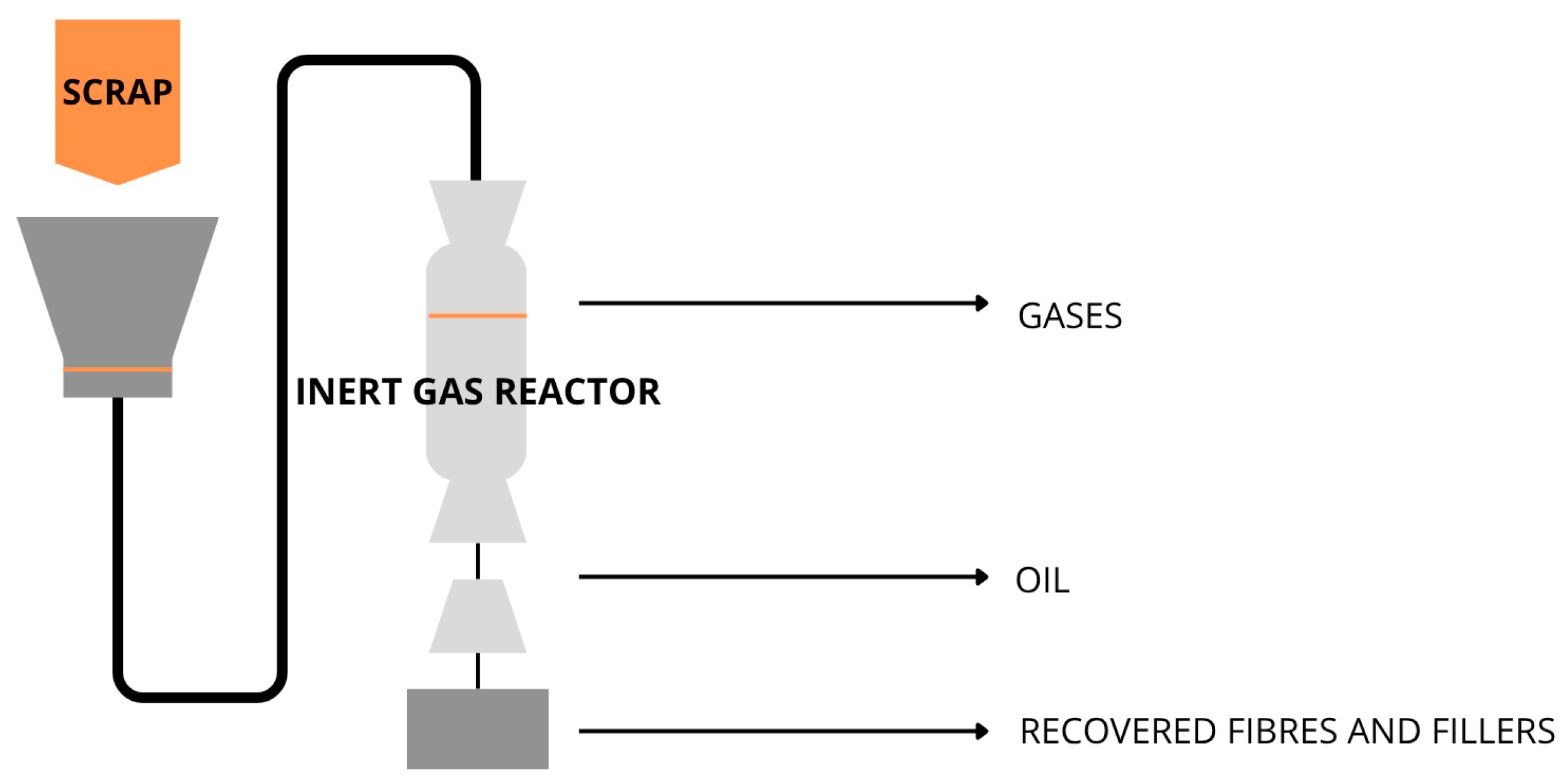
Pyrolysis, the most studied thermal recycling process, is based on heating in the absence of oxygen. As a result of the decomposition of organic molecules in an inert atmosphere within a temperature range of 450 °C to 700 °C, oil and gases are produced, while solid products such as fibres retain their structural integrity (see Figure 6) [23,29,45]. However, due to the high temperatures to which the sample is exposed, the reinforcement fibres can suffer a significant decrease in its mechanical properties, consequently reducing considerably its tensile strength. Due to the potential significant decrease in their mechanical properties, the whole process must be carefully designed, as the behaviour of the recycled fibre depends on the process variables. With optimal adjustment of these parameters, it is possible to achieve carbon fibres of up to 90% of the strength of virgin fibres [33]. In contrast to the good performance of carbon fibre, glass fibre recycled by pyrolysis undergoes extensive degradation, reaching between 40% and 50% reduction in tensile strength [47,48].
Figure 6.
Generic pyrolysis recycle diagram.
While numerous studies have investigated the influence of the parameters on resin decomposition and the loss of mechanical properties, there are few studies that have focused on the recovered components [49]. The solid part is recovered in the highest percentage, ranging from 50% to two-thirds by weight. The liquid products are between 0 and 50% by weight, while the gaseous products constitute between 5% and 15% by weight [26]. The main components of the recovered gases are H2, CH4, CO, and CO2. The obtained amount of each of them depends on the pyrolysis mode (slow or fast), pyrolysis temperature, and residence time [50].
Finally, the obtained oil shows mainly aromatic nature, in which styrene, benzene, toluene, ethylbenzene, and p-xylene are usually identified as the main components of the organic fraction. In addition to aromatic compounds, oxygenated species are also present such us phthalic acid or benzoic acid [51]. These oils are often used in boiler combustion, engine and tubular fuels, transformation into transportation fuels, or as renewable feedstock for chemicals and materials [52]. In addition, to improve the energy efficiency of the pyrolysis process, research is being conducted on the recirculation of the oil and gas obtained after pyrolysis for heat supply. This study has demonstrated that the energy efficiency of pyrolysis can be significantly improved. It has also been shown that excess heat can be stored using molten salt with a high specific heat capacity [49].
However, one of the drawbacks of the pyrolysis process is that it requires an additional post-pyrolysis procedure to remove the carbonised surface material formed by the decomposition of the matrix [36]. In order to avoid multiple reaction steps, Xu et al. [53] conducted fast pyrolysis of waste from wind turbine blades at 500 °C in three different atmospheres (100% N2, 80% N2 + 20% CO2, and 80% N2 + 20% H2O). The study observed that, compared to a pure N2 atmosphere, H2O acts as a gasifying agent, accelerating bond breakage. Furthermore, the introduction of H2O reduces the production of carbon in a single step.
2.3.2. Fluidised Bed Process
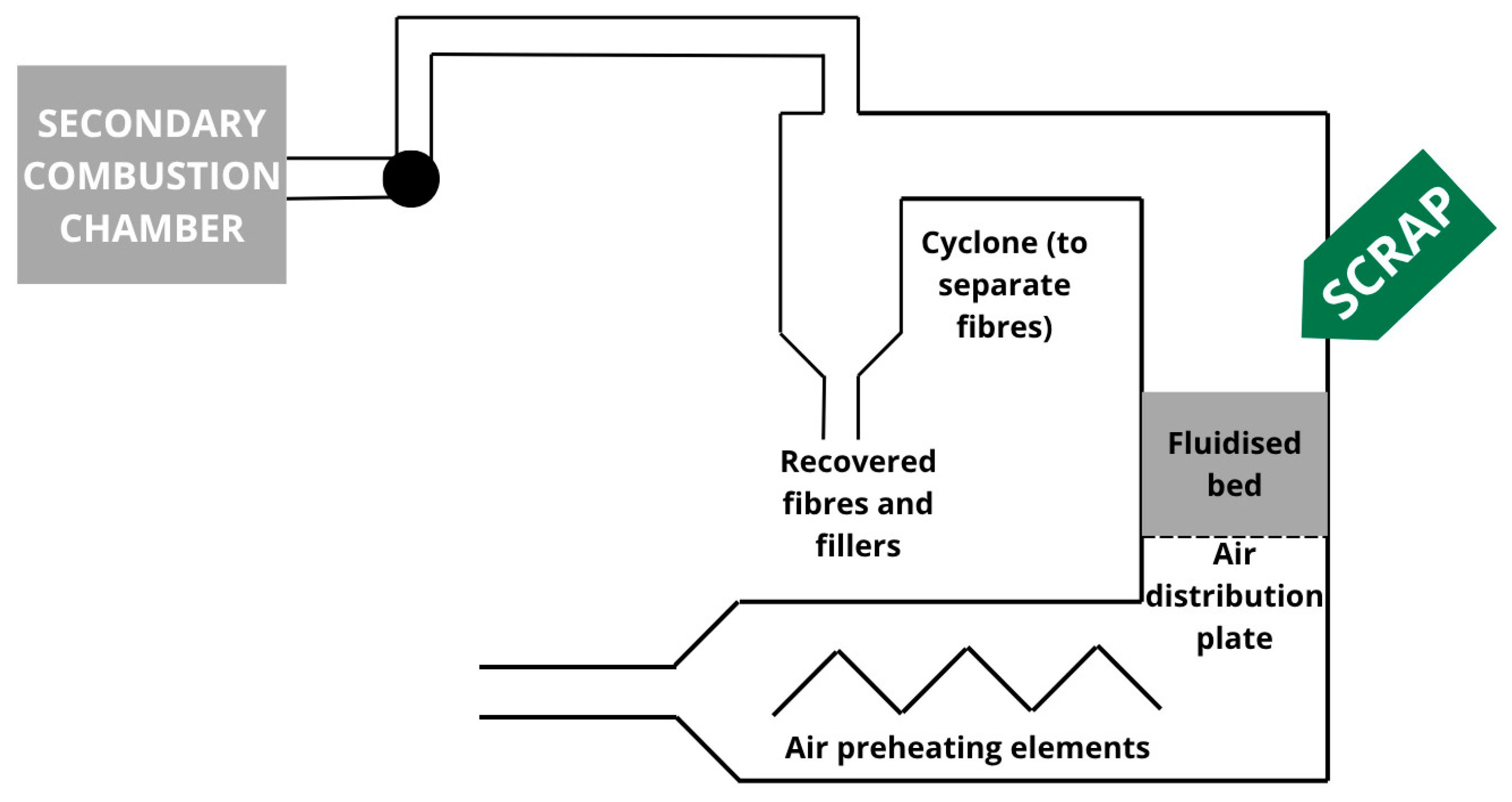
The fluidised bed process also enables the thermal decomposition of the matrix [54]. But on the contrary, this uses a hot air flow current to transfer the heat to a silica sand bath where the waste is placed, leading to the thermal degradation of the matrix. The temperature ranges around 400 °C.
The matrix is decomposed in the previously fluidised bed and subsequently the fibres and fillers are separated from the gas stream in a cyclone device that separates solid particles from gas using the centrifugal force (see Figure 7). The volatilized polymer passes into a secondary combustion chamber for heat recovery [55]. As a result of this process, the loss of mechanical properties of the fibres is evident. S.J. Pickering [56] studied the loss of mechanical properties for glass fibre, at 450 °C the tensile strength is reduced by 50%, while at 550 °C and 650 °C it is reduced by 80% and 90%, respectively. However, Hyde et al. [57] observed that with carbon fibre at 450 °C the degradation is less significant, from about 25% loss in tensile strength. Although this process causes more damage to the reinforcement fibres compared to conventional pyrolysis and does not allow for the recovery of resin-derived products other than gases [29], it should be noted that it operates at lower temperatures, resulting in higher energy efficiency.
Figure 7.
Generic diagram of fluidised bed recycling process.
Table 1 summarises the status of each of the recycling technologies mentioned above.
Table 1.
Summary of recycling methods.
There are only a limited number of industrial-scale plants that carry out these recycling processes. This is due to the aforementioned disadvantages, such as high energy and low technical and economic viability resulting from the loss of mechanical properties, particularly in the case of chemical recycling, which has not yet been industrialised. Despite their limited presence, it is worth mentioning the Fairmat and the Waste2Fiber® plants promoted by ACCIONA, based on mechanical recycling and thermal recycling, respectively. Fairmat is able to recover up to 90% of the material with 10 times fewer CO2 emissions through an automated and robotised mechanical recycling process [58]. In contrast, Waste2Fiber® uses thermal treatment to recycle 6000 tonnes of material from wind turbine blades each year [59]. These industrial plants are pioneers in the scaling-up of their respective technologies, contributing to the development of circularity and sustainability.
2.4. Incipient Recycling Methods
Beyond the recycling methods previously mentioned, several new methods are currently emerging. These can be based on combining different phases of the recycling methods described above or using other ways of breaking the chemical bonds present in the thermoset materials. These include, among others, microwave-assisted recycling, enzymatic recycling, electrochemical recycling, superheated steam recycling, and ultrasonic recycling [60].
2.4.1. Microwave-Assisted Recycling
Microwave-assisted recycling is a more energy efficient thermal recycling process as it uses microwave energy to selectivity heat the material matrix, enabling the matrix to decompose [60]. Compared to the conventional pyrolysis process which requires 24–30 MJ/kg, microwave-assisted recycling consumes 5–10 MJ/kg [21]. However, it should be considered that the effectiveness of this technology is limited when applied to materials with low dielectric constants, as these absorb microwaves poorly [61].
Additionally, the mechanical properties of the recovered fibres are comparable to those obtained from the conventional pyrolysis process [62]. It is important to note, however, that these approaches focused exclusively on carbon fibre recovery. In contrast, Cafaro et al. [63] developed an optimised Microwave-Assisted Chemical Recycling (MACR) process for epoxy resin matrices employing eco-friendly reagents, such as hydrogen peroxide and tartaric acid, to recover not only the fibre but also the polymer matrix. Additionally, LCA has indicated that the energy cost of MACR is 16 times and 30 times lower than that of chemical and pyrolysis, respectively [60,64].
Currently, this recycling method has a very limited existence, even at the pilot scale. Despite efforts by several universities and research institutions, successful implementation has not yet been achieved [21,46]. This is due to challenges such as the high cost and complexity of the equipment, dielectric property-dependent interactions with materials, difficulty in optimising the process, and limitations in the penetration and treatment of thick materials [65,66].
2.4.2. Enzymatic Recycling
Although few studies have been carried out, the potential of enzymatic degradation using oxidative enzymes such as ligninase enzymes to break down thermostable composites is being explored. Additionally, by means of protein engineering, the enzymes have been molecularly modified to enable the recovery of the thermoset resin and give them a second life [67]. This recycling method is considered to be a sustainable and environmentally friendly solution [60].
Enzymatic recycling has been tested also on thermoset polyurethane matrix. Enzymes target the ester bonds present in polyurethanes, thus enabling the production of high-value products such as alcohols or acids [68].
One of the most recent advances in thermoset recycling is being pursued within the EU-funded Bizente and Blade2Circ projects [67,69]. Through a combination of physical and chemical pre-treatments, enzymes are subsequently tailored to degrade thermoset resins, enabling the recovery and potential reuse of both resins and composite products. As this pioneering research is still ongoing, no results have been reported yet.
2.4.3. Electrochemical Recycling
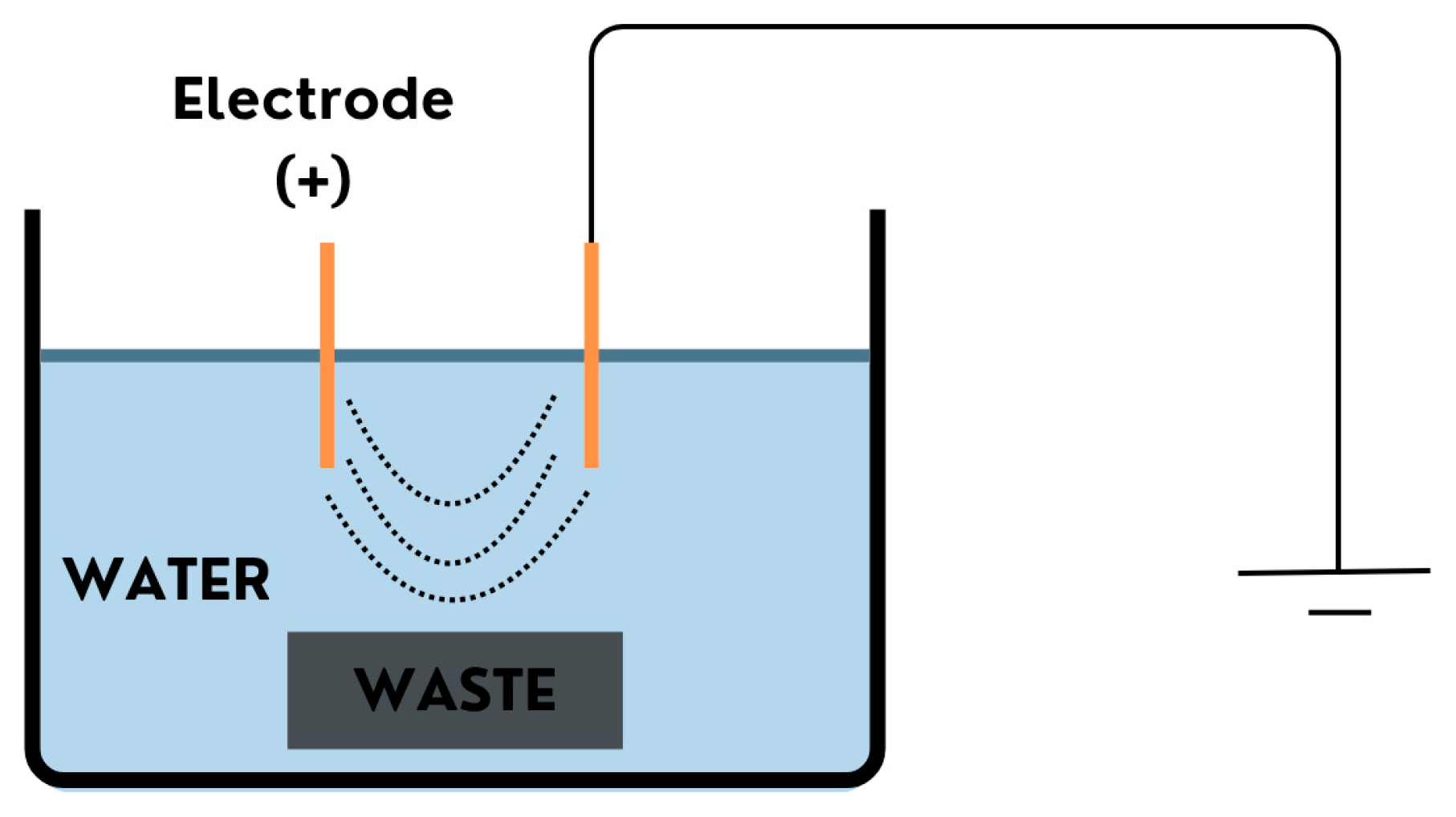
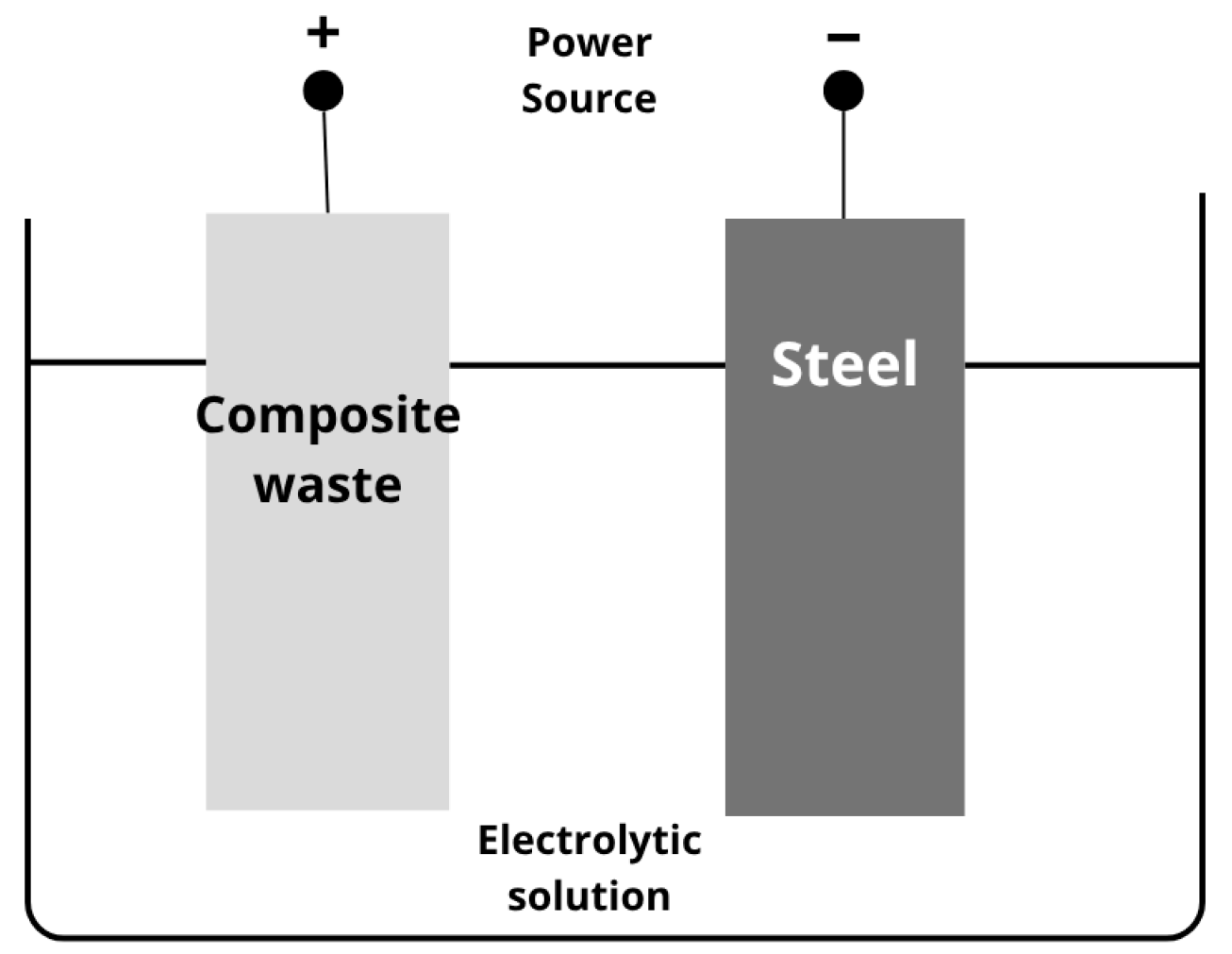
In electrochemical recycling, the thermoset composite is introduced into an electrolytic solution in which an electric current is applied (see Figure 8). The system consists of a direct current (DC) power supply, a stainless steel cathode connected to the negative terminal and the residue to be recycled which functions as an anode connected to the positive terminal [70]. The current induces the breakdown of the polymer chains due to the chemical reactions at the polymer–electrolyte interface. This recycling method is able to selectively degrade the matrix and recover the reinforcement [60]. In this context, Sun et al. [70] found, while working with carbon-reinforced epoxy composite, that the tensile strength of carbon fibre decreases with increasing solution concentration and applied current. Compared to virgin material, there is an 80% loss when operating with a 3% NaCl solution concentration and an applied current of 25 mA. Furthermore, based on SEM micrographs, resin residue on the carbon fibre was observed to decrease with decreasing applied current.
Figure 8.
Generic schema of the electrochemical recycling.
2.4.4. Superheated Steam Recycling
In superheated steam recycling, the materials are subjected to pressure steam at high temperatures, degrading the polymer matrix and facilitating the separation of the fibres [71]. Cai et al. [71] evaluated the influence of superheated steam treatment on reinforcement under different conditions. The carbon fibres were recovered after 1 h at temperatures higher than 650 °C, but optimal results were achieved at relatively lower processing temperatures when a 4% volume of O2 was used.
2.4.5. Ultrasonic Recycling
In this recycling method, ultrasonic waves are employed to induce mechanical disruption at the molecular level of the composite material. These effects promote the degradation of the polymer matrix, facilitating its separation from the reinforcing fibres [60]. Das et al. [72] studied the efficiency on the separation process, finding an almost threefold increase in decomposition compared to the non-ultrasonic process. Additionally, the recovered fibres exhibited tensile strength comparable to that of virgin fibres. According to Podara et al. [60], this technique offers significant advantages in terms of scalability and energy efficiency.
Each of the incipient methods described above presents specific advantages and limitations that will determine their future development; however, they all share the common characteristic of still being in the research phase. The following table (Table 2) summarises the advantages, limitations, and the main lines of research in each case.
Table 2.
Incipient recycling method advantages, limitations, and research areas.
3. Repurposing
Several techniques have been researched and developed to repurpose end-of-life (EoL) composite materials in other less demanding applications. The two main areas of reuse are in structural applications and in the production of cementitious materials [18,19,73,74,75].
3.1. Structural Repurposing
The reuse of composite materials in structural applications depends mainly on/upon the geometry and configuration of the obtained waste. Therefore, most of the research performed for the development of structural reuse is focused on the design, where the segmentation patterns and structural properties of recovered materials are of vital importance [75]. Currently, the most studied reuse concerns wind turbine blades. Repurposed composite materials have been used as picnic tables [73], urban furniture [75], and even for noise barriers on roads and water reservoirs [8]. Additionally, they have been employed for structural parts such as bicycle shelters and walkways [19]. A notable example of wind blade reuse in structural applications is the Wikado playground in Rotterdam, constructed by the German architecture firm Superuse Studios, which creatively incorporated repurposed wind turbine blades in its design [14]. This application represents an interesting solution that promotes the circularity of thermoset composite materials. However, over the years, concerns regarding user safety and health have emerged, particularly due to coating defects and issues associated with the epoxy resin. This case highlights the importance of carefully defining reuse strategies, including the accurate characterisation of component materials and the specification of adequate maintenance to prevent potential chemical reactions [76].
An additional area of the research has focused on the possibility of reinstalling decommissioned blades in lower-power turbines. Following condition assessments, blades from countries with more developed wind energy sectors could be sold to countries with less experience in wind energy development [8]. For instance, the Spanish company Surus Inversa has sold decommissioned wind turbine blades from dismantled wind farms through the virtual auction platform Escrapalia [77]. Despite the promising approaches, structural reuse is not considered viable at a large scale due to the expected high volumes of waste [74].
3.2. Repurposing in Cementitious Materials
The construction sector is a significant contributor to CO2 emissions, natural resource depletion, and energy consumption. Therefore, research is increasingly focused on the use of alternative materials to enhance sustainability and mitigate the environmental impacts associated with these activities [78].
In this EoL use alternative, the waste is first mechanically size-reduced as a pre-treatment step and its components are separated. On the one hand, the mineral fraction (silica, calcium carbonate, alumina, etc.) is used for clinker production (the raw material for cement), while the organic polymer matrix is converted into fuel [33]. Therefore, this process enables complete recovery of the waste, with approximately 33% obtained as energy and 67% as recovered material [21]. Prior to incorporation into concrete, the mineral fraction is divided into two groups: recycled material with higher fibre content and length, used as reinforcement, and recycled material with a higher proportion of powdered fractions, which is often used as filler [33,79].
Concretes containing thermoset composite materials have been shown to improve mechanical properties and long-term durability, as well as reduce CO2 emissions [18,33,80]. The optimal amount of recycled material to be introduced into the concrete composition is still a subject to research. The main advantage of recovery is that it extends the lifetime of the material and reduces environmental impact without requiring significant reprocessing. Its main drawbacks, however, include the substantial loss of value of the processed product and the complexity posed by hybrid components, which may contain different types of fibres [33].
4. Recyclable Resins
To reduce the generation of difficult-to-recycle composite waste, new concepts of recyclable resins for composite materials are being developed. These materials can be classified into two main groups: thermoplastic resins and recyclable thermoset resins.
4.1. Thermoplastic Resins
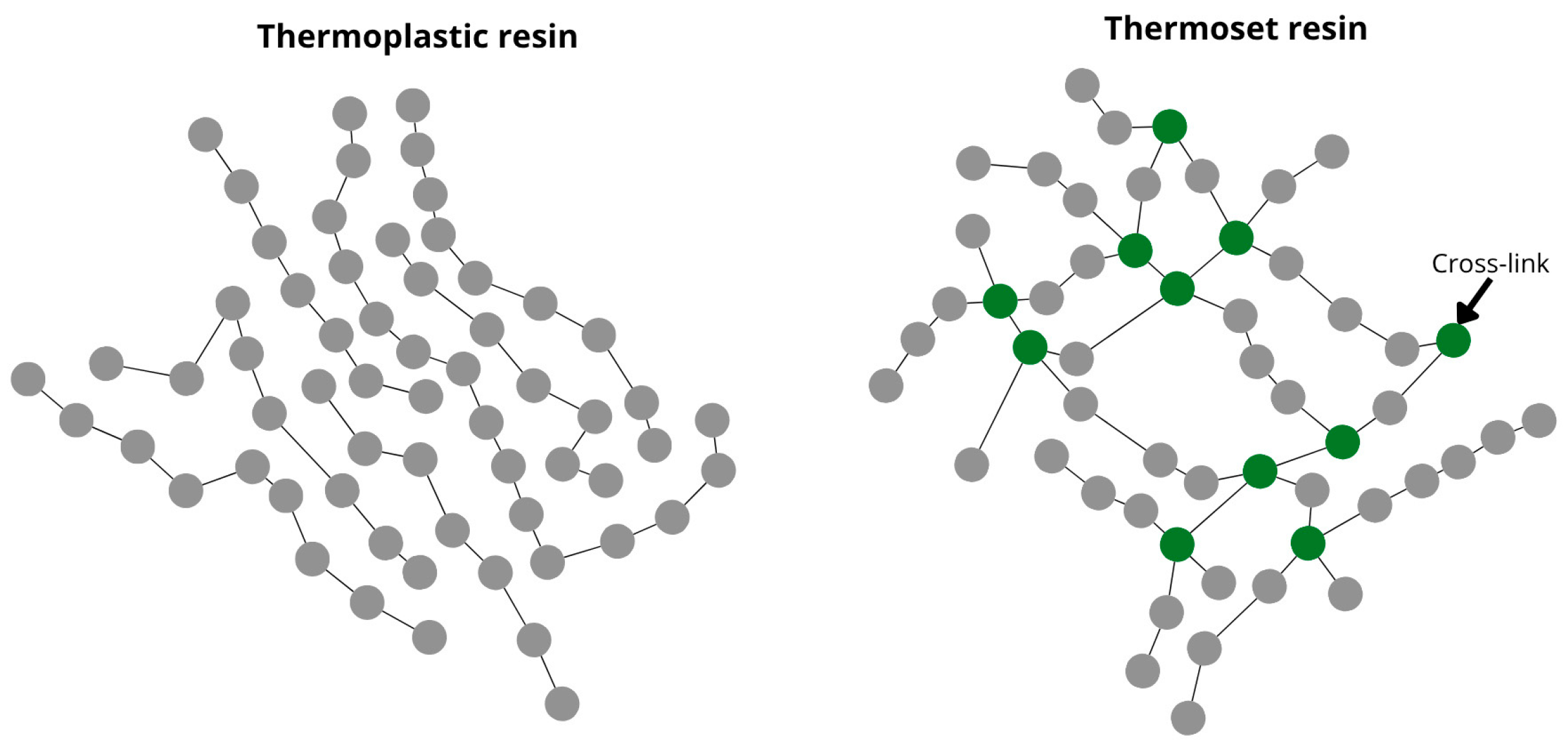
Innovative thermoplastic resins have become an attractive alternative to conventional non-recyclable thermoset resins, as they present comparable mechanical properties to thermoset materials. Conventional thermoset resins have highly cross-linked three-dimensional network structures, unlike thermoplastic ones, which are formed by linear chains with a greater freedom of movement (see Figure 9) [81].
Figure 9.
Representation of molecular structure of thermoplastic and thermoset resins.
In the past decade, the thermoplastic resin application in composites has been limited due to the challenges associated with processing liquid thermoplastic resins at room temperature [82]. This problem has been solved by the introduction of acrylic matrix polymers. Both Arkema and CSIC (Consejo Superior de Investigaciones Científicas) have succeeded in developing two thermoplastic resins, Elium® and Akelite, which enable their processing by the same techniques that thermoset matrices allow [83,84]. Additionally, these resins can be mechanically, thermally, and chemically recycled or reused by thermoforming. Since Elium® is currently commercially available, this review has focused precisely on its achievements and results.
In the first recycling method, the composites with Elium® resin are crushed and heated. The heated material is usually used to manufacture panels that can be applied in various applications, such as construction or transport [85,86]. For thermal recycling, the composite is heated to 400 °C to convert the solid resin into gaseous monomer. This monomer can then be recovered, purified, and formulated into new resin manufacturing. Finally, the Elium® resin can be chemically recycled by submerging the composites in acetone for 24 h [87]. Although recovery rates exceeding 80% can be achieved using this solvent, its high volatility makes it unsuitable for processes requiring elevated temperatures to reduce processing time. To address this limitation, Tschentscher et al. [84] evaluated the suitability of various solvents and identified acetophenone as a viable alternative for recycling applications performed at higher temperatures, although it remains under further investigation. Additionally, ethyl acetate has been investigated and validated as an environmentally friendly option.
In addition, the chemical nature of Elium® resins facilitates their repair and enables thermoforming [88]. The effects of temperature assisted reshaping on Elium® thermoplastic acrylic composites have been studied by Obande et al. [89]. From these investigations it has been concluded that the higher the number of temperature cycles, the higher the transverse flexural strength, with an increase of up to 13%. Notably, both the glass transition temperature and thermal stability remain intact after thermoforming, and no chemical change occurs in the matrix.
Furthermore, several studies have demonstrated that the new formulated resins combine the advantages of thermoplastic and thermoset matrices [90,91,92]. These findings highlight the potential of recyclable and thermoformable resins as a strong competitor of conventional commercial resins [81]. As an example, the results shown in Table 3 exhibit the flexural properties of three different resins (unsaturated polyester, epoxy, and Elium®, according to ISO 14125:1998 [93]. All samples were manufactured with two layers of glass fibre BX45 1200GSM by vacuum-assisted infusion [94].
Table 3.
Flexural properties comparative.
4.2. Recyclable Thermoset Resins
Recent approaches have focused on the development of recyclable thermoset resins that incorporate degradable or dynamic covalent bonds. On one hand, epoxy-based resin systems have been designed in which the covalent bonds can be cleaved under mild conditions through chemical recycling. This includes commercially available systems like EzCiclo [95] from Swancor (Nantou, Taiwan) and Recyclamine™ technology [96] from Aditya Birla (Mumbai, India), acquired from Connora (Hayward, CA, USA) in 2019.
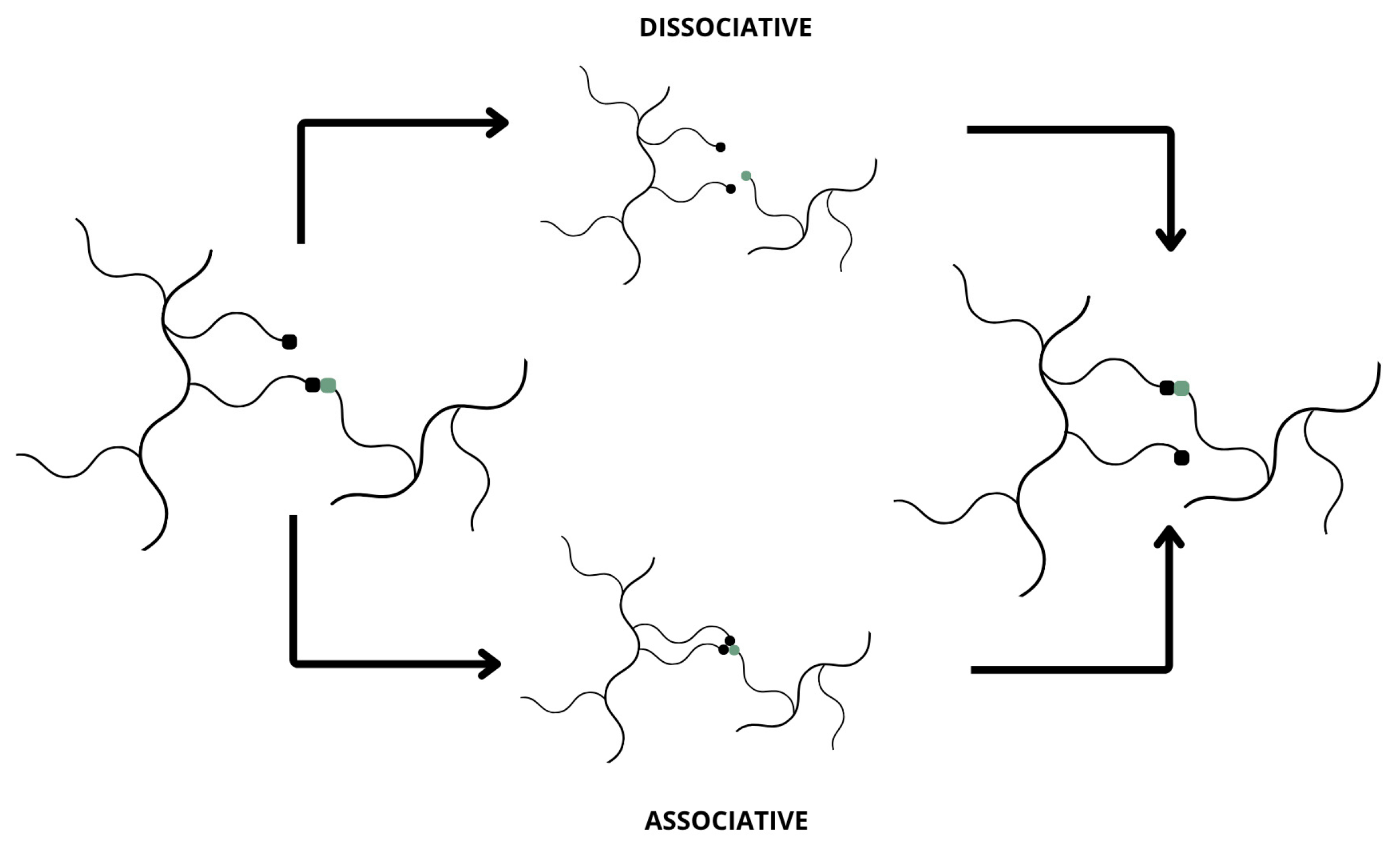
On the other hand, research has primarily focused on dynamic covalent bonds, which enable the reversible exchange of chemical cross-links between organic polymer chains [97]. One example of this are covalent adaptable networks (CAN). These networks can be classified as dissociative or associative, depending on the specific exchange mechanism governing bond formation. In dissociative networks, the cross-links are first broken, and then new ones are formed. In contrast, associative networks involve the formation of a new cross-link before the disruption of the original link (see Figure 10) [98].
Figure 10.
Representation of dissociative and associative bond exchange reactions.
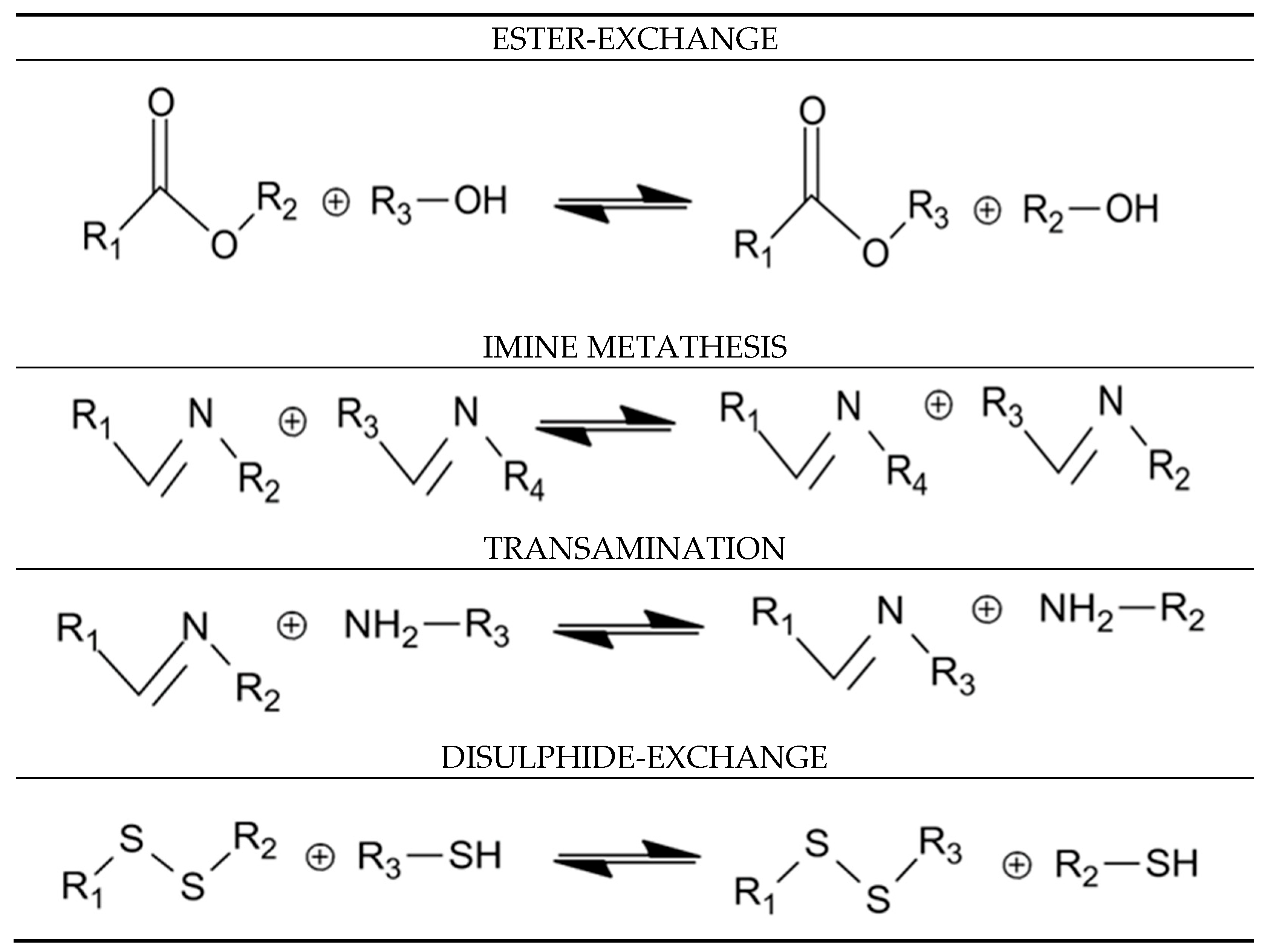
An example of such associative exchange network is vitrimer, designed in 2011 by Beibler and co-workers [99,100]. Vitrimers have mainly been studied for thermoset resins such as epoxy, polyester, polyurethane, or phenolic [101,102,103]. Ester exchange, imine metathesis, transamination, and disulphide exchange [104] are some of the most popular ways from dynamic chemistry for the design of vitrimers (see Scheme 1).
Scheme 1.
Schematic representation of dynamic exchange reactions.
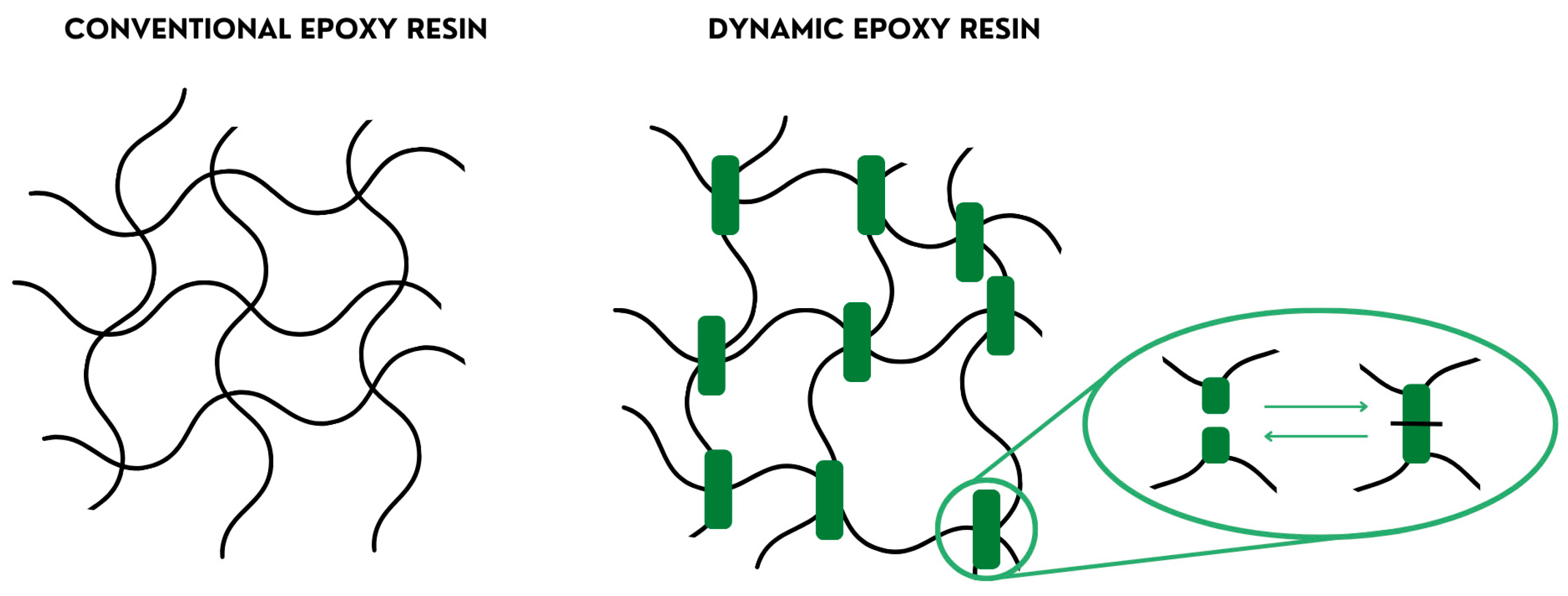
Compared to conventional thermoset resins, vitrimers have the ability to reorganise their network through externally activated reactions, enabling them to be repaired, recycled, and reprocessed [104]. This is because, although rigid cross-links are obtained below the Tg, when the material is heated above the Tg, these links can exchange with others in the network (see Figure 11) [105].
Figure 11.
Representation of dynamic bonds.
Another approach to waste management is mechanical recycling, where, in contrast to conventional thermoset composites, vitrimer-based composites can form new composite material systems. This is achieved by starting with mechanically ground fibre and resin material, taking advantage of the matrix’s potential to flow and re-establish the polymer network through the application of heat.
Among vitrimer systems investigated, the most developed and commercially available vitrimers are 3R and Vitrimax™. The VitrimaxTM resins commercialised by Mallinda (Denver, CO, USA) pioneered the development of commercially available vitrimer-based materials [106,107]. These resins are polyimine-based and are configured in a chemical network based on imine-linked networks, allowing dynamical interchangeability. The Tgs of the Mallinda-synthesised resins range from 20 °C to 240 °C [108]. In contrast, the 3R family from CIDETEC is not yet commercially available but are widely known due to the results shown in a large number of publications and projects [16,104,109].
Despite the significant progress made in the research of these systems, several challenges remain due to the chemical nature of the systems. These issues include insolubility, ageing or leaching of the catalysts, long-term instability to oxidation or hydrolysis, thermal degradation during reprocessing, low mechanical properties, scalability and cost, etc. [104].
5. Thermoforming of Cured Composite Polymeric Materials
Thermoforming of thermoplastic materials is a well-established process in which the material is heated above the Tg of the polymer, allowing the material to take the desired shape. This manufacturing or repurposing technique offers several advantages, including short cycle times, low tooling cost, and relatively clean operation. However, the main limitation of the process is that the material’s performance strongly depends on its ductility, as well as on specific parameters of the final geometry, such as depth of the draw and bending radius [110].
When working with cured composite materials, due to the high cross-linking degree of the matrix, the potential delamination of the layers, is almost inevitable. Therefore, the thermoforming strategy is fundamental to mitigate the risk of such delamination. The identified key factors influencing the thermoforming process are as follows [110,111]:
- Heating time and thermal ramp rate;
- Mould temperature;
- Thermoforming velocity;
- Cooling rate.
These parameters have a significant impact on the final product, so a preliminary characterisation study of the thermoforming conditions is necessary to define the optimal processing parameters. Finite element analysis (FEA) enables the evaluation of material deformation through numerical simulations [110].
5.1. Thermoplastic Resin Composites
For the novel thermoplastic resins described in Section 4.1, there are few studies supporting this property in reinforced composites [48]. According to the latest research by Obande et al. [89], working with Elium® 180 (Arkema—Colombes, France) and polymerised with dibenzoyl peroxide initiator (BT-50-FT), a low-temperature high-value reuse through remoulding is achievable. The laminates used in the study were composed of four layers of a glass fibre fabric with a quasi-unidirectional configuration. The laminates to be thermoformed were L-shaped laminates manufactured by infusion. The proposed method consisted of a dynamic closure of the press at 120 °C in which every 5 min the closure was increased until the laminate was completely flat. The temperature was maintained for 5 min with a complete closure at 11 bar. After this time, the laminate was cooled by maintaining the vacuum until it reached 40 °C.
The flexural test and TGA and DMTA tests showed that thermal reshaping did not damage the laminate. In addition, the Tg is maintained at 125 °C. It was predicted, based on the mass loss given in the cycles performed, that thermoforming can be performed up to 10 cycles without significant change in mass.
5.2. Dynamic Cross-Linked Thermoset Resin Composites
As mentioned earlier, CANs allow reshaping through the application of an external stimulus. Depending on whether the exchange is associative or dissociative, the reprocessing techniques for covalent adaptive network composites differ. This is because stress relaxation and viscosity reduction are more pronounced in dissociative networks, enabling the use of liquid-state processing techniques. Conversely, for associative exchange chemistry, the application of external stress is required to facilitate matrix flow, making compression moulding the most suitable technique [112].
Weidmann et al. [113] compared the thermoformability of carbon fibre-reinforced epoxy vitrimer composites, based on disulphide cross-links, with that of thermoplastic-CFRPC (Carbon Fibre-Reinforced Polymer Composite). The study was performed by a 3-point bending test on specimens with dimensions of 18 mm × 50 mm. The bending speed of the test was 1 mm/s with an applied load of 50 N. In the test, the specimens were first heated to the set temperature. The heat is maintained for 300 s to homogenise the heating of the specimen. After this time, the specimen is thermoformed to 9.5 mm and held for 300 s with the applied force and the specimen is cooled. Viscosity measurements with a torsion clamp rheometer at different temperatures show that the viscosity of the vitrimer epoxy resin decreases at temperature above Tg. Despite the decrease in resin viscosity, the vitrimer epoxy resin still shows a higher viscosity compared to the thermoplastic resin, therefore the vitrimer-CFRP composites do not flow, which presents a challenge in thermoforming.
Similarly, Aranberri et al. [99] studied the thermoformability of a dynamic epoxy system based on the reversible exchange of aromatic disulphides. In the study, a pultruded CFRP was fabricated and thermoformed by applying heat and pressure. A sheet of the profile with dimensions 120 × 100 × 3 mm was preheated at 190 °C for 10 min (Tg = 136.2 °C). A steel zig zag mould was used to press it at 100 bar to obtain a wavy 3D composite. Therefore, the significant result of this study is the development of an epoxy resin to manufacture recyclable and reshapable CFRP by pultrusion.
5.3. Conventional Thermoset Resins
As previously mentioned, conventional thermoset polymers are typically considered as non-thermoformable due to the chemical irreversibility of cross-linking. However, recent studies suggest the possibility of developing a new process for reusing thermoset composites by thermoforming [111].
The assumption of thermoformability of thermoset matrices is mainly based on shape memory polymers (SMPs), which, when heated above their glass transition temperature by applying a considerably low stress, can deform temporarily. This deformation is maintained by cooling the material below its Tg. When the material is heated again, a rapid recovery occurs, thus restoring the chains equilibrium [114].
In the case of conventional thermoset polymers, when they are heated to temperatures higher than their Tg, the elastic modulus decreases sharply and their deformation at fractures increases considerably [115]. This behaviour suggests the possibility of thermoforming.
6. Future Perspectives
This review has presented advantages related to the circularity of thermoset composite materials. Despite these advantages, there is still a long way to go to achieve sustainability, efficiency, and cost-effectiveness in the circularity of thermoset composite materials.
When discussing chemical recycling, it is essential to continue developing recycling methods that are more suitable in terms of safety, energy savings, and environmental impact. Furthermore, considering that many of the current restrictions on recycling are due to the chemical structure of the resin, another improvement strategy is based on designing the chemical structure to be recyclable, either by adding dynamic covalent bonds or by replacing conventional thermosetting resins with thermoplastic resins that are specifically designed to replicate their properties. The processing for the manufacture of composites incorporating the aforementioned thermoplastic resins is still an area that requires improvement due to the volatiles. Conversely, resins with dynamic covalent bonds face challenges such as stability against oxidation or hydrolysis, controlled degradation under mild conditions, and biocompatibility.
In the case of the repurposing in cementitious materials, thermoset composites must be sorted and processed to comply with construction requirements. Therefore, Kazemi et al. [65] proposes the creation of an infrastructure dedicated to sorting material that can be useful for construction from those that cannot. In addition, the use of a tax incentive is proposed to encourage the industry to use these materials.
Finally, the thermoforming of thermoset materials, as mentioned above, is based on shape memory polymers, but this technology is still at very low TRLs. Therefore, a study is needed to confirm that the findings of those few studies that have been conducted are accurate, and that thermoforming can be a method of repurpose.
7. Conclusions
The increasing demand for thermoset composites in various industrial sectors is leading to an accumulation of end-of-life materials, presenting a significant challenge. Currently, most waste ends up in landfills or the incinerator. Despite regulatory efforts, current data indicates that up to 70% of composite waste is still landfilled or incinerated without energy recovery. The current state of waste management highlights the urgent need for the development of innovative and economically viable recycling and reuse technologies. Despite the progress made over the last few years, current recycling methods present significant challenges, particularly with glass fibre-reinforced composite materials. The main disadvantages of these methods include high energy costs and mechanical degradation of the fibres.
The repurposing of thermoset composite materials, either for structural applications or in cementitious materials, represents a solution to reduce waste management problems and extend their service life. Despite the environmental benefits, there are also several challenges related to the value of the reused material, the variability of the composition of the recovered material and the increasing volume of waste expected to be generated in the coming years.
Novel recyclable and reusable resins represent a significant advancement in the sustainability of composite materials. Thermoplastic resins enable reuse through mechanical, chemical, and thermal recycling processes, as well as thermoforming. Complementary, thermoset resin systems with covalent adaptive networks (CAN) such as vitrimers, offer significant advantages by enabling the repairability, reprocessability, and recyclability of the composite materials manufactured with them. Advances in research on the thermoforming novel resins, particularly thermoplastic resins and thermoset resins based on CANs, highlight the potential of thermoforming as a viable technique for composite material reuse. Additionally, developments based on shape memory polymers (SMPs) suggest possibilities for thermoforming reinforced thermoset materials.
Author Contributions
Conceptualization, M.C.-I. and L.G.; formal analysis, A.I. and R.S.-R.; investigation, M.C.-I. and A-I.; writing—original draft preparation, M.C.-I.; writing—review and editing, M.C.-I. and A.I.; visualization A.I. and R.S.-R.; supervision, R.S.-R. All authors have read and agreed to the published version of the manuscript.
Funding
This research received no external funding.
Data Availability Statement
No new data were created or analyzed in this study.
Conflicts of Interest
Authors Marta Camacho-Iglesias, Lorena Germán, Aitziber Iturmendi were employed by the company GAIKER Technology Centre, Basque Research and Technology Alliance (BRTA). The authors declare that the research was conducted in the absence of any commercial or financial relationships that could be construed as a potential conflict of interest.
Abbreviations
The following abbreviations are used in this manuscript:
| DC | Direct current |
| EoL | End-of-life |
| GF | Glass fibre |
| CAN | Covalent adaptive network |
| Tg | Glass transition temperature |
| FEA | Finite element analysis |
| DMTA | Dynamic Mechanical Thermal Analysis |
| CFRPC | Carbon Fibre-Reinforced Polymer Composite |
| SMP | Shape Memory Polymer |
References
- Arussi, E.; Reiland, J.; Ierides, M.; Borghero, L. Composite Materials: A Hidden Opportunity for the Circular Economy; CSR Europe: Brussels, Belgium, 2022. [Google Scholar]
- Bhong, M.; Khan, T.K.H.; Devade, K.; Vijay Krishna, B.; Sura, S.; Eftikhaar, H.K.; Pal Thethi, H.; Gupta, N. Review of Composite Materials and Applications. Mater. Today Proc. 2023. [Google Scholar] [CrossRef]
- Jani, H.K.; Singh Kachhwaha, S.; Nagababu, G.; Das, A. A Brief Review on Recycling and Reuse of Wind Turbine Blade Materials. Mater. Today Proc. 2022, 62, 7124–7130. [Google Scholar] [CrossRef]
- Morici, E.; Dintcheva, N.T. Recycling of Thermoset Materials and Thermoset-Based Composites: Challenge and Opportunity. Polymers 2022, 14, 4153. [Google Scholar] [CrossRef]
- De, B.; Bera, M.; Bhattacharjee, D.; Ray, B.C.; Mukherjee, S. A Comprehensive Review on Fiber-Reinforced Polymer Composites: Raw Materials to Applications, Recycling, and Waste Management. Prog. Mater. Sci. 2024, 146, 101326. [Google Scholar] [CrossRef]
- Baron, N. JEC Observer—Overview of the Global Composite Market 2024–2029; JEC Group: Paris, France, 2025. [Google Scholar]
- Baron, N. JEC Observer—Overview of the Global Composite Market 2023–2028; JEC Group: Paris, France, 2024. [Google Scholar]
- AEE—Asociaciación Emperasarial Eólica. Economia Circular En El Sector Eólico—Palas de Aerogeneradores; AEE: Madrid, Spain, 2022. [Google Scholar]
- Nehls, G. Autocomposites Market Is Expected to Double Revenue by 2032; CompositesWorld: Cincinnati, OH, USA, 2024. [Google Scholar]
- How Wind Is Going Circular—Blade Recycling. ETIPWind. 2019. Available online: https://etipwind.eu/ (accessed on 5 September 2024).
- Global Fiber-Reinforced Plastic (FRP) Recycling Market (Study Period: 2019—2029). Mordor Intelligence. 2023. Available online: https://www.mordorintelligence.com/market-analysis/composites (accessed on 7 October 2025).
- Costanzo, G.; Brindley, G.; Tardieu, P. Wind Energy in Europe: 2024 Statistics and the Outlook for 2025–2030; Wind Europe: Brussels, Belgium, 2025. [Google Scholar]
- European Commission Waste Framework Directive. Available online: https://environment.ec.europa.eu/topics/waste-and-recycling/waste-framework-directive_en#end-of-waste-criteria (accessed on 6 February 2025).
- Spini, F.; Bettini, P. End-of-Life Wind Turbine Blades: Review on Recycling Strategies. Compos. Part B Eng. 2024, 275, 111290. [Google Scholar] [CrossRef]
- Zorpas, A.A. The Hidden Concept and the Beauty of Multiple “R” in the Framework of Waste Strategies Development Reflecting to Circular Economy Principles. Sci. Total Environ. 2024, 952, 175508. [Google Scholar] [CrossRef]
- Devic, A.-C.; Ierides, M.; Fernandez, V.; Verbenkov, M.; Bax, L. Polymer Composites Circularity; Suschem: Madrid, Spain, 2018. [Google Scholar]
- Boria, S.; Santulli, C.; Raponi, E.; Sarasini, F.; Tirillò, J. Evaluation of a New Green Composite Solution for Wind Turbine Blades. Multiscale Multidiscip. Model. Exp. Des. 2019, 2, 141–150. [Google Scholar] [CrossRef]
- Beauson, J.; Laurent, A.; Rudolph, D.P.; Pagh Jensen, J. The Complex End-of-Life of Wind Turbine Blades: A Review of the European Context. Renew. Sustain. Energy Rev. 2022, 155, 11847. [Google Scholar] [CrossRef]
- Schmid, M.; Gonzalez, N.; Dierckx, A.; Wegman, T. Accelerating Wind Turbine Blade Circularity; WindEurope, EuCIA, Cefic: Brussels, Belgium, 2020. [Google Scholar]
- Branfoot, C.; Folkvord, H.; Keith, M.; Leeke, G.A. Recovery of Chemical Recyclates from Fibre-Reinforced Composites: A Review of Progress. Polym. Degrad. Stab. 2023, 215, 110447. [Google Scholar] [CrossRef]
- Krauklis, A.E.; Karl, C.W.; Gagani, A.I.; Jørgensen, J.K. Composite Material Recycling Technology—State-of-the-Art and Sustainable Development for the 2020s. J. Compos. Sci. 2021, 5, 28. [Google Scholar] [CrossRef]
- WindEurope; EuCIA; UP/VE; EPOXY EUROPE; Cefic; Glass Fibre Europe; EBI; CEMBUREAU. Position Paper: Cement Co-Processing Is a Sustainable Solution for Recycling End-of-Life Composite Materials. 2023. Available online: https://eucia.eu/wp-content/uploads/2023/07/230623-Joint-position-Co-processing-Composites.pdf (accessed on 30 January 2025).
- Gharde, S.; Kandasubramanian, B. Mechanothermal and Chemical Recycling Methodologies for the Fibre Reinforced Plastic (FRP). Environ. Technol. Innov. 2019, 14, 100311. [Google Scholar] [CrossRef]
- Qureshi, J. A Review of Recycling Methods for Fibre Reinforced Polymer Composites. Sustainability 2022, 14, 16855. [Google Scholar] [CrossRef]
- Jacob, A. Composites Can Be Recycled. Reinf. Plast. 2011, 55, 45–46. [Google Scholar] [CrossRef]
- Rajan, R.; Tölli, H.; Valkjärvi, M. Towards a Sustainable Future: Exploring Methods, Technologies, and Applications for Thermoset Composite Recycling; Centria University of Applied Sciences: Ylivieska, Finland, 2024; ISBN 978-952-7173-99-2. [Google Scholar]
- Paulotto, C. Wrokshop. New Trends in Composite Materials. Composite Materials Applied in Infrastructures: Recycling Strategies; Universitat de Girona. Compus Compòsits: Girona, Spain, 2020. [Google Scholar]
- VEOLIA. Converting Household Waste into Energy. Available online: https://www.veolia.com/en/solutions/converting-household-waste-energy (accessed on 30 January 2025).
- Oliveux, G.; Dandy, L.O.; Leeke, G.A. Current Status of Recycling of Fibre Reinforced Polymers: Review of Technologies, Reuse and Resulting Properties. Prog. Mater. Sci. 2015, 72, 61–99. [Google Scholar] [CrossRef]
- Pimenta, S.; Pinho, S.T. Recycling Carbon Fibre Reinforced Polymers for Structural Applications: Technology Review and Market Outlook. Waste Manag. 2010, 31, 378–392. [Google Scholar] [CrossRef] [PubMed]
- Zhang, S.; He, E.; Liang, H.; Yang, Z.; Wang, Y.; Yang, Z.; Gao, C.; Wang, G.; Wei, Y.; Ji, Y. Chemical Recycling of Epoxy Thermosets: From Sources to Wastes. Actuators 2024, 13, 449. [Google Scholar] [CrossRef]
- Zhao, X.; Long, Y.; Xu, S.; Liu, X.; Chen, L.; Wang, Y.Z. Recovery of Epoxy Thermosets and Their Composites. Mater. Today 2023, 64, 71–97. [Google Scholar] [CrossRef]
- Tao, Y.; Hadigheh, S.A.; Wei, Y. Recycling of Glass Fibre Reinforced Polymer (GFRP) Composite Wastes in Concrete: A Critical Review and Cost Benefit Analysis. Structures 2023, 53, 1540–1556. [Google Scholar] [CrossRef]
- Guadagno, L.; Longo, R.; Raimondo, M.; Vertuccio, L.; Aliberti, F.; Bonadies, L.; Morciano, S.; Longo, L.; Pantani, R.; Calabrese, E. Chemical Recycling of Bio-Based Thermosetting Epoxy Composite Produced by Vacuum-Assisted Resin Infusion Process. Polymers 2025, 17, 1241. [Google Scholar] [CrossRef]
- Souza, P.R.; Nunes, C.S.; Freitas, A.R.; Belinato, J.R.; Pilau, E.J.; Fajardo, A.R.; da Silva Filho, E.A.; Schreiner, W.H.; Muniz, E.C. Sub- and Supercritical D-Limonene Technology as a Green Process to Recover Glass Fibres from Glass Fibre-Reinforced Polyester Composites. J. Clean. Prod. 2020, 254, 119984. [Google Scholar] [CrossRef]
- De Fazio, D.; Boccarusso, L.; Formisano, A.; Viscusi, A.; Durante, M. A Review on the Recycling Technologies of Fibre-Reinforced Plastic (FRP) Materials Used in Industrial Fields. J. Mar. Sci. Eng. 2023, 11, 851. [Google Scholar] [CrossRef]
- Vincent, G.A.; de Bruijn, T.A.; Wijskamp, S.; Abdul Rasheed, M.I.; van Drongelen, M.; Akkerman, R. Shredding and Sieving Thermoplastic Composite Scrap: Method Development and Analyses of the Fibre Length Distributions. Compos. Part B Eng. 2019, 176, 107197. [Google Scholar] [CrossRef]
- Heibeck, M.; Rudolph, M.; Modler, N.; Reuter, M.; Filippatos, A. Characterizing Material Liberation of Multi-Material Lightweight Structures from Shredding Experiments and Finite Element Simulations. Miner. Eng. 2021, 172, 107142. [Google Scholar] [CrossRef]
- Pickering, S.J. Recycling Technologies for Thermoset Composite Materials-Current Status. Compos. Part A Appl. Sci. Manuf. 2006, 37, 1206–1215. [Google Scholar] [CrossRef]
- Uenishi, K.; Shigeno, N.; Sakaguchi, S.; Yamachi, H.; Nakamori, J. Controlled Disintegration of Reinforced Concrete Blocks Based on Wave and Fracture Dynamics. Procedia Struct. Integr. 2016, 2, 350–357. [Google Scholar] [CrossRef]
- Mativenga, P.T.; Shuaib, N.A.; Howarth, J.; Pestalozzi, F.; Woisadky, J. High Voltage Fragmentation and Mechanical Recycling of Glass Fibre Thermoset Composite. CIRP Ann. 2016, 65, 45–48. [Google Scholar] [CrossRef]
- Bru, K.; Touzé, S.; Auger, P.; Dobrusky, S.; Tierrie, J.; Parvaz, D.B. Investigation of Lab and Pilot Scale Electric-Pulse Fragmentation Systems for the Recycling of Ultra-High Performance Fi Bre-Reinforced Concrete. Miner. Eng. 2018, 128, 187–194. [Google Scholar] [CrossRef]
- Diani, M.; Torvi, S.; Colledani, M. Application of High Voltage Fragmentation to Treat End-of-Life Wind Blades. Mater. Res. Proc. 2023, 35, 266–274. [Google Scholar] [CrossRef]
- Diani, M.; Torvi, S.; Colledani, M. Exploiting High Voltage Fragmentation to Enable Demand-Driven Recycling of End-of-Life Wind Blades. Procedia CIRP 2024, 122, 837–842. [Google Scholar] [CrossRef]
- Torres, A.; De Marco, I.; Caballero, B.M.; Laresgoiti, M.F.; Legarreta, J.A.; Cabrero, M.A.; González, A.; Chomón, M.J.; Gondra, K. Recycling by Pyrolysis of Thermoset Composites: Characteristics of the Liquid and Gaseous Fuels Obtained. Fuel 2000, 79, 897–902. [Google Scholar] [CrossRef]
- Oudheusden, A.V. Recycling of Composite Materials; Delft University of Technology: Delft, The Netherland, 2019. [Google Scholar]
- Ginder, R.S.; Ozcan, S. Recycling of Commercial E-Glass Reinforced Thermoset Composites via Two Temperature Step Pyrolysis to Improve Recovered Fiber Tensile Strength and Failure Strain. Recycling 2019, 4, 24. [Google Scholar] [CrossRef]
- Cousins, D.S.; Suzuki, Y.; Murray, R.E.; Samaniuk, J.R.; Stebner, A.P. Recycling Glass Fiber Thermoplastic Composites from Wind Turbine Blades. J. Clean. Prod. 2019, 209, 1252–1263. [Google Scholar] [CrossRef]
- Cheng, L.; Chen, R.; Yang, J.; Chen, X.; Yan, X.; Gu, J.; Liu, Z.; Yuan, H.; Chen, Y. Mechanisms, Technical Optimization, and Perspectives in the Recycling and Reprocessing of Waste Wind Turbine Blades: A Review. Renew. Sustain. Energy Rev. 2025, 218, 115834. [Google Scholar] [CrossRef]
- Naqvi, S.R.; Prabhakara, H.M.; Bramer, E.A.; Dierkes, W.; Akkerman, R.; Brem, G. A Critical Review on Recycling of End-of-Life Carbon Fibre/Glass Fibre Reinforced Composites Waste Using Pyrolysis Towards a Circular Economy. Resour. Conserv. Recycl. 2018, 136, 118–129. [Google Scholar] [CrossRef]
- López, F.A.; Martín, M.I.; Alguacil, F.J.; Rincón, J.M.; Centeno, T.A.; Romero, M. Thermolysis of Fibreglass Polyester Composite and Reutilisation of the Glass Fibre Residue to Obtain a Glass-Ceramic Material. J. Anal. Appl. Pyrolysis 2012, 93, 104–112. [Google Scholar] [CrossRef]
- Van De Beld, B.; Holle, E.; Florijn, J. The Use of Pyrolysis Oil and Pyrolysis Oil Derived Fuels in Diesel Engines for CHP Applications. Appl. Energy 2013, 102, 190–197. [Google Scholar] [CrossRef]
- Xu, M.X.; Ji, H.W.; Wu, Y.C.; Di, J.Y.; Meng, X.X.; Jiang, H.; Lu, Q. The Pyrolysis of End-of-Life Wind Turbine Blades under Different Atmospheres and Their Effects on the Recovered Glass Fibers. Compos. Part B Eng. 2022, 251, 110493. [Google Scholar] [CrossRef]
- Jensen, J.P.; Skelton, K. Wind Turbine Blade Recycling: Experiences, Challenges and Possibilities in a Circular Economy. Renew. Sustain. Energy Rev. 2018, 97, 165–176. [Google Scholar] [CrossRef]
- Gonçalves, R.M.; Martinho, A.; Oliveira, J.P. Recycling of Reinforced Glass Fibers Waste: Current Status. Materials 2022, 15, 1596. [Google Scholar] [CrossRef] [PubMed]
- Pickering, S.J.; Kelly, R.M.; Kennerley, J.R.; Rudd, C.D.; Fenwick, N.J. A Fluidised-Bed Process for the Recovery of Glass Fibres from Scrap Thermoset Composites. Compos. Sci. Technol. 2000, 60, 509–523. [Google Scholar] [CrossRef]
- Hyde, J.R.; Lester, E.; Kingman, S.; Pickering, S.; Wong, K.H. Supercritical Propanol, a Possible Route to Composite Carbon Fibre Recovery: A Viability Study. Compos. Part A Appl. Sci. Manuf. 2006, 37, 2171–2175. [Google Scholar] [CrossRef]
- FAIRMAT. Design and Develop Recyclable, High-Performing Products with Recycled Carbon Composites. Available online: https://www.fairmat.tech/ (accessed on 28 July 2025).
- ACCIONA. La Planta de Reciclado de Palas Eólicas de ACCIONA ‘Waste2Fiber®’, Declarada Proyecto de Interés Foral Por El Gobierno de Navarra. Available online: https://www.acciona.com/es/actualidad/noticias/planta-reciclado-palas-eolicas-acciona-waste2fiber-declarada-proyecto-interes-foral-gobierno-navarra (accessed on 28 July 2025).
- Podara, C.; Termine, S.; Modestou, M.; Semitekolos, D.; Tsirogiannis, C.; Karamitrou, M.; Trompeta, A.F.; Milickovic, T.K.; Charitidis, C. Recent Trends of Recycling and Upcycling of Polymers and Composites: A Comprehensive Review. Recycling 2024, 9, 37. [Google Scholar] [CrossRef]
- Islam, K.M.O.; Ahmad, N.; Ummer, A.C.; Ahmed, U.; Siddiqui, M.N.; Millan, M.; Abdul Jameel, A.G. Microwave-Assisted Pyrolysis of Waste Plastics: A Comprehensive Review on Process Parameters, Catalysts, and Future Prospects. Results Eng. 2025, 26, 105571. [Google Scholar] [CrossRef]
- Rani, M.; Choudhary, P.; Krishnan, V.; Zafar, S. Development of Sustainable Microwave-Based Approach to Recover Glass Fibers for Wind Turbine Blades Composite Waste. Resour. Conserv. Recycl. 2022, 179, 106107. [Google Scholar] [CrossRef]
- Cafaro, F.; Ferrari, F.; Carallo, G.A.; Greco, A.; Maffezzoli, A. A Sustainable Microwave-Assisted Process for Chemical Recycling and the Reuse of Epoxy Resin Matrices. Polymers 2025, 17, 989. [Google Scholar] [CrossRef]
- Job, S.; Leeke, G.; Mativenga, P.T.; Oliveux, G.; Pickering, S.; Shuaib, N.A. Composites Recycling: Where Are We Now? Composites UK: Berkhamsted, UK, 2016. [Google Scholar]
- Kazemi, M.; Faisal Kabir, S.; Fini, E.H. State of the Art in Recycling Waste Thermoplastics and Thermosets and Their Applications in Construction. Resour. Conserv. Recycl. 2021, 174, 105776. [Google Scholar] [CrossRef]
- Singh, M.K.; Arora, G.; Zafar, S.; Rangappa, S.M.; Siengchin, S. (Eds.) Composites Science and Technology Composite Materials Processing Using Microwave Heating Technology; Springer: Berlin/Heidelberg, Germany, 2004; ISBN 978-9819727711. [Google Scholar]
- BIZENTE. Project Applying Ligninases to Resolve End-of-Life Issues of the Thermoset Composite Plastics. Available online: https://bizente.eu/ (accessed on 21 January 2025).
- Pathak, G.S.; Hinge, M.; Otzen, D.E. Transdisciplinary Pragmatic Melioration for the Plastic Life Cycle: Why the Social, Natural, and Technical Sciences Should Prioritize Reducing Harm. Sci. Total Environ. 2023, 895, 165154. [Google Scholar] [CrossRef]
- BLADE2CIRC. Forging tha Blades of the Future with Composite Materials with Circular, Safe and Sustainable Design. Available online: https://blade2circ.eu/ (accessed on 27 July 2025).
- Sun, H.; Guo, G.; Memon, S.A.; Xu, W.; Zhang, Q.; Zhu, J.H.; Xing, F. Recycling of Carbon Fibers from Carbon Fiber Reinforced Polymer Using Electrochemical Method. Compos. Part A Appl. Sci. Manuf. 2015, 78, 10–17. [Google Scholar] [CrossRef]
- Cai, G.; Wada, M.; Ohsawa, I.; Kitaoka, S.; Takahashi, J. Interfacial Adhesion of Recycled Carbon Fibers to Polypropylene Resin: Effect of Superheated Steam on the Surface Chemical State of Carbon Fiber. Compos. Part A Appl. Sci. Manuf. 2019, 120, 33–40. [Google Scholar] [CrossRef]
- Das, M.; Varughese, S. A Novel Sonochemical Approach for Enhanced Recovery of Carbon Fiber from CFRP Waste Using Mild Acid-Peroxide Mixture. ACS Sustain. Chem. Eng. 2016, 4, 2080–2087. [Google Scholar] [CrossRef]
- Joustra, J.; Flipsen, B.; Balkenende, R. Structural Reuse of Wind Turbine Blades through Segmentation. Compos. Part C Open Access 2021, 5, 100137. [Google Scholar] [CrossRef]
- Joustra, J.; Flipsen, B.; Balkenende, R. Structural Reuse of High End Composite Products: A Design Case Study on Wind Turbine Blades. Resour. Conserv. Recycl. 2021, 167, 105393. [Google Scholar] [CrossRef]
- Bank, L.C.; Arias, F.R.; Yazdanbakhsh, A.; Gentry, T.R.; Al-Haddad, T.; Chen, J.F.; Morrow, R. Concepts for Reusing Composite Materials from Decommissioned Wind Turbine Blades in Affordable Housing. Recycling 2018, 3, 3. [Google Scholar] [CrossRef]
- Medici, P.; van den Dobbelsteen, A.; Peck, D. Safety and Health Concerns for the Users of a Playground, Built with Reused Rotor Blades from a Dismantled Wind Turbine. Sustainability 2020, 3, 3626. [Google Scholar] [CrossRef]
- SURUS. Available online: https://www.surusin.com/ (accessed on 24 June 2025).
- Li, X.; Qin, D.; Hu, Y.; Ahmad, W.; Ahmad, A.; Aslam, F.; Joyklad, P. A Systematic Review of Waste Materials in Cement-Based Composites for Construction Applications. J. Build. Eng. 2022, 45, 103447. [Google Scholar] [CrossRef]
- Xiong, C.; Li, Q.; Lan, T.; Li, H.; Long, W.; Xing, F. Sustainable Use of Recycled Carbon Fiber Reinforced Polymer and Crumb Rubber in Concrete: Mechanical Properties and Ecological Evaluation. J. Clean. Prod. 2021, 279, 123624. [Google Scholar] [CrossRef]
- Mastali, M.; Dalvand, A.; Sattarifard, A. The Impact Resistance and Mechanical Properties of the Reinforced Self-Compacting Concrete Incorporating Recycled CFRP Fiber with Different Lengths and Dosages. Compos. Part B Eng. 2017, 112, 74–92. [Google Scholar] [CrossRef]
- Santiago Bethencourt, A.; Verdejo Márquez, R.; López Manchado, M.A. Desarrollo de Materiales Compuestos Sostenibles Basados En Polímeros Reforzados Con Fibra Continua. Rev. Plást. Mod. Cienc. Y Tecnol. De Polím. 2022, 775, 3. [Google Scholar]
- Kinvi-Dossou, G.; Matadi Boumbimba, R.; Bonfoh, N.; Garzon-Hernandez, S.; Garcia-Gonzalez, D.; Gerard, P.; Arias, A. Innovative Acrylic Thermoplastic Composites versus Conventional Composites: Improving the Impact Performances. Compos. Struct. 2019, 217, 1–13. [Google Scholar] [CrossRef]
- Carnicero, R.; Cano, L.; Lopez-Manchado, M.A.; Verdejo, R. Manufacturing, Testing and Recycling of a Small Recyclable Wind Turbine Blade. J. Phys. Conf. Ser. 2022, 2265, 032013. [Google Scholar] [CrossRef]
- Tschentscher, C.; Gebhardt, M.; Chakraborty, S.; Meiners, D. Recycling of Elium CFRPs for High Temperature Dissolution: A Study with Different Solvents. In Proceedings of the Symposium Materialtechnik, Clausthal-Zellerfeld, Germany, 25–26 February 2021. [Google Scholar]
- ARKEMA. Recycling Composite Materials: What Are the Possibilities of Elium® Thermoplastic Resins? Available online: https://www.arkema.com/global/en/resources/post/incubator/elium-resin-composites-recycling-options/ (accessed on 16 January 2025).
- Cledat, G. ARKEMA Elium® Resin: A Breakthrough Innovation in Composite Materials. Available online: https://www.arkema.com/global/en/resources/post/incubator/elium-resin-breakthrough-innovation/ (accessed on 16 January 2025).
- Gebhardt, M.; Chakraborty, S.; Manolakis, I.; Meiners, D. Closed-Loop Room Temperature Recycling of Elium CFRPs and Its Influence on the 2nd Generation Composite Properties. Z. Kunststofftechnik 2020, 1, 179–210. [Google Scholar] [CrossRef]
- Sachs, U.; Akkerman, R. Viscoelastic Bending Model for Continuous Fiber-Reinforced Thermoplastic Composites in Melt. Compos. Part A Appl. Sci. Manuf. 2017, 100, 333–341. [Google Scholar] [CrossRef]
- Obande, W.; Stankovic, D.; Bajpai, A.; Devine, M.; Wurzer, C.; Lykkeberg, A.; Garden, J.A.; Ó Brádaigh, C.M.; Ray, D. Thermal Reshaping as a Route for Reuse of End-of-Life Glass Fibre-Reinforced Acrylic Composites. Compos. Part B Eng. 2023, 257, 110662. [Google Scholar] [CrossRef]
- Boufaida, Z.; Farge, L.; André, S.; Meshaka, Y. Influence of the Fiber/Matrix Strength on the Mechanical Properties of a Glass Fiber/Thermoplastic-Matrix Plain Weave Fabric Composite. Compos. Part A Appl. Sci. Manuf. 2015, 75, 28–38. [Google Scholar] [CrossRef]
- Bhudolia, S.K.; Perrotey, P.; Joshi, S.C. Mode I Fracture Toughness and Fractographic Investigation of Carbon Fibre Composites with Liquid Methylmethacrylate Thermoplastic Matrix. Compos. Part B Eng. 2018, 134, 246–253. [Google Scholar] [CrossRef]
- Bandaru, A.K.; Pothnis, J.R.; Portela, A.; Gujjala, R.; Ma, H.; O’Higgins, R.M. Flexural and Interlaminar Shear Response of Novel Methylmethacrylate Composites Reinforced with High-Performance Fibres. Polym. Test. 2024, 140, 108578. [Google Scholar] [CrossRef]
- ISO 14125:1998; Fibre-Reinforced Plastic Composites—General Principles of Design and Analysis of Composite Structures. International Organization for Standardization (ISO): Ginebra, Suiza, 1998.
- ARKEMA Elium® Liquid Thermoplastics. Available online: https://www.arkema.com/global/en/products/product-finder/product-range/incubator/elium_resins/ (accessed on 20 January 2025).
- Swancor Launched Recyclable Thermosetting Epoxy Resin. Available online: https://www.jeccomposites.com/news/spotted-by-jec/swancor-launched-recyclable-thermosetting-epoxy-resin-ezciclo-leading-to-zero-carbon-era/?news_type=announcement,business,product-technology&end_use_application=renewable-energy&tax_product=recycling,therm (accessed on 30 June 2025).
- Saitta, L.; Dattilo, S.; Rizzo, G.; Tosto, C.; Blanco, I.; Ferrari, F.; Carallo, G.A.; Cafaro, F.; Greco, A.; Cicala, G. Chemical Recycling of Bio-Based Epoxy Matrices Based on Precursors Derived from Waste Flour: Recycled Polymers Characterization. Polymers 2025, 17, 335. [Google Scholar] [CrossRef]
- Markouti, P.; Tzouma, E.; Paipetis, A.S. Conventional Thermoset Composites and Their Sustainable Alternatives with Vitrimer Matrix—Waste Management/Recycling Options with Focus on Carbon Fiber Reinforced Epoxy Resin Composites. Materials 2025, 18, 351. [Google Scholar] [CrossRef] [PubMed]
- Elling, B.R.; Dichtel, W.R. Reprocessable Cross-Linked Polymer Networks: Are Associative Exchange Mechanisms Desirable? ACS Cent. Sci. 2020, 6, 1488–1496. [Google Scholar] [CrossRef]
- Aranberri, I.; Landa, M.; Elorza, E.; Salaberria, A.M.; Rekondo, A. Thermoformable and Recyclable CFRP Pultruded Profile Manufactured from an Epoxy Vitrimer. Polym. Test. 2021, 93, 106931. [Google Scholar] [CrossRef]
- Montarnal, D.; Capelot, M.; Tournilhac, F.; Leibler, L. Silica-like Malleable Materials from Permanent Organic Networks. Science 2011, 334, 965–968. [Google Scholar] [CrossRef]
- Zhang, Y.; Zhang, L.; Yang, G.; Yao, Y.; Wei, X.; Pan, T.; Wu, J.; Tian, M.; Yin, P. Recent Advances in Recyclable Thermosets and Thermoset Composites Based on Covalent Adaptable Networks. J. Mater. Sci. Technol. 2021, 92, 75–87. [Google Scholar] [CrossRef]
- Rizzo, G.; Saitta, L.; Dattilo, S.; Tosto, C.; Pergolizzi, E.; Ivankovic, A.; Cicala, G. Thermomechanical Characterization of an Unsaturated Polyester Vitrimer Synthesized Using a Titanium Transesterification Catalyst. ACS Appl. Polym. Mater. 2023, 5, 8326–8338. [Google Scholar] [CrossRef]
- Tao, Y.; Liang, X.; Zhang, J.; Lei, I.M.; Liu, J. Polyurethane Vitrimers: Chemistry, Properties and Applications. J. Polym. Sci. 2023, 61, 2233–2253. [Google Scholar] [CrossRef]
- Ruiz De Luzuriaga, A.; Martin, R.; Markaide, N.; Rekondo, A.; Cabañero, G.; Rodríguez, J.; Odriozola, I. Epoxy Resin with Exchangeable Disulfide Crosslinks to Obtain Reprocessable, Repairable and Recyclable Fiber-Reinforced Thermoset Composites. Mater. Horiz. 2016, 3, 241–247. [Google Scholar] [CrossRef]
- Yang, Y.; Xu, Y.; Ji, Y.; Wei, Y. Functional Epoxy Vitrimers and Composites. Prog. Mater. Sci. 2021, 120, 100710. [Google Scholar] [CrossRef]
- Ares-Elejoste, P.; Seoane-Rivero, R.; Gandarias, I.; Iturmendi, A.; Gondra, K. Sustainable Alternatives for the Development of Thermoset Composites with Low Environmental Impact. Polymers 2023, 15, 2939. [Google Scholar] [CrossRef] [PubMed]
- Mallinda Mallinda. Available online: https://www.mallinda.com/ (accessed on 11 February 2025).
- Schenk, V.; Labastie, K.; Destarac, M.; Olivier, P.; Guerre, M. Vitrimer Composites: Current Status and Future Challenges. Mater. Adv. 2022, 3, 8012–8029. [Google Scholar] [CrossRef]
- García-Lecina, E. Reprocessable, Repairable and Recyclable: Materials with an Endless Lifespan. CIDETEC Surface Engineering. Available online: www.cidetec.es (accessed on 14 February 2025).
- Stack, R.M.; Lai, F. Development in Thermoforming Thermoplastic Composites. Univ. Mass. Lowell 2013, 32, 48–53. [Google Scholar]
- Nouigues, A.; Le Gal La Salle, E.; Bailleul, J.L. Thermo-Mechanical Characterization of Unsaturated Polyester/Glass Fiber Composites for Recycling. Int. J. Mater. Form. 2021, 14, 153–174. [Google Scholar] [CrossRef]
- Post, W.; Susa, A.; Blaauw, R.; Molenveld, K.; Knoop, R.J.I. A Review on the Potential and Limitations of Recyclable Thermosets for Structural Applications. Polym. Rev. 2020, 60, 359–388. [Google Scholar] [CrossRef]
- Weidmann, S.; Volk, P.; Mitschang, P.; Markaide, N. Investigations on Thermoforming of Carbon Fiber Reinforced Epoxy Vitrimer Composites. Compos. Part A Appl. Sci. Manuf. 2021, 154, 106791. [Google Scholar] [CrossRef]
- Pascault, J.P.; Williams, R.J.J. Overview of Thermosets: Structure, Properties and Processing for Advanced Applications; Elsevier eBooks: Amsterdam, The Netherlands, 2012; pp. 3–27. [Google Scholar] [CrossRef]
- Nouigues, A. Recyclage des Pièces en Composite Polyester en Fibres de Verre de Grandes Dimensions par Laminage. Ph.D. Thesis, Université de Nantes (UN), Nantes, France, 2021. [Google Scholar]
Disclaimer/Publisher’s Note: The statements, opinions and data contained in all publications are solely those of the individual author(s) and contributor(s) and not of MDPI and/or the editor(s). MDPI and/or the editor(s) disclaim responsibility for any injury to people or property resulting from any ideas, methods, instructions or products referred to in the content. |
© 2025 by the authors. Licensee MDPI, Basel, Switzerland. This article is an open access article distributed under the terms and conditions of the Creative Commons Attribution (CC BY) license (https://creativecommons.org/licenses/by/4.0/).