Article

Compression Molding of Thermoplastic Polyurethane Composites for Shape Memory Polymer Actuation

1
Department of Engineering and Science, University “Mercatorum”, 00186 Rome, Italy
2
Department of Industrial Engineering, University of Rome “Tor Vergata”, 00133 Rome, Italy
3
UniCamillus-Saint Camillus International University of Health Sciences, 00131 Rome, Italy
4
Italian National Research Council, Institute for Microelectronics and Microsystems (IMM), 00133 Rome, Italy
*
Authors to whom correspondence should be addressed.
J. Compos. Sci. 2025, 9(12), 681; https://doi.org/10.3390/jcs9120681
Submission received: 30 October 2025 / Revised: 14 November 2025 / Accepted: 1 December 2025 / Published: 8 December 2025
(This article belongs to the Special Issue Feature Papers in Journal of Composites Science in 2025)

Abstract

Background: Soft actuation relies on materials that are lightweight, flexible, and responsive to external stimuli. In biomedical applications, miniaturization and biocompatibility are key requirements for developing smart devices. Thermoplastic polyurethane (TPU) is particularly attractive due to its elasticity, processability, and biocompatibility; however, an improvement in its shape-recovery performance would significantly enhance its suitability for actuation systems. This study aims to develop TPU-based shape memory polymer (SMP) composites with improved functional behavior for biomedical applications. Methods: TPU was modified with aluminum nanoparticles (AlNPs) and multi-walled carbon nanotubes (MWCNTs), incorporated individually (1 wt.% and 3 wt.%) and in hybrid combinations (MWCNT:AlNP ratios of 2:1, 5:1, and 10:1). Samples were produced by compression molding and characterized through thermal, mechanical, electrical, and shape-recovery tests, supported by morphological analysis. Results: AlNPs moderately improved thermal conductivity, while MWCNTs significantly enhanced electrical conductivity and doubled the recovery force compared with neat TPU. Hybrid composites showed intermediate properties, with the 5:1 MWCNT:AlNP ratio offering the best balance between recovery force and activation speed. Conclusions: The synergistic combination of MWCNTs and AlNPs effectively enhances TPU’s multifunctional behavior, demonstrating strong potential for soft actuation in biomedical devices.

1. Introduction

Over the last few decades, growing environmental awareness and the global demand for sustainable materials have driven rapid advancements in polymer science, particularly in the development of advanced polymeric and bio-based materials. These materials and their composites have attracted huge attention due to their tunable functional properties, lightweight nature, and ease of processing. This has enabled innovations in various fields, ranging from flexible electronics and smart textiles to biomedical devices and soft robotics [1].
In this context, shape-memory polymers (SMPs) are a remarkable class of stimuli-responsive systems capable of undergoing large, reversible deformations. SMPs can be temporarily deformed and later recover the original shape when triggered by an external stimulus such as heat, light, electricity, magnetic field, or humidity [2,3,4,5,6]. Because of these features, SMPs have found applications in a wide range of fields, including aerospace deployable structures, minimally invasive biomedical devices, self-deploying sensors and actuators, and adaptive textiles [7,8,9]. Among SMPs, thermoplastic polyurethane (TPU) represents a particularly promising material. In fact, TPUs are segmented block copolymers consisting of alternating hard and soft domains, typically formed by the reaction of diisocyanates with polyols and chain extenders [10,11,12,13,14,15]. This segmented morphology provides an excellent balance between elasticity, toughness, abrasion resistance, and processability. The soft segments (commonly polyether or polyester chains) act as the reversible phase, while the hard segments form physical crosslinks that stabilize the permanent shape. Such a structure makes TPUs intrinsically capable of shape-memory behavior even without chemical crosslinking, unlike thermoset SMPs.
Recent studies have explored blending TPUs with biodegradable polymers, such as polylactic acid (PLA) and polycaprolactone (PCL). This process aims to improve sustainability while maintaining mechanical and shape-memory performance. For instance, TPU/PLA blends have shown synergistic combinations of elasticity and rigidity, with tunable glass transition temperatures (Tg) and melting points depending on blend ratios. In a study by Guo et al. a 70/30 TPU/PLA blend achieved a tensile strength of 14.3 MPa, an elongation at break of 117%, and a shape recovery ratio of 55% at low temperature [16]. The addition of 3 wt.% carboxyl-functionalized multi-walled carbon nanotubes (MWCNTs-COOH) further improved the tensile strength to 17.2 MPa and increased the elongation at break to 230%, with shape recovery rates above 80%. These results underline the dual benefit of bio-based content and nanofiller reinforcement in achieving sustainable and functional SMPs. Similarly, TPU/PCL systems have been widely studied for biomedical and smart applications due to their biocompatibility, degradability, and excellent shape-memory characteristics. For example, a 50/50 TPU/PCL blend produced via melt blending showed a shape-fixing rate above 95% and a recovery rate of 68% [17], values that increased further upon the incorporation of 3 wt.% MWCNTs. These findings reinforce that polymer blending combined with nanofiller reinforcement can tailor both mechanical and shape-memory performance.
Beyond sustainability considerations, shape-memory TPUs have become a keystone material for soft robotics, a field that aims to develop compliant, adaptable, and safe systems inspired by natural structures [18,19,20,21]. Unlike conventional rigid robots, soft robotic systems rely on deformable materials capable of bending, stretching, and recovering repeatedly under moderate actuation stimuli. It is worth mentioning that, in such contexts, TPUs offer a unique combination of elasticity, toughness, and thermal responsiveness, making them ideal for soft actuators, artificial muscles, wearable sensors, and adaptive structural components. Furthermore, the thermoplastic nature of TPU allows it to be processed by conventional manufacturing techniques such as extrusion, injection molding, or additive manufacturing, thus facilitating scalable production.
However, although neat TPUs exhibit moderate shape recovery and good mechanical flexibility, their thermal and electrical conductivities remain relatively low. This limitation slows down heat transfer during thermal activation and restricts the development of electro- or thermo-responsive SMPs. To overcome these drawbacks, researchers have increasingly focused on nanocomposite reinforcement. The inclusion of nanoscale fillers can enhance stiffness, conductivity, thermal stability, and even self-healing or sensing functionalities.
Various nanofillers have been explored to enhance TPU properties. Examples include graphene nanoplatelets, which improve tensile strength and electrical conductivity [22,23,24], or silica nanoparticles, which enhances oxidation and thermal resistance [25,26], titanium dioxide (TiO2), which contributes UV stability [27,28,29], or boron nitride (BN), which improves thermal management and heat conduction [30,31]. Other fillers, such as aluminum oxide (Al2O3) and hexagonal boron nitride (h-BN), have also been reported to significantly accelerate heat flow within the TPU matrix, leading to faster actuation responses in thermally triggered SMPs [32]. Among conductive nanofillers, carbon nanotubes (CNTs), especially multi-walled CNTs (MWCNTs), stand out due to their exceptional aspect ratio, mechanical strength, and electrical conductivity. Even at low concentrations (1–3 wt.%), MWCNTs can create conductive networks within the TPU matrix, improving both mechanical properties and Joule heating capability [33,34,35,36,37,38]. For example, a TPU/MWCNT composite containing 3 wt.% CNTs exhibited a tensile strength of 18.8 MPa, an elastic modulus of 12.3 MPa, and a shape-memory rate of 94.7% [39]. Similarly, hybrid TPU composites incorporating MWCNTs with silver nanoparticles (AgNPs) at a 5:1 ratio demonstrated enhanced stiffness (modulus of 25.1 MPa) and improved actuation response [30]. Consequently, the use of hybrid nanofillers has emerged as a promising strategy to synergistically combine the advantages of different filler types.
Despite extensive research on TPU-based shape-memory composites, most previous studies have focused on different-filler systems. However, the combined influence of electrically conductive MWCNTs and thermally conductive aluminum nanoparticles (AlNPs) within a TPU matrix remains unexplored. Moreover, there is a lack of systematic evaluation of actuation load, thermal responsiveness, and mechanical behavior in such hybrid nanocomposites, which are critical parameters for actuator design.
The novelty of this work lies in the development and characterization of hybrid TPU/MWCNT/AlNP composites fabricated via a scalable compression molding process, and in correlating their microstructure with actuation performance. The study provides new insights into how the ratio of multi-walled carbon nanotubes (MWCNTs) to aluminum nanoparticles (AlNPs) affects the mechanical stiffness, thermal response rate, and shape recovery under load. These findings offer a foundation for optimizing multifunctional TPU-based shape-memory materials suitable for adaptive and soft robotic systems. Specifically, a hybrid reinforcement approach was developed by incorporating MWCNTs and AlNPs into a TPU matrix. Aluminum nanoparticles are characterized by high thermal conductivity and low density, making them attractive for applications requiring efficient heat dissipation and reduced weight. Their combination with MWCNTs aims to exploit synergistic effects between the electrical conductivity of CNTs and the thermal conductivity of AlNPs, potentially enhancing actuation speed and energy efficiency in thermally triggered SMPs. TPU nanocomposites were prepared with MWCNT and AlNP contents of 1 wt.% and 3 wt.% individually, as well as in hybrid combinations with MWCNT:AlNP ratios of 2:1, 5:1, and 10:1, to evaluate the effect of composition on mechanical, thermal, and functional performance. Among all formulations, the hybrid TPU nanocomposite with an MWCNT:AlNP ratio of 5:1 exhibited the most favorable combination of properties; it achieved a balanced mechanical strength, efficient thermal response, and a rapid shape recovery. These findings demonstrate that hybrid nanofiller reinforcement can significantly enhance the multifunctional performance of TPU-based SMPs, offering a pathway toward sustainable, high-performance materials suitable for applications in soft robotics, adaptive devices, and environmentally responsible smart materials.

2. Materials and Methods

2.1. Materials

The materials used to produce hybrid shape memory polymer composite (SMPC) are commercially available products. In this study commercial materials were chosen to ensure reproducibility, standardization, quality control, and efficiency, facilitating reliable and widely comparable results. The commercial materials were used as received, without undergoing a purification process.
Commercial thermoplastic polyurethane (TPU) pellets (DiAPLEX MM3510) were purchased from SMP Technologies Inc. (Tokyo, Japan). The selected TPU is a commercially available biomedical-grade material, as specified by the manufacturer. The material properties stated by the TPU pellet manufacturer are: Tg (glass transition temperature) of 35 °C and a specific gravity of 1.25. This TPU is designed for biomedical applications and was selected for its potential in soft actuators in contact with the human body, as its Tg near body temperature enhances its suitability for such applications.
The multi-walled carbon nanotubes MWCNTs (Cheap Tubes Inc. Grafton, VT 05146 USA) used have an outer diameter of 8–15 nm, an inside diameter of 3–5 nm, and ash < 1.5 wt.%, with a purity > 95 wt.%, a length of 10–50 µm, a specific surface area of 233 m2/g, an electrical conductivity > 100 S/cm, and bulk and true densities of 0.15 g/cm3 and ~2.1 g/cm3, respectively. The aluminum nanoparticles (AlNPs) with a spherical morphology, a diameter of 40–60 nm, a purity of 99.7%, and bulk and true densities of 0.08–0.2 g/cm3 and 2.7 g/cm3 were purchased from US Research nanomaterials (Houston, TX 77084, USA).
The shape-memory TPU is triggered by temperature, specifically its glass transition temperature (Tg), to enable an autonomous shape recovery process. Thin and flexible Kapton-based microheaters were employed during the recovery phases. Microheaters (model KHLVA—0502/10, 10 W/in2 maximum 28 V) were purchased from Omega Engineering.

2.2. Experimental Methods

2.2.1. Manufacturing of TPU Composite

A laboratory mixer (Mixer 30 EHT, Brabender® Plastograph®, Brabender GmbH & Co. KG, Duisburg, Germany) was used to synthesize the TPU composite. The standard compounding procedure consisted of introducing 20 g of TPU pellets into the mixer at 160 °C, followed by mixing for 3 min at a rotation speed of 50 rpm. Subsequently, varying amounts of AlNPs and/or MWCNTs were added to the TPU and mixed for an additional 7 min. For comparison, pure TPU pellets were mixed under the following conditions: 160 °C, 5 min, 50 rpm. A scheme summarizing the manufacturing procedure is depicted in Figure 1. The compositions investigated are listed in Table 1. The upper limit of 3 wt.% for nanofiller was chosen to balance reinforcement benefits with maintaining processing feasibility and structural integrity. At higher percentages, nanoparticles tend to agglomerate due to their high surface energy, which weakens dispersion and mechanical performance, acting as stress concentrators rather than reinforcements [40]. Increased viscosity associated with elevated filler content also compromises processing; even low additions (e.g., 5 wt.% silica) can dramatically raise viscosity, highlighting how higher concentrations can adversely affect manufacturability [41]. Conversely, significant property enhancements—mechanical, electrical, or thermal—are often achievable at low nanofiller percentages (≤3 wt.%), particularly when high-aspect-ratio fillers (like CNTs) enable percolative networks at low loadings [42]. Thus, 3 wt.% can be identified as a practical threshold, providing a good compromise between enhanced electrical, thermal, and mechanical properties and the preservation of good processability and dispersion quality.
At the end of the compounding process, all samples were manually cut into small particles (a few mm3) and subsequently molded by compression molding. The TPU particles were placed into a 65 × 65 mm2 mold, using a release film to facilitate demolding. The mold was heated on a hot plate (EH35B by LabTech S.r.l., Sorisole, BG, Italy) at 170 °C for 20 min, and a counter mold applied a compressive force of approximately 200 N to ensure cohesion between particles. After molding, the samples had final dimensions of 65 × 65 mm2 and an approximate thickness of 5 mm. The material density was determined using an analytical balance (0.0001 g, BA-E Series, Infitek Co., Ltd., Shanghai, China) equipped with a hydrostatic weighing system.
Finally, the square molded samples were cut into rectangular specimens (approximately 15 × 50 × 2.5 mm3) for thermal, mechanical, and electrical measurements. These dimensions were selected to match the size of the microheaters used during the heating phases of the shape-memory recovery tests.

2.2.2. Microscopic and Spectroscopic Analysis

Three TPU composites containing 3 wt.% nanostructures were selected for scanning electron microscopy (SEM, ZEISS SIGMA, Carl Zeiss Microscopy GmbH, 20156 Milan, Italy) analysis: (i) TPU + 3% carbon nanotubes (CNT), (ii) TPU + 3% aluminum nanoparticles (Al NPs), and (iii) TPU + 3% CNT + Al NPs in a 10:1 ratio. The 3 wt.% filled samples were chosen as representatives of the highest nanofiller content incorporated. This is particularly relevant for assessing the microscopic distribution and potential clustering of the nanostructures. For sample preparation, each material was heated to ~40 °C to soften the matrix, and 5 mm cubes were excised from the bulk using a scalpel. Specimens were mounted on stubs, sputter-coated with a 30 nm gold layer to prevent charging and labeled prior to SEM analysis. Samples were oriented to expose the upper surface, avoiding lateral walls that could have been altered during cutting. Micrographs were subsequently acquired at two magnifications (1500× and 10,000×).
Fourier Transform Infrared (FTIR) spectroscopy was performed to analyze the chemical structure of the TPU composite samples containing MWCNTs and AlNPs. This analysis aimed to identify characteristic functional groups and possible interactions between the polymer matrix and the nanofillers, providing complementary information to the mechanical and morphological characterization. FTIR analyses were performed using a Jasco FT/IR-4X (Piazza Cavour, Milan, MI, Italy) spectrometer equipped with a diamond ATR (attenuated total reflectance) accessory, allowing single or multiple reflections, and a DLaTGS (deuterated L-alanine doped triglycene sulfate) detector. Measurements were conducted at room temperature over the 4000–400 cm−1 spectral range, with a resolution of 4 cm−1 and an average of 150 scans per sample. Spectra acquisition and processing were carried out using Spectra Manager™ Spectroscopy Software version 2.8 (Jasco, Piazza Cavour, Milan, MI, Italy).

2.2.3. Thermal Properties Testing

Small specimens of each composite were analyzed by differential scanning calorimetry (DSC6, Perkin Elmer Italia S.p.A., Milan, Italy) to investigate the thermal behavior of the TPU-based nanocomposites. Double heating scans were performed between –5 and 200 °C at a constant heating rate of 10 °C min−1 under a nitrogen atmosphere. The glass transition temperature (Tg) of the soft segments was determined from the second heating scan to minimize the influence of prior thermal history. DSC analysis was selected as it provides accurate quantitative information on the main thermal transitions of the polymer matrix.
The surface temperature evolution of the nanocomposites under heating was then monitored by infrared thermography using a thermal camera (Testo 883, by Testo S.p.A., Settimo Milanese, MI, Italy). Heating was applied through a microheater positioned on the surface opposite to the measured side, while thermograms were recorded every 20 s. The captured images were analyzed to extract surface temperature values as a function of time. Infrared thermography was employed as a non-contact technique, allowing a rapid and global assessment of temperature distribution over the sample surface under standardized conditions.

2.2.4. Mechanical and Thermo-Mechanical Recovery Tests

The mechanical behavior of the TPU composites was evaluated by three-point bending tests using a universal testing machine (Insight 5, MTS Systems Corp., Torino, Italy). Flexural tests were selected to assess the bending response of the composites, providing a direct measure of flexural stiffness and modulus—critical parameters in applications where the materials experience bending loads, such as during the shape-fixing phase of actuation devices. Three rectangular samples (50 × 10 × 5 mm3) were tested for each composite type to ensure reproducibility. The tests were conducted with a preload of 1 N, a span length of 40 mm, a loading speed of 5 mm/min, and a maximum displacement of 5 mm, allowing for controlled deformation within the elastic regime and reliable comparison of the composites’ mechanical performance.
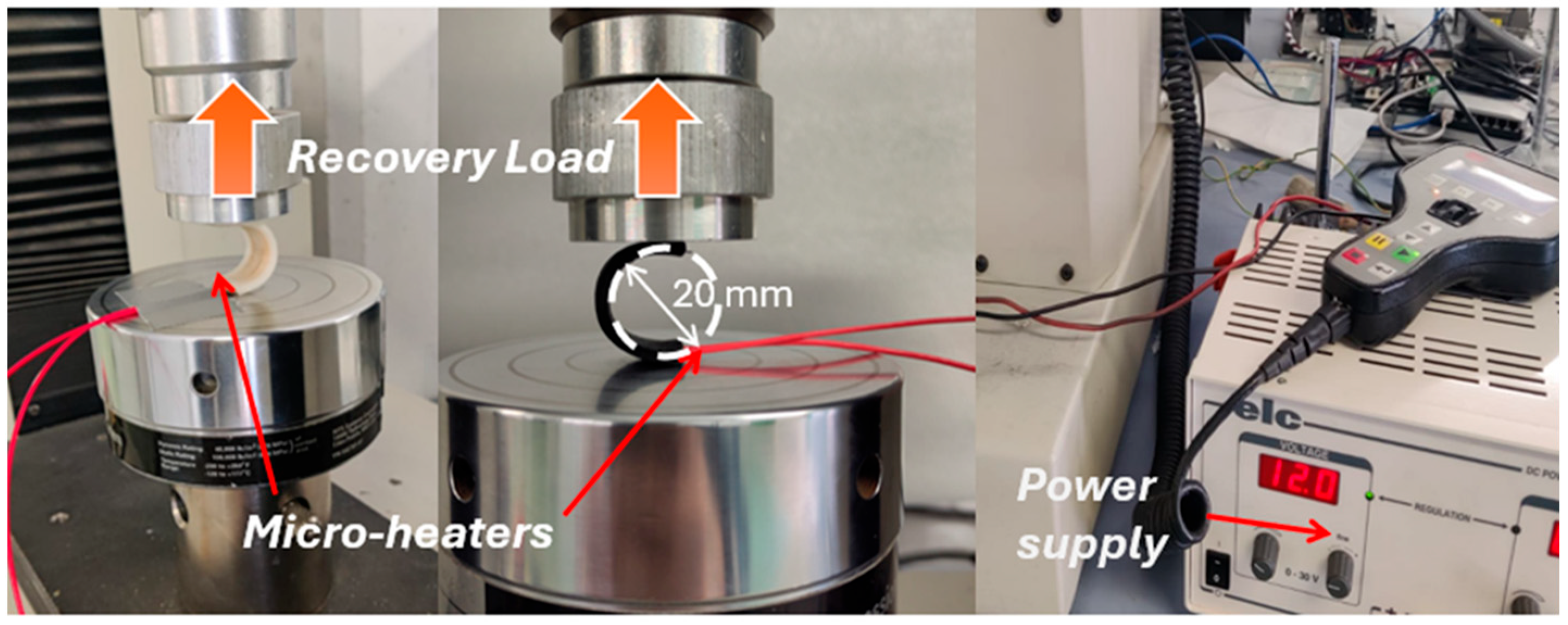
The effect of nanofillers on the shape-memory properties, particularly the recovery force relevant for actuation in soft robotics, was evaluated on rectangular samples (15 × 50 × 5 mm3). Each sample was first programmed into a curved configuration with a radius of 10 mm by heating a microheater (12 V for 3 min) attached to the inner surface of the sample (Figure 2). The heating parameters were selected based on prior tests of the samples’ thermal behavior. The programmed sample was allowed to cool to room temperature in the deformed configuration. Recovery force tests were then performed using a universal testing machine (Insight 5, MTS Systems Corp. Strada Pianezza, 289, 10151 Torino, Italy). The programmed sample was positioned between two compression plates, and the force exerted on the load cell (nominal maximum load 100 N, MTS Systems Corp.) while heating with the microheater was recorded. All tests were carried out in quintuplicate. Plateau forces from the replicates were averaged, normalized by sample mass, and the uncertainty was calculated as the standard deviation of the measurements.

2.2.5. Electrical and Thermal Conductivity Testing

The electrical properties of all samples were investigated using a multi-step approach. An initial screening was performed using a high-resolution, high-range digital multimeter (Keysight 34470A, Keysight Technologies, from RS Components Srl, 20099 Sesto San Giovanni MI, Italy). Measurements were taken by placing the DMM probes at different positions on the sample surface to assess electrical homogeneity. Samples exhibiting measurable conductivity were further analyzed using a more precise setup consisting of a probe station with two probes connected to a Source Measure Unit (SMU, Keithley 236). The probe station, designed for electrical characterization of materials, includes a working plane to secure the sample, micromanipulators for precise probe positioning along the x, y, and z axes (position accuracy < 10 µm), and an external Faraday cage that shields the system from electrical and optical noise. Silver paste contacts were applied to improve probe–sample electrical contact and reduce measurement uncertainty. The SMU applied a voltage ramp and recorded the material response, enabling the determination of current–voltage (I–V) characteristics. The measurement parameters were a voltage range of −5 to +5 V in 0.2 V steps, compliance current of 100 mA, and sensitivity fixed at 100 fA.
For selected conductive samples, additional thermal response measurements were performed using a contact thermocouple method to refine and validate the infrared results. In this setup, the microheater was fixed directly on the sample surface, and a small hole was drilled on the opposite side to insert a type-K thermocouple 1 mm beneath the heater. This configuration enabled the direct monitoring of internal temperature evolution within the composite. Once the power supply was activated at 12 V, the thermocouple signal was recorded over a 5 min heating period with a 1 s acquisition step using a data acquisition module (TC-08, Omega Engineering Ltd., Manchester, UK). The combined use of thermography and thermocouple measurements provided complementary information: while thermography offered insights into surface heating dynamics and uniformity, thermocouples allowed the assessment of internal thermal conduction and dissipation. For comparison, neat TPU specimens were also measured under identical conditions.

2.2.6. Surface Spectroscopy and Morphology

The morphology and distribution of the nanofiller within the polymer matrix were investigated using atomic force microscopy (AFM; Nanosurf FlexAFM with C3000 controller, Quantum Design, Rome, Italy). The AFM measurements were carried out in tapping mode with Dyn190Al probes (spring constant 48 N/m). Images were acquired at a resolution of 512 × 512 data points at 0.1 Hz. Imaging was also performed in phase-contrast mode to enhance the distinction between the polymer matrix and the nanofiller domains. Only the TPU nanocomposites showing the most promising electrical, thermal, and recovery-force properties were analyzed as well as the neat TPU as reference. AFM micrographs were acquired under ambient conditions, and subsequent image processing and quantitative analysis were carried out using Gwyddion 3.6 open-source software.

3. Results

The sample dimensions of the TPU composites after molding are reported in Table 2, along with the measured density values. The sizes and the density values represent the average of five independent measurements, with the error calculated as the standard deviation. Since the densities of all samples fall within the error range, they can be considered effectively constant across the dataset. The uniformity of the dimensional and density measurements confirms the reproducibility of the process, even under manual laboratory-scale conditions. The densities measured for neat TPU and its nanocomposites consistently fall within the narrow range of 1.20–1.22 g/cm3, with no statistically significant differences observed within experimental precision. The slightly lower densities observed in the 1 wt.% filler samples likely arise from subtle porosity or microvoid formation, a phenomenon documented in nanocomposite systems where low filler loadings may disrupt matrix homogeneity and introduce micro-voids [43]. In contrast, the 3 wt.% hybrid sample with a 10:1 CNT-to-AlNP ratio exhibits a modest but reproducible increase in density relative to pristine TPU, suggesting improved particle packing or densification due to synergistic filler interactions. Similar trends have been reported in CNT-filled composite systems [44]. Overall, these tight density variations corroborate the reproducibility of the compounding and molding process, and the small deviations align with anticipated effects of filler content and type.

3.1. Superficial Observations and Spectroscopic Analysis

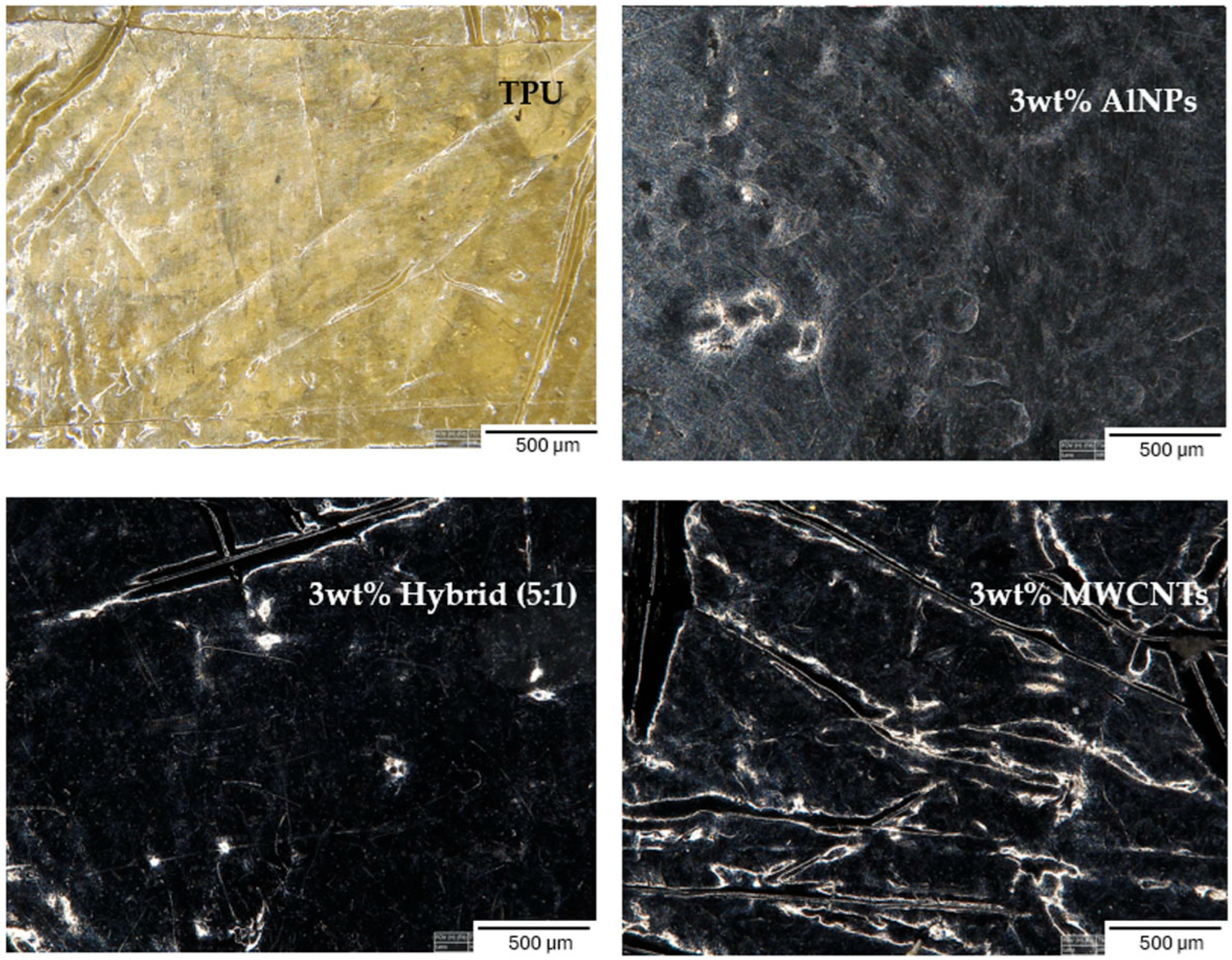
A macroscopic visual inspection of the produced samples reveals a uniform dispersion, as indicated by the consistent color homogeneity, especially considering that the base TPU is originally transparent (Figure 3). Photographic and stereoscopic images were limited to neat TPU, TPU with 3 wt.% AlNPs, TPU with 3 wt.% MWCNTs, and the hybrid TPU to provide a clear comparison of the visual and macroscopic effects of filler incorporation. Neat TPU serves as the reference material, while the 3 wt.% filling was selected as the maximum concentration studied and thus the most representative condition to highlight potential changes in color uniformity, opacity, or filler agglomeration visible at the macroscale. Lower filler loadings and other hybrid formulations were not included because their visual appearance closely matched the selected samples and would not provide additional information. A clear difference in coloration is observed: TPU filled with AlNPs shows a dark gray tone, while MWCNT-filled samples appear significantly darker. Additionally, surface irregularities are visible, likely caused by wrinkling of the release film used during compression molding.
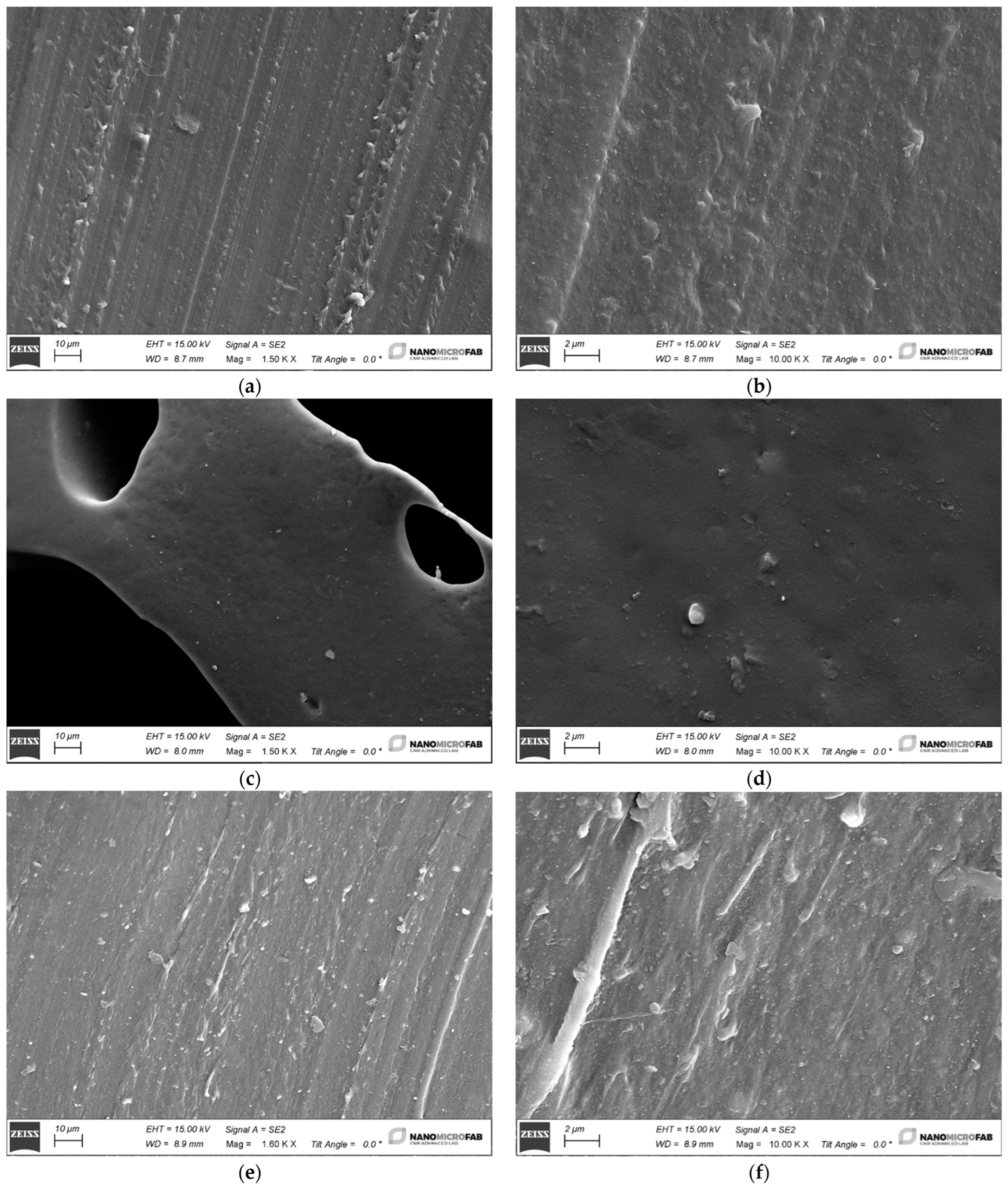
SEM images (Figure 4) further confirm, at the microscale, the absence of agglomerated regions of the nanofillers. Overall, all images exhibit relatively smooth surfaces, with only small porosities visible and no detectable microscopic clustering of the nanofillers. This indicates that the processing method achieved good dispersion of both AlNPs and MWCNTs in the TPU matrix, preventing localized stress concentrators typically caused by filler agglomeration. The absence of micro-clusters is important for ensuring uniform mechanical performance and effective load transfer. The smooth fracture surfaces also suggest good interfacial adhesion between the nanofillers and TPU, promoting efficient stress distribution and potentially improving mechanical reinforcement and shape-memory behavior. SEM evaluation was limited to microscale features because achieving a brittle fracture in TPU is difficult, preventing clearer exposure of nanoscale fillers.
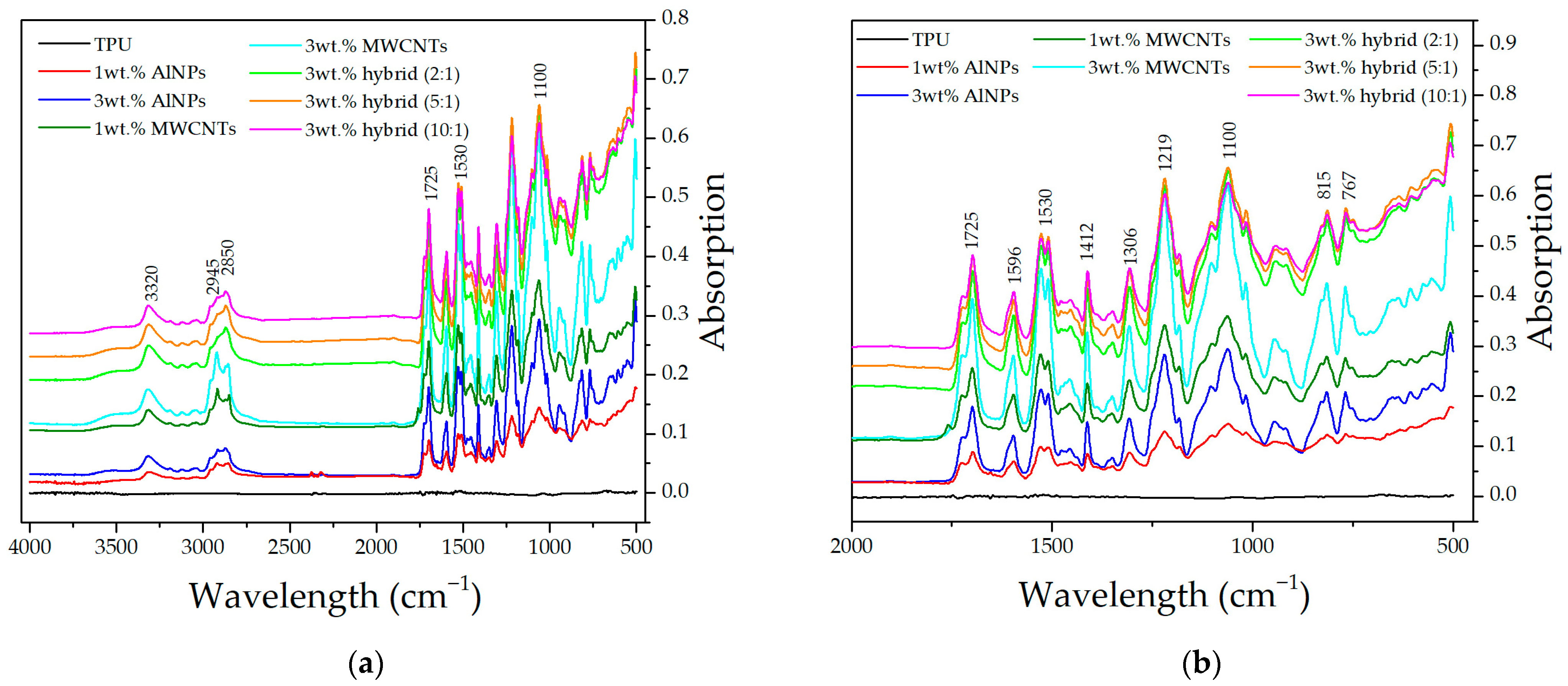
A qualitative FTIR/ATR analysis is presented in Figure 5. The spectra show the characteristic TPU absorptions at ~3320 cm−1 (N–H stretching), 2945 and 2850 cm−1 (asymmetric and symmetric CH2 stretching), 1725 cm−1 (C=O stretching of urethane carbonyl), 1530 cm−1 (amide II), and 1100 cm−1 (C–O–C stretching of the soft segment). These peaks confirm the preservation of the urethane backbone, with no new absorption bands indicative of chemical degradation or covalent bonding after filler incorporation [45]. In fact, FTIR-ATR spectra keep the characteristic of urethane absorptions; this suggests the conservation of the polymer backbone. The changes induced by fillers are qualitative and mostly related to physical interactions (hydrogen bonding, dipolar interactions), rather than covalent alteration (Figure 5a). The composite samples exhibit broadening and redistribution of the N–H and C=O bands. This is consistent with modification of hydrogen-bonding interactions at the polymer–filler interface. Shifts and broadening of the C=O and N–H bands upon MWCNT addition have been previously reported and attributed to changes in the urethane hydrogen-bond network at the polymer–filler interface (Figure 5b). In the literature, examples of FTIR-ATR used to mark filler–matrix interactions in TPU/CNT composites are reported by Mohamed et al., which registered shifts in the carbonyl band with CNT addition [46]. In this study as well, these effects are more pronounced in MWCNT-filled samples, indicating stronger interfacial interactions. Moreover, no new peaks attributable to covalent bonding were detected. In samples containing AlNPs, including hybrids, improvements in the low-frequency baseline likely reflect good particle dispersion and possible Al–O vibrational contributions.

3.2. Thermal Properties Evaluation

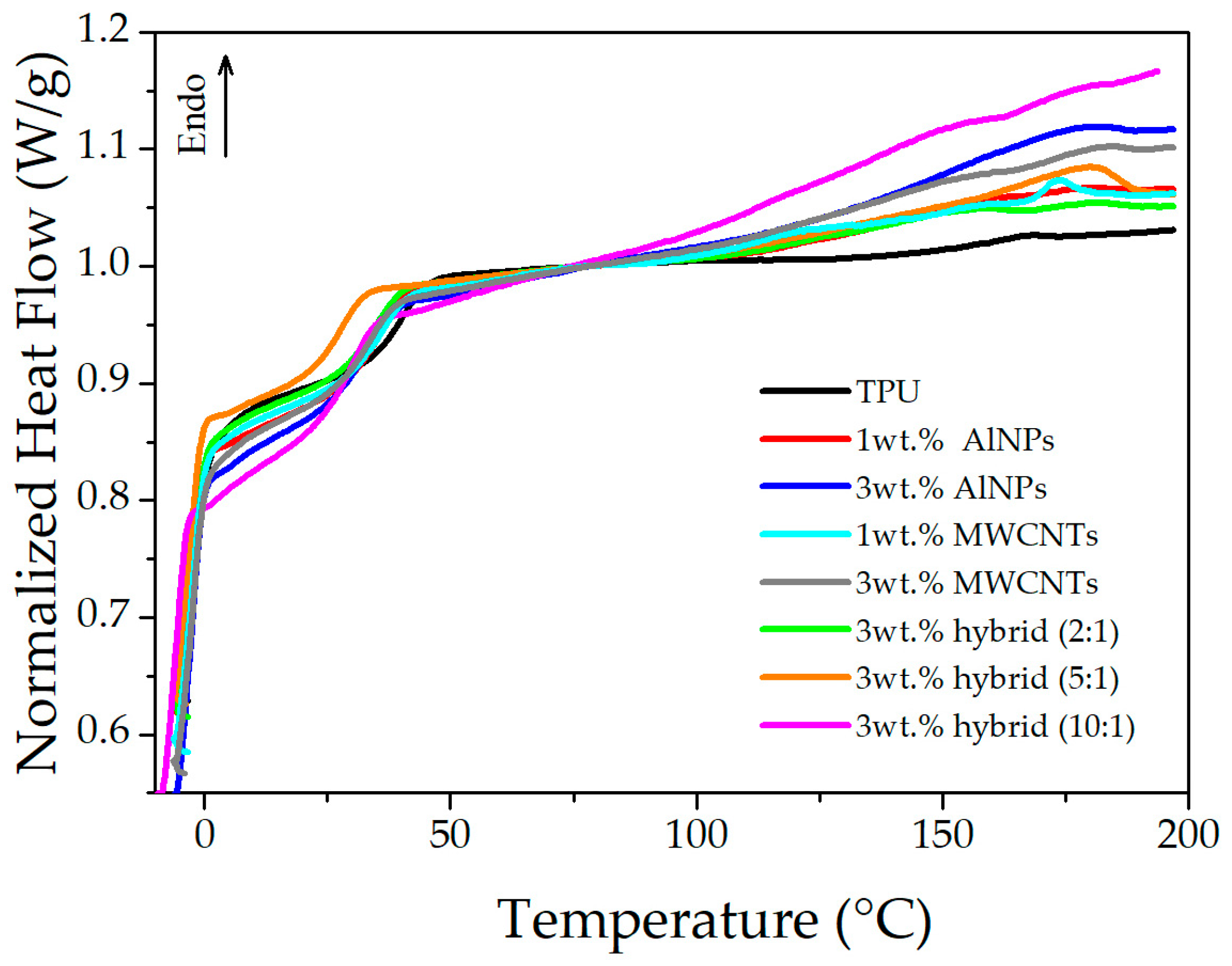
Figure 6 shows the DSC thermograms of neat TPU and the nanocomposite samples prepared by melt mixing. All samples were subjected to two heating scans, and the second heating curves are shown after normalization. The main thermal transitions observed are the glass transition of the soft segments (≈30–40 °C) and the melting of the hard segments (>150 °C). Minor anomalies observed around 100 °C may be related to the glass transition of the hard segments, although these features are not well defined.
The values of glass transition temperature (Tg) and melting temperature (Tm) extracted from the DSC curves are summarized in Table 3. TPU shows a Tg of 39.7 °C and a Tm of 157.9 °C. For the nanocomposites, Tg values decrease progressively with increasing filler content, down to 30.8 °C in the 3 wt.% hybrid (5:1) formulation. This decrease is attributed to reduced entanglement density of the soft segments, which increases chain mobility in the presence of fillers. Nanofiller agglomeration may further enhance this effect by acting as lubricating sites, increasing molecular mobility and lowering Tg [47].
The melting behavior is also influenced by filler addition. While neat TPU shows a melting peak at 157.9 °C, the nanocomposites exhibit shifted and generally higher Tm values, ranging from 163.5 °C (1 wt.% MWCNTs) up to 173.9 °C (3 wt.% MWCNTs). This shift suggests that nanofiller incorporation perturbs the crystalline packing of the hard segments, sometimes stabilizing the crystalline domains and producing an apparent increase in melting temperature. Overall, the DSC analysis shows that nanofillers lower the glass transition temperature by enhancing segmental mobility, while inducing a slight but consistent increase in the melting temperature, especially at higher loadings.

3.3. Surface Temperature Monitoring

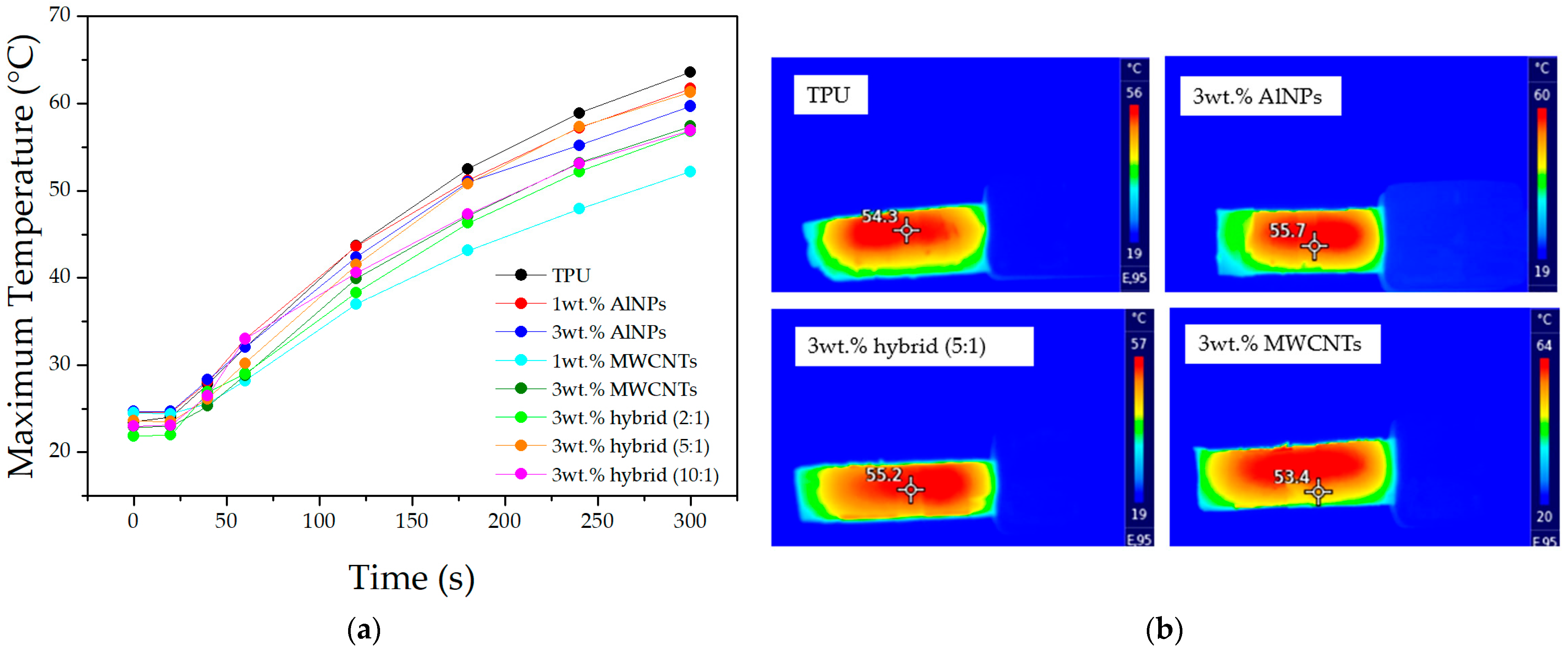
Figure 7 presents the evolution of maximum surface temperature for neat TPU and TPU-based composites during heating by microheater (Figure 7a), along with thermal camera images for selected samples (Figure 7b). Specifically, the 3 wt.% AlNP, MWCNT, and hybrid (5:1) composites are reported. Similar thermal patterns were observed for other filler loadings and combinations; therefore, only one representative image per system is shown to illustrate the general heat-distribution behavior. All samples exhibit a progressive temperature rise with increasing heating time. Neat TPU reaches the highest apparent surface temperature (~65 °C after 300 s), while filled systems display lower values. Among the composites, the 1 wt.% MWCNT sample reaches the lowest final temperature, while the AlNP-based and hybrid formulations show intermediate values, with the 3 wt.% hybrid (5:1) approaching the neat TPU response. In the case of neat TPU, the polymer matrix is semitransparent in the infrared region, and the positioning of the microheater on the opposite side of the sample allowed partial transmission of the heater’s radiation toward the thermal camera. As a result, the apparent surface temperatures for neat TPU were overestimated relative to the actual surface heating. Conversely, the nanocomposite samples containing CNTs and/or AlNPs exhibited a black and optically opaque appearance, effectively blocking transmitted radiation and allowing the thermal camera to detect only the true surface emission. This explains why the measured surface temperatures of the filled samples appear lower than those of neat TPU, despite identical heating conditions. These observations are consistent with previous reports highlighting how emissivity and transparency strongly affect the accuracy of infrared thermography measurements [48].

3.4. Mechanical Evaluation and Thermo-Mechanical Recovery

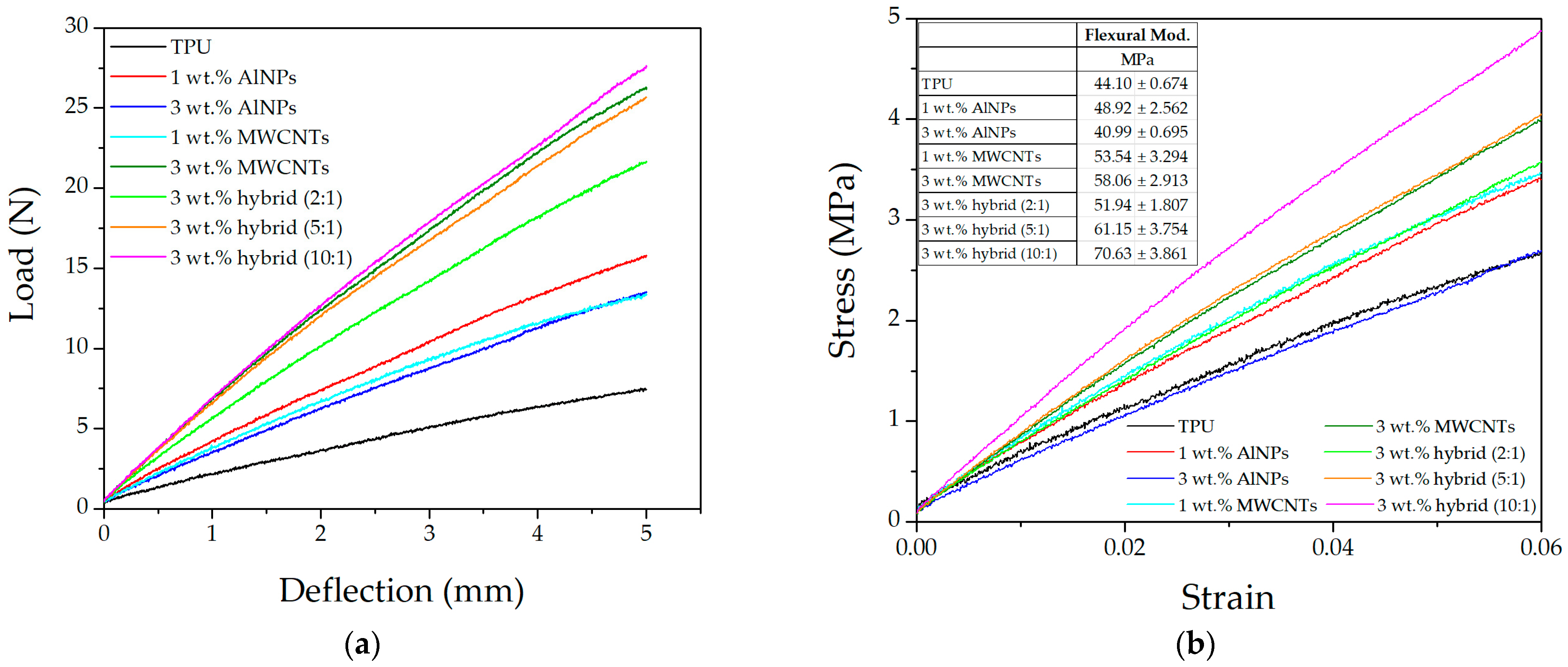
TPU and its composites were evaluated using three point bending tests. Flexural tests were performed up to a 5 mm deflection to evaluate flexural stiffness and modulus, assessing the influence of fillers on mechanical behavior. Figure 8 shows the trends of load-deflection curves (Figure 8a) and of strain–stress curves (Figure 8b). The composites show increased flexural stiffness compared with neat TPU (44 MPa), indicating effective stress transfer from the matrix to the dispersed nanofillers. The load–deflection curves maintain a linear elastic trend up to 5 mm, indicating that filler addition mainly affects elastic rigidity. TPU with 1 wt.% AlNPs shows a slight modulus increase (≈49 MPa), whereas 3 wt.% AlNPs results in a small decrease (≈41 MPa). This suggests that low AlNP content improves stiffness through limited interfacial interaction and filler rigidity, but higher loadings promote aggregation, reducing load transfer and potentially causing local stress concentrations. Both 1 wt.% and 3 wt.% MWCNTs significantly improve stiffness (≈54 MPa and 58 MPa, respectively). The high aspect ratio of MWCNTs enables efficient stress transfer by forming a quasi-percolated network within the TPU matrix. The moderate increase in stiffness and modulus with concentration indicates good dispersion at both filling percentages, though further advantages may be limited by agglomeration at higher filler content. The AlNPs alone provided only marginal reinforcement due to limited interfacial adhesion and aggregation at higher loadings. On the contrary, MWCNTs produced a more pronounced improvement, increasing the flexural modulus from 44 MPa (neat TPU) to 58 MPa at 3 wt.%. In fact, the inclusion of MWCNT in TPU has previously been reported to be capable of significantly increasing the elastic modulus (>30%) with filling contents on the order of 1–3 wt.% [49]. However, the most remarkable enhancement was observed in the hybrid systems. In those, a synergistic effect between CNTs and AlNPs led to a maximum modulus of 70 MPa for the 3 wt.% hybrid (10:1) composition. This behavior suggests the formation of a good filler network in which CNTs ensure efficient stress transfer and AlNPs promote improved packing and interfacial interaction.
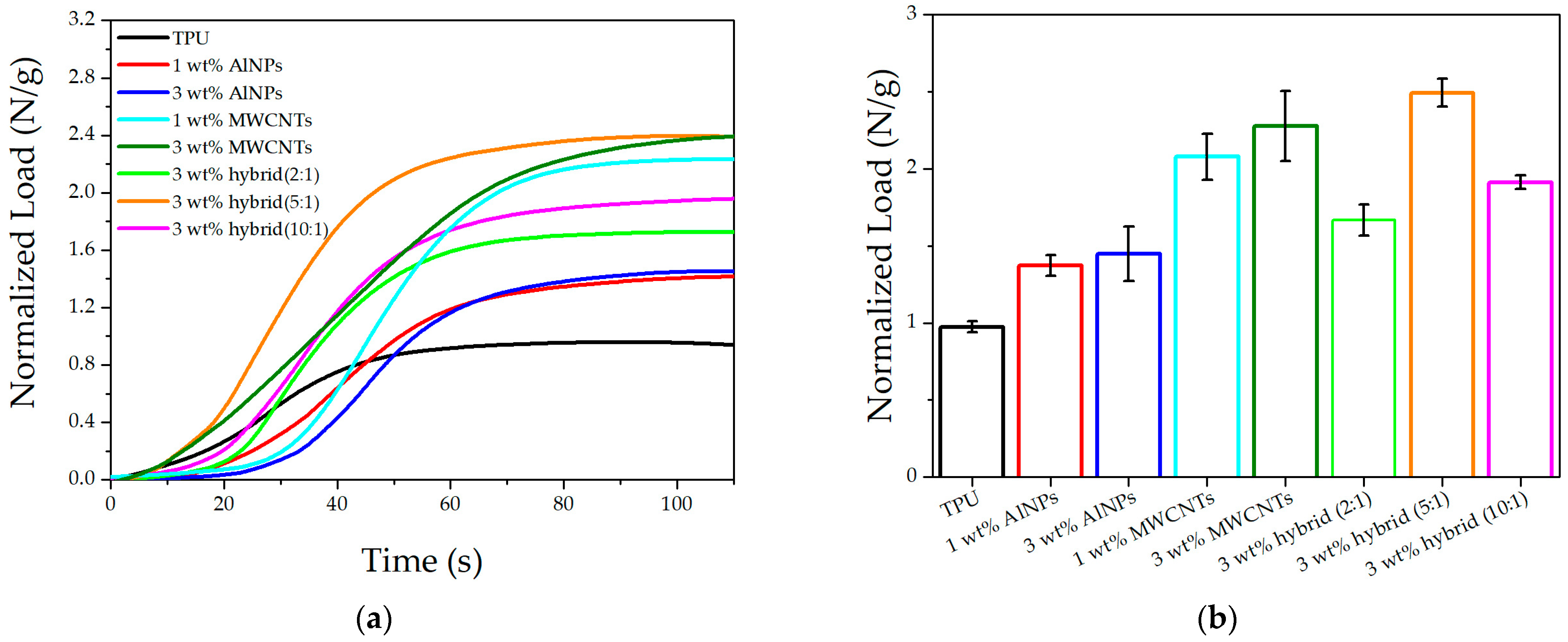
One of the key properties of soft materials with shape memory is their ability to recover and the magnitude of the force generated during shape recovery. This recovery can autonomously induce motion and perform a mechanical function when the generated force is high enough to serve as actuation. In soft robotics, this property is particularly critical. To evaluate this behavior, the fabricated nanocomposites were programmed into a curved configuration. Programming was achieved by heating the samples using a micro-heater, followed by cooling in the deformed state. Shape recovery was not allowed to occur freely; instead, the force exerted by the specimens during subsequent heating was measured using a load cell. To allow consistent comparison across samples, the measured force was normalized by the sample mass. Figure 9a shows this recovery force per unit mass as a function of time for the different composites. The neat TPU exhibited the lowest recovery force, reaching a plateau after approximately 80 s. The addition of 1 wt.% and 3 wt.% AlNPs slightly increased the recovery force, with the plateau reached at around 90 s. Samples containing 1 wt.% and 3 wt.% MWCNTs roughly doubled the recovery force, with the plateau reached at 100 s. Composites with both MWCNTs and AlNPs at 10:1 and 2:1 ratios displayed intermediate behavior between the AlNP-only and MWCNT-only formulations. The MWCNT + AlNP (5:1) sample showed a rapid increase in recovery force, reaching the plateau in just over 80 s. This is likely due to the AlNPs enhancing heat transfer, allowing the sample to reach Tg more quickly and promoting faster shape recovery, while the MWCNTs contribute to an increased maximum recovery force.
Figure 9b summarizes the maximum recovery force for each sample. The presence of AlNPs slightly enhanced the recovery force of pristine TPU, whereas MWCNTs approximately doubled it. Samples containing both fillers exhibited intermediate behavior: the 2:1 and 10:1 ratio fell between the 3 wt.% AlNP and 3 wt.% MWCNT samples. The MWCNT + AlNP (5:1) sample, which increased the recovery force by approximately three-fold, was identified as the optimal composition for the intended application.

3.5. Electrical and Thermal Conductivity

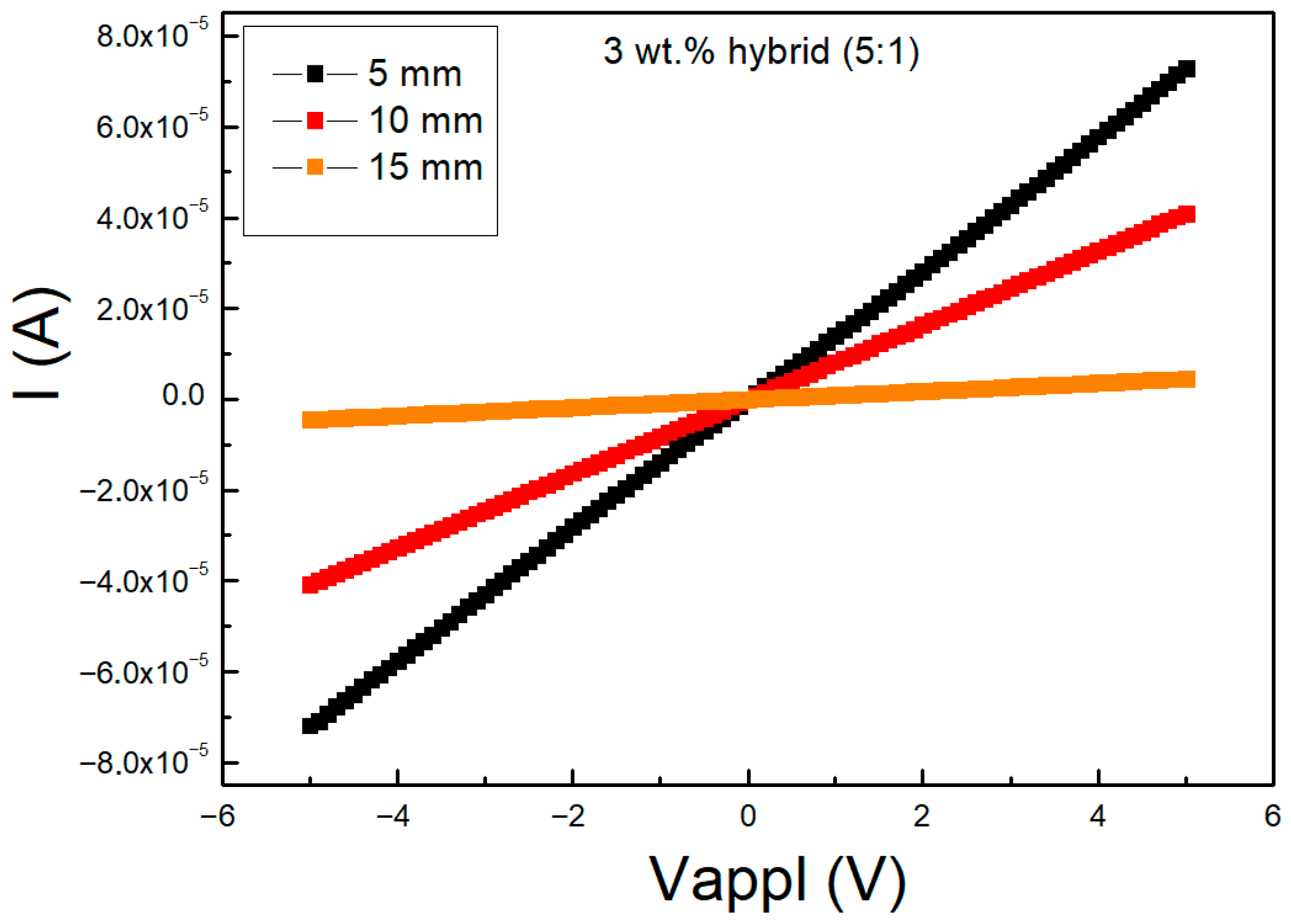
Regarding electrical behavior, only the hybrid nanofiller samples exhibited sufficiently low resistance (below 1MOhm at a distance of 1 cm) with a linear current–voltage response. Generally, except for the sample 3% wt. MWCNTs, only the hybrid nanofiller samples exhibit a sizable electrical characteristic with a linear behavior, showing a resistance in the range of hundreds of kOhm at 1 cm. A more precise electrical characterization has been performed on these samples, evaluating how resistance changes with the spacing between the contacts. This method is usually called transfer length method (TLM) and it is implemented to quickly check the ohmic behavior and the value of the contact resistance respect the material itself. As can be seen in Figure 10, there are samples where the resistance in the I-V plot scales down accordingly with the increasing distance, showing no significant contact resistance. In particular, the best resistivity is obtained for the hybrid samples 3 wt.% hybrid (5:1) and 3 wt.% hybrid (10:1).
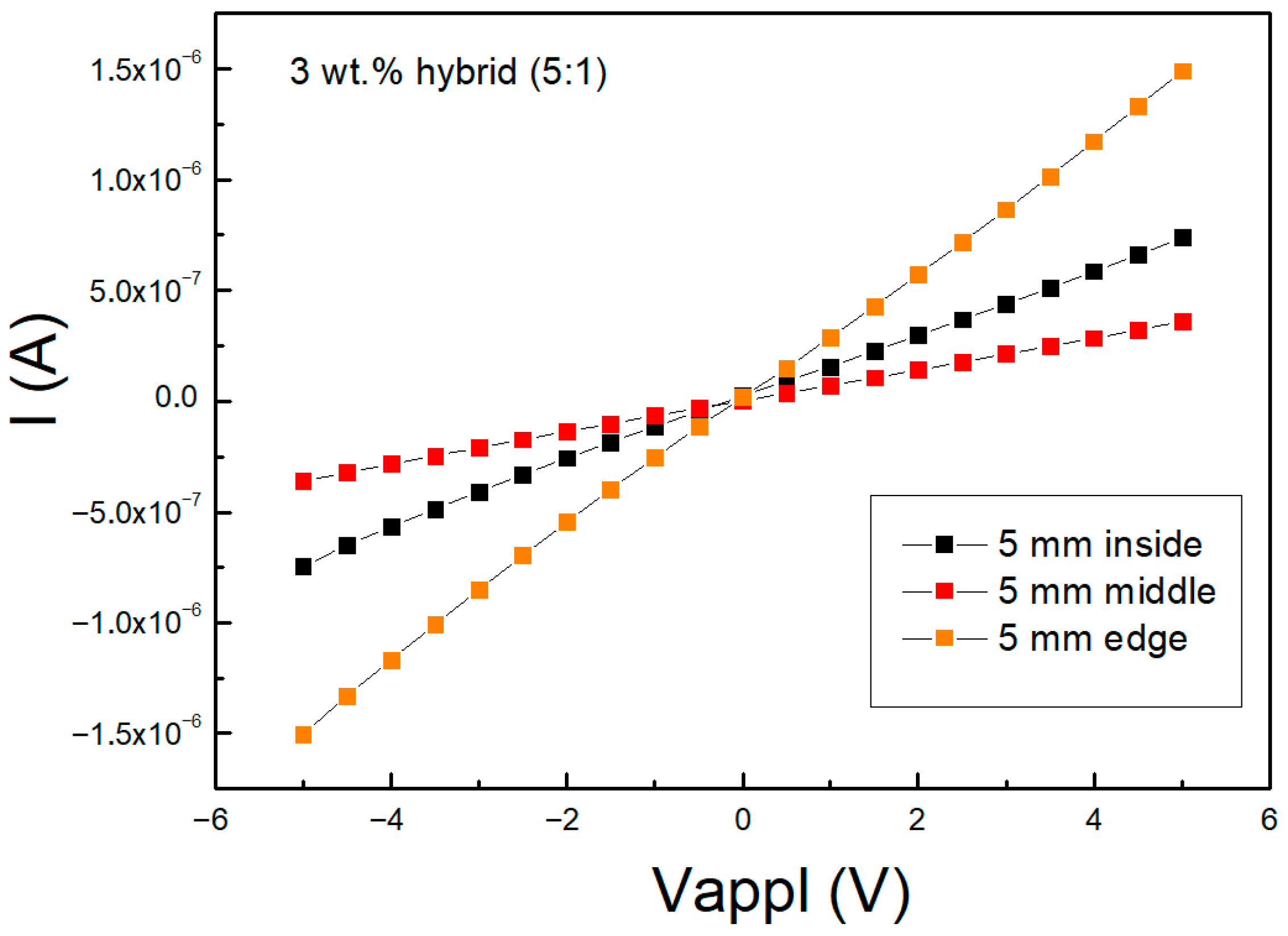
An inhomogeneous nanofiller distribution was observed, leading to inconsistent resistance measurements across the sample surface. In any case, a general trend can be observed along the length of the specific tested blend for short distances (Figure 11). This phenomenon is likely due to limited mixing efficiency and partial filler migration during the molding process, and it may be mitigated by increasing the nanoscale distribution during the mixing phase.
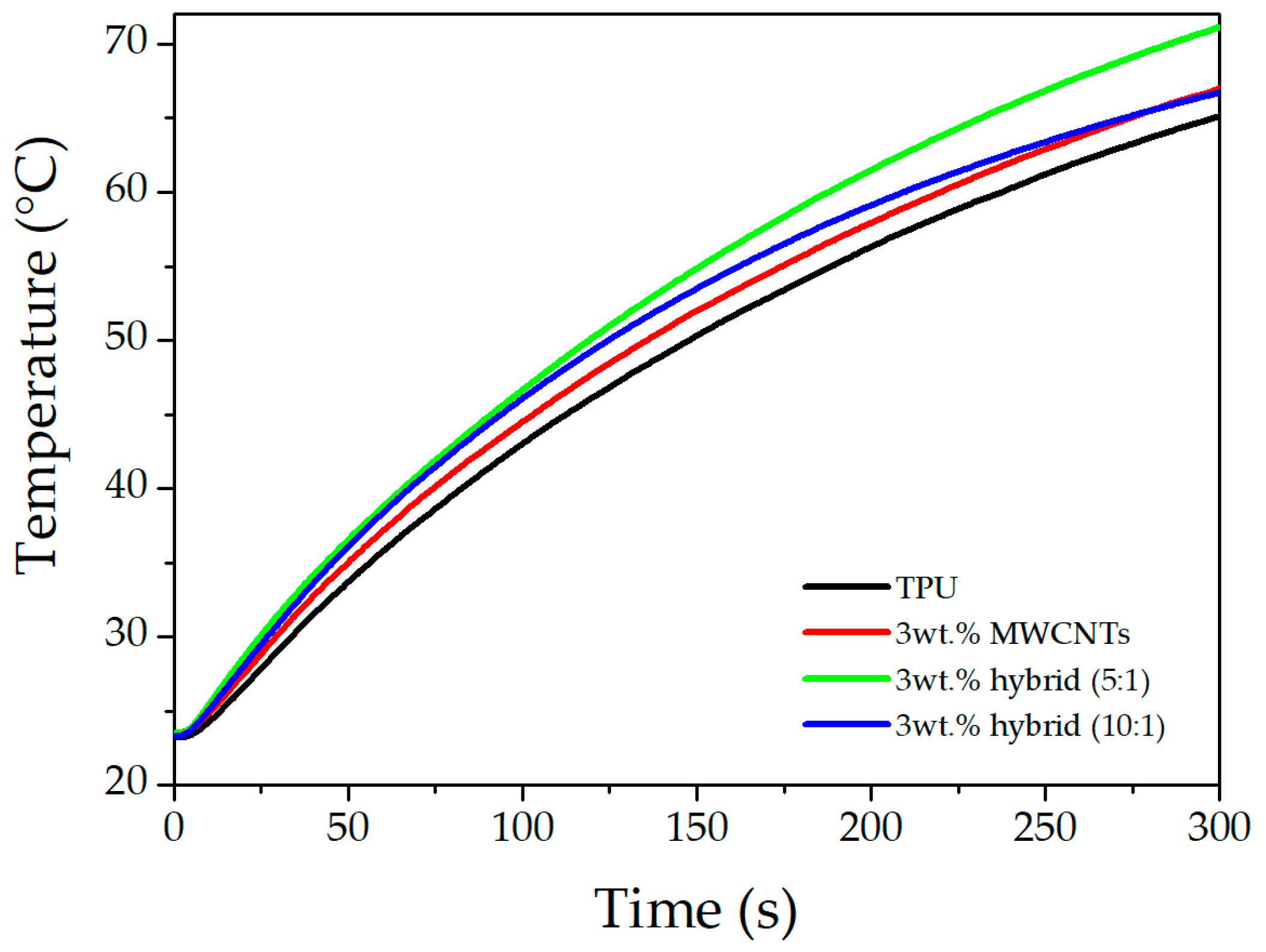
Figure 12 shows the temperature evolution over time at 1 mm from the microheater for the direct contact thermal conductivity. These measures with a thermocouple revealed that the incorporation of MWCNT nanofillers significantly enhanced both the heating rate and the maximum temperature attained by the TPU-based composites. The neat TPU reached the lowest temperature due to its insulating nature, attaining approximately 65 °C after 5 min. As expected, the TPU sample without nanofillers exhibited a lower slope in the temperature–time curve, indicating slower heat propagation compared to the filled systems. Among the hybrid composites, the formulation with a 5:1 MWCNT/AlNP ratio demonstrated the most efficient thermal response, characterized by a faster heating rate and a higher maximum temperature reached within a shorter time interval. In fact, the hybrid (5:1) formulation showed the highest thermal conductivity, reaching a maximum temperature of 71 °C. This increase is possibly due to the presence of aluminum nanoparticles that favor heat transmission along the sample [50,51,52]. This feature represents an advantage for soft-robotic systems activated through thermal stimuli. In contrast, the 10:1 hybrid sample showed a slight reduction in thermal performance, which can be attributed to limited filler homogeneity within the matrix. This interpretation is consistent with the electrical conductivity measurements, which also pointed to non-uniform filler dispersion in this formulation.

3.6. Morphological Observations

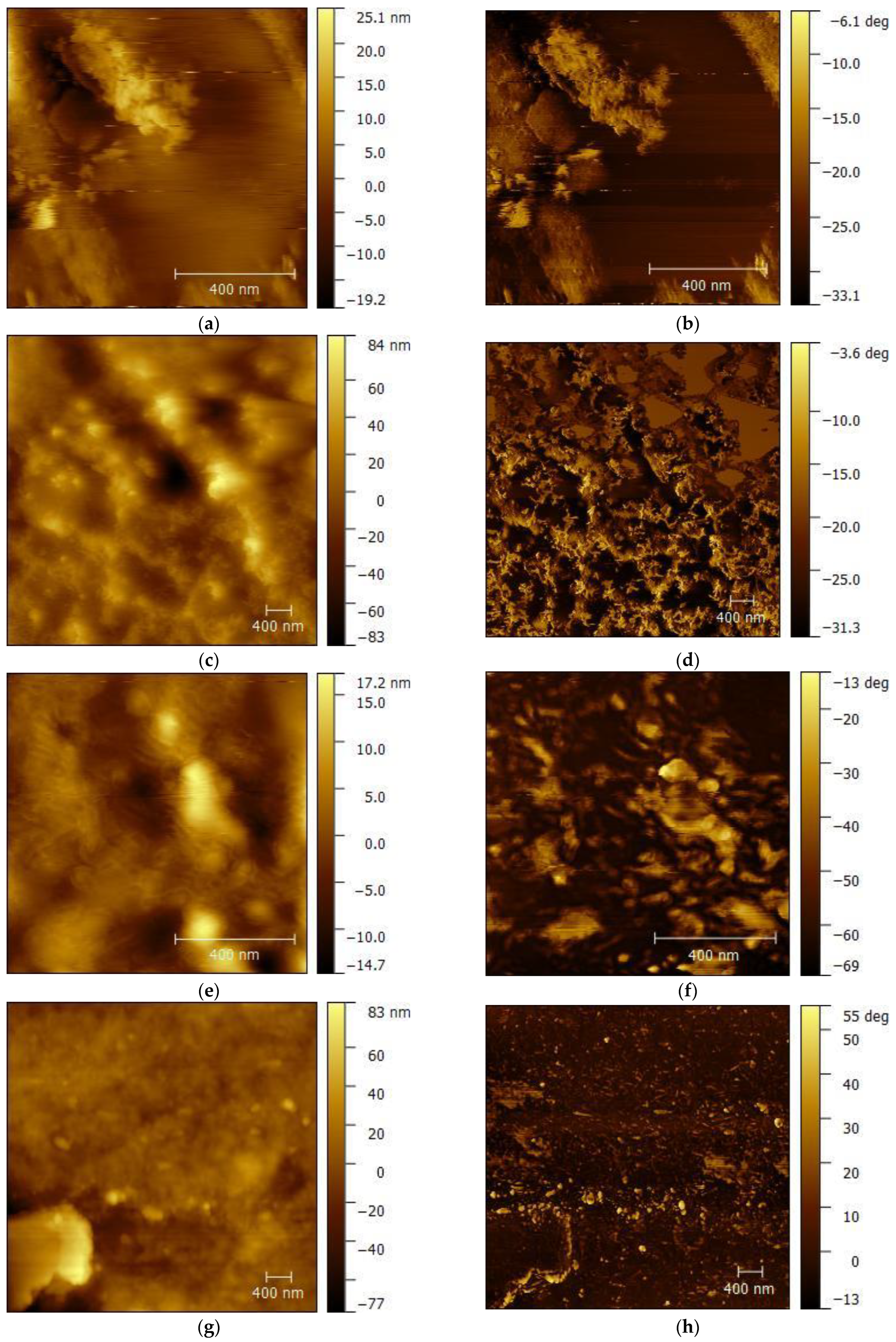
AFM images were collected to evaluate the surface morphology of neat TPU and the nanocomposite containing 3 wt.% of the hybrid (5:1) filler system. The AFM images are summarized in Figure 11 and reveal some differences between neat TPU and filled TPU composites. AFM height images clearly show the surface variability of nanocomposites (Figure 13a,c,e,g). The overall morphology is strongly influenced by hot-compression processing, which transfers the mold surface features onto the samples, with variations depending on the scanned area. AFM topography revealed notable differences in the surface morphology between neat TPU and the hybrid TPU/MWCNT–AlNP (5:1) composites. The neat TPU exhibited a smooth and homogeneous surface with Ra ≈ 10–15 nm and Rq ≈ 18–22 nm, typical of the unfilled polymer. Conversely, the hybrid composite showed a moderate increase in surface roughness (Ra ≈ 50 nm, Rq ≈ 75 nm), attributed to nanoscale surface features and partial filler protrusion. This increase in roughness suggests effective filler incorporation and interfacial bonding, as also supported by FTIR analysis, and indicates that the nanofillers slightly modify the near-surface morphology while maintaining an overall uniform texture.
Phase contrast images (Figure 13b,d,f,h) further highlight the dispersion of MWCNTs and AlNPs within the TPU matrix. MWCNTs appear as elongated, oriented domains following the polymer flow, whereas AlNPs are visible as nanoscale features embedded within the matrix. In the hybrid system, the combined presence of MWCNTs and AlNPs results in a heterogeneous but clearly discernible distribution throughout the polymer matrix. The higher contrast and irregular domains observed in the filled samples are indicative of nanoscale interactions between the polymer and the fillers, which influence both the electrical and the thermal response, as seen previously. Notably, no large agglomerates were observed, supporting the conclusion that the processing method achieved reasonably uniform microscale dispersion of the nanofillers at the microscale.

4. Discussion

Nanofiller-modified TPU exhibits properties that are highly advantageous for shape-memory actuation in soft-robotic applications. The composites were prepared from commercially available materials, ensuring scalability and compatibility for potential biomedical and robotic integration. Optical analysis showed no evident particle clustering at the microscale and revealed a macroscopically uniform surface. Moreover, the FTIR-ATR results indicated that the adopted filler-incorporation procedure does not alter the chemical structure of TPU but notably affects its molecular interactions. The increase and redistribution of the N–H and C=O bands suggest modifications to the hydrogen-bonding equilibrium between hard and soft segments, driven by interfacial interactions with the fillers. MWCNTs induce the most pronounced spectral changes, reflecting stronger physical interactions and possible restriction of polymer segmental mobility near the nanotube surfaces. AlNPs show weaker perturbations, while hybrid MWCNT–AlNP systems exhibit intermediate or synergistic effects depending on the CNT:Al ratio, indicating complementary reinforcement mechanisms. The absence of new absorption bands supports a mainly physical interaction mechanism, with hydrogen bonding and dipolar forces, rather than covalent bonding. This ensures the polymer integrity while improving overall mechanical performance. In fact, flexural tests showed that all the types and concentration of fillers significantly affect the flexural stiffness and modulus of TPU composites. MWCNTs provided the greatest enhancement in stiffness and modulus due to effective stress transfer through a percolated network and strong interfacial adhesion. AlNPs alone produced limited reinforcement, primarily constrained by particle agglomeration and weak interfacial bonding. Hybrid MWCNT–AlNP systems demonstrated an interactive response, combining the structural reinforcement of CNTs with improved filler packing and dispersion from AlNPs. This hybrid configuration enhances stiffness while maintaining processability, offering an effective approach to balance mechanical performance and manufacturability in TPU-based composites.
Thermal measurements with the IR camera highlighted some differences among the samples. In particular, the elevated surface temperatures reported for neat TPU are likely artifacts resulting from its infrared semitransparency. This enables partial penetration of the heater’s radiation and consequently inflates the thermographic temperature readings. In contrast, filled composites exhibit black and opaque surfaces, ensuring that the infrared camera detects primarily actual surface emission—leading to more accurate thermal measurements. This behavior aligns with thermography principles emphasizing the critical role of surface emissivity and transparency in measurement accuracy [48]. Overall, the heating behavior of the TPU composites followed a similar and relatively uniform trend across the formulations. In all cases, the highest temperatures were reached in the central region, where contact with the micro-heater was most efficient. While the maximum temperatures were comparable among most composites, the sample with 1 wt.% MWCNTs reached lower values. For instance, this may reflect limited conductive pathway formation associated with low filler loading or poor dispersion. In contrast, composites with AlNPs and hybrid fillers likely have improved thermal transport due to the development of more effective conductive networks. This interpretation is supported by studies showing that even low loadings (e.g., ~1 wt.%) of CNTs can significantly enhance the thermal conductivity of polymer matrices when proper percolation is achieved [53]. In another study, Chilito et al. [54] investigated TPU/MWCNT composites with 1–7 wt.% MWCNTs, reporting improvements in thermal behavior. Similarly, in the present study, MWCNT incorporation effectively enhances stiffness and thermal responsiveness, particularly when combined with metallic nanoparticles.
DSC analysis supported these observations, showing slight shifts in the Tg for filled samples compared to neat TPU. The magnitude of Tg change was highest for the 3 wt.% hybrid composites, revealing stronger polymer–filler interactions and reduced mobility. This effect can be attributed to the synergistic contribution of high-aspect-ratio CNTs, which readily form interconnected networks, together with AlNPs, which may occupy interstitial spaces and further restrict polymer chain mobility. The observed enhancement in thermal response upon incorporation of MWCNTs can be explained by the formation of conductive networks within the TPU matrix. In fact, these results are consistent with literature findings that attribute Tg shifts in TPU/CNT systems to limited chain dynamics near nanotube surfaces. The hybrid composites thus appear to achieve an optimal balance of interfacial constraint and network formation, which benefits both mechanical reinforcement and heat-triggered actuation efficiency. In contrast, the slight reduction in thermal performance observed for the 10:1 hybrid sample suggests that excessive dilution of CNTs relative to AlNPs may hinder the formation of a continuous percolation network, resulting in non-uniform filler dispersion and localized thermal bottlenecks. This interpretation aligns with the electrical conductivity analysis, supporting the conclusion that optimal thermal and electrical performances require not only sufficient filler content but also homogeneous dispersion. A homogeneous dispersion can enable effective phonon and electron transport across the matrix. Moreover, the electrical conductivity analysis further supports the potential of these composites for electrothermal (Joule heating) actuation. In fact, the hybrid nanofiller systems displayed stable and linear ohmic behavior, with resistances in the range of a few hundred kΩ at 1 cm spacing. The 3 wt.% hybrid (5:1) composite showed the lowest resistivity, revealing a well-connected percolation network of MWCNTs supported by AlNPs. Zhou et al. [55] studied an ultrathin CNT–polymer composite with a CNT content of ~0.2 wt.%, achieving an electrical conductivity of about 1.29 S/cm and rapid thermally driven actuation. Although the filler content in the present study is higher (3 wt.%), the hybrid formulation (MWCNT/AlNP = 5:1) achieved similarly efficient electrical and thermal transport. In fact, this formulation reached the highest surface temperature (≈71 °C) and the fastest heating rate among all samples, confirming its suitability for electrothermal actuation. Although direct Joule-heating cycling was not performed in this study, the electrical and thermal results indicate strong potential for future application in electroactive shape-memory devices. The enhanced electrical and thermal conductivity of TPU is valuable for soft robotics applications where temperature-driven actuation is required and is reflected in the recovery load reached.
Recovery force tests showed a limited standard deviation of the actuation loads measured across repeated tests. This establishes a good level of reproducibility and stability in the recovery response. Such behavior indicates good resistance to functional fatigue, as the mechanical and thermal responses remain consistent over successive cycles. These findings suggest that the developed TPU composites can withstand multiple actuation events without significant actuation load decay. Nevertheless, comprehensive cyclic fatigue tests involving extended actuation sequences are planned as part of future work to quantitatively assess long-term durability. Moreover, recovery force measurements showed that the composites containing MWCNTs, either alone or in the hybrid system, exhibited enhanced recovery loads. Thus, MWCNTs displayed a dominant role in enhancing actuation capability. The high aspect ratio and intrinsic conductivity of MWCNTs promote effective stress transfer and enhanced thermal transfer, jointly accelerating recovery kinetics and increasing the actuation force. The higher results of the 3 wt.% hybrid (MWCNT/AlNPs 5:1) system highlights the beneficial synergy between the two fillers. The CNTs establish a conductive percolation network, while AlNPs contribute additional pathways for phonon transport and improve filler–matrix interactions. According to Islam et al. [56], electro-active polymer nanocomposites with conductive fillers typically exhibit recovery stresses in the range of 0.2–1 MPa and activation temperatures between 60 and 80 °C. The recovery loads and actuation temperatures measured for our hybrid systems fall within or slightly above these ranges, confirming the suitability of the proposed materials for soft-robotic and electrothermal actuation.
Morphological analysis by AFM revealed that the addition of nanofillers modifies the surface structure of TPU. The pristine TPU exhibited smooth and homogeneous morphology, while the nanocomposite 3 wt.% hybrid system displayed slightly increased nanoscale roughness. This change suggests the presence of well-dispersed fillers near the surface and enhanced polymer–filler interactions. The absence of large agglomerates is particularly important, as clustering can introduce stress concentration sites and reduce mechanical integrity. The nanoscale features visible in the filled systems suggest that both AlNPs and MWCNTs are integrated into the TPU matrix, promoting a more interconnected microstructure. Overall, the AFM analysis supports the conclusion that the incorporation of nanofillers not only alters the surface morphology but also underpins the improved functional properties of the TPU-based nanocomposites. Higher nanofiller percentages may cause more pronounced agglomeration phenomena which potentially influence both mechanical and thermal behavior. Filler clustering can create heterogeneous microstructures where localized stress concentrations develop at the agglomerate–matrix interfaces, causing premature failure or reduced elongation at break. From a thermal point of view, non-uniform filler dispersion can interrupt the continuity of conductive pathways, resulting in inefficient thermal transport. These effects can ultimately compromise actuation performance, as shape-memory recovery relies on rapid and homogeneous heat distribution. Therefore, maintaining good dispersion and avoiding percolation-induced clustering is essential to achieving a balance between enhanced conductivity, mechanical integrity, and actuation efficiency. The observed superior performance of the 3 wt.% hybrid (5:1) composite likely reflects a good dispersion regime, where the filler content remains below the threshold at which agglomeration begins to offset the benefits of reinforcement.
Finally, the TPU/MWCNT/AlNP composites developed in this study exhibit performance levels that are in line with or exceed those of similar nanocomposite systems reported in the literature. Overall, the comparison demonstrates that the developed TPU/MWCNT/AlNP composites achieve competitive multifunctional performance while using scalable processing and commercially available biomedical-grade TPU.

5. Conclusions

TPU composites were fabricated by compression molding in this study. The filler incorporation, as multi-walled carbon nanotubes (MWCNTs) and aluminum nanoparticles (AlNPs), showed a substantial enhancement in thermal, mechanical, and shape-recovery performances of TPU. The hybrid system (3 wt.% hybrid, 5:1) exhibited the best improvements as in powerful polymer–filler interactions and operative conductive networks, allowing efficient heat transfer and more effective actuation.
DSC analysis underlined a restricted polymer chain mobility and filler integration, which wholly improves energy dissipation and shape-memory response. In particular, MWCNTs controlled the reinforcement action and the thermal conduction mechanism, while AlNPs provided complementary improvements, producing a synergistic effect in hybrid formulations. Specifically, AlNPs underlined a good effect in mixing balancing the higher viscosity of the composite. At the same time, FTIR and mechanical analyses underlined, particularly in hybrid and MWCNT-filled systems, that filler incorporation modifies the hydrogen-bonding network and improve stress transfer at interfaces, to improve stiffness and structural integrity.
Shape-recovery tests demonstrated that these composites develop higher recovery forces and faster actuation compared to neat TPU. This highlights that these composites are suitable as thermally driven actuators, and a careful tuning of filler type and content can enhance functional performance. The results show that the 5:1 MWCNT:AlNP hybrid formulation achieves the best balance of thermal, electrical, and shape-memory performance, suggesting its strong potential for next-generation smart materials in soft robotics and related fields.
Overall, these TPU composites are easily processable and scalable for soft-robotic applications, where temperature-responsive actuation and enhanced force and speed are essential. This makes these materials promising candidates for next-generation soft actuators.
Future work will focus on improving and better understanding filler dispersion, as well as conducting additional shape-memory characterization. Specifically, measurements of shape fixity and recovery ratio are necessary for qualifying the performances of the hybrid composite to fully assess the shape recovery potential. These advances will guide and optimize the development of TPU composites for soft-robotic actuators with improved performance and reliability.

Author Contributions

Conceptualization, D.B. and L.M.; methodology, L.B.; investigation, L.B., I.L., F.M. and L.M.; data curation, D.B.; writing—original draft preparation, L.B.; writing—review and editing, D.B. visualization, L.M.; supervision, F.Q.; funding acquisition, D.B. All authors have read and agreed to the published version of the manuscript.

Funding

This research was funded by the Research Projects of Significant National Interest (PRIN) 2022 of the Italian Ministry of University and Research (MUR), project n. 2022SFF349, with CUP Master D53D23004020008 within the project named “4D Printing of smart soft robotics (4D P.Ro.)”.

Institutional Review Board Statement

Not applicable.

Data Availability Statement

Dataset available on request from the authors.

Acknowledgments

This paper and the research behind it would not have been possible without the exceptional support of our laboratory technician, Fabrizio Betti. The authors have reviewed and edited the output and take full responsibility for the content of this publication.

Conflicts of Interest

The authors declare no conflicts of interest. The funders had no role in the design of the study; in the collection, analyses, or interpretation of data; in the writing of the manuscript; or in the decision to publish the results.

References

  1. Hassan, M.; Mohanty, A.K.; Wang, T.; Dhakal, H.N.; Misra, M. Current status and future outlook of 4D printing of polymers and composites-A prospective. Compos. C Open Access 2025, 17, 100602. [Google Scholar] [CrossRef]
  2. Zende, R.; Ghase, V.; Jamdar, V. A review on shape memory polymers. Polym. Technol. Mater. 2023, 62, 467–485. [Google Scholar] [CrossRef]
  3. Zhu, Y.; Hu, J.; Liu, Y. Shape memory effect of thermoplastic segmented polyurethanes with self-complementary quadruple hydrogen bonding in soft segments. Eur. Phys. J. E 2009, 28, 3–10. [Google Scholar] [CrossRef] [PubMed]
  4. Ji, F.; Li, J.; Weng, Y.; Ren, J. Synthesis of PLA-based thermoplastic elastomer and study on preparation and properties of PLA-based shape memory polymers. Mater. Res. Express 2020, 7, 015315. [Google Scholar] [CrossRef]
  5. Pfau, M.R.; McKinzey, K.G.; Roth, A.A.; Grunlan, M.A. PCL-Based Shape Memory Polymer Semi-IPNs: The Role of Miscibility in Tuning the Degradation Rate. Biomacromolecules 2020, 21, 2493–2501. [Google Scholar] [CrossRef]
  6. Awasthi, P.; Banerjee, S.S. Construction of stimuli-responsive and mechanically-adaptive thermoplastic elastomeric materials. Polymer 2022, 259, 125338. [Google Scholar] [CrossRef]
  7. Mi, H.-Y.; Jing, X.; Napiwocki, B.N.; Hagerty, B.S.; Chen, G.; Turng, L.-S. Biocompatible, degradable thermoplastic polyurethane based on polycaprolactone-block-polytetrahydrofuran-block-polycaprolactone copolymers for soft tissue engineering. J. Mater. Chem. B 2017, 5, 4137–4151. [Google Scholar] [CrossRef]
  8. Al Nakib, R.; Toncheva, A.; Fontaine, V.; Vanheuverzwijn, J.; Raquez, J.; Meyer, F. Thermoplastic polyurethanes for biomedical application: A synthetic, mechanical, antibacterial, and cytotoxic study. J. Appl. Polym. Sci. 2022, 139, 51666. [Google Scholar] [CrossRef]
  9. M’Bengue, M.-S.; Mesnard, T.; Chai, F.; Maton, M.; Gaucher, V.; Tabary, N.; García-Fernandez, M.-J.; Sobocinski, J.; Martel, B.; Blanchemain, N. Evaluation of a Medical Grade Thermoplastic Polyurethane for the Manufacture of an Implantable Medical Device: The Impact of FDM 3D-Printing and Gamma Sterilization. Pharmaceutics 2023, 15, 456. [Google Scholar] [CrossRef]
  10. Kojio, K.; Furukawa, M.; Nonaka, Y.; Nakamura, S. Control of Mechanical Properties of Thermoplastic Polyurethane Elastomers by Restriction of Crystallization of Soft Segment. Materials 2010, 3, 5097–5110. [Google Scholar] [CrossRef]
  11. Boubakri, A.; Haddar, N.; Elleuch, K.; Bienvenu, Y. Impact of aging conditions on mechanical properties of thermoplastic polyurethane. Mater. Des. 2010, 31, 4194–4201. [Google Scholar] [CrossRef]
  12. Kumar, S.; Singh, R.; Singh, A.P.; Wei, Y. Three-dimensional printed thermoplastic polyurethane on fabric as wearable smart sensors. Proc. Inst. Mech. Eng. Part L J. Mater. Des. Appl. 2023, 237, 1678–1692. [Google Scholar] [CrossRef]
  13. Datta, J.; Kasprzyk, P. Thermoplastic polyurethanes derived from petrochemical or renewable resources: A comprehensive review. Polym. Eng. Sci. 2018, 58, E14–E35. [Google Scholar] [CrossRef]
  14. Mishra, A.; Seethamraju, K.; Delaney, J.; Willoughby, P.; Faust, R. Long-term in vitro hydrolytic stability of thermoplastic polyurethanes. J. Biomed. Mater. Res. Part A 2015, 103, 3798–3806. [Google Scholar] [CrossRef]
  15. Cozzens, D.; Ojha, U.; Kulkarni, P.; Faust, R.; Desai, S. Long term in vitro biostability of segmented polyisobutylene-based thermoplastic polyurethanes. J. Biomed. Mater. Res. Part A 2010, 95A, 774–782. [Google Scholar] [CrossRef]
  16. Guo, Y.; Yan, L.; Zeng, Z.; Chen, L.; Ma, M.; Luo, R.; Bian, J.; Lin, H.; Chen, D. TPU/PLA nanocomposites with improved mechanical and shape memory properties fabricated via phase morphology control and incorporation of multi-walled carbon nanotubes nanofillers. Polym. Eng. Sci. 2020, 60, 1118–1128. [Google Scholar] [CrossRef]
  17. He, C.; Ge, J.; Qi, D.; Gao, J.; Chen, Y.; Liang, J.; Fang, D. A multiscale elasto-plastic damage model for the nonlinear behavior of 3D braided composites. Compos. Sci. Technol. 2019, 171, 21–33. [Google Scholar] [CrossRef]
  18. Zan, Y.; Piedrahita-Bello, M.; Alavi, S.E.; Molnár, G.; Tondu, B.; Salmon, L.; Bousseksou, A. Soft Actuators Based on Spin-Crossover Particles Embedded in Thermoplastic Polyurethane. Adv. Intell. Syst. 2023, 5, 202200432. [Google Scholar] [CrossRef]
  19. Li, C.; Xia, H.; Yao, J.; Ni, Q.-Q. Electrically induced soft actuators based on thermoplastic polyurethane and their actuation performances including tiny force measurement. Polymer 2019, 180, 121678. [Google Scholar] [CrossRef]
  20. Yasa, O.; Toshimitsu, Y.; Michelis, M.Y.; Jones, L.S.; Filippi, M.; Buchner, T.; Katzschmann, R.K. An Overview of Soft Robotics. Annu. Rev. Control Robot. Auton. Syst. 2023, 6, 1–29. [Google Scholar] [CrossRef]
  21. Lee, C.; Kim, M.; Kim, Y.J.; Hong, N.; Ryu, S.; Kim, H.J.; Kim, S. Soft robot review. Int. J. Control Autom. Syst. 2017, 15, 3–15. [Google Scholar] [CrossRef]
  22. Kumar Patel, K.; Purohit, R. Improved shape memory and mechanical properties of microwave-induced thermoplastic polyurethane/graphene nanoplatelets composites. Sens. Actuators A Phys. 2019, 285, 17–24. [Google Scholar] [CrossRef]
  23. Albozahid, M.; Naji, H.Z.; Alobad, Z.K.; Saiani, A. TPU nanocomposites tailored by graphene nanoplatelets: The investigation of dispersion approaches and annealing treatment on thermal and mechanical properties. Polym. Bull. 2022, 79, 8269–8307. [Google Scholar] [CrossRef]
  24. Cataldi, P.; Ceseracciu, L.; Marras, S.; Athanassiou, A.; Bayer, I.S. Electrical conductivity enhancement in thermoplastic polyurethane-graphene nanoplatelet composites by stretch-release cycles. Appl. Phys. Lett. 2017, 110, 121904. [Google Scholar] [CrossRef]
  25. Seyfi, J.; Jafari, S.H.; Khonakdar, H.A.; Sadeghi, G.M.M.; Zohuri, G.; Hejazi, I.; Simon, F. Fabrication of robust and thermally stable superhydrophobic nanocomposite coatings based on thermoplastic polyurethane and silica nanoparticles. Appl. Surf. Sci. 2015, 347, 224–230. [Google Scholar] [CrossRef]
  26. Liu, Y.; Cao, X.; Shi, J.; Shen, B.; Huang, J.; Hu, J.; Chen, Z.; Lai, Y. A superhydrophobic TPU/CNTs@SiO2 coating with excellent mechanical durability and chemical stability for sustainable anti-fouling and anti-corrosion. Chem. Eng. J. 2022, 434, 134605. [Google Scholar] [CrossRef]
  27. Boubakri, A.; Guermazi, N.; Elleuch, K.; Ayedi, H.F. Study of UV-aging of thermoplastic polyurethane material. Mater. Sci. Eng. A 2010, 527, 1649–1654. [Google Scholar] [CrossRef]
  28. Wang, A.; Guo, J.; Shao, C.; Chen, C. Flexible Thermoplastic Polyurethane Composites with Ultraviolet Resistance for Fused Deposition Modeling 3D Printing. 3D Print. Addit. Manuf. 2024, 11, e1810–e1818. [Google Scholar] [CrossRef]
  29. Xu, Y.; Sheng, J.; Yin, X.; Yu, J.; Ding, B. Functional modification of breathable polyacrylonitrile/polyurethane/TiO2 nanofibrous membranes with robust ultraviolet resistant and waterproof performance. J. Colloid Interface Sci. 2017, 508, 508–516. [Google Scholar] [CrossRef]
  30. Liu, J.; Li, W.; Guo, Y.; Zhang, H.; Zhang, Z. Improved thermal conductivity of thermoplastic polyurethane via aligned boron nitride platelets assisted by 3D printing. Compos. Part A Appl. Sci. Manuf. 2019, 120, 140–146. [Google Scholar] [CrossRef]
  31. Bashir, A.; Maqbool, M.; Lv, R.; Usman, A.; Guo, H.; Aftab, W.; Niu, H.; Liu, M.; Bai, S.-L. Surface modified boron nitride towards enhanced thermal and mechanical performance of thermoplastic polyurethane composite. Compos. Part B Eng. 2021, 218, 108871. [Google Scholar] [CrossRef]
  32. Su, K.-H.; Su, C.-Y.; Chi, P.-W.; Chandan, P.; Cho, C.-T.; Chi, W.-Y.; Wu, M.-K. Generation of Self-Assembled 3D Network in TPU by Insertion of Al2O3/h-BN Hybrid for Thermal Conductivity Enhancement. Materials 2021, 14, 238. [Google Scholar] [CrossRef]
  33. Tabuani, D.; Bellucci, F.; Terenzi, A.; Camino, G. Flame retarded Thermoplastic Polyurethane (TPU) for cable jacketing application. Polym. Degrad. Stab. 2012, 97, 2594–2601. [Google Scholar] [CrossRef]
  34. Wan, L.; Deng, C.; Chen, H.; Zhao, Z.-Y.; Huang, S.-C.; Wei, W.-C.; Yang, A.-H.; Zhao, H.-B.; Wang, Y.-Z. Flame-retarded thermoplastic polyurethane elastomer: From organic materials to nanocomposites and new prospects. Chem. Eng. J. 2021, 417, 129314. [Google Scholar] [CrossRef]
  35. Sattar, R.; Kausar, A.; Siddiq, M. Advances in thermoplastic polyurethane composites reinforced with carbon nanotubes and carbon nanofibers: A review. J. Plast. Film Sheeting 2015, 31, 186–224. [Google Scholar] [CrossRef]
  36. Ambuken, P.V.; Stretz, H.A.; Koo, J.H.; Messman, J.M.; Wong, D. Effect of addition of montmorillonite and carbon nanotubes on a thermoplastic polyurethane: High temperature thermomechanical properties. Polym. Degrad. Stab. 2014, 102, 160–169. [Google Scholar] [CrossRef]
  37. Kanbur, Y.; Tayfun, U. Investigating mechanical, thermal, and flammability properties of thermoplastic polyurethane/carbon nanotube composites. J. Thermoplast. Compos. Mater. 2018, 31, 1661–1675. [Google Scholar] [CrossRef]
  38. Russo, P.; Lavorgna, M.; Piscitelli, F.; Acierno, D.; Di Maio, L. Thermoplastic polyurethane films reinforced with carbon nanotubes: The effect of processing on the structure and mechanical properties. Eur. Polym. J. 2013, 49, 379–388. [Google Scholar] [CrossRef]
  39. Zhu, P.; Weng, L.; Zhang, X.; Wang, X.; Guan, L.; Shi, J.; Liu, L. Enhanced dielectric performance of TPU composites filled with Graphene@poly(dopamine)-Ag core-shell nanoplatelets as fillers. Polym. Test. 2020, 90, 106671. [Google Scholar] [CrossRef]
  40. Merzah, Z.F.; Fakhry, S.; Allami, T.G.; Yuhana, N.Y.; Alamiery, A. Enhancement of the Properties of Hybridizing Epoxy and Nanoclay for Mechanical, Industrial, and Biomedical Applications. Polymers 2022, 14, 526. [Google Scholar] [CrossRef]
  41. Olayil, R.; Arumugaprabu, V.; Das, O.; Lenin, A. A Brief Review on Effect of Nano fillers on Performance of Composites. IOP Conf. Ser. Mater. Sci. Eng. 2021, 1059, 012006. [Google Scholar] [CrossRef]
  42. Arrigo, R.; Malucelli, G. Rheological Behavior of Polymer/Carbon Nanotube Composites: An Overview. Materials 2020, 13, 2771. [Google Scholar] [CrossRef]
  43. Alasfar, R.; Ahzi, S.; Wang, K.; Barth, N. Modeling the mechanical response of polymers and nano-filled polymers: Effects of porosity and fillers content. J. Appl. Polym. Sci. 2020, 137, 49545. [Google Scholar] [CrossRef]
  44. Fenta, E.W.; Mebratie, B.A. Advancements in carbon nanotube-polymer composites: Enhancing properties and applications through advanced manufacturing techniques. Heliyon 2024, 10, e36490. [Google Scholar] [CrossRef]
  45. Smith, B.C. Infrared Spectroscopy of Polymers XIII: Polyurethanes. Spectroscopy 2023, 38, 14–16. [Google Scholar] [CrossRef]
  46. Mohamed, S.M.K.; Rajavelu, M.S.; Mandal, A.B. Thermoplastic polyurethane/single-walled carbon nanotube composites for low electrical resistance surfaces. High Perform. Polym. 2012, 25, 135–146. [Google Scholar] [CrossRef]
  47. Zhu, J.; Abeykoon, C.; Karim, N. Investigation into the effects of fillers in polymer processing. Int. J. Lightweight Mater. Manuf. 2021, 4, 370–382. [Google Scholar] [CrossRef]
  48. Minkina, W.; Dudzik, S. Infrared Thermography: Errors and Uncertainties; Wiley: Hoboken, NJ, USA, 2009. [Google Scholar]
  49. Allami, T.; Alamiery, A.; Nassir, M.H.; Kadhum, A.H. Investigating Physio-Thermo-Mechanical Properties of Polyurethane and Thermoplastics Nanocomposite in Various Applications. Polymers 2021, 13, 2467. [Google Scholar] [CrossRef] [PubMed] [PubMed Central]
  50. Ngo, I.-L.; Jeon, S.; Byon, C. Thermal conductivity of transparent and flexible polymers containing fillers: A literature review. Int. J. Heat Mass Transf. 2016, 98, 219–226. [Google Scholar] [CrossRef]
  51. Lopes, C.M.A.; Felisberti, M.I. Thermal conductivity of PET/(LDPE/AI) composites determined by MDSC. Polym. Test. 2004, 23, 637–643. [Google Scholar] [CrossRef]
  52. Zhou, Y.; Bai, Y.; Yu, K.; Kang, Y.; Wang, H. Excellent thermal conductivity and dielectric properties of polyimide composites filled with silica coated self-passivated aluminum fibers and nanoparticles. Appl. Phys. Lett. 2013, 102, 252903. [Google Scholar] [CrossRef]
  53. Latif, Z.; Ali, M.; Lee, E.-J.; Zubair, Z.; Lee, K.H. Thermal and Mechanical Properties of Nano-Carbon-Reinforced Polymeric Nanocomposites: A Review. J. Compos. Sci. 2023, 7, 441. [Google Scholar] [CrossRef]
  54. Chilito, J.M.; Bonavides, J.; Hurtado, S.; De La Pava, E.E.; De Jesús, A.M. Thermal, Viscoelastic, and Electrical Properties of MWCNT-Doped Thermoplastic Polyurethane. Polymers 2024, 16, 11225840. [Google Scholar]
  55. Zhou, G.; Byun, J.H.; Oh, Y.; Jung, Y.J.; Chou, T.W. Fast Triggering of Shape Memory Polymers Using an Ultrathin CNT Sponge–Polymer Composite. Sci. Rep. 2016, 6, 24148. [Google Scholar]
  56. Islam, R.; Rahman, M.; Shuvo, M.A.I.; Kim, H.C.; Choi, H.J. A Review of Electro-Active Shape Memory Polymer Composites. Appl. Sci. 2025, 15, 2419. [Google Scholar] [CrossRef]
Figure 1. Scheme of the manufacturing procedure for the nanocomposites production.
Jcs 09 00681 g001
Figure 2. Constrained Recovery test configuration.
Jcs 09 00681 g002
Figure 3. Surface aspect of the samples after molding with a stereoscope (Leica s9i, Wetzlar, Germany).
Jcs 09 00681 g003
Figure 4. SEM images: (a) 3 wt.% MWCNTs at 1500×; (b) 3 wt.% MWCNTs at 10,000×; (c) 3 wt.% AlNPs at 1500×; (d) 3 wt.% AlNPs at 10,000×; (e) 3 wt.% hybrid (10:1) at 1500×; (f) 3 wt.% hybrid (10:1) at 10,000×. Note: Figure 4c reports small porosity because the observed sample was a small scrap of the compression-molded sample, examined to verify the presence and distribution of nanofillers at the microscale. The holes observed are attributed to mechanical artifacts generated during sample handling, rather than inherent porosity of the composite.
Jcs 09 00681 g004
Figure 5. FTIT/ATR spectra: (a) Wavelengths of 500–4000 cm−1 and (b) 500–2000 cm−1 with peak measures.
Jcs 09 00681 g005
Figure 6. DSC thermograms for different samples.
Jcs 09 00681 g006
Figure 7. Maximum surface temperature evolution: (a) Max. temperature values vs. time for 300 s for the composite samples; (b) thermal camera images for one representative sample for each type: TPU, with AlNPs, with MWCNTs and hybrid.
Jcs 09 00681 g007
Figure 8. Flexural curves: (a) stiffness trends and (b) flexural modulus of all samples.
Jcs 09 00681 g008
Figure 9. Normalized actuation load for the neat TPU and the TPU composites: (a) Curve trends during test; (b) maximum normalized actuation load for the different samples.
Jcs 09 00681 g009
Figure 10. I–V Characteristic for a 3 wt.% hybrid (5:1) sample. As can be observed in the plot, the resistance has an ohmic behavior and no significant contact resistance.
Jcs 09 00681 g010
Figure 11. I–V Characteristic showing the strong inhomogeneity along the length of the 3 wt.% hybrid (5:1) sample and between the surface and the inner part of the sample.
Jcs 09 00681 g011
Figure 12. Temperature behavior as a function of time on different samples: TPU (black curve), 3 wt.% MWCNTs (red curve), 3 wt.% hybrid (5:1) (green curve) and 3 wt.% hybrid (10:1) (blue curve).
Jcs 09 00681 g012
Figure 13. AFM height and phase images: (a,b) TPU heights and phases, 1 × 1 µm2, (c,d) TPU heights and phases, 5 × 5 µm2, (e,f) 3 wt.% hybrid (5:1) heights and phases, 1 × 1 µm2, (g,h) 3 wt.% hybrid (5:1) heights and phases, 5 × 5 µm2.
Jcs 09 00681 g013
Table 1. Scheme of the compositions analyzed in the study and nomenclature used.
NDescriptionSample Name
1Neat TPUTPU
2TPU with 1 wt.% of AlNPs1 wt.% AlNPs
3TPU with 3 wt.% of AlNPs3 wt.% AlNPs
4TPU with 1 wt.% of MWCNTs1 wt.% MWCNTs
5TPU with 3 wt.% of MWCNTs3 wt.% MWCNTs
6TPU with 3 wt.% of MWCNTs and AlNPs with a ratio of 2:13 wt.% hybrid (2:1)
7TPU with 3 wt.% of MWCNTs and AlNPs with a ratio of 5:13 wt.% hybrid (5:1)
8TPU with 3 wt.% of MWCNTs and AlNPs with a ratio of 10:13 wt.% hybrid (10:1)
Table 2. Sizes and densities of the samples after compression molding.
SampleLength
(mm)
Width
(mm)
Thickness (mm)Density
(g/cm3)
TPU62.8 ± 0.4663.0 ± 0.194.3 ± 0.091.21 ± 0.002
1 wt.% AlNPs63.2 ± 0.3162.5 ± 0.714.7 ± 0.161.20 ± 0.004
3 wt.% AlNPs62.8 ± 1.3162.4 ± 1.054.9 ± 0.721.21 ± 0.009
1 wt.% MWCNTs62.5 ± 0.4662.6 ± 0.535.3 ± 0.381.20 ± 0.03
3 wt.% MWCNTs62.2 ± 1.1862.6 ± 0.285.3 ± 0.321.21 ± 0.03
3 wt.% hybrid (2:1)62.8 ± 0.5362.6 ± 0.384.9 ± 0.281.21 ± 0.004
3 wt.% hybrid (5:1)62.7 ± 0.7163.1 ± 0.215.2 ± 0.211.21 ± 0.01
3 wt.% hybrid (10:1)62.6 ± 0.7562.7 ± 0.444.8 ± 0.211.22 ± 0.01
Table 3. Glass transition and melting temperatures extrapolated from DSC curves.
Sample NameTg (°C)Tm (°C)
TPU39.7157.9
1 wt.% AlNPs36.3169.8
3 wt.% AlNPs33.8171.7
1 wt.% MWCNTs36.0163.5
3 wt.% MWCNTs34.1173.9
3 wt.% hybrid (2:1)34.9168.2
3 wt.% hybrid (5:1)30.8169.8
3 wt.% hybrid (10:1)32.9171.2
Disclaimer/Publisher’s Note: The statements, opinions and data contained in all publications are solely those of the individual author(s) and contributor(s) and not of MDPI and/or the editor(s). MDPI and/or the editor(s) disclaim responsibility for any injury to people or property resulting from any ideas, methods, instructions or products referred to in the content.