


Highlights
What are the main findings?
- Multi-device collaborative scheduling strategy.
- Joint Profit and Node Survival algorithm for charging scheduling.
What are the implication of the main findings?
- Ensuring full coverage of all sensor nodes in the target region.
- Maximizing overall profit while significantly improving node survival rate and the sustainability of the wireless sensor network.
Abstract
Unmanned Aerial Vehicles (UAVs) are playing an increasingly crucial role in large-scale Wireless Sensor Networks (WSNs) due to their high mobility and flexible deployment capabilities. To enhance network sustainability and profitability, this paper proposes a coordinated charging and data-collection system that integrates a green energy base station, Wireless Charging Vehicles (WCVs), and UAVs, ensuring full coverage of all sensor nodes in the target region. On the other hand, the economic feasibility of charging strategies is an essential factor, which is usually neglected. Thus, we further design a joint optimization algorithm to simultaneously maximize system profit and node survivability. To this end, we design a cylindrical-sector-based charging sequence for WCVs. In particular, we develop a dynamic cluster head selection algorithm that accounts for buffer size, residual energy, and inter-node distance. This scheme prevents cluster-head running out of energy before the charging devices arrive, thereby ensuring reliable data transmission. Simulation results demonstrate that the proposed strategy not only maximizes overall profit but also significantly improves node survivability and enhances the sustainability of the wireless sensor network.
1. Introduction
With the rapid development of the Internet of Things and the fifth-generation mobile communication technologies, Wireless Sensor Networks (WSNs) have been widely applied in various domains such as military operations, healthcare, traffic management, environmental monitoring, and space exploration, where large-scale data collection and analysis are performed to enhance service quality [1]. However, due to the limited energy of Sensor Nodes (SNs), many nodes may fail to function properly once their energy is depleted, thereby reducing the overall sensor network lifetime. Replacing depleted batteries in SNs is a straightforward solution to extend network longevity. Nevertheless, bat-terry-powered nodes suffer from several critical limitations: (a) frequent battery replacement is both costly and impractical; (b) heterogeneous energy consumption arises from variations in task priorities, data transmission frequencies, and dynamic environmental conditions, leading to severe load imbalance; and (c) large-scale deployments involve widely distributed nodes, where manual maintenance becomes inefficient. Therefore, designing more efficient strategies to prolong network lifetime remains a fundamental challenge for WSNs.
In recent years, the emergence of Wireless Power Transfer (WPT) has offered a new approach to address the aforementioned challenges and has been widely applied in various fields [2,3,4,5,6,7]. WPT transfers energy without physical contact, demonstrating significant advantages in avoiding wired connections and adapting to harsh environments. It includes near-field WPT based on inductive coupling and magnetic resonance coupling, as well as far-field WPT based on electromagnetic wave charging [8,9,10]. Among these methods, magnetic resonance coupling in near-field WPT can achieve high-efficiency energy transfer over medium distances through resonance effects. Moreover, it can penetrate non-magnetic obstacles without significant performance degradation, making it particularly suitable for applications such as Unmanned Aerial Vehicles (UAVs) and dynamically deployed sensor networks that require high continuity and flexibility in energy supply.
However, in addition to selecting an appropriate energy transfer technology, the choice and deployment of energy supply devices are also crucial. Previous studies on energy provisioning in WSNs have mainly employed either fixed independent chargers or mobile charging devices, such as UAVs and Wireless Charging Vehicles (WCVs) [11,12,13,14,15,16,17,18,19,20,21]. Fixed chargers can provide wireless power to SNs within a designated range. However, their deployment may be constrained by terrain and safety considerations, making it difficult to install them in remote or hard-to-reach areas. Moreover, the effective coverage of fixed chargers is limited due to energy attenuation during transmission, which depends on distance and the electromagnetic environment. Consequently, a large number of fixed chargers are required to achieve stable coverage of the target area. In contrast, mobile chargers can dynamically adjust their positions by moving closer to SNs [22], effectively mitigating energy transfer losses during wireless charging. This enhances charging efficiency and optimizes network coverage, providing wireless energy services to SNs in a more flexible and cost-effective manner compared with fixed solutions [23,24,25]. Furthermore, integrating environmental energy harvesting techniques, such as solar, vibration, and wind energy, can form hybrid power systems [26], enabling self-sustained network operation, improved adaptability to environmental changes, and extended operational lifetime. Such solutions are particularly suitable for remote or dynamically changing scenarios. Nevertheless, existing approaches still face several challenges. In an on-demand charging system, charging devices must not only determine which SNs to charge and in what sequence, but also coordinate data collection to satisfy overall system requirements. The ultimate goal is to enhance overall efficiency and realize intelligent charging scheduling.
To address the aforementioned challenges, this study integrates a charging and data-collection system that is composed of a Green Energy Base Station (GBS), WCVs, and UAVs. In addition, a dynamic cluster-head (CH) selection algorithm and a Joint Profit and Node Survival (JPNS) algorithm are proposed. The JPNS algorithm simultaneously maximizes both system profit and the number of surviving SNs, while reducing transmission delay through an efficient charging sequence. The main contributions of this work are summarized as follows:
- (1)
- The charging problem in large-scale WSNs is formulated as a joint maximization of network profit and the number of surviving nodes, and the JPNS algorithm is proposed to achieve an efficient charging sequence while ensuring the overall sustainability of the network.
- (2)
- Considering a multi-objective charging scenario with WCVs, a profit-oriented cylindrical sector charging model is proposed. This model comprehensively accounts for the residual energy of nodes, the amount of buffered data, and their respective consumption trends, while also incorporating distance-related gains and CH reward values, thereby enabling an integrated evaluation of the benefits of WCV visiting different regions.
- (3)
- Considering the multi-target charging scenario of WCVs, we propose a cylindrical-sector-based spatial division and scheduling method. Based on the optimal charging angle of WCVs (π/6) and the distribution of SNs, the 3D space within a cluster is divided into 12 cylindrical sectors.
2. Related Work
2.1. Heterogeneous Charging and Data Collection Co-Optimization
2.1.1. Technological Breakthrough in Hybrid Charging Mode
Early studies focused on the optimization of a single charging mode. Research on fixed chargers mainly concentrated on their deployment and placement optimization, whereas studies on mobile chargers primarily addressed path planning and scheduling issues. However, single-mode charging suffers from coverage blind spots, uneven energy consumption, and poor adaptability to complex terrains. To overcome these limitations, hybrid charging schemes have been proposed. In [27], the hybrid fixed–mobile charging scheme was first proposed, in which fixed chargers cover high-density areas to ensure continuous power supply, while UAVs and WCVs serve edge SNs. Nevertheless, this scheme did not specify a deployment algorithm for fixed chargers and ignored the dynamic distribution of SNs. Subsequent research, such as [28], introduced a regional clustering algorithm to adaptively adjust the layout of fixed chargers based on SN density, reducing the risk of energy interruption in high-load areas. However, the high deployment cost of fixed devices limits their large-scale application.
In practice, although research on hybrid charging schemes has been continuously advancing, several limitations remain. Regarding path planning and energy constraints, paper [29] proposed an optimized UAV trajectory design to overcome endurance constraints, minimizing the mission time of a single data collection task. paper [30] proposed a spatiotemporal optimization model for UAV charging paths, combining dynamic energy consumption prediction to achieve efficient coverage in three-dimensional space, but it did not consider multi-device collaboration. But they did not consider multi-device collaboration. Reference [31] optimized UAV charging positions to balance energy consumption and coverage. However, it did not consider the joint optimization of charging and data collection relays. In [32], a residual-energy-based clustered scheduling mechanism for mobile vehicles was proposed, which reduces idle travel through partitioned task allocation, yet it did not address heterogeneous device collaboration. References [33,34] proposed a multi-WCV cooperative charging strategy, and [28] demonstrated that joint UAV-WCV operation can extend network lifetime, but neither addressed scheduling conflicts arising from heterogeneous device characteristics, such as UAVs’ high speed but limited energy capacity and WCVs’ low cost but terrain constraints.
Beyond device collaboration, the optimization of directional charging techniques also offers new approaches to enhance charging efficiency. Reference [35] proposed a mobile directional charging model to study anisotropic energy transfer in multi-SN charging scenarios; References [36,37] constructed a static directional charging model to analyze the impact of sector charging angles on coverage; and ref. [38] innovatively introduced a cylindrical-sector-based partitioning strategy and proposed an optimal charging angle algorithm, dynamically adjusting charging angles to minimize charging delay. These studies provide theoretical support for improving the accuracy of directional charging.
The optimization of directional charging technology has laid the foundation for improving charging accuracy, while heterogeneous device cooperation, as a key component of hybrid charging schemes, still leaves gaps in functional integration despite some progress in related studies. In terms of heterogeneous cooperation, the three-dimensional dynamic coordination scheme [39] integrates base stations, WCVs, and UAVs in a 3D scenario, optimizing the total sleep time through dynamic partitioning and task handover mechanisms. This work demonstrates that heterogeneous cooperation can reduce the network death period, yet it does not also integrate data collection functionality. Paper [40] combined charging vehicles and UAVs to construct an efficient and low-cost charging system for large-scale WSNs. However, the focus was on the design and scheduling of the charging system, without also integrating data collection functionality. To address the limitations of traditional single-mode approaches, we propose a heterogeneous dynamic charging architecture that coordinates UAVs, WCVs, and GBS, while simultaneously incorporating data collection to adapt to complex environments.
2.1.2. Joint Scheduling of Charging and Data Collection
Previous research has mainly focused on technological breakthroughs in hybrid charging modes. However, since energy replenishment and data transmission are the two core tasks of WSNs, their joint scheduling plays a critical role in improving overall network performance and has therefore become a new research focus. In [41], a Hamiltonian path-based strategy was proposed for WCVs to simultaneously perform charging and data collection, but static paths fail to adapt to dynamic traffic variations. In [42], autonomous underwater vehicles were introduced as mobile relays in underwater sensor networks, where a CH replacement mechanism was employed to reduce latency. This idea was further extended to UAV scenarios in [43]. In [44], a periodic energy–data joint scheduling model was designed, but it failed to address the overflow risk caused by buffer capacity limitations.
To tackle these issues, clustering-based data processing strategies have demonstrated significant advantages. For example, paper [45] improved data collection efficiency in underwater sensor networks through node clustering and CH mechanisms, where a matrix-completion-based intra-cluster transmission scheme reduced latency by up to 40%. In WSNs, the joint design of clustered data collection and wireless charging can substantially improve both energy efficiency and network reliability. In this work, SNs are organized into dynamic clusters, and intelligent scheduling of charging devices is integrated to achieve joint optimization of energy replenishment and data transmission.
2.2. Economic Considerations
Beyond technical optimization, evaluating the feasibility of charging schemes from an economic perspective is also of critical importance. Driven by economic benefits, charging pricing models have gradually become a research focus. In [46], a Nash equilibrium-based pricing strategy was proposed using game theory. The authors designed a Profit-Driven UAV Charging algorithm and established a system profit model, defined as the difference between service revenue and construction and operation costs. In this model, UAVs generate revenue by wirelessly charging SNs while considering green energy conversion to reduce costs. However, this approach primarily targets profit maximization and pays limited attention to the sustainable operation of the serviced nodes. The charging models proposed in [47,48] consider the maximization of node survival but do not take economic aspects into account. Therefore, we develop a priority-based charging schedule that enables WCVs to efficiently perform parallel charging for multiple SNs, while balancing profit and node survivability.
3. System Model
Wireless charging networks usually face two main challenges. First, geographic constraints can create coverage blind spots for charging devices, such as rooftops and canyons, which are difficult for ground-based WCVs to reach. Second, when multiple types of charging devices—such as GBSs, UAVs, and WCVs—operate independently, resource scheduling conflicts arise, preventing global energy efficiency optimization. This work investigates the energy scheduling optimization of GBSs, UAVs, and WCVs, and designs a heterogeneous charging and data transmission model. By leveraging collaborative scheduling and an optimization algorithm, a solution is provided to address the challenge of sustainable operation of WSNs in complex environments.
From a technological perspective, this study investigates a collaborative architecture of GBS, WCVs, and UAVs, and designs multi-device charging and data transmission methods to achieve full-network energy supply in complex terrains. Through spatial clustering, cylindrical-sector-based partitioning, and joint profit–survivability multi-objective optimization, the charging efficiency of WCVs is significantly improved. From a theoretical perspective, the proposed JPNS algorithm balances the operator’s charging profit and SNs survivability along WCV paths. From a practical perspective, reliable data transmission and extended network lifetime are achieved through a dynamic CH selection mechanism and cylindrical-sector partitioning strategy.
This section first introduces the system model. Based on this system model, the profit maximization problem of a heterogeneous-device charging system for WSNs is then investigated.
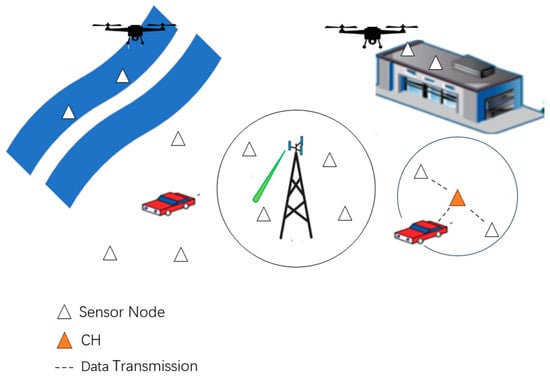
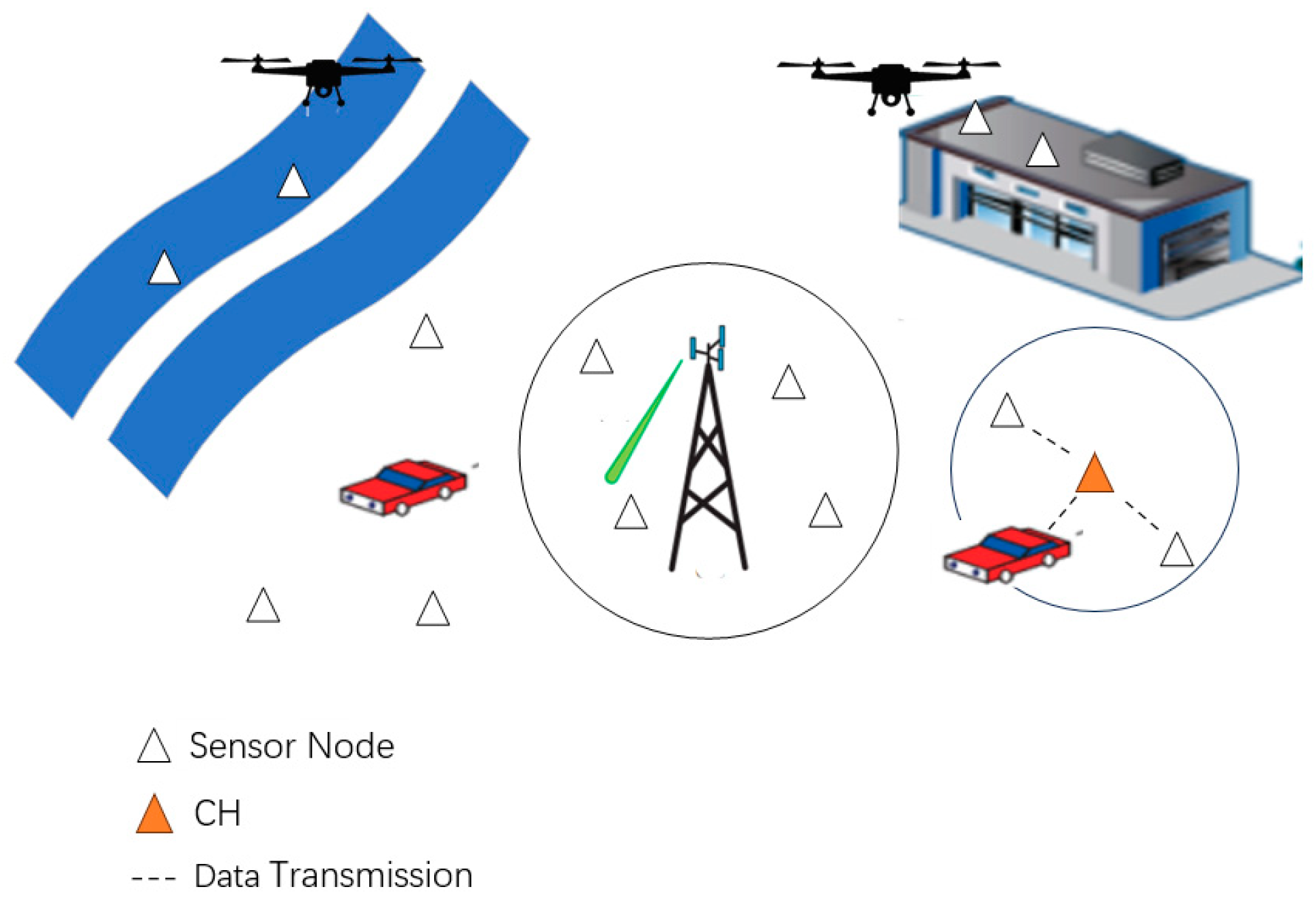
The system model is illustrated in Figure 1. WSNs are wirelessly powered by GBS, UAVs, and WCVs. A GBS is deployed at the network center to provide point-to-point wireless charging and data transmission services to SNs within the coverage. Flat areas outside the GBS coverage are serviced by WCVs. In addition, for complex terrains that WCVs cannot reach, such as rooftops or rivers, UAVs perform wireless charging and data collection, ensuring that all SNs in the region can be covered.
Figure 1.
System model.
The study assumes that S SNs are randomly and uniformly distributed. The collection for all SNs is represented as
The location of the i-th node is denoted by
The locations of SNs can be classified into three types: (a) nodes within the charging coverage of GBS; (b) nodes on the ground or at low altitudes that are outside the GBS coverage; and (c) nodes that are difficult for WCVs to reach, such as those on rivers, rooftops, or obstructed by other obstacles. All the SNs are grouped into clusters, with the cluster radius denoted as . Within each cluster, other SNs transmit data to their CHs, which then forward the data to charging devices.
The SNs of the first type are wirelessly charged and served for data transmission by GBS, and the GBS can collect green energy via wind turbines and solar panels [14]. GBS can also supply energy to UAVs and WCVs. The SNs of the second type, being outside the GBS coverage, are charged and served based on the urgency of charging and charging profit, either by UAVs or WCVs. The SNs of the third type, due to complex geographic environments, cannot be reached by WCVs and can only be served by UAVs for wireless charging and data transmission.
It is assumed that the energy threshold of each SN is E0. When the residual energy of an SN falls below E0, its sensing and data transmission capabilities are affected. Suppose the initial energy of the i-th SN Ii is denoted as , and the initial cache size is denoted as . Denote the energy of Ii at time t as , and the size of the buffer at time t as . Then if is denoted as the energy consumption rate of the Ii, then the remaining time of Ii can be denoted as .
3.1. Charging Model
To maintain continuous network operation, GBSs, UAVs, and WCVs provide charging to SNs that issue charging requests. A charging request is sent when an SN residual energy falls below the energy threshold. Since CHs need to collect and aggregate data from other SNs in the cluster and forward it to charging devices, their energy consumption is higher than that of other SNs. Therefore, to prolong network operation, the initial positions of UAVs and WCVs are set near CHs. Each cluster is divided into 12 cylindrical-sector regions, and WCVs can simultaneously charge all SNs within a single sector. The time required for a charging device to charge all SNs in the n-th sector at time t is expressed as
where the number of nodes in the n-th sector is assumed to be Sn and VCi denotes the charging rate of the charging device for SN. The time required for charging device moved to next cluster is
here, D denotes the distance between two clusters, and V represents the moving speed of charging devices. While charging SNs within a sector, the charging device also performs data collection. The data collection time is generally shorter than the charging time.
3.2. Node Energy Consumption Model
The node transmission energy model and the corresponding critical distance are based on the classical formulas proposed by Heinzelman et al. [49], which are used to analyze the energy consumption of nodes during data transmission and reception in WSNs. Let l denote the distance between a transmitter and a receiver. The energy consumed to transmit one bit of data over a distance l can be expressed as:
where the basic energy consumption of a node for receiving or transmitting one bit of data is denoted by Eelect. The channel gain of the free-space channel is denoted as Efs, while that of the multipath fading channel is denoted as Emp. The critical distance between the free-space and multipath models is given by:
In clustered SNs, the energy consumption of each SN needs to be modeled differently according to the role as a CH or a non-CH. For a non-CH SN, the residual energy of the i-th non-CH SN at time slot t after an elapsed time T(t) can be dynamically expressed as
here, let denote the residual energy of the i-th node at time slot t. The duration of each time slot is denoted by T. Assume that the data transmission and reception rates of the node and the charging device are both , and that the energy consumed for data transmission and reception is ET. The power consumption rate of a node for environmental sensing is denoted by .
For a CH, the residual energy can be expressed as
here, we assume that each cluster contains a different number of SNs. Let Ni denote the number of non-CH SNs in the i-th cluster. The energy consumed to aggregate one bit of data is denoted as . In the given expressions, and are defined as follows
As shown in (11), denotes the data aggregation rate of a CH. Here denotes the time required for the charging device to collect data from the CH node and is expressed as
We assume that the data collection rate of an SN is . From time slot t, after a duration of T(t), the total volume of environmental data generated by a single node is given by
3.3. Dynamic CH Selection Model
The selection of a CH needs to consider the current buffer size of the SN, as a smaller buffer provides more space to store data from other SNs. In addition, a CH should have a higher residual energy. Moreover, a CH should preferably be closer to other SNs to save transmission energy and reduce latency. Therefore, a CH selection criterion needs to be designed, which is expressed as
where , and are consistency factors that satisfy . is the ratio of the size of the data cache of the Ii at the moment t to the size of the data cache at the start moment. is the ratio of the residual energy of the Ii at the moment t to the initial energy, and D is the distance of the node Ii from other node Ij. In the subsequent simulations of this paper, the three factors were initially set with equal weights of 1/3 to comprehensively evaluate the cluster-head priority of each node. In practice, however, the values of , , and can be adjusted to achieve different objectives and balances. For example, when data caching becomes a bottleneck, the weight of can be increased; when network energy is constrained, the weight of can be raised; and when the node distribution within a cluster is sparse or uneven, the weight of can be appropriately increased.
The greedy strategy is a design approach that selects the locally optimal decision at each step, aiming to approximate the global optimum through the accumulation of local optima. Its core characteristic is that it only considers the best choice under the current state, without predicting future state changes. Therefore, in this chapter, CHs are dynamically selected to maximize network lifetime. The greedy strategy computes the buffer size, residual energy, and distance distribution to other SNs for each SN, and the SN with the largest is chosen as the CH.
3.4. Profit-Oriented Cylindrical Sector Charging Model
In this work, each cluster is divided into 12 cylindrical sectors. This configuration is based on the findings reported in [35]. The received charging efficiency of SNs reaches a higher level when the directional charging angle is π/6 under a fixed node–charger distance and simultaneous multi-node coverage. Dividing the 360° spatial region into 12 equal sectors ensures that each sector corresponds exactly to π/6, making the proposed spatial partitioning consistent with the theoretical optimal directional charging angle. Therefore, the 12-sector division not only aligns with established analytical conclusions but also facilitates more accurate modeling of charging gains in WSNs.
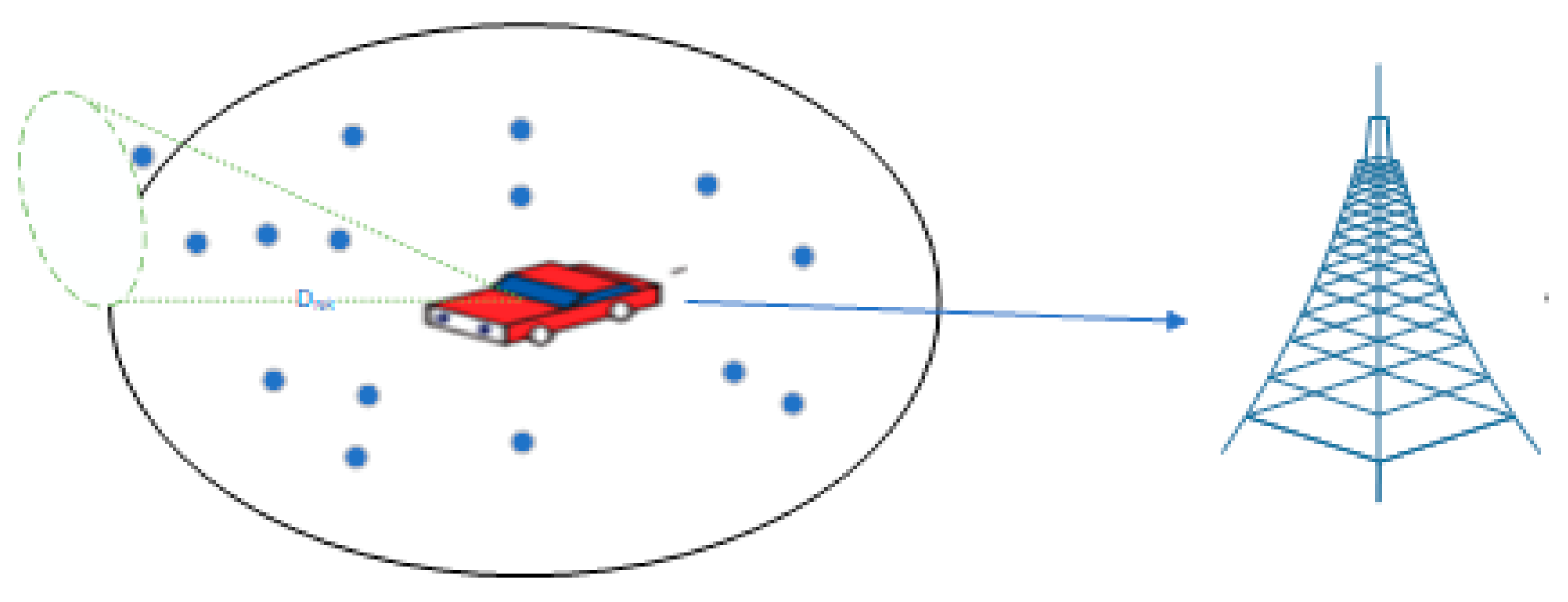
Therefore, this chapter proposes a profit-driven cylindrical-sector charging model as shown in Figure 2, in which each cluster is divided into 12 cylindrical sectors (each with a central angle of π/6), allowing the WCV to dynamically adjust its vertical charging range according to SNs distribution. In this model, the WCV is designed to perform charging and data collection for each of the 12 sectorial regions within the cylindrical sector area. The profit obtained by the WCV from wirelessly charging and collecting data from the SNs in the n-th sector can be expressed as
Figure 2.
WCV Charging Model.
Assume that the n-th sector contains Sn SNs, the cluster radius is denoted as , and represents the buffer consumption rate, with being a consistency factor. also denotes the residual energy of the i-th SN at time t, and represents the residual buffer data of the i-th SN at time t. indicates the distance between the i-th SN and the WCV.
From this formula, the profit is related to charging, data transmission, and CH distribution. denotes the profit obtained by the WCV when charging SNs, which depends on the lifetime of SNs, energy consumption rate, and their distance to the WCV, indicates that sectors with lower residual energy and closer proximity to the WCV have higher profit, and thus receive higher charging priority. represents the profit obtained by the WCV when collecting data from SNs, which is related to buffer utilization, data transmission rate, and distance to the WCV, indicates that sectors with higher buffer consumption and closer proximity to the WCV obtain higher profit, and therefore receive higher charging priority. denotes the profit weight added when a CH exists in the sector. Under equal conditions, the scheduling strategy prioritizes sectors containing CH to maintain cluster stability and intra-cluster data forwarding capability.
The profit model constructed in this study takes into account the residual energy and buffered data states of the nodes, as well as their consumption trends and the distance from the WCV to the target nodes. By using consistency factors, the model balances the benefits of energy and data collection, while additional reward values are assigned to sectors containing CH to ensure the preferential scheduling of critical nodes. This enables a comprehensive assessment of WCV visitation profit across the regions.
4. Optimization Algorithm Design
The JPNS algorithm is composed of two primary components: the sector partitioning and statistical algorithm, and the WCV-based sector profit–survival optimization algorithm. The overall goal of the algorithm is to simultaneously maximize the system-level profit and prolong the operational lifetime of the wireless sensor network by carefully balancing energy utilization and node survival.
Specifically, in the sector partitioning and statistical analysis module, each cluster is first divided into twelve cylindrical sectors, as illustrated in Algorithm 1. The resulting statistical data are then provided as inputs to the WCV-based sector profit–survival optimization algorithm. This optimization algorithm initially evaluates all candidate sectors to identify the sector that currently achieves the highest profit while minimizing the number of dead nodes. Once the optimal sector is selected, it is added to a constructed charging sequence list. The algorithm then proceeds to evaluate the remaining sectors in a similar manner, ultimately generating a complete charging sequence. By doing so, the algorithm enables the charging vehicle to make informed, data-driven decisions, enhancing energy utilization efficiency, reducing node failures, and maintaining continuous network operation.
Through the collaborative operation of these two modules, the JPNS algorithm is capable of jointly optimizing overall profit and minimizing node mortality, thereby achieving long-term network sustainability and providing a practical solution for efficient energy management in large-scale WSNs.
| Algorithm 1 Sector Partitioning and Statistical Algorithm |
| Input: set of node coordinates dataxy |
| Output: nodeCountInSector[k]; i_nodeCountInSector[k]; 1 <= k<= 12 |
| 1: Initialize the set of 12 empty sectors |
| 2: for i ← 1 to N do //Iterate over all nodes |
| 3: if ∃s make i ∈ i_nodeCountInSector[s] then continue |
| 4: (x0,y0) ← dataxy[i] //Taking the datum coordinates |
| 5: angles ← arctan2(Δy,Δx) + 360*(Δy < 0) //Calculate global relative angle |
| 6: sectorID ← |angles/30| //30 Degree Zones (1~12) |
| 7: targetSector ← findEmptySector() //Dynamic search for available sectors |
| 8: nodeCountInSector[targetSector] ← append(dataxy[i]) |
| 9: i_nodeCountInSector[targetSector] ← i |
| 10: for j ← 1 to N do |
| 11: if sectorID[j] == sectorID[i] then |
| 12: if j ∉ All Sectors Collection then |
| 13: nodeCountInSector[targetSector] ← append(dataxy[j]) |
| 14: end if |
| 15: end if |
| 16: end for |
| 17: end for |
Algorithm 1 partitions nodes into predefined sector regions according to their coordinates and counts the nodes in each sector. Specifically, 12 empty sets nodeCountInSector[1–12] are initialized to store coordinates, and another 12 sets i_nodeCountInSector[1–12] are initialized to store node indices. Let N denote the total number of nodes, and dataxy the coordinate data. The algorithm iterates over all nodes and checks whether node i has already been assigned to a sector. If yes, it is skipped. Otherwise, its coordinates are retrieved. The relative angle between the current node and others is computed, negative values are adjusted into [0°, 360°), and the angle is mapped to a sector ID with 30° per interval. For example, 45° corresponds to sector ID = 2, while 355° corresponds to sector ID = 12.
The next step dynamically identifies an available sector by selecting either the sector with the minimum current load or the first non-full sector from the 12 candidates as the target sector (targetSector), thereby achieving load balancing. The coordinates and index of the reference node i are then added to the targetSector set. Subsequently, all nodes are traversed again, and any unassigned node j sharing the same sector ID with node i is grouped into the targetSector.
Based on the twelve cylindrical sectors dynamically partitioned in Algorithm 1, the WCV-based sector profit–survival optimization algorithm implements the optimal charging strategy for the WCV. The nodeCountInSector[k] and i_nodeCountInSector[k] from Algorithm 1 will be used as inputs for Algorithm 2.
Algorithm 2 will identify the current optimal charging sector for the WCV and ultimately generates a complete charging sequence, thereby achieving a bi-objective joint optimization that maximizes charging profit while minimizing the number of node failures.
| Algorithm 2 Comprehensive Profit and Survival Optimization Algorithm for WCV Sector Regions |
| Input: nodeCountInSector[k]; i_nodeCountInSector[k]; 1 <= k<= 12; |
| Output: charging sequence list |
| 1: Initialize max_profit_order to an empty list |
| 2: t = 0 //Total time |
| 3: total_dead = 0 //Number of invalid nodes |
| 4: for h in 1-12: //Traverse up to 12 sectors |
| 5: max_profit = -INF |
| 6: best_sector = None |
| 7: best_charge_time = 0 |
| 8: best_dead = INF |
| 9: for disk sector x in 1-12: |
| 10: if x in max_profit_order: continue |
| 11: dead = 0 //Number of dead nodes |
| 12: P = 0 //Total profit |
| 13: charge_time = 0 |
| 14: for nodes in the set of nodes in sector x: |
| 15: if nodal death: |
| 16: dead += 1 |
| 17: continue |
| 18: if Nodes are CHs: |
| 19: Energy consumption = Calculate CH energy consumption |
| 20: else |
| 21: Energy consumption = Calculate non-CH node energy con- sumption |
| 22: BC = Remaining Power − Energy Consumption |
| 23: if BC <= 0: dead += 1 |
| 24: charge_time += BC/charging rate |
| 25: P += Profit calculated according to Equation (14) |
| 26: P = P/Number of surviving nodes//Calculate average profit |
| 27: if P > max_profit or (P == max_profit and dead < best_dead): |
| 28: max_profit = P |
| 29: best_sector = x |
| 30: best_charge_time = charge_time |
| 31: best_dead = dead |
| 32: if max_profit > 0: |
| 33: t += best_charge_time //Update total time |
| 34: record best_sector to max_profit_order |
| 35: total_dead += best_dead |
| 36: else |
| 37: break //early termination without profit |
| 38: end |
The algorithm begins with initialization. An empty list max_profit_order is created to record the charging sequence. The total time t is set to 0, and the total number of dead nodes total_dead is initialized to 0. Next, an outer loop is executed, with a maximum of 12 iterations corresponding to the 12 sectors. At the start of each iteration, max_profit is set to negative infinity. The variable best_sector is used to track the current optimal sector, best_dead records the number of dead nodes in that sector, and best_charge_time represents the time required to fully charge all surviving nodes. best_charge_time is initialized to 0.
Inside the outer loop, an inner loop traverses all 12 sectors, skipping those already recorded in max_profit_order. For each candidate sector, the algorithm initializes the dead node counter, accumulated profit and charging time. Subsequently, the algorithm iterates over all nodes within the sector. For each node, it first checks whether the node is dead. Dead nodes are counted and ignored in further processing. For surviving nodes, the algorithm distinguishes between CHs and non-CHs when computing energy consumption, since CHs handle more data and thus consume more energy. The remaining energy of each node is updated after subtracting the calculated energy cost. If the remaining energy falls to zero or below, the node is marked as dead, and both the dead node count and death statistics are updated. The algorithm then accumulates charging time and profit. The average profit is computed, and if the sector contains a CH, an additional weight is added to the profit value. After processing all nodes, the sector-level results are compared. The selection rule prioritizes higher profit. If two sectors yield the same profit, the one with fewer dead nodes is chosen. In addition, sectors with shorter charging distances yield higher profit due to lower energy consumption. After completing the inner loop, if a sector with positive profit is found, the algorithm updates the total time, charging sequence, and dead node count. Otherwise, the algorithm terminates early. Finally, the results are output.
Since this algorithm jointly optimizes both profit and the number of surviving nodes, it explicitly incorporates dead node counting. Specifically, if the remaining energy of a node is less than or equal to zero, the invalid node counter is incremented by one. Afterward, the data buffer of the node is updated, the average profit is computed, and the total profit is updated accordingly. If the average profit exceeds the current maximum profit while the number of dead nodes is minimized, the maximum profit and its corresponding sector index are updated. Finally, the loop variable h is increased, and the algorithm proceeds to the next iteration.
5. Simulation and Analysis
In this section, simulation results are presented for WCV wireless charging under different schemes, evaluating both charging profit and the number of surviving nodes. The performance of the JPNS scheme is compared with two other strategies: Shortest Distance First and Maximum Profit Priority, in order to validate the effectiveness of JPNS.
5.1. Simulation Configuration and Parameter Settings
Energy management parameters for the WCV and SNs used in the simulations are listed in Table 1.
Table 1.
Parameter table for energy management of WCVs and SNs.
Meanwhile, the simulations in this paper adopt a normalized cubic space of 0~1, which can be linearly mapped to real dimensions. The , , and coordinates of the nodes are generated by random functions, and . The nodes are randomly distributed in both ground and aerial layers, where ground nodes are assigned . After clustering, the cluster heads are selected using the dynamic CH selection model. For the sake of simulation simplicity, although the speed of WCVs is specified, the continuous travel time between nodes is not modeled in the simulations. Instead, the distance is only used as a weighting factor in the scheduling profit. This simplification allows us to focus on the effectiveness of the scheduling strategy. In future work, we plan to incorporate a mobility model for WCVs to further enhance the practical applicability of the scheduling strategy.
5.2. Simulation Results and Analysis
In this work, we focus on evaluating the proposed method by comparing it with two representative heuristic algorithms: the shortest-path-based algorithm and the maximum-profit-based algorithm. These two were chosen because, although many advanced algorithms have been proposed in recent years, relatively few explicitly consider charging profit as a joint optimization metric. Comparisons with other advanced algorithms are left for future research.
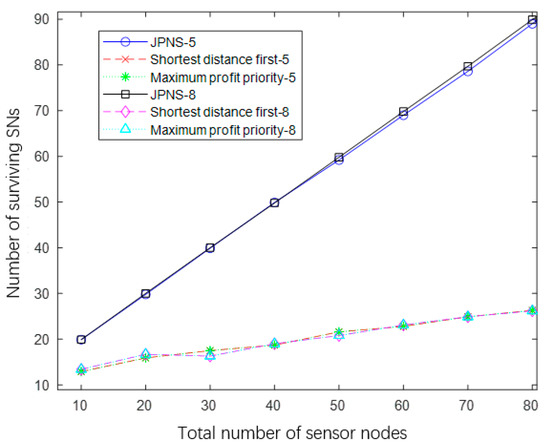
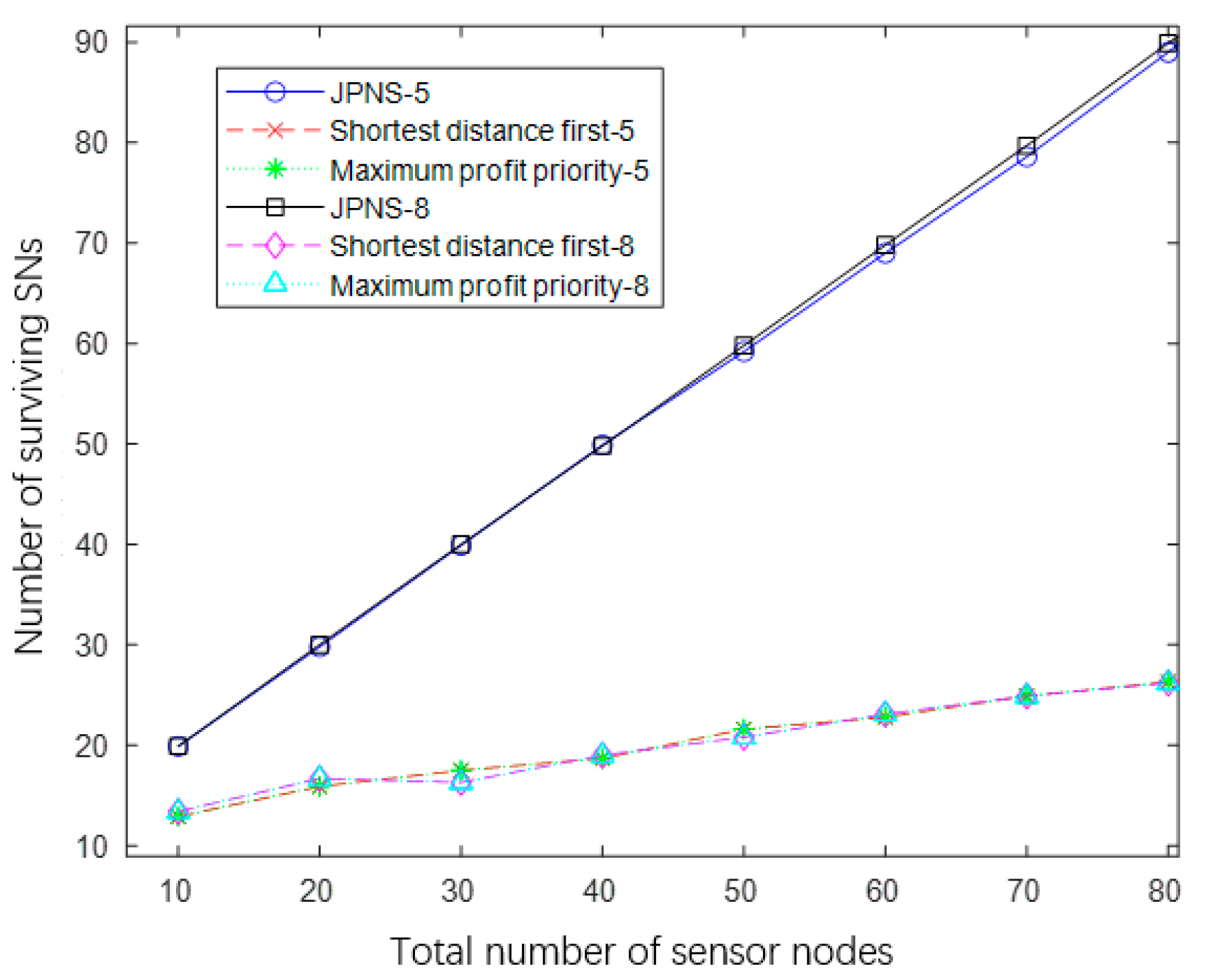
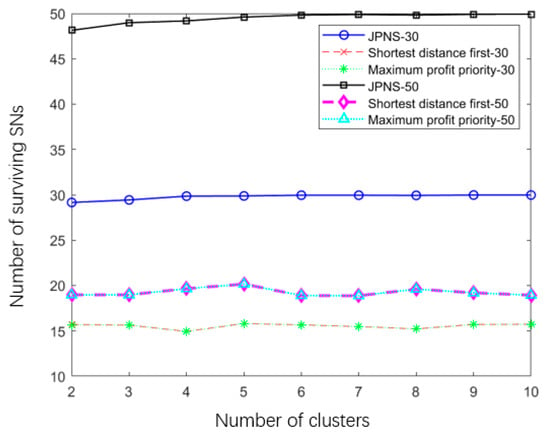
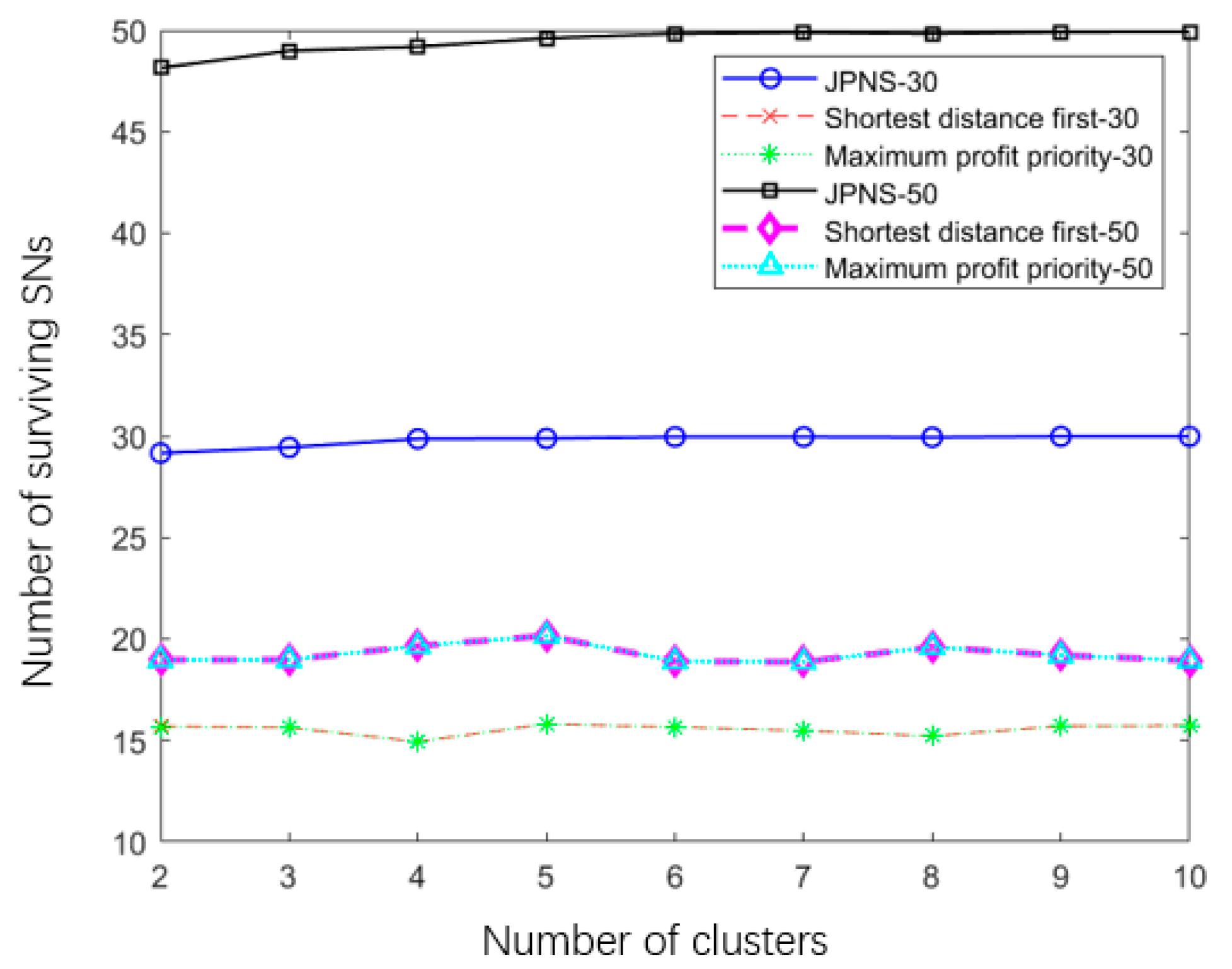
The number of surviving nodes under different node densities and varying numbers of clusters is shown in Figure 3 and Figure 4. It can be observed from these figures that, at the same node density, the JPNS algorithm achieves the highest number of surviving nodes. As the node density increases, the number of surviving nodes also rises. Moreover, when the number of clusters in JPNS is set to 8, the number of surviving nodes is slightly higher than that when the number of clusters is 5. This improvement is attributed to the fact that JPNS enables the WCV to simultaneously charge multiple nodes within a single cylindrical sector.
Figure 3.
Number of surviving nodes at different node densities.
Figure 4.
Number of surviving nodes under different sub-clusters.
Figure 3 shows that as the node density increases, the number of surviving nodes also rises. This is because high-density networks support more efficient multi-hop path selection. Moreover, when the number of clusters in JPNS is set to 8, the number of surviving nodes is slightly higher than that with 5 clusters.
As illustrated in Figure 4, the number of surviving nodes in JPNS increases with the number of clusters. This is due to the reduction in nodes per cluster when the total number of nodes remains fixed. For example, in a network of 100 nodes, dividing into 5 clusters results in 20 nodes per cluster, whereas dividing into 8 clusters gives 12 nodes per cluster. Smaller cluster sizes shorten communication distances among nodes, thereby reducing energy consumption.
In addition, the load on CHs is reduced. The energy consumption for data aggregation and forwarding at a CH is positively correlated with the number of member nodes. Increasing the number of clusters reduces the number of nodes managed by each CH, decreasing energy consumption and prolonging network lifetime. Furthermore, more clusters may lead to a more balanced energy distribution, preventing certain CHs from depleting their energy prematurely.
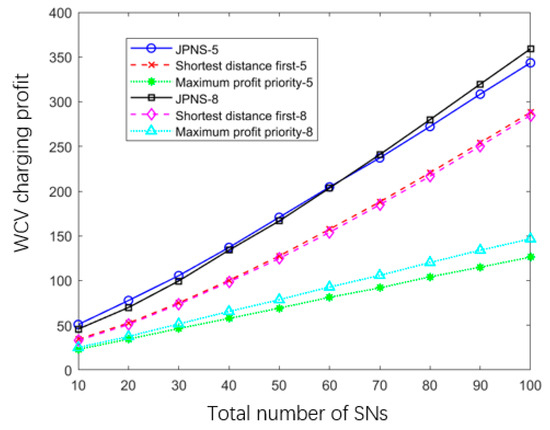
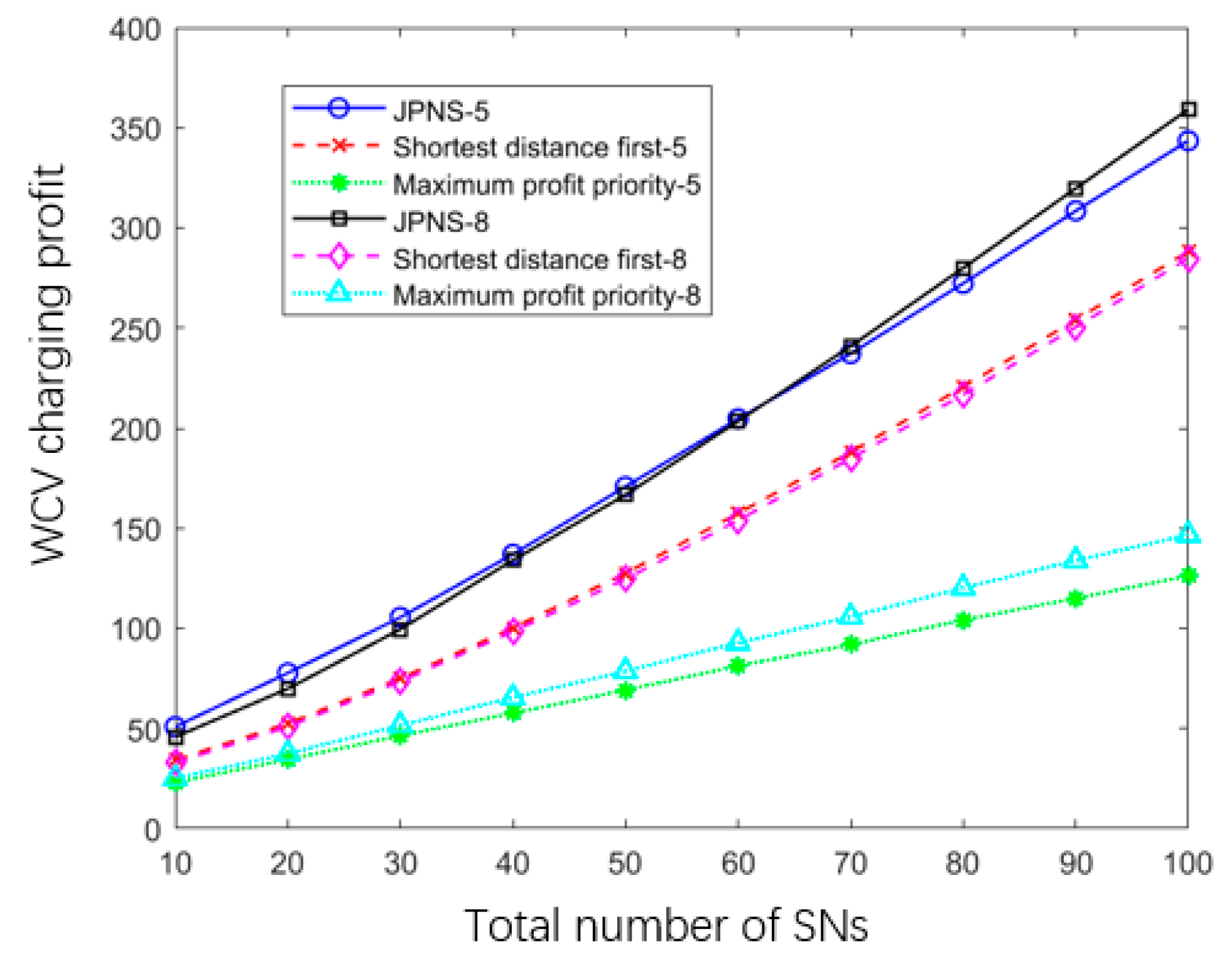
Figure 5 illustrates that, at the same node density, the JPNS algorithm achieves the highest number of surviving nodes. This is because JPNS simultaneously maximizes overall profit while considering node mortality. For instance, it prioritizes charging nodes that yield higher profit at lower cost, thereby maintaining more surviving nodes while increasing revenue. Figure 5 also shows that the overall profit rises with increasing node density. Higher node density improves coverage and reliability in data collection, enhancing data quality and generating greater profit.
Figure 5.
Profit of WCV charging at different node densities.
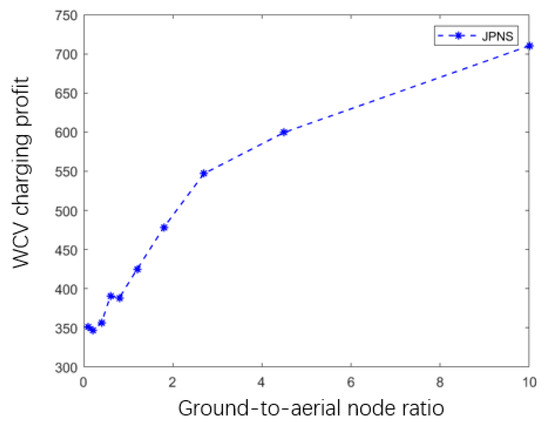
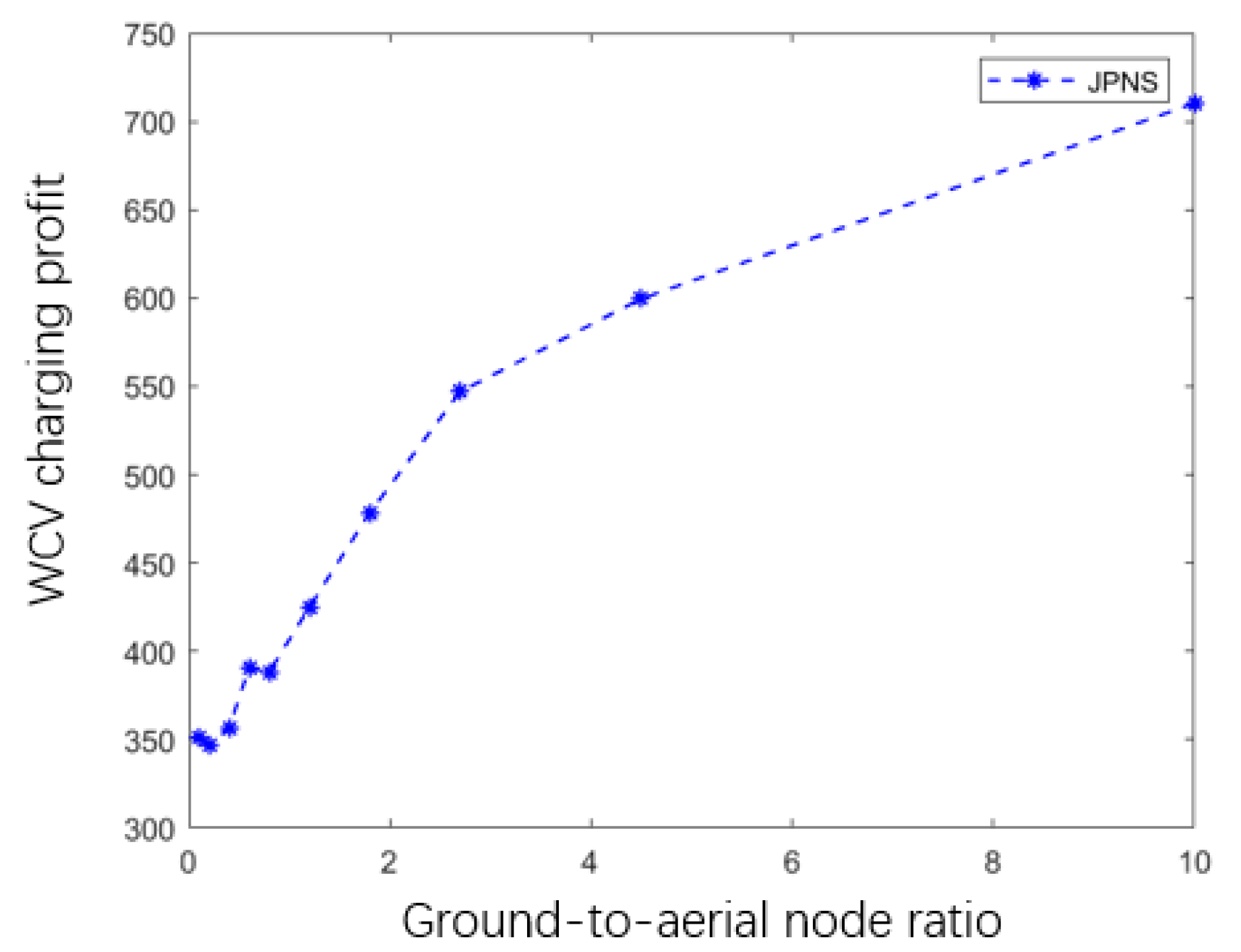
In large-scale WSNs, nodes typically include fixed sensors deployed on the ground and nodes mounted on aerial platforms. To more realistically characterize the system’s operational environment, this work classifies the SNs into ground and aerial nodes. By adjusting the ratio between the two types, different deployment scenarios can be obtained. The WCV charging profit under different ratios of ground nodes to aerial nodes is shown in Figure 6. An increase in the ground-to-aerial node ratio indicates either more ground nodes or fewer aerial nodes. As observed from Figure 6, with a fixed total number of nodes, the WCV charging profit increases as the ground-to-aerial node ratio rises. This is because ground nodes are generally more accessible to the WCV, leading to higher charging efficiency and reduced time and energy costs. Moreover, when ground nodes are densely distributed, the WCV can plan charging paths more efficiently, further reducing mobility costs. In contrast, charging aerial nodes requires higher energy expenditure, so reducing their number helps lower overall costs. Considering the distribution of ground nodes, charging demand tends to be more concentrated. JPNS leverages intelligent WCV scheduling to perform batch charging, minimizing movement frequency and time while jointly optimizing charging profit and node survivability.
Figure 6.
Profitability of WCV charging with different ratios of ground nodes to air nodes.
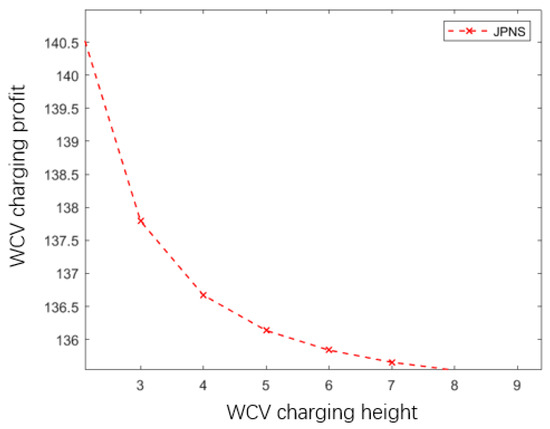
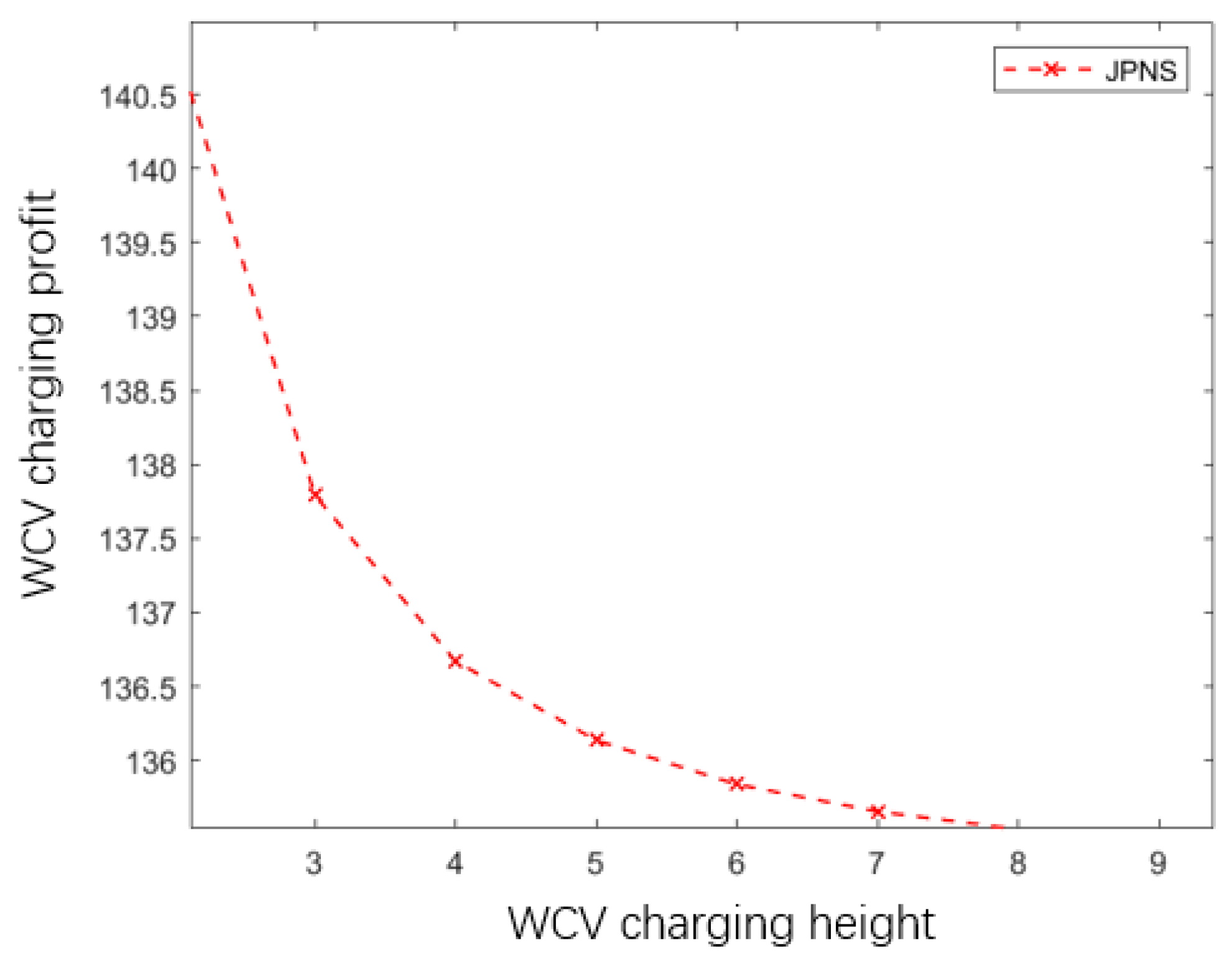
The WCV charging profit at different charging altitudes is shown in Figure 7. As observed, the charging profit decreases as the WCV charging altitude increases. This is because higher charging altitudes may reduce wireless charging efficiency due to longer distances. In addition, increased distance prolongs charging time, which in turn affects overall profit.
Figure 7.
Charging profits at different charging heights for WCVs.
6. Conclusions
This paper proposes a heterogeneous WSN charging–scheduling optimization strategy that coordinates GBS, UAVs, and WCVs. The strategy targets different environmental node types, including base station coverage areas, complex ground areas, and aerial obstacle regions. Since the WCV can perform one-to-many charging within a single region, a cylindrical-sector-based charging model is designed based on the optimal charging angle (π/6). Each cluster is divided into 12 cylindrical-sector regions. The JPNS algorithm is employed to jointly optimize profit and node survivability, enabling parallel charging of multiple nodes. Furthermore, a dynamic CH selection mechanism is introduced. It uses a weighted function considering buffer occupancy, residual energy, and inter-node distance to dynamically balance the load. Simulation results show that, compared with other schemes, JPNS achieves higher profit and node survivability. The strategy can be adapted to complex scenarios such as disaster monitoring and industrial inspection.
However, in real-world environments, terrain and obstacles may affect the feasibility of UAV and WCV routes, and the system requires real-time status information exchange between nodes and charging devices for dynamic scheduling. Practical deployments should also consider factors such as signal interference and localization errors. In addition, practical deployment also needs to consider the endurance limitations of the charging equipment itself as well as the path planning requirements, and future JPNS implementations could further incorporate reinforcement learning to optimize global scheduling.
Author Contributions
Conceptualization, Y.X., L.L. and Y.N.; methodology, Y.X., Y.Y., P.S., L.L. and Y.N.; software, L.L. and Y.N.; validation, Y.N. and L.L.; formal analysis, Y.N. and L.L.; investigation, Y.N. and L.L.; data curation, Y.N. and L.L.; writing—original draft preparation, Y.N. and L.L.; writing—review and editing, Y.X., Y.Y., P.S., L.L. and Y.N.; supervision, Y.X., Y.Y. and P.S. All authors have read and agreed to the published version of the manuscript.
Funding
This work was supported in part by the National Natural Science Foundation of China (grant numbers 62476080); Key Laboratory about Maritime Intelligent Network Information Technology of the Ministry of Education (EKLMIC202405).
Data Availability Statement
All data supporting the results reported in this study are contained within the article. For further inquiries or additional information, interested readers may directly contact the corresponding authors.
Conflicts of Interest
The authors declare no conflicts of interest.
Abbreviations
The following abbreviations are used in this manuscript:
| UAV | Unmanned Aerial Vehicle |
| WCV | Wireless Charging Vehicle |
| WSN | Wireless Sensor Network |
| SN | Sensor Node |
| WPT | Wireless Power Transfer |
| GBS | Green Energy Base Station |
| CH | Cluster head |
| JPNS | Joint Profit and Node Survival |
References
- Zhao, J.; Li, Q.; Ma, X.; Yu, F.R. Computation offloading for edge intelligence in two-tier heterogeneous networks. IEEE Trans. Netw. Sci. Eng. 2023, 11, 1872–1884. [Google Scholar] [CrossRef] [Scilit]
- Hu, J.; Yang, K.; Wen, G.; Hanzo, L. Integrated data and energy communication network: A comprehensive survey. IEEE Commun. Surv. Tutor. 2018, 20, 3169–3219. [Google Scholar] [CrossRef] [Scilit]
- Lee, C.H.; Jung, G.; Hosani, K.A.; Song, B.; Seo, D.-K.; Cho, D. Wireless power transfer system for an autonomous electric vehicle. In Proceedings of the IEEE Wireless Power Transfer Conference (WPTC), Seoul, Republic of Korea, 15–19 November 2020; pp. 467–470. [Google Scholar]
- Zijie, F.; Al-Shareeda, M.A.; Saare, M.A.; Manickam, S.; Karuppayah, S. Wireless sensor networks in the Internet of Things: Review, techniques, challenges, and future directions. Indones. J. Electr. Eng. Comput. Sci. 2023, 31, 1190–1200. [Google Scholar] [CrossRef] [Scilit]
- Huan, X.; Chen, W.; Wang, T.; Hu, H.; Zheng, Y. A one-way time synchronization scheme for practical energy-efficient LoRa network based on reverse asymmetric framework. IEEE Trans. Commun. 2023, 71, 6468–6481. [Google Scholar] [CrossRef] [Scilit]
- Huan, X.; He, H.; Wang, T.; Wu, Q.; Hu, H. A timestamp-free time synchronization scheme based on reverse asymmetric framework for practical resource-constrained wireless sensor networks. IEEE Trans. Commun. 2022, 70, 6109–6121. [Google Scholar] [CrossRef] [Scilit]
- Kandris, D.; Nakas, C.; Vomvas, D.; Koulouras, G. Applications of wireless sensor networks: An up-to-date survey. Appl. Syst. Innov. 2020, 3, 14. [Google Scholar] [CrossRef] [Scilit]
- Karakitsios, I.; Palaiogiannis, F.; Markou, A.; Hatziargyriou, N.D. Optimizing the energy transfer, with a high system efficiency in dynamic inductive charging of EVs. IEEE Trans. Veh. Technol. 2018, 67, 4728–4742. [Google Scholar] [CrossRef] [Scilit]
- Zakerian, A.; Vaez-Zadeh, S.; Babaki, A. A dynamic WPT system with high efficiency and high power factor for electric vehicles. IEEE Trans. Power Electron. 2020, 35, 6732–6740. [Google Scholar] [CrossRef] [Scilit]
- Gu, X.; Hemour, S.; Wu, K. Far-field wireless power harvesting: Nonlinear modeling, rectenna design, and emerging applications. Proc. IEEE 2022, 110, 56–73. [Google Scholar] [CrossRef] [Scilit]
- Qureshi, B.; Aziz, S.A.; Wang, X.; Hawbani, A.; Alsamhi, S.H.; Qureshi, T.; Naji, A. A state-of-the-art survey on wireless rechargeable sensor networks: Perspectives and challenges. Wirel. Netw. 2022, 28, 3019–3043. [Google Scholar] [CrossRef] [Scilit]
- Park, S.-Y.; Jeong, D.; Shin, C.S.; Lee, H. Dronenet+: Adaptive route recovery using path stitching of UAVs in ad-hoc networks. In Proceedings of the IEEE Global Communications Conference, Singapore, 4–8 December 2017; pp. 1–7. [Google Scholar]
- Yu, T.; Wang, X.; Jin, J.; McIsaac, K. Cloud-orchestrated physical topology discovery of large-scale IoT systems using UAVs. IEEE Trans. Ind. Inform. 2018, 14, 2261–2270. [Google Scholar] [CrossRef] [Scilit]
- Wu, Q.; Zeng, Y.; Zhang, R. Joint trajectory and communication design for multi-UAV enabled wireless networks. IEEE Trans. Wirel. Commun. 2018, 17, 2109–2121. [Google Scholar] [CrossRef] [Scilit]
- Zeng, Y.; Zhang, R.; Lim, T.J. Wireless communications with unmanned aerial vehicles: Opportunities and challenges. IEEE Commun. Mag. 2016, 54, 36–42. [Google Scholar] [CrossRef] [Scilit]
- Zhan, C.; Zeng, Y.; Zhang, R. Energy-efficient data collection in UAV enabled wireless sensor network. IEEE Wirel. Commun. Lett. 2018, 7, 328–331. [Google Scholar] [CrossRef] [Scilit]
- Xu, W.; Liang, W.; Jia, X.; Kan, H.; Xu, Y.; Zhang, X. Minimizing the maximum charging delay of multiple mobile chargers under the multi-node energy charging scheme. IEEE Trans. Mob. Comput. 2021, 20, 1846–1861. [Google Scholar] [CrossRef] [Scilit]
- Yu, H.; Chang, C.-Y.; Wang, Y.; Roy, D.S.; Bai, X. Coverage aware energy replenishment mechanism using mobile charger in wireless sensor networks. IEEE Sens. J. 2021, 21, 23682–23697. [Google Scholar] [CrossRef] [Scilit]
- Xue, J.; Wu, D.; Peng, J.; Xu, W.; Liu, T. Charger placement with wave interference. IEEE Trans. Mob. Comput. 2025, 24, 261–275. [Google Scholar] [CrossRef] [Scilit]
- Mo, L.; Kritikakou, A.; He, S. Energy-aware multiple mobile chargers coordination for wireless rechargeable sensor networks. IEEE Internet Things J. 2019, 6, 8202–8214. [Google Scholar] [CrossRef] [Scilit]
- Xu, J.; Zhou, K.; Wu, S.; Dai, H.; Xu, L.; Liu, L. Robust fault-tolerant placement of wireless chargers for directional charging. IEEE Trans. Mob. Comput. 2024, 23, 5295–5309. [Google Scholar] [CrossRef] [Scilit]
- Ben Ghorbel, M.; Rodriguez-Duarte, D.; Ghazzai, H.; Hossain, J.; Menouar, H. Joint position and travel path optimization for energy efficient wireless data gathering using unmanned aerial vehicles. IEEE Trans. Veh. Technol. 2019, 68, 2165–2175. [Google Scholar] [CrossRef] [Scilit]
- Zhao, J.; Quan, H.; Xia, M.; Wang, D. Adaptive resource allocation for mobile edge computing internet of vehicles: A deep reinforcement learning approach. IEEE Trans. Veh. Technol. 2023, 73, 5834–5848. [Google Scholar] [CrossRef] [Scilit]
- Zhao, J.; Sun, X.; Li, Q.; Ma, X. Edge caching and computation management for real-time internet of vehicles: An online and distributed approach. IEEE Trans. Intell. Transp. Syst. 2021, 22, 2183–2197. [Google Scholar] [CrossRef] [Scilit]
- Zhao, J.; Li, Q.; Gong, Y.; Zhang, K. Computation offloading and resource allocation for cloud assisted mobile edge computing in vehicular networks. IEEE Trans. Veh. Technol. 2019, 68, 7944–7956. [Google Scholar] [CrossRef] [Scilit]
- Aziz, S.A.; Wang, X.; Hawbani, A.; Qureshi, B.; Alsamhi, S.H.; Alabsi, A.; Zhao, L.; Al-Dubai, A.; Ismail, A. Wireless rechargeable sensor networks: Energy provisioning technologies, charging scheduling schemes, and challenges. IEEE Trans. Sustain. Comput. 2025, 10, 873–890. [Google Scholar] [CrossRef] [Scilit]
- Qin, H.; Zhao, B.; Xu, L.; Bai, X. Hybrid cyber Petri net modelling, simulation and analysis of master-slave charging for wireless rechargeable sensor networks. Sensors 2021, 21, 551. [Google Scholar] [CrossRef] [Scilit]
- Liang, W.; Xu, Z.; Xu, W.; Shi, J.; Mao, G.; Das, S.K. Approximation algorithms for charging reward maximization in rechargeable sensor networks via a mobile charger. IEEE/ACM Trans. Netw. 2017, 25, 3161–3174. [Google Scholar] [CrossRef] [Scilit]
- Zhu, Y.; Wang, S. Flying path optimization of rechargeable UAV for data collection in wireless sensor networks. IEEE Sens. Lett. 2023, 7, 1–4. [Google Scholar] [CrossRef] [Scilit]
- Pang, Y.; Zhang, Y.; Gu, Y.; Pan, M.; Han, Z.; Li, P. Efficient data collection for wireless rechargeable sensor clusters in harsh terrains using UAVs. In Proceedings of the Global Communications Conference, San Diego, CA, USA, 6–10 December 2015; pp. 234–239. [Google Scholar]
- Yan, H.; Chen, Y.; Yang, S.-H. UAV-enabled wireless power transfer with base station charging and UAV power consumption. IEEE Trans. Veh. Technol. 2020, 69, 12883–12896. [Google Scholar] [CrossRef] [Scilit]
- Sha, C.; Sun, Y.; Malekian, R. Research on cost-balanced mobile energy replenishment strategy for wireless rechargeable sensor networks. IEEE Trans. Veh. Technol. 2019, 69, 3135–3150. [Google Scholar] [CrossRef] [Scilit]
- Liang, W.; Xu, W.; Ren, X.; Jia, X.; Lin, X. Maintaining large-scale rechargeable sensor networks perpetually via multiple mobile charging vehicles. ACM Trans. Sens. Netw. 2016, 12, 1–26. [Google Scholar] [CrossRef] [Scilit]
- Chen, J.-J.; Yu, C.-W. Collaborative charging scheduling of hybrid vehicles in wireless rechargeable sensor networks. Energies 2022, 15, 2256. [Google Scholar] [CrossRef] [Scilit]
- Lin, C.; Zhou, Y.; Ma, F.; Deng, J.; Wang, L.; Wu, G. Minimizing charging delay for directional charging in wireless rechargeable sensor networks. In Proceedings of the IEEE INFOCOM 2019—IEEE Conference on Computer Communications, Paris, France, 29 April–2 May 2019; pp. 1819–1827. [Google Scholar]
- Dai, H.; Wang, X.; Liu, A.X.; Ma, H.; Chen, G. Optimizing wireless charger placement for directional charging. In Proceedings of the IEEE INFOCOM 2017—IEEE Conference on Computer Communications, Atlanta, GA, USA, 1–4 May 2017; pp. 1–9. [Google Scholar]
- Wang, X.; Dai, H.; Huang, H.; Liu, Y. Robust scheduling for wireless charger networks. In Proceedings of the IEEE Conference on Computer Communications (INFOCOM), Paris, France, 29 April–2 May 2019; pp. 1–9. [Google Scholar]
- Tan, Z.; Cao, D.; Li, S.; Huang, Q. Optimal directional charging angle in wireless rechargeable sensor network. In Proceedings of the 2021 5th International Conference on Communication and Information Systems (ICCIS), Chongqing, China, 15–17 October 2021; pp. 65–70. [Google Scholar]
- Lin, C.; Guo, C.; Deng, J.; Wu, G. 3DCS: A 3-D Dynamic Collaborative Scheduling Scheme for Wireless Rechargeable Sensor Networks with Heterogeneous Chargers. In Proceedings of the IEEE 38th International Conference on Distributed Computing Systems, Vienna, Austria, 2–5 July 2018; pp. 311–320. [Google Scholar]
- Cheng, R.-H.; Yu, C.-W. Combining heterogeneous vehicles to build a low-cost and real-time wireless charging sensor network. Energies 2023, 16, 3418. [Google Scholar] [CrossRef] [Scilit]
- Han, G.; Yang, X.; Liu, L.; Zhang, W. A joint energy replenishment and data collection algorithm in wireless rechargeable sensor networks. IEEE Internet Things J. 2017, 5, 2596–2604. [Google Scholar] [CrossRef] [Scilit]
- Wang, C.; Li, J.; Ye, F.; Yang, Y. A novel framework of multi-hop wireless charging for sensor networks using resonant repeaters. IEEE Trans. Mob. Comput. 2016, 16, 617–633. [Google Scholar] [CrossRef] [Scilit]
- Liu, Y.; Pan, H.; Sun, G.; Wang, A.; Li, J.; Liang, S. Joint scheduling and trajectory optimization of charging UAV in wireless rechargeable sensor networks. IEEE Internet Things J. 2022, 9, 11796–11813. [Google Scholar] [CrossRef] [Scilit]
- Nguyen, N.-T.; Liu, B.-H.; Pham, V.-T.; Huang, C.-Y. Network under limited mobile devices: A new technique for mobile charging scheduling with multiple sinks. IEEE Syst. J. 2016, 12, 2186–2196. [Google Scholar] [CrossRef] [Scilit]
- Huang, M.; Zhang, K.; Zeng, Z.; Wang, T.; Liu, Y. An AUV assisted data gathering scheme based on clustering and matrix completion for smart ocean. IEEE Internet Things J. 2020, 7, 9904–9918. [Google Scholar] [CrossRef] [Scilit]
- Konstantopoulos, C.; Pantziou, G.; Gavalas, D.; Mpitziopoulos, A.; Mamalis, B. A rendezvous-based approach enabling energy-efficient sensory data collection with mobile sinks. IEEE Trans. Parallel Distrib. Syst. 2011, 23, 809–817. [Google Scholar] [CrossRef] [Scilit]
- Ma, X.; Liu, X.; Ansari, N.; Ding, J. Enhancing WRSN sustainability through on-demand directional wireless charging with multiple green-powered mobile vehicles. IEEE Internet Things J. 2025, 12, 18019–18030. [Google Scholar] [CrossRef] [Scilit]
- Aziz, S.A.; Hossain, M.S.; Islam, A.K.M.M.; Rahman, M.A. MCDM-FIS-based charging scheduling for wireless rechargeable sensor networks. IEEE Sens. J. 2025, 25, 16182–16197. [Google Scholar] [CrossRef] [Scilit]
- Heinzelman, W.; Chandrakasan, A.; Balakrishnan, H. Energy-efficient communication protocol for wireless microsensor networks. In Proceedings of the 33rd Annual Hawaii International Conference on System Sciences, Maui, HI, USA, 4–7 January 2000; pp. 1–10. [Google Scholar]

Disclaimer/Publisher’s Note: The statements, opinions and data contained in all publications are solely those of the individual author(s) and contributor(s) and not of MDPI and/or the editor(s). MDPI and/or the editor(s) disclaim responsibility for any injury to people or property resulting from any ideas, methods, instructions or products referred to in the content. |
© 2025 by the authors. Licensee MDPI, Basel, Switzerland. This article is an open access article distributed under the terms and conditions of the Creative Commons Attribution (CC BY) license (https://creativecommons.org/licenses/by/4.0/).