
You are currently viewing a new version of our website. To view the old version click .
Proceedings
  • Abstract
  • Open Access

10 October 2024

Stimulation of the Nasal Cavity Using Flexible PCB Electrodes †
,
,
,
,
,
,
and
1
Laboratory of Microsystems LMIS1, Ecole Polytechnique Fédérale de Lausanne (EPFL), 1015 Lausanne, Switzerland
2
Centre de Recherche en Neurosciences de Lyon, INSERM U1028, CNRS UMR5292, Université Lyon 1 Centre Hospitalier Le Vinatier, 69675 Bron, France
3
Hospices Civils de Lyon, Hôpital Lyon Sud, Service d’ORL, d’otoneurochirurgie et de Chirurgie Cervico-Faciale, 69310 Pierre Bénite, France
4
Université de Lyon, Université Lyon 1, 69003 Lyon, France
This article belongs to the Proceedings XXXV EUROSENSORS Conference

Abstract

The loss of the sense of smell has not produced as many technological developments to mitigate the inconvenience it causes compared to the loss of vision or hearing. Anosmia or hyposmia concerns approximately 20% of the current European population and is associated with a loss of quality of life and an increased rate of household accidents. Restoring olfaction would therefore be beneficial, but it represents a technological challenge. Electrical stimulation of the nasal cavity triggers sensations that may be helpful to patients in detecting environmental odorant stimuli. We present an electrical stimulator fabricated using commercial flexible PCB technology and compare two different placement designs: A standard design based on existing medical technology that uses a metallic rod, bent to ensure contact with the nasal cavity; and a self-holding design featuring two magnets, placed across the nasal septum to ensure contact. The detection thresholds were measured for both configurations on seven normosmic individuals and show a good correlation between the two designs.

1. Introduction

If you have no olfactory impairment, you may be unaware of the importance of your sense of smell. Odors are sources of both pleasure and social bonding, they contribute to our emotional well-being, with reduced or absent olfaction being linked to depression. Olfactory deficits impair our relationship with food; our primeval sense of smell distinguishes between edible and inedible foods. Loss of smell also increases the risk of household accidents (detection of noxious gases and smoke). It is estimated that partial or total loss of smell arising from a variety of causes (trauma, age, viral infection, and other pathologies) affects about 20% of the population [1]). Given that olfactory loss has also been identified as a symptom of COVID-19 which sometimes persists over time, this prevalence may have increased in recent years. Restoring olfaction—completely or even partially—is important for society, but a difficult challenge for science. A technological device capable of restoring odorant detection and recognition has yet to be developed [2]. One of the recurring problems in this field is the practical use of electrical stimulation technologies for the nasal cavity, and in particular their ease of installation on the patient. The aim of this work is to evaluate whether a stimulation technique based on flexible PCB electrodes (which are easier for the participant to install) performs comparably to a more standard stimulation method (which requires more difficult installation).

2. Methods

Electrical stimulation of the nasal cavity has already been shown to provide different types of sensations [3]. Electrodes were thus employed using commercial flexible PCB technology, and we explored two designs for the placement of electrodes against the nasal mucosa. Figure 1 gives a schematic illustration of the set-up which allows us to perform stimulations with computer-controlled parameters. The first design (rod configuration) consists of a metallic rod with electrodes placed at its tip. The rod is inserted in one nostril and contact is ensured using the mechanical bending of the rod in conjunction with an external frame as shown in Figure 2a–c. In the second design (magnetic clip configuration), the PCB comprises two branches with electrodes and magnets at their extremity. Each branch is inserted in one nostril and the magnetic force maintains the electrodes in contact with the mucosa across the nasal septum as shown in Figure 2d–f.
Figure 1. Scheme representing the setup for electrical stimulation of the nose: the stimulator comprises electrodes and is connected via a cable to a microcontroller and a pulse generator. The computer sends the stimulation parameters to the controller, which is powered by a 9V battery.
Figure 2. (a,b) Stimulator in the rod configuration. (c) Patient with the rod stimulator in contact with the nasal mucosa as shown by the inset. (d) Stimulator in the magnetic clip configuration shown with the two branches opened to show the electrodes. (e) Stimulator in the magnetic clip configuration shown with the two branches closed by the two magnets. (f) Patient with the magnetic clip stimulator placed on either side of the nasal septum with the inset showing the contact with the mucosa.

3. Results and Discussion

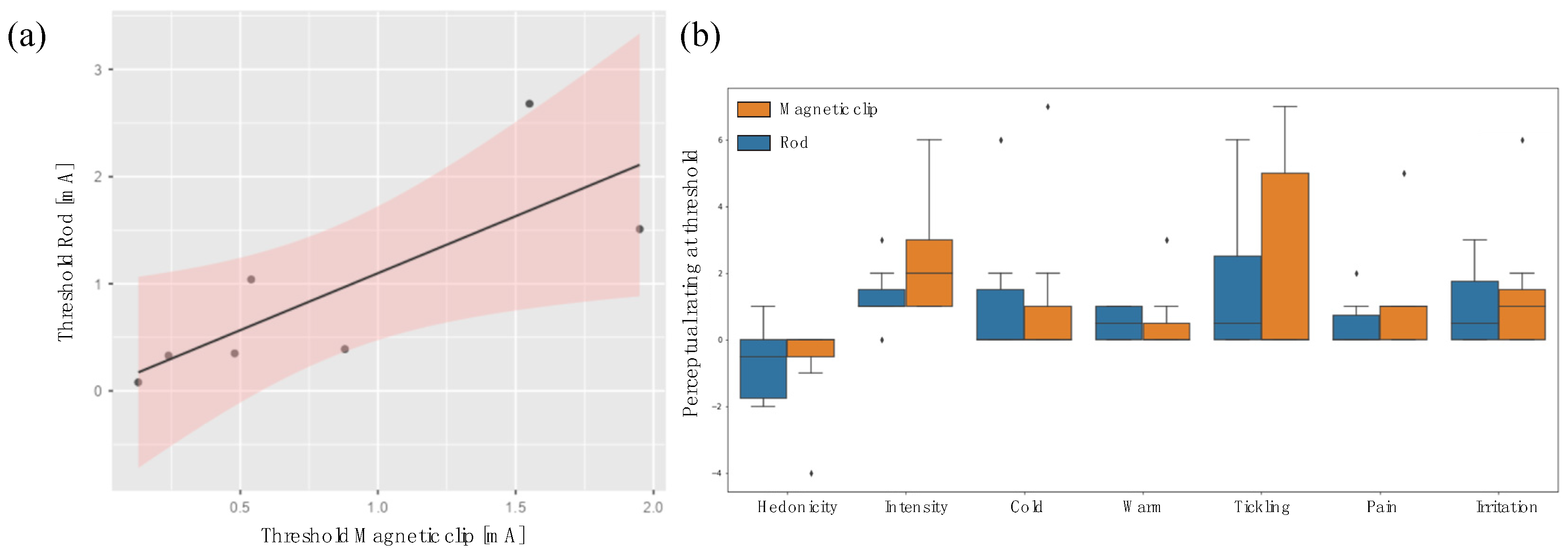
Detection thresholds for electric stimulation were measured on seven normosmic individuals using both configurations of stimulator and the results are illustrated in Figure 3a. The straight line corresponds to the best linear regression fit and the shaded area is the standard error. Despite the low number of measurements, the results indicate similar detection thresholds. Participants also provided similar perceptual ratings at threshold, again with the provision that these data are very limited (see Figure 3b) suggesting that the two stimulators produce similar sensations.
Figure 3. Perceptual ratings. (a) Comparison of threshold for electrical stimulation with best fit linear regression and standard error. (b) Comparison of perceptual ratings for seven normosmic participants to electrical stimulation at threshold at the anterior septum using the magnetic clip versus rod designs.
In conclusion, as the nasal clip generates equivalent sensations to the rod (in terms of sensitivity and qualitative perception), both stimulation devices can be considered for integration in a future device restoring olfaction. Because the nasal clip is easier to position in the nose and to use, it seems a particularly interesting option for the future.

Author Contributions

Conceptualization and methodology, C.L., E.G., H.B.S., C.F., A.B., M.B. and J.B.; investigation, C.L., E.G., H.B.S., C.F., M.F. and M.B.; data curation, H.B.S.; writing—original draft preparation, C.L.; writing—review and editing, C.L., H.B.S., A.B. and M.B.; supervision, A.B., J.B. and M.B.; project administration, M.B.; funding acquisition, A.B. and M.B. All authors have read and agreed to the published version of the manuscript.

Funding

This project has received funding from both the European Union’s Horizon 2020 research and innovation program under grant agreement No 964529 (Pathfinder Rose project).

Institutional Review Board Statement

The study was conducted in accordance with the Declaration of Helsinki and the analyzed data comes from a larger project involving patients with olfactory disorders and normosmics. In this project (Ethics Committee of CPP Sud Ouest et Outre Mer IV, 21002), participants were tested with a device comprising an artificial nose and/or a nasal cavity stimulation system.

Data Availability Statement

Data is contained within the article.

Conflicts of Interest

The authors declare no conflicts of interest.

References

  1. Manesse, C.; Ferdenzi, C.; Mantel, M.; Sabri, M.; Bessy, M.; Fournel, A.; Faure, F.; Bellil, D.; Landis, B.M.; Hugentobler, M.; et al. The prevalence of olfactory deficits and their effects on eating behavior from childhood to old age: A large-scale study in the French population. Food Qual. Prefer. 2021, 93, 104273. [Google Scholar] [CrossRef]
  2. Makin, S. Restoring smell with an electronic nose. Nature 2022, 606, S12–S13. [Google Scholar] [CrossRef] [PubMed]
  3. Karunanayaka, K.; Cheok, A.D.; Vedadi, S. Digital Smell: Towards Electrically Reproducing Artificial Smell Sensations. IEEE Access 2023, 11, 50659–50670. [Google Scholar] [CrossRef]
Disclaimer/Publisher’s Note: The statements, opinions and data contained in all publications are solely those of the individual author(s) and contributor(s) and not of MDPI and/or the editor(s). MDPI and/or the editor(s) disclaim responsibility for any injury to people or property resulting from any ideas, methods, instructions or products referred to in the content.

Article Metrics

Citations

Article Access Statistics

Multiple requests from the same IP address are counted as one view.