


Abstract
Flexible sensors, with an active layer made of graphene oxide (GO), were produced to detect volatile organic compounds (VOCs) at room temperature. Copper interdigitated electrodes were inkjet-printed on a substrate of bimatted polyester, and the direct drop-casting of a GO water solution was carried out to coat the devices. The performance of both commercial GO and GO synthesized by a modified Hummers’ method was investigated and compared. The oxygenated functional groups on the GO surface mainly enhance the selective sensing of polar analytes. The fabricated sensors exhibit the highest response towards alcohols, and minor sensitivity to esters, ketones, ethers and apolar petroleum ether.
1. Introduction
Volatile organic compounds (VOCs) are common and widespread air pollutants of both indoor and outdoor environments. As a consequence, the detection and monitoring of VOCs has attracted the attention of numerous researchers in the field of environmental protection. The development of efficient portable or wearable sensors to detect VOCs would allow us to overcome the problems associated with the commonly used method of gas chromatography, which guarantees high performance, but requires expensive equipment with complex sampling and analysis procedures. Graphene-related 2D materials are a convenient choice to design wearable devices, being flexible, stretchable, thermally stable, mechanically strong, lightweight and biocompatible [1]. In particular, the use of GO as a sensing material has gained increasing interest in recent years, due to the capability of the oxidized area to act as an adsorption site for analytes [2].
We propose flexible sensors obtained through the drop-casting of GO water solutions on copper interdigitated electrodes, previously inkjet-printed on sheets of bimatted polyester. The performance of commercial GO and GO produced by a modified Hummers’ method was investigated to correlate structural properties and device sensitivity. The fabricated sensors exhibit the highest response towards alcohols, such as ethanol and isopropanol, although they are also only able to detect esters, ketones, ethers and apolar petroleum ether with minor sensitivity.
2. Materials and Methods
Copper interdigitated electrodes were inkjet-printed on flexible polyester sheets and coated with an active layer of GO through the drop-casting of a water solution with a concentration of 2 mg/mL. The dropped volume was set to 10 µL. Two types of GO were investigated, the first one purchased from Sigma-Aldrich and used without further purification, and the second one synthesized by a modified Hummers’ method. The fabricated devices, with a size of 1 × 2 cm, were exposed to several dilutions of gas analytes in a sealed stainless cell. Each vapor test was performed by passing a carrier gas (dry air) with a controlled flow through a glass cylinder containing the liquid analyte at room temperature. Additional dry-air steam was used to tune the dilution of the saturated stream.
3. Discussion
The GO surface is characterized by the presence of several chemical groups, such as carboxyl (−COOH), hydroxyl (−OH), epoxy (C−O−C), carbonyl (−C−OH), ketone (−C=O) and 5- and 6- membered ring lactols (O−C−O). The performed tests attested that the major absorption sites for analytes are specifically those in the oxygenated polar group, since the sensor response is significantly reduced as the polarity of the analytes decreases, as shown in Figure 1a.
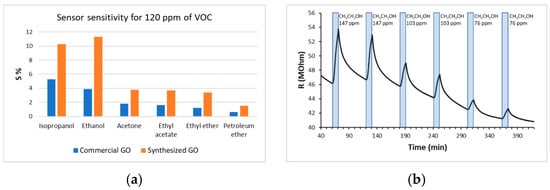
Figure 1.
(a) Sensor responses towards several VOCs with different dipole moments; (b) sensor resistance versus time upon exposure to decreasing ethanol concentrations of 147, 103 and 76 ppm.
The sensor responses were calculated by the following relationship:
where Rg and Ra are the electrical resistance measured with exposure to gas and air, respectively. In Figure 1b, the sensor responses towards ethanol are reported, for example, in the concentration range 147–176 ppm. The resistance values increase in presence of alcohol, as expected for a p-type semiconductor. Repeated cycling tests, performed in a period of six months, confirm the long-term stability of the GO active layer. Due to their capability for producing repeatable responses at room temperature, easy fabrication process, high elasticity and robustness, the described sensors could lead to the implementation of flexible wearable devices for air quality monitoring and chemical sensing.
Author Contributions
Conceptualization, A.M.L. and M.P.; methodology, G.C. and M.P.; formal analysis, E.B. and M.L.P.; investigation, A.M.L., E.B. and M.L.P.; resources, G.C. and M.P.; data curation, A.M.L. and M.P.; writing—original draft preparation, A.M.L. and M.P.; writing—review and editing, A.M.L. and M.P.; supervision, M.P. All authors have read and agreed to the published version of the manuscript.
Funding
This research received no external funding.
Institutional Review Board Statement
Not applicable.
Informed Consent Statement
Not applicable.
Data Availability Statement
The raw data supporting the conclusions of this article will be made available by the authors on request.
Acknowledgments
The authors would like to thank the BIOAGE agency for carrying out copper interdigitated electrode fabrication by using photolithographic printing techniques.
Conflicts of Interest
The authors declare no conflicts of interest.
References
- Singh, E.; Meyyappan, M.; Nalwa, H.S. Flexible graphene-based wearable gas and chemical sensors. ACS Appl. Mater. Interfaces 2017, 9, 34544–34586. [Google Scholar] [CrossRef] [PubMed]
- Toda, K.; Furue, R.; Hayami, S. Recent progress in applications of graphene oxide for gas sensing: A review. Anal. Chim Acta 2015, 878, 43–53. [Google Scholar] [CrossRef] [PubMed]
Disclaimer/Publisher’s Note: The statements, opinions and data contained in all publications are solely those of the individual author(s) and contributor(s) and not of MDPI and/or the editor(s). MDPI and/or the editor(s) disclaim responsibility for any injury to people or property resulting from any ideas, methods, instructions or products referred to in the content. |
© 2024 by the authors. Licensee MDPI, Basel, Switzerland. This article is an open access article distributed under the terms and conditions of the Creative Commons Attribution (CC BY) license (https://creativecommons.org/licenses/by/4.0/).