


Abstract
Carbon dioxide is considered a greenhouse gas and is the main cause of global warming. CO2 emissions have increased more and more each year. It is therefore important to be able to detect these levels of CO2 at room temperature. Chemical sensors consisting of FR-4 substrates with four membranes on which Fe2O3, SnO2, ZnO, and CuO nanoparticles have been deposited, were used in this experiment. The method used to create the sensors was the drop-casting technique. Two types of experiments were performed using these sensors, with each measurement considering a relative humidity value of either 0% or 50% in air. Based on the results, we have observed a significant improvement in detection for measurements with humidity. These sensors can detect concentration as low as 250 ppm with 50% humidity, compared to 700 ppm without humidity in air.
1. Introduction
Humans emit large amounts of carbon dioxide (CO2) mainly by burning fossil fuels such as coal, natural gas, and oil for energy production, transportation, as well as for industrial processes. The increase in these CO2 emissions causes the sun’s heat to be trapped in the atmosphere, leading to the climate crisis.
The current outdoor concentration of CO2 is around 400 ppm, but indoor concentrations can rise to between 2000 and 3000 ppm. Moreover, although this gas is not as harmful to humans as carbon monoxide (CO), levels of CO2 between 800 and 2000 ppm can cause headaches, tiredness, and loss of concentration.
Performing this experiment using rapid and low-cost techniques allows for the development of fast and economical sensors. The FR-4 substrates and compounds used are very affordable in terms of cost. Thanks to the UV led activation, these sensors do not require heating methods, therefore they can be easily used at room temperature.
2. Materials and Methods
The starting material was nanoparticles of Tin(IV) oxide with particle size below 100 nm, and Zinc oxide, Iron(III) oxide, and Copper(II) oxide with particle size below 50 nm, all supplied by Sigma–Aldrich (St. Louis, MO, USA).
The sensitive layers were formed creating dispersions of the metal oxide NPs, which were prepared in deionized water at a concentration of 2.5 mg/mL. They were deposited by drop-casting [1] on FR-4 substrates with interdigitated electrodes.
3. Discussion
In this project, the best responses were achieved with the SnO2 and ZnO sensors, whereas the responses were poor when using Fe2O3 and CuO oxides. As shown in Figure 1, the response was significantly better in humid air, with a response almost twice as good as that obtained in dry air.
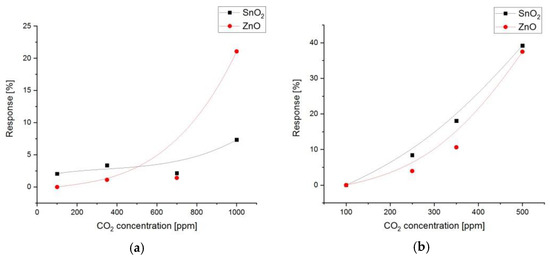
Figure 1.
Response curves of the SnO2 and ZnO sensors to different CO2 concentrations at room temperature: (a) response curves in dry air (without humidity); (b) response curves in wet air (with 50% humidity).
In this experiment, measurements were conducted to detect other gases such as CO or methane, but the best sensitivity values were obtained for CO2 gas.
The sensor response is calculated as the relative resistance change between the resistance measured in air () and the resistance measured when the gas is present ().
Author Contributions
Conceptualization and methodology, I.S. and J.P.S.; validation, I.S. and J.P.S.; formal analysis, J.G.; investigation, I.S. and J.G.; resources, I.S.; data curation J.G.; writing—original draft preparation, J.G.; writing—review and editing, I.S., J.G. and J.P.S.; visualization, I.S. and J.G.; supervision, I.S. and J.P.S. All authors have read and agreed to the published version of the manuscript.
Funding
This research received no external funding.
Institutional Review Board Statement
Not applicable.
Informed Consent Statement
Not applicable.
Data Availability Statement
Data are contained within the article.
Acknowledgments
The authors are grateful to the Spanish Ministry of Science, Innovation and Universities for supporting their research under the Smart-AirQ project (TED2021-131114B-C22) founded by MCIN/AEI/10.13039/501100011033 and by European Union “NextGenerationEU”/PRTR.
Conflicts of Interest
The authors declare no conflict of interest.
Reference
- Santos, J.; Sanchez-Vicente, C.; Azabal, A.; Ruiz-Valdepenas, S.; Lozano, J.; Sayago, I.; Sanjurjo, J. Automation and optimization device for the fabrication of sensors with nanomaterials. In Proceedings of the 2021 13th Spanish Conference on Electron Devices (CDE), Sevilla, Spain, 9–11 June 2021; pp. 129–131. [Google Scholar]
Disclaimer/Publisher’s Note: The statements, opinions and data contained in all publications are solely those of the individual author(s) and contributor(s) and not of MDPI and/or the editor(s). MDPI and/or the editor(s) disclaim responsibility for any injury to people or property resulting from any ideas, methods, instructions or products referred to in the content. |
© 2024 by the authors. Licensee MDPI, Basel, Switzerland. This article is an open access article distributed under the terms and conditions of the Creative Commons Attribution (CC BY) license (https://creativecommons.org/licenses/by/4.0/).