


Abstract
The aim of this study is to synthesize different polymeric solutions by mixing different types of polymers, metallic oxides and hydroxyapatites in different ratios suspended in alcoholic solutions and to evaluate the effectiveness of the obtained solutions by testing them on the most common types of bricks (adobe, classic, fire and cement).
1. Introduction
Due to the fact that we live in a continuously developing world, the degradation processes of heritage objects remain inevitable over time. For this reason, the continuous development of advanced materials capable of counteracting specific degradation processes is important. The destruction of heritage objects is usually linked to biological corrosion, caused by various microorganisms that include enzymes, organic and inorganic acids, amino acids, organic compounds, toxins, pigments, etc. The mechanism of damage mostly depends on the structure of the materials on which the microorganisms involved in biodeterioration grow, while the chemical composition of the substrate determines the type of microorganism. Due to the problem this research addresses, the multifunctional materials that will be obtained within this project will contribute to its sustainability after the implementation period [1,2,3,4].
2. Materials and Methods
In this study, different polymeric solutions were synthesized. The polymeric solutions were obtained by mixing different types of polymers, metallic oxides and hydroxyapatites in different ratios suspended in alcoholic solutions. To test the effectiveness of the obtained solutions, we manufactured as an inorganic support the most common types of bricks (adobe, classic, fire and cement) used in different heritage monuments. The obtained solutions were tested by different techniques to check if they have antimicrobial, hydrophobic and photocatalytic properties.
3. Results
Below is displayed a picture with classic bricks treated with the six different polymeric compounds (Figure 1).
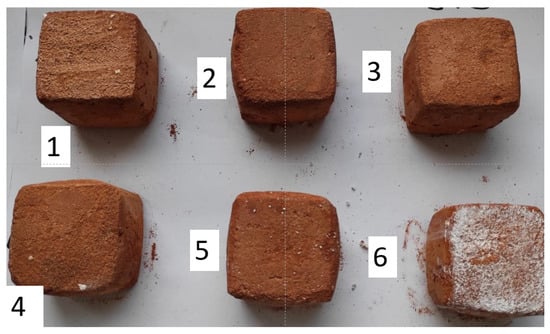
Figure 1.
Classic bricks on which the obtained polymer solutions were applied.
4. Conclusions
Both the inorganic support materials and the multifunctional polymer solutions were successfully obtained and the antimicrobial, hydrophobicity and photocatalytic tests showed promising preliminary results.
Author Contributions
Conceptualization, A.F. and R.C.F.; methodology, F.M., A.M., I.F., D.F., A.F., L.M.D. and R.C.F.; formal analysis R.C.F., A.F., I.F., A.M., L.M.D. and D.F., investigation, T.F., R.I.M., A.M.B., F.M. and C.-A.N.; writing—original draft preparation, R.C.F. and I.F.; writing—review and editing, R.C.F., L.M.D., A.F., I.F. and D.F.; supervision, R.C.F., L.M.D., A.F., I.F. and D.F.; project administration, R.C.F. All authors have read and agreed to the published version of the manuscript.
Funding
This work was supported by the Ministry of Research, Innovation and Digitization, CCCDI—UEFISCDI, project number PN-III-P2-2.1-PED-2021-0627, contract 591PED/2022, within PNCDI III. The support provided by the Ministry of Research, Innovation and Digitization through Program 1—Development of the national research and development system, Subprogram 1.2—Institutional performance—Projects to finance excellence in RDI, contract no. 15PFE/2021, is also gratefully acknowledged.
Institutional Review Board Statement
Not applicable.
Informed Consent Statement
Not applicable.
Data Availability Statement
The supporting data are available from the corresponding author.
Conflicts of Interest
The authors declare no conflict of interest.
References
- Bell, G. Euros are not the only fruit-Reaping the full harvest of Cultural Heritage. In Cultural Heritage as Economic Value; Mergos, G., Patsavos, N., Eds.; InHeriT: Athens, Greece, 2016; pp. 50–60. [Google Scholar]
- Nilson, T.; Thorell, K. Cultural Heritage Preservation: The Past, the Present and the Future; HH Press: Halmstad, Sweden, 2018. [Google Scholar]
- Fierascu, R.C.; Doni, M.; Fierascu, I. Selected Aspects Regarding the Restoration/Conservation of Traditional Wood and Masonry Building Materials: A Short Overview of the Last Decade Findings. Appl. Sci. 2020, 10, 1164. [Google Scholar] [CrossRef]
- Fierascu, R.C.; Fierascu, I.; Brazdiș, R.I.; Baroi, A.M.; Ortan, A. Antimicrobial Coating and with a Protective Role for Natural Stone Surfaces with Cultural Value and Method of Obtaining It. A00072, 13 February 2020. [Google Scholar]
Disclaimer/Publisher’s Note: The statements, opinions and data contained in all publications are solely those of the individual author(s) and contributor(s) and not of MDPI and/or the editor(s). MDPI and/or the editor(s) disclaim responsibility for any injury to people or property resulting from any ideas, methods, instructions or products referred to in the content. |
© 2023 by the authors. Licensee MDPI, Basel, Switzerland. This article is an open access article distributed under the terms and conditions of the Creative Commons Attribution (CC BY) license (https://creativecommons.org/licenses/by/4.0/).