Abstract
Cinnamon (Cinnamomum zeylanicum) is a spice largely consumed worldwide, but there is still restricted information about its fingerprint. This work aimed to investigate the mineral composition as a possible marker for the classification of cinnamon samples. To this aim, the mineral composition (P, S, Mg, Ca, K, Cu, Zn, B, Fe, Al, Mn, and Si contents) of 56 ground cinnamon samples from different regions of the State of São Paulo, Brazil was determined by inductively coupled plasma optical emission spectroscopy (ICP OES). Principal component analysis was exploited for sample classification, and the microelements presented the best correlation: PC1, PC2, and PC3 explained 93% of the observed variance at 95% confidence level. Si, Al, Fe, and Cu presented the most significant contributions to cluster analysis. Samples were classified into six groups, in which those presenting C. zeylanicum were well clustered, and the samples acquired in bulk as well as those whose labels declared traces of grains and/or spices presented the highest variability. Thus, it was pioneeringly demonstrated the possibility of identifying C. zeylanicum in commercial cinnamon powders, using microelements as authenticity markers.
1. Introduction
Cinnamon (Cinnamomum zeylanicum) is a spice originally from Asia, largely used worldwide for feeding and medicinal aims [1]. It presents a rich volatile composition, including bioactive compounds, such as cinnamic acid, cinnamate, and cinnamaldehyde [1,2]. Furthermore, benefits for human health, such as prevention of metabolic syndrome, insulin resistance, and reduction in lipids levels have been evidenced [3].
Spices are one of the most frequent and vulnerable foods to fraud worldwide [4]. The rising prices of cinnamon and the complexity of its production chain contribute to explain this vulnerability [4,5,6]. A typical fraud involves mislabeling with other lower-cost products with a similar composition, such as Cinnamomum cassia.
Food authenticity is important to protect the consumers, the food chain, and to mitigate food fraud [7]. Several strategies may be exploited to recognize standards for authentic foods, frequently involving instrumental techniques associated to chemometrics aiming at recognition of standards for authentic and nonauthentic food based on nontargeted (e.g., infrared and Raman spectroscopy) or targeted (e.g., chromatography and DNA-based) strategies [7,8].
Mineral composition has been used as a marker of food origin (terroir) and traceability of the geographic origin of foods, such as white tea [9], Spanish virgin olive oils [10], and yerba mate [11] were demonstrated. Moreover, the mineral composition determined by different spectroscopic techniques has been exploited to discriminate authentic and nonauthentic food, such as ethnic foods [12], honey [13], and organic sugarcane juice [14].
In this context, the aim of this work was to evaluate the feasibility of mineral composition as a possible authenticity marker for classifying cinnamon samples commercialized in Brazil. To this aim, 12 elements (P, S, Mg, Ca, K, Cu, Zn, B, Fe, Al, Mn, and Si) were investigated as targets, also considering their importance for human nutrition. The analytical procedure was based on microwave-assisted acid digestion and elemental determination by inductively coupled plasma optical emission spectroscopy (ICP OES). Principal component analysis was exploited for sample classification.
2. Materials and Methods
2.1. Material
Samples of ground cinnamon (n = 56) were acquired in 15 different supermarkets of 4 different regions of the State of Sao Paulo, Brazil. From these 56 samples, 8 were acquired in bulk and 48 were from different brands and product batches. Samples were identified and stored under refrigeration until the digestion for mineral determination.
2.2. Methods
2.2.1. Sample Preparation
Samples were ground by using a cryogenic mill (Freezer Mill 6870, SPEX, Elk River, MN, USA) under the conditions: 5 min of freezing followed by 5 cycles of 2 min of grinding (at 30 cps) intercalated with 1 min of freezing, in order to achieve a particle size lower than 100 µm. For microwave-assisted acid digestion (ETHOS 1600, Milestone, Sorisole, BG, Italy), 500 mg of each ground sample was transferred to Teflon flasks and 6.0 mL of 2.0 mol L−1 HNO3 plus 2.0 mL of 30% v/v H2O2 were added. The heating program involved 6 steps (1.3 min/120 °C (ramp); 2. 2 min at 120 °C; 3. 3 min/160 °C (ramp); 4. 2 min at 160 °C; 5.5 min/220 °C (ramp) and 6. 20 min at 220 °C). After the digestion, the volume was adjusted to 25 mL with water.
2.2.2. Mineral Determination
The mineral content of the samples was determined by ICP OES (iCAP 7400, Thermo, Waltham, MA, USA), under optimized conditions: radio-frequency power: 1.2 kW; plasma gas flow rate: 12.0 L min−1; nebulizer gas flow rate: 0.60 L min−1; sample aspiration rate: 1.5 mL min−1. The analyte concentrations were determined by external calibration. A certified reference material (CRM) with a similar composition to the samples (NIST SRM 1515—Apple leaves, Gaithersburg, MD, USA) was used to evaluate the accuracy of the procedure. The limits of detection (LOD) and quantification (LOQ) were determined according to the Equations (1) and (2), respectively.
LOD = 3.3 × (sdb/m)
LOQ = 3 × LOD
In which sdb = standard deviation of 10 blank measurements; m = calibration curve slope for each element.
2.2.3. Sample Classification
Principal component analysis (PCA) by the software The Unscrambler X (version 10.4, CAMO Software, Norway, 2016) was exploited to evaluate the sample clustering. Data treatment was based on total composition of minerals in the samples and carried out at the 95% confidence level, also considering the identification of outliers.
3. Results and Discussion
3.1. General Information about Cinnamon Samples
Samples were first separated into six groups, considering the labelled information. Samples in group (A, n = 9) are declared to contain gluten; samples in group (B, n = 17) and (C, n = 10) declared being originated of Cinnamomum zeylanicum, but only samples in set (C) were specified to be originated in Sri Lanka; (D, n = 8) corresponded to samples bought in bulk; (E, n = 8) corresponded to “Chinese cinnamon” (Cinnamomum cassia); and (F, n = 4) corresponded to ground cinnamon that declared to contain traces of celery, mustard, and/or other spices. The prices of the samples varied from US$ 0.02/g to US$ 0.14/g.
3.2. Mineral Composition and Sample Classification
Both microwave-assisted acid digestion and ICP OES are well established for elemental determination in food samples [15]. In addition, coefficient of variations lower than 8% and the agreement of the determined mass fractions with the certified values are indicative of good precision and accuracy for mineral determination in the samples. Ca, Mg, P, K, S, Fe, Al, and Si were determined in radial axial viewed configuration, while the microelements (Cu, Zn, B, and Mn) were determined by axial viewed configuration. The mass fractions are presented in Table 1.
Table 1.
Mineral mass fractions (mg kg−1) of cinnamon powder samples acquired in the Brazilian market. Mean values and uncertainties from triplicate measurements.
The mineral mass fractions found in this procedure agreed to a preliminary study in which it was proposed to identify possible differences between C. zeylanicum and C. cassia based on chemical composition. In the previous study [16], the variability observed in the mass fractions were lower than in the present study, which can be explained by the higher samples analyzed in the present work. Samples commercialized in the Brazilian market showed higher amounts of minerals than some reported in the literature [2,17], which is to be expected when considering the different geographical origins of the samples.
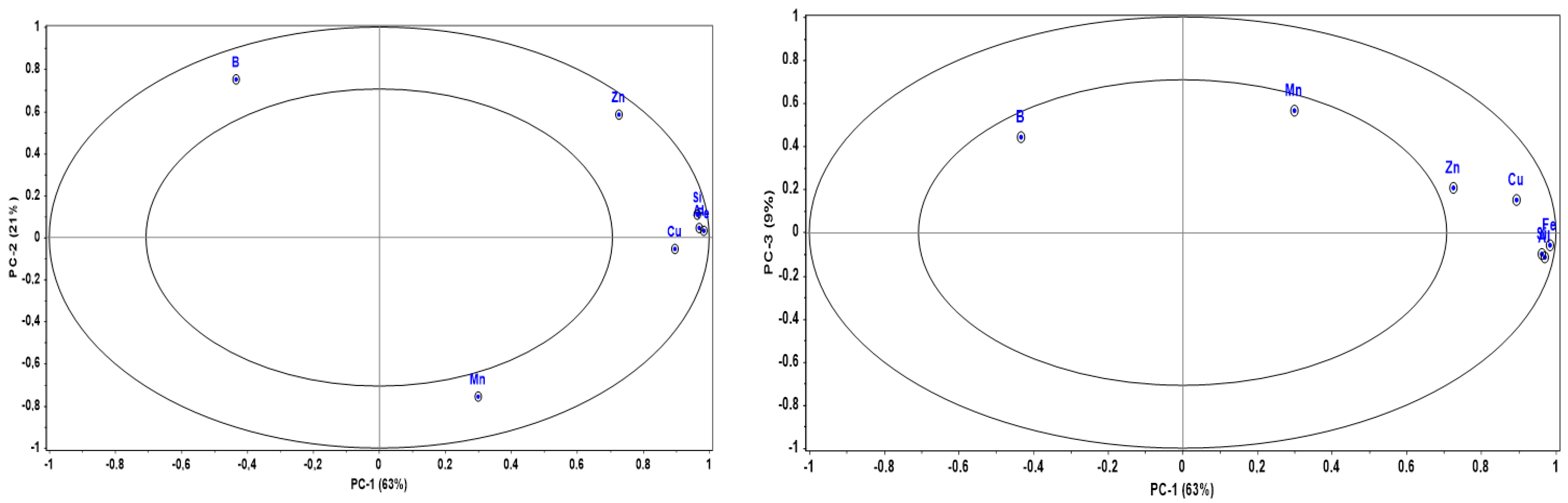
Principal Component Analysis (PCA) was exploited to evaluate the clustering of the samples divided into the A, B, C, D, E, and F groups (as defined by topic 3.1), according to the mineral profile. After the analysis of perceptual maps, it was observed that microelements were highest correlated and better explained the variability present in the sample set analyzed. So, the role of microelements in this classification was better investigated and a new classification model based on PCA was designed. The perceptual map showed that Fe, Cu, Al (as well as Si) presented the highest correlation and explained the variability of data, as previously indicated [16]. PC1, PC2 and PC3 are responsible for explaining 93% of the observed variance (Figure 1).
Figure 1.
Perceptual maps obtained by principal component analysis (PCA), in which PC1 explains 63% of the observed variance, PC2 21%, and PC3 9%, at the 95% confidence level.
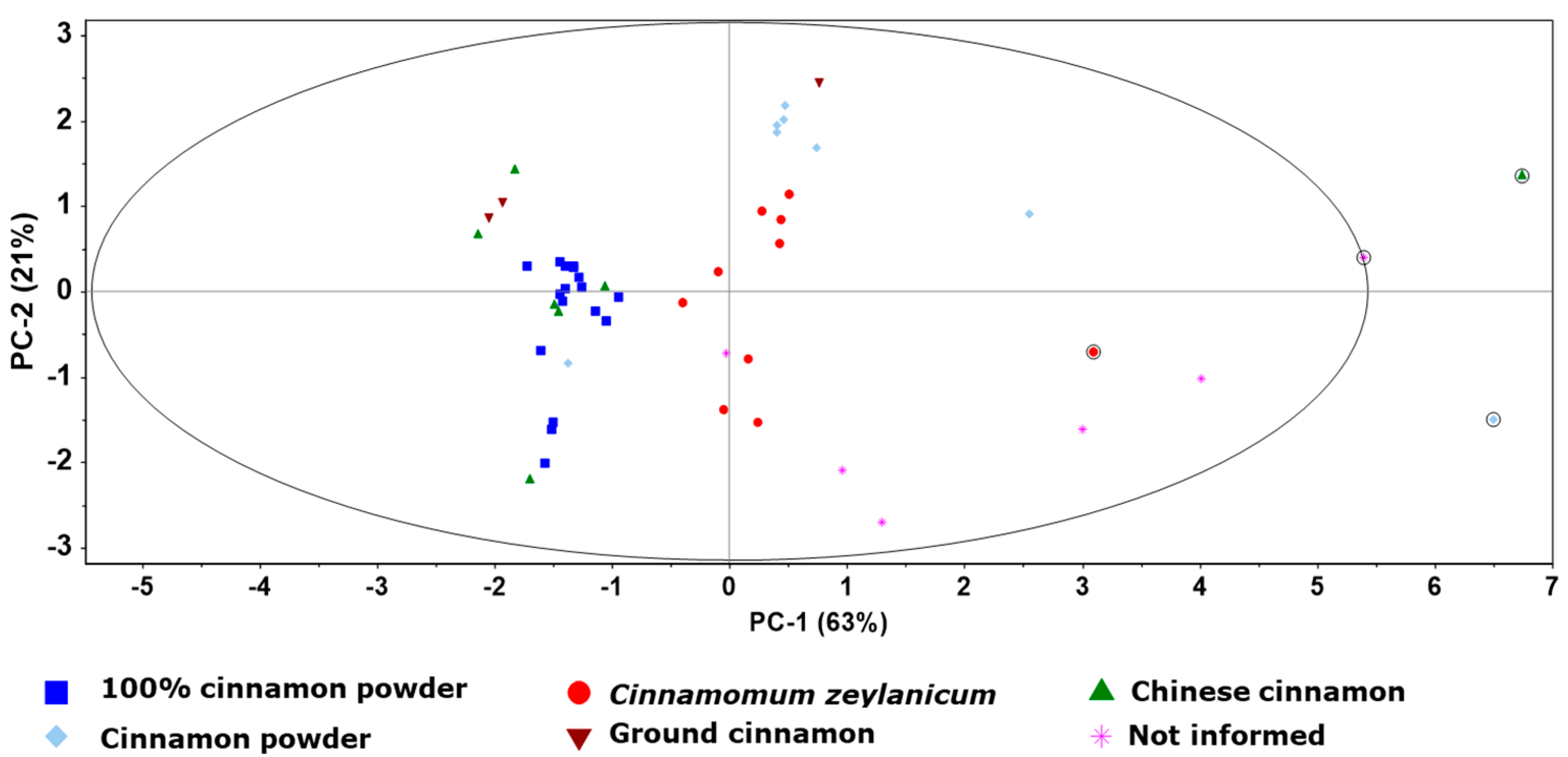
The six groups of samples were coherently classified and the groups B and C (those in which C. zeylanicum was the ingredient) were strongly clustered. Samples acquired in bulk as well as those whose labels declared traces of grains and/or spices, i.e., groups A, D, F, presented the highest variability and were dispersed. The group in which C. cassia was the main ingredient (group E) presented a high clustering for four samples, although the other four samples were dispersed among other groups. Four samples were pointed out as outliers according to the model, one of them did not cluster to C. zeylanicum group, another is in the limit established, and two others did not present the same profile of all other samples analyzed. Figure 2 shows the clusters observed for the samples analyzed, demonstrating the possibility of using this approach for classification of cinnamon available in retail.
Figure 2.
Sample distribution in the defined groups. Outliers were pointed out by circles.
4. Conclusions
The proposed pioneering strategy indicated the possibility to identify C. zeylanicum in commercial cinnamon powders, using microelements determined by ICP OES as authenticity markers. It also indicated the possibility to distinguish samples from C. cassia and others containing other grains, spices, and gluten, even though more studies are required to establish standard models for the classification of this product.
Author Contributions
Conceptualization: A.F.S.S., S.W.E., S.v.R., F.R.P.R.; methodology: L.C.M., L.M.B.M., I.C.G., B.B.R.d.G.; software: A.F.S.S.; validation: L.M.B.M., A.F.S.S.; formal analysis: A.F.S.S., L.M.B.M., L.C.M., I.C.G., B.B.R.d.G.; investigation: S.W.E., B.B.R.d.G., I.C.G.; resources: A.F.S.S., S.W.E., S.v.R., F.R.P.R.; data curation: A.F.S.S., L.M.B.M.; writing—original draft preparation: A.F.S.S., L.C.M., L.M.B.M., I.C.G., B.B.R.d.G.; writing—review and editing: S.W.E., S.v.R., F.R.P.R.; visualization: S.W.E., S.v.R., F.R.P.R.; supervision: S.W.E., S.v.R., F.R.P.R.; project administration: S.W.E., F.R.P.R., S.v.R.; funding acquisition: F.R.P.R., S.v.R. All authors have read and agreed to the published version of the manuscript.
Funding
This research was funded by Coordination for the Improvement of Higher Education Personnel (CAPES, financial code 001); University of Sao Paulo Program of Internationalization (USP/PrInt) supported by Capes (process number: 88887.371000/2019-00); National Council for Scientific and Technological Development (CNPq); São Paulo Research Foundation (FAPESP); and National Institute of Advanced Analytical Sciences and Technologies (INCTAA).
Institutional Review Board Statement
Not applicable.
Informed Consent Statement
Not applicable.
Data Availability Statement
Data sharing is not applicable to this article.
Conflicts of Interest
The authors declare no conflict of interest.
References
- Rao, P.V.; Gan, S.H. Cinnamon: A multifaceted medicinal plant. Evid. Based Complement. Alternat. Med. 2014, 2014, 642942. [Google Scholar] [CrossRef] [PubMed]
- Gul, S.; Safdar, M. Proximate composition and mineral analysis of cinnamon. Pak. J. Nutr. 2009, 8, 1456–1460. [Google Scholar] [CrossRef]
- Qin, B.; Panickar, K.S.; Anderson, R.A. Cinnamon: Potential role in the prevention of insulin resistance, metabolic syndrome, and type 2 diabetes. J. Diabetes Sci. Technol. 2010, 4, 685–693. [Google Scholar] [CrossRef] [PubMed]
- Silvis, I.C.J.; van Ruth, S.M.; van der Fels-Klerx, H.J.; Luning, P.A. Assessment of food fraud vulnerability in the spices chain: An explorative study. Food Control 2017, 81, 80–87. [Google Scholar] [CrossRef]
- Mordor Intelligence. Available online: https://www.mordorintelligence.com/industry-reports/cinnamon-market (accessed on 16 October 2020).
- Jeremić, K.; Kladar, N.; Vučinić, N.; Todorović, N.; Hitl, M.; Lalić-Popović, M.; Gavarić, N. Morphological characterization of cinnamon bark and powder available in the Serbian market. Biol. Serbica 2019, 41, 89–39. [Google Scholar] [CrossRef]
- Kamiloglu, S. Authenticity and traceability in beverages. Food Chem. 2019, 277, 12–24. [Google Scholar] [CrossRef] [PubMed]
- Oliveri, P.; Downey, G. Multivariate class modeling for the verification of food-authenticity claims. Trends Anal. Chem. 2012, 35, 74–86. [Google Scholar] [CrossRef]
- Ye, X.; Jin, S.; Wang, D.; Zhao, F.; Yu, Y.; Zheng, D.; Ye, N. Identification of the origin of white tea based on mineral element content. Food Anal. Methods 2017, 10, 191–199. [Google Scholar] [CrossRef]
- Beltrán, M.; Sánchez-Astudillo, M.; Aparicio, R.; García-González, D.L. Geographical traceability of virgin olive oils from south-western Spain by their multi-elemental composition. Food Chem. 2015, 169, 350–357. [Google Scholar] [CrossRef] [PubMed]
- Marcelo, M.C.A.; Martins, C.A.; Pozebon, D.; Dressler, V.L.; Ferrão, M.F. Classification of yerba mate (Ilex paraguariensis) according to the country of origin based on element concentrations. Microchem. J. 2014, 117, 164–171. [Google Scholar] [CrossRef]
- Kokhar, S.; Garduño-Diaz, S.D.; Marletta, L.; Shahar, D.R.; Ireland, J.D.; Jansen-van der Vliet, M.; Henauw, S. Mineral composition of commonly consumed ethnic foods in Europe. Food Nutr. Res. 2012, 56, 1–8. [Google Scholar] [CrossRef] [PubMed][Green Version]
- Chudzinska, M.; Baralkiewicz, D. Estimation of honey authenticity by multielements characteristics using inductively coupled plasma-mass spectrometry (ICP-MS) combined with chemometrics. Food Chem. Toxicol. 2010, 48, 284–290. [Google Scholar] [CrossRef]
- Barbosa, R.M.; Batista, B.L.; Barião, C.V.; Varrique, R.M.; Coelho, V.A.; Campiglia, A.D.; Barbosa, F., Jr. A simple and practical control of the authenticity of organic sugarcane samples based on the use of machine-learning algorithms and trace elements determination by inductively coupled plasma mass spectrometry. Food Chem. 2015, 184, 154–159. [Google Scholar] [CrossRef] [PubMed]
- Korn, M.G.A.; Boa Morte, E.S.; Santos, D.C.M.B.; Castro, J.T.; Barbosa, J.T.P.; Teixeira, A.P.; Fernandes, A.P.; Welz, B.; Santos, W.P.C.; Santos, E.B.G.N.; et al. Sample Preparation for the Determination of Metals in Food Samples Using Spectroanalytical Methods—A Review. Appl. Spectrosc. Rev. 2008, 43, 67–92. [Google Scholar] [CrossRef]
- Al-Numair, K.S.; Ahmed, S.E.B.; Ahmad, D.; Al-Assaf, A.H. Nutritive value, levels of polyphenols and anti-nutritional factors in Sri Lankan cinnamon (Cinnamomum zeyalnicum) and Chinese cinnamon (cinnamomum cassia). Res. Bult. Food Sci. Agric. Res. Cent. 2007, 154, 5–21. [Google Scholar]
- United States Department of Agriculture. Available online: https://www.nal.usda.gov/fnic/food-composition (accessed on 16 October 2020).
Publisher’s Note: MDPI stays neutral with regard to jurisdictional claims in published maps and institutional affiliations. |
© 2020 by the authors. Licensee MDPI, Basel, Switzerland. This article is an open access article distributed under the terms and conditions of the Creative Commons Attribution (CC BY) license (https://creativecommons.org/licenses/by/4.0/).