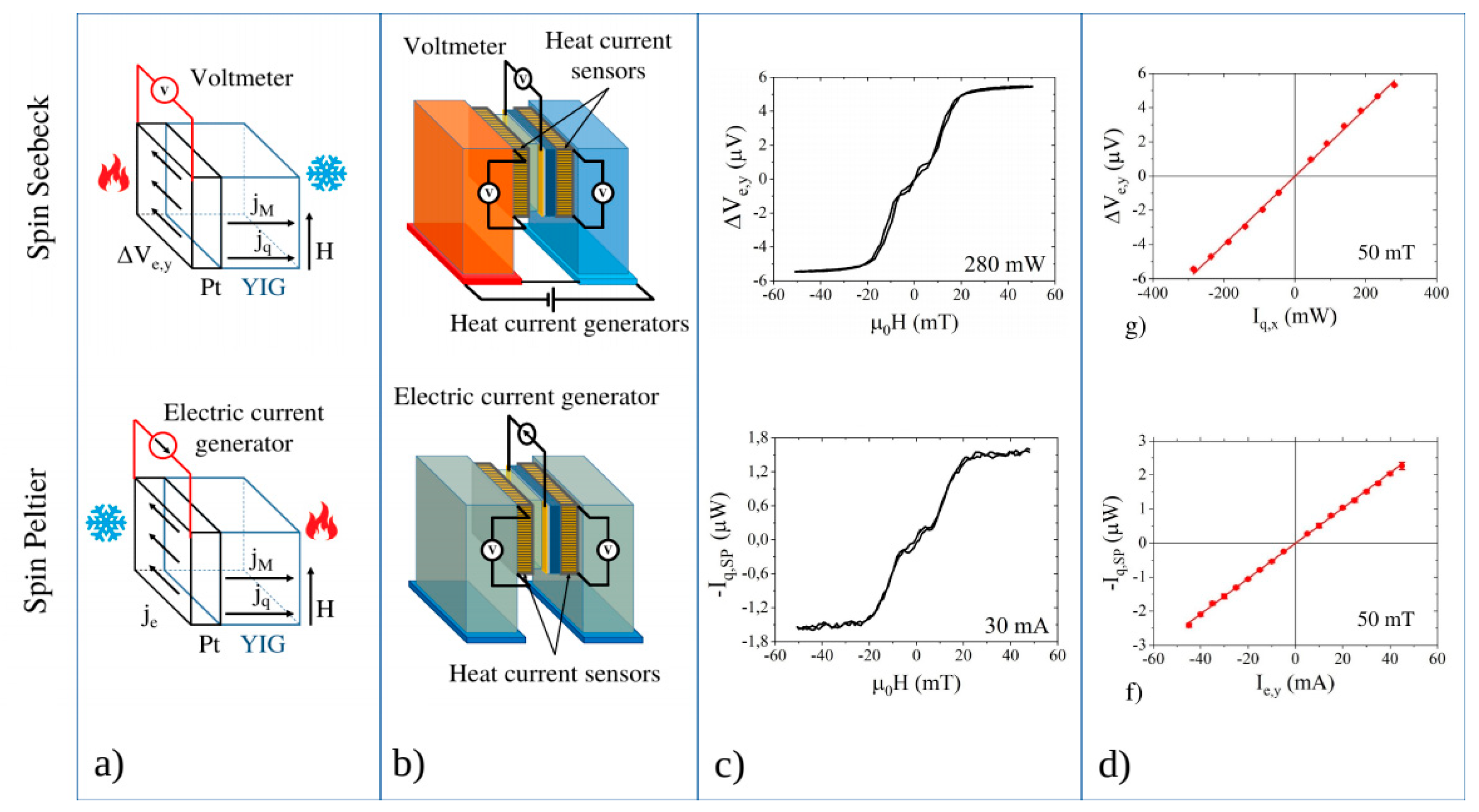
Reciprocal Relation between Spin Peltier and Spin Seebeck Effects †


References
- Uchida, K.; Adachi, H.; Ota, T.; Nakayama, H.; Maekawa, S.; Saitoh, E. Observation of longitudinal spin- Seebeck effect in magnetic insulators. Appl. Phys. Lett. 2010, 97, 172505. [Google Scholar] [CrossRef]
- Bauer, G.E.W.; Saitoh, E.; van Wees, B.J. Spin caloritronics. Nat. Mater. 2012, 391, 11. [Google Scholar]
- Saitoh, E.; Ueda, M.; Miyajima, H.; Tatara, G. Conversion of spin current into charge current at room temperature: Inverse spin-Hall effect. Appl. Phys. Lett. 2006, 88, 182509. [Google Scholar] [CrossRef]
- Flipse, J.; Dejene, F.; Wagenaar, D.; Bauer, G.E.W.; Youssef, J.B.; van Wees, B. Observation of the spin Peltier effect for magnetic insulators. Phys. Rev. Lett. 2014, 113, 027601. [Google Scholar] [CrossRef] [PubMed]
- Daimon, S.; Uchida, K.; Iguchi, R.; Hioki, T.; Saitoh, E. Thermographic measurements of the spin Peltier effect in metal/yttrium-iron-garnet junction systems. Phys. Rev. B 2017, 96, 024424. [Google Scholar] [CrossRef]
- Basso, V.; Kuepferling, M.; Sola, A.; Ansalone, P.; Pasquale, M. The spin Seebeck and spin Peltier reciprocal relation. IEEE Magn. Lett. 2018, 9, 1–4. [Google Scholar] [CrossRef]
- Sola, A.; Basso, V.; Kuepferling, M.; Dubs, C.; Pasquale, M. Experimental proof of the reciprocal relation between spin Peltier and spin Seebeck effects in a bulk YIG/Pt bilayer. Sci. Rep. 2019, 9, 204. [Google Scholar] [CrossRef] [PubMed]
© 2019 by the authors. Licensee MDPI, Basel, Switzerland. This article is an open access article distributed under the terms and conditions of the Creative Commons Attribution (CC BY) license (http://creativecommons.org/licenses/by/4.0/).
Share and Cite
Sola, A.; Basso, V.; Kuepferling, M.; Dubs, C.; Pasquale, M. Reciprocal Relation between Spin Peltier and Spin Seebeck Effects. Proceedings 2019, 26, 15. https://doi.org/10.3390/proceedings2019026015
Sola A, Basso V, Kuepferling M, Dubs C, Pasquale M. Reciprocal Relation between Spin Peltier and Spin Seebeck Effects. Proceedings. 2019; 26(1):15. https://doi.org/10.3390/proceedings2019026015
Chicago/Turabian StyleSola, Alessandro, Vittorio Basso, Michaela Kuepferling, Carsten Dubs, and Massimo Pasquale. 2019. "Reciprocal Relation between Spin Peltier and Spin Seebeck Effects" Proceedings 26, no. 1: 15. https://doi.org/10.3390/proceedings2019026015
APA StyleSola, A., Basso, V., Kuepferling, M., Dubs, C., & Pasquale, M. (2019). Reciprocal Relation between Spin Peltier and Spin Seebeck Effects. Proceedings, 26(1), 15. https://doi.org/10.3390/proceedings2019026015