

Next Issue
Volume 134, ETAGRO 2025
Previous Issue
Volume 132, IOCB 2025
 
 
proceedings-logo

Journal Browser

Journal Browser

Proceedings, 2025, Molecules4Life 2025
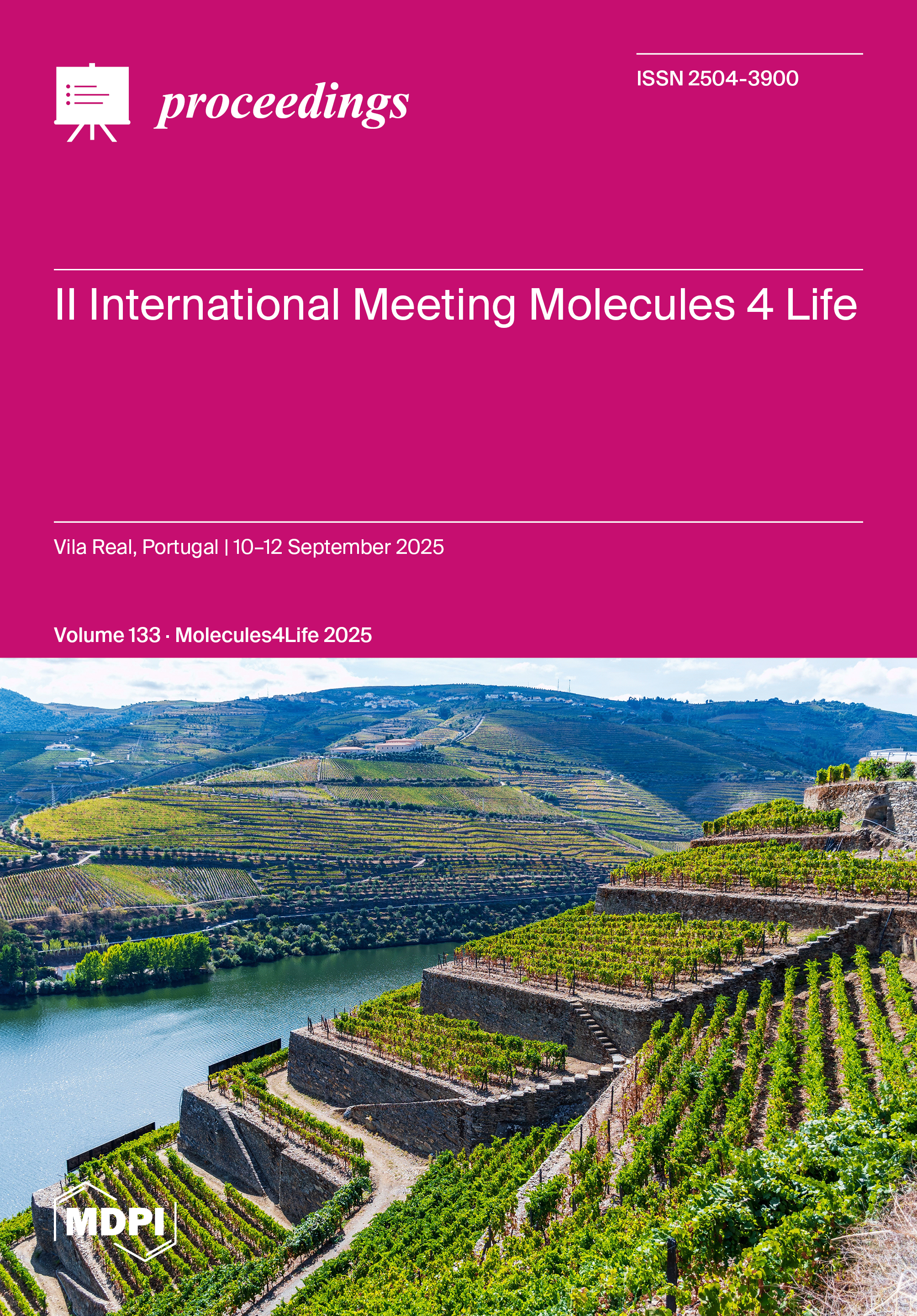
II International Meeting Molecules 4 Life

Vila Real, Portugal | 10–12 September 2025

Volume Editors:
Miguel Ribeiro, Chemistry Research Centre-Vila Real (CQ-VR), Vila Real, Portugal
Marco Lucas, Chemistry Research Centre-Vila Real (CQ-VR), Vila Real, Portugal

Number of Papers: 8
  • Issues are regarded as officially published after their release is announced to the table of contents alert mailing list.
  • You may sign up for e-mail alerts to receive table of contents of newly released issues.
  • PDF is the official format for papers published in both, html and pdf forms. To view the papers in pdf format, click on the "PDF Full-text" link, and use the free Adobe Reader to open them.
Cover Story (view full-size image): Molecules4Life 2025 brought together scientists from a wide range of disciplines to explore innovative paths toward sustainable development. Under the theme “Molecules4…Sustainable [...] Read more.
Order results
Result details
Select all
Export citation of selected articles as:

Editorial

Jump to: Other

4 pages, 164 KB  
Editorial
Preface of II International Meeting of Molecules4Life
by Miguel Ribeiro and Marco S. Lucas
Proceedings 2025, 133(1), 7; https://doi.org/10.3390/proceedings2025133007 - 23 Dec 2025
Viewed by 184
Abstract
The II International Meeting of Molecules4Life (M4L) was held from 10 to 12 September 2025 at the School of Life Sciences and Environment (ECVA), University of Trás-os-Montes and Alto Douro (UTAD), Vila Real, Portugal [...] Full article
(This article belongs to the Proceedings of II International Meeting Molecules 4 Life)
1 pages, 123 KB  
Editorial
Statement of Peer Review
by Miguel Ribeiro and Marco S. Lucas
Proceedings 2025, 133(1), 8; https://doi.org/10.3390/proceedings2025133008 - 23 Dec 2025
Viewed by 224
Abstract
In submitting conference proceedings to Proceedings, the Volume Editors of the proceedings would like to certify to the publisher that all papers published in this volume have been subjected to peer review by the designated expert referees and were administered by the [...] Read more.
In submitting conference proceedings to Proceedings, the Volume Editors of the proceedings would like to certify to the publisher that all papers published in this volume have been subjected to peer review by the designated expert referees and were administered by the Volume Editors in strict accordance with the peer review policies established for this conference [...] Full article
(This article belongs to the Proceedings of II International Meeting Molecules 4 Life)

Other

Jump to: Editorial

4 pages, 652 KB  
Proceeding Paper
From CO2 to Methane: A Thermodynamic Study of the Sabatier Reaction for Clean Energy Applications
by Carlos Andrade, Marisa Martins and Amadeu Borges
Proceedings 2025, 133(1), 1; https://doi.org/10.3390/proceedings2025133001 - 8 Dec 2025
Viewed by 353
Abstract
This work presents a numerical analysis of the steady-state thermodynamic equilibrium of the CO2 methanation reaction, based on solving mass balance equations using equilibrium constants. It evaluates how temperature, pressure, and the H2/CO2 ratio affect methane yield and by-product [...] Read more.
This work presents a numerical analysis of the steady-state thermodynamic equilibrium of the CO2 methanation reaction, based on solving mass balance equations using equilibrium constants. It evaluates how temperature, pressure, and the H2/CO2 ratio affect methane yield and by-product formation. The results show that temperatures below 450 °C, high pressures, and a stoichiometric H2/CO2 ratio maximize methane production and CO2 conversion. For instance, at 400 °C and 10 bar, the equilibrium molar fractions are approximately 0.30 for CH4, 0.00021 for CO, and 0.020 for CO2. The process is particularly promising when renewable hydrogen is used, offering a viable pathway for CO2 valorization. The methane produced can be integrated into existing natural gas networks, supporting the energy transition and helping reduce greenhouse gas emissions. Full article
(This article belongs to the Proceedings of II International Meeting Molecules 4 Life)
Show Figures

Figure 1

4 pages, 184 KB  
Proceeding Paper
Pyrolysis of Sewage Sludge: Unlocking the Hidden Potential for Valorization and Carbon Sequestration
by Miguel Oliveira, Vitor Valente and Amadeu Borges
Proceedings 2025, 133(1), 2; https://doi.org/10.3390/proceedings2025133002 - 8 Dec 2025
Viewed by 375
Abstract
Sewage sludge management remains a critical environmental and economic challenge due to high volumes, transport requirements, and landfill restrictions. Pyrolysis offers a promising alternative by reducing sludge mass and producing biochar with potential for soil fertility enhancement and long-term carbon sequestration. This study [...] Read more.
Sewage sludge management remains a critical environmental and economic challenge due to high volumes, transport requirements, and landfill restrictions. Pyrolysis offers a promising alternative by reducing sludge mass and producing biochar with potential for soil fertility enhancement and long-term carbon sequestration. This study integrates physicochemical characterization of Portuguese wastewater treatment plant sludges with experimental drying data and literature-based pyrolysis yields to estimate mass reduction, energy requirements, and carbon retention. A simplified life cycle comparison highlights potential reductions in greenhouse gas emissions, human toxicity, and land use, while also suggesting significant economic savings from avoided transport and landfill disposal. Full article
(This article belongs to the Proceedings of II International Meeting Molecules 4 Life)
4 pages, 721 KB  
Proceeding Paper
Numerical Analysis of PEMFCs as a Clean Energy Solution for Mobility
by Marisa Martins, Carlos Andrade and Amadeu D. S. Borges
Proceedings 2025, 133(1), 3; https://doi.org/10.3390/proceedings2025133003 - 8 Dec 2025
Viewed by 165
Abstract
This study investigates the potential of proton exchange membrane fuel cells (PEMFCs) for application in the transport sector through a numerical modelling approach, evaluating their performance and alignment with the European Union’s climate objectives. The model’s performance was assessed by calculating the percentage [...] Read more.
This study investigates the potential of proton exchange membrane fuel cells (PEMFCs) for application in the transport sector through a numerical modelling approach, evaluating their performance and alignment with the European Union’s climate objectives. The model’s performance was assessed by calculating the percentage error across the operating range, that were found to range from a minimum of 0.045% to a maximum of 2.913% across current densities up to 0.80 A/cm2. The objective is to assess the viability of PEMFCs as a clean alternative to internal combustion engines and to identify the key technical and policy challenges hindering their wider adoption. Full article
(This article belongs to the Proceedings of II International Meeting Molecules 4 Life)
Show Figures

Figure 1

4 pages, 1044 KB  
Proceeding Paper
Simulation of New Renewable Gas Mixtures for Injection into Natural Gas Networks
by Vitor Valente, Miguel Oliveira and Amadeu Borges
Proceedings 2025, 133(1), 4; https://doi.org/10.3390/proceedings2025133004 - 8 Dec 2025
Viewed by 234
Abstract
This study presents a computational tool for analyzing gas mixtures resulting from the integration of biomethane and hydrogen into natural gas networks. It calculates key properties, such as relative density, higher heating value and Wobbe index, based on composition, temperature and pressure, using [...] Read more.
This study presents a computational tool for analyzing gas mixtures resulting from the integration of biomethane and hydrogen into natural gas networks. It calculates key properties, such as relative density, higher heating value and Wobbe index, based on composition, temperature and pressure, using the van der Waals equation to model real gas behavior. The tool also offers interactive 3D visualizations to explore how these properties vary under different conditions. With prediction errors below 0.5% at 20 atm, it provides a reliable basis for assessing technical feasibility, regulatory compliance and energy efficiency in the integration of alternative gases into existing networks. Full article
(This article belongs to the Proceedings of II International Meeting Molecules 4 Life)
Show Figures

Figure 1

4 pages, 701 KB  
Proceeding Paper
Characterization of Pd Nanocomposites for the Oxygen-Reduction Reaction
by Ilias Ouanzi and Maria C. Oliveira
Proceedings 2025, 133(1), 5; https://doi.org/10.3390/proceedings2025133005 - 10 Dec 2025
Viewed by 335
Abstract
Carbon nanocomposites are essential supports in fuel cell catalysts, ensuring dispersion, anchoring, and reactant access. Here, we demonstrated an in situ synthesis of Pd nanoparticles using electrogenerated hydrophilic carbon (EHC) matrix that acts simultaneously as Pd support and reducing agent. To further enhance [...] Read more.
Carbon nanocomposites are essential supports in fuel cell catalysts, ensuring dispersion, anchoring, and reactant access. Here, we demonstrated an in situ synthesis of Pd nanoparticles using electrogenerated hydrophilic carbon (EHC) matrix that acts simultaneously as Pd support and reducing agent. To further enhance oxygen availability, a second EHC form with high oxygen storage capacity was integrated. The resulting material was characterized in terms of its electrochemical behaviour and long-term stability and compared with a nanocomposite without the O2-storing component. A time-dependent decline in electrolyte access to Pd sites was observed in both, but substantially mitigated at long-term by the oxygen-storing component. Full article
(This article belongs to the Proceedings of II International Meeting Molecules 4 Life)
Show Figures

Graphical abstract

5 pages, 180 KB  
Proceeding Paper
Enhancing the Nutritional Profile of Acheta domesticus with DHA-Rich Microalgae Supplementation
by Joana Ferreira, Patrícia Henriques, Paulo Bispo, Paula Ruivo, Nair Cunha, Vanda Andrade, Narcisa Bandarra and Gabriela Basto de Lima
Proceedings 2025, 133(1), 6; https://doi.org/10.3390/proceedings2025133006 - 19 Dec 2025
Viewed by 234
Abstract
Growing pressure to build sustainable food systems is steering interest toward edible insects as efficient, nutrient-rich alternatives. In this work, it was evaluated whether adding DHA extracted from microalgal biomass to the standard diet of Acheta domesticus can enrich the crickets’ lipid quality. [...] Read more.
Growing pressure to build sustainable food systems is steering interest toward edible insects as efficient, nutrient-rich alternatives. In this work, it was evaluated whether adding DHA extracted from microalgal biomass to the standard diet of Acheta domesticus can enrich the crickets’ lipid quality. Diets containing 0, 5, and 10% DHA were fed under controlled rearing. Subadult crickets were milled and analyzed. Compared with controls, supplemented groups showed higher total lipids and a healthier fatty-acid profile, with clear increases in omega-3 and the appearance of DHA. This minor dietary change is simple, scalable, and compatible with low-impact rearing, supporting the development of higher-value insect-based ingredients for human nutrition. Full article
(This article belongs to the Proceedings of II International Meeting Molecules 4 Life)
Back to TopTop
