Unlocking the Role of Food Processing in Nutrition-Smart and Nutrition-Sensitive Agriculture in West Africa: Challenges, Opportunities, and a Framework for Deployment †
 , and
, and
Abstract
1. Introduction
2. Conceptual Foundations: Integrating Nutrition into Agriculture Through NSA, NSmartAg, and Food Processing
2.1. Nutrition-Sensitive Agriculture (NSA)
2.2. Nutrition-Smart Agriculture (NSmartAg)
2.3. Food Processing as a Nexus for Nutrition and Agriculture
2.4. Toward a Unified Framework
3. Nutrition and Agriculture in West Africa: Status, Trends, and Structural Drivers
3.1. Nutrition Landscape: Persistent Deficits Amidst Dietary Transitions
3.2. Agricultural Systems: High Potential, Low Nutritional Yield
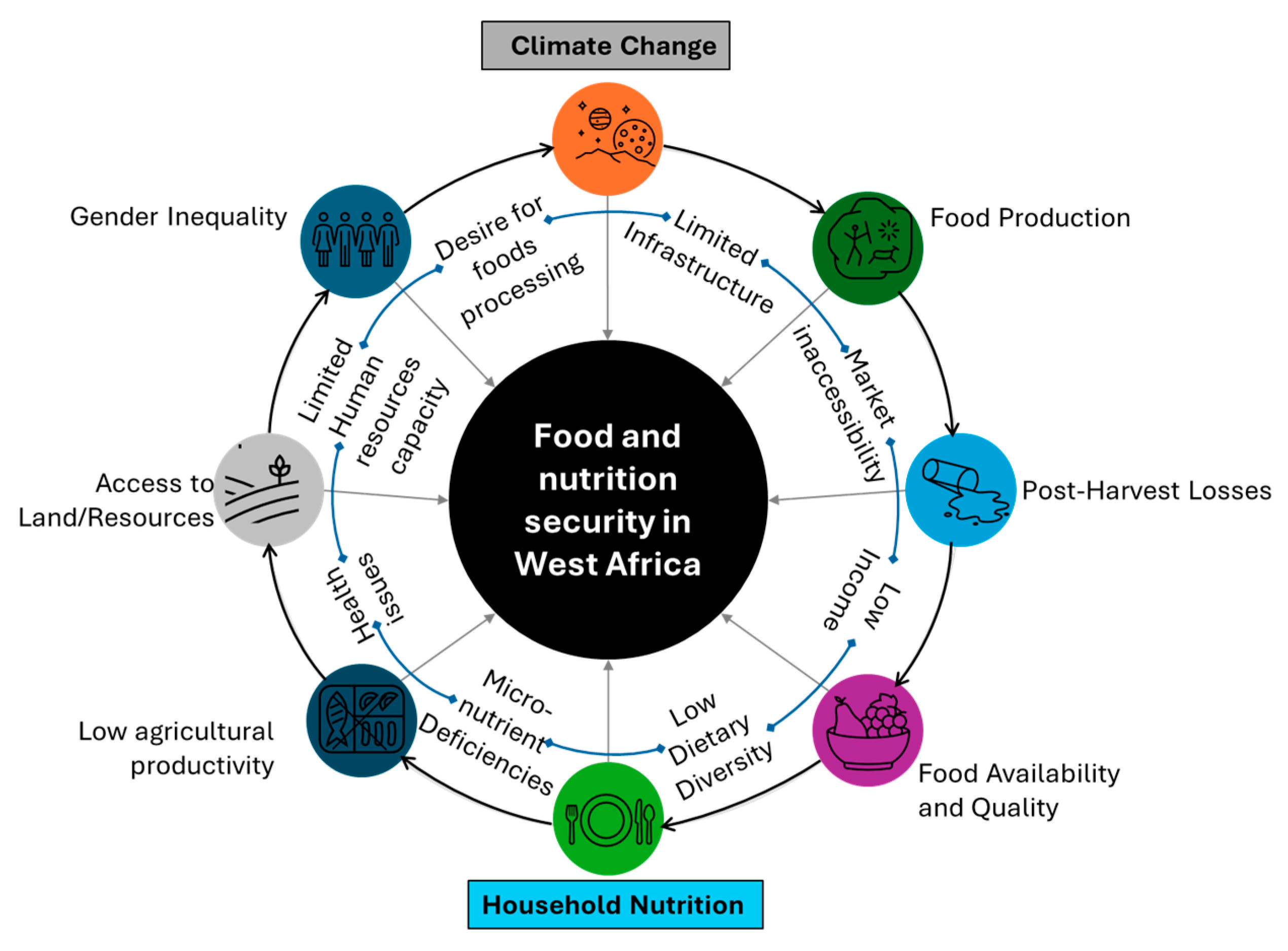
3.3. Structural Drivers of Nutrition Insecurity
4. Food Processing as a Link for Agricultural Production and Nutrition: Relevance, Challenges, and Opportunities
4.1. Structural and Technological Constraints
4.2. Financial and Market Barriers
4.3. Institutional and Policy Challenges
4.4. Socio-Economic Inequities and Gender Constraints
4.5. Emerging Opportunities for Sectoral Transformation
5. Challenges to the Implementation of NSA and NSmartAg in West Africa
5.1. Institutional Fragmentation and Policy Incoherence
5.2. Underinvestment in Nutrition-Oriented Research and Infrastructure
5.3. Capacity Gaps and Limited Technical Expertise
5.4. Financial Exclusion and Market Limitations
5.5. Sociocultural Barriers and Gender Inequality
5.6. Climate Vulnerability and Environmental Constraints
6. Leveraging Food Processing to Implement Nutrition-Sensitive and Nutrition-Smart Agriculture in West Africa
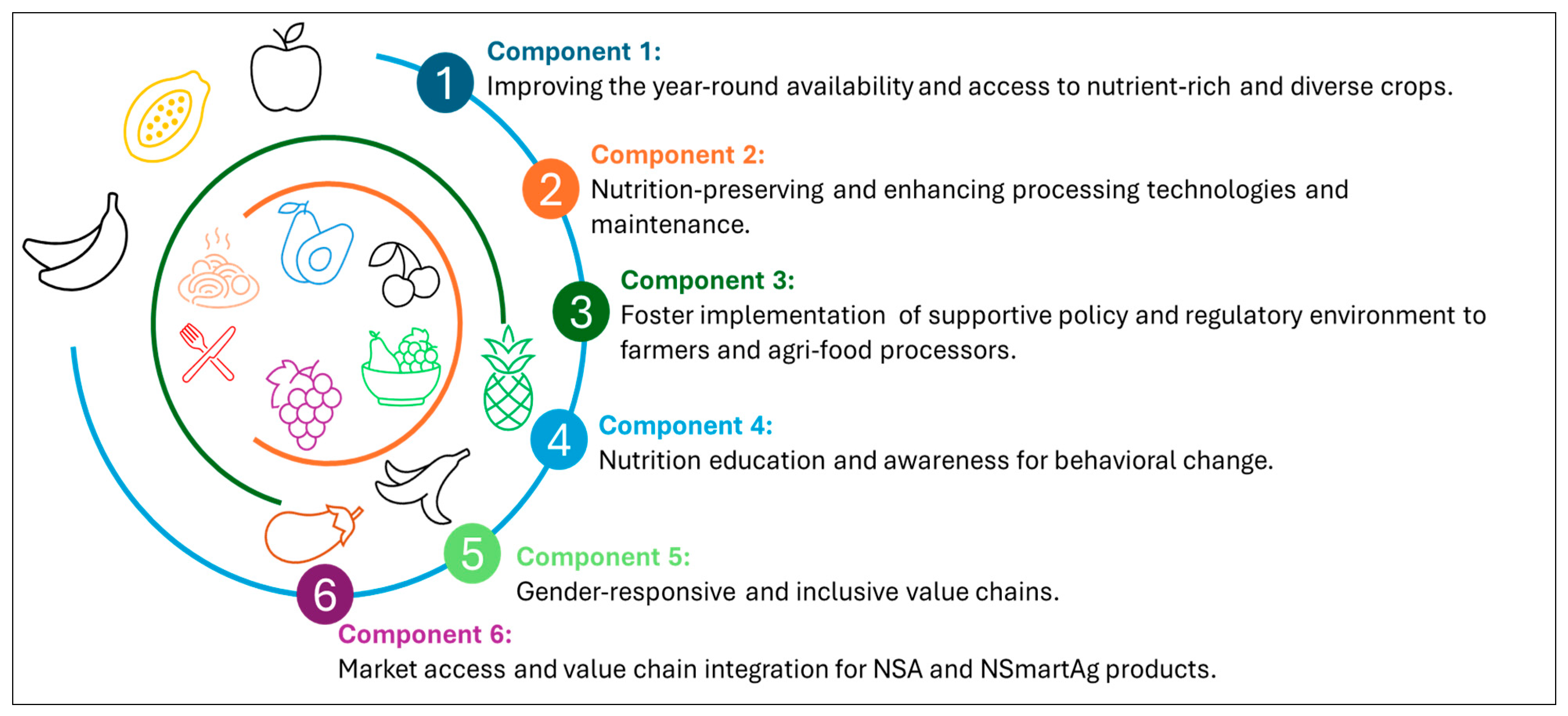
6.1. Conceptual Framework for Nutrition-Oriented Food Processing Actions
6.1.1. Year-Round Availability of Nutrient-Dense Raw Materials
6.1.2. Nutrition-Preserving and -Enhancing Processing Technologies
6.1.3. Supportive Policy and Regulatory Environment
6.1.4. Nutrition Education and Behavioral Change
6.1.5. Gender-Responsive and Inclusive Value Chains
6.1.6. Market Access and Value Chain Integration
6.2. Operationalizing the Framework: Pathways and Entry Points
- Crop-Processing Alignment: Link biofortified crop value chains to local processors through input subsidies and aggregation models. For example, supporting farmer cooperatives to grow iron-rich pearl millet that is processed into fortified porridge mixes.
- Investment in Appropriate Technology: Promote affordable, energy-efficient processing tools suitable for small and medium enterprises [e.g., solar dryers and low-cost extruders]. These technologies reduce nutrient loss while enhancing food safety.
- Nutrition-Sensitive Procurement Policies: Integrate locally processed, fortified foods into institutional feeding programs, such as school meals or maternal health initiatives, to stabilize demand and improve nutritional outcomes.
- Capacity Building for Processors: Provide training in nutrient-preserving processing, regulatory compliance, and business development. This includes incubator programs for youth- and women-led food ventures.
- Public–Private Partnerships [PPPs]: Incentivize partnerships between governments, NGOs, and private sector actors to co-develop value chains for nutrition-oriented products, especially in underserved areas.
- Monitoring and Evaluation Systems: Embed nutrition and gender metrics into food system assessments to guide policy and investment. Indicators should track not just production or income, but access to the market, actual dietary outcomes, and the affordability of nutritious processed foods.
7. Conclusions
Author Contributions
Funding
Institutional Review Board Statement
Informed Consent Statement
Data Availability Statement
Conflicts of Interest
References
- FAO; IFAD; UNICEF; WFP; WHO. In Brief to The State of Food Security and Nutrition in the World 2023. Urbanization, Agrifood Systems Transformation and Healthy Diets Across the Rural–Urban Continuum; FAO: Rome, Italy, 2023. [Google Scholar] [CrossRef] [Scilit]
- Ahinkorah, B.O.; Amadu, I.; Seidu, A.A.; Okyere, J.; Duku, E.; Hagan, J.E., Jr.; Budu, E.; Archer, A.G.; Yaya, S. Prevalence and factors associated with the triple burden of malnutrition among mother-child pairs in sub-Saharan Africa. Nutrients 2021, 13, 2050. [Google Scholar] [CrossRef] [Scilit]
- Popkin, B.M.; Ng, S.W. The nutrition transition to a stage of high obesity and noncommunicable disease prevalence dominated by ultra-processed foods is not inevitable. Obes. Rev. 2022, 23, e13366. [Google Scholar] [CrossRef] [Scilit] [PubMed]
- John, C.; Poh, B.K.; Jalaludin, M.Y.; Michael, G.; Adedeji, I.; Oyenusi, E.E.; Akor, B.; Charles, N.C.; Buthmanaban, V.; Muhardi, L. Exploring disparities in malnutrition among under-five children in Nigeria and potential solutions: A scoping review. Front. Nutr. 2024, 10, 1279130. [Google Scholar] [CrossRef] [Scilit]
- WHO. Global Nutrition Report 2023: Addressing Malnutrition in Fragile Contexts; World Health Organization: Geneva, Switzerland, 2023. [Google Scholar]
- UNICEF. Child Nutrition Situation in West and Central Africa: Regional Overview and Country Profiles; United Nations Children’s Fund: New York, NY, USA, 2022. [Google Scholar]
- Simane, B.; Kapwata, T.; Naidoo, N.; Cissé, G.; Wright, C.Y.; Berhane, K. Ensuring Africa’s Food Security by 2050: The Role of Population Growth, Climate-Resilient Strategies, and Putative Pathways to Resilience. Foods 2025, 14, 262. [Google Scholar] [CrossRef] [Scilit] [PubMed]
- Hussain, M.A.; Li, L.; Kalu, A.; Wu, X.; Naumovski, N. Sustainable Food Security and Nutritional Challenges. Sustainability 2025, 17, 874. [Google Scholar] [CrossRef] [Scilit]
- FAO. Nutrition-Sensitive Agriculture and Food Systems in Practice: Options for Intervention; Food and Agriculture Organization of the United Nations: Rome, Italy, 2017. [Google Scholar]
- World Bank. Nutrition-Smart Agriculture in Haiti; 2020; Volume 1. Available online: http://documents.worldbank.org/curated/en/222031597126417223 (accessed on 14 May 2025).
- Bilali, H.E.; Rokka, S.; Calabrese, G.; Borelli, T.; Grazioli, F.; Tietiambou, S.R.F.; Nanema, J.; Guimbo, I.D.; Dambo, L.; Nouhou, B.; et al. Conservation and promotion of neglected and underutilized crop species in West Africa: Policy and governance. Sustainability 2024, 16, 6194. [Google Scholar] [CrossRef] [Scilit]
- Adeyeye, S.A.O. The role of food processing and appropriate storage technologies in ensuring food security and food availability in Africa. Nutr. Food Sci. 2017, 47, 122–139. [Google Scholar] [CrossRef] [Scilit]
- Ruel, M.T.; Quisumbing, A.R.; Balagamwala, M. Nutrition-sensitive agriculture: What have we learned so far? Glob. Food Secur. 2018, 17, 128–153. [Google Scholar] [CrossRef] [Scilit]
- Avnee; Sood, S.; Chaudhary, D.R.; Jhorar, P.; Rana, R.S. Biofortification: An approach to eradicate micronutrient deficiency. Front. Nutr. 2023, 10, 1233070. [Google Scholar] [CrossRef] [Scilit]
- Sheoran, S.; Kumar, S.; Ramtekey, V.; Kar, P.; Meena, R.S.; Jangir, C.K. Current status and potential of biofortification to enhance crop nutritional quality: An overview. Sustainability 2022, 14, 3301. [Google Scholar] [CrossRef] [Scilit]
- Prentice, A.M. The triple burden of malnutrition in the era of globalization. In Nestlé Nutrition Institute Workshop Series; Karger: Basel, Switzerland, 2023; Volume 97, pp. 51–61. [Google Scholar] [CrossRef] [Scilit]
- Compaore, E.W.R.; Ouedraogo, O.; Bationo, P.E.; Zerbo, P. Determinants of stunting in children aged 0–59 months in three regions of Burkina Faso. BMC Public Health 2024, 24, 2392. [Google Scholar] [CrossRef] [Scilit]
- Tamir, T.T.; Gezhegn, S.A.; Dagnew, D.T.; Mekonenne, A.T.; Aweke, G.T.; Lakew, A.M. Prevalence of childhood stunting and determinants in low and lower-middle income African countries: Evidence from standard demographic and health survey. PLoS ONE 2024, 19, e0302212. [Google Scholar] [CrossRef] [Scilit] [PubMed]
- UNICEF. Child Nutrition Situation in West and Central Africa: Regional Overview and Country Profiles; United Nations Children’s Fund: New York, NY, USA, 2023. [Google Scholar]
- Bailey, R.L.; West, K.P.; Black, R.E. The epidemiology of global micronutrient deficiencies. Ann. Nutr. Metab. 2015, 66 (Suppl. S2), 22–33. [Google Scholar] [CrossRef] [Scilit]
- Casari, S.; Di Paola, M.; Banci, E.; Diallo, S.; Scarallo, L.; Renzo, S.; Gori, A.; Renzi, S.; Paci, M.; de Mast, Q.; et al. Changing dietary habits: The impact of urbanization and rising socio-economic status in families from Burkina Faso in sub-Saharan Africa. Nutrients 2022, 14, 1782. [Google Scholar] [CrossRef] [Scilit] [PubMed]
- Muonde, M.; Olorunsogo, T.O.; Ogugua, J.O.; Maduka, C.P.; Omotayo, O. Global nutrition challenges: A public health review of dietary risks and interventions. World J. Adv. Res. Rev. 2024, 21, 1467–1478. [Google Scholar] [CrossRef] [Scilit]
- FAO; IFAD; UNICEF; WFP; WHO. The State of Food Security and Nutrition in the World 2022. Repurposing Food and Agricultural Policies to Make Healthy Diets More Affordable; FAO: Rome, Italy, 2022. [Google Scholar] [CrossRef] [Scilit]
- Tura, M.; Tappi, S.; Valli, E.; Salas, P.G.; Suleiman, R.; Thabet, C.; Essaidi, I.; Muyonga, J.H.; Akumu, G.; Bahri, W.R.; et al. A selection of African traditional and emerging foods: Processing, composition, nutritional, sensory and nutraceutical aspects. Curr. Res. Food Sci. 2025, 101112, in press. [Google Scholar] [CrossRef] [Scilit]
- Mnisi, C.M.; Oyeagu, C.E.; Akuru, E.A.; Ruzvidzo, O.; Lewu, F.B. Sorghum, millet and cassava as alternative dietary energy sources for sustainable quail production—A review. Front. Anim. Sci. 2023, 4. [Google Scholar] [CrossRef] [Scilit]
- Vilakazi, B.; Mafongoya, P.L.; Odindo, A.O.; Phophi, M.M. The Role of Neglected Grain Legumes in Food and Nutrition Security and Human Health. Sustainability 2025, 17, 350. [Google Scholar] [CrossRef] [Scilit]
- Bhardwaj, R.L.; Parashar, A.; Parewa, H.P.; Vyas, L. An alarming decline in the nutritional quality of foods: The biggest challenge for future generations’ health. Foods 2024, 13, 877. [Google Scholar] [CrossRef] [Scilit]
- Furtak, K.; Wolińska, A. The impact of extreme weather events as a consequence of climate change on the soil moisture and on the quality of the soil environment and agriculture—A review. Catena 2023, 231, 107378. [Google Scholar] [CrossRef] [Scilit]
- FAO. The State of Food and Agriculture 2019: Moving Forward on Food Loss and Waste Reduction; Food and Agriculture Organization of the United Nations: Rome, Italy, 2019. [Google Scholar]
- Kumar, D.; Kalita, P. Reducing postharvest losses during storage of grain crops to strengthen food security in developing countries. Foods 2017, 6, 8. [Google Scholar] [CrossRef] [Scilit] [PubMed]
- Awulachew, M.T. Evaluation of pot technology preservation techniques for tomato fruit in East Arsi, Ethiopia. Int. J. Res. Agric. Food Sci. 2019, 5, 24–31. [Google Scholar]
- Bryan, E.; Alvi, M.; Huyer, S.; Ringler, C. Addressing gender inequalities and strengthening women’s agency to create more climate-resilient and sustainable food systems. Glob. Food Secur. 2024, 40, 100731. [Google Scholar] [CrossRef] [Scilit]
- Gnisci, D. Women’s Roles in the West African Food System: Implications and Prospects for Food Security and Resilience; OECD Publishing: Paris, France, 2016. [Google Scholar] [CrossRef]
- Lawrence, M. Fundamentals of a healthy and sustainable diet. Nutr. J. 2024, 23, 150. [Google Scholar] [CrossRef] [Scilit]
- de Bruin, S.; Dengerink, J.; van Vliet, J. Urbanisation as driver of food system transformation and opportunities for rural livelihoods. Food Sec. 2021, 13, 781–798. [Google Scholar] [CrossRef] [Scilit]
- Hawkes, C.; Harris, J.; Gillespie, S. Changing diets: Urbanization and the nutrition transition. In 2017 Global Food Policy Report; International Food Policy Research Institute (IFPRI): Washington, DC, USA, 2017; Chapter 4; pp. 34–41. [Google Scholar] [CrossRef] [Scilit]
- Baby-friendly Hospital Initiative (BFHI) tools. Nutrition and Food Safety. Available online: www.who.int/teams/nutrition-and-food-safety/food-and-nutrition-actions-in-health-systems/ten-steps-to-successful-breastfeeding (accessed on 18 May 2023).
- WHO. Report of the Commission on Ending Childhood Obesity; World Health Organization: Geneva, Switzerland, 2016. [Google Scholar]
- IFPRI. 2021 Global Food Policy Report: Transforming Food Systems After COVID-19; International Food Policy Research Institute: Washington, DC, USA, 2021. [Google Scholar] [CrossRef] [Scilit]
- World Bank. Macro Poverty Outlook. Country-by-Country Analysis and Projections for the Developing World; Word Bank: Washington, DC, USA, 2022. [Google Scholar]
- Knez, E.; Kadac-Czapska, K.; Grembecka, M. Effect of fermentation on the nutritional quality of the selected vegetables and legumes and their health effects. Life 2023, 13, 655. [Google Scholar] [CrossRef] [Scilit]
- Wudil, A.H.; Usman, M.; Rosak-Szyrocka, J.; Pilař, L.; Boye, M. Reversing Years for Global Food Security: A Review of the FoodSecurity Situation of theSub-Saharan Africa (SSA). Int. J. Environ. Res. Public Health 2022, 19, 14836. [Google Scholar] [CrossRef] [Scilit]
- OECD. Making Better Policies for Food Systems; OECD Publishing: Paris, France, 2021. [Google Scholar] [CrossRef] [Scilit]
- Corigliano, O.; Algieri, A. A comprehensive investigation on energy consumptions, impacts, and challenges of the food industry. Energy Convers. Manag. 2024, 23, 100661. [Google Scholar] [CrossRef] [Scilit]
- Zhou, Y.; Staatz, J. Projected demand and supply for various foods in West Africa: Implications for investments and food policy. Food Policy 2016, 61, 198–212. [Google Scholar] [CrossRef] [Scilit]
- Kariuki, A.N. Upgrading strategies and food security implications on smallholder farmers in Sub-Saharan Africa: A value chain review. J. Food Secur. 2018, 6, 141–154. [Google Scholar]
- Pingali, P. Agricultural policy and nutrition outcomes—Getting beyond the preoccupation with staple grains. Food Secur. 2015, 7, 583–591. [Google Scholar] [CrossRef] [Scilit]
- Balz, A.G.; Heil, E.A.; Jordan, I. Nutrition-sensitive agriculture: New term or new concept? Agric. Food Secur. 2015, 4, 6. [Google Scholar] [CrossRef] [Scilit]
- Global Nutrition Report. Action on Equity to End Malnutrition; Development Initiatives. 2020. Available online: https://globalnutritionreport.org/reports/2020-global-nutrition-report/ (accessed on 19 May 2025).
- World Bank. Financing Agribusiness in Sub-Saharan Africa: Opportunities, Challenges, and Investment Models. 2016. Available online: https://www.findevgateway.org/sites/default/files/publications/files/africa_agrifinance_2016.pdf (accessed on 14 May 2025).
- Langyintuo, A. Smallholder farmers’ access to inputs and finance in Africa. In The Role of Smallholder Farms in Food and Nutrition Security; Gomez y Paloma, S., Riesgo, L., Louhichi, K., Eds.; Springer: Berlin/Heidelberg, Germany, 2020; pp. 133–152. [Google Scholar] [CrossRef] [Scilit]
- Thompson, B.; Amoroso, L. Combating Micronutrient Deficiencies: Food-Based Approaches; Food and Agriculture Organization of the United Nations and CAB International: Rome, Italy, 2011. [Google Scholar]
- Masset, E.; Haddad, L.; Cornelius, A.; Isaza-Castro, J. A Systematic Review of Agricultural Interventions That Aim to Improve Nutritional Status of Children; EPPI-Centre, Social Science Research Unit, Institute of Education, University of London: London, UK, 2011. [Google Scholar]
- Herforth, A.; Ballard, T.J. Nutrition indicators in agriculture projects: Current measurement, priorities, and gaps. Glob. Food Secur. 2016, 10, 1–10. [Google Scholar] [CrossRef] [Scilit]


| Country | Stunting Rate (%) | Vitamin A Deficiency (%) | Iron Deficiency (%) | Agriculture GDP Share | Major Crops | Urban Obesity | Food Insecurity Rate | Post-Harvest Losses | References |
|---|---|---|---|---|---|---|---|---|---|
| Niger | 45.1 | 50 | 42 | 40 | Millet, Sorghum, Cowpeas | Low but increasing | 50 | 43 | [6] |
| Nigeria | 36.8 | 35 | 30 | 21 | Maize, Cassava, Yam, Millet, Rice | Rising rapidly | 42 | Up to 45 | [1,37,38] |
| Burkina Faso | 33.1 | 42 | 36 | 31 | Sorghum, Millet, Maize, Groundnut | Gradual rise | 41 | 40 | [29,39] |
| Mali | 30.4 | 40 | 34 | 38 | Sorghum, Millet, Maize, Rice | Moderate increase | 36 | 35 | [6] |
| Liberia | 28.0 | 38 | 29 | 33 | Rice, Cassava, Oil palm | Moderate rise | 39 | 35 | [1,37] |
| Sierra Leone | 26.3 | 36 | 30 | 35 | Cassava, Rice, Cocoa | Moderate increase | 38 | 32 | [6] |
| Guinea | 25.0 | 34 | 31 | 27 | Rice, Cassava, Groundnuts | Moderate rise | 35 | 30 | [9,29] |
| Gambia | 23.4 | 31 | 28 | 22 | Groundnuts, Rice, Millet | Slight increase | 33 | 28 | [37] |
| Côte d’Ivoire | 21.6 | 30 | 27 | 24 | Cocoa, Cassava, Yam, Rice | Urbanizing rapidly | 30 | 28 | [9,29] |
| Ghana | 18.8 | 28 | 22 | 20 | Cassava, Cocoa, Maize, Yam | Significant in cities | 24 | 25 | [37] |
| Togo | 18.6 | 29 | 24 | 26 | Maize, Cassava, Sorghum | Gradual urban rise | 27 | 26 | [1] |
| Senegal | 17.3 | 25 | 21 | 15 | Groundnut, Millet, Rice, Horticulture | Urban growth trend | 28 | 30 | [1] |
| Benin | 16.2 | 26 | 23 | 20 | Maize, Cassava, Rice, Yam | Moderate urban trend | 29 | 27 | [1,6] |
| Cabo Verde | 8.5 | 14 | 15 | 10 | Maize, Potatoes, Vegetables | High urbanization | 10 | 15 | [1,40] |
| Strategic Entry Point | Recommended Actions | Expected Outcomes |
|---|---|---|
| Availability of nutrient-dense raw materials | Promote climate-resilient and biofortified crop varieties Support crop diversification programs | Year-round availability of nutritious crops Expanded supply base for processors |
| Nutrition-preserving processing technologies | Introduce low-cost, nutrient-retaining equipment [e.g., solar dryers, extruders] Train processors in safe and hygienic techniques | Improved nutrient quality and food safety Reduced post-harvest nutrient loss |
| Policy and regulatory support | Integrate food processing in national food and nutrition strategies Simplify food safety compliance for SMES | Institutional alignment Increased formalization and product quality assurance |
| Nutrition education and behavior change | Implement consumer awareness campaigns Introduce school-based nutrition interventions | Increased demand for fortified and diverse foods Greater dietary diversity |
| Gender-responsive and inclusive value chains | Provide finance, training, and cooperative support to women/youth-led processors Reduce barriers to land and credit access | Increased inclusion and empowerment Enhanced productivity and enterprise growth |
| Market access and value chain integration | Develop rural–urban supply linkages Promote regional trade under afcfta Leverage digital platforms for logistics and sales | Expanded access to affordable nutritious foods Strengthened regional food systems |
| Monitoring and adaptive learning | Establish metrics for nutrition and equity impact Use monitoring and evaluation data to refine programs | Evidence-based policy adjustments Scalable, replicable interventions |
Disclaimer/Publisher’s Note: The statements, opinions and data contained in all publications are solely those of the individual author(s) and contributor(s) and not of MDPI and/or the editor(s). MDPI and/or the editor(s) disclaim responsibility for any injury to people or property resulting from any ideas, methods, instructions or products referred to in the content. |
© 2025 by the authors. Licensee MDPI, Basel, Switzerland. This article is an open access article distributed under the terms and conditions of the Creative Commons Attribution (CC BY) license (https://creativecommons.org/licenses/by/4.0/).
Share and Cite
Kpadonou, G.E.; Sobgui, C.M.; Edoh, R.; Ganyo, K.K.; Anihouvi, S.E.L.; Lamien, N. Unlocking the Role of Food Processing in Nutrition-Smart and Nutrition-Sensitive Agriculture in West Africa: Challenges, Opportunities, and a Framework for Deployment. Proceedings 2025, 118, 17. https://doi.org/10.3390/proceedings2025118017
Kpadonou GE, Sobgui CM, Edoh R, Ganyo KK, Anihouvi SEL, Lamien N. Unlocking the Role of Food Processing in Nutrition-Smart and Nutrition-Sensitive Agriculture in West Africa: Challenges, Opportunities, and a Framework for Deployment. Proceedings. 2025; 118(1):17. https://doi.org/10.3390/proceedings2025118017
Chicago/Turabian StyleKpadonou, G. Esaïe, Caroline Makamto Sobgui, Rebeca Edoh, Kyky Komla Ganyo, Sedo Eudes L. Anihouvi, and Niéyidouba Lamien. 2025. "Unlocking the Role of Food Processing in Nutrition-Smart and Nutrition-Sensitive Agriculture in West Africa: Challenges, Opportunities, and a Framework for Deployment" Proceedings 118, no. 1: 17. https://doi.org/10.3390/proceedings2025118017
APA StyleKpadonou, G. E., Sobgui, C. M., Edoh, R., Ganyo, K. K., Anihouvi, S. E. L., & Lamien, N. (2025). Unlocking the Role of Food Processing in Nutrition-Smart and Nutrition-Sensitive Agriculture in West Africa: Challenges, Opportunities, and a Framework for Deployment. Proceedings, 118(1), 17. https://doi.org/10.3390/proceedings2025118017