


Abstract
In this article, we develop multiplicative fractional versions of Simpson’s and Newton’s formula-type inequalities for differentiable generalized convex functions with the help of established identities. The main motivation for using generalized convex functions lies in their ability to extend results beyond traditional convex functions, encompassing a broader class of functions, and providing optimal approximations for both lower and upper bounds. These inequalities are very useful in finding the error bounds for the numerical integration formulas in multiplicative calculus. Applying these results to the Quadrature formulas demonstrates their practical utility in numerical integration. Furthermore, numerical analysis provides empirical evidence of the effectiveness of the derived findings. It is also demonstrated that the newly proven inequalities extend certain existing results in the literature.
Keywords:
Hermite–Hadamard Inequalities (HHIs); Riemann–Liouville fractional; Simpson’s inequality; Newton’s inequality; multiplicative calculus; multiplicatively convex function; s-convex function MSC:
26D10; 26D15; 26A51; 34A08
1. Introduction
Convexity is a basic notion in mathematics, notably in mathematical analysis, calculus, and optimization. The origins of convexity can be traced back to ancient civilizations, where early geometric concepts were first explored. Notably, mathematicians like Euclid (300 BC) delved into the properties of convex shapes such as circles and triangles. However, the formalization of convex functions emerged much later. The study of convex functions began to take shape during subsequent periods, with notable contributions from mathematicians such as Leonhard Euler (1707–1783) and Johann Radon (1887–1956). Euler, in particular, investigated the properties of convex curves. Mathematically, a convex function is defined as follows:
The systematic exploration of convex functions gained momentum as the field of convex analysis developed. Mathematicians such as Hermann Minkowski (1864–1909) and Constantin Carathéodory (1873–1950) laid the foundational groundwork in convex geometry and optimization theory. Today, convex optimization is a fundamental component of applied mathematics, with applications across diverse fields including engineering, economics, computer science, and machine learning. For more details about the history of convexity, one can visit [1,2]. Numerous researchers have been exploring the inequalities related to convexity from various perspectives; see [3,4,5] and the references listed therein. Hermite–Hadamard Inequalities (HHIs) represent one of the most significant mathematical inequalities involving convex mappings. For convex functions, HHI is stated as follows:
The inequalities (2) are reversed when a function is concave. The interested reader can visit [6,7,8,9,10,11] for more detials about inequality (2).
In [12], Breckner was the first mathematician to introduce a generalized convex function in 1979. Pycia was the first mathematician to verify Breckner’s results in 2001 [13]. The s-convexity enables a more precise examination of the function’s behavior, accelerating the search for optimum solutions. The s-convexity in the second sense is negotiated in [14]. The s-convexity is used in a variety of domains, including machine learning, optimization theory, and finance. We also observe in the main section that the results obtained by s-convexity are much better than those obtained by convexity. Secondly, s-convexity is the generalization of a convex function, so we can obtain the results for convex functions by using in the results of s-convex functions. A function is said to be s-convex if the following conditions hold:
with . When , the aforementioned inequality (3), defined on , reduces s-convexity to ordinary convexity. Dragomir et al. [15] presented Hermite–Hadamard’s type inequalities (HHIs) for s-convex functions in the second sense as follows:
The Simpson-type inequality is defined as follows:
Theorem 1.
Consider a function Ω defined on the interval . If Ω is four times continuously differentiable on , then
where .
This inequality provides an error bound for Simpson’s rule by comparing the actual integral of over to the Simpson’s rule approximation. Readers can find some recent interesting findings regarding inequality (5) in [16,17].
Grossman and Katz introduced non-Newtonian calculus between 1967 and 1970 by modifying the classical calculus of Leibniz and Newton. For more details on its concepts, see [18]. Bashirov et al. [19] fully described the ideas of multiplicative calculus appended to exponential functions, multiplicative derivative, and integral. Though less widespread than traditional calculus, it can be especially useful in fields like economics and finance. Multiplicative calculus is particularly useful for modeling systems that involve complex growth or decay. Unlike traditional calculus, which often relies on simple, linear approximations, multiplicative calculus uses nonlinear approximations, allowing it to capture more intricate interactions within nonlinear systems. This makes it especially valuable in fields like finance and economics, where both positive and negative numbers are frequently involved. The key advantages of multiplicative calculus are its ability to model complex growth patterns, handle both positive and negative numbers, and accurately represent exponential changes.
Initially, a multiplicative version of HHI was proved by Ali et al. [20], which is as follows:
Theorem 2
([20]). For a positive and multiplicative convex function on interval , the following inequalities hold:
After the seminal work by Ali et al. [20], researchers have extensively explored integral inequalities through multiplicative calculus. Ali et al. [21] derived bounds for Simpson’s and Ostrowski’s type inequalities for multiplicative integrals. Zhan et al. [22] extended these results to generalized convex functions and provided computational analyses to validate their findings. Chasreechai et al. [23] established Simpson’s and Newton’s type inequalities in the context of multiplicative calculus. Ali [24] investigated the fractional version of Simpson’s and Newton’s type inequalities. Bai and Qi [25] explored HHI for multiplicative convex functions. Budak et al. [26] presented multiplicative fractional HHI. Fu et al. [27] addressed integral inequalities involving multiplicative tempered fractional integrals. Chen and X. Huang [28] established Simpson’s type inequalities for s-convex functions via fractional integrals. Dragomir [29] discussed Hermite–Hadamard type inequalities associated with multiplicative convex functions. Khan and Budak [30] investigated midpoint and trapezoidal type inequalities for multiplicative integrals. For further details, references, and comprehensive reviews, readers can see [31,32,33,34].
Motivated by ongoing research, this work developed a fractional version of Simpson’s and Newton’s type inequalities using a multiplicatively generalized convexity of functions. These inequalities allow us to estimate error bounds for Simpson’s and Newton’s formulas in multiplicative calculus without relying on higher derivatives, which may be non-existent or difficult to determine. The s-convexity offers a broader range of bounds compared to convex functions, enhancing the robustness and effectiveness of these integral inequalities. We present numerical examples and computational analysis to validate these new inequalities and demonstrate their applicability to quadrature in multiplicative calculus. Multiplicative calculus is also a modern calculus with extensive applications in banking and finance, underscoring its study’s importance.
The structure of the article is outlined as follows. An overview of multiplicative convex functions is given in Section 2. Section 3 introduces our primary findings on multiplicative fractional Simpson- and Newton-type integral inequalities for s-convex functions in the second sense. Section 4 includes numerical examples and analysis to validate our results. Section 5 discusses applications to quadrature formulas. Finally, the concluding remarks and proposed future research directions are presented in Section 6.
2. Preliminary Concepts
In this section, we revisit some key concepts of multiplicative calculus and discuss certain inequalities. It is important to note that multiplicative calculus specifically focuses on positive functions. This means it deals exclusively with functions where all values are greater than zero, excluding negative values. One of the most important concepts is the multiplicative convex function, which may be defined as follows.
Definition 1
([35]). A function is said to be multiplicative convex if the following condition holds:
Based on Definition 1, we can conclude that
Definition 2
([36]). A function is said to be multiplicative s-convex in the second sense if the following condition holds:
Remark 1.
When , Definition 2 simplifies to Definition 1.
In 2008 [37], Bashirov gave the new concept of multiplicative operators termed *integral, denoted by . The usual integral is represented as . The function is multiplicative integrable on , if is positive and Riemann integrable on and
Definition 3
([37]). The multiplicative derivative of a positive function Ω is as follows:
If Ω has positive values and is differentiable at ς, then exists, where relates to the usual derivative , which is as follows:
Definition 4.
The multiplicative second derivative of a positive function Ω is as follows:
Here, exists because exists. If we iterate this procedure n-times, we affirm that if is a positive function and its derivative of nth order exists at , then exists:
Lemma 1
([37]). Suppose is multiplicative differentiable and suppose is differentiable so the function is multiplicative integrable, then
Definition 5
([38,39]). For , the Riemann–Liouville integrals and of order with are defined as follows:
and
respectively [38,39]. Here, denotes the well-known Gamma function. By setting , then Definition 5 reduces to the classical integral.
In [40], Abdeljawed and Grossman presented the following multiplicative Riemann–Liouville fractional integrals.
Definition 6
([40]). The multiplicative Riemann–Liouville fractional integrals (left) and (right) of order with are defined as follows:
Definition 7
([40]). The multiplicative Riemann–Liouville fractional derivatives (left) and (right) of order with are defined as follows:
One can consult [40] for more details about the multiplicative fractional calculus. The fractional version of the Hermite–Hadamard type inequalities (HHIs) was presented by Sarikaya et al. in 2013, stated as follows:
Theorem 3
([41]). Let be a positive function with and , then the following double inequalities hold:
Theorem 4
([26]). Let be a positive function with and , then following double inequalities holds for multiplicative Riemann-Liouville fractional (RLF) integrals:
3. Main Results
In this section, we establish the multiplicative versions of Simpson’s and Newton’s type inequalities using fractional integrals for multiplicative generalized convex functions. To derive our main inequalities, we rely on the succeeding lemmas:
Lemma 2.
Let be a multiplicative differentiable function on , with . If is a function integrable in the multiplicative sense, then the following identity holds:
Lemma 3.
Let be a multiplicative differentiable function on , with . If is a function integrable in the multiplicative sense, then the following identity holds:
3.1. Multiplicative Fractional Simpson’s Type Inequalities
In this part, we proved Simpson’s type inequalities for multiplicative generalized convex functions via Reimann–Liouville fractional integrals by using Lemma 2.
Theorem 5.
Assuming that the conditions outlined in Lemma 2 hold, if is a multiplicative s-covex function in the second sense on for some fixed , then the following Simpson’s type inequality holds:
where
Proof.
From Lemma 2 and using the multiplicative s-convexity of after taking the modulus property in (6), we have
Remark 3.
By setting in Theorem 5, then inequality (8) reduces to Theorem 4.1 in [24].
Remark 4.
By setting in inequality (8), then we obtain Theorem 6 in [22].
Corollary 1.
By taking in (8), then we have the following midpoint-type inequality:
Remark 5.
By setting in Theorem 5, then we have the following inequality:
Remark 6.
Inequality (17) provided better bounds for midpoint-type inequalities in multiplicative calculus compared to those established in ([30], Theorem 3.3).
Theorem 6.
Assuming that the conditions outlined in Lemma 2 hold, if is multiplicative s-covex in the second sense on , for some fixed , and then the following Simpson’s type inequality holds:
where
and .
Proof.
Remark 7.
By taking in inequality (18), then we obtain Theorem 4.3, which is proved by Ali in [24].
Remark 8.
By taking in inequality (18), then we obtain Theorem 7, which is proved by Zhan et al. in [22].
Remark 9.
By setting in inequality (18), then we obtain the following inequality:
This inequality is established by Chasreechai et al. in [23].
Corollary 2.
By taking in inequality (24), then we have the following midpoint-type inequality:
3.2. Multiplicative Fractional Newton’s Type Inequalities
In this part, we proved Newton’s type inequalities for multiplicative generalized convex functions via Reimann–Liouville fractional integral by using Lemma 3.
Theorem 7.
Assuming that the conditions outlined in Lemma 3 hold, if is multiplicative s-convex in the second sense on , for some fixed then we have the following inequality:
where
Proof.
Taking the modulus in (7) and using the multiplicative s-convexity of , we have
Hence,
This completes the proof. □
Remark 10.
By setting in Theorem 7, then inequality (25) is reduced to Theorem 5.1 in [24].
Corollary 3.
By setting in Theorem 7, then we obtain the following inequality:
where
Remark 11.
By setting in Theorem 7, then inequality (25) is reduced to Theorem 5.1 in [23].
Theorem 8.
Assuming that the conditions outlined in Lemma 3 hold, if is multiplicatively s-convex in the second sense on , for some fixed , , and then we have:
where
Proof.
Remark 12.
By setting in Theorem 8, then inequality (27) is reduced to Theorem 5.3 in [24].
Remark 13.
By setting in Theorem 8, then inequality (27) is reduced to Theorem 5.2 in [23].
Corollary 4.
By setting in Theorem 7, then we obtain the following inequality:
where
4. Numerical Examples and Their Computational Analysis
In this section, we conducted a comprehensive numerical analysis to validate the effectiveness of newly derived results. Through various numerical tests, we assess the accuracy and efficiency of the proposed approach in approximating integrals of differentiable multiplicatively convex functions. We aim to corroborate the theoretical findings with concrete numerical evidence and evaluate the performance of Simpson’s and Newton’s type inequalities across various scenarios.
Example 1.
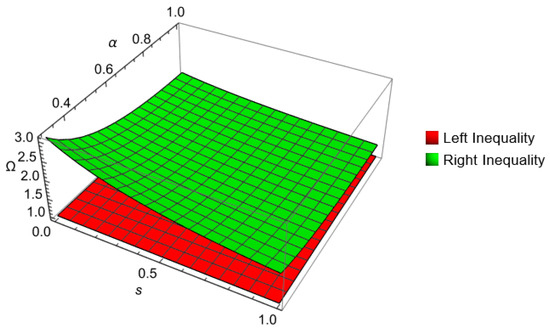
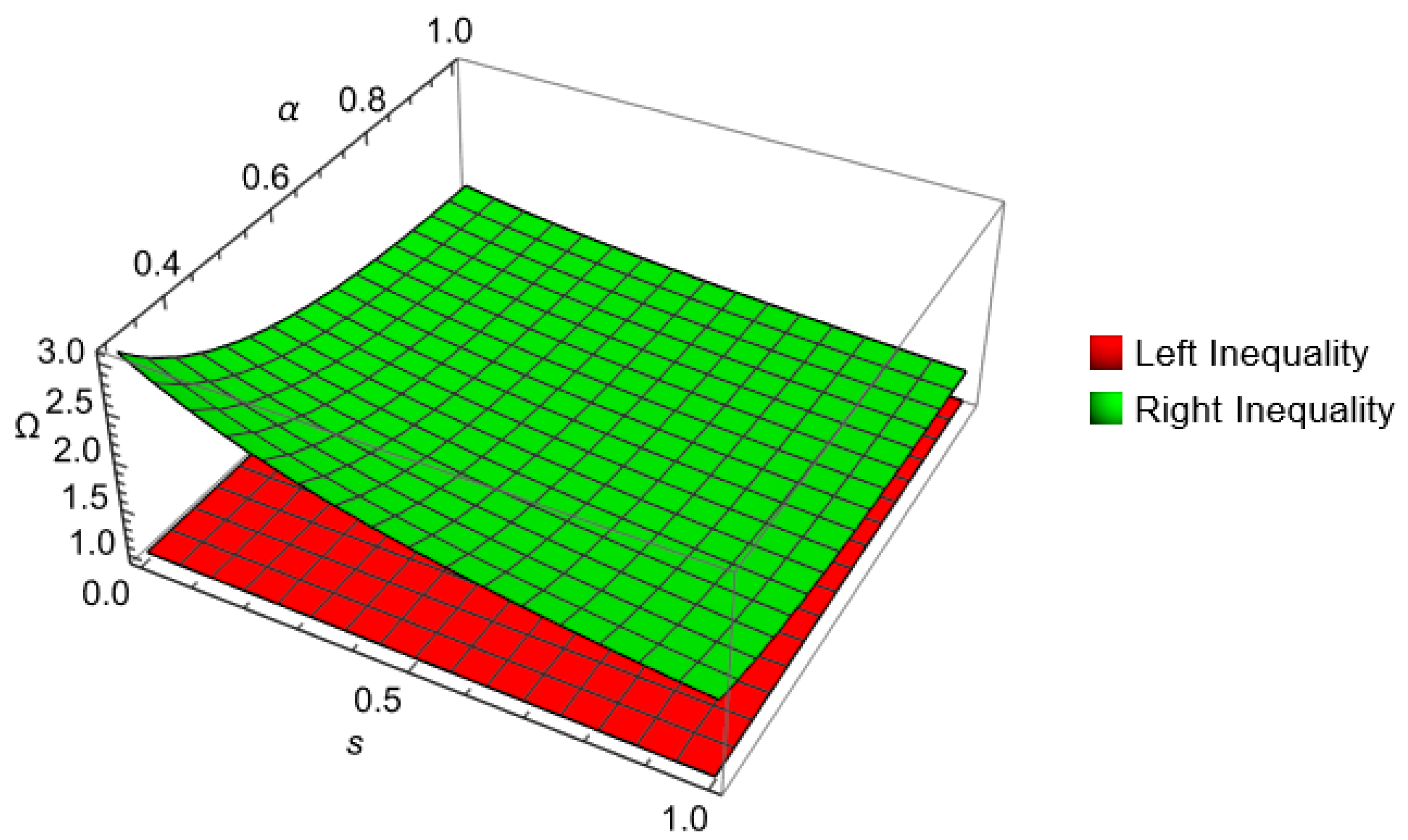
The graph of the inequalities of Example 1 is depicted in Figure 1 for and , which demonstrates the validity of Theorem 5.
Figure 1.
Graphical visualization of Theorem 5.
Example 2.
Example 3.
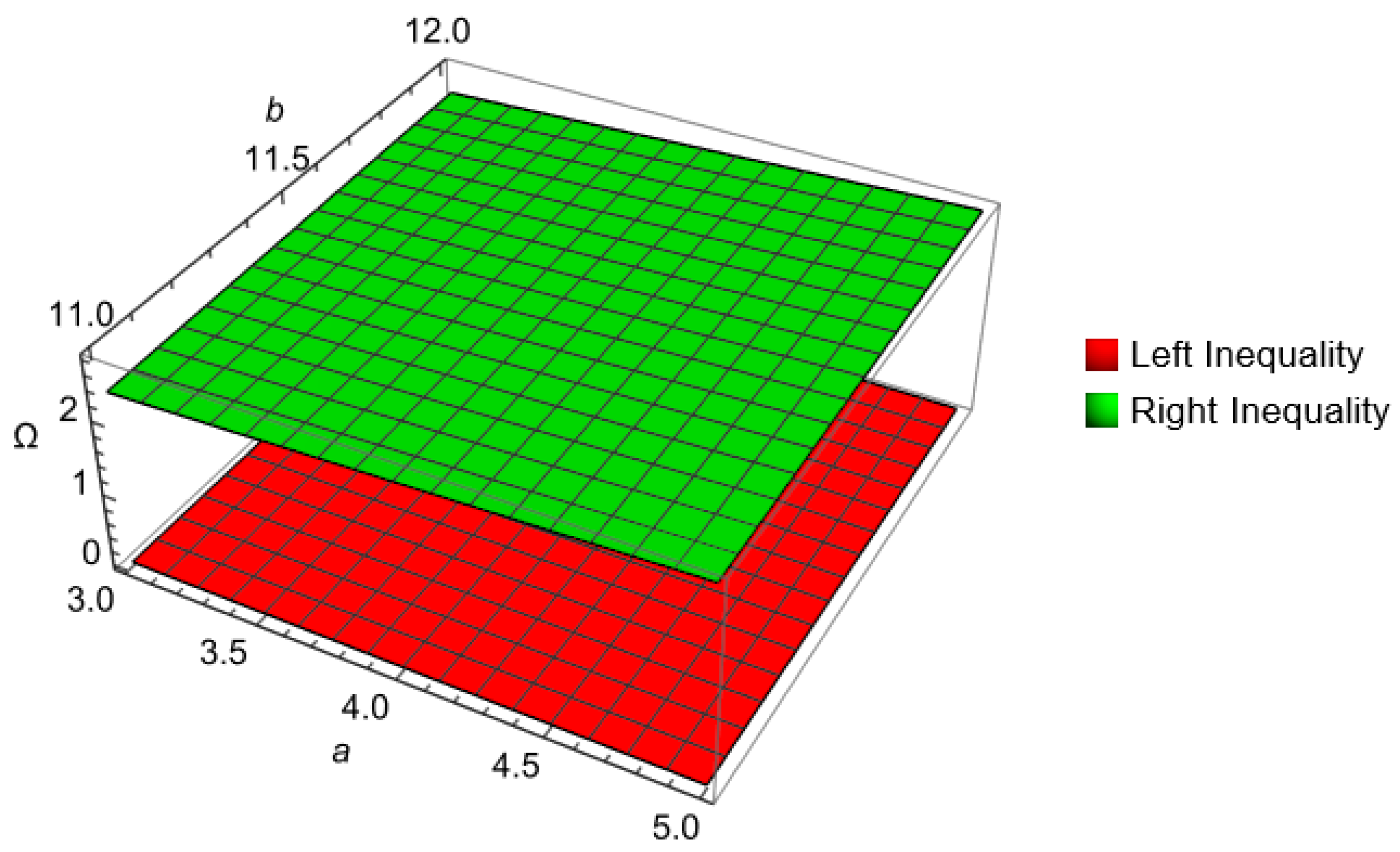
The graph of the inequalities of Example 3 is depicted in Figure 2 for and , which demonstrates the validity of Theorem 7.
Figure 2.
Graphical visualization of Theorem 7.
5. Applications to Quadrature Formula
In this section, we explore the application of the derived Simpson’s and Newton’s type inequalities to Quadrature formulas in multiplicative calculus. Applying Simpson’s and Newton’s inequalities to the Quadrature formula enhances the accuracy and efficiency of numerical integration techniques. By incorporating these inequalities, we can refine the approximation process in the Quadrature formula, particularly for functions with specific properties such as multiplicative convexity. These applications extend the theoretical understanding of Simpson’s and Newton’s inequalities and demonstrate their practical relevance in numerical analysis and computational mathematics.
5.1. Applications to Simpson’s Formula
Let be a partition of the points of the interval and consider Simpson’s quadrature formula:
where
is the multiplicative version of Simpson’s formula and the remainder term satisfies the estimation:
where , and are defined in Theorem 5. Now, we derive some error estimates for Simpson’s formula.
Proposition 1.
Using the conditions set in Theorem 5, then in (43), for every division Υ of , we have
where , and are defined in Theorem 5.
Proof.
Proposition 2.
Using the conditions set in Theorem 6, then in (43), for every division Υ of , we have
where and are defined in Theorem 6.
Proof.
With the help of Theorem 6, the proof is similar to Proposition 1. □
Remark 14.
The traditional error estimates for Simpson’s formula rely on the fourth-derivative from Taylor expansions. When the fourth derivative is either non-existent or significantly large across , these conventional estimates become impractical. In such scenarios, Equation (44) introduce alternative approximations for Simpson’s formula, marking a fresh perspective within multiplicative calculus.
5.2. Applications to Newton’s Formula
Let be a partition of the points of the interval and consider Newton’s quadrature formula:
where
is the multiplicative version of Newton’s formula and the remainder term satisfies the estimation:
where , and are defined in Theorem 7. Now, we derive some error estimates for Newton’s formula.
Proposition 3.
Using the conditions set in Theorem 7, then in (48), for every division Υ of , we have
where and are defined in Theorem 7.
Proof.
Proposition 4.
Using the conditions set in Theorem 8, then in (48), for every division Υ of , we have
where , and are defined in Theorem 8.
Proof.
With the help of Theorem 8, the proof is similar to Proposition 3. □
6. Conclusions
In conclusion, the research presented in this paper on multiplicative fractional Simpson’s and Newton’s type inequalities marks a significant advancement in numerical analysis and mathematical computation. This study has expanded the theoretical framework surrounding these inequalities and opened up new avenues for approximating definite integrals and solving mathematical problems. We established multiplicative fractional integral inequalities of Simpson’s and Newton’s type for generalized convex functions in the second sense. The use of multiplicative generalized convex function extends the results for convex functions and covers a large class of functions. The multiplicative generalized convex function also gave the best approximation. For example, from Table 1, it is clearly observed that when , we obtain the poor approximation, which is the case for convex functions, and when , we obtain very good lower and upper bounds of the inequalities. We conclude that the bounds obtained through generalized convex functions are better as compared to convex functions. Applying these results to the Quadrature formula demonstrates their practical utility in numerical integration. Furthermore, numerical analysis provides empirical evidence of the effectiveness of the derived findings. By understanding the results of this paper, future researchers can derive similar inequalities for coordinate convex functions and other domains of mathematics. These generalizations will also be beneficial for researchers working in the fields of mathematical modeling, optimization, and numerical analysis.
Table 1.
Comparative analysis between the left and right inequalities for discretization of s in Theorem 5 when in Example 1.
Author Contributions
Conceptualization, A.M.; Methodology, A.M., S.Ö. and B.B.-M.; Software, A.M.; Validation, A.M., S.Ö. and B.B.-M.; Writing—original draft, A.M.; Writing—review and editing, A.M. and S.Ö.; Supervision, Z.Z.; Project administration, Z.Z. and S.Ö. All authors have read and agreed to the final version of the manuscript.
Funding
This paper is supported by Researchers Supporting Project number (RSP2024R158), King Saud University, Riyadh, Saudi Arabia.
Data Availability Statement
Data are contained within the article.
Acknowledgments
This paper is supported by Researchers Supporting Project number (RSP2024R158), King Saud University, Riyadh, Saudi Arabia. The authors are thankful to the editor and the anonymous reviewers for their valuable comments and suggestions.
Conflicts of Interest
The authors declare no conflict of interest.
References
- Dwilewicz, R.J. A short history of Convexity. Differ. Geom. Dyn. Syst. 2009, 11, 112–129. [Google Scholar]
- Mitrinovic, D.S.; Pecaric, J.; Fink, A.N. Inequalities Involving Functions and Their Integrals and Derivatives; Springer Science Business Media: Berlin/Heidelberg, Germany, 1991; Volume 53. [Google Scholar]
- Budak, H.; Tunç, T.; Sarikaya, M.Z. Fractional Hermite-Hadamard type inequalities for interval valued functions. Proc. Am. Math. Soc. 2020, 148, 705–718. [Google Scholar] [CrossRef] [Scilit]
- Latif, M.A. Inequalities of Hermite–Hadamard type for functions whose derivatives in absolute value are convex with applications. Arab. J. Math. Sci. 2015, 21, 84–97. [Google Scholar] [CrossRef] [Scilit]
- Özcan, S. Some Integral Inequalities of Hermite-Hadamard Type for Multiplicatively s-Preinvex Functions. Int. J. Math. Model. Comput. 2019, 9, 253–266. [Google Scholar] [CrossRef] [Scilit]
- Robertson, E.F.; Hadamard, J. MacTutor History of Mathematics Archive; University of St Andrews: St Andrews, UK.
- Mandelbrojt, S.; Schwartz, L. Jacques Hadamard (1865–1963). Bull. Am. Math. Soc. 1965, 71, 107–129. [Google Scholar] [CrossRef] [Scilit]
- Sarikaya, M.Z.; Aktan, N. On the generalization of some integral inequalities and their applications. Math. Comput. Model. 2011, 54, 2175–2182. [Google Scholar] [CrossRef] [Scilit]
- Dragomir, S.S.; Agarwal, R.P. Two inequalities for differentiable mappings and applications to special means of real numbers and to trapezoidal formula. Appl. Math. Lett. 1998, 11, 91–95. [Google Scholar] [CrossRef] [Scilit]
- Kirmaci, U.S. Inequalities for differentiable mappings and applications to special means of real numbers to midpoint formula. Appl. Math. Comput. 2004, 147, 137–146. [Google Scholar] [CrossRef] [Scilit]
- Latif, M.A.; Dragomir, S.S.; Momoniat, E. On Hermite–Hadamard type integral inequalities for n-times differentiable m- and (α,m)-logarithmically convex functions. Filomat 2016, 30, 3101–3114. [Google Scholar] [CrossRef] [Scilit]
- Breckner, W.W. Stetigkeitsaussagen füreine Klasse verallgemeinerter konvexer funktionen in topologischen lin-earen Räumen. Publ. Inst. Math. 1978, 23, 13–20. [Google Scholar]
- Pycia, M. A direct proof of the s-Hölder Contin. Breckners-Convex Functions. Aequ. Math. 2001, 61, 128–130. [Google Scholar] [CrossRef] [Scilit]
- Hudzik, H.; Maligranda, L. Some remarks on s-convex functions. Aequ. Math. 1994, 48, 100–111. [Google Scholar] [CrossRef] [Scilit]
- Dragomir, S.S.; Fitzpatrick, S. The Hadamard’s inequality for s-convex functions in the second sense. Demonstr. Math. 1999, 32, 687–696. [Google Scholar]
- Rangel-Oliveros, Y.; Nwaeze, E.R. Simpson’s type inequalities for exponentially convex functions with applications. Open J. Math. Sci. 2021, 5, 84–94. [Google Scholar] [CrossRef] [Scilit]
- Sarikaya, M.Z.; Set, E.; Ozdemir, M.E. On new inequalities of Simpson’s type for s-convex functions. Appl. Math. Comput. 2010, 60, 2191–2199. [Google Scholar] [CrossRef] [Scilit]
- Grossman, M.; Katz, R. Non-Newtonian Calculus; Lee Press: Pigeon Cove, MA, USA, 1972. [Google Scholar]
- Bashirov, A.E. On line and double multiplicative integrals. TWMS J. Appl. Eng. Math. 2013, 3, 103–107. [Google Scholar]
- Ali, M.A.; Abbas, M.; Zhang, Z.; Sial, I.B.; Arif, R. On integral inequalities for product and quotient of two multiplicatively convex functions. Asian Res. J. Math. 2019, 12, 1–11. [Google Scholar] [CrossRef] [Scilit]
- Ali, M.A.; Budak, H.; Sarikaya, M.Z.; Zhang, Z. Ostrowski and Simpson type inequalities for multiplicative integrals. Proyecciones 2021, 40, 743–763. [Google Scholar] [CrossRef] [Scilit]
- Zhan, X.; Mateen, A.; Toseef, M.; Ali, M.A. Some Simpson- and Ostrowski-Type Integral Inequalities for Generalized Convex Functions in Multiplicative Calculus with Their Computational Analysis. Mathematics 2024, 12, 1721. [Google Scholar] [CrossRef] [Scilit]
- Chasreechai, S.; Ali, M.A.; Naowarat, S.; Nonlaopon, T.S.K. On Some Simpson’s and Newton’s Type Inequalities in Multiplicative Calculus with Applications. AIMS Math. 2023, 8, 3885–3896. [Google Scholar] [CrossRef] [Scilit]
- Ali, M.A. On Simpson’s and Newton’s type inequalities in multiplicative fractional calculus. Filomat 2023, 37, 10133–10144. [Google Scholar] [CrossRef] [Scilit]
- Bai, Y.M.; Qi, F. Some integral inequalities of the Hermite-Hadamard type for log-convex functions on co-ordinates. J. Nonlinear Sci. 2016, 9, 5900–5908. [Google Scholar] [CrossRef] [Scilit]
- Budak, H.; Ozcelik, K. On Hermite-Hadamard type inequalities for multiplicative fractional integrals. Miskolc Math. Notes 2020, 21, 91–99. [Google Scholar] [CrossRef] [Scilit]
- Fu, H.; Peng, Y.; Du, T. Some inequalities for multiplicative tempered fractional integrals involving the λ-incomplete gamma functions. AIMS Math. 2021, 6, 7456–7478. [Google Scholar] [CrossRef] [Scilit]
- Chen, J.; Huang, X. Some new inequalities of Simpson’s type for s-convex functions via fractional integrals. Filomat 2017, 31, 4989–4997. [Google Scholar] [CrossRef] [Scilit]
- Dragomir, S.S. Further inequalities for log-convex functions related to Hermite-Hadamard result. Proyecciones 2019, 38, 267–293. [Google Scholar] [CrossRef] [Scilit]
- Khan, S.; Budak, H. On midpoint and trapezoidal type inequalities for multiplicative integral. Mathematica 2017, 59, 124–133. [Google Scholar]
- Peng, Y.; Özcan, S.; Du, T. Symmetrical Hermite–Hadamard type inequalities stemming from multiplicative fractional integrals. Chaos Solitons Fractals 2017, 183, 114960. [Google Scholar] [CrossRef] [Scilit]
- Zhang, X.M.; Jiang, W.D. Some properties of log-convex function and applications for the exponential function. Comput. Math. Appl. 2012, 63, 1111–1116. [Google Scholar] [CrossRef] [Scilit]
- Daletskii, Y.L.; Teterina, N.I. Multiplicative stochastic integrals. Uspekhi Mat. Nauk 1972, 27, 167–168. [Google Scholar]
- Bashirov, A.E.; Riza, M. On complex multiplicative differentiation. TWMS J. Appl. Eng. Math. 2011, 1, 75–85. [Google Scholar]
- Pecaric, J.E.; Proschan, F.; Tong, Y.L. Convex Functions, Partial Orderings and Statistical Applications; Academic Press: Boston, MA, USA, 1992. [Google Scholar]
- Xi, B.Y.; Qi, F. Some integral inequalities of Hermite-Hadamard type for s-logarithmically convex functions. Acta Math. Sci. Engl. Ser. 2015, 35A, 515–526. [Google Scholar]
- Bashirov, A.E.; Kurpınar, E.M.; Özyapıcı, A. Multiplicative calculus and its applications. J. Math. Anal. Appl. 2008, 337, 36–48. [Google Scholar] [CrossRef] [Scilit]
- Gorenflo, R.; Mainardi, F. Fractional Calculus: Integral and Differential Equations of Fractional Order; Springer: Wien, Austria, 1997. [Google Scholar]
- Kilbas, A.A.; Srivastava, H.M.; Trujillo, J.J. Theory and Applications of Fractional Differential Equations; Elsevier: Amsterdam, The Netherlands, 2006. [Google Scholar]
- Abdeljawad, T.; Grossman, M. On geometric fractional calculus. J. Semigroup Theory Appl. 2016, 2016, 2. [Google Scholar]
- Sarikaya, M.Z.; Set, E.; Yaldiz, H.; Başak, N. Hermite–Hadamard’s inequalities for fractional integrals and related fractional inequalities. Math. Comput. Model. 2013, 57, 2403–2407. [Google Scholar] [CrossRef] [Scilit]


Disclaimer/Publisher’s Note: The statements, opinions and data contained in all publications are solely those of the individual author(s) and contributor(s) and not of MDPI and/or the editor(s). MDPI and/or the editor(s) disclaim responsibility for any injury to people or property resulting from any ideas, methods, instructions or products referred to in the content. |
© 2024 by the authors. Licensee MDPI, Basel, Switzerland. This article is an open access article distributed under the terms and conditions of the Creative Commons Attribution (CC BY) license (https://creativecommons.org/licenses/by/4.0/).