


Abstract
The intent of the current study is to explore convex stochastic processes within a broader context. We introduce the concept of unified stochastic processes to analyze both convex and non-convex stochastic processes simultaneously. We employ weighted quasi-mean, non-negative mapping , and center-radius ordering relations to establish a class of extended -interval-valued convex stochastic processes. This class yields a combination of innovative convex and non-convex stochastic processes. We characterize our class by illustrating its relationships with other classes as well as certain key attributes and sufficient conditions for this class of processes. Additionally, leveraging Riemann–Liouville stochastic fractional operators and our proposed class, we prove parametric fractional variants of Jensen’s inequality, Hermite–Hadamard’s inequality, Fejer’s inequality, and product Hermite–Hadamard’s like inequality. We establish an interesting relation between means by means of Hermite–Hadamard’s inequality. We utilize the numerical and graphical approaches to showcase the significance and effectiveness of primary findings. Also, the proposed results are powerful tools to evaluate the bounds for stochastic Riemann–Liouville fractional operators in different scenarios for a larger space of processes.
Keywords:
convex mapping; stochastic processes; interval-valued; center-radius ordering; Riemann–Liouville fractional operator MSC:
26A51; 26D10; 26D15
1. Introduction and Preliminaries
The development, modification, and extension of new and classical mathematical concepts from different strategies is a fascinating subject of research. Originally, modifications were always made to fulfill the limitations of already established results and theories. One of the robust concepts is convexity of sets and mappings, which lay the foundations for advanced analysis. Based on the utility of convexity, numerous approaches have been deployed for the ramifications of convexity to conclude some new refinements and fulfill the limitations of classical concepts. The subject of convexity is a power tool for the derivation of various integral inequalities. To list all the applications of inequalities is not possible, but they play a vital role in analyzing the complex systems and crucial problems of optimization and error analysis of numerical quadrature procedures. Let us retrospect at trapezium inequality for convex function, Let be a convex mapping with , then
For a comprehensive study, see [1,2,3,4].
Wu et al. introduced the idea of unified convexity by means of weighted quasi-mean in [5].
Definition 1
([5]). A mapping is said to be θ-convex with respect to an invertible mapping θ, if
Interval-valued calculus and analysis is a specific field of set-valued analysis that is beneficial to tackle with uncertain data and quantities in deterministic problems. Moore looked into the subject in an innovative manner, demonstrating its relevance in error estimations, and he wrote extremely fascinating monographs on interval analysis in both real and fuzzy environments. These books set the precedent for subsequent advances. For additional details, visit [6]. His exceptional contributions to the interval realm inspired scholars to examine numerous challenges in the interval environment. Recently, authors utilized fractional interval-valued terminologies to explore neural networking, dynamical systems of differential equations, combinatorics, and inequalities. Breckner [7] purported the idea of set-valued convexity.
Now, we recover some useful results of interval analysis, which are quite helpful in the determination of principle findings.
Theorem 1
([6]). Presume that is an interval-valued mapping such that and
One of the crucial problems is the ranking of intervals; for this, several partial orderings such as left-right or Kulish–Miranker and up–down orderings have been heavily investigated. In [8], Bhunia et al. introduced the total ordering via center and radius of intervals, which is reported as
Moreover, the center radius ()-ranking relation is described as
Definition 2
([8]). For two intervals and , we define the -order relation as
Shi et al. [9] proved the monotone property concerning -ordering for the integral.
Theorem 2
([9]). Consider to be two I.V. mappings such that . If and , then
Zhao et al. [10,11] discovered Jensen’s, trapezium, and Chebyshev kinds of inequalities associated with interval-valued h-convex functions. Budak et al. [12] computed the fractional counterparts of classical inequalities for interval-valued convex mappings. Author [13] introduced a potential class of convexity relying on -connected sets in a fuzzy environment and computed the fractional versions of Jensen’s and Hadamard’s like inequalities. Bin-Mohsin et al. [14] demonstrated the conception of parametric convexity based on quasi-mean and non-negative mapping h. They computed a fractional blended form of Hadamard-type inequalities associated with containment relations. In [15], Rahman et al. purported the idea of interval-valued convex mappings and presented its utility in optimization problems with non-linear constraints. Shi et al. [9] extended the class of interval-valued convex functions incorporated with non-negative mapping h and computed several interesting classical inequalities. Liu et al. [16] investigated the interval-valued harmonic convex mappings and provided new counterparts of existing inequalities based on this class. Soubhagya et al. constructed several integral inequalities associated with preinvex -convex mappings in [17]. Vivas-Cortez et al. [18] developed the idea of - convex functions and explored its application in inequalities. In 2022, Du and Zhou [19] investigated the exponential fractional forms of coordinated trapezium like inequalities. In [20,21], the authors have analyzed the interval-valued Ostrwoski’s like inequalities with applications in error analysis. In [22], Costa and Roman-Flores established fuzzy interval-valued integral inequalities. In 2017, Costa and Roman-Flores [23] formulated some fundamental inequalities incorporated with interval-valued mappings. Bin-Mohsin [24] examined the coordinated Hadamard’s like inequalities associated with Raina’s fractional operators and harmonic convex mappings. In 2023, Bin-Mohsin et al. [25] deployed the multi-parameter fractional operators to explore the trapezium like inequalities. Recently, Fahad et al. [26] initiated the idea of totally ordered convex mappings and presented its some crucial properties and applications.
Next, we provide some facts about second-order stochastic processes, which are useful for future proceedings.
Stochastic Analysis
Stochastic processes are regarded as a family of random variables depending on parameters and probability measure space. Techniques related to stochastic calculus played a critical role in studying mathematical models with randomness. In [27], the authors explored deterministic and stochastic class–age-structured rumour propagation models, focusing on media coverage and age-dependent education, using differential equations, Lyapunov function, and numerical simulations. In [28,29], Zhang et al. analyzed the output feedback finite-time stabilization in probability for a family of high-order stochastic non-linear feed-forward systems and fuzzy stochastic sliding mode control systems, respectively. In [30], the author addressed asynchronous sliding-mode control for non-linear singular Markovian jump systems leveraging Takagi–Sugeno fuzzy models and presented a novel adaptive technique. In [31], the authors studied the mean square admissibility problem for a family of stochastic singular systems that use Poisson switching. In [32,33], the authors investigated the finite-time stochastic and singular non-linear systems based on an observer controller and output constraints, respectively. This theory has expanded at a high rate since its emergence in diverse directions, specifically convexity processes, which is an intriguing sight of research. Convex stochastic processes received significant attention due to their immense utility in optimal design, optimization and approximation theory.
Let be a probability space. Any measurable function is known as a random variable. A function is known as a stochastic process if for all , the function is random variable.
A stochastic process is known as
- P-upper bounded on if
- P-lower bounded on if
- P-bounded if it is P-upper and lower bounded on .
- Continuous on I, if ,where P-limit denotes the limit in probability space.
- Mean square continuous in I, ifand represents the expectation of random variable .
- Mean square differentiable at if there exists a random variable , such that
- Process is a mean square integrable with . The random variable is a mean square integral of if for each partition of such that and for all , we have
From the above expression, we have
Now, we report the notion of a center-radius stochastic process
Definition 3
([34]). Let . Any interval-valued stochastic process is said to be an center-radius h convex stochastic process, if
Next, we give the interval-valued stochastic Riemann–Liouville (RL)-fractional operators.
Definition 4.
Let and and be mean square Riemann integrable on . Then
and
with . We observe that
and
It is necessary to mention the scholarly articles in convex stochastic processes. In 1980, Nikodem expanded the convexity concepts for stochastic processes and presented their essential characterization in [35]. In [36,37], Skowronski developed the classes of J and Wright convex stochastic processes, respectively, and explored some interesting properties. In 2015, Kotrys [38,39] established the Hemite–Hadamard inequality for convex stochastic processes and delivered the concept of strongly convex stochastic processes, respectively. Jarad et al. [40] deployed fractional concepts and convex stochastic processes to investigate Mercer-type inequalities with applications. Agahi and Babakhani [41] explored fractional analogues of the trapezium and Jensen’s type inequalities associated with convex stochastic processes. In 2023, Afzal and Botmart [42] extended the idea of the Godunova–Levin type of convexity bridging with stochastic theory. They established the Trapezium and Jensen’s like inequalities through interval-valued mean square calculus. Afzal et al. [43] investigated the interval-valued Godunova stochastic processes via Kulish Miranker ordering relation to analyze the novel versions of classical inequalities. In [44], the authors studied the totally ordered interval-valued stochastic processes in Godunova sense and derived the Hadamard’s like inequalities.
From the above discussion, we have observed a research gap: how can we investigate all of the above-mentioned convex and convex-like stochastic processes from the perspective of inequalities at the same time within interval-valued fractional concepts? In this regard, we will develop an extended interval-valued convex stochastic process incorporated with invertible mapping , non-negative mapping , and total ordered relation. The major objective of this investigation is to explore generalized convex stochastic processes and their role in constructing stochastic fractional analogues of classical inequalities like Jensen’s inequality and Hermite–Hadamard’s kinds of inequalities within the framework of interval analysis. The article’s layout is as follows: the first part is devoted to reviewing the preamble and facts required for the completion of the study. Next, we explain our suggested concept of stochastic processes and obtain novel fractional analogues of classical results of inequalities. Furthermore, we offer a visual explanation of our findings. We anticipate that this study will open up new research opportunities.
2. Results and Discussions
In the following section, we discuss our main results.
2.1. Analysis of Extended Class of Convex Stochastic Process
We give a unified extended class of stochastic processes based on invertible mapping and non-negative mapping .
Definition 5.
Let be non-negative mapping. Any mapping is known as an extended convex stochastic process if
where . If the inequality holds in the reverse direction, then is said to be an extended concave stochastic process.
Definition 6.
Let be non-negative mapping. Any mapping satisfying is known as an extended -interval-valued convex stochastic process, if
where .
Now, we discuss the potential consequences of Definition 6.
- Selecting in Definition 6, we obtain a convex stochastic process:
- Selecting in Definition 6, we obtain a convex stochastic process:
- Selecting in Definition 6, we obtain a Godunova–Levin convex stochastic process:
- Selecting in Definition 6, we obtain a Godunova–Levin convex stochastic process:
- Selecting in Definition 6, we obtain a tgs convex stochastic process:
- Selecting in Definition 6, we obtain a Q-convex stochastic process:
- Selecting and in Definition 6, we obtain a convex stochastic process:
- Selecting and in Definition 6, we obtain a convex stochastic process:
- Selecting and in Definition 6, we obtain a convex stochastic process:
- Selecting and in Definition 6, we obtain a Godunova-Levin convex stochastic process:
- Selecting and in Definition 6, we obtain a tgs convex stochastic process:
- Selecting in Definition 6, we obtain a harmonic convex stochastic process:
- Selecting and in Definition 6, we obtain a harmonic convex stochastic process:
- Selecting and in Definition 6, we obtain a convex stochastic process:
- Selecting and in Definition 6, we obtain a harmonic convex stochastic process:
- Selecting and in Definition 6, we obtain a Godunova-Levin harmonic convex stochastic process:
- Selecting and in Definition 6, we obtain a harmonic convex stochastic process:
- Selecting , in Definition 6, we obtain a convex stochastic process:
- Selecting and in Definition 6, we obtain a convex stochastic process:
- Selecting and in Definition 6, we obtain a Godunova–Levin convex stochastic process:
- Selecting and in Definition 6, we obtain a convex stochastic process:
- Selecting and in Definition 6, we obtain a convex stochastic process:
- Selecting and in Definition 6, we obtain a Godunova–Levin convex stochastic process:
We have described the collection including the extended convex (concave) stochastic process, extended -interval-valued convex stochastic process and extended -interval-valued concave stochastic process by , and respectively.
Now, we are going to address certain important features of Definition 6.
Proposition 1.
Let be the two I.V. stochastic process. If , then
- (a)
- .
- (b)
- for .
Proof.
The proof is immediately evident from Definition 6. □
Proposition 2.
Let and ; then, .
Proof.
We leave the proof for curious readers. □
Proposition 3.
Let be the similar order I.V. stochastic processes such that . If and and where and then .
Proof.
The proof follows naturally from Definition 6. □
Theorem 3.
Suppose is an I.V. stochastic process such that with . Then, , if .
Proof.
Suppose that ; then,
and
If , for each and , then
This implies that
Otherwise, for each and , then
This implies that
Hence, the result is achieved. □
Example 1.
Let be an I.V stochastic process such that , where and with and be a extended -interval-valued convex stochastic process.
Here is a visual illustration of the aforementioned example.
Figure 1 gives a visual of Example 1.
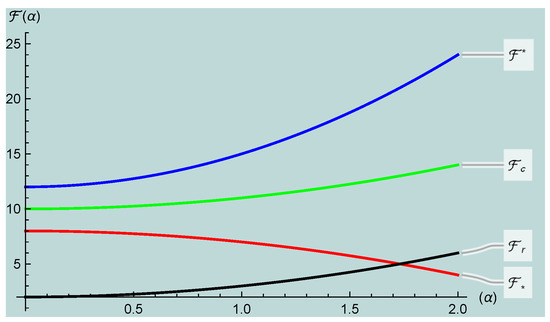
Figure 1.
Graphical visualization of .
Now, we present a generalized Jensen’s inequality.
Theorem 4.
Let be a non-negative multiplicative mapping and ; then,
for and .
Proof.
We deploy the well-known technique of mathematical induction to achieve our result. Suppose and for in (4), then
Now, suppose that the result (4) is true for such that
Now, we show that it is true for .
Hence, the result is acquired. □
Now, we discuss some potential consequences of Theorem 4.
- Selecting in Theorem 4, then we acquire Jensen’s inequality for a -convex stochastic process,
- Selecting in Theorem 4, then we acquire the Jensen’s inequality for a harmonically -convex stochastic process,
- Selecting , in Theorem 4, then we acquire Jensen’s inequality for a convex stochastic process,
- Choosing in Theorem 4, we acquire the Jensen’s inequality for a convex stochastic process,
Remark 1.
We can obtain several other significant generalizations of Jensen’s inequality by specifying the different values for and .
Now, we deliver a parametric Hermite–Hadamard inequality incorporated with an extended interval-valued stochastic process.
Theorem 5.
Let be an I.V stochastic process and with . If and a -interval-valued mean-square integrable on almost everywhere, then we have
Proof.
Since , then
Replacing and in the preceding inequality, taking the product by , and by the process of integration, we have
Now,
Also
We obtain
Comparing (6) and (7), we have
To attain a second inequality, we incorporate with a I.V. convexity of .
Summing (8) and (9), taking the product of the resulting inequality by , and employing the integration on both sides with respect to ℓ on , then we achieve our desired finding. □
Here, we demonstrate some deductions of Theorem 5.
- Selecting in Theorem 5, we achieve
- Selecting in Theorem 5, we obtainwhere is a well-known beta function.
- Choosing , in Theorem 5, we acquire
- Choosing , and in Theorem 5, we acquirewhere .
Remark 2.
By utilizing different values of and in Theorem 5, a series of trapezium-like inequalities for stochastic processes can be obtained.
Example 2.
Let with be an extended -interval-valued convex stochastic process. It satisfies all conditions of Theorem 5; then,
and
also
For graphical visualization, we vary .
Figure 2 provides the graphical visualization of Theorem 5, where and represent the lower and upper functions of left, middle and right sides of Theorem 5.
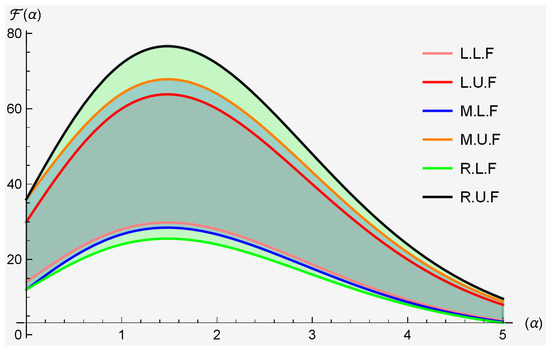
Figure 2.
Clearly substantiates the accuracy of Theorem 5.
Now, we give a tabular illustration of Theorem 5.
Table 1 clearly demonstrates the accuracy of Theorem 5 depending on .

Table 1.
Comparison of all the sides of Theorem 5.
Now, we report the fractional version of weighted Hermite–Hadamard inequality, which is known as the Hermite–Hadamard–Fejer inequality for an extended class of interval-valued stochastic processes.
Theorem 6.
Let be an I.V. stochastic process and be a symmetric stochastic process with respect to . If and there is a -interval-valued mean-square integrable on almost everywhere, then
and .
Proof.
If , then we have
Replacing and in the aforementioned inequality, taking the product of the resulting inequality by , then we obtain
Now, we use the fact that
And
Combining (10)–(12) yields the required result.
To achieve a second relation, we sum (8) and (9) and multiply both sides of the resulting by . Then, by applying the integration with respect to ℓ on ,
Through simple computations, we achieve our desired result. □
Now, we discuss some special cases of Theorem 6.
- Choosing in Theorem 6, we haveand .
- Choosing and in Theorem 6, thenand .
- Choosing in Theorem 6, thenand .
- If we choose and in Theorem 6, thenand .
Now, we utilize the graphical approach to demonstrate the correctness of Theorem 6.
Example 3.
Let with be an extended -interval-valued convex stochastic process and symmetric stochastic process at . Admiring the property and is defined as:
They satisfy all conditions of Theorem 6; then, we obtain
and
also
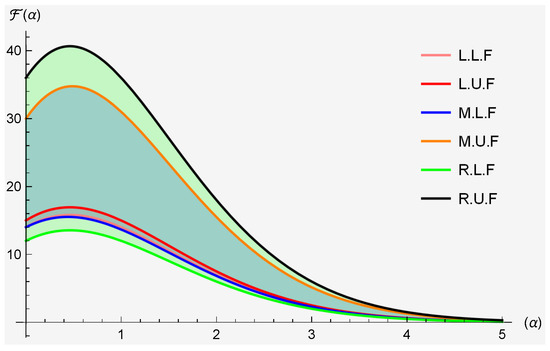
For graphical visualization, we vary .
Figure 3 provides the graphical visualization of Theorem 6, where and represent the lower and upper functions of left, middle and right sides of Theorem 6.
Figure 3.
Clearly demonstrates the graphical visualization of Theorem 6.
Now, we deliver a tabular illustration of Theorem 6.
Table 2 clearly illustrates the accuracy of Theorem 6 depending .
Table 2.
Comparison of all the sides of Theorem 6.
Theorem 7.
Let represent I.V. stochastic processes. If and there is a -interval-valued mean-square integrable on almost everywhere, then we have
where
and .
Proof.
Since , then
Taking the product of (15) and (16), then we have
Similarly, we have
Taking the sum of (17) and (18), multiplying both sides of the resulting inequality by and integrating with respect to ℓ on , then we have
Now, by comparing with the stochastic Riemann–Liouville fractional operators, then
Hence, the proof is completed. □
Here, we report the consequences of Theorem 7.
- Choosing in Theorem 7, then
- Choosing and in Theorem 7, then
- Choosing and in Theorem 7, then
Example 4.
Let and with , being the two extended -interval-valued convex stochastic processes. They satisfy all assumptions of Theorem 7; then,
and
For graphical visualization, we vary .
Figure 4 provides the graphical visualization of Theorem 7, where and represent the lower and upper functions of left and right sides of Theorem 7.
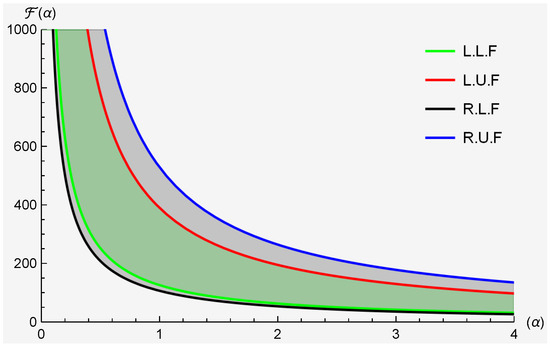
Figure 4.
Clearly substantiates the accuracy of Theorem 7.
Now, we deliver a tabular illustration of Theorem 7.
Table 3 clearly demonstrates the accuracy of Theorem 7 depending .
Table 3.
Comparison of all the sides of Theorem 7.
Theorem 8.
Let be I.V. stochastic processes. If
and there is a -interval-valued mean-square integrable on almost everywhere, then we have
where and are given by (13) and (14), respectively.
Proof.
Since , then we have
Taking the product of the preceding inequality by and integrating with respect to ′ℓ′ on , then
Applying the definition of I.V. convexity, we acquire
Also
and
Combining (20)–(22) leads to the desired outcome. □
Now, we report the consequences of Theorem 8.
- Choosing in Theorem 8, thenwhere and are given by (13) and (14), respectively.
- Choosing and in Theorem 8, thenwhere and are given by (13) and (14), respectively.
- Choosing and in Theorem 8, thenwhere and are given by (13) and (14), respectively.
Example 5.
Let and with , being the two extended -interval-valued convex stochastic processes. They satisfy all assumptions of Theorem 8; then,
and
For graphical visualization, we vary . Now, we deliver a tabular illustration of Theorem 8.
Figure 5 provides the graphical visualization of Theorem 8, where and represent the lower and upper functions of left and right sides of Theorem 5.
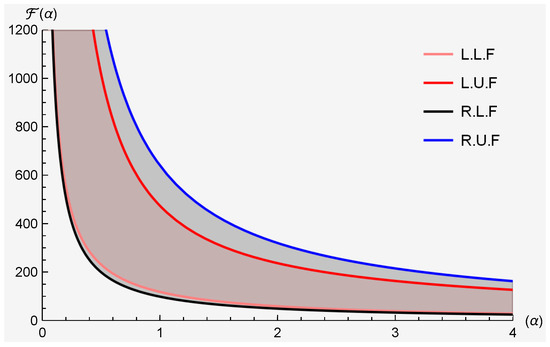
Figure 5.
Clearly substantiates the accuracy of Theorem 8.
Table 4 clearly demonstrates the accuracy of Theorem 8 depending .
Table 4.
Comparison of all the sides of Theorem 8.
2.2. Applicable Analysis
Now, we offer a relation between special means by taking into account the -interval-valued stochastic version of Hermite–Hadamard’s inequality.
- The arithmetic mean:
- The generalized log-mean:
Proposition 4.
For , then
Proof.
The claim follows immediately by applying and and in Theorem 5. □
3. Conclusions
In our study, we explored the notion of a generic stochastic process connected with totally ordered relations and mean square interval-valued calculus. Also, we offered several characterizations of our proposed space of processes. The main advantage of this class is that it allows us to construct a family of innovative stochastic process classes. In addition, we delivered parametric Jensen’s inequality and fractional Hadamard’s-like inequalities incorporated with a newly suggested class of convexity in the context of mean square interval analysis. Also, we discuss numerous significant consequences of primary findings to enhance the existing literature. We hope that the ideas offered in this paper will motivate further investigation in optimization and other applied sciences domains. By applying similar strategies, several classes of convex stochastic processes can be obtained. Another interesting problem in the realm of stochastic interval-valued analysis is how fractional reverse Minkowski’s and Hölder’s-like inequalities can be obtained utilizing the -ordering relation. In the future, we try to investigate this class of stochastic processes in a fuzzy environment. Also, these results can be utilized to investigate sampled-data stabilization of chaotic non-linear systems and fixed-point techniques. For more details, see [45,46]. We hope that this will serve as a starting point for subsequent investigations.
Author Contributions
Conceptualization, M.Z.J., M.U.A. and L.C.; methodology, M.Z.J., M.U.A., L.C., S.S.D. and Y.A.; software, M.Z.J., M.U.A. and L.C.; validation, M.Z.J., M.U.A. and L.C.; formal analysis, M.Z.J., M.U.A., L.C., S.S.D. and Y.A.; investigation, M.Z.J., M.U.A., L.C., S.S.D. and Y.A.; writing—original draft preparation, M.Z.J.; writing—review and editing, M.Z.J., M.U.A., L.C., S.S.D. and Y.A.; supervision, M.U.A. and S.S.D. All authors have read and agreed to the published version of the manuscript.
Funding
Yahya Almalki extends his appreciation to the Deanship of Research and Graduate Studies at King Khalid University for funding this work through Large Research Project under grant number RGP2/430/45.
Data Availability Statement
The original contributions presented in the study are included in the article, further inquiries can be directed to the corresponding authors.
Acknowledgments
The authors are grateful to the editor and the anonymous reviewers for their valuable comments and suggestions.
Conflicts of Interest
The authors declare no conflicts of interest.
References
- Dragomir, S.S.; Pearce, C.E.M. Selected Topics on Hermite–Hadamard Inequalities and Applications; Research Group in Mathematical Inequalities and Applications (RGMIA), Victoria University: Melbourne, Australia, 2000. [Google Scholar]
- Peajcariaac, J.E.; Tong, Y.L. Convex Functions, Partial Orderings, and Statistical Applications; Academic Press: New York, NY, USA, 1992. [Google Scholar]
- El Farissi, A. Simple proof and refinement of Hermite-Hadamard inequality. J. Math. Inequalities 2010, 4, 365–369. [Google Scholar] [CrossRef]
- Gao, X. A note on the Hermite-Hadamard inequality. J. Math. Inequalities 2010, 4, 587–591. [Google Scholar] [CrossRef]
- Wu, S.; Awan, M.U.; Noor, M.A.; Noor, K.I.; Iftikhar, S. On a new class of convex functions and integral inequalities. J. Inequalities Appl. 2019, 2019, 131. [Google Scholar] [CrossRef]
- Moore, R.E. Interval Analysis; Prentice-Hall: Englewood Cliffs, NJ, USA, 1966; Volume 4, pp. 8–13. [Google Scholar]
- Breckner, W.W. Continuity of generalized convex and generalized concave set-valued functions. Rev. Analyse Numer. Theor. Approx. 1993, 22, 39–51. [Google Scholar]
- Bhunia, A.K.; Samanta, S.S. A study of interval metric and its application in multi-objective optimization with interval objectives. Comput. Ind. Eng. 2014, 74, 169–178. [Google Scholar] [CrossRef]
- Shi, F.; Ye, G.; Liu, W.; Zhao, D. cr-h-convexity and some inequalities for cr-h-convex function. ResearchGate 2022. [Google Scholar]
- Zhao, D.; An, T.; Ye, G.; Liu, W. New Jensen and Hermite-Hadamard type inequalities for h-convex interval-valued functions. J. Inequalities Appl. 2018, 2018, 302. [Google Scholar] [CrossRef]
- Zhao, D.; An, T.; Ye, G.; Liu, W. Chebyshev type inequalities for interval-valued functions. Fuzzy Sets Syst. 2020, 396, 82–101. [Google Scholar] [CrossRef]
- Budak, H.; Tunc, T.; Sarikaya, M. Fractional Hermite-Hadamard-type inequalities for interval-valued functions. Proc. Am. Math. Soc. 2020, 148, 705–718. [Google Scholar] [CrossRef]
- Bin-Mohsin, B.; Rafique, S.; Cesarano, C.; Javed, M.Z.; Awan, M.U.; Kashuri, A.; Noor, M.A. Some general fractional integral inequalities involving LR-Bi-convex fuzzy interval-valued functions. Fractal Fract. 2022, 6, 565. [Google Scholar] [CrossRef]
- Bin-Mohsin, B.; Javed, M.Z.; Awan, M.U.; Kashuri, A. On some new AB-fractional inclusion relations. Fractal Fract. 2023, 7, 725. [Google Scholar] [CrossRef]
- Rahman, M.S.; Shaikh, A.A.; Bhunia, A.K. Necessary and sufficient optimality conditions for non-linear unconstrained and constrained optimization problem with interval valued objective function. Comput. Ind. Eng. 2020, 147, 106634. [Google Scholar] [CrossRef]
- Liu, W.; Shi, F.; Ye, G.; Zhao, D. The Properties of Harmonically cr-h-Convex function and Its Applications. Mathematics 2022, 10, 2089. [Google Scholar] [CrossRef]
- Sahoo, S.K.; Latif, M.A.; Alsalami, O.M.; Treanta, S.; Sudsutad, W.; Kongson, J. Hermite-Hadamard, Fejér and Pachpatte-Type integral inequalities for center-radius order interval-valued preinvex functions. Fractal Fract. 2022, 6, 506. [Google Scholar] [CrossRef]
- Vivas-Cortez, M.; Ramzan, S.; Awan, M.U.; Javed, M.Z.; Khan, A.G.; Noor, M.A. IV-CR-γ-Convex functions and Their Application in Fractional Hermite-Hadamard Inequalities. Symmetry 2023, 15, 1405. [Google Scholar] [CrossRef]
- Du, T.; Zhou, T. On the fractional double integral inclusion relations having exponential kernels via interval-valued co-ordinated convex functions. Chaos Solitons Fractals 2022, 156, 111846. [Google Scholar] [CrossRef]
- Chalco-Cano, Y.; Flores-Franulic, A.; Roman-Flores, H. Ostrowski type inequalities for interval-valued functions using generalized Hukuhara derivative. Comput. Appl. Math. 2012, 31, 457–472. [Google Scholar]
- Chalco-Cano, Y.; Lodwick, W.A.; Condori-Equice, W. Ostrowski type inequalities and applications in numerical integration for interval-valued functions. Soft Comput. 2015, 19, 3293–3300. [Google Scholar] [CrossRef]
- Costa, T.M.; Román-Flores, H. Some integral inequalities for fuzzy-interval-valued functions. Inf. Sci. 2017, 420, 110–125. [Google Scholar] [CrossRef]
- Roman-Flores, H.; Chalco-Cano, Y.; Lodwick, W. Some integral inequalities for interval-valued functions. Comput. Appl. Math. 2018, 37, 1306–1318. [Google Scholar] [CrossRef]
- Bin-Mohsin, B.; Awan, M.U.; Javed, M.Z.; Budak, H.; Khan, A.G.; Noor, M.A. Inclusions Involving interval-valued harmonically co-Ordinated convex functions and Raina’s Fractional Double Integrals. J. Math. 2022, 2022, 5815993. [Google Scholar] [CrossRef]
- Bin-Mohsin, B.; Awan, M.U.; Javed, M.Z.; Khan, A.G.; Budak, H.; Mihai, M.V.; Noor, M.A. Generalized AB-fractional operator inclusions of Hermite-Hadamard’s type via fractional integration. Symmetry 2023, 15, 1012. [Google Scholar] [CrossRef]
- Fahad, A.; Wang, Y.; Ali, Z.; Hussain, R.; Furuichi, S. Exploring properties and inequalities for geometrically arithmetically-Cr-convex functions with Cr-order relative entropy. Inf. Sci. 2024, 662, 120219. [Google Scholar] [CrossRef]
- Tong, X.; Jiang, H.; Chen, X.; Li, J.; Cao, Z. Deterministic and stochastic evolution of rumor propagation model with media coverage and class-age-dependent education. Math. Methods Appl. Sci. 2023, 46, 7125–7139. [Google Scholar] [CrossRef]
- Zhang, X.; Liu, E.; Qiu, J.; Zhang, A.; Liu, Z. Output feedback finite-time stabilization of a class of large-scale high-order nonlinear stochastic feedforward systems. Discret. Contin. Dyn. Syst. 2023, 16, 1892–1908. [Google Scholar] [CrossRef]
- Zhang, N.; Qi, W.; Pang, G.; Cheng, J.; Shi, K. Observer-based sliding mode control for fuzzy stochastic switching systems with deception attacks. Appl. Math. Comput. 2022, 427, 127153. [Google Scholar] [CrossRef]
- Yang, C.; Li, F.; Kong, Q.; Chen, X.; Wang, J. Asynchronous fault-tolerant control for stochastic jumping singularly perturbed systems: An H∞ sliding mode control scheme. Appl. Math. Comput. 2021, 389, 125562. [Google Scholar] [CrossRef]
- Jiao, T.; Zong, G.; Pang, G.; Zhang, H.; Jiang, J. Admissibility analysis of stochastic singular systems with Poisson switching. Appl. Math. Comput. 2020, 386, 125508. [Google Scholar] [CrossRef]
- Zhao, F.; Chen, X.; Cao, J.; Guo, M.; Qiu, J. Finite-time stochastic input-to-state stability and observer-based controller design for singular nonlinear systems. Nonlinear Anal. Model. Control. 2020, 25, 980–996. [Google Scholar] [CrossRef]
- Fang, L.; Ma, L.; Ding, S.; Zhao, D. Finite-time stabilization for a class of high-order stochastic nonlinear systems with an output constraint. Appl. Math. Comput. 2019, 358, 63–79. [Google Scholar] [CrossRef]
- Afzal, W.; Abbas, M.; Macias-Diaz, J.E.; Treanta, S. Some H-Godunova-Levin function inequalities using center-radius (Cr) order relation. Fractal Fract. 2022, 6, 518. [Google Scholar] [CrossRef]
- Nikodem, K. On convex stochastic processes. Aequationes Math. 1980, 20, 184–197. [Google Scholar] [CrossRef]
- Skowronski, A. On some properties of J-convex stochastic processes. Aequationes Math. 1992, 44, 249–258. [Google Scholar] [CrossRef]
- Skowronski, A. On Wright-convex stochastic processes. Ann. Math. Silesianae 1995, 9, 29–32. [Google Scholar]
- Kotrys, D. Hermite-Hadamard inequality for convex stochastic processes. Aequationes Math. 2012, 83, 143–151. [Google Scholar] [CrossRef]
- Kotrys, D. Remarks on strongly convex stochastic processes. Aequationes Math. 2013, 86, 91–98. [Google Scholar] [CrossRef]
- Jarad, F.; Sahoo, S.K.; Nisar, K.S.; Treanta, S.; Emadifar, H.; Botmart, T. New stochastic fractional integral and related inequalities of Jensen-Mercer and Hermite-Hadamard-Mercer type for convex stochastic processes. J. Inequalities Appl. 2023, 2023, 51. [Google Scholar] [CrossRef]
- Agahi, H.; Babakhani, A. On fractional stochastic inequalities related to Hermite-Hadamard and Jensen types for convex stochastic processes. Aequationes Math. 2016, 90, 1035–1043. [Google Scholar] [CrossRef]
- Afzal, W.; Botmart, T. Some novel estimates of Jensen and Hermite-Hadamard inequalities for h-Godunova-Levin stochastic processes. AIMS Math. 2023, 8, 7277–7291. [Google Scholar] [CrossRef]
- Afzal, W.; Aloraini, N.M.; Abbas, M.; Ro, J.S.; Zaagan, A.A. Some novel Kulisch-Miranker type inclusions for a generalized class of Godunova-Levin stochastic processes. AIMS Math. 2024, 9, 5122–5146. [Google Scholar] [CrossRef]
- Afzal, W.; Eldin, S.M.; Nazeer, W.; Galal, A.M.; Afzal, W.; Eldin, S.M.; Galal, A.M. Some integral inequalities for harmonical cr-h-Godunova-Levin stochastic processes. AIMS Math. 2023, 8, 13473–13491. [Google Scholar] [CrossRef]
- Xia, Y.; Wang, J.; Meng, B.; Chen, X. Further results on fuzzy sampled-data stabilization of chaotic nonlinear systems. Appl. Math. Comput. 2020, 379, 125225. [Google Scholar] [CrossRef]
- Sarwar, M.; Li, T. Fuzzy fixed point results and applications to ordinary fuzzy differential equations in complex valued metric spaces. Hacet. J. Math. Stat. 2019, 48, 1712–1728. [Google Scholar] [CrossRef]
Disclaimer/Publisher’s Note: The statements, opinions and data contained in all publications are solely those of the individual author(s) and contributor(s) and not of MDPI and/or the editor(s). MDPI and/or the editor(s) disclaim responsibility for any injury to people or property resulting from any ideas, methods, instructions or products referred to in the content. |
© 2024 by the authors. Licensee MDPI, Basel, Switzerland. This article is an open access article distributed under the terms and conditions of the Creative Commons Attribution (CC BY) license (https://creativecommons.org/licenses/by/4.0/).