


Abstract
In this paper, we study a fractional Brusselator reaction–diffusion model with the help of the residual power series transform method. Specific reaction–diffusion chemical processes are modeled by applying the fractional Brusselator reaction–diffusion model. It should be mentioned that many problems in nonlinear science are characterized by fractional differential equations, where an unknown term occurs when a fractional-order derivative is operating on it. The analytic method of this problem is rarely discussed in the literature, despite numerous scholars having researched its application and usefulness. To validate our proposed method’s accuracy, we compare the numerical results of the residual power series transform method and the exact result with different fractional orders. The solution shows that the introduced approach is a good tool for solving linear and nonlinear fractional system differential equations. Finally, we provide two and three-dimensional graphical plots to support the impact of the fractional derivative on the behavior of the achieved profile results to the proposed equations.
1. Introduction
Fractional calculus, which includes fractional order derivatives and fractional integrals, has attracted interest in the areas of natural sciences and technology due to its vast implementations in electromagnetic waves, viscoelasticity, diffusion of biological population, nanotechnology, image and signal processing, random walk, control theory of dynamical systems, anomalous transport, and anomalous diffusion [1,2,3]. Nonlinear ordinary and partial differential equations (PDEs) are used to represent the majority of real-world scientific and engineering phenomena [4]. In the mathematical modeling of numerous natural phenomena, fractional nonlinear differential equations are particularly helpful. The essential quality of fractional derivatives is their nonlocality, which emphasizes the fact that the future state derives from the current state and all prior states. The study of nonlinear ordinary differential equations is required to observe the behavior of a system. However, evaluating the analytical solution for these types of situations is difficult. As a result, they are dealt with by utilizing approximate numeric techniques [5,6,7].
Chemical reactions play an essential function, as shown by the Brusselsator reaction–diffusion system. The reaction terms in this model come from the modeling of the chemical structures, which includes plasma and laser physics, enzyme reactions, and other processes. This nonlinear partial differential equation develops since chemical reactions involve two unstable intermediates with controllable output and input compounds. Ozone generation by atomic oxygen is one of the physical issues the Brusselsator reaction–diffusion system solves. Specific chemical reaction–diffusion processes are modeled using the fractional Brusselator reaction–diffusion system. It should be mentioned that many models in nonlinear science are characterized by fractional differential equations, where an unknown function occurs when a fractional-order derivative is operating on it. The approximate analysis of this system is rarely discussed in the literature, despite numerous scholars having researched its application and usefulness [8,9,10,11]. Recently, the development of numerical schemes for the numerical solutions of reaction–diffusion Brusselator systems has received considerable attention, such as the decomposition method [12,13], the finite-difference method [14], the Runge–Kutta–Chebyshev technique [15], the dual-reciprocity boundary element technique [16], the differential quadrature technique [17], the collocation technique applying the radial basis function [18], the homotopy perturbation method [19], the residual power series method [20] and the variational iteration method [21].
The residual power series method is a semianalytical tool for investigating many types of fuzzy, partial, ordinary, and fractional-order integrodifferential problems. It is an effective optimization method, since it delivers solutions in the closed type of available features. Various fractional differential and integral equations and fuzzy fractional differential equations have been effectively solved using the residual power series technique, for example, the Newell–Whitehead–Segel fractional order equations [22] and the fractional Fokker–Planck equations [23]. Researchers have coupled the fractional resonant Schrodinger equation [24], massive fractional Thirring and Kundu–Eckhaus problems [25], and particular categories of fractional fuzzy differential equations [26,27]. The Yang transform (YT), which Xiao-Jun Yang introduced, can be used to resolve a variety of differential equations with constant coefficients. This article aims to analyze the analytic and approximated solution for a nonlinear system’s fractional partial differential equations by applying the residual power series transform method. The residual power series transform method is a combination of the Yang transformation and the residual power series method, which provides the analytical results as a easily fractional power series solution by converting the suggested problems to Yang space and creating the results for the equations. Finally, the result can be achieved by the inverse Yang transform of the achieved solutions. Using the limit concept, the unknown coefficients in a Yang expansion can be determined, as opposed to the residual power series transform method, which relies on the fractional derivative and may require time to determine the fractional derivatives to identify the results. The residual power series transform method requires fewer processing resources and less time and provides more precision.
This work is arranged as follows: Section 2 contains some useful basic definitions of the Yang transform. The suggested method is explained in terms of achieving the results for the fractional partial differential equations schemes in Section 3. In Section 4, numerical solutions are presented for some problems. Lastly, concluding remarks are drawn in Section 2.
2. Preliminaries
This section is concerned with the fundamental concept of fractional calculus along with the Yang transform theory.
2.1. Definition
The fractional Caputo derivative is given as [28]
2.2. Definition
The Yang transform is stated as [28]
and the inverse Yang transform is
2.3. Definition
The nth derivative Yang transform is stated as [28]
2.4. Definition
The Yang transform in connection with the fractional-order derivative is stated as [28]
3. Methodology
In this section, we present the suggested methodology of the fractional partial differential equations [29]
subject to:
where refers to the of order are well-known nonlinear analytic functions, and can be represented as
Now, the technique for the RPSM solution of the fractional partial differential equations in (6) and (7) can be constructed through the following steps.
Step 1. We write the fractional nonlinear differential equation as in Equations (6) and (7) in the following short form:
subject to:
Step 2. Applying the Yang transform to both sides of Equation (8), it becomes:
where , , and .
Step 3. Suppose that the solutions of fractional partial differential equations in Equation (10) are in the form:
Applying Equation (9), we have . Therefore, the series form solutions can be represented as:
Step 4. We define the k th-truncated series of as follows:
Step 5. We define the Yang residual functions of Equation (10) and the k th-Yang residual functions, respectively, as follows:
Step 7. We multiply Equation (15) by .
Step 8. We solve the following algebraic equations recursively:
then, we obtain the forms of the unknown coefficients, , respectively.
Step 9. We substitute the obtained forms of to obtain the series form solutions of Equation (10).
4. Results
Example 1.

We considered the system of the fractional reaction–diffusion equation
with the initial conditions
where p is constant.
Using the Yang transformation on Equation (17) and applying Equation (18), we obtained
The -truncated term series were
and the -Yang residual functions were
Now, to find , and , , we substituted the -truncated series Equation (21) into the -Yang residual function Equation (22), multiplied the achieved solutions by , and then recursively investigated the relations and , . The first few functions were
Putting the values of and , into Equation (21), we obtained
Using the inverse Yang transform, we obtained
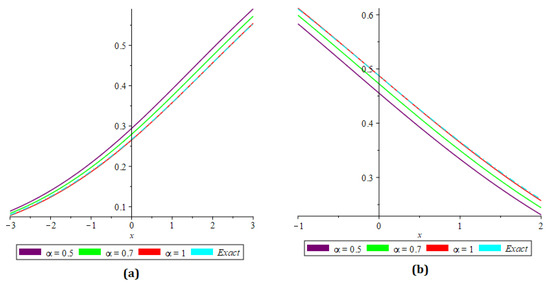
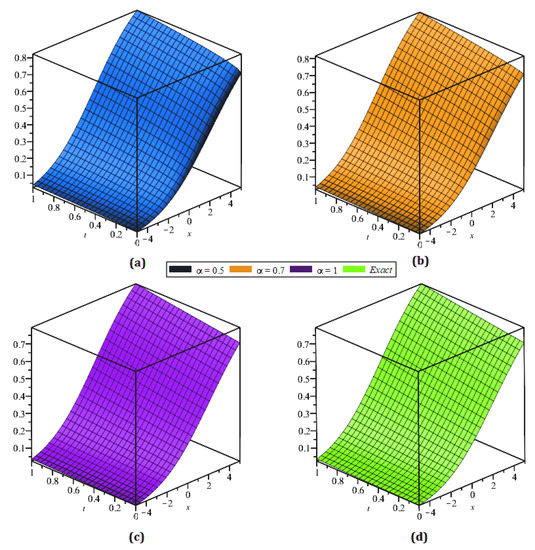
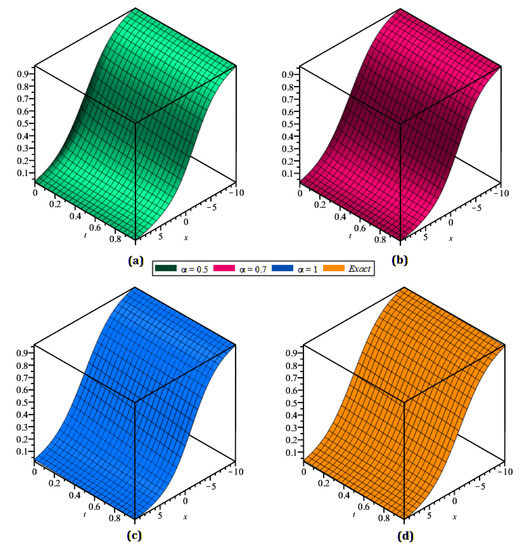
The residual power series transformation method was implemented to achieve the analytical and exact results for the strongly nonlinear fractional reaction–diffusion equation with the initial conditions. In Figure 1, the analytical solutions of (a) and (b) of Example 1 are shown. In Figure 2, (a) the fractional order , (b) , (c) the actual result and (d) analytical solution of Eaxample 1 of . Similarly, in Figure 3, (a) the fractional order , (b) , (c) the actual result and (d) analytical solution of Eaxample 1 of . In the above, the figures showed that in the residual power series transformation method, the analytical results were close to each other. Table 1 and Table 2 detail the numerical analysis of and of the given example from Example 1, with different values of φ, τ, and .
Figure 1.
The analytical solution for and from Example 1.
Figure 2.
The actual and analytical results for at , , and different values of ℘ from Example 1.
Figure 3.
The actual and analytical solutions for at , , and different values of ℘ from Example 1.
Table 1.
Numerical analysis of of the example given in Example 1 with different values of , , and .
Table 2.
Numerical analysis of of the example given in Example 1 with different values of , , and .
Example 2.
We considered the fractional order reaction–diffusion Brusselator equation
with the initial conditions
where and represent the chemical concentrations of the intermediate reaction products, and A and B are the constant concentrations of the input reagents, where and .
The truncate series terms were
and the -Yang residual functions were
Now, to calculate and , we put the -truncate series (Equation (30)) into the -Yang residual function (Equation (31)), multiplied the solution equation by , and then recursively analyzed the relations , and , . The first few terms were defined as:
Putting the value of and , , into Equation (30), we obtained
Now, applying the inverse Yang transform, we obtained
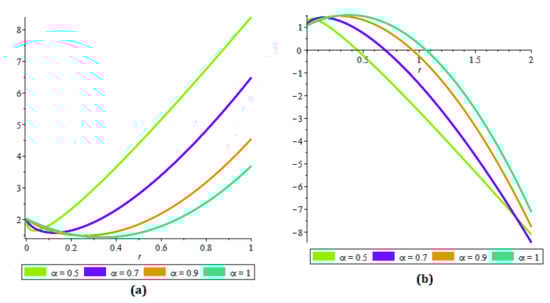
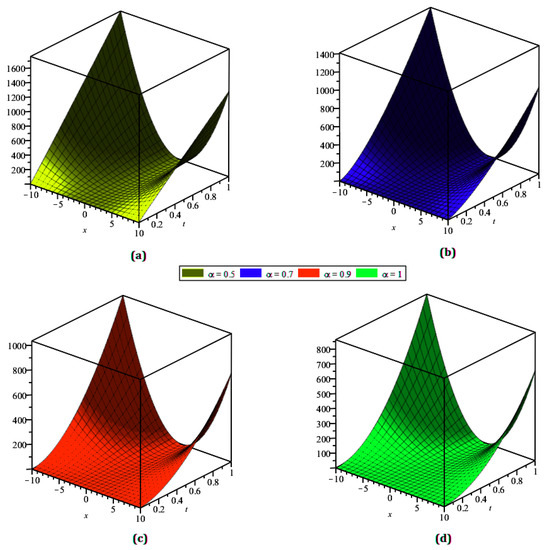
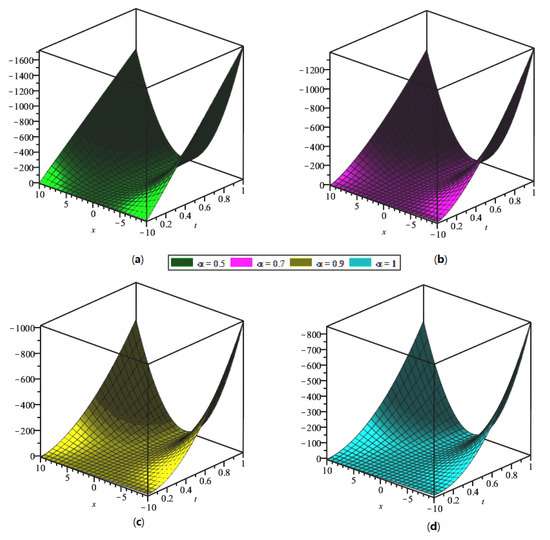
The residual power series transformation method was implemented to achieve the analytical and exact results of the strongly nonlinear fractional reaction–diffusion equation with the initial conditions. In Figure 4, the analytical solutions of (a) and (b) of Example 2 are shown. In Figure 5, (a) the fractional order , (b) , (c) the actual result and (d) analytical solution of Eaxample 2 of . Similarly, in Figure 6, (a) the fractional order , (b) , (c) the actual result and (d) analytical solution of Example 2 of . These figures showed that in using the residual power series transformation method, the analytical results were close to each other. Table 3 and Table 4 detail the numerical analysis of and from Example 2 with different values of φ, τ, and .
Figure 4.
The analytical solution (a) and subplot (b) at , , , and , respectively, from Example 2.
Figure 5.
The analytical solution for at , , and for distinct values of ℘ from Example 2.
Figure 6.
The analytical solution for at , , and for different values of ℘ from Example 2.
Table 3.
Numerical analysis of of the example given in 2 with different values of , , and .
Table 4.
Numerical analysis of of the example given in 2 with different values of , , and .
5. Conclusions
This paper examined the fractional reaction–diffusion and reaction–diffusion Brusselator equations in terms of the Caputo fractional derivative. With the aid of the RPSM, the series solution of the investigated model was successfully attained. Plots were made of the numerical simulations of the proposed solution using various fractional values of ℘. The technique was applied to the suggested fractional-order systems to investigate its analytical solutions. The solutions showed that the method was inexpensive and suitable for achieving analytical solutions. We, therefore, conclude that the suggested fractional models connected to the Caputo fractional derivative are very helpful in efficiently investigating the problems arising in science and engineering.
Author Contributions
Conceptualization, S.A. and M.M.A.-S.; methodology, J.R.H.; software, S.A.; validation, M.M.A.-S.; formal analysis, J.R.H.; investigation, S.A; resources, M.M.A.-S.; data curation, J.R.H.; writing—original draft preparation, M.M.A.-S.; writing—review and editing, J.R.H.; visualization, S.A.; supervision, M.M.A.-S.; project administration, J.R.H.; funding acquisition, S.A. All authors have read and agreed to the published version of the manuscript.
Funding
This research received no external funding.
Institutional Review Board Statement
Not applicable.
Informed Consent Statement
Not applicable.
Data Availability Statement
Not applicable.
Acknowledgments
This research was funded by the Deputy for Research & Innovation, the Ministry of Education, through the Initiative of Institutional Funding at the University of Ha’il-Saudi Arabia through project number IFP-22 127.
Conflicts of Interest
The authors declare no conflict of interest.
References
- Magin, R. Fractional calculus in bioengineering, part 1. Crit. Rev. Biomed. Eng. 2004, 32, 104. [Google Scholar]
- Machado, J.T.; Kiryakova, V.; Mainardi, F. Recent history of fractional calculus. Commun. Nonlinear Sci. Numer. Simul. 2011, 16, 1140–1153. [Google Scholar] [CrossRef]
- Sabatier, J.A.T.M.J.; Agrawal, O.P.; Machado, J.T. Advances in Fractional Calculus; Springer: Dordrecht, The Netherlands, 2007; Volume 4, p. 9. [Google Scholar]
- Giusti, A.; Colombaro, I.; Garra, R.; Garrappa, R.; Polito, F.; Popolizio, M.; Mainardi, F. A practical guide to Prabhakar fractional calculus. Fract. Calc. Appl. Anal. 2020, 23, 9–54. [Google Scholar] [CrossRef]
- Baleanu, D.; Diethelm, K.; Scalas, E.; Trujillo, J.J. Fractional Calculus: Models and Numerical Methods; World Scientific: Singapore, 2012; Volume 3. [Google Scholar]
- Debnath, L. Recent applications of fractional calculus to science and engineering. Int. J. Math. Math. Sci. 2003, 2003, 3413–3442. [Google Scholar] [CrossRef]
- Axtell, M.; Bise, M.E. Fractional calculus application in control systems. In Proceedings of the IEEE Conference on Aerospace and Electronics, Dayton, OH, USA, 21–25 May 1990; pp. 563–566. [Google Scholar]
- El-Saka, H.A.A.; Arafa, A.A.M.; Gouda, M.I. Dynamical analysis of a fractional SIRS model on homogenous networks. Adv. Differ. Equ. 2019, 2019, 1–15. [Google Scholar] [CrossRef]
- Alyousef, H.A.; Yasmin, H.; Shah, N.A.; El-Sherif, L.S.; El-Tantawy, S.A. Mathematical Modeling and Analysis of the Steady Electro-Osmotic Flow of Two Immiscible Fluids: A Biomedical Application. Coatings 2023, 13, 115. [Google Scholar] [CrossRef]
- Alyousef, H.A.; Nonlaopon, K.; El-Sherif, L.S.; El-Tantawy, S.A. An Efficient Analytical Method for Analyzing the Nonlinear Fractional Klein-Fock-Gordon Equations. Symmetry 2022, 14, 2640. [Google Scholar] [CrossRef]
- Singh, J.; Rashidi, M.M.; Kumar, D.; Swroop, R. A fractional model of a dynamical Brusselator reaction-diffusion system arising in triple collision and enzymatic reactions. Nonlinear Eng. 2016, 5, 277–285. [Google Scholar] [CrossRef]
- Adomian, G. The diffusion-Brusselator equation. Comput. Math. Appl. 1995, 29, 1–3. [Google Scholar] [CrossRef]
- Wazwaz, A.M. The decomposition method applied to systems of partial differential equations and to the reaction-diffusion Brusselator model. Appl. Math. Comput. 2000, 110, 251–264. [Google Scholar] [CrossRef]
- Twizell, E.H.; Gumel, A.B.; Cao, Q. A second-order scheme for the Brusselator reaction-diffusion system. J. Math. Chem. 1999, 26, 297–316. [Google Scholar] [CrossRef]
- Verwer, J.G.; Hundsdorfer, W.H.; Sommeijer, B.P. Convergence properties of the Runge-Kutta-Chebyshev method. Numer. Math. 1990, 57, 157–178. [Google Scholar] [CrossRef]
- Ang, W.T. The two-dimensional reaction-diffusion Brusselator system: A dual-reciprocity boundary element solution. Eng. Anal. Bound. Elem. 2003, 27, 897–903. [Google Scholar] [CrossRef]
- Mittal, R.C.; Jiwari, R. Numerical study of two-dimensional reaction-diffusion Brusselator system by differential quadrature method. Int. J. Comput. Methods Eng. Sci. Mech. 2011, 12, 14–25. [Google Scholar] [CrossRef]
- Ali, A.; Haq, S. A computational modeling of the behavior of the two-dimensional reaction-diffusion Brusselator system. Appl. Math. Model. 2010, 34, 3896–3909. [Google Scholar]
- Kumar, S.; Khan, Y.; Yildirim, A. A mathematical modeling arising in the chemical systems and its approximate numerical solution. Asia-Pac. J. Chem. Eng. 2012, 7, 835–840. [Google Scholar] [CrossRef]
- Alderremy, A.A.; Shah, R.; Iqbal, N.; Aly, S.; Nonlaopon, K. Fractional Series Solution Construction for Nonlinear Fractional Reaction-Diffusion Brusselator Model Utilizing Laplace Residual Power Series. Symmetry 2022, 14, 1944. [Google Scholar] [CrossRef]
- Jafari, H.; Kadem, A.; Baleanu, D. Variational iteration method for a fractional-order Brusselator system. Abstr. Appl. Anal. 2014, 2014, 496323. [Google Scholar] [CrossRef]
- Saadeh, R.; Alaroud, M.; Al-Smadi, M.; Ahmad, R.R.; Salma Din, U.K. Application of fractional residual power series algorithm to solve Newell-Whitehead-Segel equation of fractional order. Symmetry 2019, 11, 1431. [Google Scholar] [CrossRef]
- Freihet, A.; Hasan, S.; Alaroud, M.; Al-Smadi, M.; Ahmad, R.R.; Salma Din, U.K. Toward computational algorithm for time-fractional Fokker-Planck models. Adv. Mech. Eng. 2019, 11, 1687814019881039. [Google Scholar] [CrossRef]
- Al-Smadi, M.; Arqub, O.A.; Momani, S. Numerical computations of coupled fractional resonant Schrodinger equations arising in quantum mechanics under conformable fractional derivative sense. Phys. Scr. 2020, 95, 075218. [Google Scholar] [CrossRef]
- Al-Smadi, M.; Arqub, O.A.; Hadid, S. Approximate solutions of nonlinear fractional Kundu-Eckhaus and coupled fractional massive Thirring equations emerging in quantum field theory using conformable residual power series method. Phys. Scr. 2020, 95, 105205. [Google Scholar] [CrossRef]
- Alaroud, M.; Al-Smadi, M.; Ahmad, R.R.; Salma Din, U.K. Computational optimization of residual power series algorithm for certain classes of fuzzy fractional differential equations. Int. J. Differ. Equ. 2018, 2018, 8686502. [Google Scholar] [CrossRef]
- Aljahdaly, N.H.; Agarwal, R.P.; Botmart, T. The analysis of the fractional-order system of third-order KdV equation within different operators. Alex. Eng. J. 2022, 61, 11825–11834. [Google Scholar] [CrossRef]
- Dattu, M.K.U. New integral transform: Fundamental properties, investigations and applications. Iaetsd J. Adv. Res. Appl. Sci. 2018, 5, 534–539. [Google Scholar]
- Oqielat, M.A.N.; Eriqat, T.; Al-Zhour, Z.; Ogilat, O.; El-Ajou, A.; Hashim, I. Construction of fractional series solutions to nonlinear fractional reaction-diffusion for bacteria growth model via Laplace residual power series method. Int. J. Dyn. Control. 2022, 2022, 1–8. [Google Scholar] [CrossRef]
Disclaimer/Publisher’s Note: The statements, opinions and data contained in all publications are solely those of the individual author(s) and contributor(s) and not of MDPI and/or the editor(s). MDPI and/or the editor(s) disclaim responsibility for any injury to people or property resulting from any ideas, methods, instructions or products referred to in the content. |
© 2023 by the authors. Licensee MDPI, Basel, Switzerland. This article is an open access article distributed under the terms and conditions of the Creative Commons Attribution (CC BY) license (https://creativecommons.org/licenses/by/4.0/).