
Abstract
The main purpose of this paper is to investigate the existence and Ulam-Hyers stability (U-Hs) of solutions of a nonlinear neutral stochastic fractional differential system. We prove the existence and uniqueness of solutions to the proposed system by using fixed point theorems and the Banach contraction principle. Also, by using fundamental schemes of fractional calculus, we study the (U-Hs) to the solutions of our suggested system. Besides, we study an example, best describing our main result.
1. Introduction
As we know, modeling natural phenomena is one of the ways to understand and interpret them. Therefore, the discovery of new modeling tools has always been of interest to researchers. Fractional calculus is one of these useful and new tools. Fractional differential equations have been used in different fields, such as control theory, biomath [1,2], thermodynamics, signal processing, and so on [3,4]. The application of fractional calculus by new researchers has been developed in the field of time-dependent damping behavior in the viscoelastic behavior sciences. Furthermore, fractional differential equations (FDEs) also have great applications in the nonlinear oscillation of earthquakes, with several physical phenomena such as fluid dynamics, traffic models, seepage flow in porous media, etc. [5,6,7,8,9,10,11,12,13,14,15,16,17,18,19,20,21,22,23]. Disavowing FDEs is like saying that irrational numbers do not exist. In addition, boundary value problems play a special role in solving and interpreting real-world problems, for example, population dynamics, thermoplasticity, chemical engineering, blood flow, underground water flow, etc. [24].
The concept of stability is one of the qualitative aspects of dynamic systems. Stability theory is very significant, as each practicable control system is structured to be stable. Additionally, in physical use, the stability of solutions is very beneficial because variations in mathematical models undoubtedly stem from measurement errors. A stable solution may become variable through such variations. The analysis of the stability properties of solutions has captivated a lot of research workers through its promising applications. Specifically, the Ulam–Hyers stability analysis and its uses have been studied by legion researchers. The definition of (U-Hs) has applicable significance; it means if someone is capitalizing upon the (U-Hs), then one does not necessarily need to approach the exact solution. It testifies that there is a consistently exact solution to each of the approximate solutions. This is advantageous in all fields, including economics, numerical analysis, optimizations theory, biology, etc., where finding the exact solution is quite tiring or time-consuming; see [25,26,27,28,29,30].
On the other hand, physical models often fluctuate due to stochastic noise or perturbation, so it makes sense to include stochastic effects into the fractional differential equation to investigate this type of modeling. This leads us to focus on this type of equation in this study. One can find many published works in this area; see, for example, refs. [31,32,33,34].
According to the lack of investigations on the existence and the (U-Hs) of the solutions of a nonlinear neutral stochastic fractional differential system, it is of great interest to perform some investigations in this area. Dai et al. [35] investigated the following fractional differential equation for existence and Ulam–Hyers type stability
where and represents the fractional Caputo derivative of order and the fractional Riemann–Liouville integral such that , respectively. The function is continuous and , while is a fixed number.
Y. Guo et al. [36], investigated the impulsive neutral functional stochastic differential equation for existence and UH stability as follows:
where represents the Riemann–Liouville fractional derivative of order , and . We also have . The functions are continuous and is the Wiener process, while is a phase space. The notations represent appropriate functions, and are Riemann–Liouville fractional integrals with orders and , respectively. The are defined by
Here, the maps have been defined by .
Sathiyaraj et al. [37] studied (U-Hs) results of the solutions of the following fractional stochastic differential system involving the Hilfer fractional derivative of order and type for
where and are a matrix of dimension . The functions and are nonlinear and continuous.
There exists extensive prose about the existence and uniqueness (EU) of solutions related to FDEs involving ordinary and fractional derivatives, etc., while in the setting of a nonlinear neutral stochastic FDEs system involving ordinary derivative, as far as we know, existence, uniqueness, and stability have not been discussed.
Motivated by the above content, in this article we study the EU and (U-Hs) of the following nonlinear stochastic fractional differential system:
where represents the diagonal matrix of dimensions , with the Caputo fractional deferential operators , each of order . is a standard Brownian motion on the complete probability space along with some filtration satisfy some conditions, while consists of -null sets. Additionally, , and are n-dimensional locally integrable measurable bounded vector functions on and its entries admit the Laplace transformation. Furthermore, is an unknown vector function, and is measurable -valued random vector.
The remainder of the article is arranged as follows: In the Section 2, we evoke a few useful definitions and results akin to fractional integrals and fractional derivatives. The EU of solutions to the suggested system (1) and Ulam–Hyres stability results are investigated in Section 3. A precise example is discussed in Section 4.
2. Preliminaries
This portion is dedicated to introducing a few conceptions and recalling helpful definitions and preliminary results employed in the whole article.
Let be endowed with standard Euclidean norm and denotes the space of all measurable processes l, satisfying
It is known that is a Banach space and , are measurable and bounded functions satisfying the following hypothesis:
- (A1)
- There exist positive constants such that for all and
- (A2)
- Assume that and . Note that the condition implies .The next condition is a consequence of , but we list it here because of our easy access.
- (A3)
- Let , be the same constants in and there exist real numbers , such that for all and ,
Definition 1
([6]). Assume that is a real-valued integrable function and Γ denotes the Gamma function. The fractional Riemann–Liouville integral of order ℘, for which , is defined by
Definition 2
([6]). Let be an absolutely continuous function; then, the fractional derivative in the Caputo sense, of order , , is defined as:
Definition 3
([6]). The 2-parametric Mittag–Leffler matrix function is defined as:
Particularly, has the following property
We further suppose that there exist constants and , where
The last two estimates will be used in the coming results.
Furthermore, let be the Caputo fractional derivative of ; then, its Laplace transform, where , is
Lemma 1.
For any , and the following integral inequality
holds.
Proof.
Consider
□
The following integral inequality has a vital role in obtaining certain estimates in our main theory throughout the paper.
For any and , assume that is an -valued process satisfying . Then, we can find a constant , where
Definition 4
([38]). A function l is said to be of exponential order if , where for some we have
Lemma 2
([38]). The Laplace transform for a function g, which is piecewise continuous on and exponential order ℏ, exists for and converges absolutely.
Theorem 1
([39] (Krasnoselskii fixed-point theorem)). Let be a closed and convex subset of Banach space . Consider two operators such that
- 1
- , where .
- 2
- is compact and continuous operator.
- 3
- is contraction operator.
Then such that .
3. Main Results
3.1. Existence and Uniqueness
Before studying the qualitative behavior of solutions to system (1), we consider
where represents the fractional Caputo derivative of order and is an matrix.
Definition 5.
A stochastic process is said to be a mild solution of the system (1), if
- is adapted to with , ;
- has a continuous path on and for all , satisfies the following integral equation
Theorem 2.
Let , then any mild solution of
is formulated by
Proof.
Since , both and are bounded. Then, , and are of exponential order. Thus, the Laplace transform of and exist for . Consider
By applying the Laplace transform , on both sides of (3), we find
where . In the matrix form, for (4) we obtain
where the diagonal matrix diag . We can rewrite (5) in the form
By multiplying the inverse matrix diag we find
where is n-th order identity matrix. Clearly, the matrix is invertible. We solve Equation (7) for as
By applying the inverse Laplace transform to Equation (8) yields
where the matrix functions , and are given by
while the convolution products ∗ are defined by
and
If , then we have
and
Thus, Equation (9) becomes
□
Next, on the basis of Theorem 2, we presume the solution of system (1).
Theorem 3.
Let the assumptions and hold. Then, there exists a continuously differentiable unique mild solution with the same initial condition of system (1) expressed by:
Proof.
Let . One can easily check that is a closed subspace of the Banach space . Define an operator on by
Obviously, the operator is well-defined. Let be endowed with the maximum norm , defined as
Since is a closed subspace of the Banach space , is also a Banach space. Thus, we can find and choose a fixed positive number such that .
On the basis of assumption with the use of It isometry and Cauchy–Schwartz inequality, we have
Thus, by Lemma 1 and the definition of , we obtain
Therefore,
Since by the assumption , then the operator is a contraction on . Hence, due to the contraction mapping principle, the operator possesses a unique fixed point, which is the unique solution of system (1). □
Theorem 4.
Let the assumptions to be satisfied and . Then, the problem (1) has at least one mild solution, provided that .
Proof.
To discuss the solvability of system (1), we transform the considered system (1) into an equivalent fixed point problem. Consider a closed ball
where
with
and define two operators and on by
For any we conclude that
Therefore,
Thus, . In view of Theorem 3, we conclude that is a contraction mapping if
It follows directly from the proof of the Theorem 3.
Next, we show that the operator is continuous as well as compact. First, we show that is continuous. For this, we construct a differentiable uniformly convergent sequence in such that as .
we have
so
Using the weighted maximum norm, we obtain
The last inequality implies the operator is continuous. Moreover, the operator is uniformly bounded, which follows from the start of the proof.
Finally, we show that is equi-continuous. Let with . For any , we have
which further implies that as . This shows that the operator is compact. Therefore, in view of the Arzela–Ascoli theorem, is compact. Hence, the problem (1) has at least one solution on , thanks to Theorem 1. □
3.2. The Ulam–Hyres Stability Results
Now, in the following, we want to examine the (U-Hs) result about the system (1) in on the interval .
Definition 6.
Definition 7.
Remark 1.
A function is said to be the solution of the inequality (10) if, and only if, we can find a function such that
Note: A similar remark can be obtained on considering inequality (11).
Lemma 3.
A function satisfying (10) also satisfies the following integral inequality
Proof.
According to Remark 1 we can write
By applying expectation and Cauchy–Schwartz inequality, we obtain
□
Theorem 5.
If the assumptions and are true, then the system (1) is (U-H) stable, provided that
Proof.
Suppose that and be a continuously differentiable function satisfying (10) and are the unique solution of system (1). By applying the Ito’s isometry along with the following inequality, we find
and so
Thus, by using Lemma 1 and the definition of , we obtain
By taking maximum over , and considering the assumption
we obtain
where
By Definition 6, the system (1) is (U-H) stable. □
Remark 2.
The Ulam–Hyers–Rasssias stability can be discussed in the same manner.
4. Example
We now present an example to defend our pivotal results of the theory attained above.
Example 1.
Consider the Cauchy neutral fractional stochastic differential equation system
where , , and is the standard Brownian motion while the measurable functions are given by
and
Comparing with our considered problem (1), we have
By taking , , , we obtain
Therefore, in view of Theorem 3, Equation (1) has a unique solution.
Furthermore,
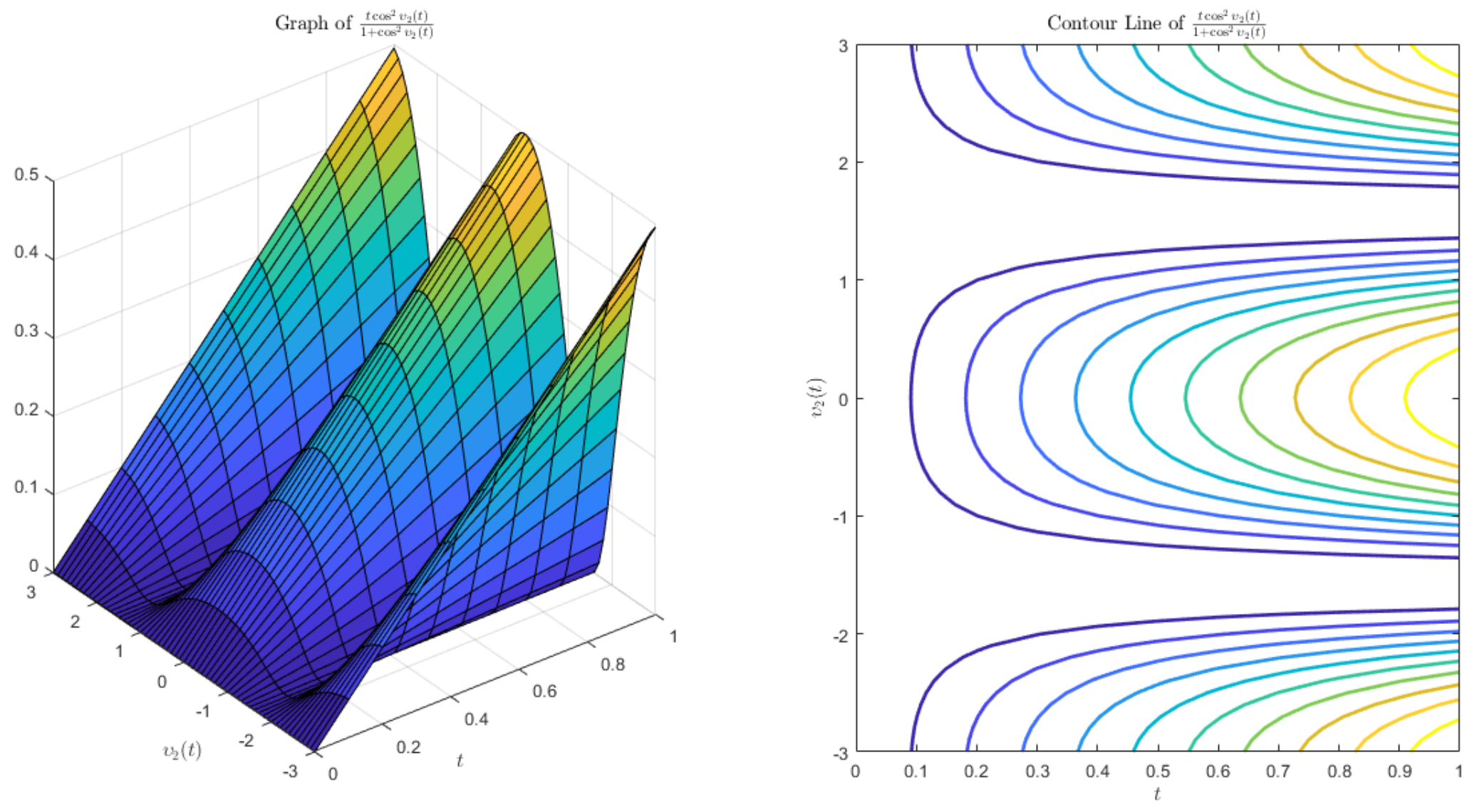
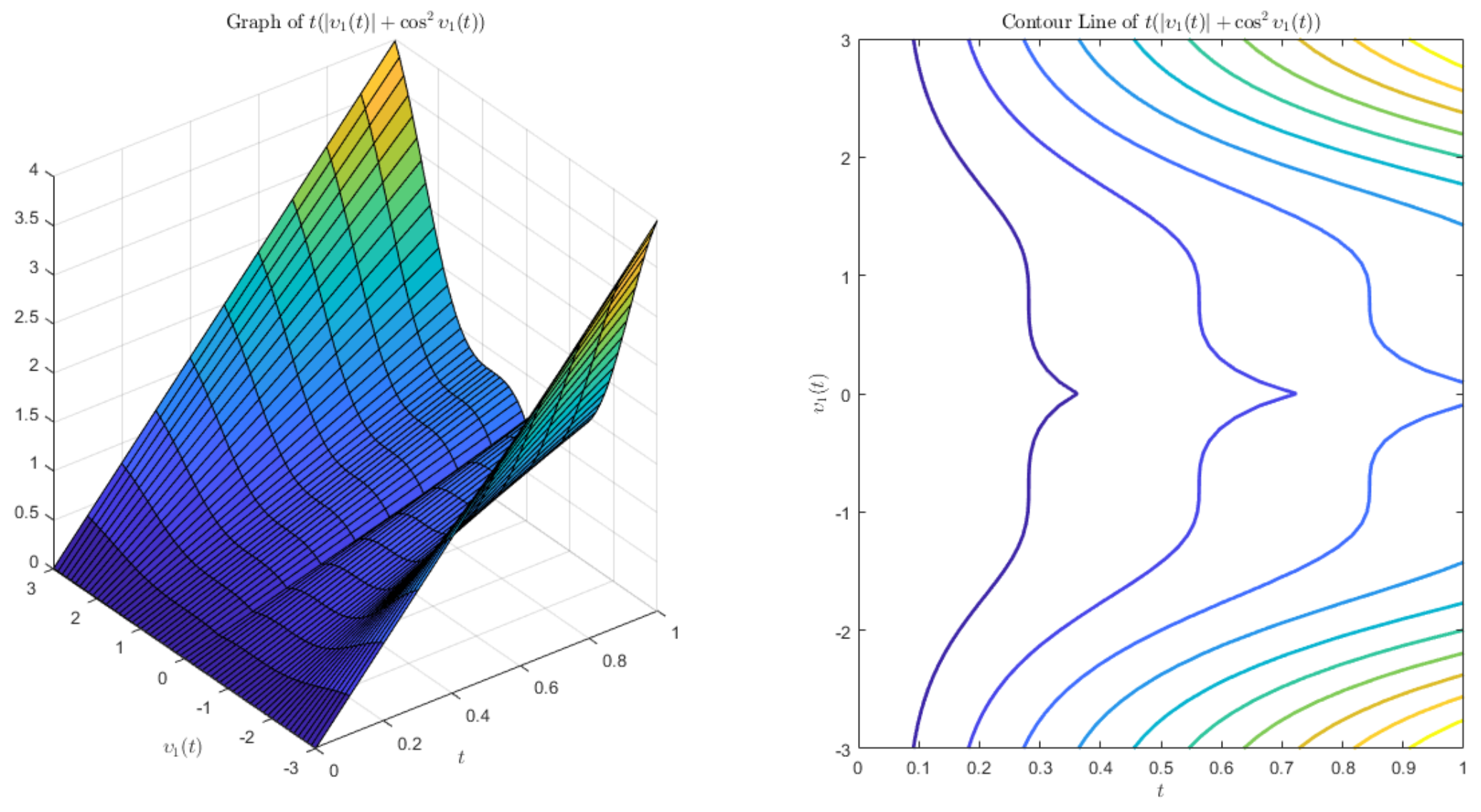
Thus, by Theorem 5, system (1) is Ulam–Hyers stable. To better understand this example, graphs of some functions are provided in Figure 1 and Figure 2.
Figure 1.
The graph of .
Figure 2.
The graph of .
5. Conclusions
The fractional stochastic neutral differential system has many applications in various fields, such as viscoelasticity, automatic control, electrochemistry, etc. Based on some well-known fixed-point theorems of fractional calculus and the technique of stochastic analysis, the existence of results for the considered system has been obtained. Likewise, under specific assumptions and conditions, we have found the (U-Hs) result for the solution of system (1). We also provided an example and some figures to show the performance of the results that we proved.
Author Contributions
Conceptualization, M.A., A.Z.; Formal analysis, M.A., A.Z., M.G., R.G., S.R.; Funding acquisition, R.G.; Methodology, M.A., A.Z., M.G., R.G., S.R.; Software, M.G., S.R.; All authors have read and agreed to the published version of the manuscript.
Funding
This research received no external funding.
Institutional Review Board Statement
Not applicable.
Informed Consent Statement
Not applicable.
Data Availability Statement
Data sharing not applicable to this article as no datasets were generated or analyzed during the current study.
Acknowledgments
The third and fifth authors would like to thank Azarbaijan Shahid Madani University.
Conflicts of Interest
The authors declare no conflict of interest.
Abbreviations
The following abbreviations are used in this manuscript:
| U-Hs | Ulam-Hyers stability |
| FDEs | Fractional Differential Equations |
| EU | Existence and Uniqueness |
References
- Baleanu, D.; Jajarmi, A.; Mohammadi, H.; Rezapour, S. A new study on the mathematical modelling of human liver with Caputo-Fabrizio fractional derivative. Chaos Solitons Fractals 2020, 134, 109705. [Google Scholar] [CrossRef]
- Mohammadi, H.; Kumar, S.; Rezapour, S.; Etemad, S. A theoretical study of the Caputo-Fabrizio fractional modeling for hearing loss due to Mumps virus with optimal control. Chaos Solitons Fractals 2021, 144, 110668. [Google Scholar] [CrossRef]
- Herrmann, R. Fractional Calculus, an Introduction for Physicists; World Scientific Publishing Company: Singapore, 2011. [Google Scholar]
- Deng, W.; Hou, R.; Wang, W.; Xu, P. Modeling Anomalous Diffusion: From Statistics to Mathematics; World Scientific: Singapore, 2020. [Google Scholar]
- Matar, M.M.; Abbas, M.I.; Alzabut, J.; Kaabar, M.K.A.; Etemad, S.; Rezapour, S. Investigation of the p-Laplacian nonperiodic nonlinear boundary value problem via generalized Caputo fractional derivatives. Adv. Differ. Equ. 2021, 2021, 68. [Google Scholar] [CrossRef]
- Podlubny, I. Fractional Differential Equations; Academic Press: Cambridge, MA, USA, 1999. [Google Scholar]
- Lakshmikantham, V.; Leela, S.; Devi, J.V. Theory of Fractional Dynamic Systems; Cambridge Scientific Publishers: Cambridge, UK, 2009. [Google Scholar]
- Balachandran, K.; Park, J.Y. Controllability of fractional integrodifferential systems in Banach spaces. Nonlinear Anal. Hybrid Syst. 2009, 3, 363–367. [Google Scholar] [CrossRef]
- Bellman, R. The stability of solutions of linear differential equations. Duke Math. J. 1943, 4, 643–647. [Google Scholar] [CrossRef]
- Sousa, J.V.D.C.; Oliveira, E.C.D. On the Ψ-fractional derivative. Commun. Nonlinear Sci. Numer. Simul. 2018, 60, 72–91. [Google Scholar] [CrossRef]
- Caraballo, T.; Real, J.; Taniguchi, T. The exponential stability of neutral stochastic delay partial differential equations. Discret. Contin. Dyn. Syst. 2007, 18, 295–313. [Google Scholar] [CrossRef]
- Deinz, H. On the behaviour of measure of noncompactness with respect to differentiation and integration of vector-valued functions. Nonlinear Anal. Theory Methods Appl. 1983, 7, 1351–1371. [Google Scholar] [CrossRef]
- Chen, W.H.; Zheng, W.X. Delay–dependent robust stabilization for uncertain neutral systems with distributed delays. Automatica 2007, 43, 95–104. [Google Scholar] [CrossRef]
- Miller, K.S.; Ross, B. An Introduction to the Fractional Calculus and Differential Equations; John Wiley: New York, NY, USA, 1993. [Google Scholar]
- Diethelm, K. The Analysis of Fractional Differential Equations; Springer: Berlin/Heidelberg, Germany, 2010. [Google Scholar]
- Zhou, Y. Basic Theory of Fractional Differential Equations; World Scientific: New York, NY, USA, 2014. [Google Scholar]
- Granas, A.; Dugundji, J. Fixed Point Theory; Springer: New York, NY, USA, 2003. [Google Scholar]
- Sethi, A.K.; Ghaderi, M.; Rezapour, S.; Kaabar, M.K.A.; Inc, M.; Masiha, H.P. Sufficient conditions for the existence of oscillatory solutions to nonlinear second order differential equations. J. Appl. Math. Comput. 2021. [Google Scholar] [CrossRef]
- Baitiche, Z.; Derbazi, C.; Wang, G. Monotone iterative method for nonlinear fractional p-Laplacian differential equation in terms of ψ-Caputo fractional derivative equipped with a new class of nonlinear boundary conditions. Math. Methods Appl. Sci. 2022, 45, 967–976. [Google Scholar] [CrossRef]
- Wang, G.; Ren, X.; Zhang, L.; Ahmad, B. Symmetry of standing waves for two kinds of fractional Hardy-Schrödinger equations. Alex. Eng. J. 2021, 60, 3991–3995. [Google Scholar] [CrossRef]
- Guan, T.; Wang, G.; Xu, H. Initial boundary value problems for space-time fractional conformable differential equation. AIMS Math. 2021, 6, 5275–5291. [Google Scholar] [CrossRef]
- Guan, T.; Wang, G. Maximum Principle for the Space-Time Fractional Conformable Differential System Involving the Fractional Laplace Operator. J. Math. 2020, 2020, 7213146. [Google Scholar] [CrossRef]
- Thabet, S.T.M.; Etemad, S.; Rezapour, S. On a coupled Caputo conformable system of pantograph problems. Turk. J. Math. 2021, 45, 496–519. [Google Scholar] [CrossRef]
- Alsaedi, A.; Ahmad, B.; Alghanmi, M. Extremal solutions for generalized Caputo fractional differential equations with Stieltjes-type fractional integro-initial conditions. Appl. Math. Lett. 2019, 91, 113–120. [Google Scholar] [CrossRef]
- Ahmad, M.; Zada, A.; Alzabut, J. Hyers–Ulam stability of a coupled system of fractional differential equations of Hilfer-Hadamard type. Demonstr. Math. 2019, 52, 283–295. [Google Scholar] [CrossRef]
- Ahmad, M.; Zada, A.; Alzabut, J. Stability analysis of a nonlinear coupled implicit switched singular fractional differential system with p-Laplacian. Adv. Differ. Equ. 2019, 2019, 436. [Google Scholar] [CrossRef]
- Yan, B. Boundary value problems on the half-line with impulses and infinite delay. J. Math. Anal. Appl. 2001, 259, 94–114. [Google Scholar] [CrossRef] [Green Version]
- Deng, S.; Shu, X.; Mao, J. Existence and exponential stability for impulsive neutral stochastic functional differential equations driven by fBm with noncompact semigroup via Monch fixed point. J. Math. Anal. Appl. 2018, 467, 398–420. [Google Scholar] [CrossRef]
- Dong, X.; Bai, Z.; Zhang, W. Positive solutions for nonlinear eigenvalue problems with conformable fractional differential derivatives. J. Shandong Univ. Sci. Technol. Nat. Sci. 2016, 35, 85–90. [Google Scholar]
- Diaz, J.B.; Margolis, B. A fixed point theorem of the alternative for contractions on a generalized complete metric space. Bull. Am. Math. Soc. 1968, 74, 305–309. [Google Scholar] [CrossRef] [Green Version]
- Sakthivel, R.; Revathi, P.; Ren, Y. Existence of solutions for nonlinear fractional stochastic differential equations. Nonlinear Anal. 2013, 1, 70–86. [Google Scholar] [CrossRef]
- Abdeljawad, T.; Agarwal, R.P.; Karapinar, E.; Kumari, P.S. Solutions of the nonlinear integral equation and fractional differential equation using the technique of a fixed point with a numerical experiment in extended b-metric space. Symmetry 2019, 11, 686. [Google Scholar] [CrossRef] [Green Version]
- Sathiyaraj, T.; Wang, J.; Balasubramaniam, P. Ulam’s stability of Hilfer fractional stochastic differential systems. Eur. Phys. J. Plus 2019, 134, 605. [Google Scholar] [CrossRef]
- Wang, D.; Ding, X.L.; Ahmad, B. Existence and stability results for multi-time scale stochastic fractional neural networks. Adv. Differ. Equ. 2019, 2019, 441. [Google Scholar] [CrossRef] [Green Version]
- Dai, Q.; Gao, R.; Li, Z.; Wang, C. Stability of UlamHyers and UlamHyersRassias for a class of fractional differential equations. Adv. Differ. Equ. 2020, 2020, 103. [Google Scholar] [CrossRef]
- Guo, Y.; Shu, X.B.; Li, Y.; Xu, F. The existence and Hyers–Ulam stability of solution for an impulsive Riemann–Liouville fractional neutral functional stochastic differential equation with infinite delay of order 1 < β < 2. Bound. Value Probl. 2019, 2019, 59. [Google Scholar] [CrossRef]
- Abdeljawad, T.; Karapinar, E.; Kumari, P.S.; Mlaiki, N. Solutions of boundary value problems on extended-Branciari b-distance. J. Inequal. Appl. 2020, 2020, 103. [Google Scholar] [CrossRef]
- Schiff, J.L. The Laplace Transform: Theory and Applications; Springer: New York, NY, USA, 1999. [Google Scholar]
- Krasnoselskii, M.A. Two remarks on the method of successive approximations. Usp. Mat. Nauk 1955, 1, 123–127. [Google Scholar]
Publisher’s Note: MDPI stays neutral with regard to jurisdictional claims in published maps and institutional affiliations. |
© 2022 by the authors. Licensee MDPI, Basel, Switzerland. This article is an open access article distributed under the terms and conditions of the Creative Commons Attribution (CC BY) license (https://creativecommons.org/licenses/by/4.0/).