
Abstract
This paper investigates the solitary wave solutions for the perturbed nonlinear Schrödinger equation with six different nonlinearities with the essence of the generalized classical derivative, which is known as the beta derivative. The aforementioned nonlinearities are known as the Kerr law, power, dual power law, triple power law, quadratic–cubic law and anti-cubic law. The dark, bright, singular and combinations of these solutions are retrieved using an efficient, simple integration scheme. These solutions suggest that this method is more simple, straightforward and reliable compared to existing methods in the literature. The novelty of this paper is that the perturbed nonlinear Schrödinger equation is investigated in different nonlinear media using a novel derivative operator. Furthermore, the numerical simulation for certain solutions is also presented.
1. Introduction
Finding solitary wave solutions is the most interesting work in soliton theory [1,2]. Many physical phenomena are represented as prototypes in the form of nonlinear partial differential equations (PDEs), particularly in nonlinear Schrödinger equations (NSEs). The NS equation is a generic model that governs the wave evolution in a broad range of physical circumstances including water waves, blood flow in blood vessels, nonlinear optics, magnetic films and plasma physics [3,4,5,6]. These models indicate the parameters that affect the phenomenon, which are not seen directly by observing the phenomenon. Various models have been formulated in the field of science and engineering representing a different phenomenon. For example, most naturally occurring phenomena have been modeled in the structure of NLSEs [7,8,9,10,11]. The NLSE affirms diverse solutions; for instance, dark and bright solitons, localized waves and periodic traveling waves, which have attracted a great deal of interest due to their applications in different physical systems. For the determination of solutions to these models, different techniques have been constructed. For example, the semi-inverse variational method [12] has been employed to determine the two types of solitons for the Perturbed Gerdjikov–Ivanov equation (PGIE). The hyperbolic rational function solutions of the Boussinesq fractional type models have been explored using an exponential rational function scheme [13].
In addition to the above-mentioned models, there is another efficient model, named the perturbed nonlinear Schrödinger equation. A variety of solutions for this model has been determined by using the different schemes [14,15,16,17,18]. A great deal of attention has been devoted to the study of exact solutions of NPDEs for more than two decades. Many efficient approaches have been reported to extract wave solutions [19,20,21,22,23,24,25,26]. There are many ways to derive a series of solutions for -dimensional FDEs; for example, the expansion method [27] and the modified extended tanh expansion method [28,29] are efficient approaches to investigate the different types of wave solutions. By using the modified extended tanh expansion method, dark and singular wave solutions of the famous Biswas and Arshed model with full nonlinearity were obtained in [30]. A variety of wave solutions to the -dimensional integrable non-linear Schrödinger equation is presented in [31].
The main aim of this paper is to determine the solitary wave solutions of the perturbed nonlinear Schrödinger equation with a beta time-fractional derivative by applying the modified extended tanh expansion method. We study the aforementioned equation for different nonlinearities including the Kerr, power, quadratic-cubic, anti-cubic, dual power and triple power laws [32,33,34,35,36]. Moreover, we recall the definition of the -time derivative and its properties [37,38,39].
Definition 1.
Suppose is a function that is defined for all non-negative τ. Then, the -time derivative of the function g of order β is given as
Theorem 1.
Suppose and are the -time differentiable functions for all and . Then,
2. Model and Method Description
Consider the following dimensionless form of the perturbed nonlinear Schrödinger equation, given as [40]
where shows the traveling wave profile, depending on the space of the independent variables x and time t. In Equation (1), the first term indicates the linear evaluation of the phenomena, the coefficient of represents the spatio-temporal dispersion (STD) and the coefficient of shows the group velocity dispersion (GVD). The perturbation terms appear on the right-hand side of Equation (1). The coefficient of represents the inter-model dispersion, the coefficient of shows the self-steepening perturbation term and the coefficient indicates the nonlinear dispersion, while p is the full nonlinearity parameter. The coefficient represents the non-Kerr Law nonlinearity term, modeled by the function G.
2.1. The Modified Extended tanh Expansion Method
Let us assume the non-linear PDE of the form:
here . Let us examine the following transformations:
with is the wave speed. Substituting the Equation (3) in Equation (2) yields the following nonlinear ODE:
Moreover, consider the trial solution of Equation (4) in the form:
In Equation (5), are unknowns and both and are not vanish simultaneously. The homogenous balance method between the nonlinear term and highest derivative term in Equation (4) produces the value of m. The function satisfies the following Riccati differential equation
having the solutions given in [41] depending on the unknown parameter .
2.2. Mathematical Analysis of the Model
We start with the following wave transformations:
Here U demonstrates the amplitude portion of the wave solution, reveals the velocity of the wave solution. The frequency of the wave solution is and exhibits the wave number of the wave solution. Furthermore, the phase constant of the wave solution is given by and .
By inserting Equation (7) in Equation (1), we ensure the real and imaginary parts as follows:
Real part:
Imaginary part:
From Equation (11), we grab the speed of the wave solution by taking the coefficient of , equal to zero.
along with the constraint conditions for the existence of wave solutions.
We now take up the six forms of nonlinearities in the following subsections.
3. Application of the Method with Different Nonlinear Medias
3.1. Kerr Law
For this law, . Equation (1) for PNLSE with Kerr Law nonlinearity becomes:
For the Equation (1) to be integrable, put in the Kerr Law nonlinear medium. Equation (10) changes into the following form:
By using the homogeneous balance technique into the Equation (15), we get . For , Equation (5) reduces into:
Here , and are unknown parameters. By putting the Equations (16) and (6) into Equation (15) and collecting the coefficients of each power of , we get the algebraic expressions involving , and and other parameters. Now with the use of symbolic software, we get the following solution sets:
Set 1:
We now using the Equations (17) and (16) in Equation (7) and secure the subsequent cases.
If , then
or
If , then
If , then
or
Set 2:
We now using the Equations (23) and (26) in Equation (7) and grab the subsequent cases.
If , then
If , then
Set 3:
We now using the Equations (23) and (26) in Equation (7) and obtain the following cases.
If , then
or
If , then
or
Set 4:
We now using the Equations (31) and (26) in Equation (7) and get the following cases.
If , then
or
If , then
or
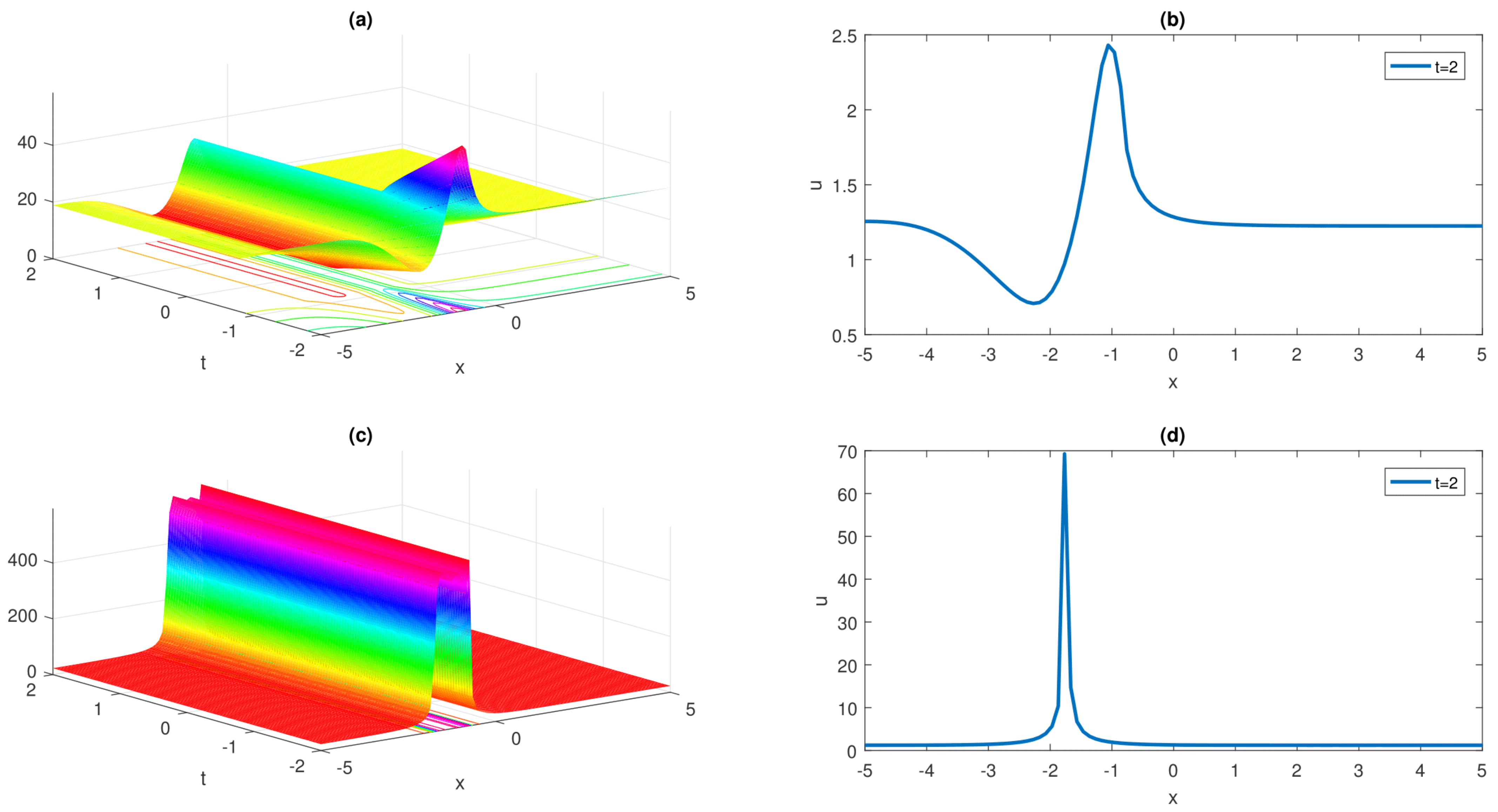
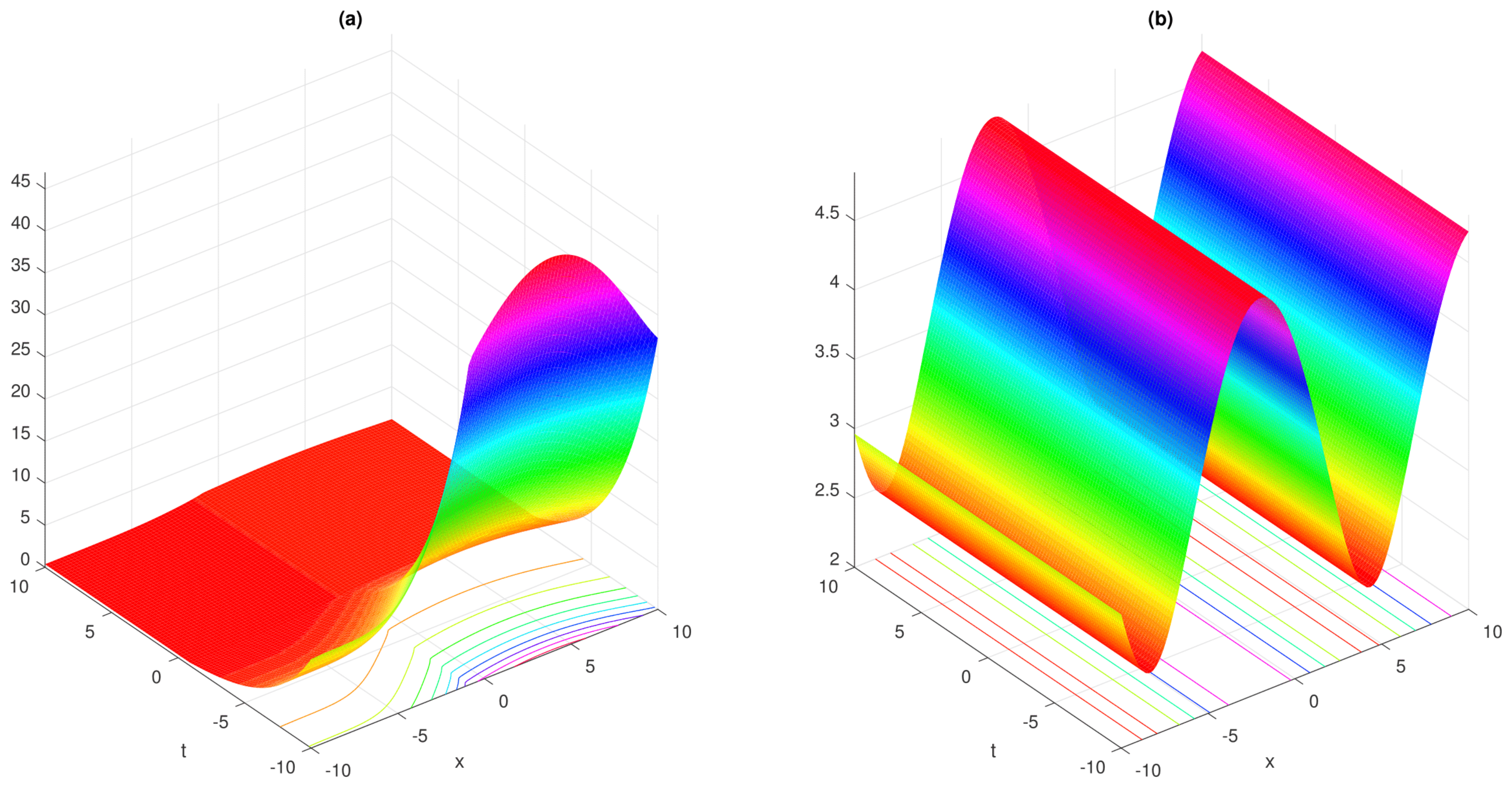
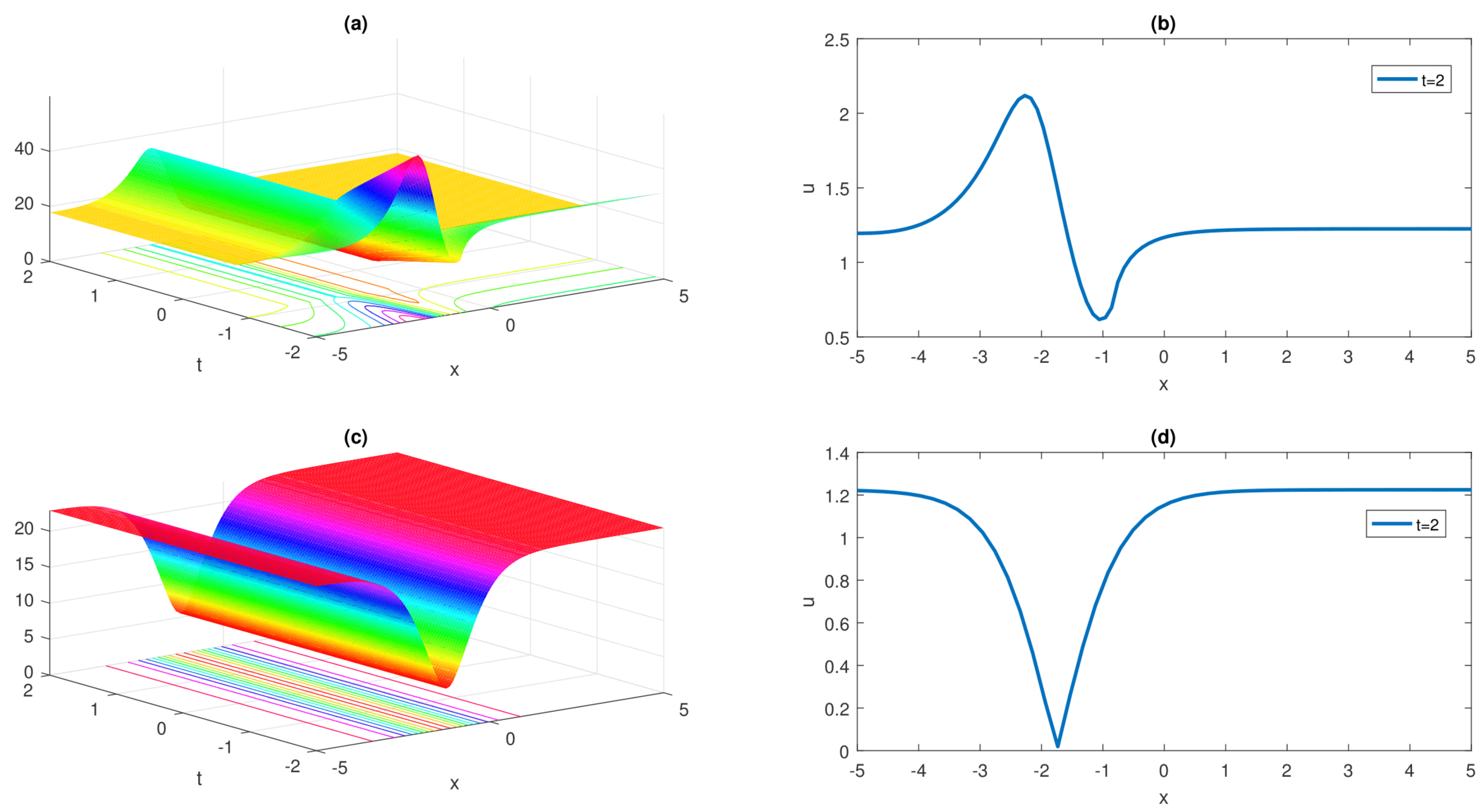
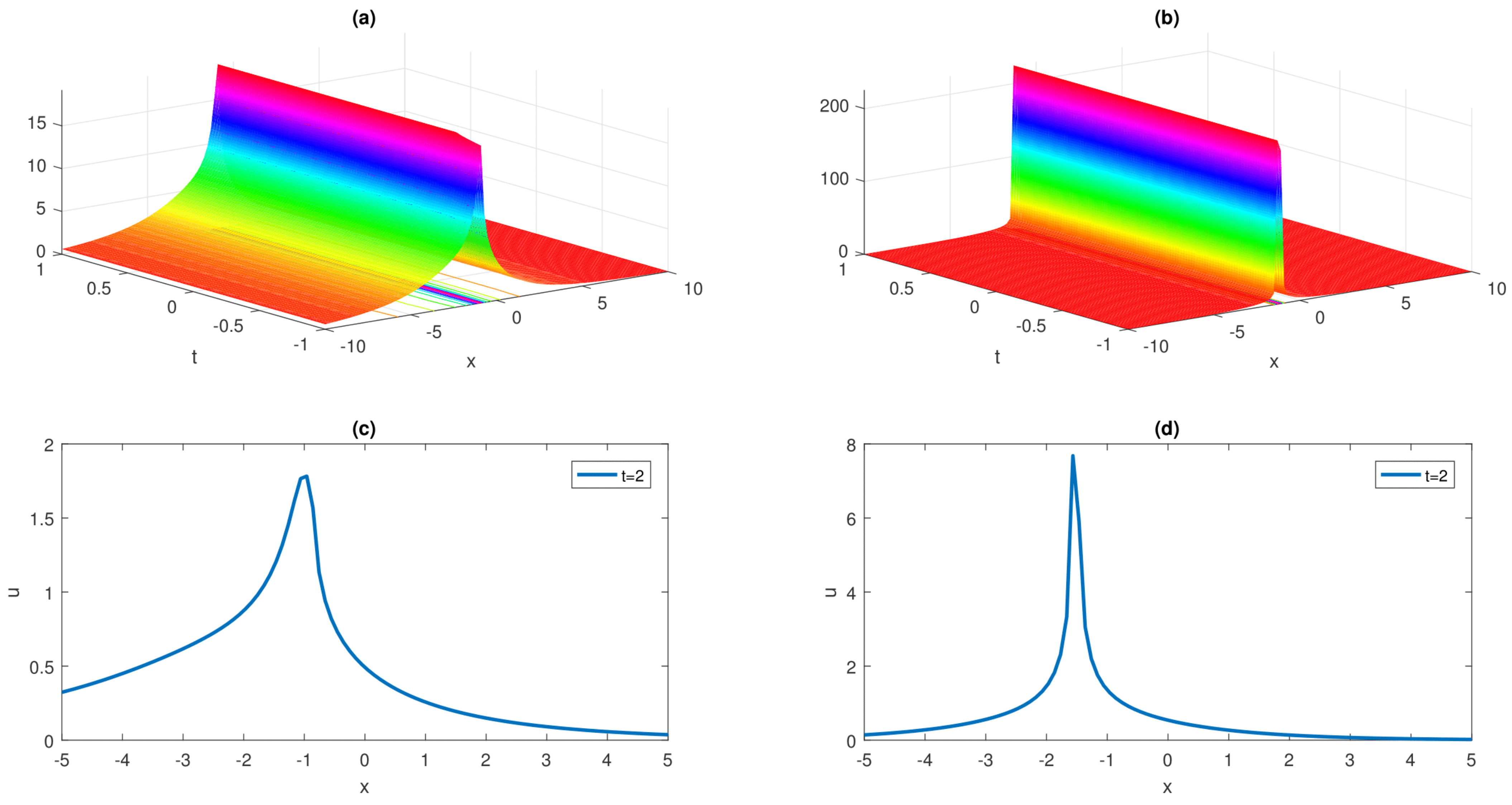
Here the and graphs, by taking , , are displayed in Figure 1 and Figure 2 for selected solutions to visualized their dynamics.
Figure 1.
and wave simulations of dark soliton type solution (18) are presented in (a–d) for fractional parameter .
Figure 2.
and wave simulations of bright soliton type solution (19) are presented in (a–d) for fractional parameter .
3.2. Power Law
For this law, , where , shows the power law nonlinearity factor. If , then power law reduces to Kerr law. Equation (1) for PNLSE with Power Law nonlinearity becomes:
For the Equation (1) to be integrable, put in the Power Law nonlinear medium. Equation (10) changes into the following form:
To retrieve the solutions, we use the following transformation on the above equation.
we get the following equation:
By using the homogeneous balance technique into the Equation (39), we get . For , Equation (5) reduces into:
Here , , , and are unknown parameters. By putting the Equations (40) and (6) into Equation (15) and collecting the coefficients of each power of , we get the algebraic expressions involving , , , , and other parameters. We now, with the use of symbolic software, grab the following solution sets:
Set 1:
We now using the Equations (41) and (40) in Equation (7) and secure the following cases.
If , then
or
If , then
or
Set 2:
We now using the Equations (46) and (40) in Equation (7) and get the following cases.
If , then
Set 3:
We now using the Equations (48) and (40) in Equation (7) and secure the subsequent cases.
If , then
if , then
if , then
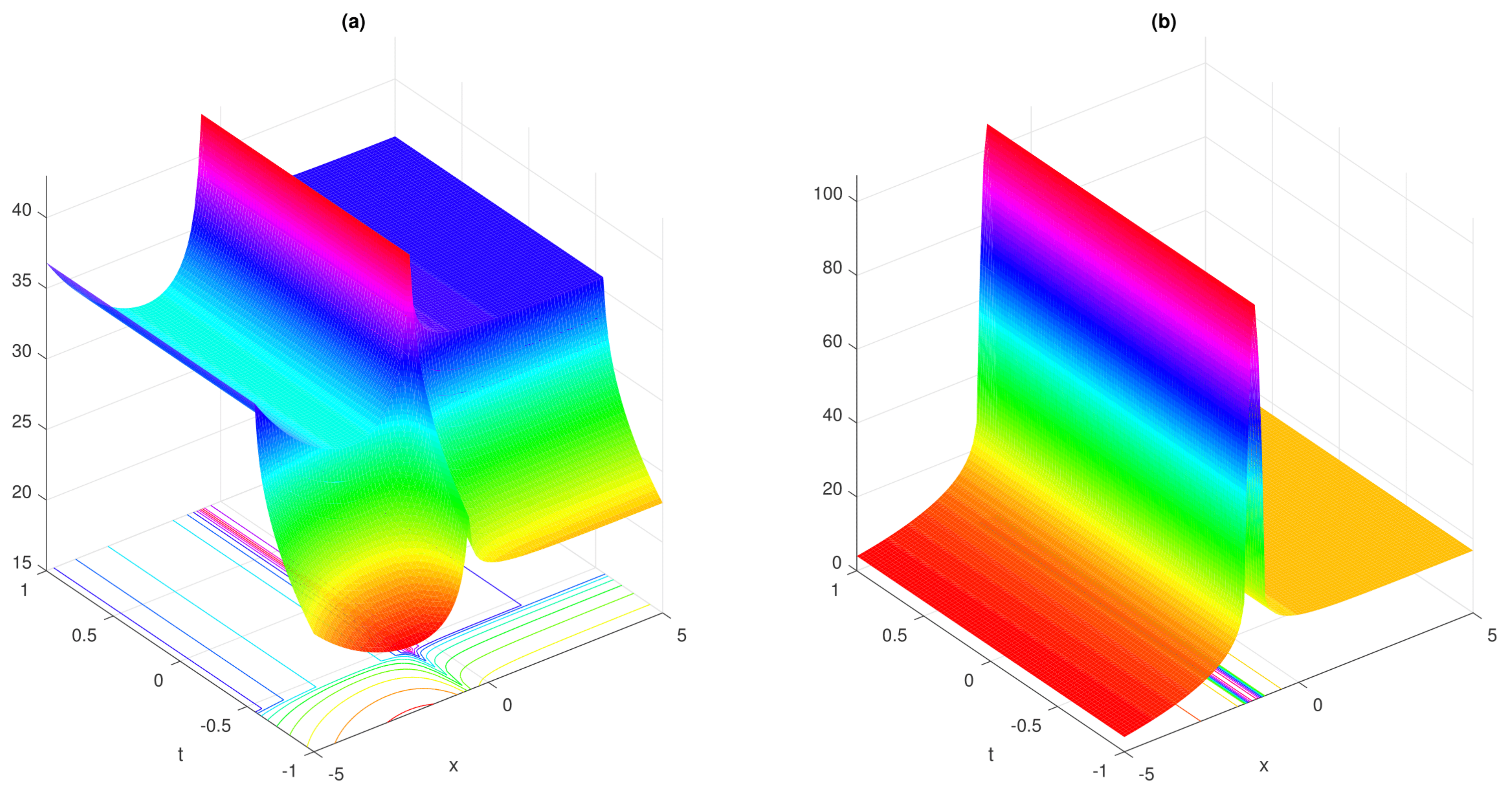
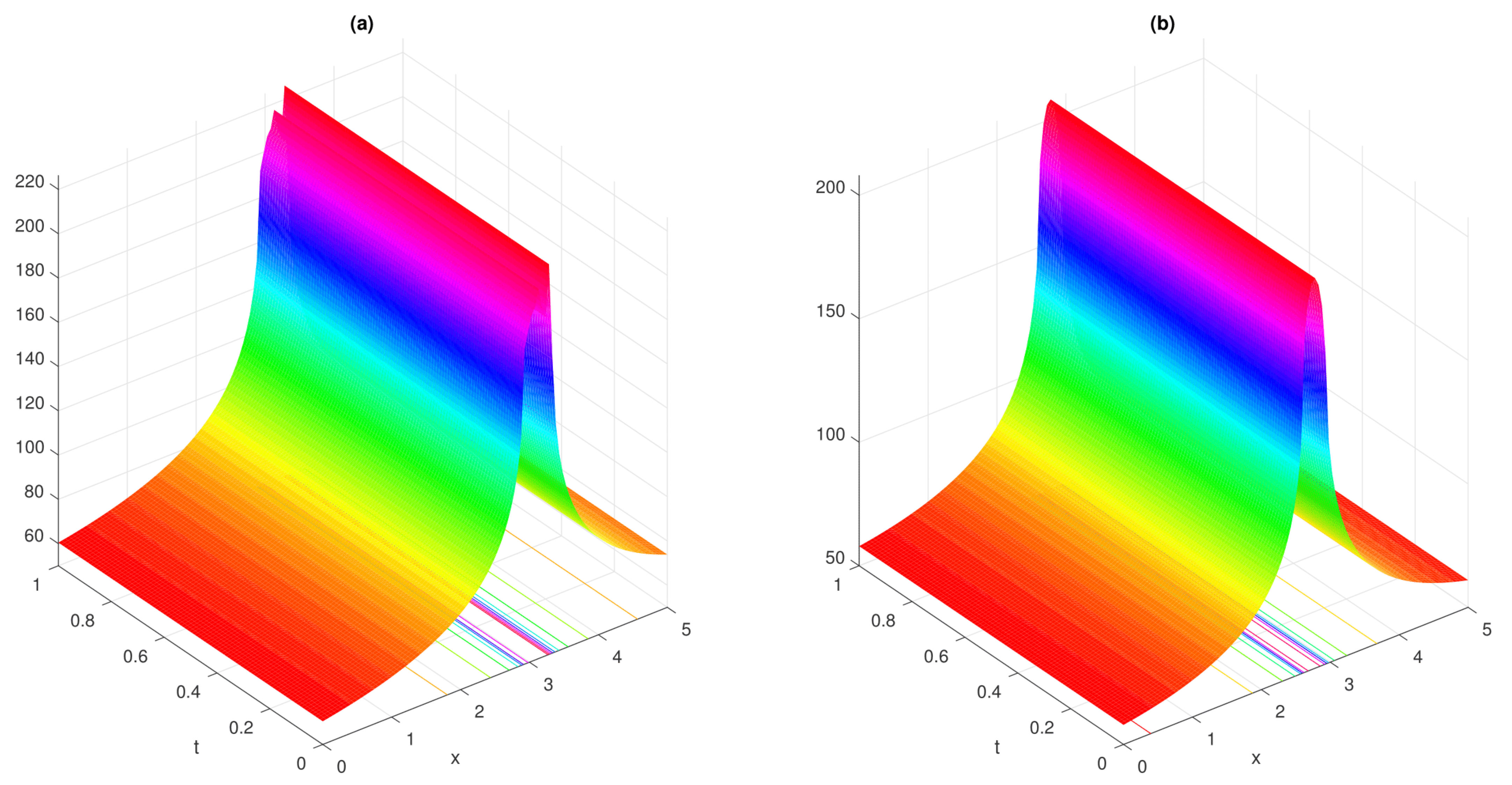
Here the and graphs, by taking , , and are displayed in Figure 3 and Figure 4 for selected solutions to visualized their dynamics.
Figure 3.
and wave simulations of singular soliton type solution (42) are presented in (a–d) for fractional parameter and .
Figure 4.
and wave simulations of bright soliton type solution (43) are presented in (a–d) for fractional parameter and .
3.3. Quadratic-Cubic Law
For this law , where and are constants. Equation (1) for PNLSE with Quadratic-cubic Law nonlinearity becomes:
Equation (10) changes into the following form:
By using the homogeneous balance technique into the Equation (53), we get . For , Equation (5) reduces into:
Here , and are unknown parameters. By using the Equations (16) and (6) into Equation (15) and collecting the coefficients of each power of , we get the algebraic expressions involving , and and other parameters. We now, with the use of symbolic software, we gain the following solution sets:
Set 1:
We now using the Equations (55) and (54) in Equation (7) and grab the subsequent cases.
If , then
or
If , then
or
Set 2:
We now using the Equations (60) and (54) in Equation (7) and set to the below cases.
If , then
or
If , then
If , then
or
Set 3:
We now using the Equations (66) and (54) in Equation (7) and secure the consequent cases.
If , then
or
If , then
or
Set 4:
We now using the Equations (71) and (54) in Equation (7) and set to the below cases.
If , then
or
If , then
or
Set 5:
We now using the Equations (76) and (54) in Equation (7) and grab the below cases.
If , then
or
If , then
If , then
or
Set 6:
We now using the Equations (82) and (54) in Equation (7) and set the following results.
If , then
or
If , then
or
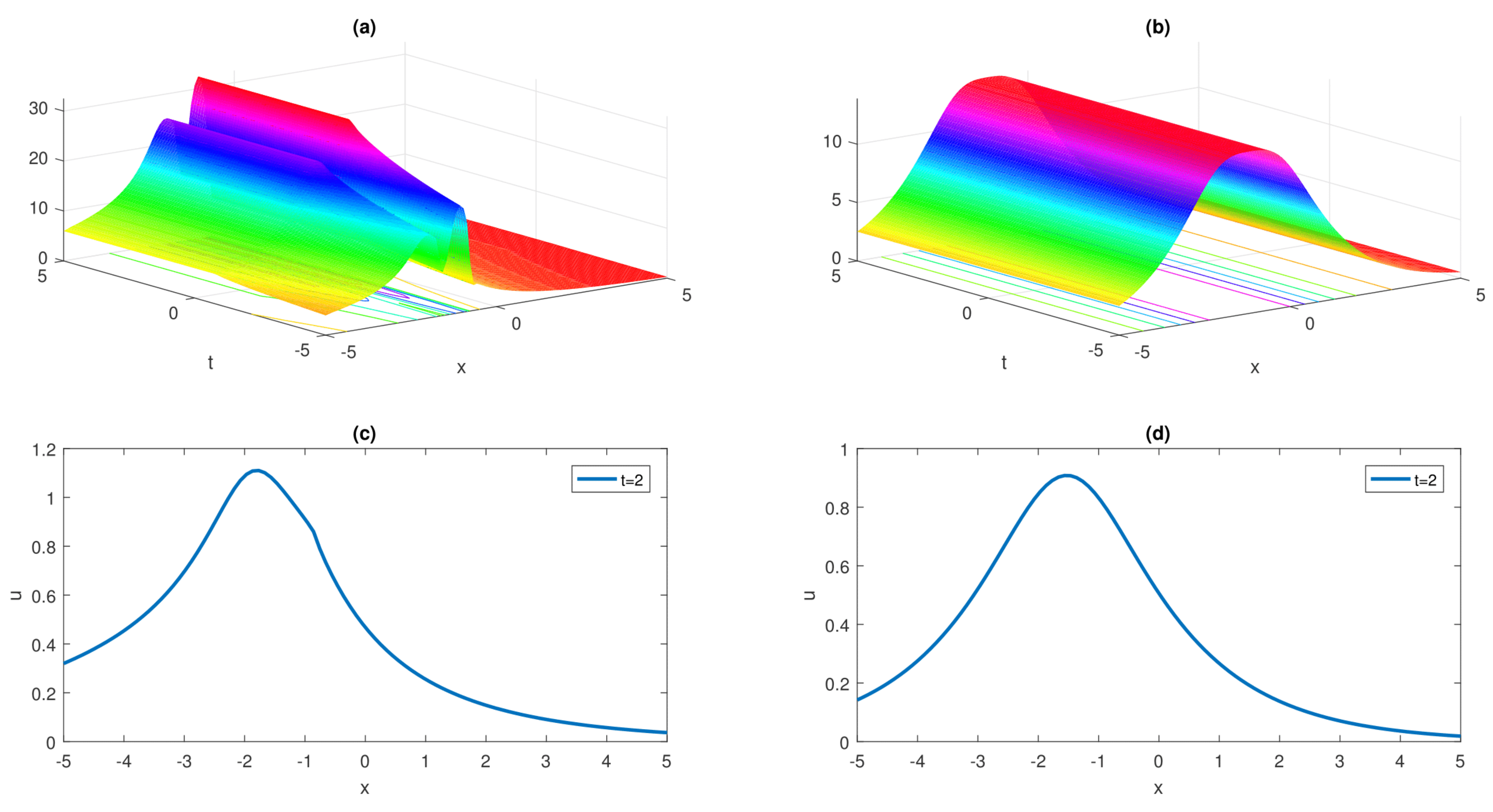
Here the and graphs, by taking , and are displayed in Figure 5 and Figure 6 for selected solutions to visualized their dynamics.
Figure 5.
and wave simulations of singular soliton solution (56) are presented in (a,b), for fractional parameter and .
Figure 6.
and wave simulations of dark soliton solution (57) are presented in (a–d) for fractional parameter and , .
3.4. Anti-Cubic Law
For this law , where , and are constants. Equation (1) for PNLSE with Anti-cubic Law nonlinearity becomes:
Equation (10) reduces into the following form:
To get the solutions in retrieve form, we use the transformation . The above Equation (88) reduces into:
By using the homogeneous balance technique onto the Equation (89), we get . For , Equation (5) reduces into:
Here , and are unknown parameters. By putting the Equations (90) and (6) into Equation (89) and collecting the coefficients of each power of , we get the algebraic expressions involving , and and other parameters. We now, with the use of symbolic software and taking , we attain the following solution sets:
Set 1:
We now using the Equations (91) and (90) in Equation (7) and grab the subsequent cases.
If , then
or
If , then
or
Set 2:
We now using the Equations (96) and (90) in Equation (7) and secure the subsequent cases.
If , then
or
If , then
or
Set 3:
We now using the Equations (101) and (90) in Equation (7) and grab the subsequent cases.
If , then
or
If , then
or
Set 4:
We now using the Equations (106) and (90) in Equation (7) and get the consequent cases.
If , then
or
If , then
or
Set 5:
We now using the Equations (111) and (90) in Equation (7) and secure the following results.
If , then
If , then
Set 6:
We now using the Equations (114) and (90) in Equation (7) and get the following results.
If , then
If , then
Set 7:
We now using the Equations (117) and (90) in Equation (7) and secure the subsequent results.
If , then
If , then
3.5. Dual Power Law
For this law, , where and are constants. Equation (1) for PNLSE with dual power law nonlinearity becomes:
here as in the case of power law. Moreover, if dual power law becomes to the parabolic law. Equation (10) changes into the following form:
To get the solutions in retrieve form, we use the transformation . The above Equation (121) reduces into:
By using the homogeneous balance technique into the Equation (122), we get . For , Equation (5) reduces to:
Here , and are unknown parameters. By putting the Equations (123) and (6) into Equation (122) and collecting the coefficients of each power of , we get the algebraic expressions involving , and and other parameters. We now, with the use of symbolic software and taking , we attain the following solution sets:
Set 1:
We now using the Equations (124) and (123) in Equation (7) and secure the following results.
If , then
or
If , then
or
Set 2:
We now using the Equations (129) and (123) in Equation (7) and get the following cases.
If , then
or
If , then
or
Set 3:
We now using the Equations (134) and (123) in Equation (7) and get the following cases.
If , then
or
If , then
or
3.6. Triple Power Law
For this law, , where , and are constants. Equation (1) for PNLSE with triple power law nonlinearity becomes:
Equation (10) changes into the following form:
To get the solutions in retrieve form, we use the transformation . The above Equation (88) reduces into:
By using the homogeneous balance technique onto the Equation (141), one secure and for , Equation (5) reduces to:
Here , and are unknown parameters. By putting the Equations (142) and (6) into Equation (141) and collecting the coefficients of each power of , we get the algebraic expressions involving , and and other parameters. We now, with the use of symbolic software and taking , we gain the following solution sets:
Set 1:
We now using the Equations (143) and (142) in Equation (7) and secure the following cases.
If , then
or
If , then
If , then
or
Set 2:
We now using the Equations (149) and (142) in Equation (7) and secure the following cases.
If , then
or
If , then
or
Set 3:
Now using the Equations (154) and (142) in Equation (7), one can get the following cases.
If , then
or
If , then
or
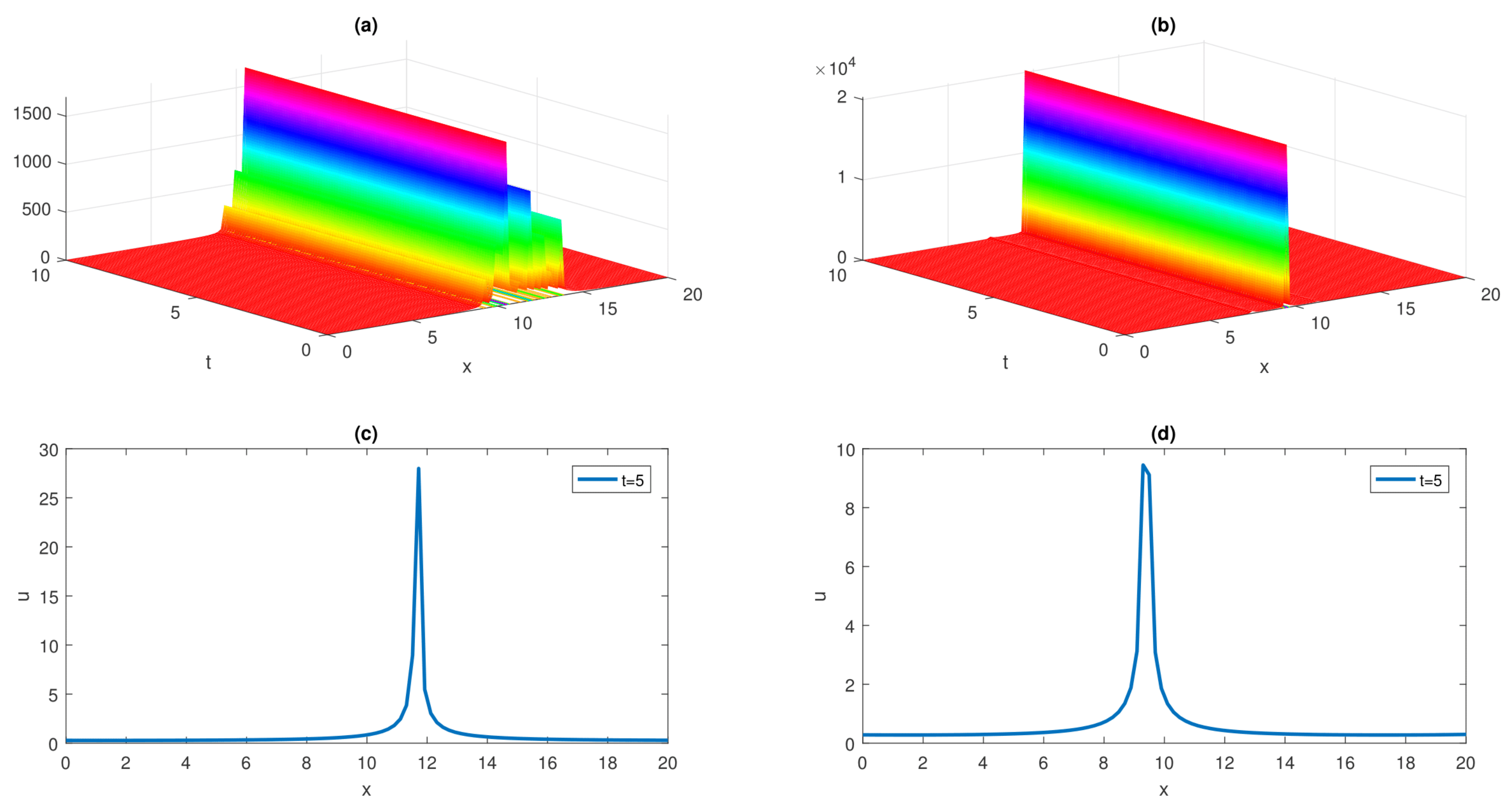
Here the graphs, by taking , and are displayed in Figure 7, Figure 8 and Figure 9 for selected solutions to visualized their dynamics.
Figure 7.
wave simulations of complex solitary solution (144) are presented in (a,b) for fractional parameter and , .
Figure 8.
wave simulations of complex solitary solution (145) are presented in (a,b) for fractional parameter and , .
Figure 9.
wave simulations of complex periodic solution (147) are presented in (a,b) for fractional parameter and , .
4. Conclusions
We have produced the different types of solitary wave solutions of the perturbed nonlinear Schrödinger equation with different nonlinearities successfully. The novel beta derivative operator and the modified extended tanh expansion method have been employed to retrieve dark, singular and combined solitary wave solutions. The obtained solutions have been verified through some symbolic mathematical tools. The obtained solutions have been demonstrated via numerical simulation by taking suitable values for physical and arbitrary parameters. The novelty of this paper has been proved by investigating the perturbed nonlinear Schrödinger equation for the first time in the generalized form of classical derivative sense.
Author Contributions
Conceptualization, A.Z., M.R. and M.Q.Z.; formal analysis, K.S.N., M.S.O. and A.E.; investigation, A.Z., M.R., K.S.N. and M.S.O.; software, A.Z., M.Q.Z., K.S.N. and M.S.O.; validation, M.R. and K.S.N.; writing—original draft, A.Z., M.R., M.Q.Z., K.S.N. and M.S.O.; writing—review, revision and editing, A.Z., K.S.N., R.N.M. and A.E.; funding acquisition, K.S.N., R.N.M. and A.E.; resources, K.S.N., R.N.M. and A.E. All authors have read and agreed to the published version of the manuscript.
Funding
This research received no external funding.
Institutional Review Board Statement
Not applicable.
Informed Consent Statement
Not applicable.
Data Availability Statement
Not applicable.
Acknowledgments
This work was supported by Taif University researchers supporting project number (TURSP-2020/102), Taif University, Taif, Saudi Arabia.
Conflicts of Interest
The authors hereby declare that there is no conflict of interests regarding the publication of this paper.
References
- Osman, M.S.; Machado, J.A.T. New nonautonomous combined multi-wave solutions for (2 + 1)-dimensional variable coefficients KdV equation. Nonlinear Dyn. 2018, 93, 733–740. [Google Scholar] [CrossRef]
- Osman, M.S.; Abdel-Gawad, H.I.; El Mahdy, M.A. Two-layer-atmospheric blocking in a medium with high nonlinearity and lateral dispersion. Results Phys. 2018, 8, 1054–1060. [Google Scholar] [CrossRef]
- Biswas, A.; Konar, S. Introduction to Non-Kerr Law Optical Solitons; CRC Press: Boca Raton, FL, USA, 2006. [Google Scholar]
- Wazwaz, A.M. A study on linear and nonlinear Schrodinger equations by the variational iteration method. Chaos Solitons Fractals 2008, 37, 1136–1142. [Google Scholar] [CrossRef]
- Ma, X.W.; Chen, M. Direct search for exact solutions to the nonlinear Schrödinger equation. Appl. Math. Comput. 2009, 215, 2835–2842. [Google Scholar] [CrossRef] [Green Version]
- Bi, Y.; Zhang, Z.; Liu, Q.; Liu, T. Research on nonlinear waves of blood flow in arterial vessels. Commun. Nonlinear Sci. Numer. Simul. 2021, 102, 105918. [Google Scholar] [CrossRef]
- Manafian, J. Optical soliton solutions for Schrodinger type nonlinear evolution equations by the tan(ϕ/2)-expansion method. Optik 2016, 127, 4222–4245. [Google Scholar] [CrossRef]
- Zhou, Q.; Biswas, A. Optical soliton in parity-time-symmetric mixed linear and nonlinear lattice with non-Kerr law nonlinearity. Superlatices Microstruct. 2017, 109, 588–598. [Google Scholar] [CrossRef]
- Boutabba, N. Kerr-effect analysis in a three-level negative index material under magneto cross-coupling. J. Opt. 2018, 20, 025102. [Google Scholar] [CrossRef]
- Eleuch, H.; Elser, D.; Bennaceur, R. Soliton propagation in an absorbing three-level atomic system. Laser Phys. Lett. 2004, 1, 391. [Google Scholar] [CrossRef]
- Boutabba, N.; Eleuch, H.; Bouchriha, H. Thermal bath effect on soliton propagation in three-level atomic system. Synth. Met. 2009, 159, 1239–1243. [Google Scholar] [CrossRef]
- Biswas, A.; Alqahtani, R.T. Chirp-free bright optical solitons for perturbed Gerdjikov-Ivanov equation by semi-inverse variational principle. Optik 2017, 147, 72–76. [Google Scholar] [CrossRef]
- Rezazadeh, H.; Osman, M.S.; Eslami, M.; Mirzazadeh, M.; Zhou, Q.; Badri, S.A.; Korkmaz, A. Hyperbolic rational solutions to a variety of conformable fractional Boussinesq-Like equations. Nonlinear Eng. 2019, 8, 224–230. [Google Scholar] [CrossRef]
- Biswas, A.; Yildirim, Y.; Yasar, E.; Triki, H.; Zhou, Q.; Moshokoa, S.P.; Ullah, M.Z.; Belic, M. Optical soliton with full nonlinearity in polarization-preserving fibers using trial equation method. J. Optoelectron. Adv. Mater. 2018, 20, 385–402. [Google Scholar]
- Ekici, M.; Sonmezoglu, A.; Zhou, Q.; Moshokoa, S.P.; Ullah, M.Z.; Biswas, A.; Belic, M. Solitons in magneto-optic waveguides by extended trial function scheme. Superlattices Microstruct. 2017, 107, 197–218. [Google Scholar] [CrossRef] [Green Version]
- Ekici, M.; Sonmezoglu, A.; Zhou, Q.; Biswas, A.; Ullah, M.Z.; Asma, M.; Moshokoa, S.P.; Belic, M. Optical solitons in DWDM system by extended trial equation method. Optik 2017, 141, 157–167. [Google Scholar] [CrossRef]
- Ekici, M.; Mirzazadeh, M.; Sonmezoglu, A.; Ullah, M.Z.; Zhou, Q.; Triki, H.; Moshokoa, S.P.; Biswas, A. Optical solitons with anti-cubic nonlinearity by extended trial equation method. Optik 2017, 136, 368–373. [Google Scholar] [CrossRef]
- Osman, M.S. On multi-soliton solutions for the (2 + 1)-dimensional breaking soliton equation with variable coefficients in a graded-index waveguide. Comput. Math. Appl. 2018, 75, 1–6. [Google Scholar] [CrossRef]
- Osman, M.S.; Liu, J.G.; Hosseini, K.; Yusuf, A. Different wave structures and stability analysis for the generalized (2 + 1)-dimensional Camassa-Holm-Kadomtsev-Petviashvili equation. Phys. Scr. 2020, 95, 035229. [Google Scholar] [CrossRef]
- Ma, W.X.; Huang, T.; Zhang, Y. A multiple exp-function method for nonlinear differential equations and its application. Phys. Scr. 2010, 82, 065003. [Google Scholar] [CrossRef]
- Ma, W.X.; Zhu, Z. Solving the (3 + 1)-dimensional generalized KP and BKP equations by the multiple exp-function algorithm. Appl. Math. Comput. 2012, 218, 11871–11879. [Google Scholar] [CrossRef]
- Ghanbari, B.; Gómez-Aguilar, J.F. The generalized exponential rational function method for Radhakrishnan-Kundu-Lakshmanan equation with β-conformable time derivative. Rev. Mex. Física 2019, 65, 503–518. [Google Scholar] [CrossRef] [Green Version]
- Hosseini, K.; Mirzazadeh, M.; Ilie, M.; Gómez-Aguilar, J.F. Biswas-Arshed equation with the beta time derivative: Optical solitons and other solutions. Optik 2020, 217, 164801. [Google Scholar] [CrossRef]
- Hosseini, K.; Mirzazadeh, M.; Ilie, M.; Radmehr, S. Dynamics of optical solitons in the perturbed Gerdjikov-Ivanov equation. Optik 2020, 206, 164350. [Google Scholar] [CrossRef]
- Zafar, A.; Bekir, A.; Khalid, B.; Rezazadeh, H. Abundant solitary wave solutions for the fractional coupled Jaulent-Miodek equations arising in applied physics. Int. J. Mod. Phys. B 2020, 34, 2050279. [Google Scholar] [CrossRef]
- Abdel-Gawad, H.I.; Osman, M.S. On the variational approach for analyzing the stability of solutions of evolution equations. Kyungpook Math. J. 2013, 53, 661–680. [Google Scholar] [CrossRef] [Green Version]
- Zhang, W.H.; Yang, H.W.; Gao, D.Z. Time fractional order mZK model and its exact solution in dust plasma. Math. Model. Appl. 2020, 9, 66–73. [Google Scholar]
- Wazwaz, A.M. The extended tanh method for the Zakharov-Kuznestsov(ZK) equation, the modified ZK equation, and its generalized forms. Commun. Nonlinear Sci. 2008, 13, 1039–1047. [Google Scholar] [CrossRef]
- Ma, W.X.; Lee, J.H. A transformed rational function method and exact solutions to the (3 + 1) dimensional Jimbo-Miwa equation. Chaos Solitons Fractals 2009, 42, 1356–1363. [Google Scholar] [CrossRef] [Green Version]
- Zafar, A.; Raheel, M.; Bekir, A. Expolring the dark and singular soliton solutions of Biswas-Arshed model with full nonlinear form. Optik 2020, 204, 164133. [Google Scholar] [CrossRef]
- Latha, M.M.; Christal, V.C. An integrable model of (2 + 1)-dimensional Heisenberg ferromagnetic spin chain and soliton excitations. Phys. Scr. 2014, 89, 065204. [Google Scholar] [CrossRef]
- Boutabba, N.; Eleuch, H. Soliton-pair propagation under thermal bath effect. Math. Model. Nat. Phenom. 2012, 7, 32–37. [Google Scholar] [CrossRef]
- Boutabba, N.; Eleuch, H. Slowing light control for a soliton-pair. Appl. Math. Inf. Sci. 2013, 7, 1505. [Google Scholar] [CrossRef]
- Kohl, R.; Biswas, A.; Milovic, D.; Zerrad, E. Optical soliton perturbation in a non-Kerr law media. Opt. Laser Technol. 2008, 40, 647–662. [Google Scholar] [CrossRef]
- Kohl, R.; Milovic, D.; Zerrad, E.; Biswas, A. Optical solitons by He’s variational principle in a non-Kerr law media. J. Infrared Millim. Terahertz Waves 2009, 30, 526–537. [Google Scholar] [CrossRef]
- Biswas, A.; Milovic, D. Optical solitons in (1 + 2)- dimensions with time-dependent dispersion, nonlinearity and attenuation in a Kerr-Law media. J. Electromagn. Waves Appl. 2008, 22, 1801–1808. [Google Scholar] [CrossRef]
- Atangana, A.; Alqahtani, R.T. Modelling the spread of river blindness disease via the Caputo fractional derivative and the beta-derivative. Entropy 2016, 18, 40. [Google Scholar] [CrossRef]
- Yusuf, A.; Inc, M.; Aliyu, A.I.; Baleanu, D. Optical solitons possessing beta derivative of the Chen-Lee-Liu equation in optical fibers. Front. Phys. 2019, 7, 34. [Google Scholar] [CrossRef] [Green Version]
- Uddin, M.F.; Hafez, M.G.; Hammouch, Z.; Baleanu, D. Periodic and rogue waves for Heisenberg models of ferromagnetic spin chains with fractional beta derivative evolution and obliqueness. Waves Random Complex Media 2020. [Google Scholar] [CrossRef]
- Arshed, S. New soliton solutions to the perturbed nonlinear Schrödinger equation by exp(−ϕ(ξ))-expansion method. Optik 2020, 220, 165123. [Google Scholar] [CrossRef]
- Raslan, K.R.; Khalid, K.A.; Shallal, M.A. The modified extended tanh method with the Riccati equation for solving the space-time fractional EW and MEW equations. Chaos Solitons Fractals 2017, 103, 404–409. [Google Scholar] [CrossRef]
Publisher’s Note: MDPI stays neutral with regard to jurisdictional claims in published maps and institutional affiliations. |
© 2021 by the authors. Licensee MDPI, Basel, Switzerland. This article is an open access article distributed under the terms and conditions of the Creative Commons Attribution (CC BY) license (https://creativecommons.org/licenses/by/4.0/).