
Abstract
We present a general series representation formula for the local solution of the Bernoulli equation with Caputo fractional derivatives. We then focus on a generalization of the fractional logistic equation and present some related numerical simulations.
1. Introduction
Interest in time fractional evolutive systems has progressively grown in recent years. Models arising with aspects related to non-local behavior need to be studied in the fractional setting; see [1,2] for an overview and [2,3] for fractional growth models for social and biological dynamics. The fractional derivatives are indeed non-local operators, that is, convolution-type operators. In the applied sciences, the main interest in fractional models is due to the fact that such models introduce the so-called memory effect. This effect is mainly justified by the non-locality of the time-fractional derivative, and it seems to be relevant in the characterization of many applied models. A second reading is given in terms of the delaying effect. Indeed, the time-fractional derivative introduces a different clock for the underlying model, as in the case of the relaxation equation. When the order of the fractional derivative is one, the underlying model emerges.
Here, we locally solve the following Cauchy system, involving a fractional Bernoulli equation of the form
where , with , and are real numbers and denotes the Caputo derivative. If then and (1) is the Bernoulli equation, studied by Jacob Bernoulli (1695). We remark that Bernoulli equations (with ) arise in non-linear models of production and capital accumulation, in particular when polynomial production functions are considered, see ([4] Chapter 6.3). As an example of an application to mathematical bio-medicine, we refer to ([5] Chapter 4), where the parameter p is associated with the exponential growth rate of a homogeneous avascular tumor.
As a particular case, the exact solution in the case and is given by
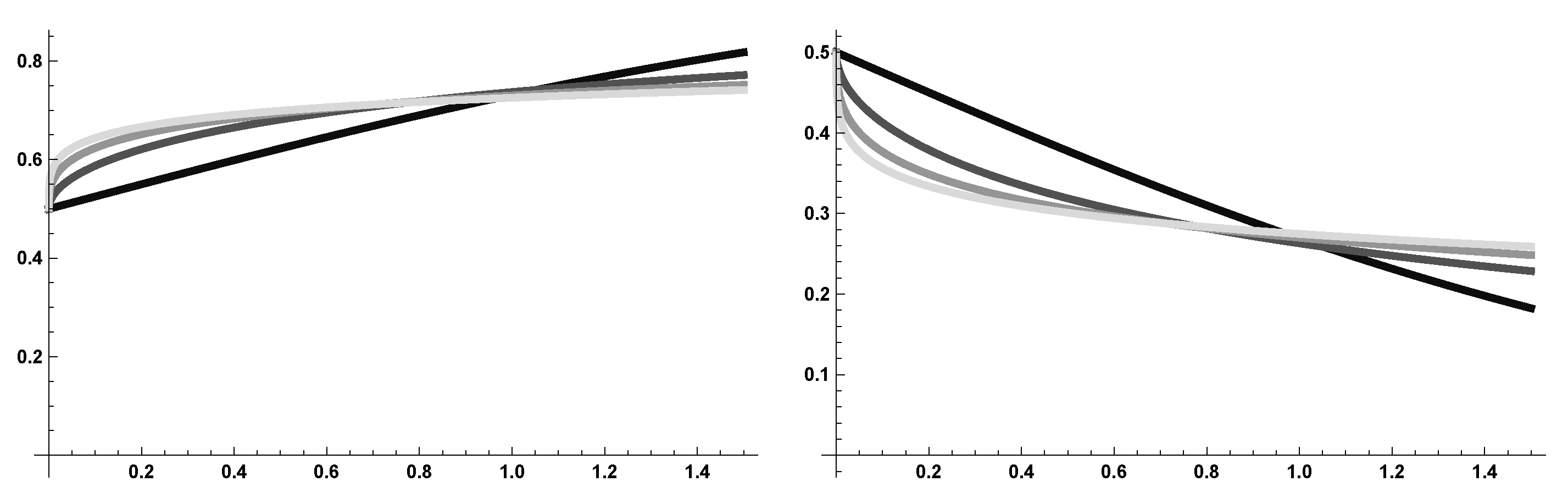
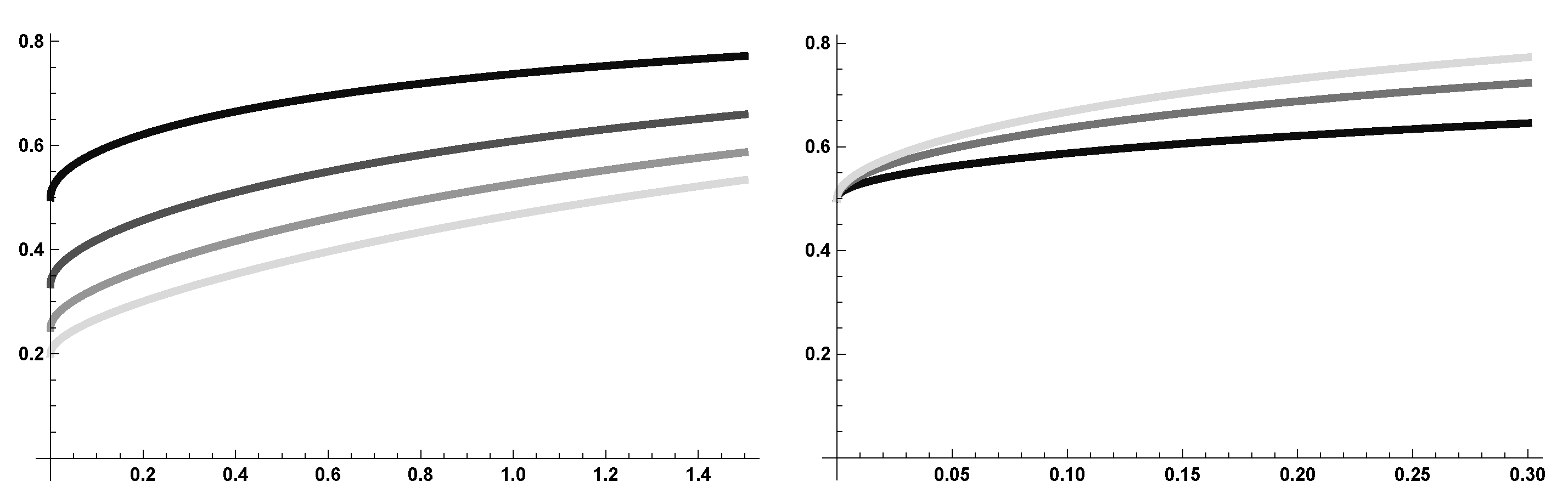
Moving to the fractional setting, we have similar approaches that cannot be followed. As it is well known, the solution of the fractional logistic equation—corresponding to and in (1)—was an open problem, and in [6], the first and the third author were able to solve the fractional logistic equation by series representation, giving a detailed formula involving Euler numbers for . The use of a logistic equation to model population dynamics dates back to the mid-19th century when Pierre François Verhulst devoted a series of papers [7,8,9] to the description of a model of population growth. Since then, the logistic equation is largely used in bio-mathematical modeling, for instance, to describe cancer growth models and epidemic models. In the particular case of social dynamics, the need to model memory effects and non-local behavior lead to a decline of the above models in a fractional setting. At this early stage, the problem of addressing non-linear dynamics and series expansions proved, at least in a local setting, to be a viable approach. This methodology was applied to SIS epidemic models in [10] (a compartmental epidemic model in which the population is split into susceptible and infective individuals) and also further investigated in [11]. The present study extends the result in [6] to general initial data and to Bernoulli equations of general degree : we present a recursive formula for the coefficients of the solutions and explicit closed formulas for the first terms. Note that the relation with Euler numbers for general initial data, even in the logistic case , appears to be lost, but the general recursive formula preserves its structure, based on generalized binomial coefficients that were introduced in [6] and further investigated in [12]. Then the proposed method is applied to the particular case , related to the fractional logistic equation, and we present a qualitative analysis of the solutions based on numerical simulations—see Figure 1.
Figure 1.
On the (left), solutions of the logistic equation (on the left) with and ; darker lines correspond to bigger s. On the (right), solutions of the logistic equation with and ; darker lines correspond to bigger ps.
Preliminaries on Fractional Calculus
Let us consider the set of continuous functions with a derivative in . Thus, is continuous and such that , that is, v has the representation
We notice that the space coincides with the Sobolev space
endowed with the norm
For and , we introduce the Riemann–Liouville derivative of v,
and the Caputo derivative of v,
Further on, we use the following relation between derivatives
The relation (5), together with the existence of the derivatives (3) and (4), hold a.e. on and with (see for example ([13] page 28)).
In this study, we consider the fractional equations on . Let us emphasize that if , then Formula (5) gives the equivalence
2. Fractional Bernoulli Equations
Let us introduce
where is the radius of convergence and are real coefficients.
Next, we introduce the generalized binomial coefficient
Theorem 1.
The unique continuous solution on to
Proof.
We consider
where denotes the Caputo derivative. Let us denote the power of u as follows
where
and, by further iterations,
where
Note that for
Therefore,
Thus, we obtain
From the fact that by construction, we write
Then the solution to
can be written in terms of the coefficients , given by
□
Some Closed Formulas
The first few elements of the sequence , (over the index p) are
We compute the first terms of . Fix and note that and if then
To compute we need for . By (9) one can prove by induction that for
To compute , we also need for . Using (9), we obtain
and, by an inductive argument, using also the fact that for all , one can prove the closed formula for all
Then
3. Fractional Logistic Equations
Here, we extend some of the results established in [6] for the fractional logistic equation with initial datum to the case of general initial data . Applying the above method, if and , then the solution of
can be represented in series form
where
Note that, as shown in [6], when , the above formula reduces to
Keeping and considering the equation with generic p, we have that the solution of
can be represented in series form
where
Remark 1
(On the null coefficients in the general case). Note that if then, in view of (11), , in agreement with the case . However, it is not possible to deduce that as in the case , because even for , choosing one can numerically verify that and . Then, one may look for some other generalization, for instance imposing and guess whether for some . Furthermore, in this case, the answer is negative. Indeed, using the last equality (12) to solve the equation with respect to the initial datum , we get by a direct computation that if and if then , but symbolic numerical computations yield for .
Consider now the case . Then the solution of
can be represented as
where
We compare the coefficients and . We have , and, by induction, . Moreover, . However, this symmetry breaks as soon as we consider ; indeed, we have
Numerical Simulations
Our tests rely on a direct application of the above explicit formulas. Coefficients are calculated via Wolfram Mathematica software. In our tests, we focused on the logistic case and on the case . We computed the coefficients using the recursive Formulas (9) and (10), and we approximated the solution of (1) with the partial sum
with , the parameter N was tuned so that no appreciable difference can be noted with respect to higher-order approximations. The method was validated by comparison with the exact solutions of (1), which can be explicitly computed in the ordinary case .
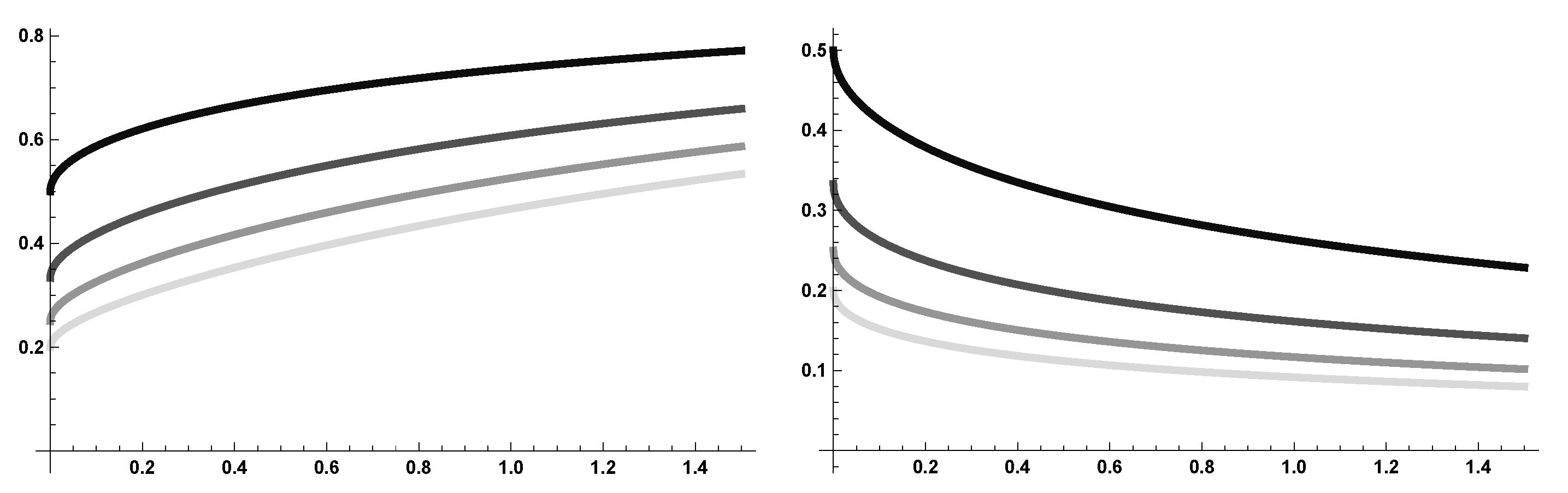
In Figure 2, we evaluated with fixed initial datum and and several orders of fractional derivatives. We may note the expected damping effect of fractional derivation.
Figure 2.
Numerical solutions of (on the left) and of (on the right) with and . Darker lines correspond to bigger ’s.
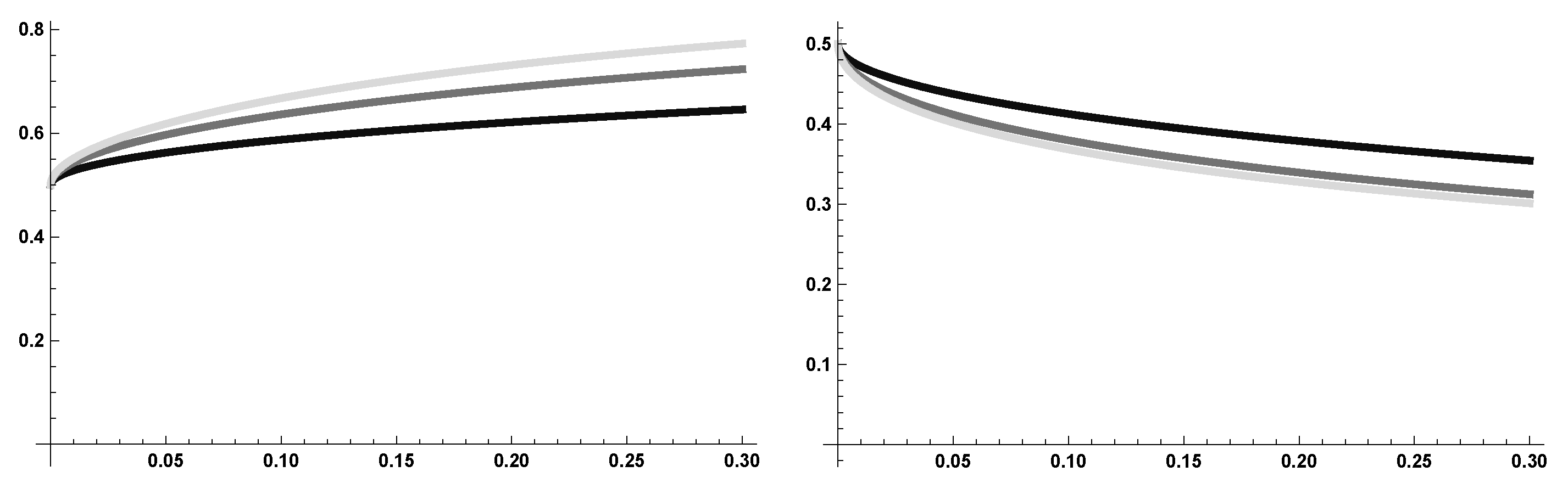
Figure 3 compares the solutions with different initial data, setting and . The resulting set of ordered curves suggests the local uniqueness of the solutions; however, the investigation of this is beyond the purpose of the present paper.
Figure 3.
Solutions of (on the left) and of (on the right) with and . Darker lines correspond to bigger ’s.
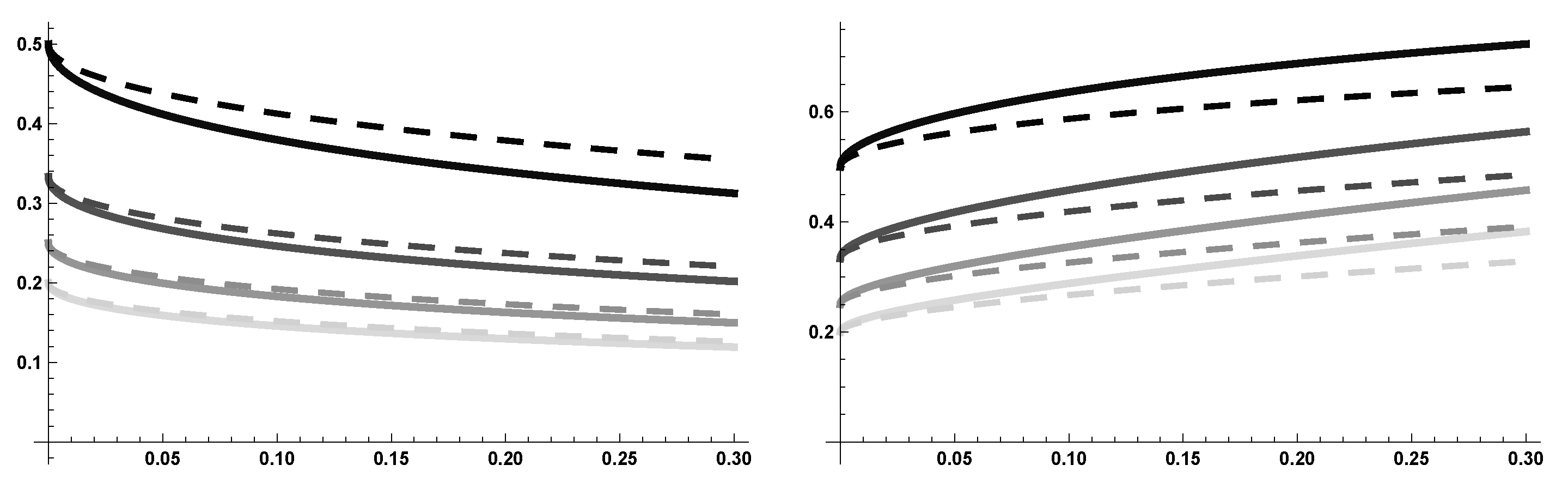
We then investigated higher degree fractional Euler equations, setting and letting p vary between 1 and 3, see Figure 4. At least near 0, from a qualitative point of view, the solutions display a similar behavior, and no intersections between the solutions are detected.
Figure 4.
Solutions of (on the left) and of (on the right) with and . Darker lines correspond to bigger p’s.
For the sake of comparison, we collected some of the above results in Figure 5, showing the combined effect of varying initial data and degrees p.
Figure 5.
Solutions of (on the left) and of (on the right) with and and . Darker lines correspond to bigger ’s; continuous lines correspond to and dashed lines correspond to .
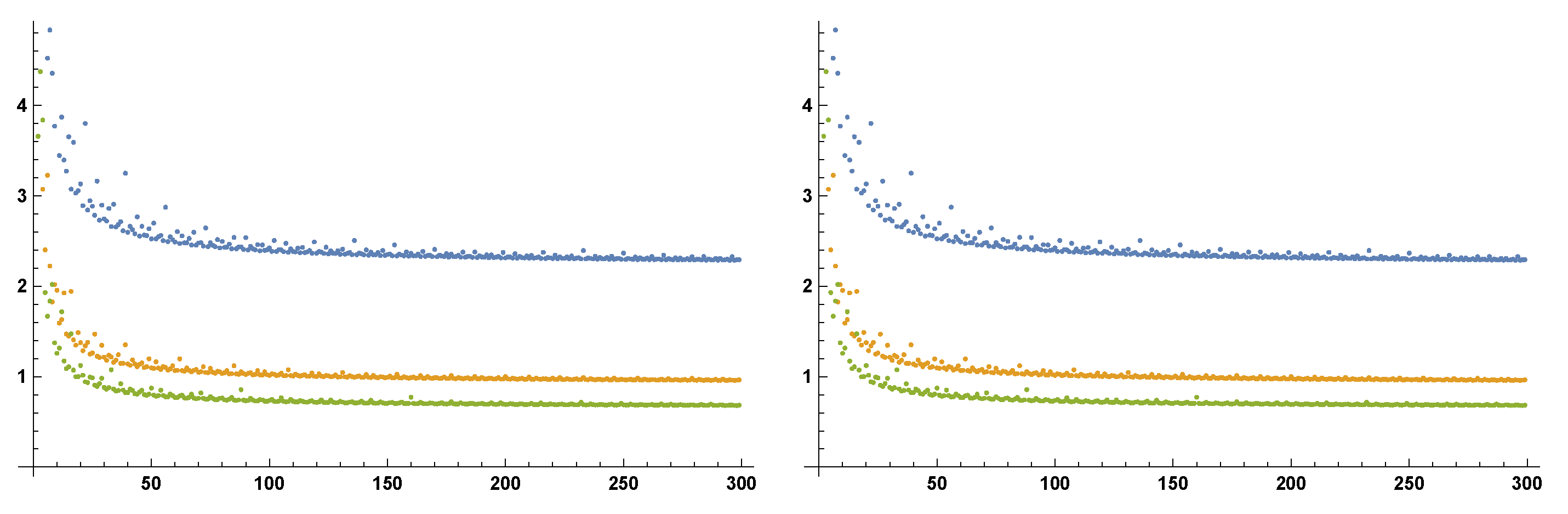
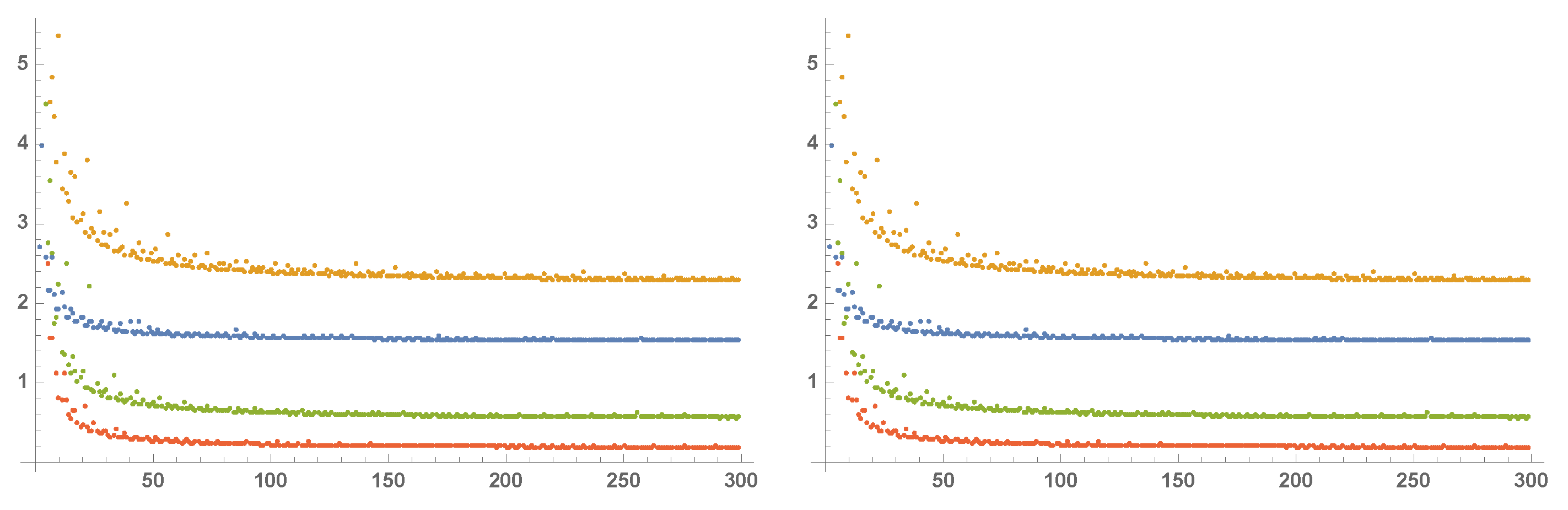
Finally we propose some numerical estimations for the radius of convergence of the series (8), by computing the sequence
In Figure 6 and Figure 7, we plotted the first 300 terms of with varying degrees p and orders of derivation . The asymptotic behavior of suggests an exponential increase for the series coefficients in all the cases under exam. Furthermore, their comparison shows the radius of convergence to be decreasing with respect to both the degree p (Figure 6) and order of derivation (Figure 7). Finally, no substantial difference between the case and the case emerged.
Figure 6.
Asymptotic behavior of the sequence approximating the radius of convergence for (on the left) and (on the right) with , and in blue, orange, and green, respectively.
Figure 7.
Asymptotic behavior of the sequence approximating the radius of convergence for (on the left) and (on the right) with , , and in blue, orange, green, and red, respectively.
4. Conclusions
Although the fractional differential calculus is as old as the ordinary one (the first introduction of a fractional derivative dates back to Leibniz in 1695), the complexity of the computations involved still prevents a full exploitation of its applicative potential. Here, we consider the Caputo fractional derivative. The presence of a singular kernel introduces a memory, and it gives a non-local character to the dynamics. These non-local aspects are realistic in the applications. By introducing fractional derivatives, we obtain a global effect, which may slow down the underlying dynamics. In particular, for non-linear equations, we still observe the classical delaying effect introduced by the fractional derivative for linear equations. This motivates our analysis. Further directions include estimations of the radius of convergence, global existence results, and possible generalization to other non-linear fractional dynamics.
Author Contributions
Conceptualization; methodology; software; validation; formal analysis; investigation;writing—original draft preparation; writing—review and editing: M.D., A.C.L. and P.L. All authors have read and agreed to the published version of the manuscript.
Funding
This research was funded by the Sapienza Università di Roma Project “Fractional derivatives in Science and Engineering” (2018).
Institutional Review Board Statement
Not applicable.
Informed Consent Statement
Not applicable.
Data Availability Statement
Not applicable.
Conflicts of Interest
The authors declare no conflict of interest. The funders had no role in the design of the study; in the collection, analyses, or interpretation of data; in the writing of the manuscript, or in the decision to publish the results.
References
- Podlubny, I. Fractional Differential Equations; Mathematics in Science and Engineering; Academic Press: Cambridge, MA, USA, 1999; Volume 198. [Google Scholar]
- Valentim, C.A., Jr.; Oliveira, N.A.; Rabi, J.A.; David, S.A. Can fractional calculus help improve tumor growth models? J. Comput. Appl. Math. 2020, 379, 112964. [Google Scholar] [CrossRef]
- Yang, X.J.; Tenreiro Machado, J. A new insight into complexity from the local fractional calculus view point: Modelling growths of populations. Math. Mod. Meth. Appl. Sci. 2017, 40, 6070–6075. [Google Scholar] [CrossRef]
- Haavelmo, T. A Study in the Theory of Economic Evolution; North-Holland: Amsterdam, The Netherlands, 1964. [Google Scholar]
- Helen, M. Byrne, Modelling Avascular Tumour Growth. In Cancer Modelling and Simulation; Preziosi, L., Ed.; Chapman & Hall/CRC: Boca Raton, FL, USA, 2003. [Google Scholar]
- D’Ovidio, M.; Loreti, P. Solutions of fractional logistic equations by Euler’s numbers. Phys. A Stat. Mech. Appl. 2018, 506, 1081–1092. [Google Scholar] [CrossRef]
- Verhulst, P.-F. Notice sur la loi que la population poursuit dans son accroissement. Corresp. Math. Phys. 1838, 10, 113–121. [Google Scholar]
- Verhulst, P.-F. Recherches mathématiques sur la loi d’accroissement de la population. Nouv. Mémoires L’Académie R. Sci. Belles Lett. Brux. 1845, 18, 8. [Google Scholar]
- Verhulst, P.-F. Deuxième mémoire sur la loi d’accroissement de la population. Mémoires L’Académie R. Sci. Lett. Beaux-Arts Belg. 1847, 20, 1–32. [Google Scholar]
- Balzotti, C.; D’Ovidio, M.; Loreti, P. Fractional SIS Epidemic Models. Fractal Fract. 2020, 4, 44. [Google Scholar] [CrossRef]
- Area, I.; Nieto, J.J. Power series solution of the fractional logistic equation. Phys. A Stat. Mech. Appl. 2021, 573, 125947. [Google Scholar] [CrossRef]
- D’Ovidio, M.; Lai, A.C.; Loreti, P. Generalized binomials in fractional calculus. arXiv 2020, arXiv:2010.05610. [Google Scholar]
- Diethelm, K. The Analysis of Fractional Differential Equations. In Lecture Notes in Mathematics; Springer: Berlin/Heidelberg, Germany, 2010. [Google Scholar]
Publisher’s Note: MDPI stays neutral with regard to jurisdictional claims in published maps and institutional affiliations. |
© 2021 by the authors. Licensee MDPI, Basel, Switzerland. This article is an open access article distributed under the terms and conditions of the Creative Commons Attribution (CC BY) license (https://creativecommons.org/licenses/by/4.0/).