1. Introduction
In many scientific domains, missing data is an important problem. In the health, finance, and surveillance sectors, which rely on large, complex datasets, missing data can undermine confidence in the analysis and introduce biases that distort results. There are many approaches to managing these gaps, ranging from simple statistical methods to sophisticated machine learning and deep learning imputation techniques [
1,
2,
3,
4]. Each methodology entails considerable trade-offs among accuracy, scalability, and flexibility to various constraints, with its efficacy profoundly affected by data features and the configuration of missing-data mechanisms [
5]. In addition to recent advances, existing techniques face limitations: traditional statistical methods struggle to model complex nonlinear dependencies, whereas recent deep learning approaches often lack explicit uncertainty quantification, which is essential for reliable decision-making.
A frequently overlooked problem arises from systematic changes that occur when data are acquired under disparate conditions, at different times, or across different technology platforms. These variations, commonly referred to as batch effects in genomics [
6] or domain shifts in machine learning, introduce confounding correlations that are not related to the true models. In multi-site biomedical studies, for example, systematic differences between collection stations undermine the accuracy of imputation. Furthermore, conventional imputation methods treat all samples uniformly, thereby amplifying rather than correcting these batch-specific biases.
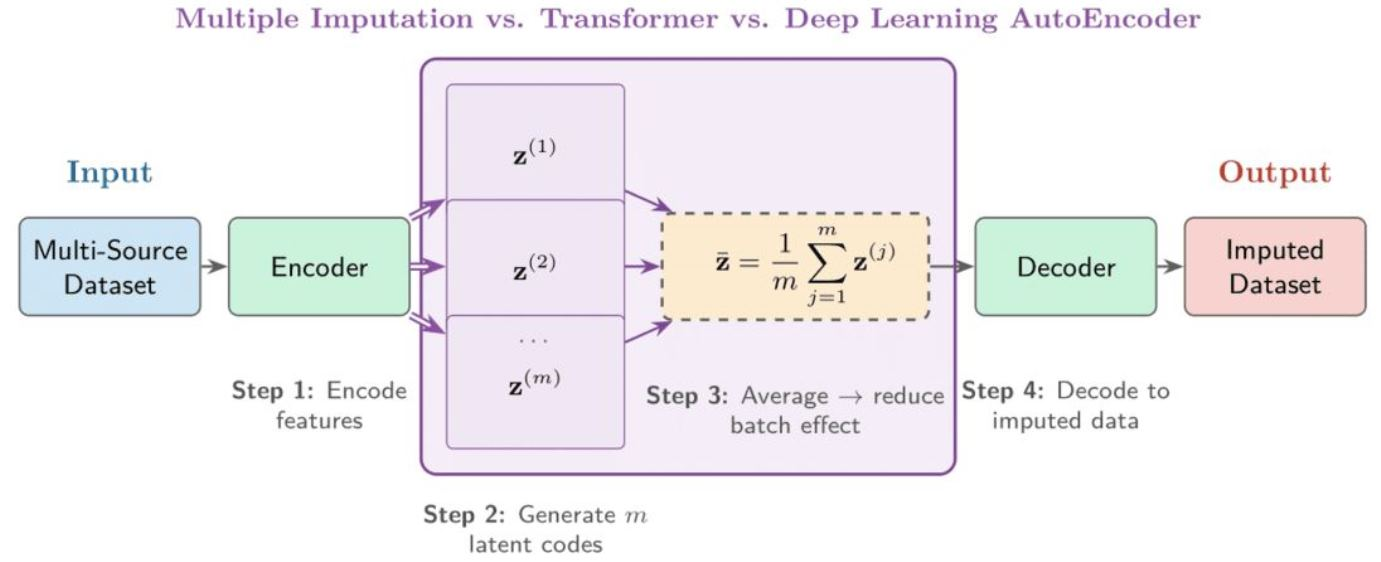
In this study, a novel imputation technique is introduced: (1) conducting multiple imputations within the autoencoder’s latent space instead of the original feature space, thereby creating average representations that reflect a robust data structure; (2) offering implicit batch correction via the latent space average, which effectively mitigates source-specific anomalies while retaining the genuine signal, all without the need for explicit batch identifiers; and (3) preserving uncertainty quantification through the multiple imputation strategy, allowing for confidence-weighted downstream analysis that is not accessible in deterministic deep learning methods. This innovative approach is highly advantageous because it uses the latent space, which compresses and denoises the representation, where intricate relationships among features and non-linear dependencies are represented more effectively than in the original high-dimensional space. By merging the statistical robustness of multiple imputation with the representational capabilities of deep autoencoders, our technique provides both practical, impressive accuracy and interpretable uncertainty estimates.
Evaluation on standard reference datasets under both the missing completely at random (MCAR) and missing not at random (MNAR) conditions shows that our imputation technique has distinct strengths. Statistical evaluations indicate that this new technique yields significant practical advantages over conventional methods, including a reduction in root-mean-square error (RMSE), while achieving performance on par with advanced deep learning solutions such as generative adversarial imputation networks (GAIN) and multiple imputation using denoising autoencoders (MIDA). An examination of batch-size sensitivity confirms that mini-batch training ensures consistency during the multiple-imputation process in the latent space. The structure of this article is organized as follows:
Section 2 discusses current imputation methods and their shortcomings.
Section 3 outlines the methodology, detailing the mathematical framework and algorithmic execution.
Section 4 presents the experimental findings and the comparative assessment.
Section 5 explores the implications and practical uses.
Section 6 concludes by summarizing the key contributions and future research directions.
3. Materials and Methods
In this section, we present the materials used to build the new hybrid imputation technique, which is based on an integrated structure combining pre-processing strategies, deep learning architectures, and iterative learning mechanisms. The approach revolves around complementary components that work together to handle complex missing-data patterns in tabular data.
3.1. Datasets Experimental Design
We evaluated our approach on benchmark datasets from the UCI Machine Learning Repository.
Table 1 presents the characteristics of each dataset.
Our technique implements a comprehensive strategy for generating and handling different missing mechanisms, following established protocols in the literature [
60,
61]. We simulate four distinct missing data patterns by combining two mechanisms (MCAR and MNAR) with two distribution methods (uniform and random). Each dataset was stratified for the split of train-test with test_size = 0.3 (70% training, 30% testing) using random_state = 42. Synthetic missing data was generated following four mechanisms at one missing rate
using the procedure detailed in Algorithm 1.
| Algorithm 1 Synthetic Missingness Pattern Generation |
 |
For MCAR scenarios, we generate a uniform random matrix , where n is the number of rows (samples) and m is the number of columns (features). Then a binary missingness mask M is created such that if , with representing the missingness threshold. In the uniform variant, this applies to all features, yielding . In the random variant, missingness is restricted to a subset of features with , so that .
For MNAR mechanisms, we introduce systematic dependency by sampling two reference features
and computing their medians
and
. The conditional missingness probability becomes Equation (
1):
where the logical conjunction ∧ enforces that both conditions hold simultaneously, producing structured missingness patterns that depend on the data distribution.
In the random MNAR mechanism, missing data are restricted to a random subset
of features with
, which leads to Equation (
2):
3.2. Proposed Approach
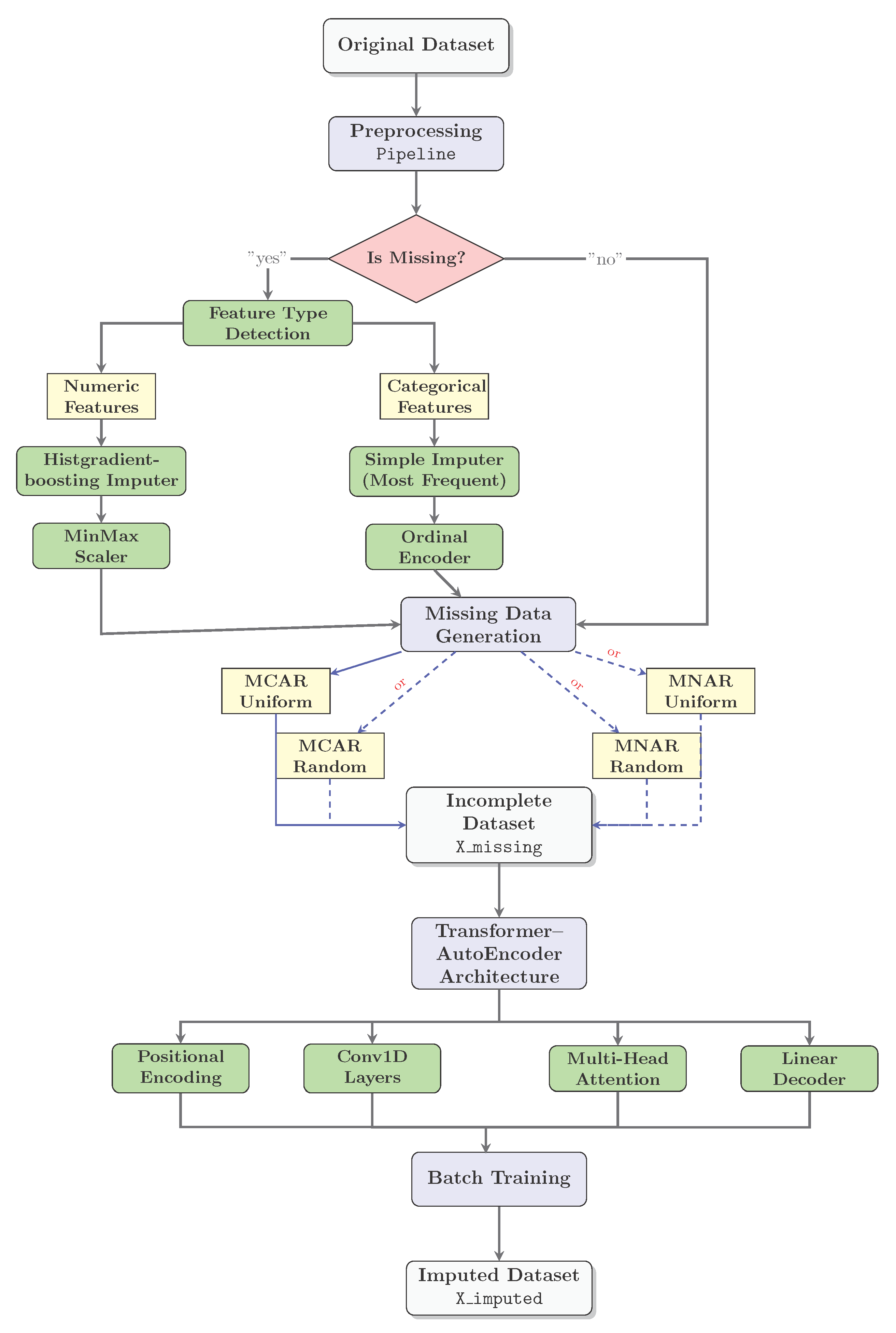
The proposed technique consists of a structure that integrates pre-processing and imputation based on deep learning and the transformer.
Figure 1 presents an overview of the structure, progressively from raw data to the final imputed result.
3.2.1. Preprocessing Stage
The pre-processing step uses an architecture implemented with the scikit-learn column transformer to process numerical and categorical features separately. The complete procedure is described in Algorithm 2. We specify here that this concerns only the pre-processing of the data before artificially adding missing values.
For numeric features, a custom imputer is utilized: HistGradientBoostingRegressor. During training for each numeric column with missing data, the model learns to predict missing values by using all other columns as predictors. To handle missing data in the predictor columns, median imputation is temporarily applied to fill any gaps, ensuring the model receives complete input data. The same median-filling process is repeated during the prediction of missing entries. After completion of imputation, the data are normalized to the range using MinMaxScaler as Equation (
3):
| Algorithm 2 Preprocessing stage Pipeline construction |
 |
Categorical features are processed using simple imputation with the most frequent value, followed by encoding with OrdinalEncoder, which assigns a specific code to unknown categories. The processed numeric and categorical features are then combined into the final input matrix for the Transformer model.
3.2.2. Transformer-CNN Hybrid Architecture
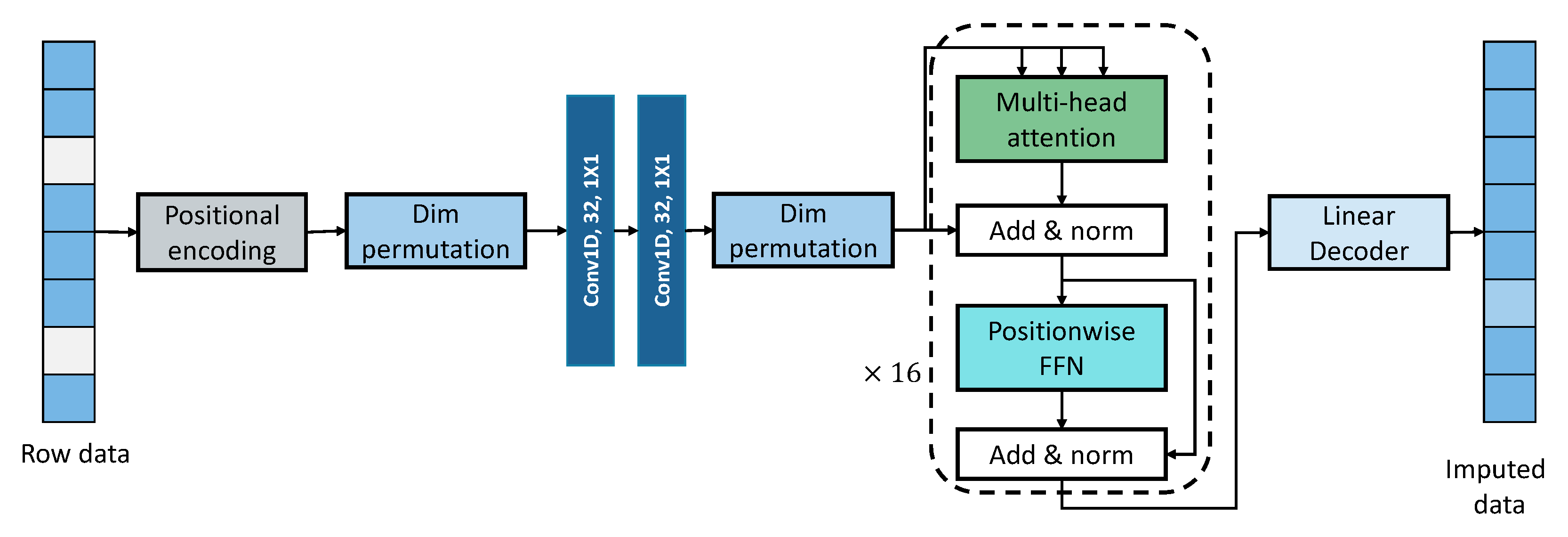
Our technique leverages the complementary strengths of both Transformer encoders and autoencoders with convolutional layers to capture global context and fine-grained local features effectively. Our architecture (
Figure 2) includes the following components, explained step-by-step:
- 1.
Positional Encoding Layer: Adds positional information to the input sequence using a sine function:
denotes the position index within the input sequence, i is the dimension index in the embedding of the model, and is the internal representation of the dimensionality model. Only the sine component is used; the cosine component is omitted in our implementation. Next, after positional encoding, the dropout rate is applied to help regularize the model.
- 2.
Convolutional Feature Extraction: Two Conv1D layers with kernel size 1 are used to transform the input features. These layers help the model focus on local patterns in the data:
The input feature matrix after positional encoding is . The outputs of the first and second convolutional layers are and , respectively
- 3.
Transformer Encoder Stack: A stack of 16 layers of Transformer encoders to provide hierarchical abstraction capacity, allowing the structure to capture deep, nonlinear dependencies across features; and then processes the sequence with multi-head self-attention, where
, and number of heads
to model diverse relationships efficiently without excessive complexity:
In the attention mechanism,
Q,
K, and
V are the query, key, and value matrices. The scalar
is the dimension of the key vectors used to scale the dot product. In addition, the missingness mask
prevents the model from attending to future positions, where the entries of
mask such positions during training:
- 4.
Linear Decoder: Finally, a linear layer projects the encoded representation back to the original feature space:
with weights initialized uniformly as
, and biases set to zero
to transform the output of transformer
back to the predicted features
.
In conclusion, the architecture, depicted in
Figure 2 and Algorithm A1, combines Conv1D and Transformer layers to balance local feature extraction with global contextual modeling. Conv1D (
) functions as a pointwise transformation, converting input features into a latent space of uniform dimensionality (
) for the Transformer while only capturing limited local relationships among adjacent features.
3.2.3. Implicit Batch Correction Through Latent Averaging
Effectively addressing batch effects related to missing data requires a careful strategy, with the stepwise imputation method (SIM) emerging as particularly effective. SIM fills in missing data in batches that exhibit higher missing data rates, utilizing insights from batches with fewer missing entries, all while considering batch-specific variations. Nevertheless, the implementation of SIM requires meticulous planning to prevent the introduction of additional batch effects during the imputation process. Our suggested technique, a hybrid model that integrates a deep learning autoencoder with convolutional neural network (CNN) layers and Transformer frameworks, is capable of capturing both local and global data patterns, making it highly effective for imputing missing values that are influenced by batch effects. This approach enhances imputation accuracy, minimizes error propagation, acknowledges batch-specific influences, and provides a transparent and flexible framework for multi-batch datasets.
Our technique provides implicit batch correction through latent-space averaging (Equation (
11)). Given a dataset
where
are samples and
represents (potentially unobserved) batch membership, the data generating process can be decomposed as follows:
where
indicates the common signal,
captures systematic variations that are specific to each batch, and
represents random noise.
In contrast to post-hoc methods [
56] that depend on explicit labels, the reduction in dimensionality effectively diminishes batch-specific variations
while maintaining the shared structure
. The multiple imputation process can be expressed as follows:
further improves robustness by averaging
m latent codes, which minimize the variance of batch artifacts:
. This represents implicit batch correction: the combination of dimensionality reduction and latent averaging mitigates systematic variations without needing explicit batch identifiers or post-hoc adjustments. The full imputation procedure that includes batch correction is detailed in Algorithm 3.
| Algorithm 3 Batch-Aware Latent-Space Multiple Imputation with Uncertainty Quantification |
 |
Interpretation of the Implicit Batch Correction Mechanism
The proposed strategy for averaging in latent space is effective because two theoretical mechanisms work together to minimize non-informative variation in the encoded representation. While these characteristics offer a logical rationale, they do not serve as formal proof and should be viewed as empirical hypotheses backed by the results obtained.
Property 1: Dimensionality Reduction as Noise and Bias Filtering
The autoencoder’s bottleneck () necessitates compression that highlights globally consistent patterns across samples. Since batch effects reflect deviations specific to the source rather than common trends, they are expected to have a minimal contribution to the reconstruction objective and therefore will be somewhat diminished in the latent representation. In general, if , the encoder is likely to map onto components with lower variance, which in turn reduces its effect on .
Property 2: Latent-Space Averaging as Variance Stabilization
Multiple imputations represent stochastic outcomes of latent codes affected by both the uncertainty of the model and the noise related to specific data. By using averages of these imputations, performs a variance-reducing function such that under independence. Although batch effects are systematic rather than random, empirical findings indicate that averaging in the latent space still helps lessen their influence by focusing on stable features across imputations that correspond to shared structure rather than artifacts specific to batches.
Together, these mechanisms suggest—rather than establish—that the underlying process can inherently diminish batch-related distortions through low-dimensional representation learning and the averaging of multiple imputations.
3.3. Evaluation
In the first place, our imputation technique is compared to three state-of-the-art deep learning-based imputation techniques and one classical statistical method (see
Table 2). Generative Adversarial Imputation Networks (GAIN) [
16] is a GAN-based approach that uses a generator to impute missing values and a discriminator to distinguish observed from imputed data. The model employs hint mechanisms to guide the imputation process. Multiple Imputation using Denoising Autoencoders (MIDA) [
40] generates multiple imputations using stacked denoising autoencoders trained with dropout noise to capture uncertainty. The multiple imputation Denoising Autoencoder (DAE) [
62] is similar to MIDA but focuses on single imputation with enhanced denoising capabilities through corruption mechanisms. Multivariate Imputation by Chained Equations (MICE) [
63,
64] is a classical iterative imputation using chained regression models. MICE draws imputations by iterating over conditional densities, which has the added advantage of being able to model different densities for different variables. Classical approaches (such as MICE and KNN) treat all samples identically. Recent deep learning methods—GAIN, MIDA, and denoising autoencoders—similarly lack mechanisms to account for systematic variations. The performance of the model is evaluated using several complementary measures to assess both the accuracy of the imputation and the effectiveness of subsequent tasks.
Root Mean Squared Error (RMSE): the metric for imputation accuracy on artificially masked values:
Mean Squared Error (MSE): a variance-focused imputation metric:
Mean Absolute Error (MAE): a robust metric less sensitive to outliers:
where
represents the set of missing positions introduced artificially.
Classification Accuracy (ACC): Proportion of correctly classified instances using imputed data as input to a standard classifier, measuring the practical utility of imputed values:
4. Experimental Results
GAIN was used with default hyperparameters, and we added preprocessing stages to MIDA (training parameters detailed in
Table A2).
Dataset-specific analysis (
Table 3) revealed pronounced advantages in multi-source data. In Glass—comprising forensic measurements from multiple laboratories with documented variations in analytical equipment—our imputation technique achieved a
improvement over GAIN (
vs.
RMSE, rank
) and
over MIDA. This validates that latent-space averaging effectively suppresses lab-specific systematic biases. In Credit, aggregated from multiple financial institutions, our imputation technique presented practical significance to traditional approaches by
versus MICE while achieving comparable performance with GAIN (
) and moderate improvement over MIDA (
). The 2–3× larger improvements on Glass (high batch evidence) versus Credit (medium batch evidence) confirm that the benefits of batch correction correlate with the severity of systematic variations (Spearman
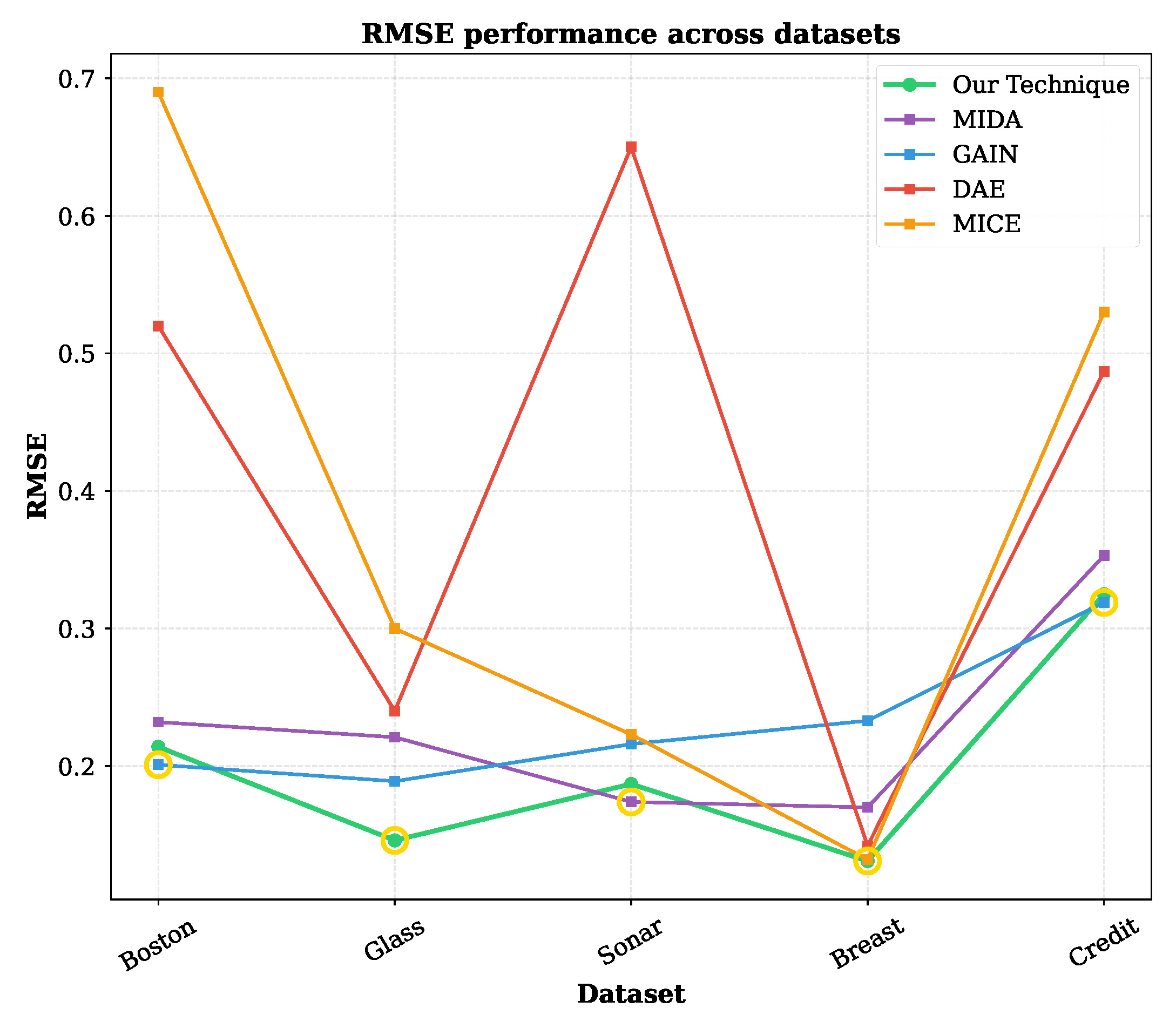
). As illustrated in
Figure 3, our imputation technique, depicted in green, achieves the lowest RMSE across most datasets, particularly for Glass, Sonar, and Breast, demonstrating reliable reconstruction accuracy across diverse data structures.
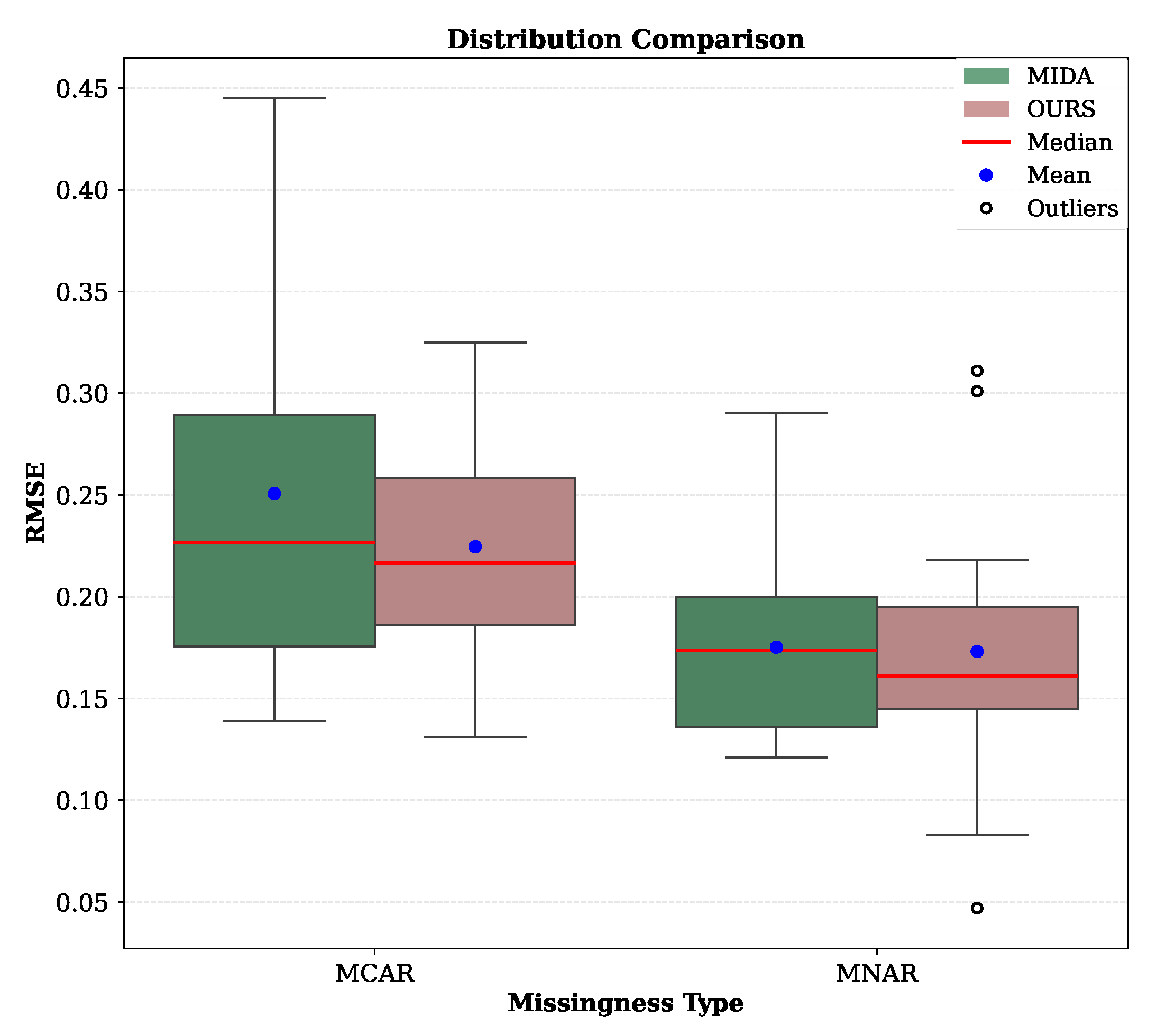
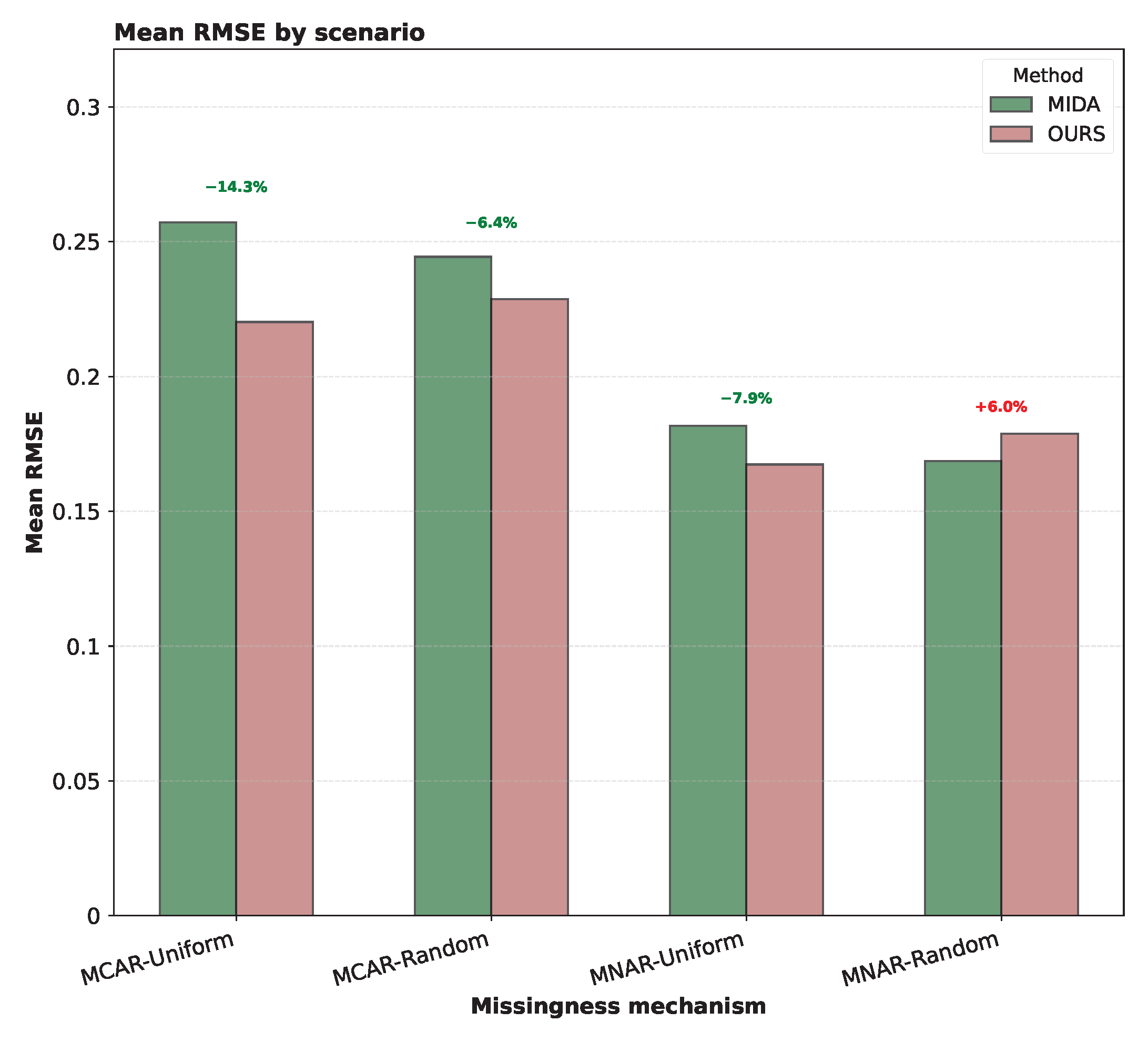
To thoroughly assess the performance of our imputation technique in relation to a deep learning-like architecture, we carried out comprehensive comparisons with MIDA across four different missing data mechanisms (MCAR-Uniform, MCAR-Random, MNAR-Uniform, MNAR-Random) and nine reference datasets. Both techniques were applied with the same experimental parameters (num_epochs = 50) to ensure a fair evaluation. The outcomes are displayed in
Table A3. The distribution analysis presented in
Figure 4 indicates that while the median RMSE values for our proposed technique are marginally lower in the MCAR and MNAR scenarios, the variance remains similar, demonstrating consistent but not statistically superior performance.
In
Figure 5, the mean RMSE of MIDA is compared to that of our imputation technique (“OURS”) under four missingness mechanisms: MCAR-Uniform, MCAR-Random, MNAR-Uniform, and MNAR-Random. The blue bars illustrate MIDA’s performance, while the red bars represent OURS. In all cases, except for MNAR-Random, OURS exhibits a lower RMSE, with reductions varying from 6.4% to 14.3%, the most significant enhancement occurring under MCAR-Uniform conditions. In the MNAR-Random scenario, our technique underperforms MIDA by 6.0%, indicating no reduction in RMSE and a decrease in performance compared to MIDA.
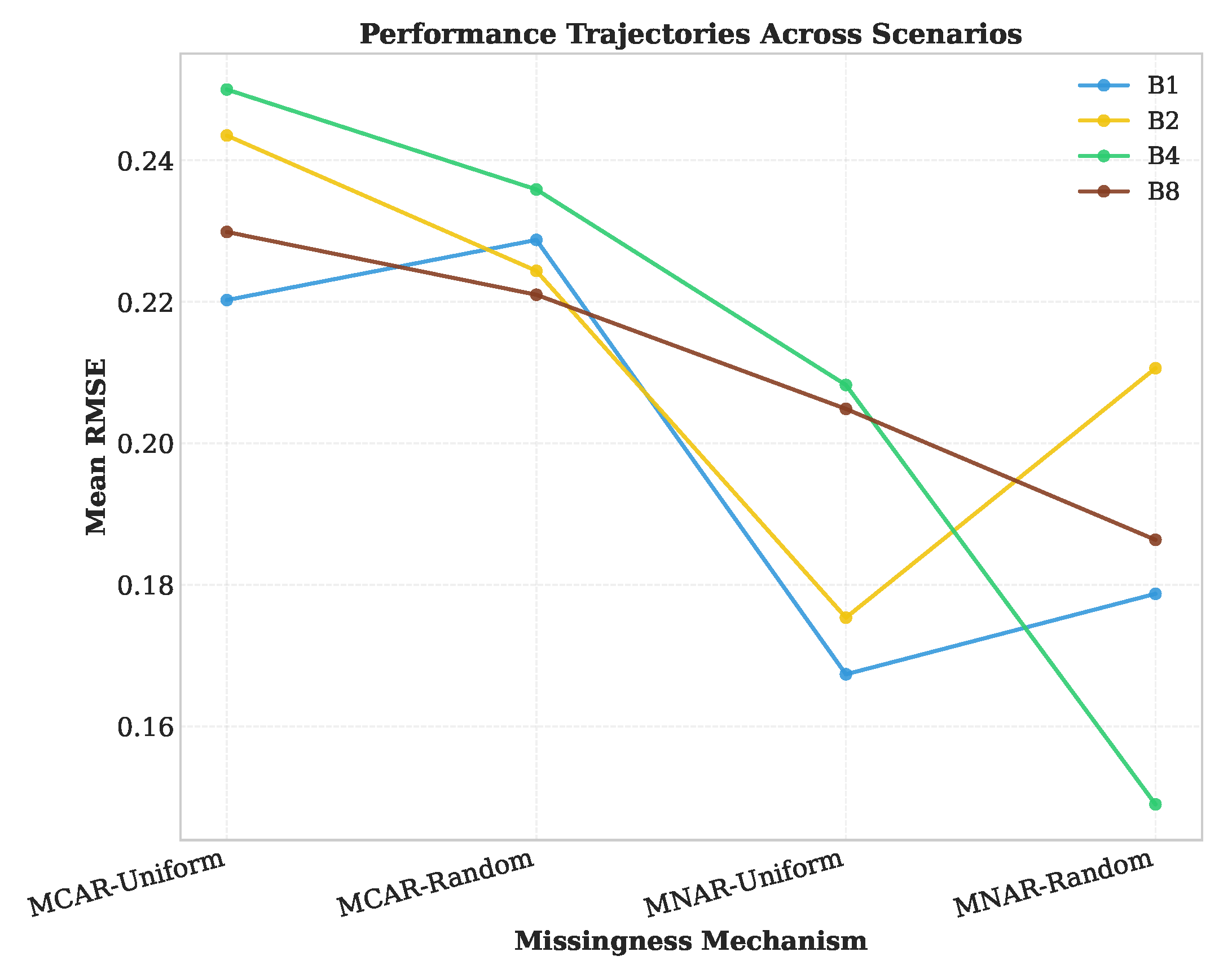
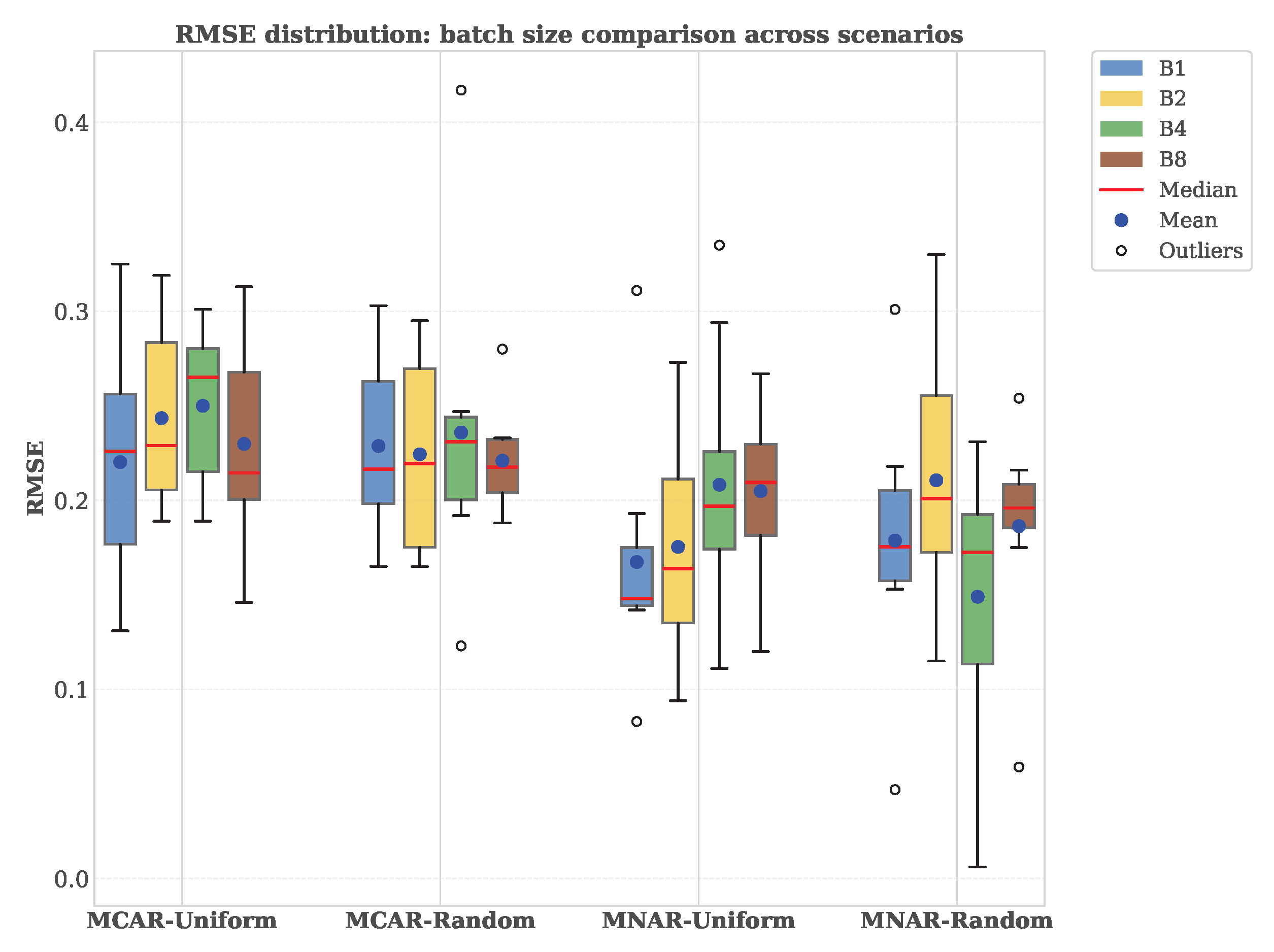
Finally, we performed a batch-size sensitivity analysis to examine its effect on imputation performance. Experiments were conducted on nine datasets under four missingness mechanisms (MCAR/MNAR × Uniform/Random at 10% missingness). We evaluated four configurations: online learning (batch_size = 1), small mini-batches (batch_size = 2 and 4), and intermediate mini-batch training (batch_size = 8), each for 50 epochs. The online configuration with batch_size = 1 achieved a balanced win rate of 31.2% (10/32) in all scenarios, with varying performance by dataset size. Datasets of smaller size often benefited from more precise gradient updates afforded by smaller batch sizes, whereas larger datasets occasionally preferred the stability provided by larger batches. Wilcoxon tests did not indicate significant differences in batch sizes (all ), suggesting that changing batch sizes strikes a balance between flexibility and consistency, with no clear benefits.
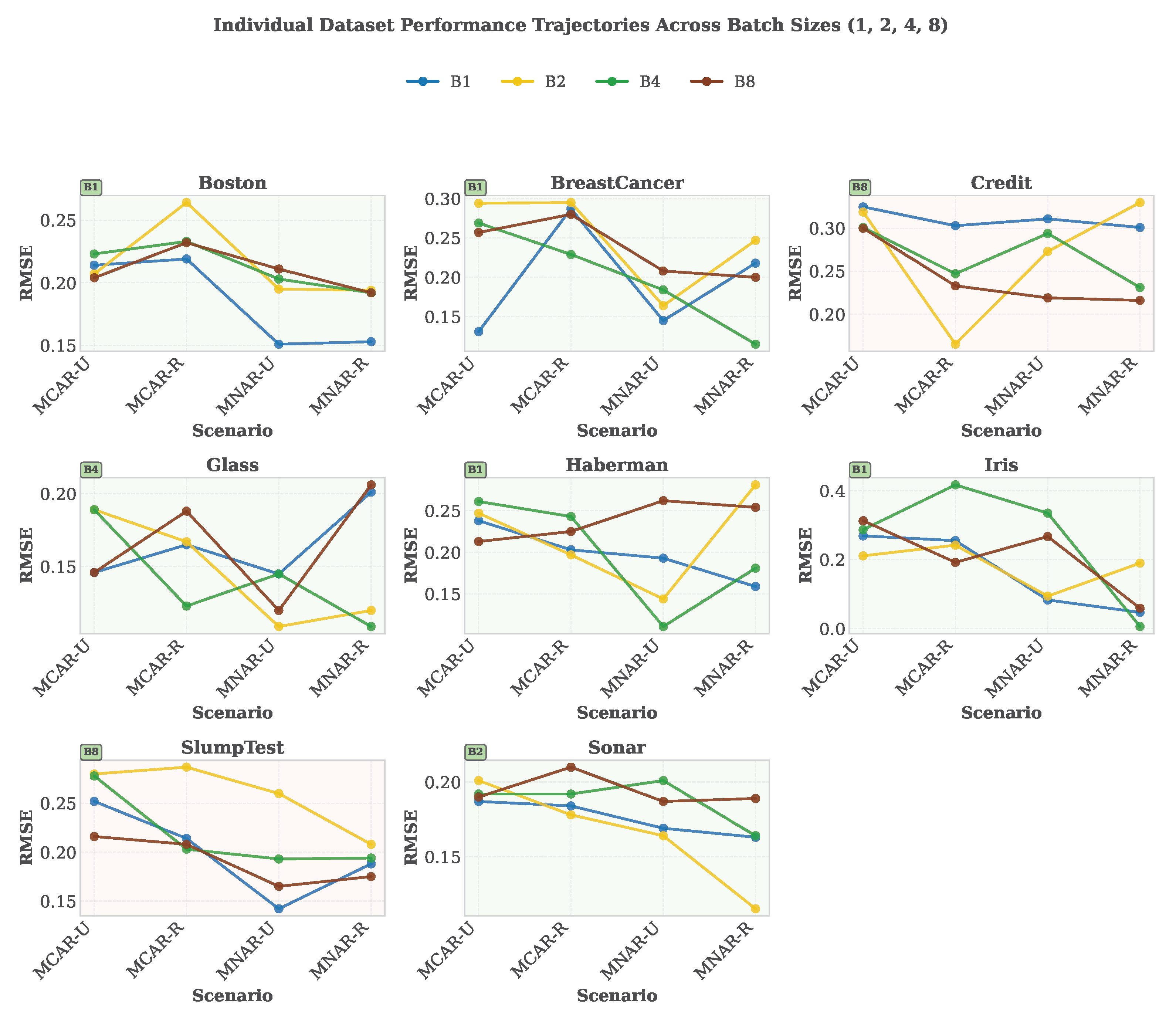
Figure 6 summarizes the mean RMSE trajectories in all datasets and mechanisms for four batch sizes.
Figure 7 presents the RMSE distributions for four batch sizes across missingness mechanisms. The box plots reveal that batch_size = 1 achieves the lowest median RMSE and the smallest variance under the conditions MCAR and MNAR, indicating both superior accuracy and stability.
Figure 8 shows the RMSE trajectories specific to the data set between the mechanisms and four batch sizes (1, 2, 4, 8). Most datasets—including Iris, Haberman, and Boston—show a lower RMSE for Batch = 1, indicating practical performance with online learning. Only larger datasets, such as Credit, occasionally favor larger batch sizes (Batch = 8), suggesting that fine-grained updates benefit smaller, heterogeneous datasets, while mini-batching remains competitive for larger ones.
Summary Statistics and Statistical Testing
The mean RMSEs across all scenarios show batch_size = 1 with slight advantages. Statistical significance tests confirm mainly non-significant differences, with a single MCAR-Uniform aggregated comparison (batch_size = 1 vs. batch_size = 4) showing a modest significant difference (Wilcoxon ). The aggregated results of the Friedman test in batch sizes (1, 2, 4, 8) are as follows:
MCAR-Uniform: (significant differences)
MCAR-Random: (no significant difference)
MNAR-Uniform: (no significant difference)
MNAR-Random: (no significant difference)
The Friedman test aggregated all scenarios, producing and indicating that there are no significant differences in RMSE performance between batch sizes in general.
5. Discussion
5.1. Performance Interpretation
Experiment 1 (see
Figure 3 and
Table 2 and
Table 3): Our imputation technique achieved competitive performance (mean rank
) with significant advantages over traditional methods. The Friedman test confirmed significant differences between methods (
where the number 4 represents the degrees of freedom, which in this context corresponds to one less than the number of methods being compared (i.e., the total number of methods − our technique = 4),
p-value = 0.0477), validating post-hoc comparisons. Pairwise Wilcoxon tests revealed large effect sizes compared to DAE (
, Wilcoxon
) and MICE (
, Wilcoxon
), both of which survive Bonferroni correction (
). The results translate into RMSE reductions of
and
, respectively—significant practical enhancements that highlight the benefits of incorporating multiple imputation into latent representations. Compared with leading methodologies, our approach demonstrated comparable performance: GAIN (
, Wilcoxon
) and MIDA (
, Wilcoxon
) showed small effect sizes without notable differences. This indicates the advancement of deep learning imputation, where various techniques achieve similar levels of accuracy. However, the technique offers distinct benefits, i.e., clear uncertainty quantification via multiple imputation and thorough correction for batch effects—features lacking in adversarial (GAIN) or purely autoencoder-based (MIDA) systems.
Experiment 2 (see
Figure 4 and
Figure 5 and
Table A3) is a comparative evaluation of our imputation technique against MIDA across four missingness mechanisms and nine datasets that revealed a competitive but balanced performance profile. Our approach recorded a win rate of
(
pairwise comparisons of RMSE), confirming overall equivalence with the baseline. In the MCAR-Uniform scenario, our technique produced a
reduction in RMSE compared to MIDA (Wilcoxon
, Cohen’s
), indicating a marginally significant improvement. In particular, the most substantial improvements were observed in datasets characterized by strong nonlinear or heterogeneous feature dependencies, such as Iris. In the MCAR-Random and MNAR-Uniform scenarios, our technique achieved modest, non-significant RMSE reductions (
and
, respectively; and Wilcoxon values
), while the MNAR-Random conditions showed no reduction in performance (Wilcoxon
,
increase). A global Friedman test (
) illustrated the lack of overall significance between mechanisms. These findings validate our latent-space multiple imputation approach as competitive with MIDA, while also providing unique advantages in modeling nonlinear dependencies, quantifying uncertainty, and addressing structured missingness patterns.
Experiment 3 (see
Figure 6,
Figure 7 and
Figure 8 and
Table 2 and
Table A5) revealed that the use of smaller batch sizes can consistently improve performance across different missingness mechanisms. In particular, a batch size of 1 achieved a mean RMSE of
compared to
for a batch size of 2, resulting in an RMSE augmentation of
. The greatest gains appeared under the MNAR-uniform mechanism (up to a reduction in RMSE of
), although the differences were not statistically significant (Wilcoxon
p = 0.31–0.94). Under the MCAR mechanism, the differences were smaller and non-significant, suggesting broadly comparable performance across batch sizes. Dataset-specific analysis showed batch_size = 1 dominating datasets such as Boston, Haberman, and Iris. These trends support the notion that fine-grained online learning is especially beneficial for small-to-medium datasets (approximately 150–700 samples) with complex or non-random missingness patterns.
5.2. Batch Size Impact on Computational Efficiency
Under conditions consistent with MCAR-Uniform across various datasets, the batch size plays a crucial role in determining training efficiency (
Table 4). Batch 8 produced a mean execution time of 141 s, yielding time savings of 51.4% compared to batch 4 and 78.4% compared to batch 1, reinforcing that larger batches significantly enhance efficiency by improving memory usage and lessening gradient overhead.
Using smaller batches leads to non-linear increases in computational time: batch 2 results in double the execution time relative to batch 4, whereas the use of online learning (batch 1) results in a fourfold increase in computational expense. This trend is consistent across all dimensions—resulting in a slowdown from batch 8 to batch 1 for the Iris dataset, while the Sonar dataset shows a decline—underscoring that the configuration of the batch has a greater impact than the size of the dataset.
Anomalies specific to certain datasets indicate complexities that go beyond simple scaling. The Haberman dataset (size = 1220; 4 features) demands 137–602 s for processing, which is significantly longer than is needed for the SlumpTest dataset (size = 1133; 11 features, taking 47–204 s), implying that the sparsity of features influences convergence rates. In contrast, the high-dimensional Sonar dataset (with 61 features) exhibits efficient processing (taking 94 s at batch 8), likely attributable to its well-structured representations.
5.3. Limitations and Future Perspectives
One major limitation arises from the memory constraints experienced when training on larger datasets, although our method has proven capable of processing vast amounts of data, as evidenced by the supplementary study on execution times (see
Table A4 and
Table A6). While the evaluation concentrated on small-to-medium benchmarks (150–700 samples) for the sake of computational feasibility and comparability, this approach does not fully represent high-dimensional industrial scenarios (>10,000 samples) or intricate temporal dependencies. Furthermore, we tested fixed missingness levels (10% MCAR/MNAR); however, real-world data typically involves a combination of mechanisms or time-varying patterns that were not addressed in this analysis. We note that future work will include extending validation to high-dimensional or large-scale datasets in order to assess scalability. We will provide further details on how the model responds to hyperparameters (such as the number of heads and the latent dimension) and its tendency toward overfitting.
Looking forward, several promising paths for expanding this work come to mind. First, integrating hybrid architectures that merge adversarial generation with explicit multiple-imputation techniques could enhance GAIN’s predictive accuracy while allowing for more robust uncertainty quantification. Second, creating methods to automatically identify batch effects—without the need for prior labels—would significantly enhance the applicability of this imputation technology to datasets from diverse or multiple sources. Third, employing dynamic batch-sizing strategies could help manage the balance between online and mini-batch learning, making the technique more adaptable to datasets of varying sizes. Additionally, incorporating modeling approaches that address temporal or hierarchical missingness would widen usability to longitudinal or structured contexts. Finally, enhancing training efficiency—by lowering computational costs without sacrificing statistical integrity—would be crucial for implementing this technique in large-scale or real-time imputation processes. These avenues hold the potential to strengthen the reliability and flexibility of the imputation technique, fostering broader adoption and significant applications.
6. Conclusions
This study introduced a hybrid technique for imputation that merges multiple imputation with deep learning-based autoencoders and explicit correction for batch effects. A comprehensive evaluation across diverse datasets, four mechanisms for missing data, and a comparative study against conventional methods and deep learning approaches demonstrated its competitive capabilities along with distinct methodological advantages. The core innovation lies in conducting multiple imputation within learned latent representations, alongside providing implicit batch correction through averaging—a fusion that tackles limitations found in both statistical techniques (MICE, which is inadequate for nonlinear patterns) and deep learning approaches (GAIN/MIDA, which lack uncertainty quantification and proper batch management). Our technique showed significant practical enhancements over standard methods, with effect-size measures indicating considerable decreases in RMSE relative to both DAE and MICE (achieving Bonferroni-corrected significance). Compared with current deep learning models, our approach exhibited performance that was practically aligned, with statistical support suggesting meaningful benefits under MCAR-Uniform conditions, especially for datasets exhibiting strong nonlinear dependencies. A targeted analysis on specific mechanisms revealed intricate performance trends, suggesting that advantages were dataset-specific rather than universally applicable. Online learning consistently outperformed mini-batch training, with substantial enhancements observed under MNAR mechanisms, underscoring that accurate gradient updates enhance adaptability to complex missing-data patterns in datasets of moderate size. These findings confirm that robust statistical frameworks, paired with deep learning, yield competitive accuracy while preserving interpretability and methodological soundness. The key contribution here is not solely about achieving universal accuracy superiority—the balanced performance rates and converged results among deep learning techniques mirror the evolution of the field—but rather about demonstrating the synergistic melding of statistical rigor with neural network frameworks. Our method uniquely integrates explicit uncertainty quantification via multiple imputation, systematic batch-effect correction absent in purely data-driven models, and competitive predictive accuracy. In multi-laboratory biomedical studies, correcting for batch effects and quantifying uncertainty facilitates trustworthy clinical decision-making among diverse patient groups. In the finance sector, this approach offers regulatory-compliant audit trails and addresses intricate patterns of missing transactions that are not random. The technique positions latent-space multiple imputation as a robust, interpretable, and uncertainty-aware solution, with both predictive performance and methodological clarity at the forefront.



 ,
,