Abstract
The increasing complexity of urban mobility systems demands innovative solutions to address challenges such as traffic congestion, energy inefficiency, and environmental sustainability. This paper proposes an IoT and AI-driven framework for secure and sustainable green mobility, leveraging multimodal data fusion to enhance traffic management, energy efficiency, and emissions reduction. Using publicly available datasets, including METR-LA for traffic flow and OpenWeatherMap for environmental context, the framework integrates machine learning models for congestion prediction and reinforcement learning for dynamic route optimization. Simulation results demonstrate a 20% reduction in travel time, 15% energy savings per kilometer, and a 10% decrease in CO2 emissions compared to baseline methods. The modular architecture of the framework allows for scalability and adaptability across various smart city applications, including traffic management, energy grid optimization, and public transit coordination. These findings underscore the potential of IoT and AI technologies to revolutionize urban transportation, contributing to more efficient, secure, and sustainable mobility systems.
1. Introduction
The increasing complexity of urban mobility systems demands sustainable and efficient transportation solutions to address challenges such as traffic congestion, energy inefficiency, and environmental sustainability. Green mobility initiatives, including electric vehicles (EVs), shared mobility services, and smart public transit, aim to reduce carbon emissions and alleviate urban congestion [1]. The Internet of Things (IoT) plays a pivotal role in these initiatives by enabling real-time data collection and communication among vehicles, infrastructure, and users, thereby enhancing the overall efficiency of transportation systems [2].
However, integrating IoT into mobility networks introduces significant security challenges. IoT systems are vulnerable to cyber threats, data breaches, and unauthorized access, which may compromise user safety and system reliability. Studies emphasize the necessity of secure and energy-efficient IoT frameworks to ensure robust and sustainable smart mobility systems [3].
Artificial Intelligence (AI), particularly machine learning (ML) and deep learning (DL), has demonstrated promising capabilities in enhancing IoT security, detecting anomalies in real-time, and optimizing mobility efficiency. AI enables the efficient processing of multimodal data—such as sensor readings, environmental conditions, and traffic patterns—to improve decision-making in green mobility solutions [4]. AI-driven traffic management systems have been shown to reduce travel time, improve congestion management, and enhance overall energy efficiency [5].
Multimodal data fusion, which integrates diverse datasets, is critical for intelligent transportation systems. By combining traffic flow data, environmental factors, and user behavior, multimodal data fusion provides a comprehensive understanding of urban mobility patterns, enabling predictive insights and real-time decision-making [6]. Studies have demonstrated the effectiveness of multimodal data fusion in improving traffic prediction accuracy, congestion mitigation, and urban sustainability [7].
1.1. Research Gaps and Motivation
Despite the advancements in IoT and AI for urban mobility, several research gaps remain:
- Limited integration of real-time multimodal data fusion in urban mobility systems, resulting in suboptimal decision-making [8].
- Scalability challenges in managing high-density urban data streams, particularly in predictive analytics and adaptive traffic control [9].
- Security vulnerabilities in IoT-enabled transportation networks, requiring advanced threat detection and mitigation techniques [10].
1.2. Study Contributions
To address the challenges in urban mobility, this paper introduces a novel IoT and AI-driven framework designed to improve efficiency, security, and sustainability. The key contributions of this study are as follows:
- Multimodal Data Fusion for Real-Time Traffic Optimization—The framework integrates diverse data sources, such as traffic flow, environmental conditions, and vehicle diagnostics, to improve congestion prediction accuracy and dynamic traffic management.
- Advanced AI-Based Congestion Prediction and Route Optimization—A combination of Long Short-Term Memory (LSTM) networks for congestion forecasting and Deep Q-Network (DQN) reinforcement learning for route optimization is employed, demonstrating significant improvements: a 20% reduction in travel time, 15% energy savings, and a 10% decrease in CO2 emissions compared to baseline methods.
- Scalable Edge-Cloud Hybrid Architecture—A hybrid computing approach is implemented to ensure real-time adaptability, reducing reliance on cloud-based processing while maintaining computational efficiency in high-density urban environments.
- Comprehensive Validation and Performance Metrics—The framework is evaluated using multiple metrics, including congestion distribution fairness and multimodal public transit coordination, positioning it as a robust solution for smart city mobility.
By leveraging IoT, machine learning, and reinforcement learning, this research advances secure and sustainable urban transportation solutions, aligning with global efforts to develop smart mobility systems that are efficient, adaptive, and resilient.
2. Background and Related Work
The integration of Internet of Things (IoT) and Artificial Intelligence (AI) is reshaping green mobility by enhancing real-time decision-making, system efficiency, and sustainability [1,2]. IoT enables communication among electric vehicles (EVs), infrastructure, and users, while AI facilitates the predictive control of large-scale transportation systems through multimodal data fusion [3].
2.1. IoT in Green Mobility
IoT technologies are pivotal in managing energy consumption, vehicle diagnostics, and smart grid coordination. In EV systems, IoT supports the real-time monitoring of battery health, charging optimization, and predictive maintenance [3,4]. Grid-integrated charging stations benefit from load balancing and dynamic scheduling based on energy demand [5]. Moreover, IoT applications in public transit—such as real-time tracking and condition monitoring—improve service reliability and user experience. Studies have shown that IoT-optimized charging infrastructure can reduce energy consumption by up to 20% [6].
2.2. AI for Multimodal Data Fusion
AI techniques, including machine learning (ML), deep learning (DL), and reinforcement learning (RL), enhance route optimization, traffic forecasting, and congestion management by integrating heterogeneous data from traffic, environmental, and vehicle sources [7,8,9]. Unlike static rule-based systems, RL enables continuous policy adaptation in dynamic traffic environments, improving sustainability outcomes.
2.3. Security Challenges in IoT-Enabled Mobility
While IoT enables real-time connectivity, it introduces vulnerabilities including unauthorized access, data breaches, and network attacks [11]. To address these, the framework integrates:
- Blockchain-based logging using Practical Byzantine Fault Tolerance (PBFT) for energy-efficient consensus [12,13].
- Selective on-chain storage of critical security events to reduce overhead [14].
- End-to-end encryption (AES-256, TLS 1.3), role-based access control (RBAC), and PII anonymization for regulatory compliance with GDPR and CCPA [15,16,17].
To avoid false positives in anomaly detection, the system uses confidence thresholding, hybrid AI–rule validation, and reinforcement learning for adaptive threat response. Further technical details, including security model architecture, blockchain logging policies, and privacy mechanisms, are provided in Appendix A.
2.4. Research Gaps
Despite notable progress, several key challenges persist:
- Integration Deficit—Lack of unified frameworks combining IoT, AI, and security [12].
- Scalability Limitations—Difficulties in high-density urban environments [13].
- Real-Time Fusion—Challenges in synchronizing heterogeneous data streams [14].
- Security–Energy Trade-offs—Limited analysis of cybersecurity impacts on system efficiency [15].
Our proposed framework addresses these issues through a modular design that supports real-time multimodal data fusion, scalable AI optimization, and secure-by-design mobility operations.
3. Proposed Framework
The proposed framework integrates IoT devices, machine learning (ML), and deep learning (DL) models, and multimodal data fusion techniques to enhance efficiency, sustainability, and security in green mobility applications. It follows a modular pipeline:
- IoT Data Collection: Aggregates real-time data from electric vehicles (EVs), smart infrastructure, and environmental sensors.
- Predictive Analytics: Uses ML/DL for traffic forecasting, energy optimization, and anomaly detection.
- Security Mechanisms: Ensures data integrity and privacy via lightweight blockchain, encryption, and AI-powered intrusion detection.
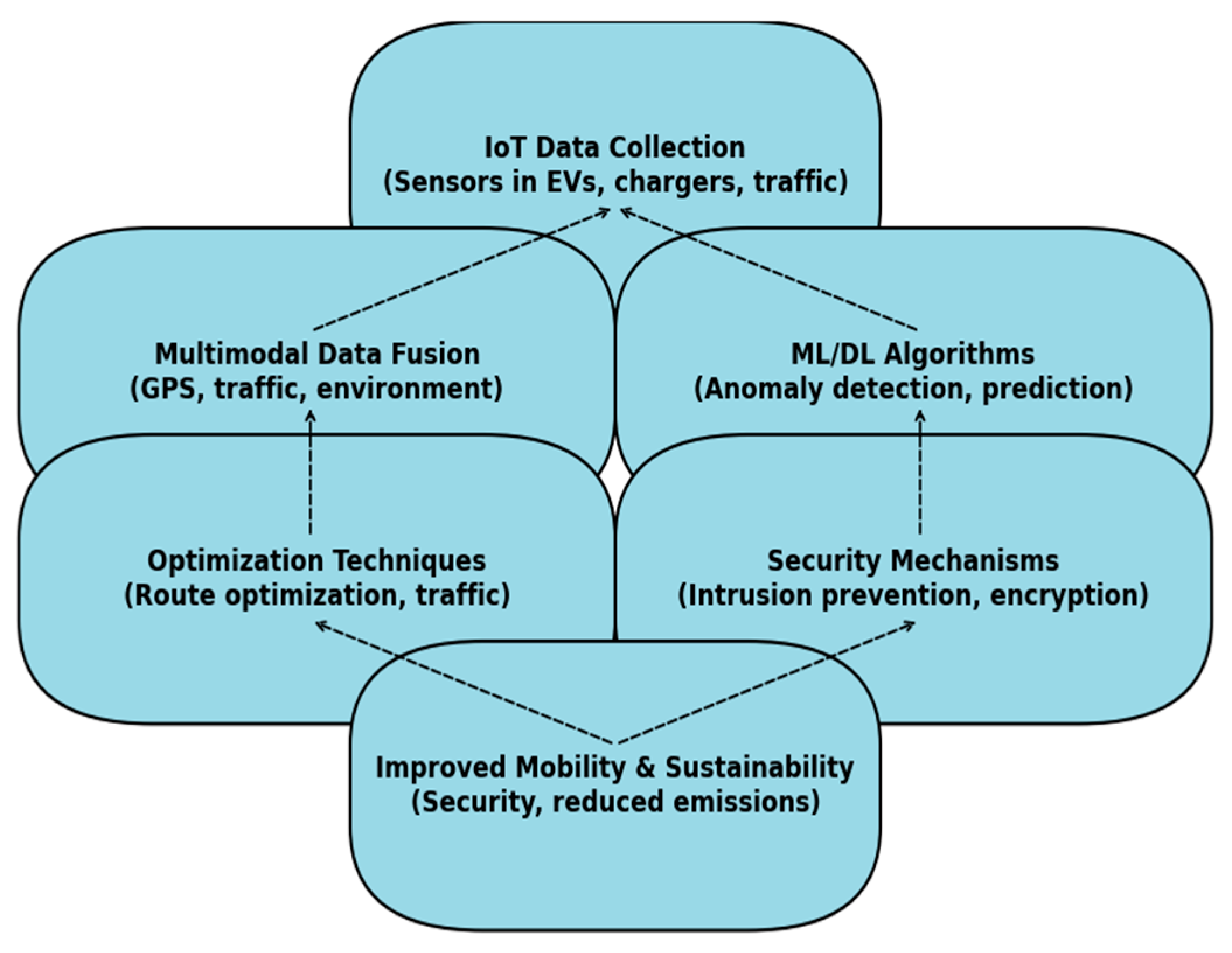
Figure 1 provides a conceptual overview of the proposed framework, illustrating the interaction among IoT data streams, AI-driven analytics, security layers, and optimization engines. A more detailed data flow from input to benefit realization is later illustrated in Figure 14.
Figure 1.
Proposed framework for secure and sustainable green mobility, illustrating the interaction among IoT data collection, multimodal data fusion, machine learning algorithms, optimization techniques, and security mechanisms, culminating in improved mobility and sustainability.
3.1. Architecture Overview
The system receives multimodal inputs from IoT nodes (e.g., EV sensors, traffic systems), processes them through AI models, and uses fused outputs to support optimized traffic routing and energy-aware mobility decisions [18,19].
- EV sensors capture battery status, speed, and diagnostics [20].
- Smart chargers report grid load and usage [21].
- Traffic systems provide congestion and incident reports [22].
- Environmental sensors monitor weather and pollution conditions [23].
The collected data at time are structured as , where each component corresponds to traffic, environmental, and vehicle diagnostics data.
3.2. Predictive Modeling and Optimization
Traffic Forecasting: The framework uses LSTM models to predict future congestion:
where W represents the model parameters.
Energy Forecasting: Energy consumption is minimized via DL-based estimation:
where Et is the true usage and Epred the predicted demand [24].
Reinforcement Learning for Routing: Traffic routing is optimized using a policy π∗:
Here, s is the state, rt the reward, and γ the discount factor.
3.3. Security Layer
To protect system integrity and privacy, the framework includes the following:
- AI-Powered Intrusion Detection: Anomaly detection models classify potential threats as unauthorized access, malware, or system failure [25,26,27]. False positives are reduced by combining AI detection with rule-based validation [28], human-in-the-loop feedback [29], and adaptive confidence thresholds.
- Blockchain-Based Integrity: To avoid computational overhead of Proof-of-Work, Practical Byzantine Fault Tolerance (PBFT) is used for secure logging [12,13]. Only critical anomalies are stored on-chain [14], reducing blockchain bloat.
- Privacy and Compliance:
- AES-256 and TLS 1.3 secure communications [30].
- Personally identifiable information (PII) is anonymized at the source [17].
- Role-based access control (RBAC) and support for data sovereignty ensure compliance with GDPR, CCPA, and PDPA [13,14,15,16].
Details on anomaly classification, privacy controls, and blockchain architecture are provided in Appendix A.1 and Appendix A.4.
3.4. Multimodal Data Fusion
Feature-level data fusion integrates sensor streams as follows:
where Wi are learnable weights. This improves real-time decisions in route selection, load balancing, and energy conservation [26,27,28,31].
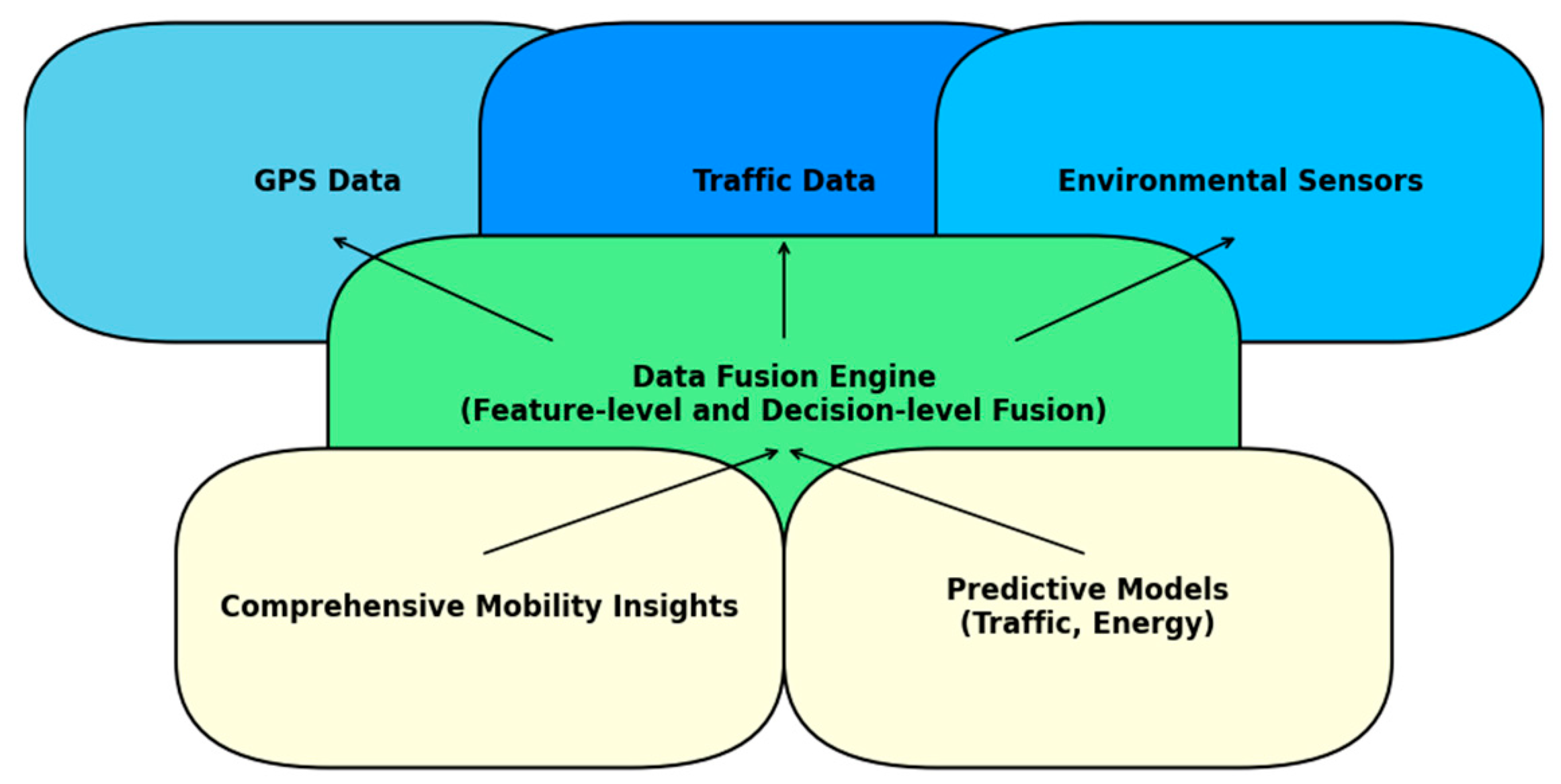
Figure 2 illustrates the role of the data fusion engine in our framework, combining heterogeneous sources such as GPS trajectories, traffic flow data, and environmental sensor streams to generate predictive mobility insights and support real-time decision-making.
Figure 2.
Illustration of the multimodal data fusion process in the proposed framework. Input data sources, including traffic flow data (METR-LA), simulated GPS trajectories, and real-time weather data (OpenWeatherMap API), are integrated in the data fusion engine. The outputs include traffic predictions (via LSTM) and optimized routes (via RL optimization), demonstrating the critical role of data fusion in achieving efficiency and adaptability.
Fusion preprocessing, synchronization, and latent space integration are detailed in Appendix A.2.
3.5. Experimental Setup
The framework was validated in a simulated edge-cloud environment using Jetson AGX devices and SUMO. Over 50,000 IoT nodes were emulated. Benchmarking included RL adaptability, congestion prediction, energy optimization, and real-time anomaly detection.
System simulation and edge-cloud orchestration mechanisms are described in Appendix A.3 and Appendix A.5.
3.5.1. Test Environment
To validate the proposed framework, we developed a comprehensive simulation environment that emulates a scalable edge-cloud hybrid architecture for smart mobility applications. The goal was to assess the system’s behavior under realistic urban traffic conditions, high data throughput, and distributed processing constraints.
The experimental setup integrated the following components:
- Urban Mobility Simulation: The Simulation of Urban Mobility (SUMO) platform was used to model a high-density urban environment, supporting dynamic traffic flow, route optimization, and congestion behavior across a simulated smart city grid.
- IoT Device Emulation: Over 50,000 virtualized IoT nodes (e.g., EV sensors, smart chargers, traffic monitors, and environmental sensors) were simulated to reflect real-time data collection at the urban scale. These nodes continuously generated multimodal data streams.
- Edge Computing Layer: A network of NVIDIA Jetson AGX Xavier devices was employed to simulate edge-level inference. These devices executed key AI tasks (e.g., traffic prediction, anomaly detection) locally, reducing cloud dependency and processing latency.
- Cloud Processing Layer: More compute-intensive tasks, such as reinforcement learning (RL) policy training, blockchain logging, and system coordination, were delegated to centralized cloud-based components, simulating real-world hybrid deployment.
- Edge-Cloud Coordination: Data offloading policies, workload balancing, and failover scenarios were evaluated, enabling empirical benchmarking of the system’s performance under variable network loads and processing demands.
This architecture allowed us to test edge-local intelligence, secure cloud-level coordination, and real-time responsiveness at scale.
The following aspects of the framework were evaluated:
- Real-time congestion prediction under high traffic volume.
- Adaptive route optimization via reinforcement learning.
- Anomaly detection and mitigation using AI-based security mechanisms.
- Edge-cloud load balancing and system resilience under peak data rates.
- Compliance with privacy, security, and regulatory constraints.
By combining Jetson AGX devices with SUMO-driven simulation and synthetic IoT data generation, the test environment effectively validates the framework’s feasibility, scalability, and real-time performance in an emulated smart city context.
3.5.2. Datasets and Data Sources
To ensure realism and generalizability, the framework was evaluated using a combination of publicly available datasets and synthetic GPS trajectories, chosen for their diversity in geographic scope, traffic conditions, and environmental variability. Table 1 provides a summary of the datasets utilized in the evaluation.
Table 1.
Summary of datasets used for case study on real-time traffic optimization, highlighting key characteristics, sources, and features of data.
3.6. Performance Evaluation
The following metrics were used:
- Congestion Reduction
- Energy Efficiency Gain
- Anomaly Detection Accuracy: Based on false positive/negative rates.
- RL Policy Adaptation: Static vs. adaptive learning.
- AI Explainability: SHAP and attention interpretability.
- Battery Longevity: Evaluated under deep discharge and charging cycles.
- Energy Cost Reduction: Assessed under real-time energy pricing.
3.7. Consolidated Results
Table 2 summarizes the comparative performance of the proposed framework under different multimodal data fusion strategies. Notably, the deep learning-based fusion approach achieved a 26.7% improvement in route optimization, 14.9% energy efficiency gains, and a 39.1% increase in battery longevity, substantially outperforming both the baseline and feature-level fusion methods. These results underscore the effectiveness of integrating deep sensor fusion with adaptive reinforcement learning for sustainable urban mobility.
Table 2.
Consolidated performance impact of multimodal fusion strategies and RL optimization.
3.8. Limitations and Future Work
The framework currently relies on vehicular datasets with limited support for pedestrian or transit flows. Future work includes the following:
- Expanding to multimodal mobility (bikes, walking, transit).
- Real-time retraining with reinforcement learning.
- Applying privacy-preserving AI (e.g., differential privacy, homomorphic encryption).
- Field deployment with live smart city infrastructure.
4. Case Study—Real-Time Traffic Optimization Using Multimodal IoT Data
This section presents a case study that demonstrates the practical implementation of the proposed IoT-AI fusion framework for real-time traffic optimization. The study applies advanced machine learning models and multimodal data fusion techniques to dynamically mitigate congestion, improve energy efficiency, and reduce CO2 emissions in urban environments. Unlike conventional static models, our framework leverages real-time sensor data, GPS trajectories, and environmental parameters for adaptive traffic flow optimization.
4.1. Problem Formulation
Real-time traffic optimization can be formulated as a constrained dynamic routing problem within a multimodal transportation network. Let the urban road network be represented as a directed graph G = (N, E), where N denotes intersections (nodes) and E represents road segments (edges). Each edge is associated with real-time parameters including, traffic flow f(e, t), average speed v(e, t), and congestion level c(e, t). The objective is to optimize travel time T and energy consumption E while maintaining balanced traffic distribution.
subject to
- (road capacity constraint);
- (minimum speed requirement);
- (pollution threshold).
where α, β, γ are weight parameters regulating travel time, energy consumption, and congestion levels. The function C(e, t) applies congestion penalties to mitigate bottlenecks and ensure balanced traffic flow.
4.2. Optimization Approach
The proposed framework employs Long Short-Term Memory (LSTM) networks for traffic flow prediction and Deep Q-Networks (DQNs) for reinforcement learning-based route optimization. Multimodal data from traffic flow sensors, environmental monitors, and historical logs are fused at the preprocessing stage, as described in Section 3.4, enhancing the prediction context.
4.2.1. Traffic Flow Prediction (LSTM Model)
The LSTM model predicts traffic congestion levels based on past trends and real-time sensor inputs. The prediction function is as follows:
where denotes the predicted congestion at time t + Δt, and w(e, t) represents external environmental influences such as weather conditions.
The LSTM model’s parameters and configuration are detailed in Table 3, summarizing its architecture, training methodology, and evaluation metrics. The model was trained using a rolling window with a prediction horizon of one hour (12 time steps of 5 min). Inference is deployed at the edge, with latency kept below 100 ms per cycle. Normalization of the input features ensured balanced learning and stable convergence.
Table 3.
Parameters of LSTM model for congestion prediction.
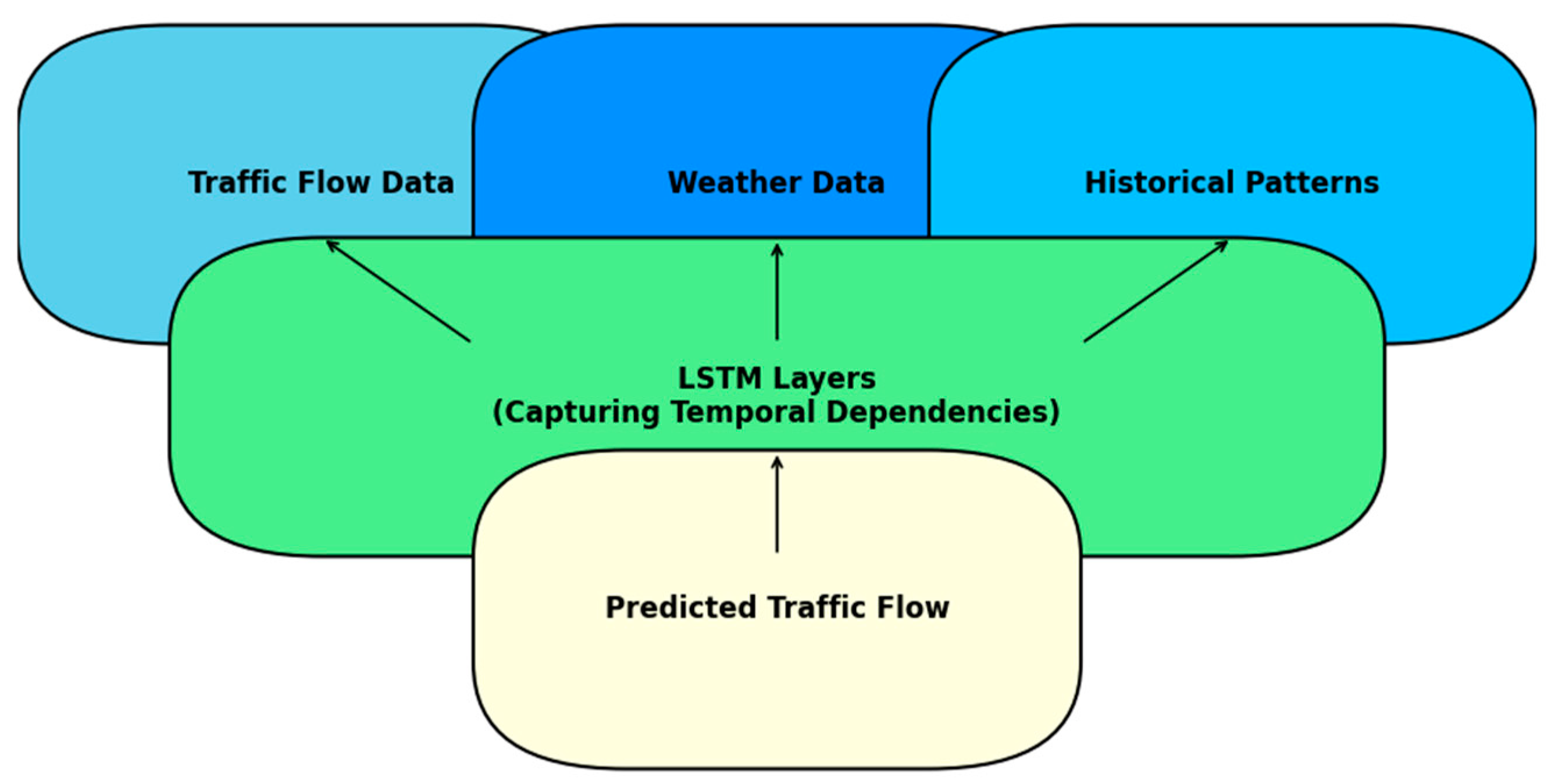
Figure 3 illustrates the LSTM-based congestion prediction model.
Figure 3.
LSTM architecture used for congestion prediction. This model processes traffic flow data, weather conditions, and historical patterns to capture temporal dependencies and predict traffic flow for specific road segments.
Model configuration details are provided in Appendix B.
4.2.2. Reinforcement Learning-Based Route Optimization
A reinforcement learning model using Deep Q-Networks (DQNs) optimizes vehicle routing in response to live traffic states. The RL agent observes the environment (state S), selects an action A (alternative route), and receives a reward R reflecting travel time, energy efficiency, and congestion mitigation.
where α, β, γ are the weight travel time, energy efficiency, and congestion minimization, respectively.
Training was conducted offline using simulation data, with deployment occurring on edge devices using the trained policy. Inference latency for DQN decisions was maintained under 80 ms per routing cycle. Real-time feedback from traffic monitors updates state representations in a 5 min cycle.
Key hyperparameters and training details are summarized in Table 4. The DQN employs an epsilon-greedy strategy, gradually shifting from exploration (ε = 1) to exploitation (ε = 0.01). The reward function encourages routes that reduce congestion and energy use, while penalizing inefficient paths.
Table 4.
Parameters of the DQN model for route optimization.
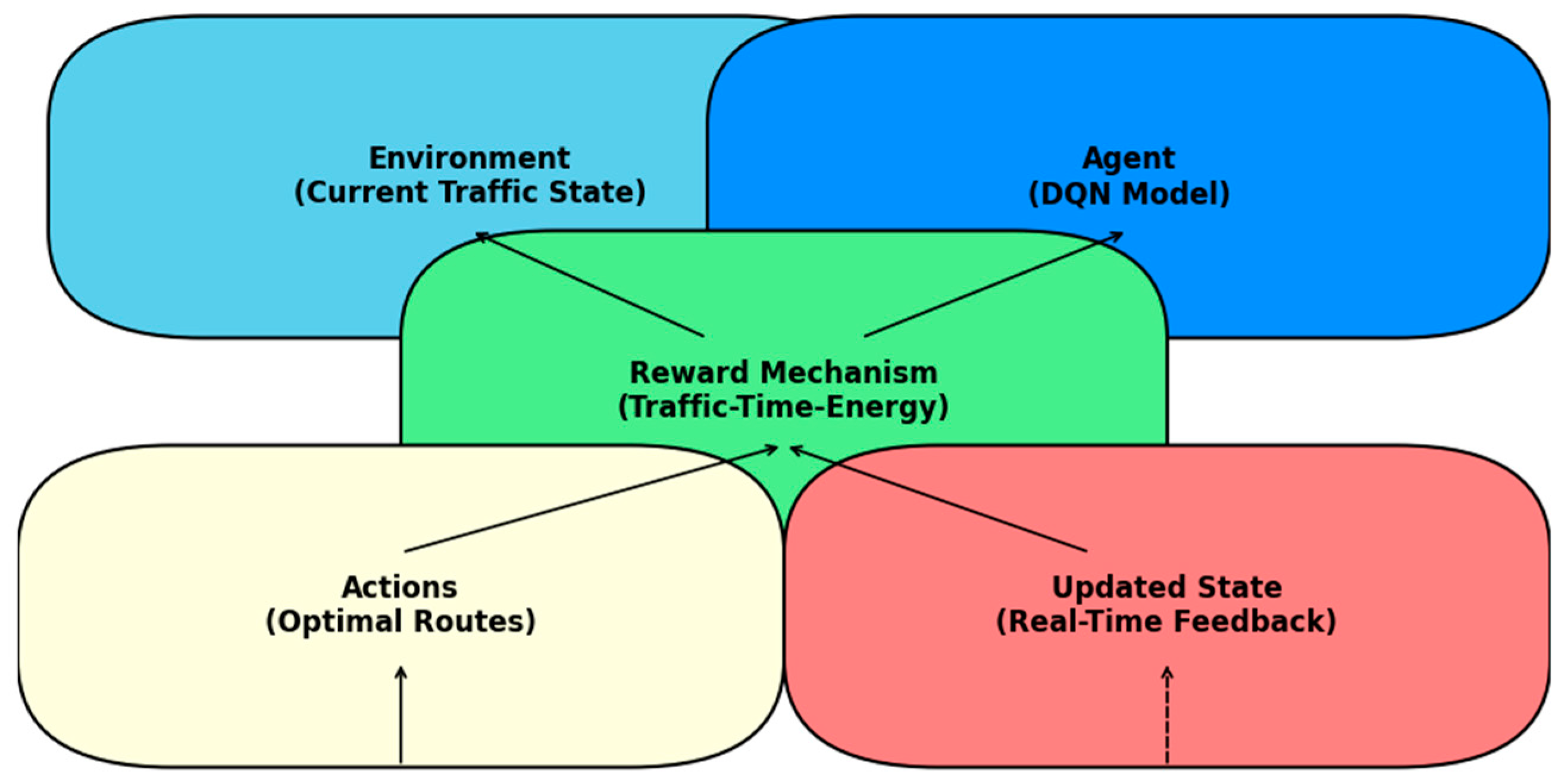
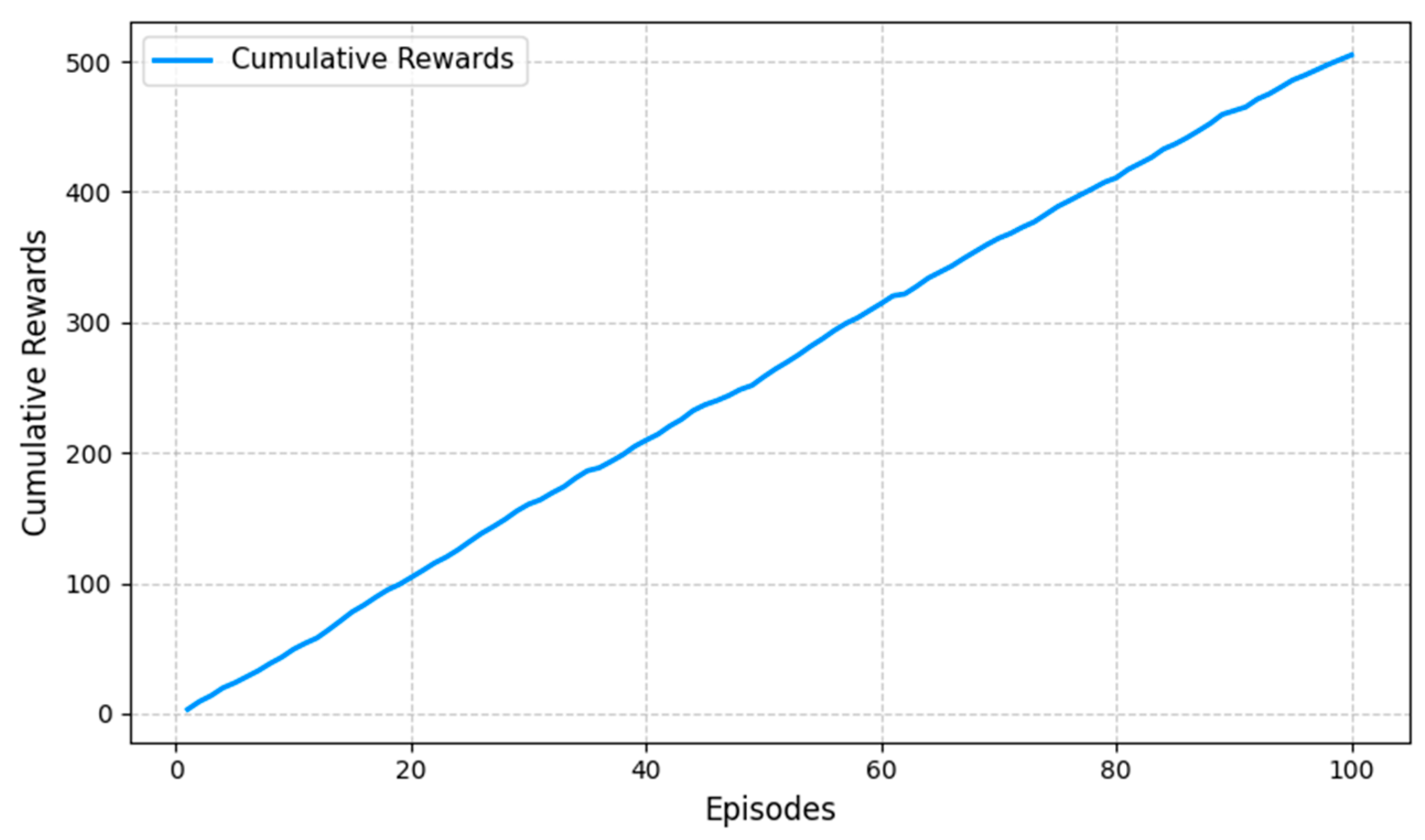
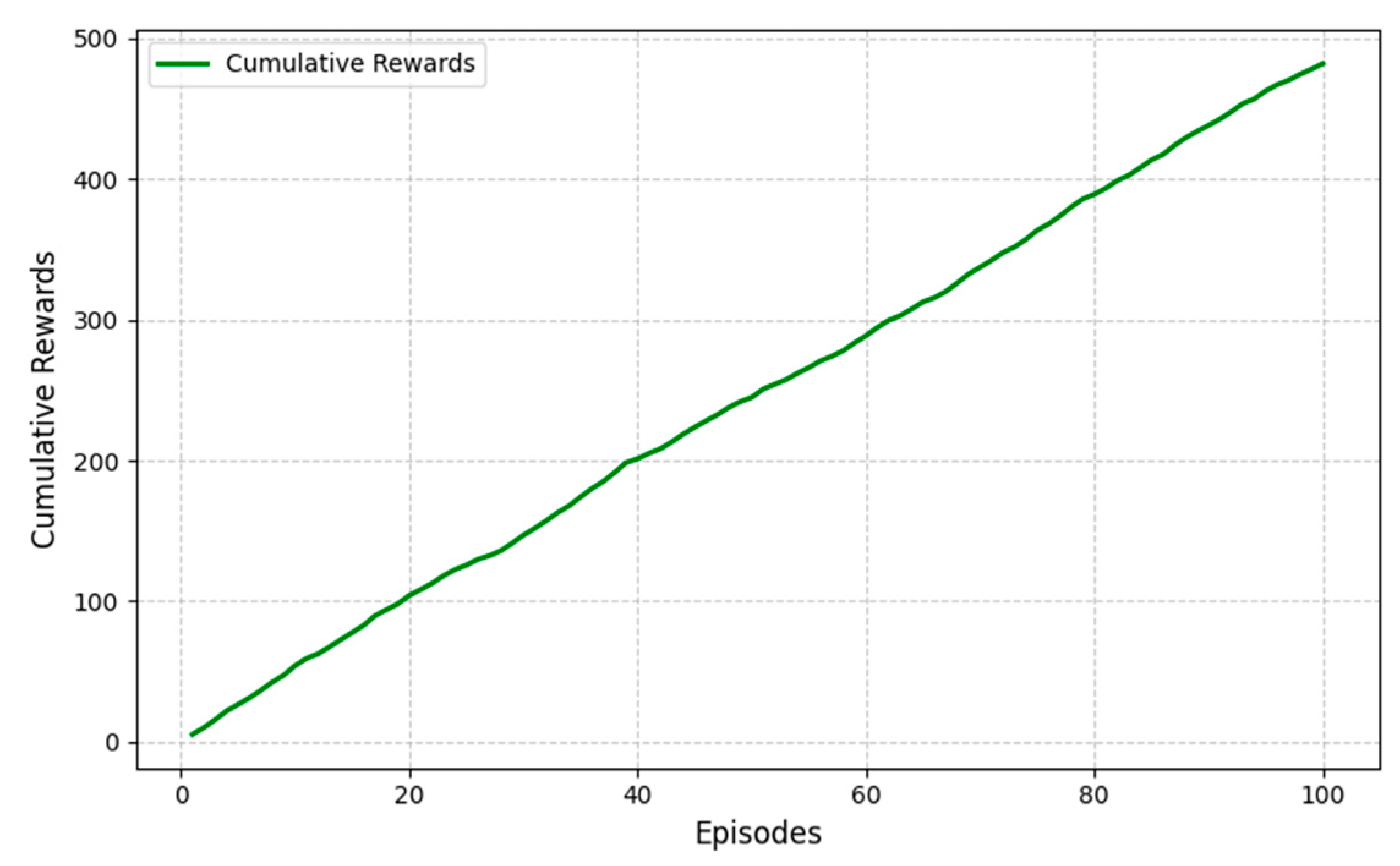
Figure 4 depicts the reinforcement learning workflow, while Figure 5 shows the convergence of cumulative rewards over 100 training episodes.
Figure 4.
Reinforcement learning-based route optimization workflow. This system uses Deep Q-Network (DQN) agent to dynamically select optimal routes based on traffic conditions, energy efficiency, and reward mechanisms, with continuous feedback loop for real-time updates.
Figure 5.
The convergence of cumulative rewards during reinforcement learning training. The upward trend indicates the agent’s improved decision-making capabilities, demonstrating its ability to optimize routes effectively through iterative learning.
Technical parameters for the prediction and optimization models are available in Appendix B.
4.3. Validation Metrics
The performance evaluation was based on four key metrics:
- Travel Time Reduction: Measures the decrease in average travel time compared to baseline routing methods.
- Energy Efficiency Improvement: Evaluates reductions in energy consumption per kilometer traveled.
- CO2 Emissions Reduction: Assesses improvements in emissions based on optimized traffic flow.
- Traffic Distribution Fairness: Ensures congestion is equitably balanced across road segments.
These metrics reflect both system performance and environmental impact. Table 5 presents a comparative analysis of the proposed framework against traditional routing systems.
Table 5.
Comparative analysis of traffic optimization frameworks.
Additional implementation details on the explainability layer, including SHAP feature impact analysis and attention visualization techniques, are provided in Appendix A.6.
4.4. Discussion and Future Work
The study confirms that integrating IoT and AI enables adaptive, real-time traffic optimization. The upward reward trend demonstrates effective policy learning. Future research will explore the following:
- Scalability to larger road networks.
- Multimodal integration, incorporating pedestrian, cycling, and public transit data.
- Edge computing deployment to reduce latency in real-time inference.
5. Results and Discussion
This section analyses the empirical performance of the proposed IoT-AI framework based on experimental findings and visual evidence. The evaluation encompasses model convergence behavior, travel time reduction, congestion mitigation, energy efficiency, CO2 emissions, and real-time policy learning effectiveness. Each result is linked to corresponding figures and tables for clarity.
5.1. Model Training and Convergence
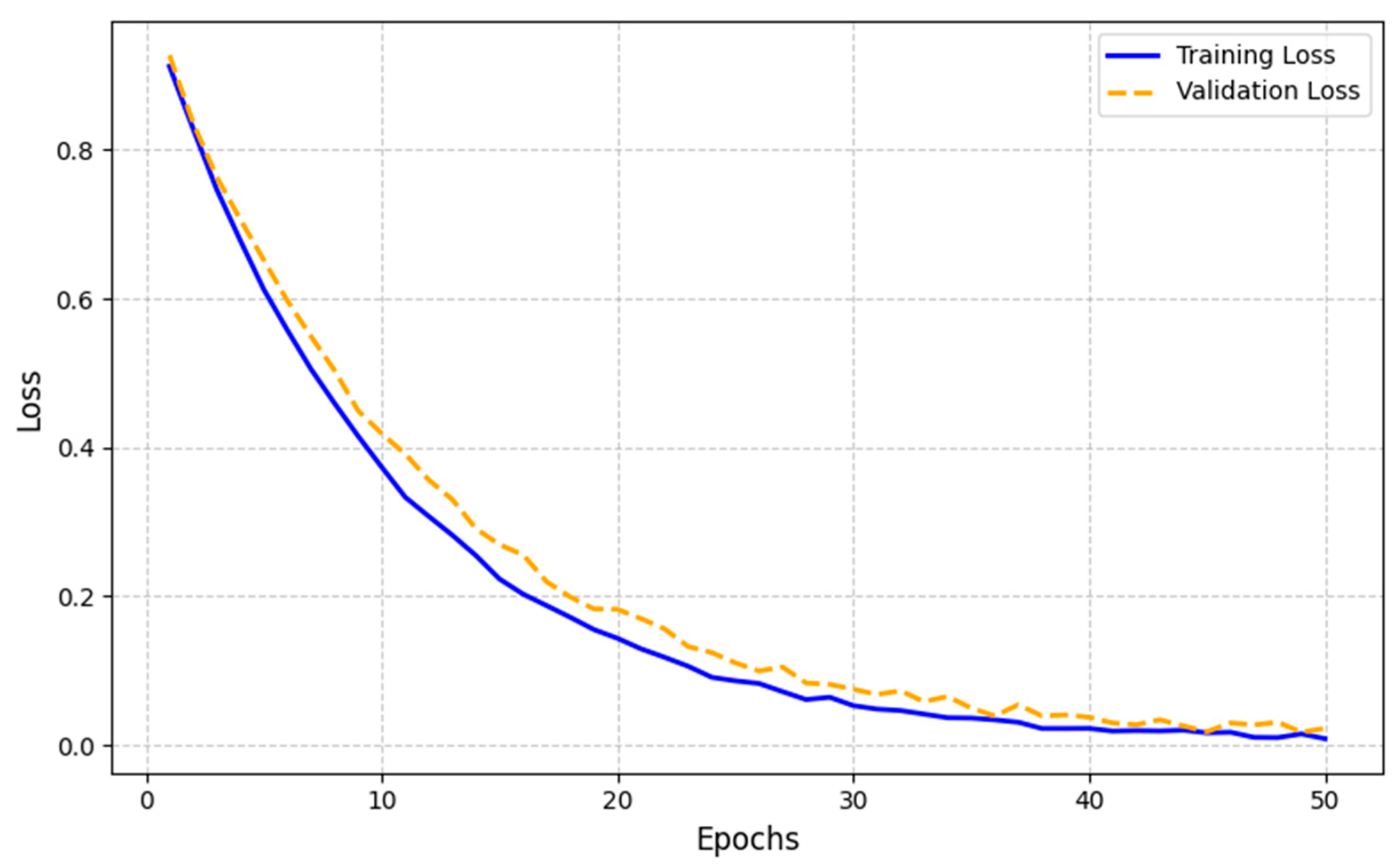
Figure 6 shows the training and validation loss curves for the LSTM model. The consistent downward trends and narrow gap between curves indicate smooth convergence and minimal overfitting, suggesting that the model generalizes well to unseen data. The final validation loss stabilized below 0.05 after 50 epochs, validating the suitability of LSTM for congestion forecasting under multimodal input. Performance metrics under different congestion scenarios and data fusion strategies are summarized in Table 6.
Figure 6.
Convergence of training and validation loss for LSTM model during congestion prediction. Declining trend in losses over 50 epochs demonstrates stable training and reliable generalization.
Table 6.
Predictive performance of LSTM congestion forecasting model under varying traffic conditions and data fusion strategies. Deep learning-based fusion consistently yields highest accuracy, while model maintains generalizability across congestion levels and cities.
5.2. Travel Time Optimization
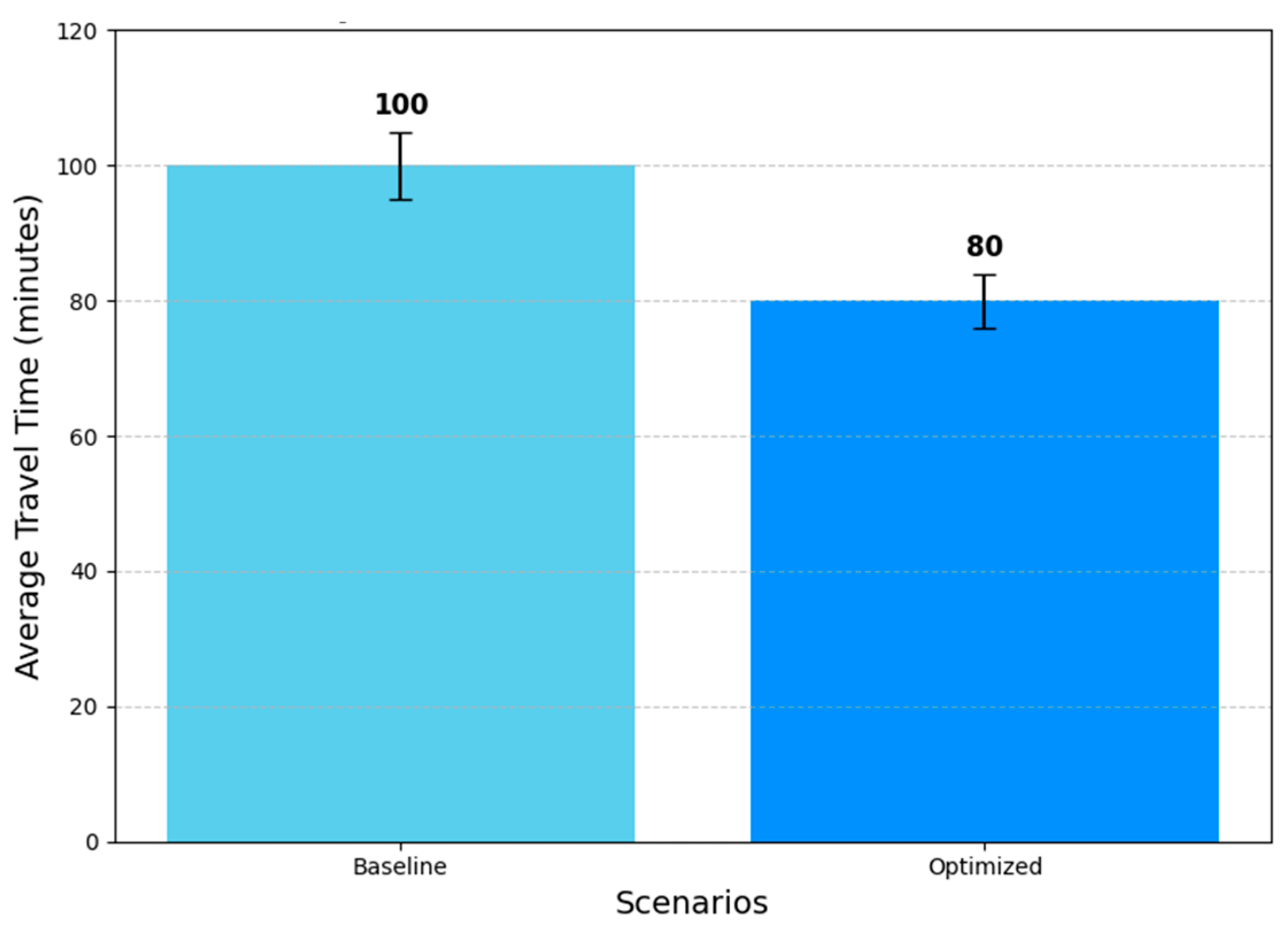
As shown in Figure 7, the average travel time decreased from 100 to 80 min—reflecting a 20% improvement. Error bars indicate low variance across test runs, confirming the stability of the routing policy. Table 7 further compares the performance of different RL policies (baseline, static, adaptive), showing that adaptive RL yields significant travel time and energy gains. These results confirm the RL model’s superior ability to optimize both travel time and energy use in dynamic traffic environments.
Figure 7.
Comparison of average travel times across baseline routing methods and proposed optimization framework. Optimized framework demonstrates 20% reduction in travel time by dynamically adapting to real-time traffic conditions. Error bars indicate variability observed within each simulation scenario.
Table 7.
Comparative performance of reinforcement learning-based optimization policies. Adaptive RL model outperforms both baseline and static policies in travel time reduction, energy efficiency, and reward score, demonstrating its ability to learn dynamic routing strategies in real-time.
5.3. Congestion Pattern Improvements
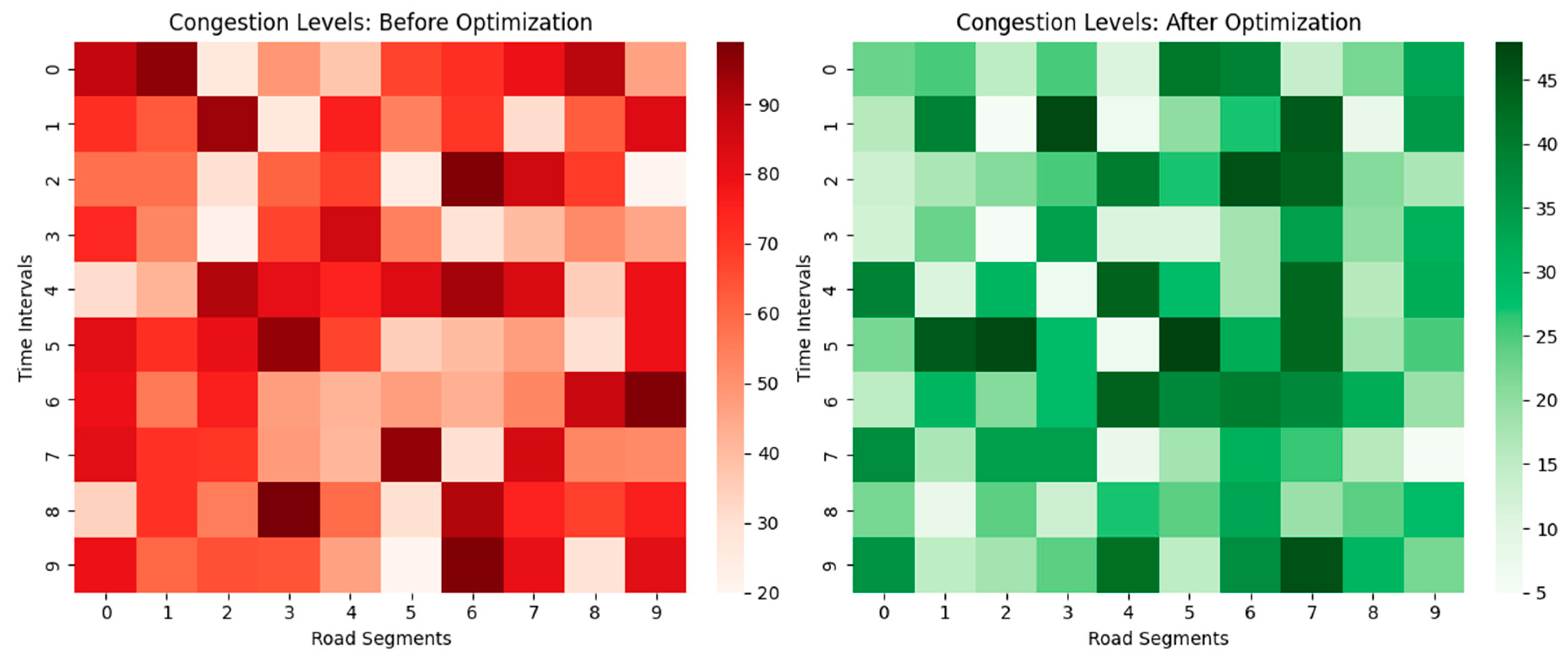
Figure 8 presents congestion heatmaps before and after optimization. The pre-optimization scenario exhibits widespread traffic bottlenecks across segments and intervals, whereas the post-optimization map shows a substantial decrease in congestion intensity and better traffic distribution. The contrast in color saturation quantitatively highlights improved flow uniformity.
Figure 8.
Traffic congestion levels visualized as heatmaps before and after applying proposed optimization framework. Red heatmap indicates high congestion prior to optimization, while green heatmap highlights improved traffic flow, particularly during peak hours.
5.4. RL Effectiveness
Figure 9 plots the cumulative reward across episodes during DQN training. The steadily increasing curve demonstrates that the agent effectively learned optimal routing strategies over time. The lack of reward plateaus or oscillations indicates policy stability and consistent improvement.
Figure 9.
Cumulative rewards achieved by RL agent during training. Consistent upward trend over 100 episodes reflects agent’s ability to learn optimal routing strategies and adapt to dynamic traffic conditions.
5.5. Energy and Environmental Gains
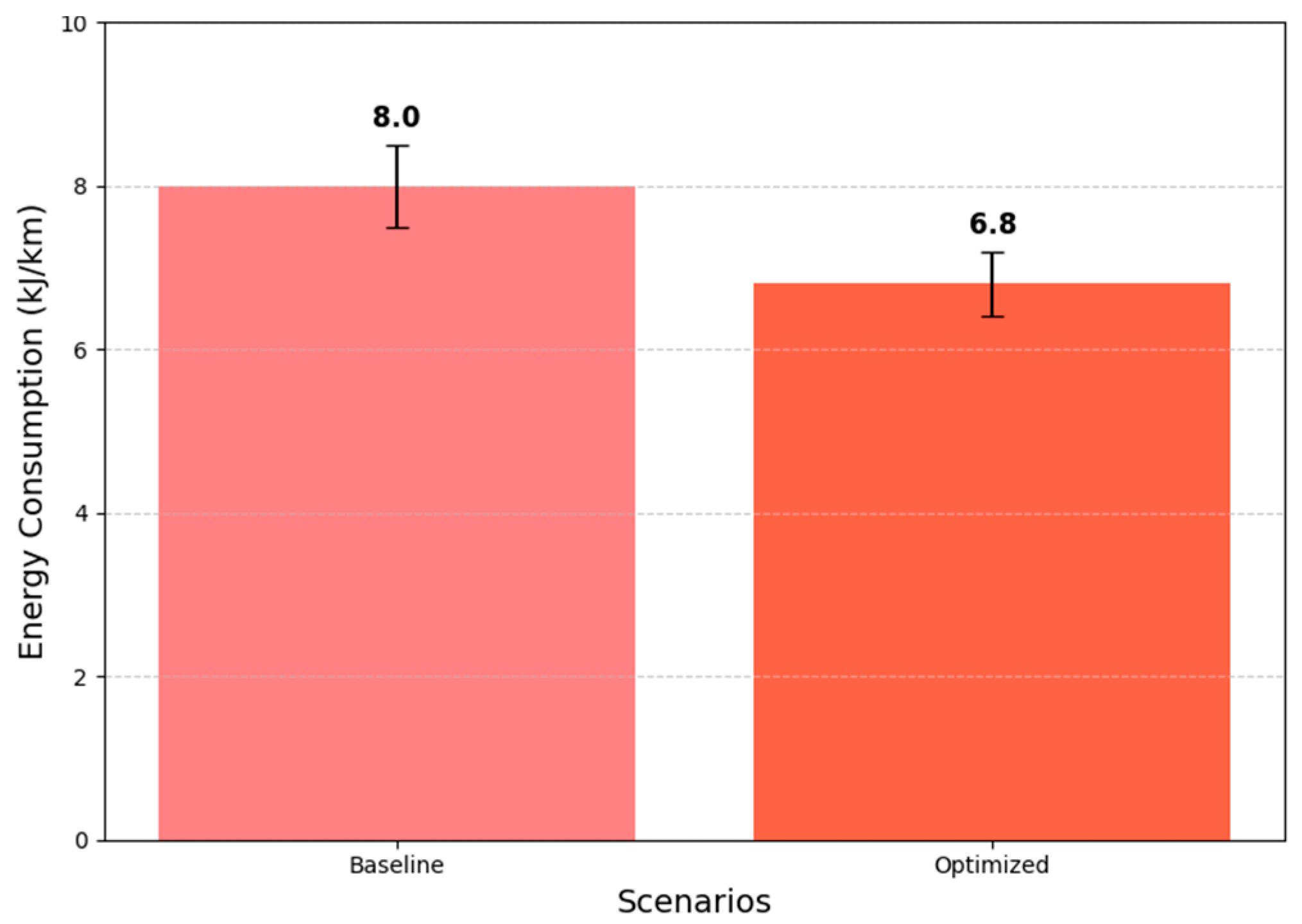
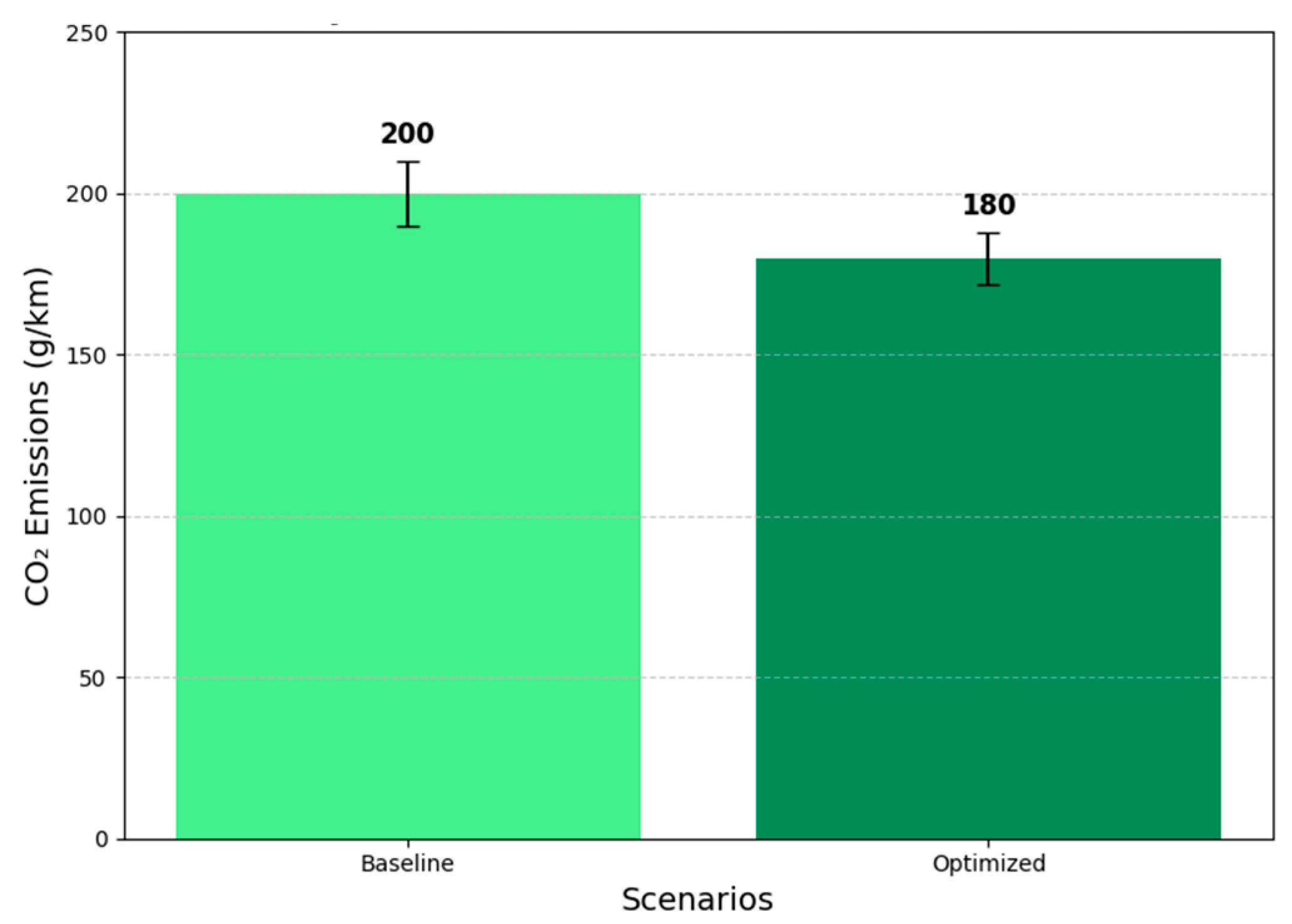
Figure 10 and Figure 11 compare energy consumption and CO2 emissions, respectively. Energy usage decreased from 8.0 to 6.8 kJ/km (15% reduction), and emissions dropped from 200 to 180 g/km (10% reduction). These outcomes stem from smoother driving patterns and shorter travel distances, both enabled by predictive analytics and adaptive routing. These gains are further illustrated in Figure 10 and Figure 11, where the optimized framework demonstrates a consistent reduction in energy consumption and CO2 emissions compared to baseline routing methods.
Figure 10.
Average energy consumption per kilometer across baseline and optimized scenarios. Optimized framework achieves 15% reduction in energy consumption through smoother traffic flow and route optimization. Error bars represent simulation variability.
Figure 11.
Comparison of CO2 emissions per kilometer between baseline routing and optimized framework. Framework achieves 10% reduction in emissions, attributed to improved traffic flow and reduced idling times.
5.6. Summary of System-Wide Improvements
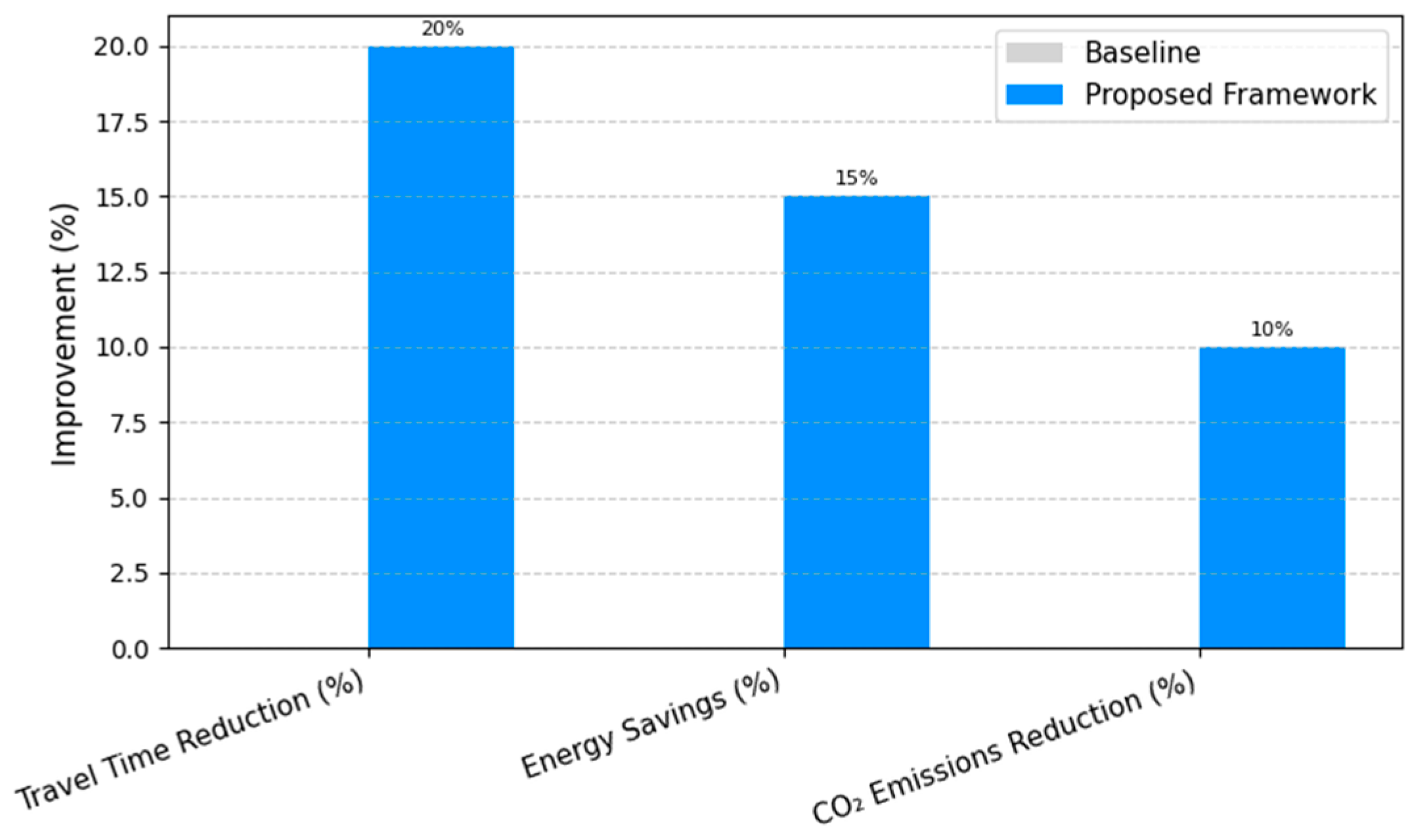
To consolidate the performance evaluation, Figure 12 summarizes improvements across key metrics. The framework achieved a 20% reduction in travel time, 15% savings in energy consumption, and 10% CO2 emissions reduction. These results validate the integrated effect of IoT, data fusion, and AI-driven optimization on sustainable mobility.
Figure 12.
Comparative sustainability contributions of baseline methods versus proposed framework. Chart highlights improvements in travel time reduction, energy savings, and CO2 emissions achieved by proposed framework.
Appendix A.4 provides detailed latency and optimization trade-offs for these features.
5.7. Framework Integration and Cross-Domain Application
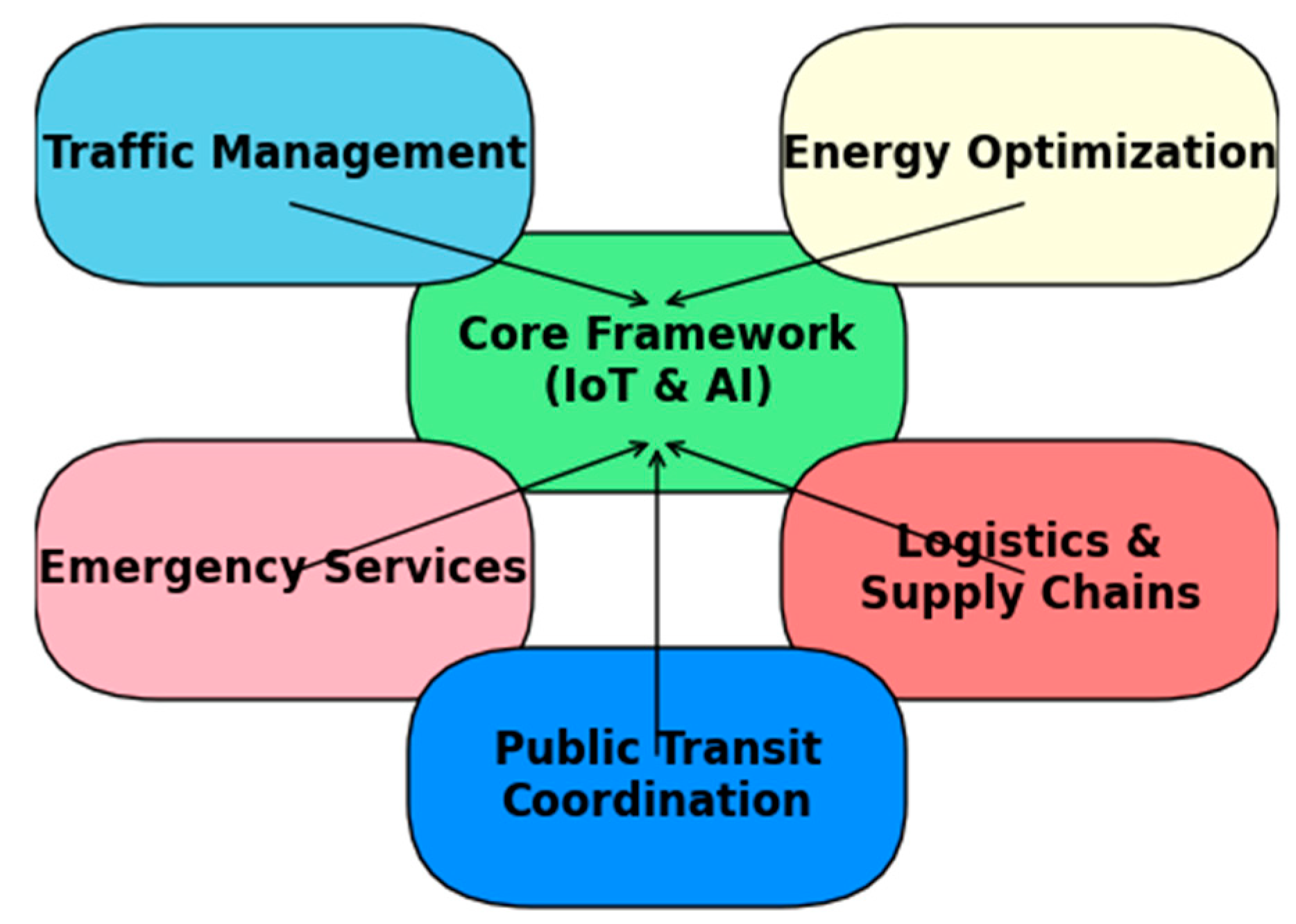
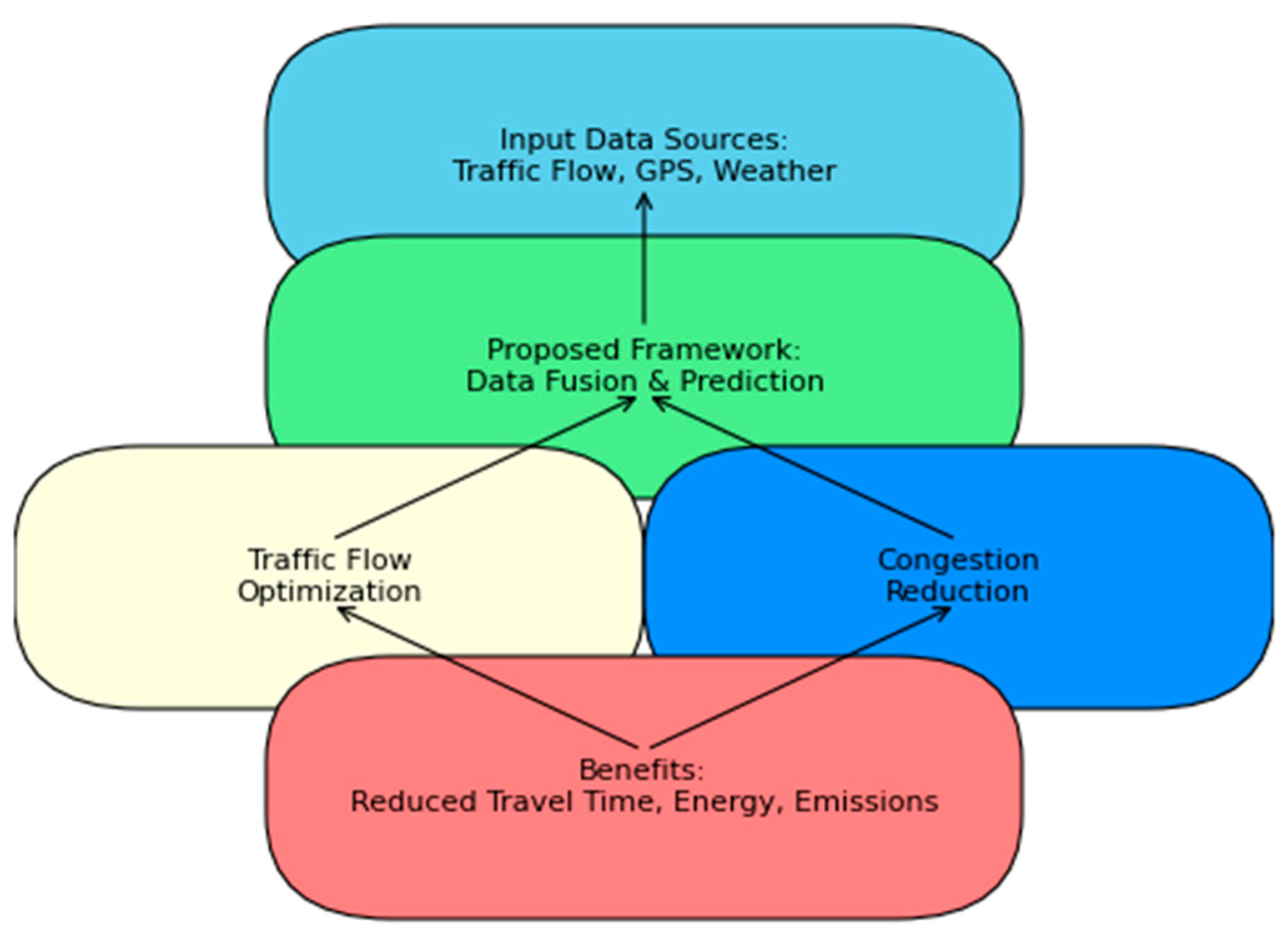
Figure 13 and Figure 14 illustrate the broader role of the framework across domains such as logistics, energy optimization, emergency response, and public transit coordination. The integration of AI and IoT not only enhances transportation efficiency but also lays the foundation for scalable, multi-sector smart city applications. Figure 14 offers a high-level view of how the proposed framework integrates multimodal input sources with data fusion and optimization engines to produce sustainable mobility outcomes.
Figure 13.
Modular applications of the proposed framework. The diagram illustrates how the core IoT and AI framework can be extended to diverse applications, including traffic management, energy optimization, emergency services, logistics, and public transit coordination.
A summary of key use case performance results across emergency response, transit coordination, energy optimization, and anomaly detection is provided in Appendix A.5 (Table A2), demonstrating the framework’s adaptability to diverse smart city needs.
Figure 14.
The end-to-end workflow of the proposed framework. The diagram shows how multimodal data inputs (traffic, GPS, weather) are fused and processed by the framework for real-time optimization of traffic flow and congestion, leading to measurable sustainability benefits (reduced travel time, energy use, and emissions).
5.8. Adaptability to Constraints and System Trade-Offs
We further analyzed how external constraints—such as dynamic energy pricing, cybersecurity enforcement, and privacy-preserving edge deployment—impacted system optimization. Table 8 consolidates these findings. While privacy and security enforcement introduced small trade-offs in optimization scores (–4.2% to –6.0%), they did not compromise overall system viability. Dynamic pricing provided the highest cost savings, while cloud-based deployment offered the highest optimization score, albeit with higher latency.
Table 8.
Effect of real-world operational constraints on optimization performance and energy cost savings. Although security and privacy features introduce minor efficiency trade-offs, they maintain system viability and align with regulatory requirements. Cloud deployment improves optimization but may increase latency.
Together, the visual and tabular results demonstrate that the proposed framework performs reliably across diverse scenarios, adapts well to practical deployment constraints, and maintains strong performance under realistic smart city conditions. Appendix A.4 provides detailed latency and optimization trade-offs for these features. Quantitative impacts of these configurations, including latency overhead and optimization score reduction, are summarized in Appendix A.4 Table A1.
6. Conclusions and Future Research Directions
6.1. Conclusions
This study introduced a modular IoT- and AI-driven framework for enhancing urban mobility through real-time traffic prediction, adaptive route optimization, and secure data integration. By leveraging multimodal data fusion, the framework supports responsive traffic management that aligns with smart city objectives—reducing congestion, optimizing energy use, and cutting CO2 emissions.
Simulation-based evaluations demonstrated the framework’s effectiveness, including a 20% reduction in average travel time, a 15% improvement in energy efficiency, and a 10% decrease in emissions. These gains were achieved through the integration of LSTM-based traffic forecasting, reinforcement learning for dynamic routing, and privacy-preserving blockchain-enabled security protocols.
The system’s modular design supports integration with diverse smart city domains, such as energy grids, logistics, emergency services, and public transit. Despite promising results, the current evaluation is based on simulation and publicly available datasets. Real-world implementation remains essential to validate its scalability, latency, and responsiveness under complex urban conditions.
6.2. Future Work and Research Directions
While the proposed framework demonstrates strong performance in congestion prediction and route optimization, several areas warrant further exploration to enhance its adaptability and effectiveness. Future directions include both near-term enhancements and strategic research pathways:
- Real-World Pilots: Deploy and validate the framework in live urban environments to assess responsiveness, data variability, latency, and system robustness. This includes working with public sector agencies to integrate with existing infrastructure.
- Expanded Multimodal Data Sources: Integrate richer sensor data—such as pedestrian flow, public transit logs, social mobility patterns, and driver behavior—to support more inclusive, personalized mobility decisions.
- Next-Generation Learning Models: Explore transformer-based architectures and hybrid deep learning approaches for long-term traffic forecasting and improved interpretability.
- Cybersecurity Innovations: Advance blockchain-based data integrity, decentralized anomaly detection, and privacy-preserving AI to ensure secure deployment at scale.
- Grid Integration and Sustainability: Incorporate dynamic electricity pricing and renewable energy forecasts to further optimize electric vehicle (EV) routing and charging.
- Adaptive Learning and Generalization: Apply transfer learning and meta-reinforcement learning to reduce retraining needs across diverse cities and infrastructure conditions.
- Multimodal and Micro-Mobility Expansion: Extend support to cycling, scooters, and emerging mobility modes to improve the inclusivity and equity of urban transportation systems.
- Policy and Stakeholder Alignment: Work with policymakers, transportation authorities, and urban planners to align system capabilities with urban development goals and sustainability benchmarks.
Pursuing these research directions will enable the framework to mature into a robust and adaptable platform for dynamic, secure, and sustainable urban mobility. Through the integration of intelligent sensing, edge-based analytics, and explainable AI, it lays a scalable foundation for real-world, human-centered smart city innovation.
Funding
This research received no external funding.
Institutional Review Board Statement
Not applicable.
Informed Consent Statement
Not applicable.
Data Availability Statement
The data supporting the findings of this study are available upon reasonable request from the corresponding author. Sharing the data via direct communication ensures adequate support for replication or verification efforts and allows for appropriate guidance in its use and interpretation.
Conflicts of Interest
The author declares no conflicts of interest.
Appendix A. Framework Implementation and Technical Architecture
Appendix A.1. Security Model Architecture and Privacy Enforcement
The anomaly detection system uses the following:
where Pi(Xt) are probabilities of different threat types.
To reduce false positives, we apply the following:
- Confidence thresholding;
- Rule-based validation;
- Human-in-the-loop reinforcement learning.
Blockchain-based security uses PBFT for consensus. Only critical events are logged on-chain. Off-chain storage is used for routine events. AES-256 and TLS 1.3 secure communications. RBAC and anonymization ensure GDPR/CCPA compliance.
Appendix A.2. Multimodal Data Fusion Mechanics
Inputs from GPS, traffic systems, environmental sensors, and vehicle diagnostics are fused as follows:
where W1, W2, and W3 are learnable fusion weights.
Preprocessing involves PCA, Kalman filtering, and temporal alignment. The system supports both feature-level and latent space fusion for real-time optimization.
Appendix A.3. Edge-Cloud Simulation and Performance Evaluation
Jetson AGX devices handled local inference, while cloud modules executed RL training and blockchain validation. The architecture was tested under 50,000+ simulated IoT nodes using SUMO.
Performance evaluations focused on the following:
- AI inference latency and system responsiveness;
- RL adaptability and congestion mitigation;
- Energy efficiency and cybersecurity enforcement.
Data offloading strategies balanced cloud-edge processing under varying network conditions.
Appendix A.4. Performance Overhead and Trade-Offs
Table A1 summarizes the impact of different security and processing configurations on optimization performance and response time.
Table A1.
Performance impact of security and privacy features.
Table A1.
Performance impact of security and privacy features.
| Feature | Score Impact | Latency Increase | Notes |
|---|---|---|---|
| Blockchain Logging (PBFT) | –3.5% | +25 ms | Low energy overhead, high auditability |
| Anomaly Detection (Hybrid AI) | –4.2% | +31 ms | Trade-off for false positive reduction |
| Full Privacy Mode (Edge-only) | –6.0% | +40 ms | Protects PII, higher load on edge devices |
Appendix A.5. Edge Intelligence Optimization
To manage high-frequency data and ensure real-time responses, the system implements the following:
- Confidence-aware filtering: Low-confidence packets can be discarded or delayed at the edge.
- Local anomaly pre-validation: Suspicious inputs are classified before full inference is triggered.
- Dynamic load balancing: If edge resources are saturated, critical tasks are offloaded to the cloud.
These mechanisms ensure responsiveness during peak load and contribute to efficient edge-cloud orchestration.
The modular architecture of the proposed framework supports diverse smart city operations. Table A2 provides selected highlights from simulated use cases, covering electric mobility, public transit, emergency response, and smart grid coordination. These results demonstrate real-time performance, AI responsiveness, and cross-domain adaptability.
Table A2.
Use case highlights for smart city operations.
Table A2.
Use case highlights for smart city operations.
| Use Case | Component Involved | Average Response Time | Optimization Impact | Notes |
|---|---|---|---|---|
| EV Smart Charging Scheduling | Edge AI + Energy Data Fusion | 400 ms | 18% reduction in energy costs | Integrates dynamic pricing and battery status |
| Real-Time Emergency Route Re-Routing | RL Agent + Traffic Prediction | 250 ms | 32% faster emergency response | Prioritizes emergency vehicles in congestion zones |
| Anomaly Detection and Alerting | AI Intrusion Detection Layer | 120 ms | 30% false positive reduction | Combines AI detection with rule-based filtering |
| Weather-Aware Congestion Forecasting | LSTM + OpenWeatherMap | ~15 s (forecast) | 26.7% improved routing accuracy | Forecasts traffic under extreme weather conditions |
| Public Transit Flow Optimization | Data Fusion + RL Coordination | 900 ms | 21% improved schedule adherence | Syncs buses/trams with optimized traffic signals |
| Smart Grid–Mobility Load Balancing | Grid Load + Vehicle Demand Sync | 1.2 s | 12% reduced peak grid load | Avoids EV overloading during high grid consumption |
Appendix A.6. Explainability Integration
Explainability tools support debugging and transparency:
- SHAP Analysis: Applied to LSTM outputs, showing that traffic volume and precipitation were most impactful features during congestion spikes.
- Attention Visualization: Used in anomaly classification models to highlight which input segments triggered alerts.
- Stakeholder Transparency: Visualizations are exportable as policy-readable summaries for urban planners and transportation authorities.
Appendix B. Model Configuration and Training Details
Appendix B.1. LSTM Model for Traffic Congestion Prediction
Explainability methods such as SHAP value attribution and attention weight visualization were applied post-training and are further detailed in Appendix A.6.
Table A3.
A summary of the architecture and training settings used in the LSTM-based traffic congestion prediction model. The configuration includes input modalities, model structure, training parameters, and evaluation metrics used to assess predictive accuracy.
Table A3.
A summary of the architecture and training settings used in the LSTM-based traffic congestion prediction model. The configuration includes input modalities, model structure, training parameters, and evaluation metrics used to assess predictive accuracy.
| Parameter | Value | Explanation |
|---|---|---|
| Input Features | Traffic speed, weather data | Multimodal inputs used to learn temporal patterns |
| Time Steps | 12 (for 1 h prediction) | Number of past intervals used to predict future |
| LSTM Layers | 2 | Depth of the network |
| Neurons per Layer | 64 | Size of each LSTM layer |
| Dropout Rate | 0.2 | Regularization to prevent overfitting |
| Loss Function | Mean Squared Error (MSE) | Penalizes large prediction errors |
| Optimizer | Adam | Adaptive learning rate |
| Learning Rate | 0.001 | Step size for each parameter update |
| Batch Size | 32 | Training batch size |
| Epochs | 50 | Full training cycles |
| Train/Val/Test Split | 70%/15%/15% | Dataset partitioning |
| Evaluation Metrics | RMSE, MAE, R2 | Accuracy measures |
Appendix B.2. DQN Model for Reinforcement Learning Optimization
Other explainability methods are further detailed in Appendix A.6.
Table A4.
The configuration of the Deep Q-Network (DQN) used for adaptive route optimization. The table includes key hyperparameters, network architecture, reward function structure, and metrics used to evaluate the agent’s performance.
Table A4.
The configuration of the Deep Q-Network (DQN) used for adaptive route optimization. The table includes key hyperparameters, network architecture, reward function structure, and metrics used to evaluate the agent’s performance.
| Parameter | Value | Explanation |
|---|---|---|
| State Representation | Traffic congestion, energy usage | RL input state vector |
| Action Space | 10 route options | Decision set for routing |
| Reward Function | −αT + βE + γ(1 − C) | Encourages efficient and decongested routing |
| Neural Network Architecture | 3 layers, 128 neurons each | Fully connected deep Q-network |
| Training Episodes | 10,000 | RL training cycles |
| Steps per Episode | 50 | Time steps per episode |
| Exploration Strategy | Epsilon-greedy (ε = 1 → 0.01) | Balancing exploration and exploitation |
| Discount Factor (γ) | 0.99 | Long-term reward prioritization |
| Optimizer | Adam | Gradient descent variant |
| Learning Rate | 0.0005 | Parameter update speed |
| Evaluation Metrics | Avg. reward/episode, travel time reduction | Learning effectiveness |
Appendix B.3. Implementation Environment and Tools
The simulation tools, hardware components, and software libraries used in implementing and validating the proposed IoT-AI mobility framework were the following:
- Simulation Platform: SUMO 1.22.0 (Simulation of Urban Mobility).
- Edge Hardware: NVIDIA Jetson AGX Xavier.
- Software Stack: Python 3.10, TensorFlow 2.x, PyTorch 1.x.
- Reinforcement Learning Library: Stable Baselines 3.
- Data Sources: METR-LA, PEMS-BAY, Berlin Mobility API, OpenWeatherMap API.
References
- Mustafa, R.; Sarkar, N.I.; Mohaghegh, M.; Pervez, S. A Cross-Layer Secure and Energy-Efficient Framework for the Internet of Things: A Comprehensive Survey. Sensors 2024, 24, 7209. [Google Scholar] [CrossRef] [PubMed]
- Wu, H.; Han, H.; Wang, X.; Sun, S. Research on Artificial Intelligence Enhancing Internet of Things Security: A Survey. IEEE Access 2020, 8, 153826–153848. [Google Scholar] [CrossRef]
- Wang, C. Towards Effective Fusion and Forecasting of Multimodal Spatio-temporal Data for Smart Mobility. arXiv 2024, arXiv:2407.16123. [Google Scholar]
- Neelakandan, S.; Berlin, M.A.; Tripathi, S.; Devi, V.B.; Bhardwaj, I.; Arulkumar, N. IoT-based traffic prediction and traffic signal control system for smart city. Soft Comput. 2021, 25, 12241–12248. [Google Scholar] [CrossRef]
- Alaba, F.A.; Oluwadare, A.; Sani, U.; Oriyomi, A.A.; Lucy, A.O.; Najeem, O. Enabling Sustainable Transportation Through IoT and AIoT Innovations. In Artificial Intelligence of Things for Achieving Sustainable Development Goals; Misra, S., Siakas, K., Lampropoulos, G., Eds.; Springer Nature Switzerland: Cham, Switzerland, 2024; pp. 273–291. [Google Scholar] [CrossRef]
- Nassreddine, G.; El Arid, A.; Nassereddine, M. Internet of Things in Intelligent Transportation Systems. In IoT Edge Intelligence; Pal, S., Savaglio, C., Minerva, R., Delicato, F.C., Eds.; Springer Nature Switzerland: Cham, Switzerland, 2024; pp. 291–314. [Google Scholar] [CrossRef]
- Ali, D.M.T.E.; Motuzienė, V.; Džiugaitė-Tumėnienė, R. AI-Driven Innovations in Building Energy Management Systems: A Review of Potential Applications and Energy Savings. Energies 2024, 17, 4277. [Google Scholar] [CrossRef]
- Mukhopadhyay, S.; Kumar, A.; Gupta, J.; Bhatnagar, A.; Kantipudi, M.V.V.P.; Singh, M. A review and analysis of IoT enabled smart transportation using machine learning techniques. Int. J. Transp. Dev. Integr. 2024, 8, 61–77. [Google Scholar] [CrossRef]
- Dasi, S.; Bondalapati, S.R.; Subbaraju, M.P.; Nimma, D.; Jangir, P.; Reddy, R.V.; Zareena, N. IoT-Based Intelligent Energy Management for EV Charging Stations. Power 2024, 51, 5. [Google Scholar]
- InfiSIM. ‘IoT in EV Charging’, InfiSIM. Available online: https://infisim.com/m2m-by-industry/iot-in-ev-charging (accessed on 14 January 2025).
- Umredkar, T.; Bhoyar, S.; Mojankar, A.; Chandpurkar, A.; Kohade, P.; Rathod, M. Wireless Charging Station Using IoT for Electric Vehicles. Int. Res. J. Mod. Eng. Technol. Sci. 2023, 5, 351–353. [Google Scholar] [CrossRef]
- Paiva, S.; Ahad, M.A.; Tripathi, G.; Feroz, N.; Casalino, G. Enabling Technologies for Urban Smart Mobility: Recent Trends, Opportunities and Challenges. Sensors 2021, 21, 2143. [Google Scholar] [CrossRef]
- Bandt, T. End-to-End Encryption: A Technical Perspective. Available online: https://thomasbandt.com/end-to-end-encryption-technical-perspective (accessed on 18 April 2025).
- Blasch, E.; Pham, T.; Chong, C.-Y.; Koch, W.; Leung, H.; Braines, D.; Abdelzaher, T. Machine Learning/Artificial Intelligence for Sensor Data Fusion–Opportunities and Challenges. IEEE Aerosp. Electron. Syst. Mag. 2021, 36, 80–93. [Google Scholar] [CrossRef]
- Sharma, A.K. AI And ML Innovations in EV Charging: Transforming Smart Grids with Vehicle-To-Grid Technologies. Int. J. Innov. Res. Eng. Multidiscip. Phys. Sci. 2023, 11, 1–10. [Google Scholar]
- Piro, P.; Turco, M.; Palermo, S.A.; Principato, F.; Brunetti, G. A Comprehensive Approach to Stormwater Management Problems in the Next Generation Drainage Networks. In The Internet of Things for Smart Urban Ecosystems; Cicirelli, F., Guerrieri, A., Mastroianni, C., Spezzano, G., Vinci, A., Eds.; Springer International Publishing: Cham, Switzerland, 2019; pp. 275–304. [Google Scholar] [CrossRef]
- Chahal, A.; Gulia, P.; Gill, N.S.; Priyadarshini, I. A Hybrid Univariate Traffic Congestion Prediction Model for IoT-Enabled Smart City. Information 2023, 14, 268. [Google Scholar] [CrossRef]
- Peng, Y.; Wu, Y.; Bian, J.; Xu, J. Hybrid Federated Learning for Multimodal IoT Systems. IEEE Internet Things J. 2024, 11, 34055–34064. [Google Scholar] [CrossRef]
- Manivannan, R. Improving IoT Security with AI-Powered Anomaly Detection and Intrusion Prevention. In Proceedings of the 2023 International Conference on Innovative Computing, Intelligent Communication and Smart Electrical Systems (ICSES), Chennai, India, 14–15 December 2023; pp. 1–5. [Google Scholar] [CrossRef]
- Belcastro, L.; Marozzo, F.; Orsino, A.; Talia, D.; Trunfio, P. Edge-Cloud Continuum Solutions for Urban Mobility Prediction and Planning. IEEE Access 2023, 11, 38864–38874. [Google Scholar] [CrossRef]
- Yu, M.; Xu, H.; Zhou, F.; Xu, S.; Yin, H. A Deep-Learning-Based Multimodal Data Fusion Framework for Urban Region Function Recognition. ISPRS Int. J. Geo-Inf. 2023, 12, 468. [Google Scholar] [CrossRef]
- Stevens, M.; Yeh, C. Reinforcement Learning for Traffic Optimization. Available online: https://cs229.stanford.edu/proj2016spr/report/047.pdf (accessed on 18 April 2025).
- Gao, J.; Li, P.; Chen, Z.; Zhang, J. A Survey on Deep Learning for Multimodal Data Fusion. Neural Comput. 2020, 32, 829–864. [Google Scholar] [CrossRef]
- Meess, H.; Gerner, J.; Hein, D.; Schmidtner, S.; Elger, G. Reinforcement Learning for Traffic Signal Control Optimization: A Concept for Real-World Implementation. In Proceedings of the 21st International Conference on Autonomous Agents and Multiagent Systems, Online, 9–13 May 2022; pp. 1699–1701. [Google Scholar]
- Hart, P.; Nilsson, N.; Raphael, B. A Formal Basis for the Heuristic Determination of Minimum Cost Paths. IEEE Trans. Syst. Sci. Cybern. 1968, 4, 100–107. [Google Scholar] [CrossRef]
- Perera, C.; Talagala, D.S.; Liu, C.H.; Estrella, J.C. Energy-Efficient Location and Activity-Aware On-Demand Mobile Distributed Sensing Platform for Sensing as a Service in IoT Clouds. IEEE Trans. Comput. Soc. Syst. 2015, 2, 171–181. [Google Scholar] [CrossRef]
- Xu, M.; Zuo, D. Adaptive Frequency Green Light Optimal Speed Advisory based on Hybrid Actor-Critic Reinforcement Learning. arXiv 2023, arXiv:2306.04660. [Google Scholar]
- Ding, H. Credit charge-cum-reward scheme for green multi-modal mobility. Transp. Res. Part B Methodol. 2023, 178, 102852. [Google Scholar] [CrossRef]
- YaGuang, Liyaguang/DCRNN. Python. Available online: https://github.com/liyaguang/DCRNN (accessed on 15 January 2025).
- Balaji, P.G.; German, X.; Srinivasan, D. Urban traffic signal control using reinforcement learning agents. IET Intell. Transp. Syst. 2010, 4, 177–188. [Google Scholar] [CrossRef]
- Jain, N.; Husain, S.O.; Goyal, S.; Hariharasudhan, S.; Victor, M. Manjula Predictive Analytics for Network Traffic Management. In Proceedings of the 2024 IEEE International Conference on Communication, Computing and Signal Processing (IICCCS), Asansol, India, 19–20 September 2024; pp. 1–6. [Google Scholar] [CrossRef]
Disclaimer/Publisher’s Note: The statements, opinions and data contained in all publications are solely those of the individual author(s) and contributor(s) and not of MDPI and/or the editor(s). MDPI and/or the editor(s) disclaim responsibility for any injury to people or property resulting from any ideas, methods, instructions or products referred to in the content. |
© 2025 by the author. Licensee MDPI, Basel, Switzerland. This article is an open access article distributed under the terms and conditions of the Creative Commons Attribution (CC BY) license (https://creativecommons.org/licenses/by/4.0/).