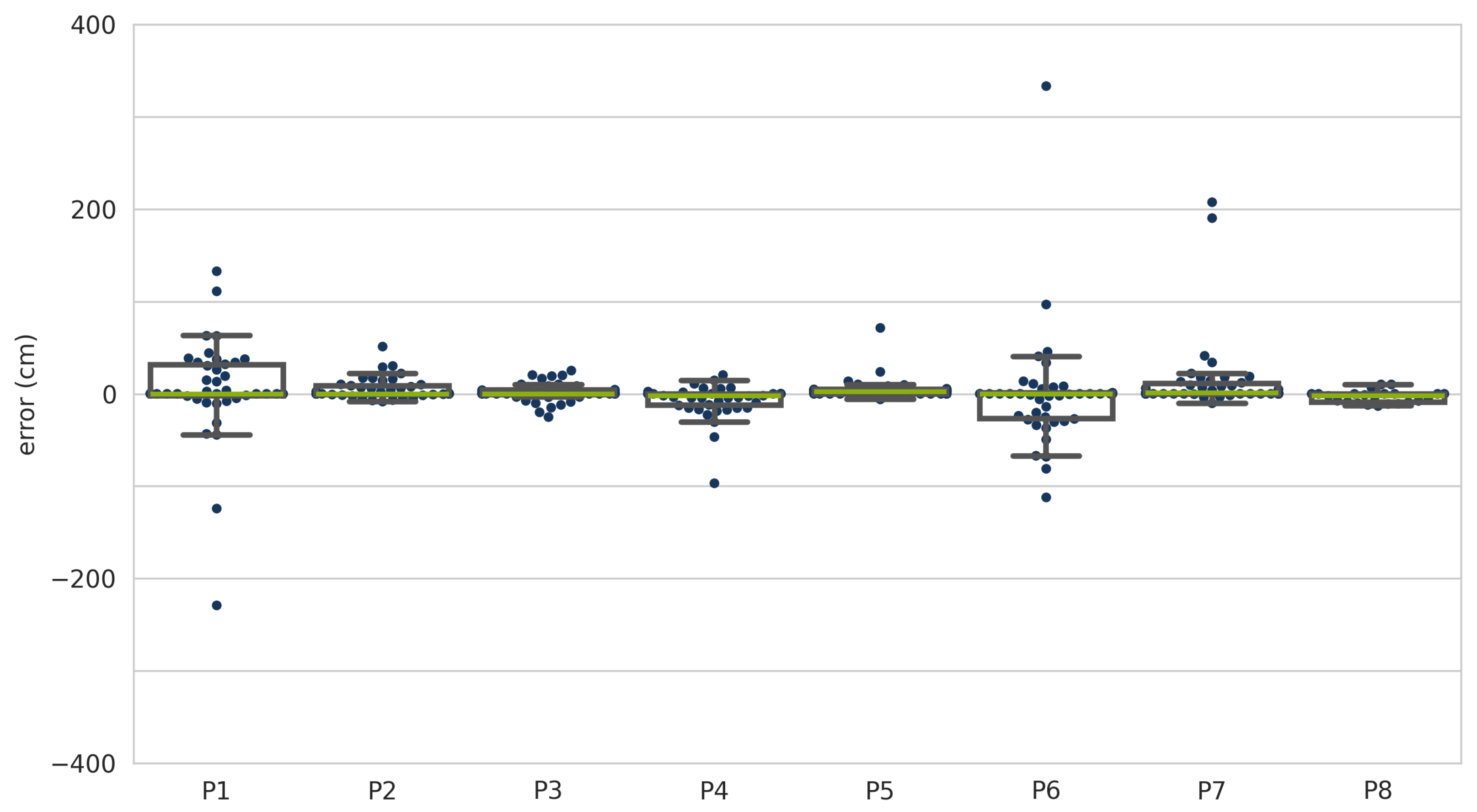


Extracting Geometric Parameters of Bridge Cross-Sections from Drawings Using Machine Learning


Abstract
1. Introduction
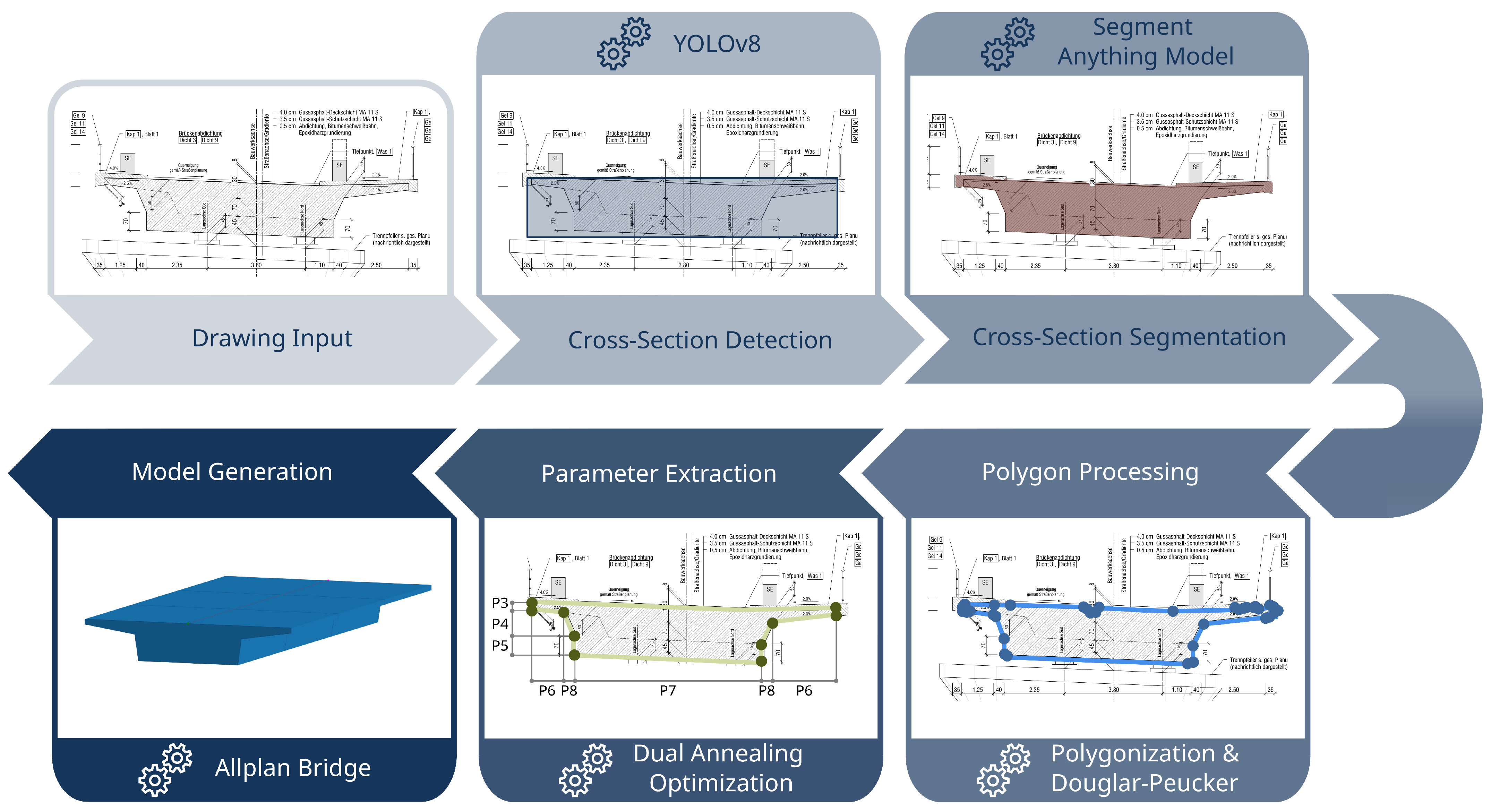
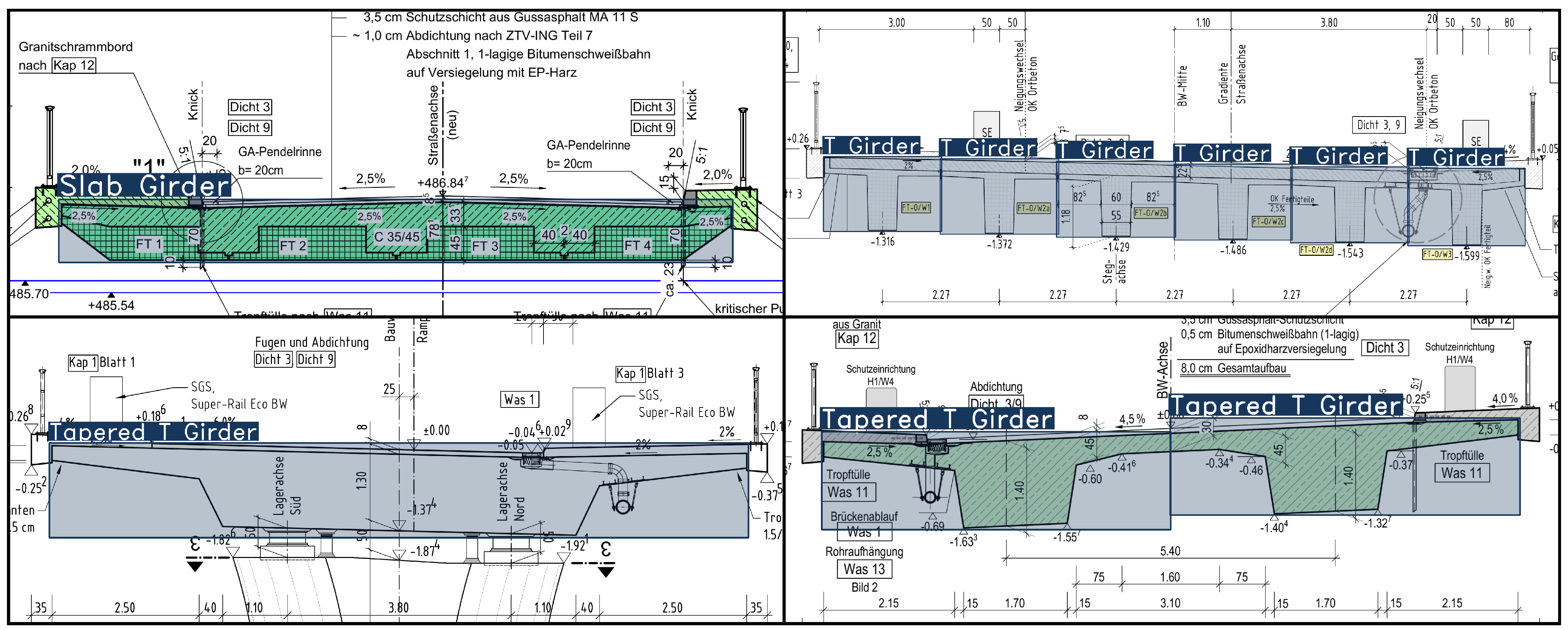
- To extract cross-sections from pixel-based drawings, we introduce an automated pipeline that integrates object detection, segmentation, and parametric templates.
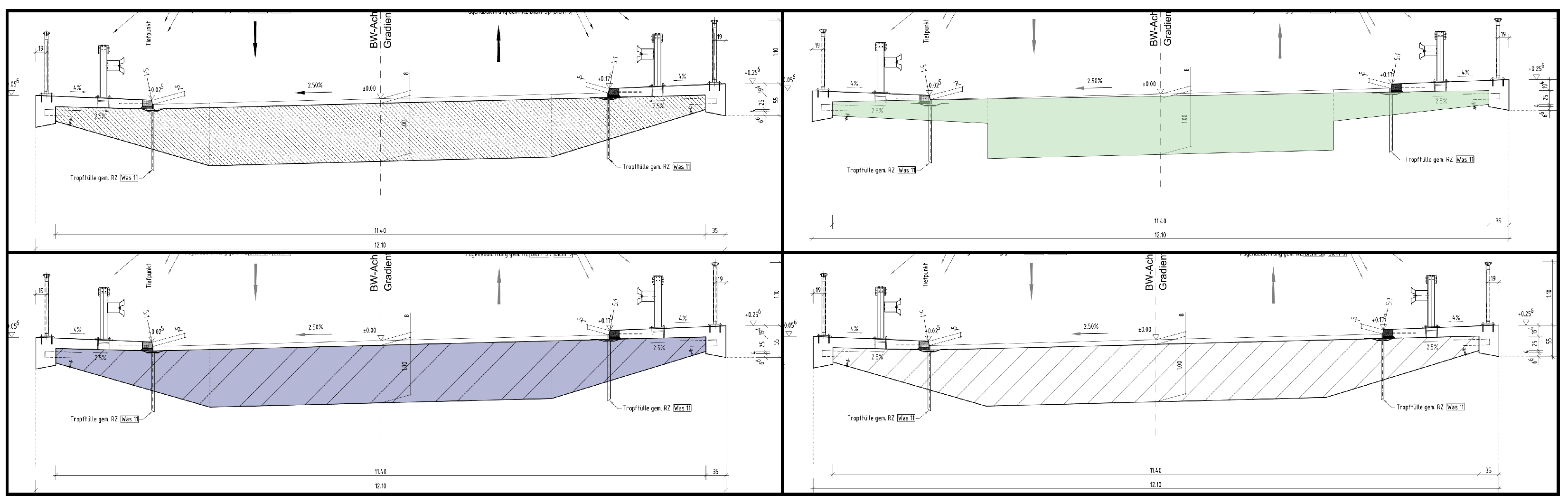
- We propose a semantic segmentation process that is independent of cross-section types and requires no task-specific data or additional model training.
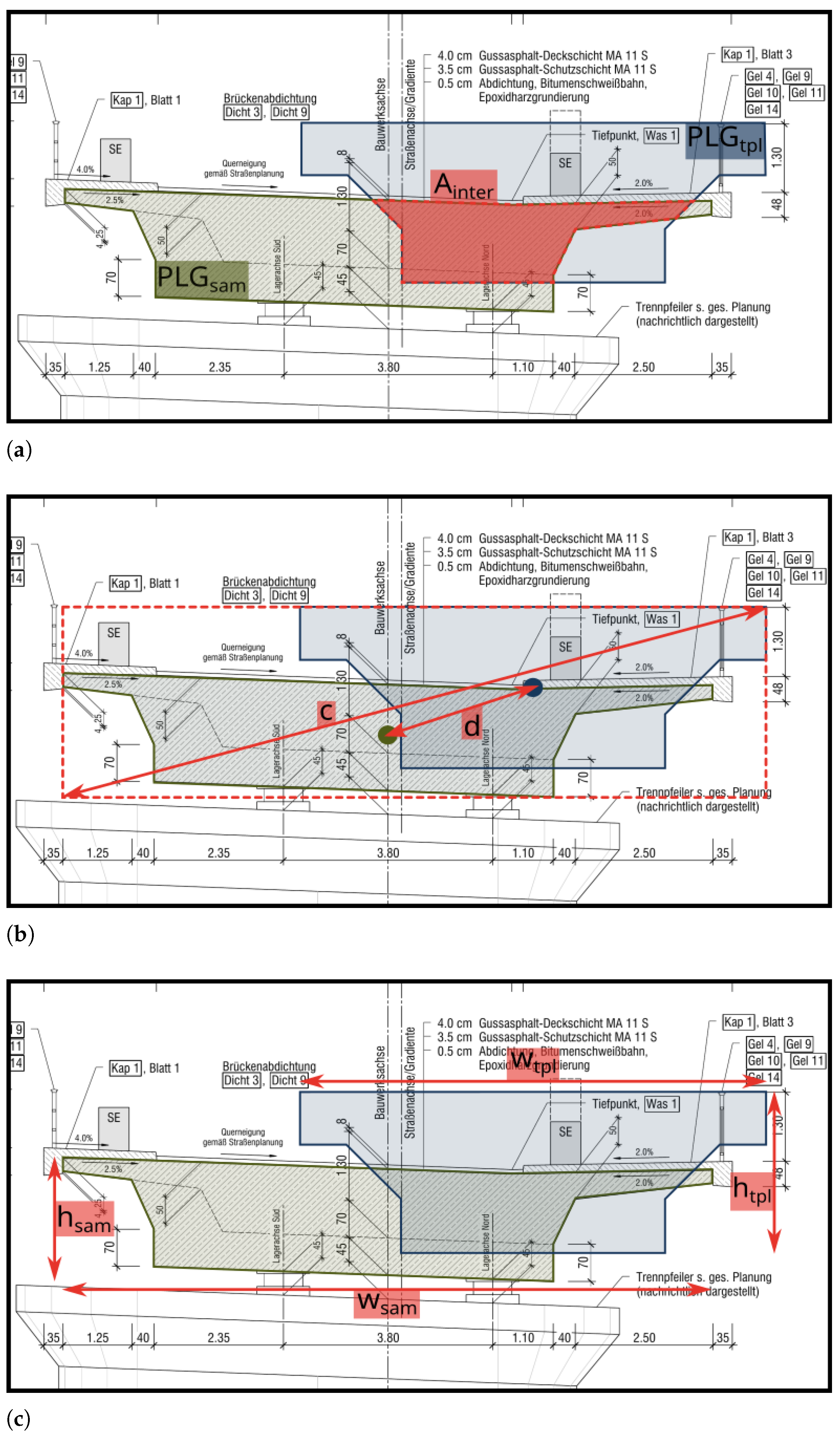
- We define a task-specific loss function that guides the optimization of parametric cross-section templates to accurately fit the extracted masks.
2. Background and Related Literature
2.1. Reconstruction from Drawings
2.2. Parametric Bridge Design
2.3. Research Gaps
- There is a lack of research on bridge reconstruction from drawings, with most existing methods still relying heavily on manual input.
- Current research does not utilize parametric bridge models for drawings, limiting the reuse of reconstruction methods across different bridge types.
3. Methodology
3.1. Cross-Section Detection
3.2. Cross-Section Segmentation
3.3. Polygon Extraction and Processing
3.4. Template-Based Parameter Extraction
3.5. Model Geometry Generation
4. Experiments
4.1. Dataset
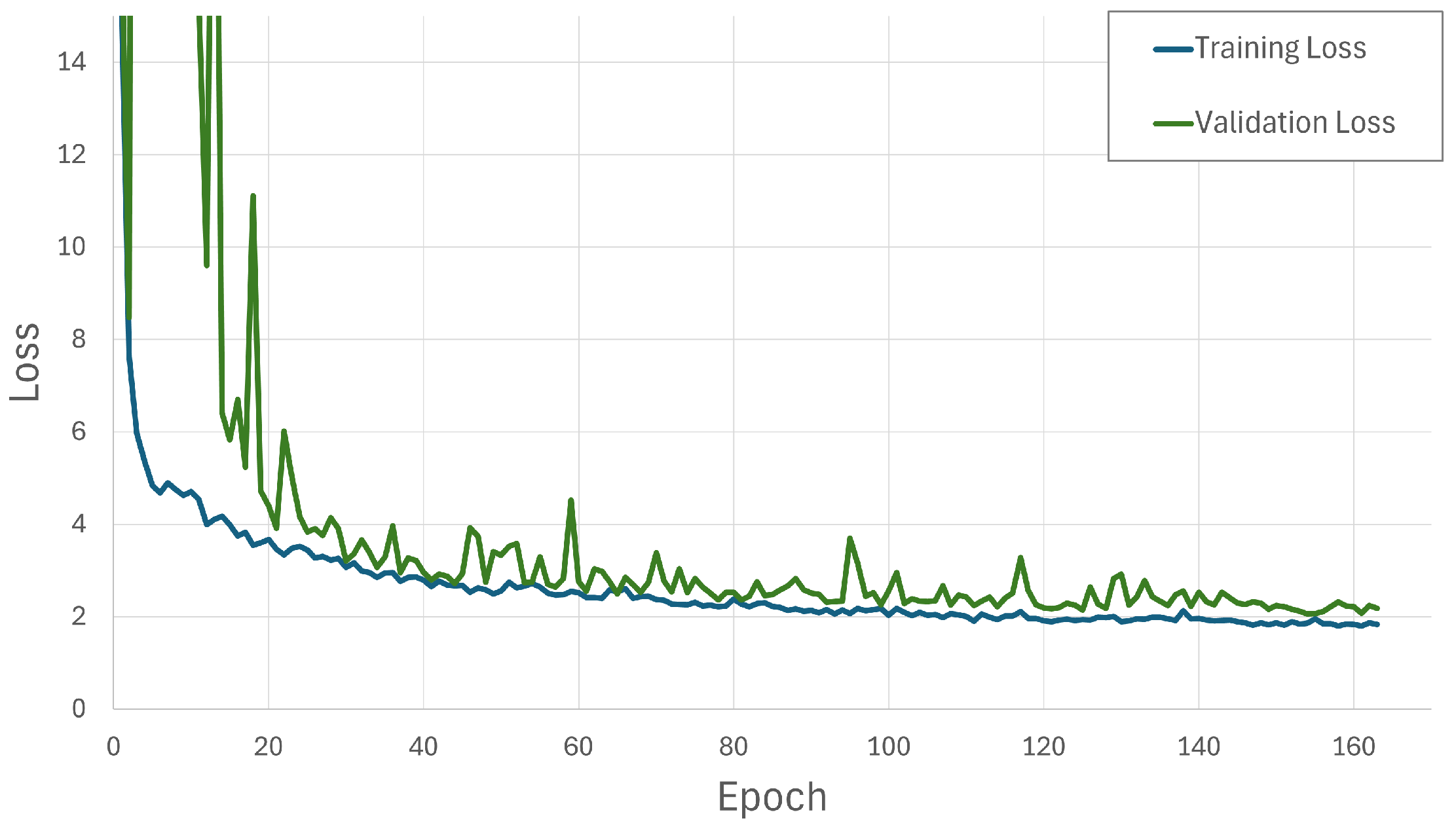
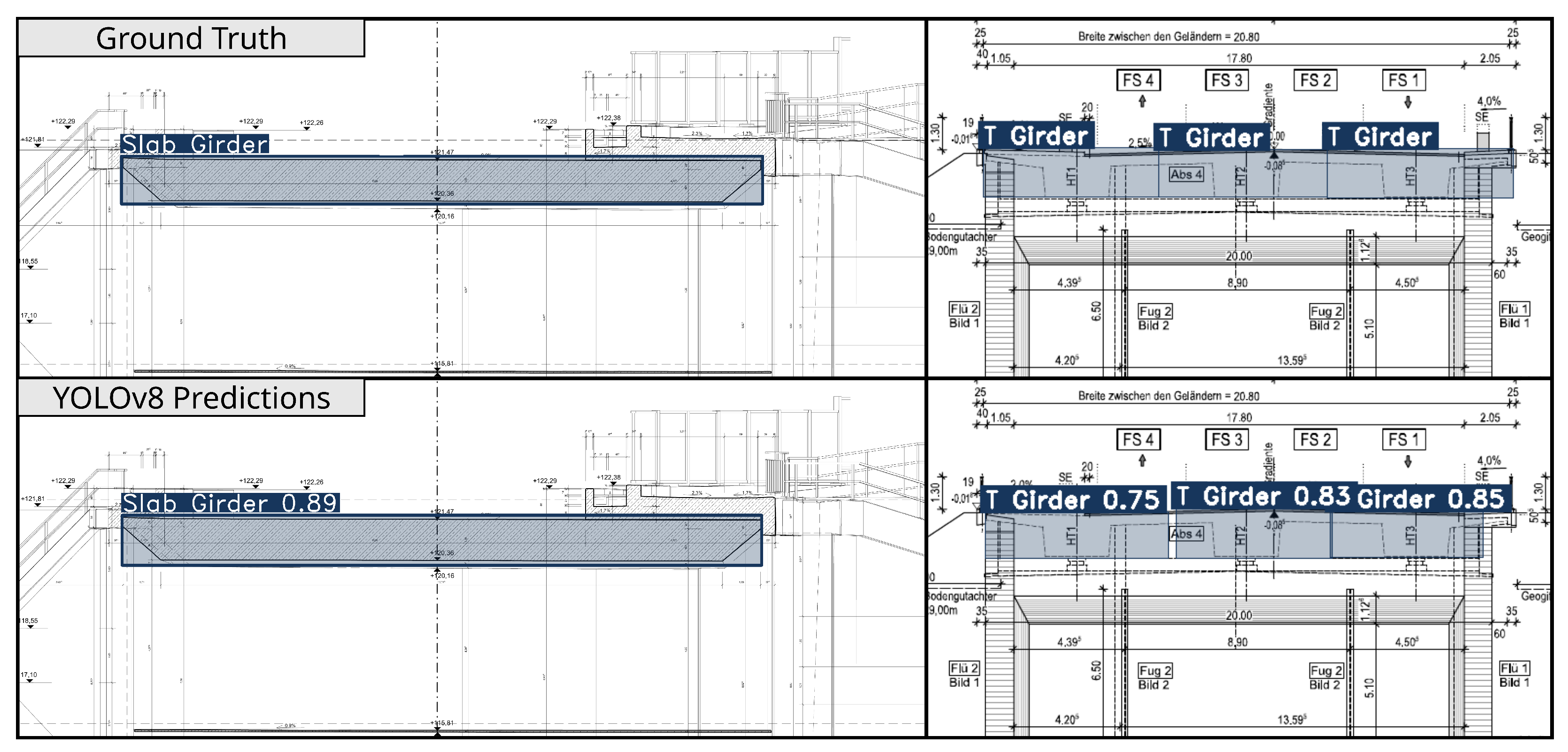
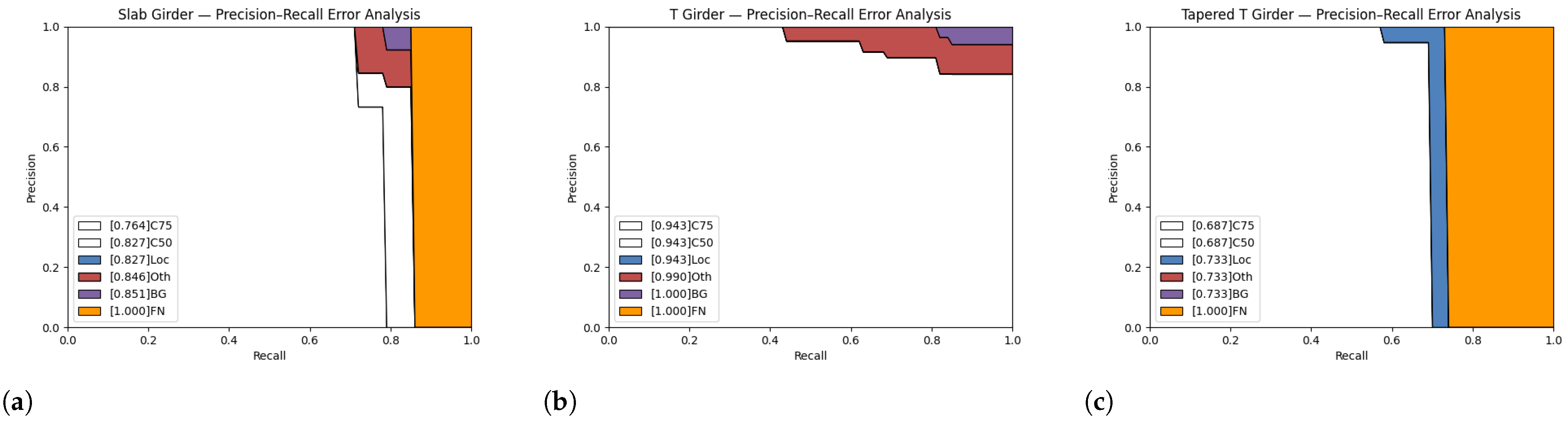
4.2. Detection Results
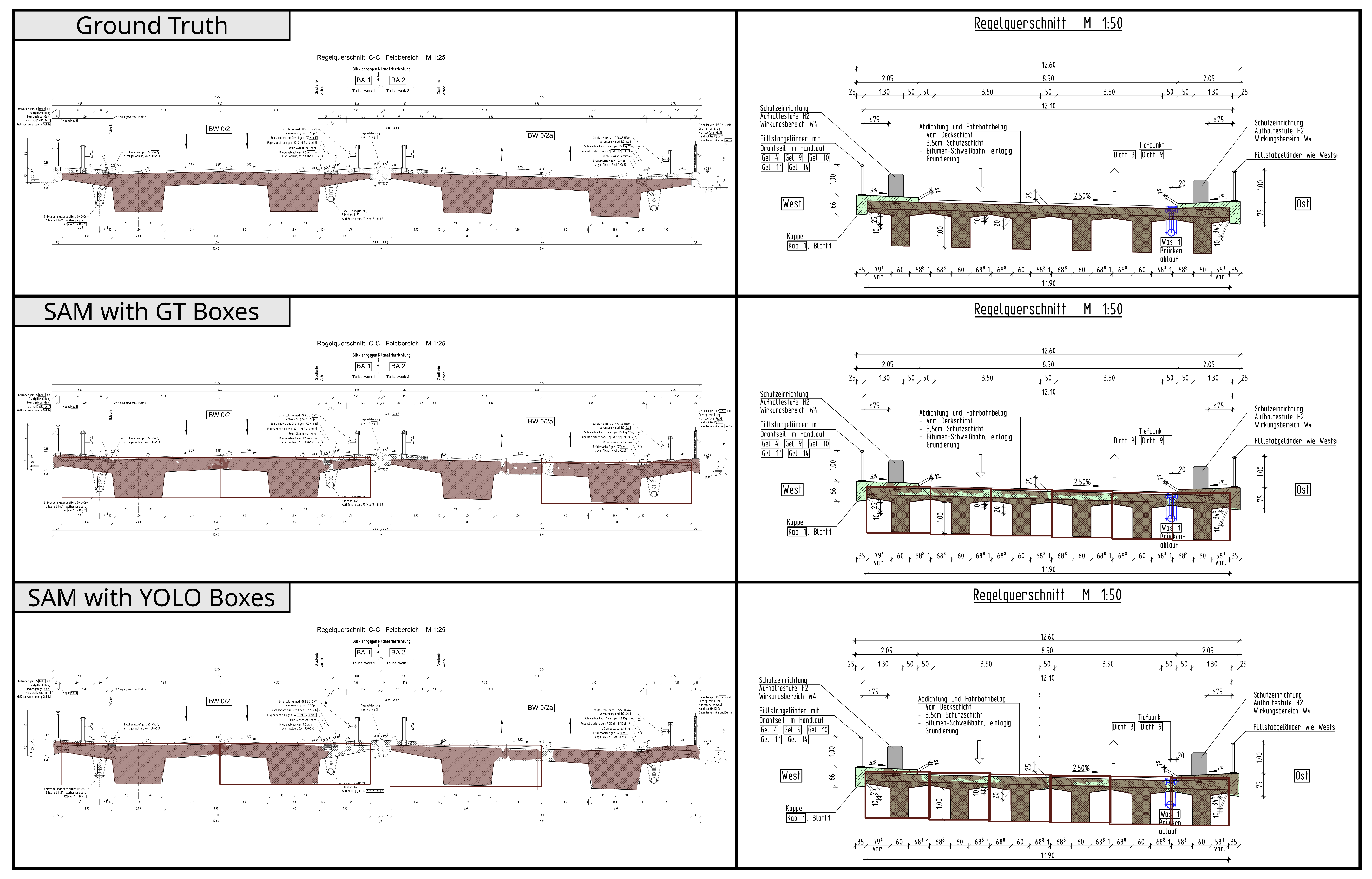
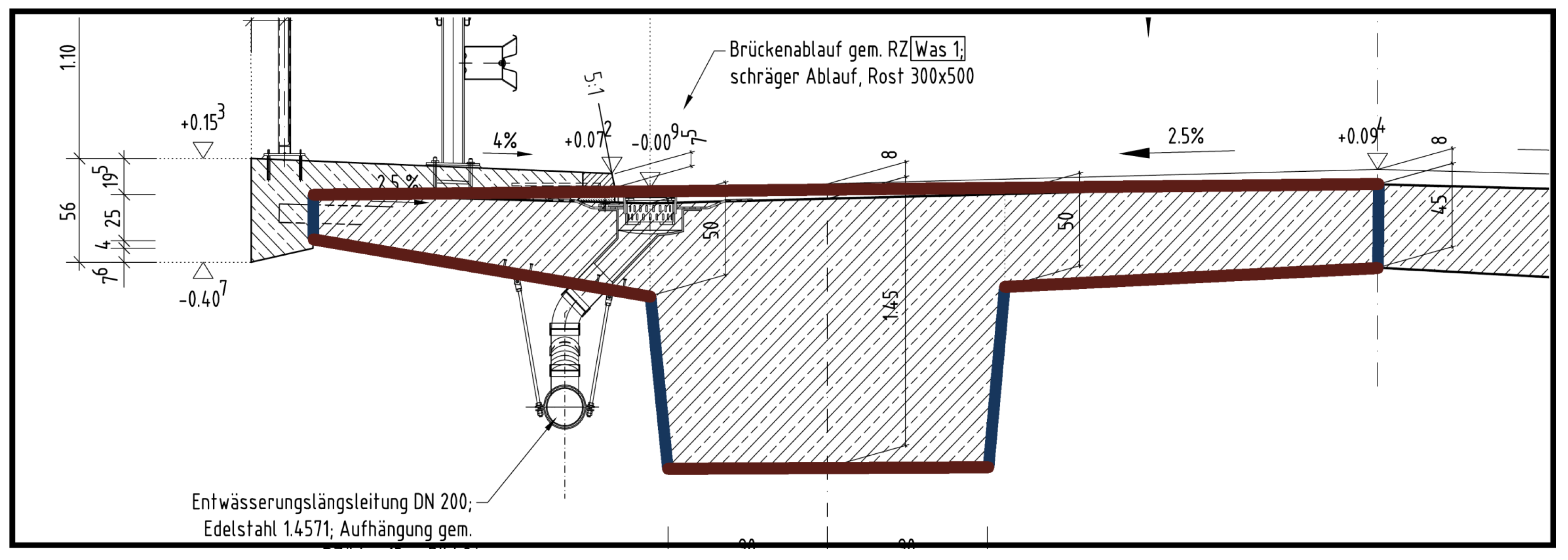
4.3. Object Mask Construction
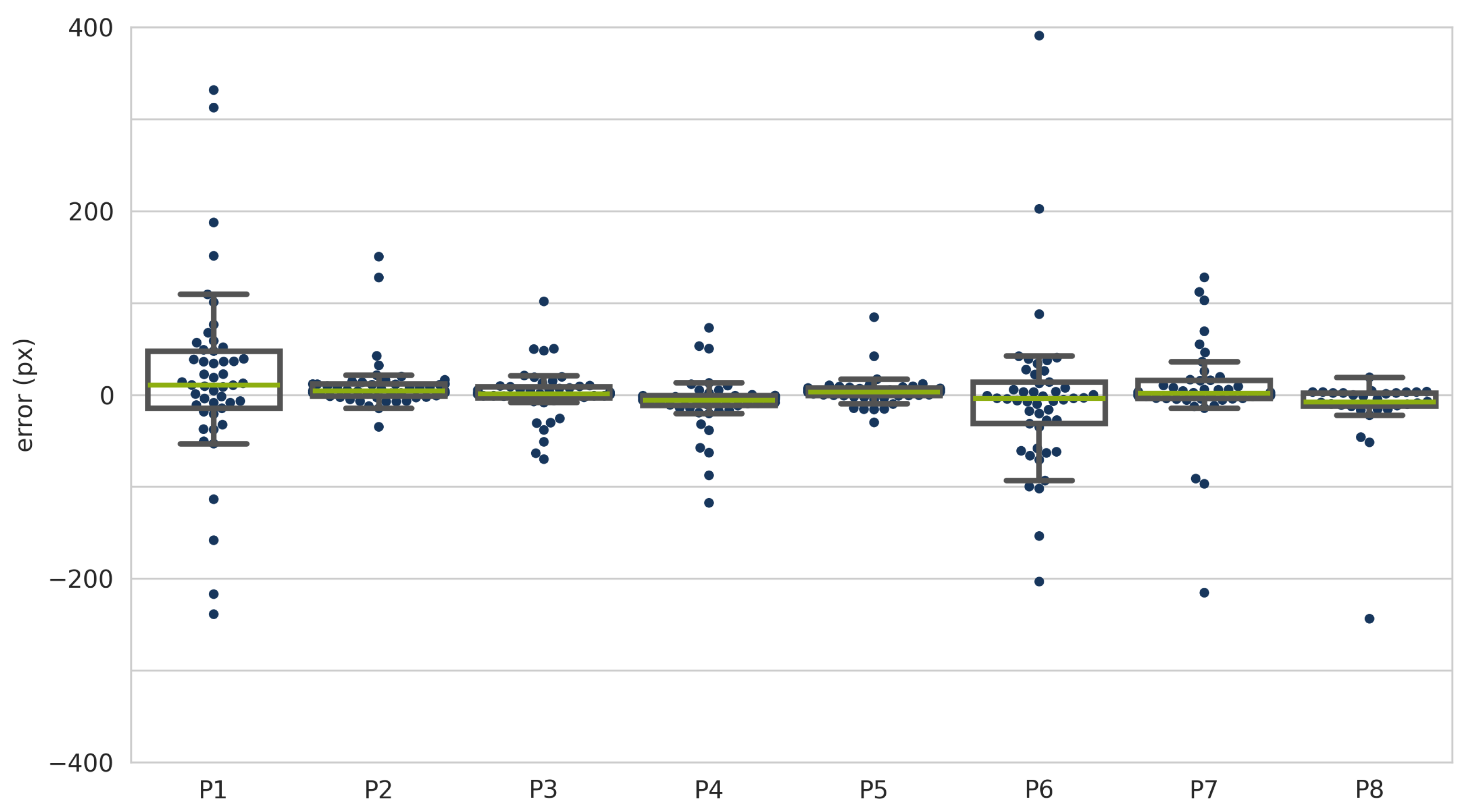
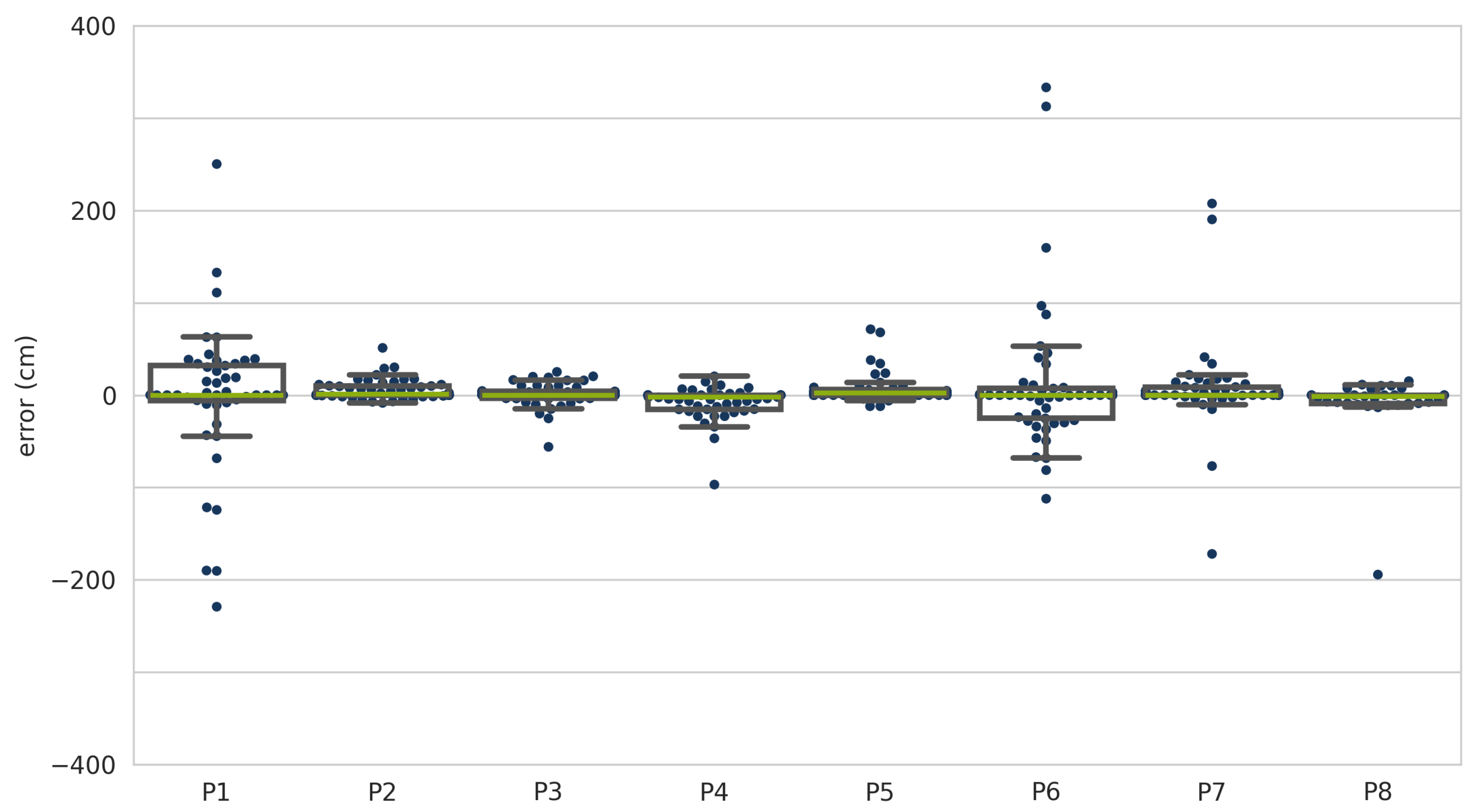
4.4. Parameter Extraction
4.5. Attempts to Enhance Performance
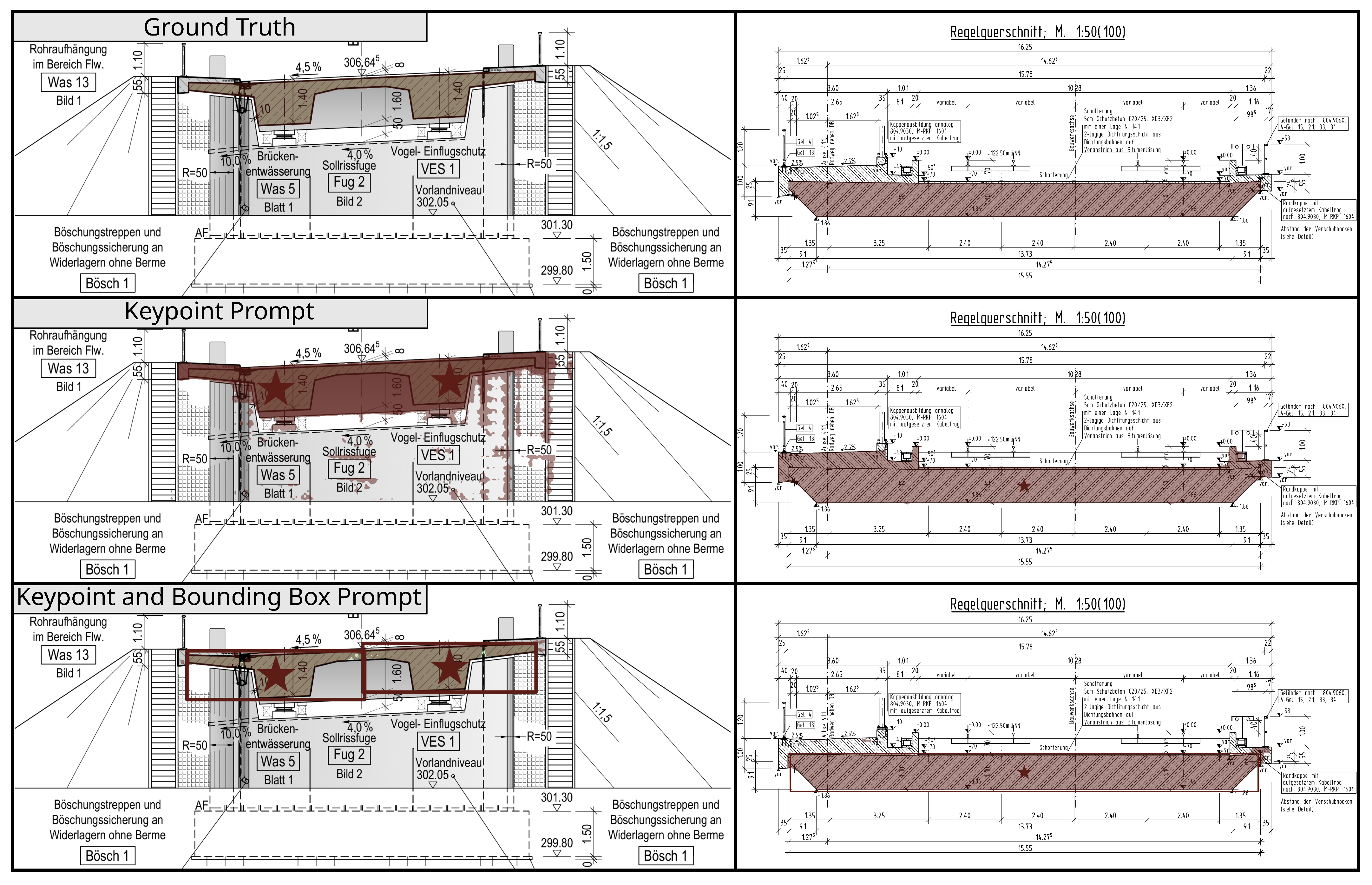
4.5.1. Keypoint-Based Prompting for SAM
4.5.2. Shape-Based Parameter Initialization
4.5.3. Impact of Loss Factors
5. Discussion
5.1. Reflections
5.2. Shortcomings
5.3. Future Work
6. Conclusions
Author Contributions
Funding
Data Availability Statement
Acknowledgments
Conflicts of Interest
Appendix A
| Listing 1: The script variables.tcl contains the extracted parameter values in real-world units. |
| # 0: Slab girder, 1: T-girder or |
| # 2: Tapered T-girder |
| set template_type 2 |
| # Parameters |
| set P3 0.35000 |
| set P4 0.50000 |
| set P5 1.50000 |
| set P6 2.50000 |
| set P7 8.00000 |
| set P8 0.40000 |
| Listing 2: This script uses the parameters provided in variables.tcl to create slab girder cross-section. |
| CSECTIONS BEGIN |
| CSECTION "Slab girder" |
| TEXT "" |
| CVARS BEGIN |
| VAR "P3" $P3 LENGTH "" |
| VAR "P4" $P4 LENGTH "" |
| VAR "P6" $P6 LENGTH "" |
| VAR "P7_h" [expr {$P7/2}] LENGTH "" |
| CVARS END |
| CLINES BEGIN |
| ZAXIS "Zloc" 0.00000 0.00000 |
| YAXIS "Yloc" 0.00000 90.00000 |
| PARALLEL "L1" "P7_h" POS LINE "Yloc" |
| PARALLEL "L2" "P7_h" NEG LINE "Yloc" |
| PARALLEL "L3" "P6" POS LINE "L1" |
| PARALLEL "L4" "P6" NEG LINE "L2" |
| PARALLEL "L7" "P3" NEG LINE "Zloc" |
| PARALLEL "L8" "P4" NEG LINE "L7" |
| CLINES END |
| CBOUNDARIES BEGIN |
| BOUNDARY "Boundary Line 1" |
| POINTS BEGIN |
| BPOINT 1 LSECT "L3" "Zloc" |
| BPOINT 2 LSECT "L4" "Zloc" |
| BPOINT 3 LSECT "L4" "L7" |
| BPOINT 4 LSECT "L2" "L8" |
| BPOINT 5 LSECT "L1" "L8" |
| BPOINT 6 LSECT "L3" "L7" |
| POINTS END |
| BOUNDARY END |
| CBOUNDARIES END |
| CUNITS BEGIN |
| SBEAM 1 LSECT "Zloc" "Yloc" |
| SBEAM 1 BOUNDARY "Boundary Line 1" |
| CUNITS END |
| CSECTION END |
| CSECTIONS END |
| Listing 3: This script uses the parameters provided in variables.tcl to create T-girder cross-section. |
| CSECTIONS BEGIN |
| CSECTION "T-girder" |
| TEXT "" |
| CVARS BEGIN |
| VAR "P3" $P3 LENGTH "" |
| VAR "P4" $P4 LENGTH "" |
| VAR "P5" $P5 LENGTH "" |
| VAR "P6" $P6 LENGTH "" |
| VAR "P7_h" [expr {$P7/2}] LENGTH "" |
| CVARS END |
| CLINES BEGIN |
| ZAXIS "Zloc" 0.00000 0.00000 |
| YAXIS "Yloc" 0.00000 90.00000 |
| PARALLEL "L1" "P7_h" POS LINE "Yloc" |
| PARALLEL "L2" "P7_h" NEG LINE "Yloc" |
| PARALLEL "L3" "P6" POS LINE "L1" |
| PARALLEL "L4" "P6" NEG LINE "L2" |
| PARALLEL "L7" "P3" NEG LINE "Zloc" |
| PARALLEL "L8" "P4" NEG LINE "L7" |
| PARALLEL "L9" "P5" NEG LINE "L8" |
| CLINES END |
| CBOUNDARIES BEGIN |
| BOUNDARY "Boundary Line 1" |
| POINTS BEGIN |
| BPOINT 1 LSECT "L3" "Zloc" |
| BPOINT 2 LSECT "L4" "Zloc" |
| BPOINT 3 LSECT "L4" "L7" |
| BPOINT 4 LSECT "L2" "L8" |
| BPOINT 5 LSECT "L2" "L9" |
| BPOINT 6 LSECT "L1" "L9" |
| BPOINT 7 LSECT "L1" "L8" |
| BPOINT 8 LSECT "L3" "L7" |
| POINTS END |
| BOUNDARY END |
| CBOUNDARIES END |
| CUNITS BEGIN |
| SBEAM 1 LSECT "Zloc" "Yloc" |
| SBEAM 1 BOUNDARY "Boundary Line 1" |
| CUNITS END |
| CSECTION END |
| CSECTIONS END |
| Listing 4: This script uses the parameters provided in variables.tcl to create tapered T-girder cross-section. |
| CSECTIONS BEGIN |
| CSECTION "Tapered T-girder" |
| TEXT "" |
| CVARS BEGIN |
| VAR "P3" $P3 LENGTH "" |
| VAR "P4" $P4 LENGTH "" |
| VAR "P5" $P5 LENGTH "" |
| VAR "P6" $P6 LENGTH "" |
| VAR "P7_h"[expr {$P7/2}] LENGTH "" |
| VAR "P8" $P8 LENGTH "" |
| CVARS END |
| CLINES BEGIN |
| ZAXIS "Zloc" 0.00000 0.00000 |
| YAXIS "Yloc" 0.00000 90.00000 |
| PARALLEL "L1" "P7_h" POS LINE "Yloc" |
| PARALLEL "L2" "P7_h" NEG LINE "Yloc" |
| PARALLEL "L3" "P8" POS LINE "L1" |
| PARALLEL "L4" "P8" NEG LINE "L2" |
| PARALLEL "L5" "P6" POS LINE "L3" |
| PARALLEL "L6" "P6" NEG LINE "L4" |
| PARALLEL "L7" "P3" NEG LINE "Zloc" |
| PARALLEL "L8" "P4" NEG LINE "L7" |
| PARALLEL "L9" "P5" NEG LINE "L8" |
| CLINES END |
| CBOUNDARIES BEGIN |
| BOUNDARY "Boundary Line 1" |
| POINTS BEGIN |
| BPOINT 1 LSECT "L5" "Zloc" |
| BPOINT 2 LSECT "Zloc" "Yloc" |
| BPOINT 3 LSECT "L6" "Zloc" |
| BPOINT 4 LSECT "L6" "L7" |
| BPOINT 5 LSECT "L4" "L8" |
| BPOINT 6 LSECT "L2" "L9" |
| BPOINT 7 LSECT "L9" "Yloc" |
| BPOINT 8 LSECT "L1" "L9" |
| BPOINT 9 LSECT "L3" "L8" |
| BPOINT 10 LSECT "L5" "L7" |
| POINTS END |
| BOUNDARY END |
| CBOUNDARIES END |
| CUNITS BEGIN |
| SBEAM 1 LSECT "Zloc" "Yloc" |
| SBEAM 1 BOUNDARY "Boundary Line 1" |
| CUNITS END |
| CSECTION END |
| CSECTIONS END |
References
- Zhang, Y.; Cheng, L. The Role of Transport Infrastructure in Economic Growth: Empirical Evidence in the UK. Transp. Policy 2023, 133, 223–233. [Google Scholar] [CrossRef] [Scilit]
- American Society of Civil Engineers (ASCE). A Comprehensive Assessment of America’s Infrastructure. 2025. Available online: https://infrastructurereportcard.org/ (accessed on 23 June 2025).
- BASt-Bundesanstalt für Straßen-und Verkehrswesen. Bridge Statistics. 2025. Available online: https://www.bast.de/DE/Ingenieurbau/Fachthemen/brueckenstatistik/bruecken_hidden_node.html (accessed on 23 June 2025).
- Borrmann, A.; König, M.; Koch, C.; Beetz, J. Building Information Modeling: Why? What? How? In Building Information Modeling; Springer International Publishing: Cham, Switzerland, 2018; pp. 1–24. [Google Scholar] [CrossRef] [Scilit]
- Volk, R.; Stengel, J.; Schultmann, F. Building Information Modeling (BIM) for existing buildings—Literature review and future needs. Autom. Constr. 2014, 38, 109–127. [Google Scholar] [CrossRef] [Scilit]
- Khajavi, S.H.; Motlagh, N.H.; Jaribion, A.; Werner, L.C.; Holmstrom, J. Digital Twin: Vision, Benefits, Boundaries, and Creation for Buildings. IEEE Access 2019, 7, 147406–147419. [Google Scholar] [CrossRef] [Scilit]
- Boje, C.; Guerriero, A.; Kubicki, S.; Rezgui, Y. Towards a semantic Construction Digital Twin: Directions for future research. Autom. Constr. 2020, 114, 103179. [Google Scholar] [CrossRef] [Scilit]
- Al-Shalabi, F.A.; Turkan, Y.; Laflamme, S. BrIM implementation for documentation of bridge condition for inspection. In Proceedings of the 5th International/11th Construction Specialty Conference, Vancouver, BC, Canada, 7–10 June 2015; pp. 1–8. [Google Scholar] [CrossRef] [Scilit]
- Saback, V.; Popescu, C.; Blanksvärd, T.; Täljsten, B. Asset Management of Existing Concrete Bridges Using Digital Twins and BIM: A State-of-the-Art Literature Review. Nord. Concr. Res. 2022, 66, 91–111. [Google Scholar] [CrossRef] [Scilit]
- Stipanovic, I.; Palic, S.S.; Casas, J.R.; Chacón, R.; Ganic, E. Inspection and Maintenance KPIs to Support Decision Making Integrated into Digital Twin Tool. ce/papers 2023, 6, 1234–1241. [Google Scholar] [CrossRef] [Scilit]
- Sun, Z.; Liang, B.; Liu, S.; Liu, Z. Data and Knowledge-Driven Bridge Digital Twin Modeling for Smart Operation and Maintenance. Appl. Sci. 2024, 15, 231. [Google Scholar] [CrossRef] [Scilit]
- Costin, A.; Adibfar, A.; Hu, H.; Chen, S.S. Building Information Modeling (BIM) for Transportation Infrastructure—Literature Review, Applications, Challenges, and Recommendations. Autom. Constr. 2018, 94, 257–281. [Google Scholar] [CrossRef] [Scilit]
- Byun, N.; Han, W.S.; Kwon, Y.W.; Kang, Y.J. Development of BIM-Based Bridge Maintenance System Considering Maintenance Data Schema and Information System. Sustainability 2021, 13, 4858. [Google Scholar] [CrossRef] [Scilit]
- Jiang, F.; Ma, L.; Broyd, T.; Chen, K. Digital Twin and Its Implementations in the Civil Engineering Sector. Autom. Constr. 2021, 130, 103838. [Google Scholar] [CrossRef] [Scilit]
- Xu, Y.; Turkan, Y. BrIM and UAS for Bridge Inspections and Management. Eng. Constr. Archit. Manag. 2019, 27, 785–807. [Google Scholar] [CrossRef] [Scilit]
- Lu, R.; Brilakis, I. Digital Twinning of Existing Reinforced Concrete Bridges from Labelled Point Clusters. Autom. Constr. 2019, 105, 102837. [Google Scholar] [CrossRef] [Scilit]
- Schönfelder, P.; Aziz, A.; Faltin, B.; König, M. Automating the retrospective generation of As-is BIM models using machine learning. Autom. Constr. 2023, 152, 104937. [Google Scholar] [CrossRef] [Scilit]
- Rashidi, M.; Mohammadi, M.; Sadeghlou Kivi, S.; Abdolvand, M.M.; Truong-Hong, L.; Samali, B. A Decade of Modern Bridge Monitoring Using Terrestrial Laser Scanning: Review and Future Directions. Remote Sens. 2020, 12, 3796. [Google Scholar] [CrossRef] [Scilit]
- Qin, G.; Zhou, Y.; Hu, K.; Han, D.; Ying, C. Automated Reconstruction of Parametric BIM for Bridge Based on Terrestrial Laser Scanning Data. Adv. Civ. Eng. 2021, 2021, 8899323. [Google Scholar] [CrossRef] [Scilit]
- Wang, Q.; Tan, Y.; Mei, Z. Computational Methods of Acquisition and Processing of 3D Point Cloud Data for Construction Applications. Arch. Comput. Methods Eng. 2020, 27, 479–499. [Google Scholar] [CrossRef] [Scilit]
- Schatz, Y.; Domer, B. 7Semi-Automated Creation of IFC Bridge Models from Point Clouds for Maintenance Applications 0. Front. Built Environ. 2024, 10, 1375873. [Google Scholar] [CrossRef] [Scilit]
- Xu, Y.; Stilla, U. Toward Building and Civil Infrastructure Reconstruction From Point Clouds: A Review on Data and Key Techniques. IEEE J. Sel. Top. Appl. Earth Obs. Remote Sens. 2021, 14, 2857–2885. [Google Scholar] [CrossRef] [Scilit]
- Byun, Y.; Sohn, B.S. ABGS: A System for the Automatic Generation of Building Information Models from Two-Dimensional CAD Drawings. Sustainability 2020, 12, 6713. [Google Scholar] [CrossRef] [Scilit]
- Lin, S.; Duan, L.; Jiang, B.; Liu, J.; Guo, H.; Zhao, J. Scan vs. BIM: Automated Geometry Detection and BIM Updating of Steel Framing through Laser Scanning. Autom. Constr. 2025, 170, 105931. [Google Scholar] [CrossRef] [Scilit]
- Faltin, B.; Schönfelder, P.; Gann, D.; König, M. Reconstructing As-Built Beam Bridge Geometry from Construction Drawings Using Deep Learning-Based Symbol Pose Estimation. Adv. Eng. Informatics 2024, 62, 102808. [Google Scholar] [CrossRef] [Scilit]
- Pizarro, P.N.; Hitschfeld, N.; Sipiran, I.; Saavedra, J.M. Automatic Floor Plan Analysis and Recognition. Autom. Constr. 2022, 140, 104348. [Google Scholar] [CrossRef] [Scilit]
- Akanbi, T.; Zhang, J. Framework for Developing IFC-Based 3D Documentation from 2D Bridge Drawings. J. Comput. Civ. Eng. 2022, 36, 04021031. [Google Scholar] [CrossRef] [Scilit]
- Akanbi, T.; Zhang, J. Semi-automated generation of 3D bridge models from 2D PDF bridge drawings. In Proceedings of the Construction Research Congress, Arlington, Virginia, 9–12 March 2022; pp. 1347–1354. [Google Scholar] [CrossRef] [Scilit]
- Akanbi, T.; Zhang, J. Erratum for “Framework for Developing IFC-Based 3D Documentation from 2D Bridge Drawings” by Temitope Akanbi and Jiansong Zhang. J. Comput. Civ. Eng. 2022, 36, 08222001. [Google Scholar] [CrossRef] [Scilit]
- Poku-Agyemang, K.N.; Reiterer, A. 3D Reconstruction from 2D Plans Exemplified by Bridge Structures. Remote Sens. 2023, 15, 677. [Google Scholar] [CrossRef] [Scilit]
- Li, H.; Yang, F.; Zhang, J. IFC-Based Semantic Segmentation and Semantic Enrichment of BIM for Bridges. In Proceedings of the Construction Research Congress 2024, Des Moines, Iowa, 20–23 March 2024; pp. 597–606. [Google Scholar] [CrossRef] [Scilit]
- Gölzhäuser, P.; Peng, M.; Jäkel, J.I.; Klemt-Albert, K.; Marx, S. Approach to Generate a Simple Semantic Data Model from 2D Bridge Plans Using AI-based Text Recognition. In Proceedings of the 33rd European Safety and Reliability Conference, Southampton, UK, 3–7 September 2023; pp. 3006–3013. [Google Scholar] [CrossRef] [Scilit]
- Mafipour, M.S.; Ahmed, D.; Vilgertshofer, S.; Borrmann, A. Digitalization of 2D bridge drawings using deep learning models. In Proceedings of the 30th Int. Conference on Intelligent Computing in Engineering (EG-ICE), London, UK, 4–7 July 2023. [Google Scholar]
- Feist, S.; Jacques De Sousa, L.; Sanhudo, L.; Poças Martins, J. Automatic Reconstruction of 3D Models from 2D Drawings: A State-of-the-Art Review. Eng 2024, 5, 784–800. [Google Scholar] [CrossRef] [Scilit]
- Wang, W.; Dong, S.; Zou, K.; Li, W.s. Room Classification in Floor Plan Recognition. In Proceedings of the 4th International Conference on Advances in Image Processing, Sanya, China, 1–3 January 2021; pp. 48–54. [Google Scholar] [CrossRef] [Scilit]
- Zhang, Y.; Zhu, M.; Zhang, Q.; Shen, T.; Zhang, B. An Approach of Line Vectorization of Engineering Drawings Based on Semantic Segmentation. In Proceedings of the 2022 IEEE 17th Conference on Industrial Electronics and Applications (ICIEA), Chengdu, China, 16–19 December 2022; pp. 1447–1453. [Google Scholar] [CrossRef] [Scilit]
- Zhang, W.; Joseph, J.; Yin, Y.; Xie, L.; Furuhata, T.; Yamakawa, S.; Shimada, K.; Kara, L.B.; Guo, T.; Liu, Y. Component Segmentation of Engineering Drawings Using Graph Convolutional Networks. Comput. Ind. 2023, 147, 103885. [Google Scholar] [CrossRef] [Scilit]
- Xing, J.; Wu, L.; Zeng, T.; Wu, Y.; Shang, J. Comprehensive Floor Plan Vectorization with Sparse Point Set Representation. Autom. Constr. 2025, 173, 106023. [Google Scholar] [CrossRef] [Scilit]
- Schönfelder, P.; Aziz, A.; Bosché, F.; König, M. Enriching BIM Models with Fire Safety Equipment Using Keypoint-Based Symbol Detection in Escape Plans. Autom. Constr. 2024, 162, 105382. [Google Scholar] [CrossRef] [Scilit]
- Wu, Y.; Shang, J.; Chen, P.; Zlatanova, S.; Hu, X.; Zhou, Z. Indoor Mapping and Modeling by Parsing Floor Plan Images. Int. J. Geogr. Inf. Sci. 2021, 35, 1205–1231. [Google Scholar] [CrossRef] [Scilit]
- Urbieta, M.; Urbieta, M.; Laborde, T.; Villarreal, G.; Rossi, G. Generating BIM Model from Structural and Architectural Plans Using Artificial Intelligence. J. Build. Eng. 2023, 78, 107672. [Google Scholar] [CrossRef] [Scilit]
- Yamasaki, T.; Zhang, J.; Takada, Y. Apartment Structure Estimation Using Fully Convolutional Networks and Graph Model. In Proceedings of the 2018 ACM Workshop on Multimedia for Real Estate Tech, Yokohama, Japan, 11 June 2018; pp. 1–6. [Google Scholar] [CrossRef] [Scilit]
- Jang, H.; Yu, K.; Yang, J. Indoor Reconstruction from Floorplan Images with a Deep Learning Approach. ISPRS Int. J. Geo-Inf. 2020, 9, 65. [Google Scholar] [CrossRef] [Scilit]
- Zeng, Z.; Li, X.; Yu, Y.K.; Fu, C.W. Deep Floor Plan Recognition Using a Multi-Task Network With Room-Boundary-Guided Attention. In Proceedings of the IEEE/CVF International Conference on Computer Vision (ICCV), Seoul, Republic of Korea, 27 October–2 November 2019; pp. 9095–9103. [Google Scholar] [CrossRef] [Scilit]
- Upadhyay, A.; Dubey, A.; Kuriakose, S.M. FPNet: Deep Attention Network for Automated Floor Plan Analysis. In Proceedings of the Document Analysis and Recognition—ICDAR 2023 Workshops, San José, CA, USA, 24–26 August 2023; Volume 14193, pp. 163–176. [Google Scholar] [CrossRef] [Scilit]
- Dodge, S.; Xu, J.; Stenger, B. Parsing Floor Plan Images. In Proceedings of the Fifteenth IAPR International Conference on Machine Vision Applications (MVA), Nagoya, Japan, 8–12 May 2017; pp. 358–361. [Google Scholar] [CrossRef] [Scilit]
- Lv, X.; Zhao, S.; Yu, X.; Zhao, B. Residential Floor Plan Recognition and Reconstruction. In Proceedings of the 2021 IEEE/CVF Conference on Computer Vision and Pattern Recognition (CVPR), Nashville, TN, USA, 20–21 June 2021; pp. 16712–16721. [Google Scholar] [CrossRef] [Scilit]
- Surikov, I.Y.; Nakhatovich, M.A.; Belyaev, S.Y.; Savchuk, D.A. Floor Plan Recognition and Vectorization Using Combination UNet, Faster-RCNN, Statistical Component Analysis and Ramer-Douglas-Peucker. In Proceedings of the Computing Science, Communication and Security, Gujarat, India, 26–27 March 2020; Volume 1235, pp. 16–28. [Google Scholar] [CrossRef] [Scilit]
- Anderl, R.; Mendgen, R. Parametric Design and Its Impact on Solid Modeling Applications. In Proceedings of the Third ACM Symposium on Solid Modeling and Applications, Salt Lake City, UT, USA, 17–19 May 1995; pp. 1–12. [Google Scholar] [CrossRef] [Scilit]
- Monedero, J. Parametric Design: A Review and Some Experiences. Autom. Constr. 2000, 9, 369–377. [Google Scholar] [CrossRef] [Scilit]
- Lin, V.C.; Gossard, D.C.; Light, R.A. Variational geometry in computer-aided design. Comput. Graph. 1981, 15, 171–177. [Google Scholar] [CrossRef] [Scilit]
- Shah, J.J. Designing with Parametric CAD: Classification and comparison of construction techniques. In Proceedings of the International Workshop on Geometric Modelling, Tokyo, Japan, 7–9 December 1998; pp. 53–68. [Google Scholar]
- Burry, M. Parametric Design and the Sagrada Familia. Archit. Res. Q. 1996, 1, 70–81. [Google Scholar] [CrossRef] [Scilit]
- Mitossi, V.; Koutamanis, A. Parametric design of stairs. In Proceedings of the 3rd Design and Decision Support Systems in Architecture and Urban Planning Conference. Part One: Architecture Proceedings, Spa, Belgium, 18-21 August 1996. [Google Scholar]
- Havemann, S.; Fellner, D. Generative Parametric Design of Gothic Window Tracery. In Proceedings of the Shape Modeling Applications, Genova, Italy, 7–9 June 2004; pp. 350–353. [Google Scholar] [CrossRef] [Scilit]
- Park, S.M.; Elnimeiri, M.; Sharpe, D.C.; Krawczyk, R.J. Tall Building Form Generation by Parametric Design Process. In Proceedings of the CTBUH 2004 Seoul Conference, Seoul, Republic of Korea, 10–13 October 2004; pp. 10–13. [Google Scholar]
- Steinø, N.; Veirum, N.E. A Parametric Approach to Urban Design. In Proceedings of the eCAADe 2005: Digital Design: The Quest for New Paradigms, Lisbon, Portugal, 21–24 September 2005; pp. 679–686. [Google Scholar] [CrossRef] [Scilit]
- Zeng, X.; Tan, J. Building Information Modeling Based on Intelligent Parametric Technology. Front. Archit. Civ. Eng. China 2007, 1, 367–370. [Google Scholar] [CrossRef] [Scilit]
- Santos, R.; Costa, A.A.; Grilo, A. Bibliometric Analysis and Review of Building Information Modelling Literature Published between 2005 and 2015. Autom. Constr. 2017, 80, 118–136. [Google Scholar] [CrossRef] [Scilit]
- Goli, A.; Alaghmandan, M.; Barazandeh, F. Parametric Structural Topology Optimization of High-Rise Buildings Considering Wind and Gravity Loads. J. Archit. Eng. 2021, 27, 04021038. [Google Scholar] [CrossRef] [Scilit]
- Gan, V.J.; Wong, C.; Tse, K.; Cheng, J.C.; Lo, I.M.; Chan, C. Parametric Modelling and Evolutionary Optimization for Cost-Optimal and Low-Carbon Design of High-Rise Reinforced Concrete Buildings. Adv. Eng. Informatics 2019, 42, 100962. [Google Scholar] [CrossRef] [Scilit]
- Hollberg, A.; Ruth, J. LCA in Architectural Design—a Parametric Approach. Int. J. Life Cycle Assess. 2016, 21, 943–960. [Google Scholar] [CrossRef] [Scilit]
- Tam, V.W.; Zhou, Y.; Illankoon, C.; Le, K.N. A Critical Review on BIM and LCA Integration Using the ISO 14040 Framework. Build. Environ. 2022, 213, 108865. [Google Scholar] [CrossRef] [Scilit]
- Touloupaki, E.; Theodosiou, T. Optimization of Building Form to Minimize Energy Consumption through Parametric Modelling. Procedia Environ. Sci. 2017, 38, 509–514. [Google Scholar] [CrossRef] [Scilit]
- Girardet, A.; Boton, C. A Parametric BIM Approach to Foster Bridge Project Design and Analysis. Autom. Constr. 2021, 126, 103679. [Google Scholar] [CrossRef] [Scilit]
- Khoshamadi, N.; Banihashemi, S.; Poshdar, M.; Abbasianjahromi, H.; Tabadkani, A.; Hajirasouli, A. Parametric and Generative Mechanisms for Infrastructure Projects. Autom. Constr. 2023, 154, 104968. [Google Scholar] [CrossRef] [Scilit]
- Wu, S.; Ramli, M.Z.; Ngian, S.P.; Qiao, G.; Jiang, B. Review on Parametric Building Information Modelling and Forward Design Approaches for Sustainable Bridge Engineering. Discov. Appl. Sci. 2025, 7, 127. [Google Scholar] [CrossRef] [Scilit]
- Yalcinkaya, M.; Singh, V. Patterns and Trends in Building Information Modeling (BIM) Research: A Latent Semantic Analysis. Autom. Constr. 2015, 59, 68–80. [Google Scholar] [CrossRef] [Scilit]
- Jäkel, J.I.; Heinlein, E.; Gölzhäuser, P.; Kellner, M.; Klemt-Albert, K.; Reiterer, A. How to Digitise Bridge Structures—A Systematic Review of the Status Quo for Creating Digital BIM Models of Existing Bridge Structures in the Operational Phase. Infrastructures 2025, 10, 47. [Google Scholar] [CrossRef] [Scilit]
- Hu, F.; Zhao, J.; Huang, Y.; Li, H. Structure-aware 3D Reconstruction for Cable-stayed Bridges: A Learning-based Method. Comput.-Aided Civ. Infrastruct. Eng. 2021, 36, 89–108. [Google Scholar] [CrossRef] [Scilit]
- Lee, J.H.; Park, J.J.; Yoon, H. Automatic Bridge Design Parameter Extraction for Scan-to-BIM. Appl. Sci. 2020, 10, 7346. [Google Scholar] [CrossRef] [Scilit]
- Hu, K.; Han, D.; Qin, G.; Zhou, Y.; Chen, L.; Ying, C.; Guo, T.; Liu, Y. Semi-Automated Generation of Geometric Digital Twin for Bridge Based on Terrestrial Laser Scanning Data. Adv. Civ. Eng. 2023, 2023, 6192001. [Google Scholar] [CrossRef] [Scilit]
- Mafipour, M.S.; Vilgertshofer, S.; Borrmann, A. Automated Geometric Digital Twinning of Bridges from Segmented Point Clouds by Parametric Prototype Models. Autom. Constr. 2023, 156, 105101. [Google Scholar] [CrossRef] [Scilit]
- Mafipour, M.S.; Vilgertshofer, S.; Borrmann, A. Deriving Digital Twin Models of Existing Bridges from Point Cloud Data Using Parametric Models and Metaheuristic Algorithms. In Proceedings of the EG-ICE 2021 Workshop on Intelligent Computing in Engineering, Berlin, Germany, 30 June–2 July 2021; Volume 464. [Google Scholar]
- Mafipour, M.S.; Vilgertshofer, S.; Borrmann, A. Creating Digital Twins of Existing Bridges through AI-based Methods. In Proceedings of the IABSE Symposium, Prague 2022: Challenges for Existing and Oncoming Structures, Prague, Czech Republic, 25–27 May 2022; pp. 727–734. [Google Scholar] [CrossRef] [Scilit]
- Peng, M.; Cui, A.; Kang, C.; Marx, S. Main Title: AI-Based Extraction and Management of Text and View Information from 2D Bridge Engineering Drawings. In Proceedings of the EG-ICE 2025: International Workshop on Intelligent Computing in Engineering, Glasgow, UK, 1–3 July 2025. [Google Scholar] [CrossRef]
- Faltin, B. Zenodo, Version 2.0; RUB CrossSectAI: Bochum, Germany, 2025.
- Redmon, J.; Divvala, S.; Girshick, R.; Farhadi, A. You Only Look Once: Unified, Real-Time Object Detection. In Proceedings of the 2016 IEEE Conference on Computer Vision and Pattern Recognition (CVPR), Las Vegas, NV, USA, 27–30 June 2016; pp. 779–788. [Google Scholar] [CrossRef] [Scilit]
- Redmon, J.; Farhadi, A. YOLO9000: Better, Faster, Stronger. In Proceedings of the 2017 IEEE Conference on Computer Vision and Pattern Recognition (CVPR), Honolulu, HI, USA, 21–26 July 2017; pp. 6517–6525. [Google Scholar] [CrossRef] [Scilit]
- Bochkovskiy, A.; Wang, C.Y.; Liao, H.Y.M. YOLOv4: Optimal Speed and Accuracy of Object Detection. arXiv 2020. [Google Scholar] [CrossRef] [Scilit]
- Wang, C.Y.; Bochkovskiy, A.; Liao, H.Y.M. YOLOv7: Trainable Bag-of-Freebies Sets New State-of-the-Art for Real-Time Object Detectors. arXiv 2022. [Google Scholar] [CrossRef] [Scilit]
- Yaseen, M. What Is YOLOv8: An In-Depth Exploration of the Internal Features of the Next-Generation Object Detector. arXiv 2024. [Google Scholar] [CrossRef] [Scilit]
- Vilgertshofer, S.; Stoitchkov, D.; Borrmann, A.; Menter, A.; Genc, C. Recognising Railway Infrastructure Elements in Videos and Drawings Using Neural Networks. Proc. Inst. Civ. Eng. Smart Infrastruct. Constr. 2019, 172, 19–33. [Google Scholar] [CrossRef] [Scilit]
- Rezvanifar, A.; Cote, M.; Albu, A.B. Symbol Spotting on Digital Architectural Floor Plans Using a Deep Learning-based Framework. In Proceedings of the 2020 IEEE/CVF Conference on Computer Vision and Pattern Recognition Workshops (CVPRW), Seattle, WA, USA, 14–19 June 2020; pp. 568–569. [Google Scholar] [CrossRef] [Scilit]
- Gupta, M.; Wei, C.; Czerniawski, T. Automated Valve Detection in Piping and Instrumentation (P&ID) Diagrams. In Proceedings of the 39th International Symposium on Automation and Robotics in Construction, Bogota, Colombia, 12–15 July 2022; pp. 630–637. [Google Scholar] [CrossRef] [Scilit]
- He, K.; Gkioxari, G.; Dollár, P.; Girshick, R. Mask R-CNN. In Proceedings of the 2017 IEEE International Conference on Computer Vision (ICCV), Venice, Italy, 22–29 October 2017; pp. 2961–2969. [Google Scholar] [CrossRef] [Scilit]
- Kirillov, A.; Mintun, E.; Ravi, N.; Mao, H.; Rolland, C.; Gustafson, L.; Xiao, T.; Whitehead, S.; Berg, A.C.; Lo, W.Y.; et al. Segment Anything. arXiv 2023. [Google Scholar] [CrossRef] [Scilit]
- He, K.; Chen, X.; Xie, S.; Li, Y.; Dollár, P.; Girshick, R. Masked Autoencoders Are Scalable Vision Learners. arXiv 2021. [Google Scholar] [CrossRef] [Scilit]
- Nguyen, D.K.; Assran, M.; Jain, U.; Oswald, M.R.; Snoek, C.G.M.; Chen, X. An Image Is Worth More Than 16x16 Patches: Exploring Transformers on Individual Pixels. arXiv 2025. [Google Scholar] [CrossRef] [Scilit]
- Radford, A.; Kim, J.W.; Hallacy, C.; Ramesh, A.; Goh, G.; Agarwal, S.; Sastry, G.; Askell, A.; Mishkin, P.; Clark, J.; et al. Learning Transferable Visual Models From Natural Language Supervision. In Proceedings of the International Conference on Machine Learning, Virtual Event, 18–24 July 2021; pp. 8748–8763. [Google Scholar]
- Suzuki, S.; Be, K. Topological structural analysis of digitized binary images by border following. Comput. Vision, Graph. Image Process. 1985, 30, 32–46. [Google Scholar] [CrossRef] [Scilit]
- Douglas, D.H.; Peucker, T.K. Algorithms for the reduction of the number of points required to represent a digitized line or its caricature. Cartogr. Int. J. Geogr. Inf. Geovisualization 1973, 10, 112–122. [Google Scholar] [CrossRef] [Scilit]
- Zheng, Z.; Wang, P.; Ren, D.; Liu, W.; Ye, R.; Hu, Q.; Zuo, W. Enhancing Geometric Factors in Model Learning and Inference for Object Detection and Instance Segmentation. arXiv 2021. [Google Scholar] [CrossRef] [Scilit] [PubMed]
- Zheng, Z.; Wang, P.; Liu, W.; Li, J.; Ye, R.; Ren, D. Distance-IoU Loss: Faster and Better Learning for Bounding Box Regression. Proc. AAAI Conf. Artif. Intell. 2020, 34, 12993–13000. [Google Scholar] [CrossRef] [Scilit]
- Xiang, Y.; Gong, X.G. Efficiency of Generalized Simulated Annealing. Phys. Rev. E 2000, 62, 4473–4476. [Google Scholar] [CrossRef] [Scilit]
- Faltin, B.; Schönfelder, P.; König, M. Towards a Robust Deep Learning-Based Scale Inference Approach in Construction Drawings. In Proceedings of the Computing in Civil Engineering 2023, Corvallis, Oregon, 25–28 June 2024; pp. 721–728. [Google Scholar] [CrossRef] [Scilit]
- Gao, L.; He, Y.; Sun, X.; Jia, X.; Zhang, B. Incorporating Negative Sample Training for Ship Detection Based on Deep Learning. Sensors 2019, 19, 684. [Google Scholar] [CrossRef] [Scilit]
- Bayer, H.; Faltin, B.; König, M. Automated Extraction of Bridge Gradient from Drawings Using Deep Learning. In Proceedings of the 23rd International Conference on Construction Applications of Virtual Reality, Florence, Italy, 13–16 November 2023; Volume 137, pp. 683–690. [Google Scholar] [CrossRef]
- Nogueira-Rodríguez, A.; Glez-Peña, D.; Reboiro-Jato, M.; López-Fernández, H. Negative Samples for Improving Object Detection—A Case Study in AI-Assisted Colonoscopy for Polyp Detection. Diagnostics 2023, 13, 966. [Google Scholar] [CrossRef] [Scilit]
- Lin, T.Y.; Maire, M.; Belongie, S.; Hays, J.; Perona, P.; Ramanan, D.; Dollár, P.; Zitnick, C.L. Microsoft COCO: Common objects in context. In Proceedings of the 2014 European Conference on Computer Vision (ECCV), Zurich, Switzerland, 6–12 September 2014; pp. 740–755. [Google Scholar] [CrossRef] [Scilit]
- Naumets, S.; Lu, M. Investigation into Explainable Regression Trees for Construction Engineering Applications. J. Constr. Eng. Manag. 2021, 147, 04021084. [Google Scholar] [CrossRef] [Scilit]
- Zhao, H.; Zhang, X.; Ding, Y.; Guo, T.; Li, A.; Soh, C.K. Probabilistic mixture model driven interpretable modeling, clustering, and predicting for physical system data. Eng. Appl. Artif. Intell. 2025, 160, 112069. [Google Scholar] [CrossRef] [Scilit]
- Xu, F.; Uszkoreit, H.; Du, Y.; Fan, W.; Zhao, D.; Zhu, J. Explainable AI: A Brief Survey on History, Research Areas, Approaches and Challenges. In Proceedings of the International Conference on Natural Language Processing and Chinese Computing (NLPCC 2019), Dunhuang, China, 9–14 October 2019; Volume 11839, pp. 563–574. [Google Scholar] [CrossRef] [Scilit]
- Dwivedi, R.; Dave, D.; Naik, H.; Singhal, S.; Omer, R.; Patel, P.; Qian, B.; Wen, Z.; Shah, T.; Morgan, G.; et al. Explainable AI (XAI): Core Ideas, Techniques, and Solutions. ACM Comput. Surv. 2023, 55, 1–33. [Google Scholar] [CrossRef] [Scilit]
- Hakert, A.; Schönfelder, P. Informed Machine Learning Methods for Instance Segmentation of Architectural Floor Plans. In Proceedings of the 33. Forum Bauinformatik, München, Germany, 7–9 September 2022; pp. 395–403. [Google Scholar]
- Duan, D.Y.; Qiu, W.G.; Cheng, Y.J.; Zheng, Y.C.; Lu, F. Reconstruction of shield tunnel lining using point cloud. Autom. Constr. 2021, 130, 103860. [Google Scholar] [CrossRef] [Scilit]
- Ye, Y.; Yi, R.; Gao, Z.; Zhu, C.; Cai, Z.; Xu, K. NEF: Neural Edge Fields for 3D Parametric Curve Reconstruction from Multi-View Images. In Proceedings of the 2023 IEEE/CVF Conference on Computer Vision and Pattern Recognition (CVPR), Vancouver, BC, Canada, 18–22 June 2023; pp. 8486–8495. [Google Scholar] [CrossRef] [Scilit]



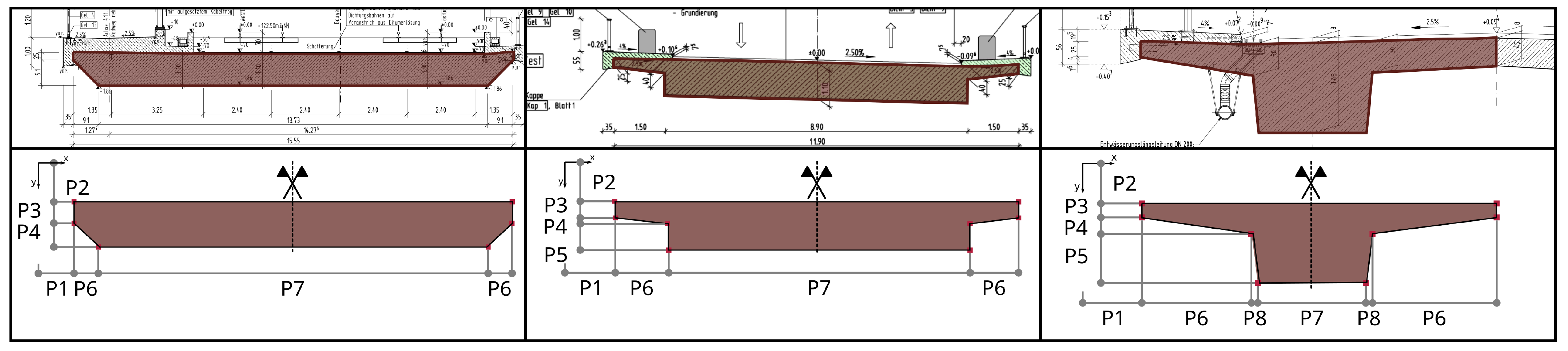
| Parameter | Description | Slab Girder | T-Girder | Tapered T-Girder |
|---|---|---|---|---|
| P1 | Offset X | ✓ | ✓ | ✓ |
| P2 | Offset Y | ✓ | ✓ | ✓ |
| P3 | Flange Height | ✓ | ✓ | ✓ |
| P4 | Flange Taper Height | ✓ | ✓ | ✓ |
| P5 | Web Height | ✓ | ✓ | |
| P6 | Flange Width | ✓ | ✓ | ✓ |
| P7 | Web Width | ✓ | ✓ | ✓ |
| P8 | Web Taper Width | ✓ |
| Parameter | Slab Girder | T-Girder | Tapered T-Girder |
|---|---|---|---|
| P1 | X-coordinate of top-left corner | ||
| P2 | Y-coordinate of top-left corner | ||
| P3 | 50% Height | 25% Height | 25% Height |
| P4 | 50% Height | 25% Height | 25% Height |
| P5 | - | 50% Height | 50% Height |
| P6 | 12.5% Width | 25% Width | 25% Width |
| P7 | 75% Width | 50% Width | 25% Width |
| P8 | - | - | 12.5% Width |
| Cross-Sectional Views | Cross-Sections | ||||||
|---|---|---|---|---|---|---|---|
| Split | Real | Synthetic | Negative | Total | Real | Synthetic | Total |
| Training | 120 | 80 | 200 | 400 | 224 | 107 | 331 |
| Validation | 29 | 20 | 0 | 49 | 51 | 26 | 77 |
| Testing | 37 | 0 | 0 | 37 | 72 | 0 | 72 |
| Total | 186 | 100 | 200 | 486 | 347 | 133 | 480 |
| Split | Type | Real | Synthetic | Total |
|---|---|---|---|---|
| Training | Slab girder | 40 | 40 | 80 |
| T-girder | 138 | 11 | 149 | |
| Tapered T-girder | 46 | 56 | 102 | |
| Validation | Slab girder | 8 | 6 | 14 |
| T-girder | 27 | 5 | 32 | |
| Tapered T-girder | 16 | 15 | 31 | |
| Testing | Slab girder | 14 | 0 | 14 |
| T-girder | 32 | 0 | 32 | |
| Tapered T-girder | 26 | 0 | 26 |
| Augmentation | Description | Probability | Value Range |
|---|---|---|---|
| hsv_h | Hue adjustment (HSV) | 1.0 | ±0.015 |
| hsv_s | Saturation adjustment (HSV) | 1.0 | ±0.7 |
| hsv_v | Value adjustment (HSV) | 1.0 | ±0.4 |
| translate | Image translation | 1.0 | 10% of image size |
| scale | Image scaling | 0.5 | ±0.5 |
| fliplr | Flipping image left-right | 0.5 | - |
| mosaic | Mosaic augmentation | 1.0 | - |
| Girder Type | ||||
|---|---|---|---|---|
| Slab girder | 0.827 | 0.764 | 0.686 | 0.686 |
| T-girder | 0.943 | 0.943 | 0.887 | 0.905 |
| Tapered T-girder | 0.687 | 0.687 | 0.614 | 0.614 |
| Total | 0.819 | 0.798 | 0.729 | 0.735 |
| Segmentation with Ground Truth | 0.894 | 0.603 | 0.561 | 0.611 |
| Segmentation with YOLOv8 | 0.743 | 0.418 | 0.358 | 0.459 |
| Pipeline Variant | P1 | P2 | P3 | P4 | P5 | P6 | P7 | P8 |
|---|---|---|---|---|---|---|---|---|
| Default | 5.88 | 2.45 | 0.00 | −2.98 | 2.53 | −3.14 | 2.76 | −8.00 |
| Polygon-based Init. | 6.04 | 2.45 | 0.00 | −2.95 | 3.76 | −2.74 | 3.01 | −7.95 |
| IoU only | 5.93 | 2.45 | 0.10 | −2.09 | 2.48 | −1.75 | 3.87 | −8.00 |
| DIoU only | 5.88 | 2.45 | 0.00 | −2.46 | 2.21 | −3.20 | 2.88 | −8.00 |
| Pipeline Variant | P1 | P2 | P3 | P4 | P5 | P6 | P7 | P8 |
|---|---|---|---|---|---|---|---|---|
| Default | 83.44 | 21.23 | 16.01 | 14.29 | 18.76 | 62.97 | 68.36 | 71.51 |
| Polygon-based Init. | 85.19 | 20.99 | 22.89 | 25.17 | 21.74 | 91.42 | 132.97 | 11.63 |
| IoU only | 80.46 | 20.98 | 21.94 | 19.06 | 22.03 | 59.79 | 70.06 | 70.33 |
| DIoU only | 81.75 | 21.16 | 16.02 | 14.06 | 18.43 | 59.19 | 68.45 | 70.37 |
Disclaimer/Publisher’s Note: The statements, opinions and data contained in all publications are solely those of the individual author(s) and contributor(s) and not of MDPI and/or the editor(s). MDPI and/or the editor(s) disclaim responsibility for any injury to people or property resulting from any ideas, methods, instructions or products referred to in the content. |
© 2026 by the authors. Licensee MDPI, Basel, Switzerland. This article is an open access article distributed under the terms and conditions of the Creative Commons Attribution (CC BY) license.
Share and Cite
Faltin, B.; Alani, R.; König, M. Extracting Geometric Parameters of Bridge Cross-Sections from Drawings Using Machine Learning. Infrastructures 2026, 11, 48. https://doi.org/10.3390/infrastructures11020048
Faltin B, Alani R, König M. Extracting Geometric Parameters of Bridge Cross-Sections from Drawings Using Machine Learning. Infrastructures. 2026; 11(2):48. https://doi.org/10.3390/infrastructures11020048
Chicago/Turabian StyleFaltin, Benedikt, Rosa Alani, and Markus König. 2026. "Extracting Geometric Parameters of Bridge Cross-Sections from Drawings Using Machine Learning" Infrastructures 11, no. 2: 48. https://doi.org/10.3390/infrastructures11020048
APA StyleFaltin, B., Alani, R., & König, M. (2026). Extracting Geometric Parameters of Bridge Cross-Sections from Drawings Using Machine Learning. Infrastructures, 11(2), 48. https://doi.org/10.3390/infrastructures11020048