1. Introduction
During the service life of coal-mine roadways, variations in geological conditions, surrounding-rock properties, mining-induced disturbances, and support structures, as well as other natural factors and engineering conditions, lead to roadway deformation and failure. When such deformation and failure impede normal roadway functionality, repair operations are typically undertaken to restore the working space of the roadway. Among these failures, floor heave accounts for approximately 50% of the total roadway repair workload; however, repeated floor excavation intensifies the disturbance to the ribs and roof surrounding rock, which is influenced by multiple factors such as in situ stress, engineering geological conditions, and construction techniques. Meng et al. [
1], Sakhno and Sakhno [
2], Li et al. [
3], and Fu et al. [
4] reported the failure mechanisms and control technologies of deep/soft-rock roadways and roadway floor heave, highlighting that repeated disturbances and unfavorable hydro-mechanical conditions can significantly aggravate deformation and instability.
A number of studies have been conducted on surrounding-rock behavior under repeated repair-induced disturbances. Yu Weijian [
5,
6] elucidated the support-failure mechanisms and instability pathways of semi-coal–rock roadways and investigated the deformation mechanisms and repair-control technologies. Zhang et al. [
7] analyzed the deformation–failure mechanism and support effect of deep fractured rock masses, supported by numerical analysis and engineering evidence.. Guo Zhibiao [
8] analyzed the deformation–failure mechanisms and dominant controlling factors of high-rib-fall zones in typical roadways of the Hegang mining area. Wang Jun [
9] proposed analyzing the mechanism of floor heave based on the depth of the zero-displacement contour line in the floor. Zheng Wenxiang [
10] established a mechanical analysis model for the horizontal beam of the floor and revealed the mechanical mechanism by which rock bolts control floor heave. Li Xinwang [
11] examined the influence of weak interlayer thickness on the occurrence of floor heave. Yang Jun [
12] investigated the control method for Tertiary soft-rock roadways using bolt–mesh–cable combined with double-layer truss support technology.
In recent years, research has increasingly focused on the time-dependent and cumulative damage of deep roadways subjected to high in situ stress and mining-induced dynamic disturbance, which often results in repeated rehabilitation and aggravated floor heave. Wang et al. [
13] and Wang et al. [
14] verified that whole-section anchor–grouting reinforcement and U-shaped steel sets combined with anchor-grouting can effectively control loose/fractured and rheological soft-rock roadways. Shi et al. [
15] showed that fully enclosed U-shaped steel ring support and floor anchor cables can significantly improve long-term stability and extend the renovation interval of deep roadways. Jia et al. [
16] and Li et al. [
17] further clarified, through numerical simulations, how repeated multi-seam mining and disturbance conditions influence stress evolution and the development of yielding/plastic zones in the surrounding rock, which are closely related to floor-heave behavior. Li et al. [
18] demonstrated that pressure-relief measures such as floor grooving/slotting can reduce stress concentration and maintenance costs in deep roadways.
More recently, Wu et al. [
19] emphasized that the progressive deterioration of surrounding rock under sustained disturbance and long-term loading is essentially a time-dependent and cumulative-damage process, which accelerates crack development and the expansion of the plastic (yield) zone, thereby aggravating long-term instability and floor heave.. Meanwhile, Liao and Feng [
20], Zhang et al. [
21], and Kang et al. [
22] reported that anchor–grouting reinforcement can enhance the integrity and bearing capacity of fractured rock masses and improve long-term stability in deep soft-rock and fractured roadways. In addition, Zhou et al. [
23] and Shou et al. [
24] proposed and developed energy-absorbing or constant-resistance support components to adapt to large deformation under strong disturbance and high stress, providing an important direction for improving support reliability in deep roadways. Furthermore, Lu et al. [
25] and Wang et al. [
26] provided new insights into disturbance-related failure mechanisms (e.g., blasting-induced disturbance and near-field dynamic disturbance), which is valuable for understanding repeated disturbances and optimizing targeted control measures.
In the North Wing Main Roadway of Shaanxi Jinyuan Zhaoxian Mining, floor heave, roof fragmentation, and rib expansion occurred after roadway excavation and formation. The flat section of the North Wing Main Roadway underwent multiple rounds of repair, with recurrent floor heave repeatedly affecting normal and safe mine production during deformation, failure, and repair periods. Therefore, fundamentally understanding the deformation and failure characteristics of this type of roadway surrounding rock is essential for reducing repair frequency and providing theoretical support for surrounding-rock control.
2. Engineering Overview and Deformation–Failure Characteristics
2.1. Project Overview
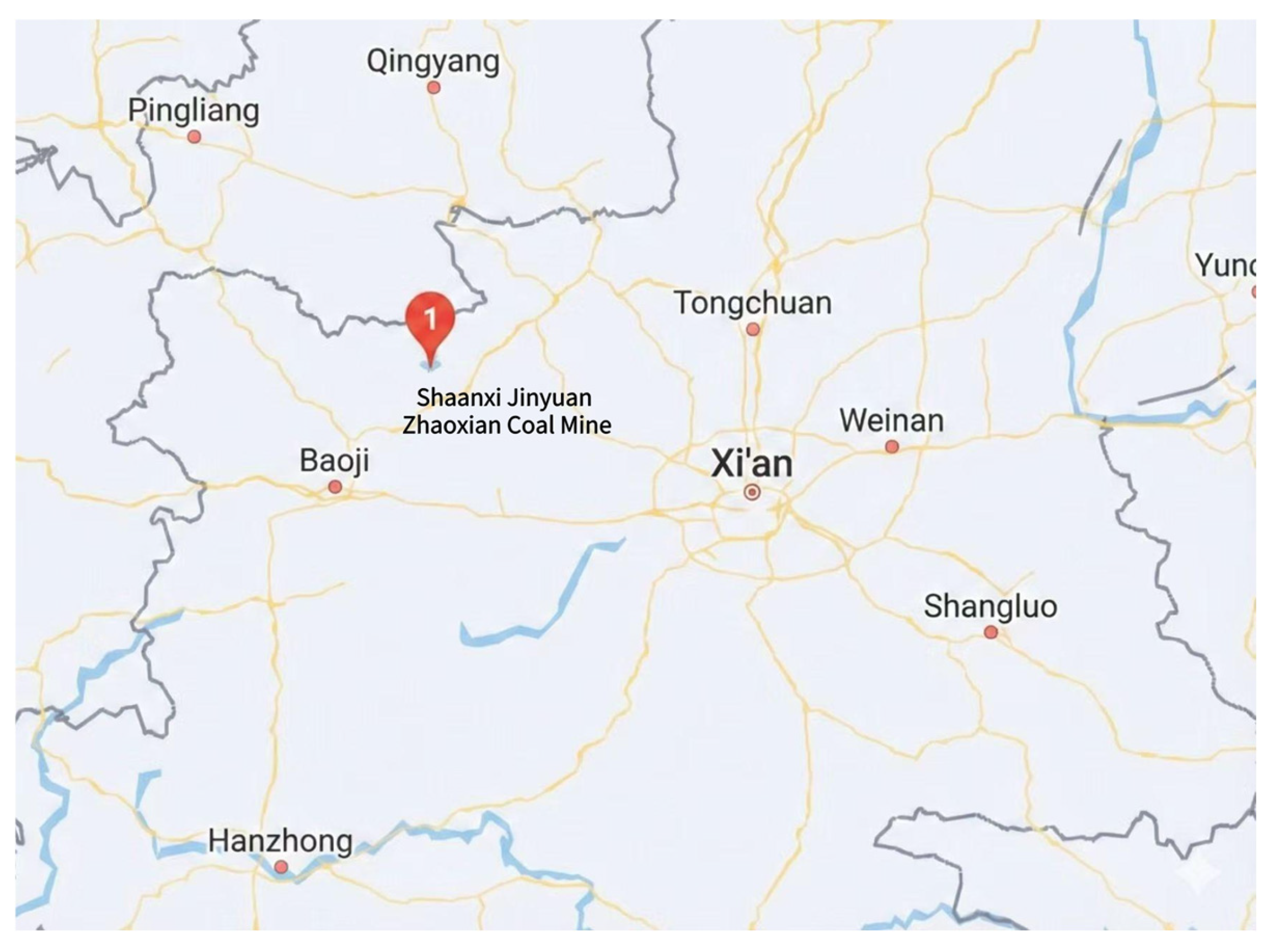
Figure 1 shows the location of the Shaanxi Jinyuan Zhaoxian Coal Mine at the province–city–county scale to facilitate understanding of the engineering background.
The North Wing Main Roadway consists of three entries—the return-air roadway, the haulage roadway, and the auxiliary haulage roadway. The average burial depth ranges from approximately 480 to 590 m. As development roadways of the mine, the gradients are 4‰ from 0–10 m, 5.5° from 10–62.168 m, and 4‰ from 62.168–543.463 m. The lower end of the inclined section lies within Seam No. 3, and the excavation intersects the Mailigou syncline; the lower segment remains within the roof of Seam No. 3, while the upper end of the inclined section passes from within Seam No. 3 to its floor. The roadway is affected by the DF6 fault, dipping at 60° with a throw of 0–18 m. Seam No. 3 has an average thickness of 15.42 m and an average dip of 10°. The immediate roof consists of carbonaceous mudstone, and the main roof is composed of gray-green mudstone, which is loose and fractured. The floor is composed of grayish-brown bauxitic mudstone or bauxitic siltstone, and certain local segments of the roadway contain clay-rich argillaceous swelling rock within the surrounding rock mass.
In the initial construction stage of the horizontal section of the North Wing Auxiliary Haulage Roadway, a straight-wall semicircular-arch cross-section was adopted, with a clear height of 4700 mm and a clear width of 5200 mm. The original support system consisted of bolt–mesh–beam–cable reinforcement combined with shotcrete. The rock bolts were left-hand, ribless steel bolts (Φ22 × 2400 mm) installed at a spacing of 800 mm × 800 mm, with ladder beams welded from Φ14 mm reinforcing bars. Each bolt was installed using one Z2370 and one K2335 resin cartridge, providing an anchorage force of no less than 127 kN and a torque of no less than 300 N·m. The cable bolts were high-strength, low-relaxation prestressed steel strands (Φ21.8 mm, 7300 mm in length), installed at a spacing of 1600 mm × 1600 mm; each cable bolt employed two Z2370 and one K2335 resin cartridges, with a prestressing force not less than 210 kN. The metal mesh was fabricated from Φ6.5 mm steel bars, with panel dimensions of 1000 mm × 2000 mm and mesh openings of 100 mm × 100 mm, connected by overlapping.
2.2. Deformation and Failure Characteristics of the Roadway
To provide a basis for the repair and reinforcement of the North Wing Main Roadway, an on-site investigation of the current deformation and failure conditions was conducted. The surrounding-rock deformation and failure of the roadway were found to manifest primarily in the following forms:
- (1)
Floor heave and floor-corner failure. The dominant deformation of the surrounding rock in the horizontal section of the North Wing Main Roadway is floor heave, with a maximum value of 500 mm, generally inclined from the roadway center toward both sides. This severely affects the normal functioning of the track system; the concrete pedestrian walkway tilts, and the drainage ditch adjacent to the roadway ribs is squeezed and deformed. In sections repaired with U-shaped steel sets, the inward movement of the floor corners ranges from 200 to 300 mm.
- (2)
Severe cracking of the shotcrete layer on both ribs. Cracking of the shotcrete layer on the roadway ribs appears primarily as longitudinal fissures, with the distribution of cracks decreasing progressively from the straight wall upward to the arch springline; localized cracking is more pronounced near the arch springline. When no floor heave occurs or when floor heave is minor, the shotcrete layer on the ribs does not exhibit cracking. Rib displacement is generally smaller compared with roof and floor displacement, although localized pipeline support beams are severely squeezed and deformed.
- (3)
Deformation and failure of the roadway roof. Cracks in the shotcrete layer of the roof are approximately aligned with the roadway axis, with local shotcrete detachment and exposure of the reinforcement mesh. The roof surrounding rock exhibits overall subsidence, and the crown beams of the U-shaped sets are twisted and deformed. Back plates are fractured, and the reinforcement mesh becomes compressed into basket-like shapes. In sections where roof deformation and failure are severe, rib cracking and significant floor heave often coexist, requiring repeated repairs of floor heave.
- (4)
Repair measures and their effectiveness. When excessive floor heave impedes normal production, floor excavation is performed, followed by reconstruction of the drainage ditch, pedestrian walkway, and track installation. Rib and roof deformation is addressed by installing additional cable bolts (19-strand, Φ21.8 × 7400 mm), with 3–4 cables per row. In severely deformed segments, U29 steel sets and shotcrete are installed after additional cable support. The horizontal section and locally inclined sections of the North Wing Main Roadway have undergone multiple rounds of rib scaling, floor excavation, and strengthened support measures; however, floor heave recurs frequently, and the overall effectiveness remains limited.
3. Analysis of Surrounding-Rock Characteristics in the Roadway
Horizontal tectonic stress constitutes the mechanical environment generated by the synclinal structure, and faulting commonly accompanies synclines. The horizontal section of the North Wing Main Roadway passes through the Mailigou syncline and the FBF-1 fault, while the inclined section intersects the DF6, DF7, and DF8 faults. These faults and associated joint–fracture networks are well developed, and such structural weak planes govern the physical–mechanical properties of the rock mass, including compressive strength, tensile strength, elastic modulus, and permeability coefficient. Consequently, the resistance of the surrounding rock to external loads and its self-supporting capacity decrease sharply, and the roadway support system is subjected to increased mining-induced stress.
X-ray diffraction testing was performed on surrounding-rock samples collected from severely deformed sections of the North Wing roadway. The results indicate that the local surrounding rock mainly comprises illite–montmorillonite mixed layers, quartz, calcite, kaolinite, siderite, and dolomite. Among these minerals, kaolinite, illite, and montmorillonite are strongly hydrophilic and exhibit swelling upon water exposure, classifying them as clay-rich argillaceous swelling rocks. Immersion tests on surrounding-rock samples indicate that the rock belongs to the second type of sedimentary argillaceous swelling rock, which swells without involving chemical reactions. Both floor and roof samples exhibited detachment of rock debris upon immersion; rock fragments became friable after soaking for several hours. Certain roof samples disintegrated into hard fragments upon water exposure. Thus, the surrounding rock of the North Wing Main Roadway is primarily weakly swelling rock, with a small portion exhibiting moderate swelling behavior.
Due to the loose structure of illite–montmorillonite mixed layers and the loosening effect of excavation, numerous fissures develop within the floor strata. When groundwater infiltrates these fissures, argillaceous rocks undergo swelling deformation, leading to a reduction in the load-bearing capacity of the surrounding rock. Simultaneously, water reduces interlayer bonding strength, causing stratification within the rock mass and forming slip surfaces, thereby diminishing the tensile and compressive resistance of the rock and rendering it more susceptible to deformation and failure. The combined effects of moisture ingress and swelling progressively reduce the strength of the surrounding rock while generating significant swelling deformation. The synergistic action of rock fragmentation-induced bulking and swelling deformation makes the roadway particularly prone to surrounding-rock deformation and failure.
4. Optimization of the Support Scheme
4.1. Scheme Design
In this numerical study, four support schemes were evaluated to identify a rational support method and corresponding parameters. Schemes (a) and (b) represent two practical bolt–cable configurations commonly adopted in engineering practice, whereas schemes (c) and (d) were constructed on the basis of scheme (b) by stepwise introducing 29U-type closed steel sets and grouting, respectively. The 29U-type steel sets represent a yielding (deformable) steel support system widely used in coal mines, providing confinement while allowing controlled deformation. The numerical simulation scheme for support design is summarized in
Table 1.
Design logic of the comparative schemes. The four support schemes (a–d) were organized following a progressive “add-on” logic to facilitate attribution analysis of support effects. Schemes (a) and (b) represent two practical bolt–cable configurations commonly adopted in engineering practice, differing in bolt length and support density. Based on scheme (b), additional measures were then introduced stepwise to form schemes (c) and (d), namely 29U-type closed steel sets (scheme c) and grouting (scheme d). For schemes (b)–(d), the roof/rib bolt–cable layout was kept the same so that the incremental contributions of the added measures can be discussed on a consistent baseline, minimizing confounding effects from simultaneous changes in the primary bolt–cable arrangement. The complete parameter set is summarized in
Table 2, where the items changed relative to the preceding scheme are explicitly marked.
To further enhance attribution clarity, the results are interpreted through successive comparisons between neighboring schemes. Schemes (a) and (b) are compared to illustrate the sensitivity of deformation control to bolt–cable configuration under the same geological and stress conditions. Subsequently, the differences between schemes (b) and (c) are attributed to the introduction of 29U-type closed steel sets, which provide closed-ring confinement and improve the global load-sharing behavior of the support–rock system. The differences between schemes (c) and (d) are then used to evaluate the additional benefit of grouting, which fills fractures and cements the loosened rock mass, thereby improving the integrity and self-bearing capacity of the surrounding rock. These effects are assessed using multiple numerical indicators, including deformation control, damage intensity, and failure extent. Overall, the introduction of 29U-type closed steel sets reduces the extent of yielding and confines deformation within a smaller zone, indicating stronger overall confinement, while grouting provides the most significant additional improvement, as reflected by the lowest shear strain increment level and the most limited yield-zone extent among the schemes.
4.2. Numerical Modeling
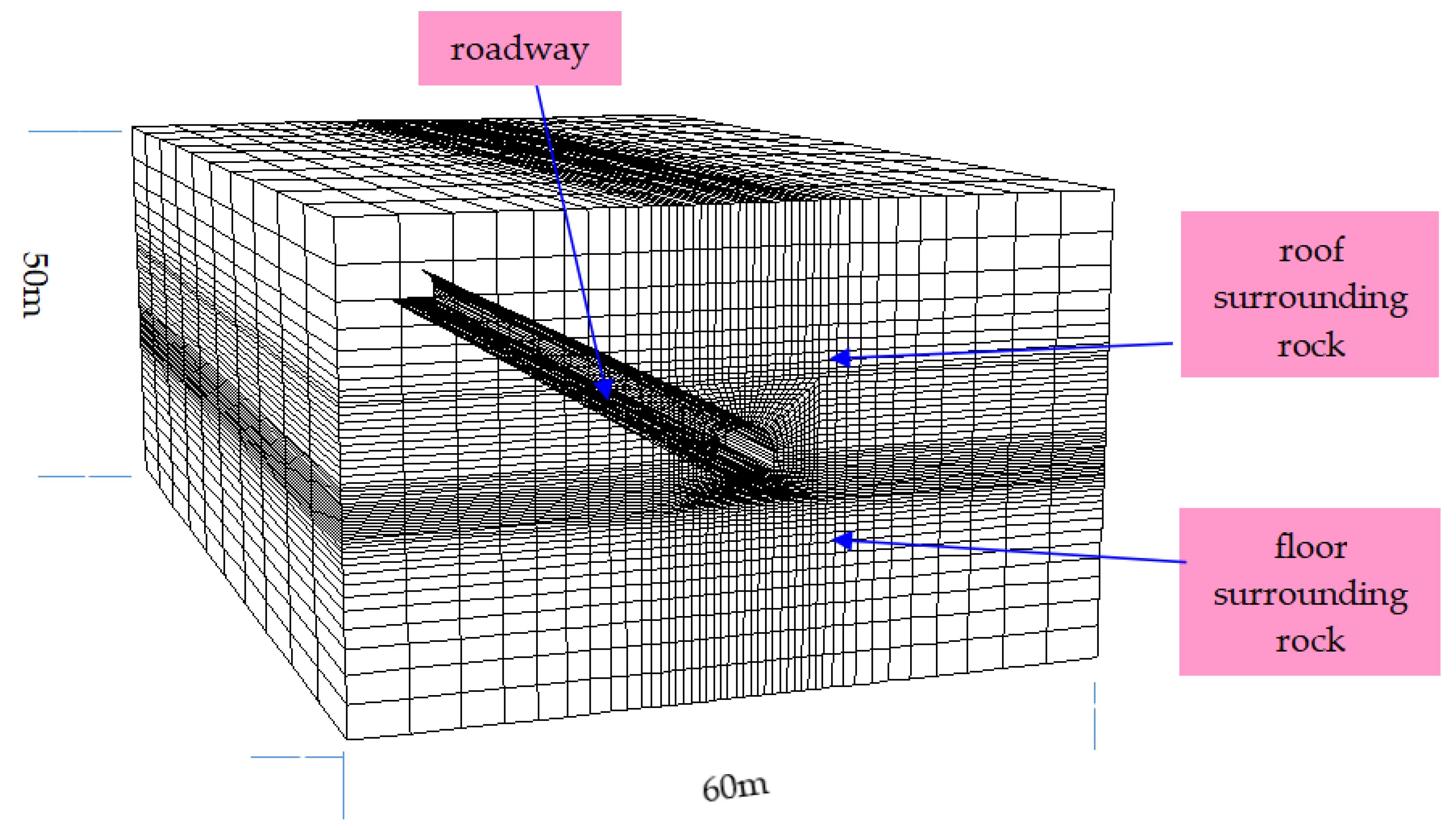
Geometric model: A three-dimensional numerical model was established using FLAC3D 3.0, and the actual geological conditions were appropriately simplified for the simulations. The model length along the roadway axis was 100 m, and the roadway cross-section in the test segment was 6.1 m (width) × 4.6 m (height). Boundary zones of approximately 25 m were reserved on both sides of the roadway. The mesh was locally refined around the roadway, with an element size of 0.5 m × 0.5 m. The total model height was 50 m; for the overlying strata not explicitly included in the model, an equivalent load was applied to represent their weight.
Figure 2 shows the geometric model of the roadway and surrounding rock mass.
During the simulation, the model was first run to reach equilibrium under the initial in situ stress field. The roadway was then excavated and the support structures were installed, after which the calculation was continued until a new stress equilibrium was achieved. Finally, the mechanical response of the support system, as well as the stress distribution and displacement characteristics of the surrounding rock mass, were analyzed. In all simulations, the Mohr–Coulomb yield criterion was adopted to determine rock-mass failure.
Boundary conditions. Zero-displacement boundary conditions were imposed on the front, rear, left, and right boundaries of the model. Specifically, the front/rear boundaries and the left/right boundaries were constrained by prescribing u = 0 and v = 0, where u and v denote the displacements in the x- and y-directions, respectively (i.e., single-constraint boundaries). The bottom boundary was fully fixed with u = v = 0 (i.e., a fully constrained boundary).
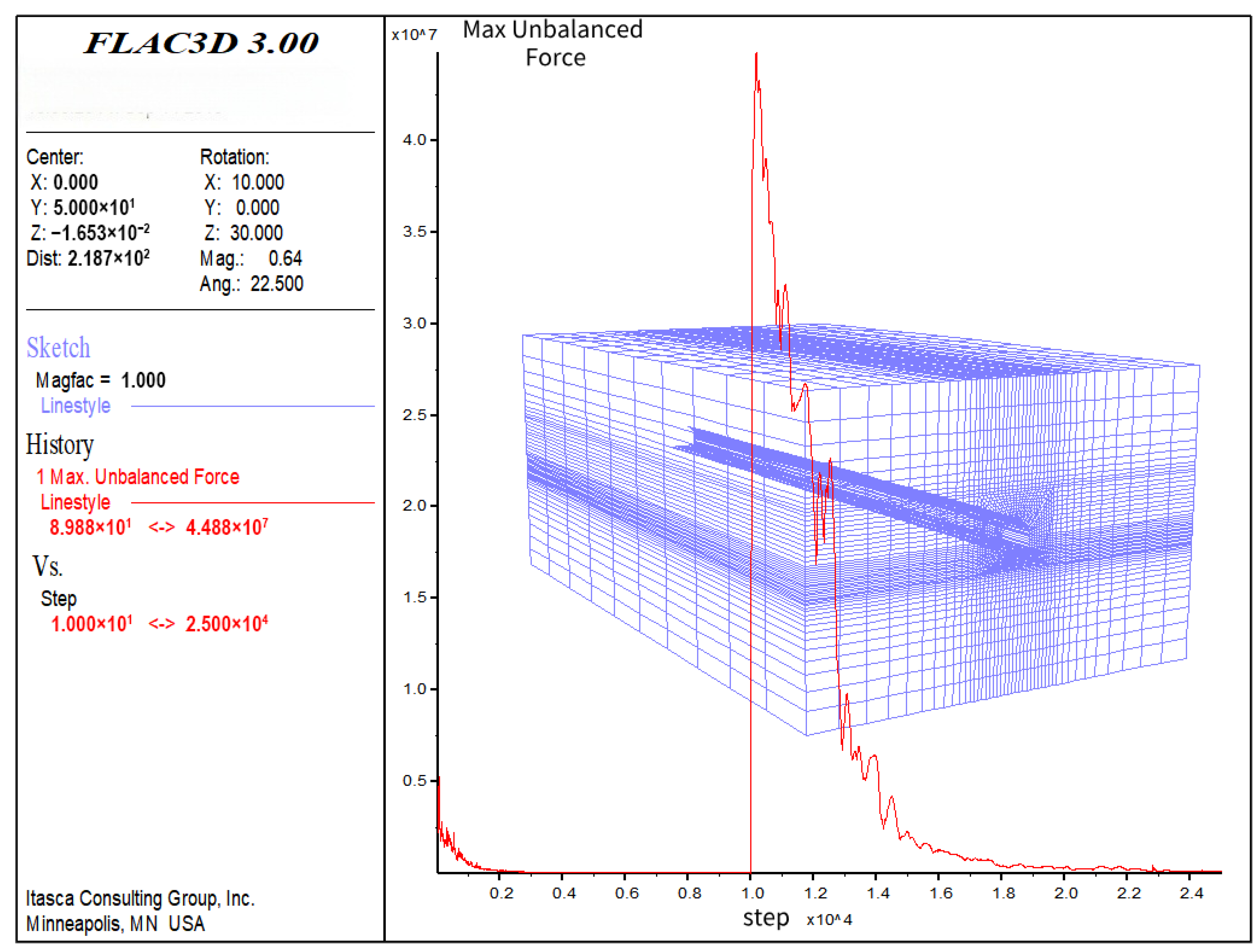
Calculation procedure. The model was first established, and an equivalent load was applied at the top boundary to represent the overlying strata not explicitly simulated. The calculation was then performed until stress equilibrium was achieved in all elements. Subsequently, the roadway was excavated and the support structures were installed, after which the computation was continued until a new stress equilibrium state was reached (
Figure 3). The numerical results were then post-processed and analyzed.
The simulations were conducted using FLAC3D, which is based on an explicit finite-difference formulation in a Lagrangian framework. The governing equations are solved through time-marching with damping until a static equilibrium state is reached, as indicated by the reduction of unbalanced forces to a prescribed tolerance. The modeling procedure followed staged construction: (i) initialization and equilibrium under the in situ stress state, (ii) stepwise excavation of the roadway along the y-direction, with the 100 m model length divided into excavation advances of Δy = 2 m, (iii) installation of support elements immediately after each excavation step, resulting in an effective face-to-support distance of approximately 2 m per step, and (iv) continued calculation to reach a new equilibrium state. Key outputs include stress redistribution, displacement fields, and the yielded (plastic) zone for comparative assessment of the support schemes.
Characteristics of the roadway strata in the test section. The immediate roof, from bottom to top, comprises a coal seam (≈5.0 m thick), mudstone (≈10.0 m thick), and fine-grained sandstone (≈1.6 m thick), and the roadway is excavated within the coal seam. The floor strata, from top to bottom, consist of a coal seam (≈5.0 m thick), mudstone (≈1.4 m thick), and fine-grained sandstone (≈3.7 m thick). The mechanical parameters of the coal–rock mass are listed in
Table 3. These rock mechanical properties were obtained from site investigation and laboratory mechanical tests conducted on representative coal and rock specimens from the study area (as documented in the geological exploration report). The adopted values correspond to representative mean parameters for each lithological unit, and their rationality was further verified by comparing the simulated deformation level with field monitoring results under the optimized support scheme.
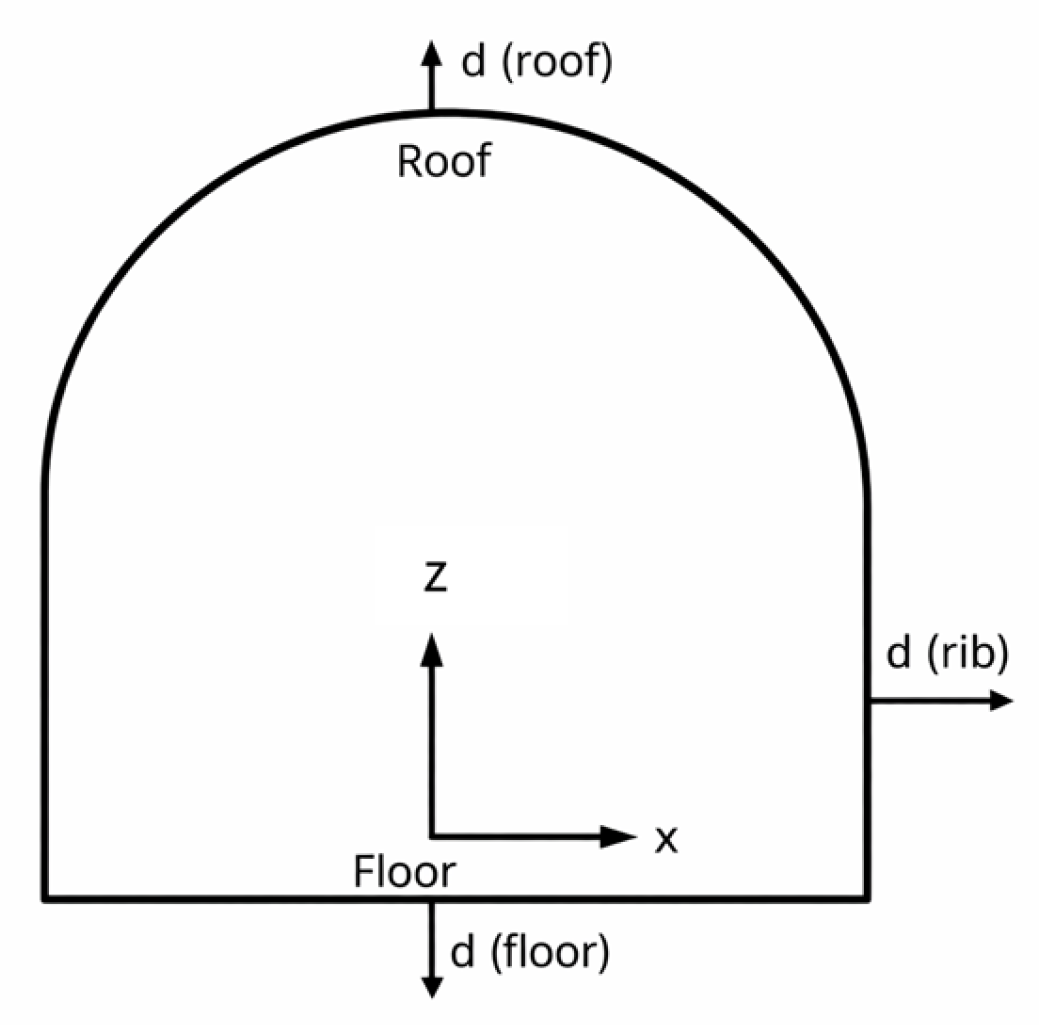
To avoid ambiguity, a right-handed Cartesian coordinate system is adopted, where the y-axis is aligned with the tunnel axis (roadway strike direction), the x-axis is horizontal in the cross-section, and the z-axis is vertical. The stress–depth profiles presented in the following results figures were extracted from a fixed cross-section at the mid-length of the 3D model (y = 50 m). The quantity plotted in
Figure 4 is the vertical stress component σ
v (i.e., σ
z, along the z-direction). The horizontal axis in the two dot-line plots presented later denotes the depth d measured perpendicularly from the excavation boundary (intrados) into the rock mass: for the roof, d is measured upward from the roof boundary; for the floor, d is measured downward from the floor boundary; and for the ribs, d is measured outward from the rib boundary.
4.3. Optimization of the Roadway Support Scheme: Numerical Results and Analysis
4.3.1. Stress Characteristics of Roadway Surrounding Rock
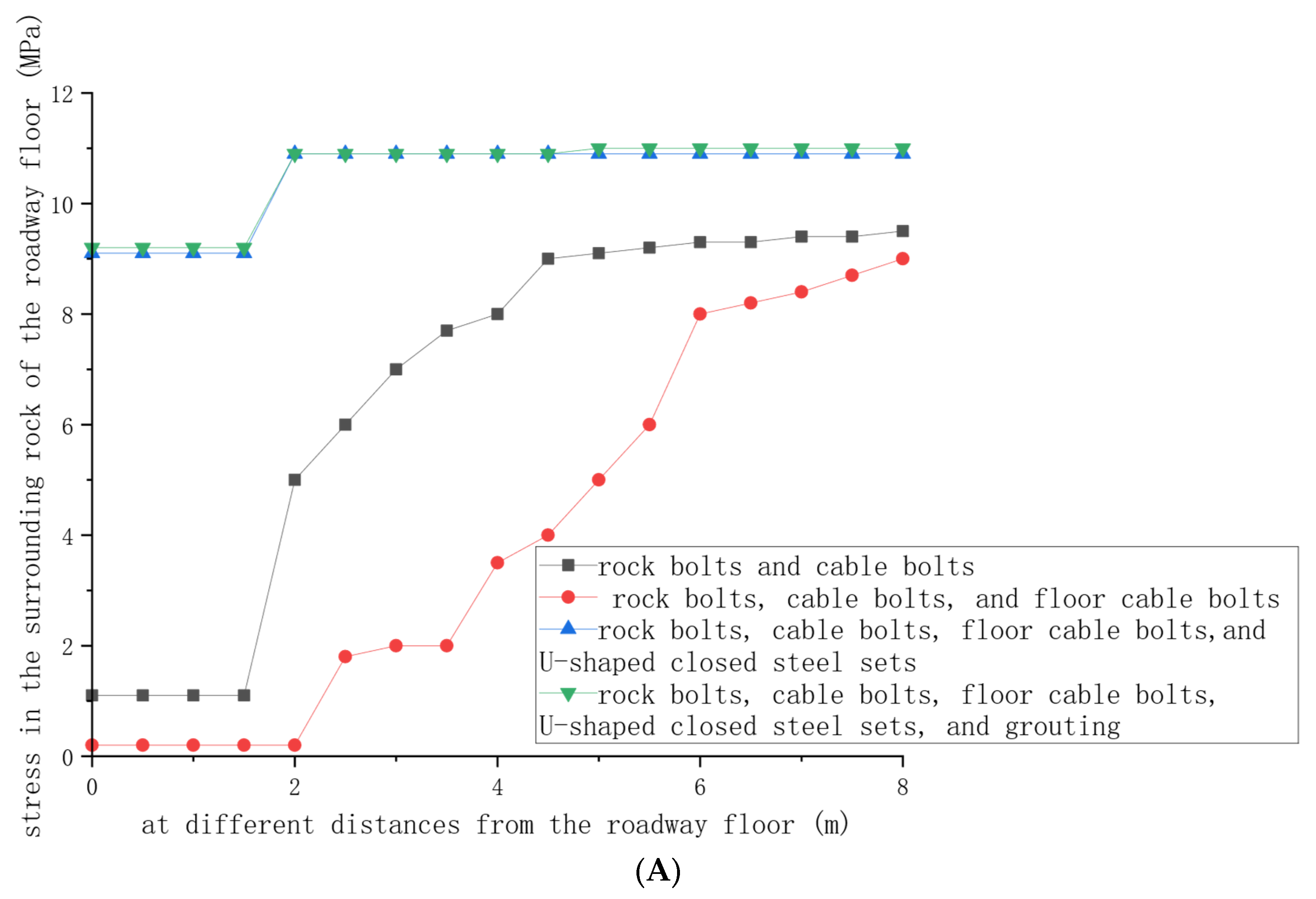
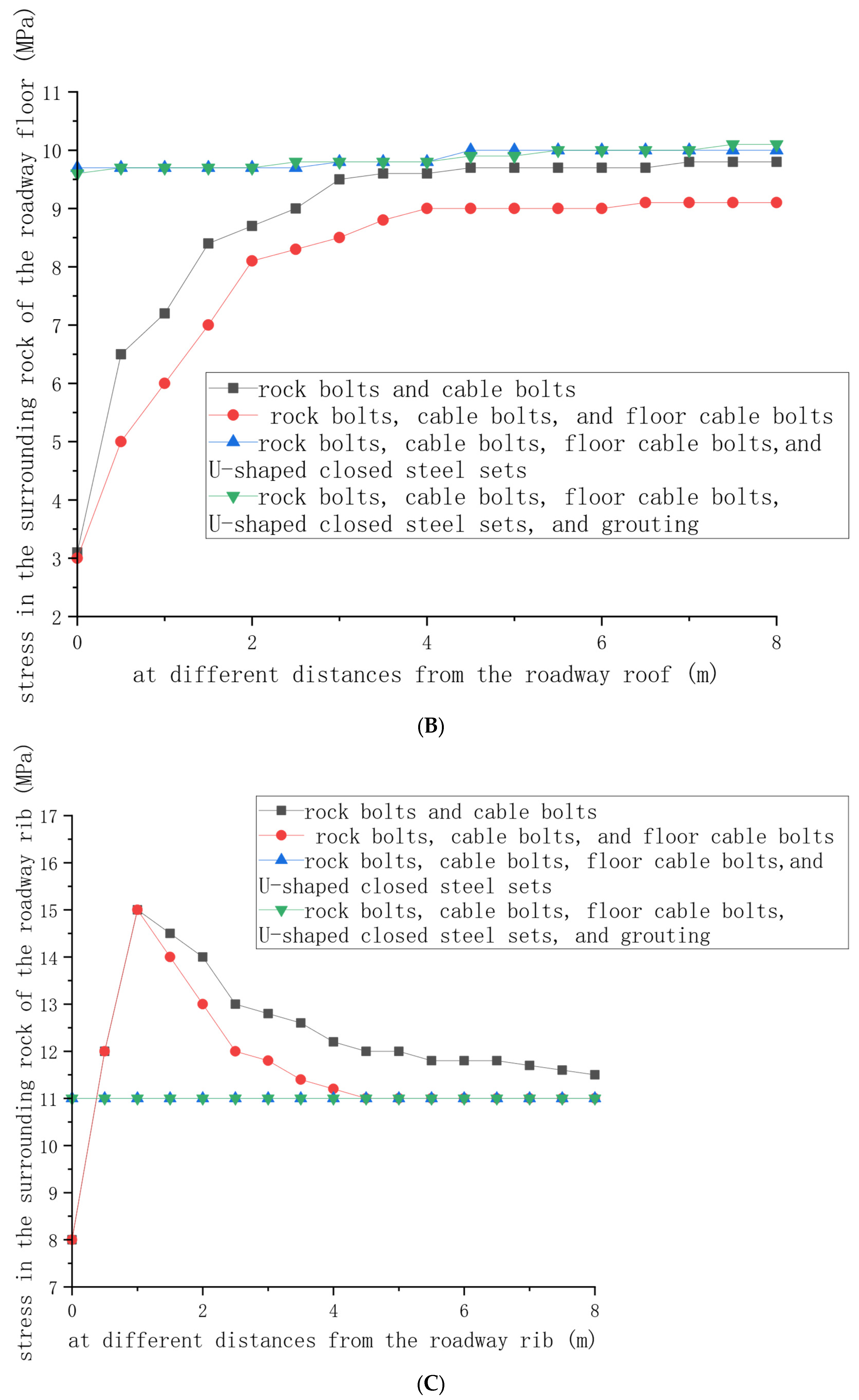
The stress distributions at different depths of the roadway surrounding rock under various support schemes are shown in
Figure 5. In this study, compressive stress is taken as positive.
It should be noted that the yielded zone does not necessarily correspond to the maximum stress. Excavation induces stress redistribution and local unloading; once yielding develops, the near-field rock mass may undergo stress relief, while higher stresses can be transferred and concentrated in the adjacent elastic zone. Therefore, lower compressive-stress values near the excavation boundary can coincide with yielded rock, whereas higher compressive stresses may appear in the intact elastic zone.
As illustrated in
Figure 5A, schemes (a) and (b) exhibit a stress-reduction zone of approximately 5 m in the roadway floor. Within the depth range of 0–2.0 m, the floor rock mass experiences the lowest stress, indicating complete failure with virtually no load-bearing capacity. At depths of 2.0–4.0 m, the stress ranges from 2.0 MPa to 8.0 MPa, suggesting that the rock mass is in a state of plastic yielding failure but retains a certain load-bearing capability. Under schemes (c) and (d), deformation of the surrounding rock is well controlled. Within the floor depth of 0–1.5 m, the stress remains within a reduced zone but maintains a magnitude of approximately 9.0 MPa, and beyond this depth the stress stabilizes at around 10 MPa.
From
Figure 5B, it can be observed that schemes (a) and (b) produce a stress-reduction zone of roughly 2.5 m in the roof. In the depth range of 0–0.5 m, the roof stress decreases significantly from 3.6 MPa to 7.0 MPa. At depths of 0.5–2.5 m, the stress ranges from 7.0 MPa to 9.0 MPa, and the rate of stress reduction gradually diminishes. Beyond 2.5 m, the stress tends to stabilize. Under schemes (c) and (d), deformation of the surrounding rock is effectively controlled, and within the depth of 0–1.5 m the roof stress remains within the reduced zone but maintains a value of approximately 10.0 MPa.
As shown in
Figure 5C, both schemes (a) and (b) exhibit distinct stress peaks located at approximately 0.8 m within the ribs. Beyond a rib depth of 2.5 m, the stress variation becomes stable. In contrast, schemes (c) and (d) show a relatively uniform stress distribution in the surrounding rock.
4.3.2. Displacement Characteristics of Roadway Surrounding Rock
The values in
Table 3 are the maximum displacements obtained at the mid-length cross-section (y = 50 m) along the excavation boundary. Roof and floor displacements refer to vertical movements, and rib displacements refer to inward horizontal movements. For ease of comparison, the table reports displacement magnitudes (absolute values).
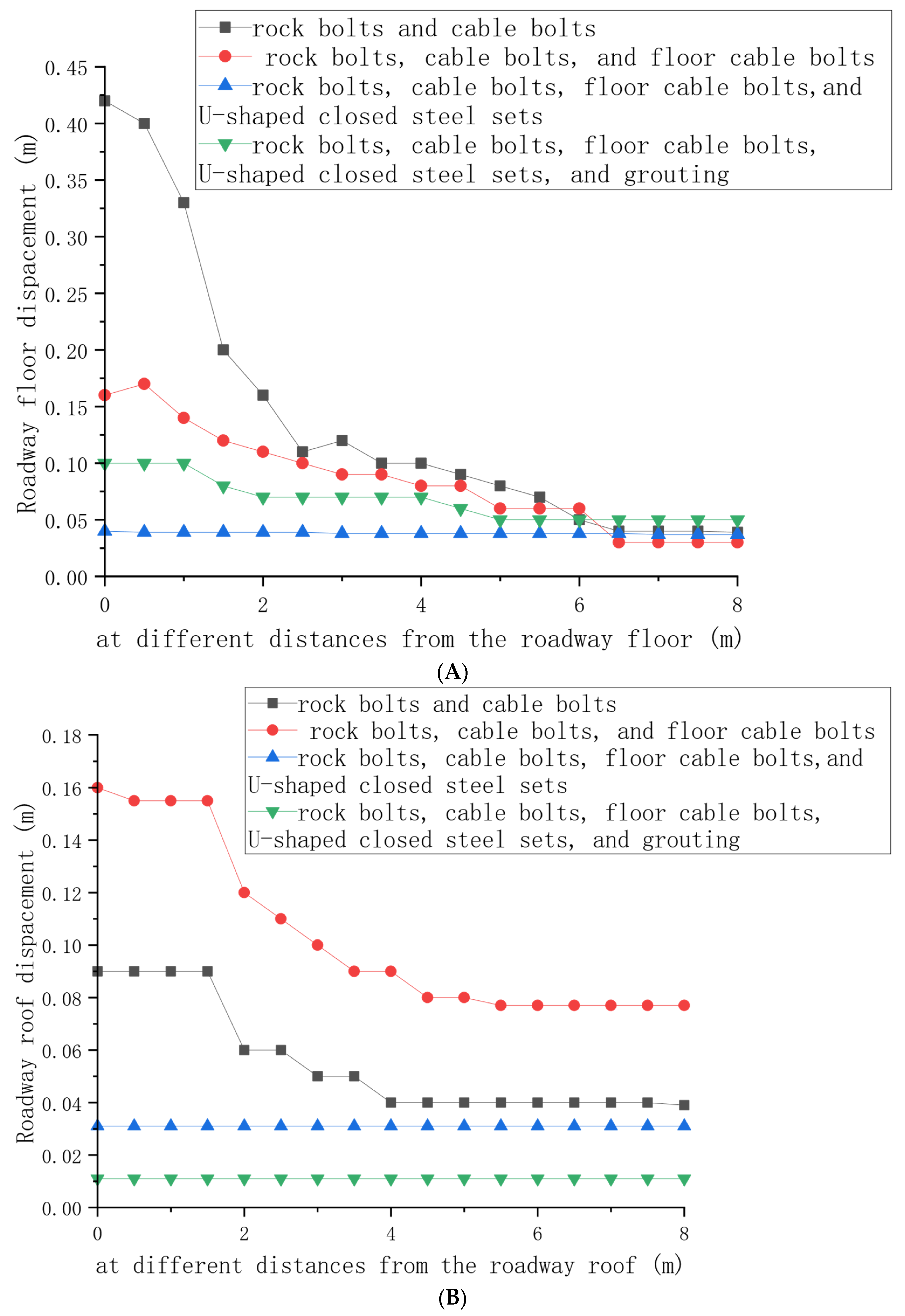
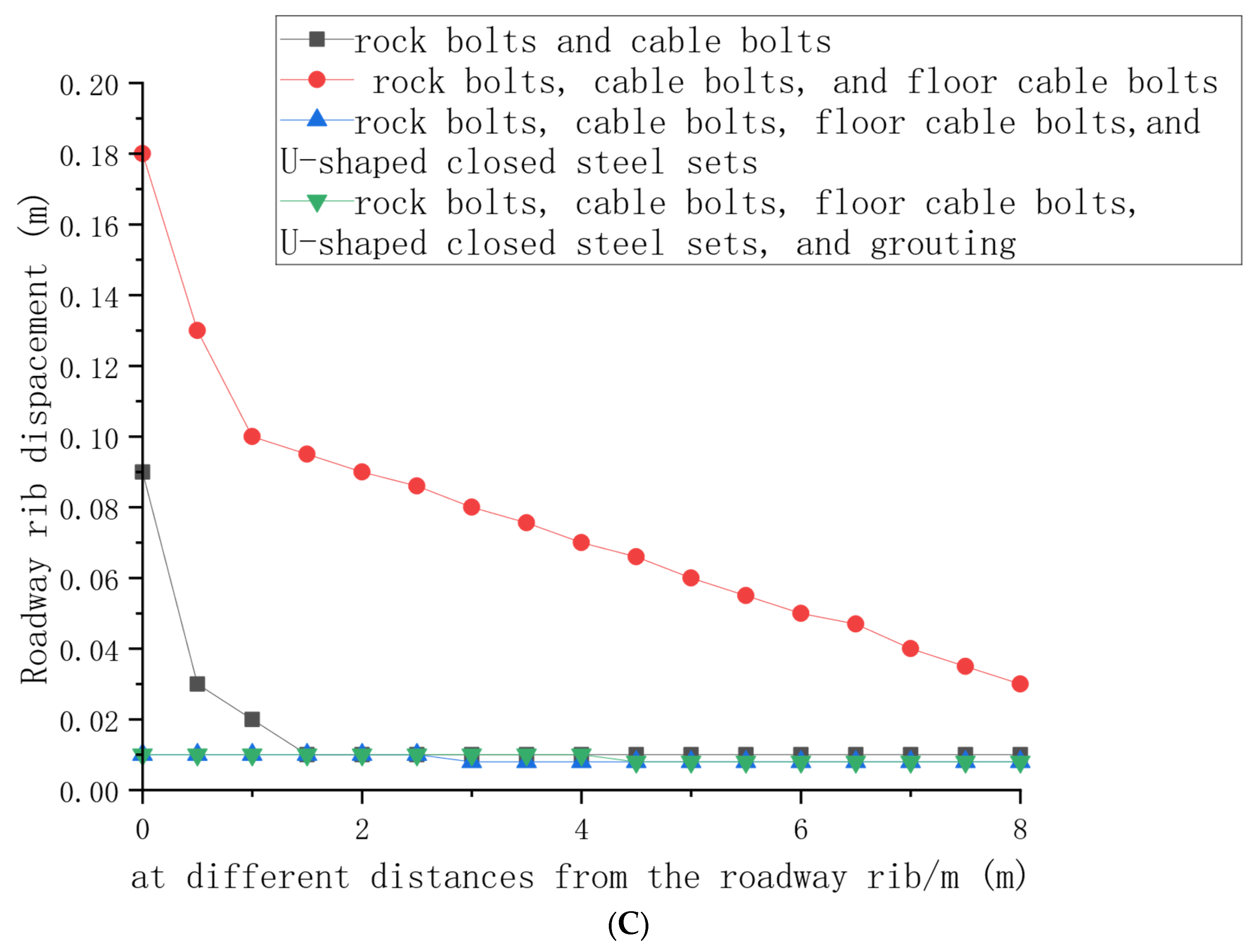
The displacements at different depths in the roadway floor under various support schemes are shown in
Figure 6 and
Table 4. As illustrated in
Figure 6A, in scheme (a), the ribs and roof of the roadway are reinforced while the floor remains unsupported. The resulting floor heave reaches 0.43 m. The displacement of the floor rock mass decreases progressively with increasing depth, and beyond a depth of 1.8 m, the rate of displacement reduction becomes less pronounced. At a depth of 2.8 m, the displacement variation of the floor surrounding rock is comparable to that observed in support schemes (b) and (c). At a depth of 5.0 m, the support conditions have no observable influence on floor deformation.
In scheme (b), the floor heave is reduced to 0.17 m. Within the anchorage zone of the floor cables (5.0 m), the displacement of the floor rock mass remains small. In scheme (c), the affected depth range of floor rock displacement extends to approximately 5.0 m, and the displacement magnitudes at various depths are further reduced compared with schemes (a) and (b). In scheme (d), the displacement throughout the floor depth remains within 0.05 m, indicating excellent control of floor deformation.
From
Figure 6B, it can be observed that scheme (a), compared with scheme (b), increases the density of rock bolts and consequently reduces the roof subsidence. In scheme (b), the maximum roof subsidence reaches 0.17 m. For both schemes (a) and (b), the roof settlement within the depth range of 1.8 m remains essentially constant. Beyond this depth, the settlement of the roof surrounding rock gradually decreases, and at a roof depth of 5.5 m, the support structures have no significant influence on the displacement of the surrounding rock. In scheme (d), the displacement at various depths in the roof remains within 0.01 m, indicating excellent control of roof deformation.
From
Figure 6C, the maximum horizontal displacement of the left rib in scheme (a) is 0.11 m, while that of the right rib is 0.10 m, resulting in a total rib convergence of 0.21 m. In scheme (b), the maximum horizontal displacement of both ribs reaches 0.18 m, and the total convergence increases to 0.36 m. This indicates that increasing bolt length while reducing bolt density is unfavorable for controlling the lateral convergence of the ribs. In scheme (c), the maximum horizontal displacement of the left rib is 0.028 m and that of the right rib is 0.012 m, giving a total convergence of 0.04 m. Scheme (d) yields similar results, with displacements of 0.028 m on the left rib and 0.012 m on the right rib, and a total convergence of 0.04 m.
Overall, the effectiveness of the four support schemes in controlling rib deformation, from best to poorest, is: (d) > (c) > (a) > (b).
4.3.3. Shear Strain Increment Characteristics of the Roadway Surrounding Rock
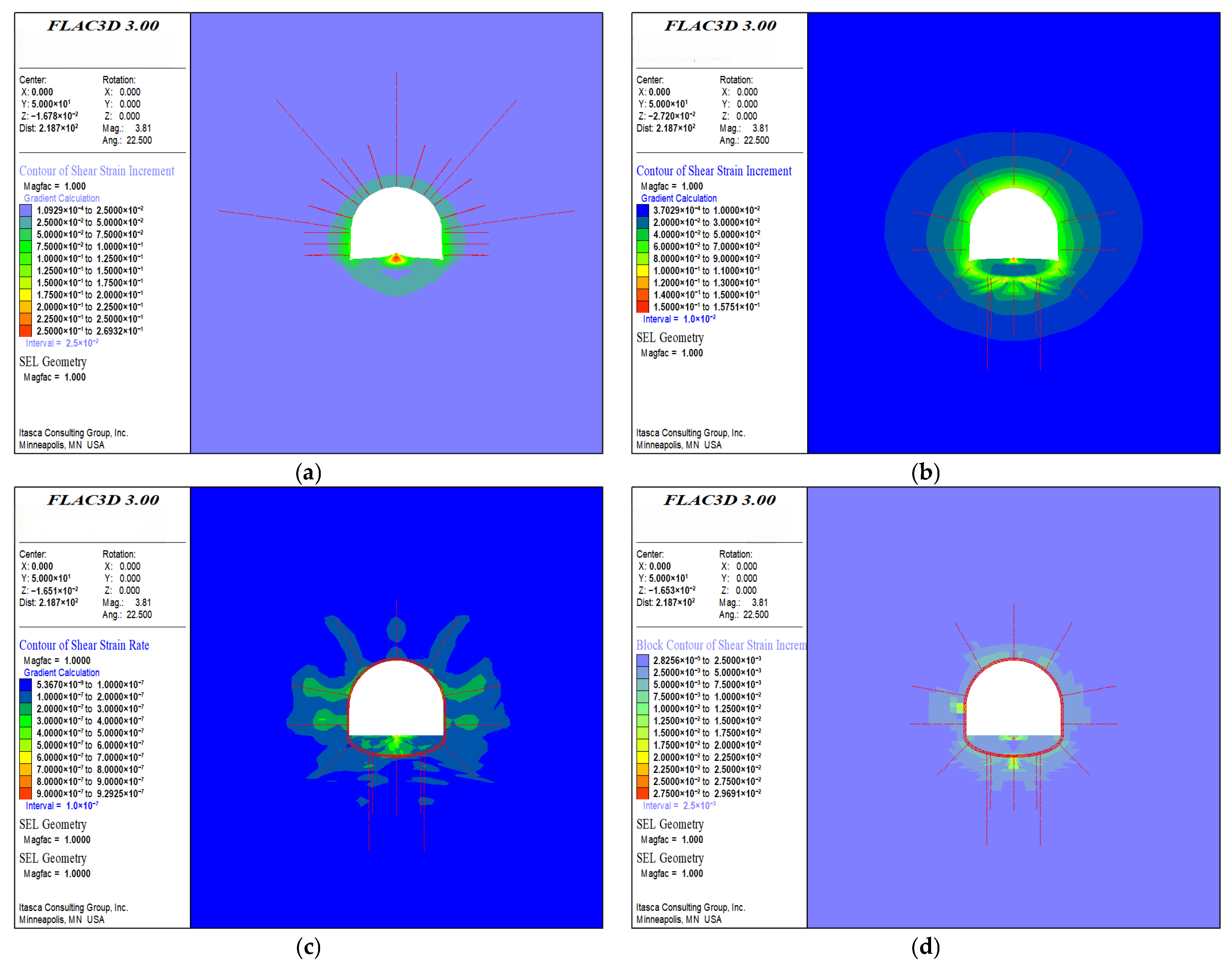
Figure 7 presents the incremental shear strain contours of the surrounding rock under different support schemes. The model was first calculated to reach equilibrium under the initial in situ stress condition; subsequently, roadway excavation and support installation were performed, and the calculation continued until a new stress equilibrium was achieved. Therefore, the contours in convergence deformation of Cross-
Section 3 in the First Test Segment of the Roadway (29U closed steel sets + grouting + cables) correspond to the post-excavation equilibrium state under the corresponding support scheme. In the present numerical procedure, excavation-induced unloading/relaxation is represented through this staged equilibrium calculation, while the excavation-face advance effect is not explicitly simulated.
The shear strain increment reflects the degree and affected depth of unloading-induced failure in the surrounding rock. In scheme (a) the maximum shear strain increment reaches 2.69 × 10⁻¹, mainly concentrated in the roadway floor, and the two ribs range from 1.25 × 10⁻¹ to 0.5 × 10⁻¹. In scheme (b), the maximum value decreases to 1.5 × 10⁻¹, still dominated by the floor, while the ribs and roof are between 0.9 × 10⁻¹ and 0.4 × 10⁻¹, with an influence range of approximately 0.5 m. In scheme (c), the maximum shear strain increment further decreases to 9.2 × 10⁻². In scheme (d), the maximum shear strain increment is reduced to 2.9 × 10⁻², indicating the most effective mitigation of unloading-induced damage among the four schemes.
4.3.4. Plastic Zone (Yielded-Element) Characteristics of the Roadway Surrounding Rock
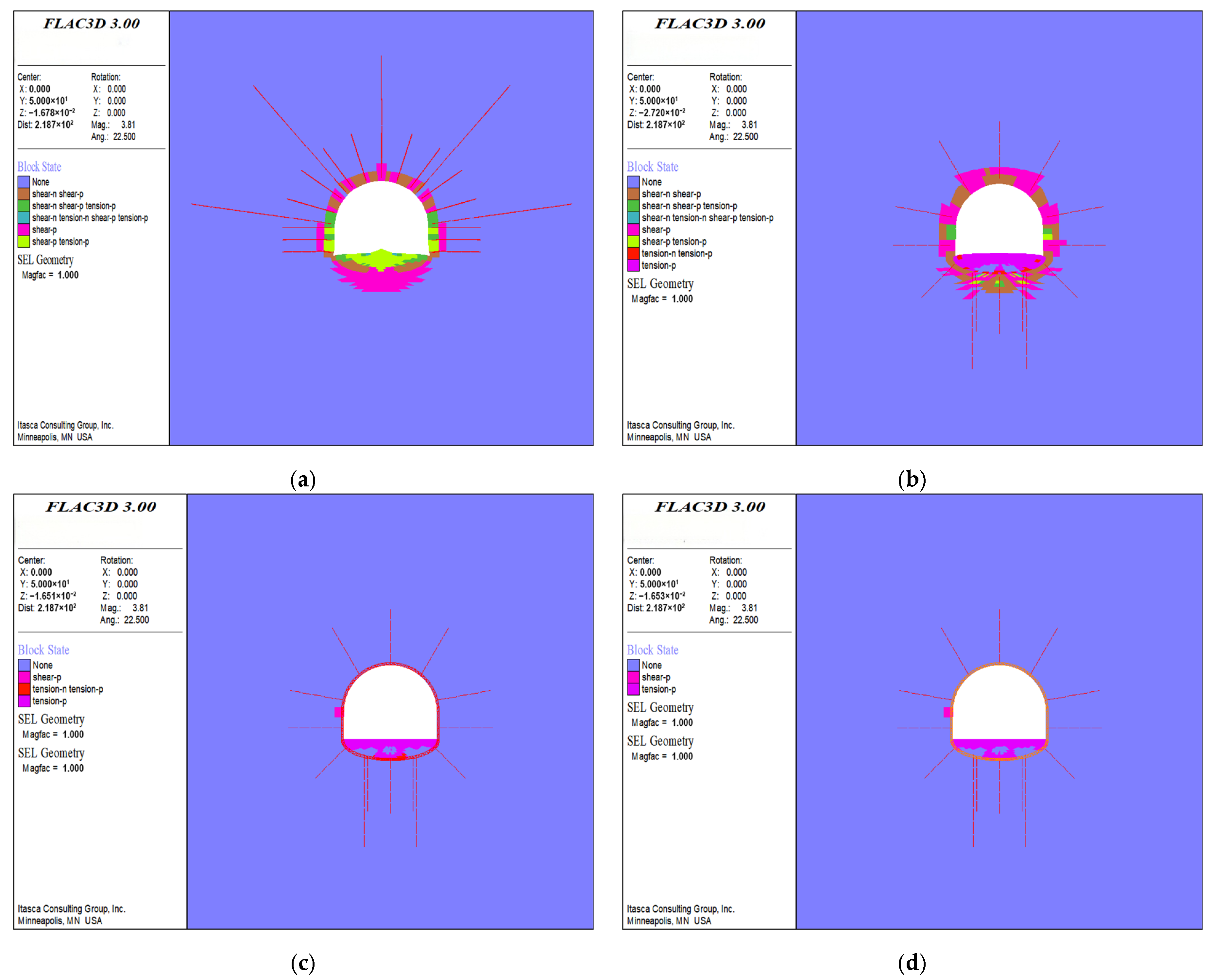
To explicitly illustrate the extent of yielding/failure, the yielded-element (plastic) zone distribution based on the Mohr–Coulomb criterion is presented (
Figure 8), delineating the yield zones under each support scheme.
Figure 8 shows the plastic yielding distribution of the surrounding rock under different support schemes. In scheme (a) (bolt length 2.4 m, spacing 0.8 m; cable length 7.3 m, spacing 1.6 m), the yielded zone is relatively extensive. In scheme (b) (bolt length 3.0 m, spacing 1.8 m; floor cable length 5.0 m, spacing 3.0 m × 1.6 m), the yielding characteristics indicate that reducing the bolt spacing to 0.8 m can effectively decrease the yielding/failure of the surrounding rock. In contrast, simply increasing the bolt length while reducing the support density is unfavorable for controlling the surrounding rock.
The floor failure is dominated by shear yielding. For the north-wing auxiliary transportation roadway, adopting only floor bolts and floor cables is unfavorable for controlling floor heave. In scheme (c) (bolts and cables + floor cables + U-shaped closed steel sets), the plastic yielding range is significantly reduced compared with the bolt–cable support schemes. A local yielded zone still appears within the inverted-arch region of the floor, which is attributed to the backfilling adopted in this region and the corresponding reduction of the element strength parameters. Scheme (d) further incorporates grouting on the basis of scheme (c) (bolts and cables + floor cables + U-shaped closed steel sets + grouting). A comparison between schemes (c) and (d) indicates that the U-shaped closed steel sets provide a marked improvement in controlling the surrounding rock.
It is also noted that the floor heave in the north-wing auxiliary transportation roadway occurred after multiple re-excavation and repair operations, and cracks and deformations were observed in both ribs and the roof. Using only closed steel sets belongs to passive support and cannot improve the intrinsic strength of the surrounding rock. Grouting can fill fractures and cement the fractured rock mass, which helps improve the integrity of the surrounding rock and enhances its self-bearing capacity.
5. Analysis of Surrounding Rock Control Measures and Engineering Practice Effects
5.1. Supporting Plan
Based on the optimized calculation and analytical results of the roadway reinforcement scheme, the test section of the roadway was selected from 50 m to 70 m in front of the self-measurement point Y12, with a construction length of approximately 20 m. The support system adopted a combination of 29U closed steel sets, grouted bolts, and bundled grouted cables, with the layout on the plane expanded along the centerline of the floor. The test roadway was supported using 29U steel sets, with a designed spacing of 700 mm. The inverted-arch beam on the floor was formed by bending 29U steel sets into an inverted-arch shape, with a rise-to-span ratio of 0.2, and a vertical height of 1200 mm between the midpoint and both ends of the arch. The metal mesh was made of Ф6.5 mm steel bars, with mesh panel dimensions of 1000 mm × 2000 mm and a mesh size of 100 mm × 100 mm, connected by overlapping. The shallow boreholes had a depth of 1.0 m and a diameter of Ф22 mm. Marisan was used as the grouting material for the floor, while cement slurry was used for the ribs and roof; grouting was stopped when the pump pressure reached 0.5–1.0 MPa, and the typical grouting duration for a single borehole was 1–2 minutes. The specifications of the hollow grouted cables were SKP18-1/1860, with a length of 5000 mm. The bundled grouted cables were arranged with a spacing of 3000 × 1400 mm, with four cables symmetrically placed in the floor. The grouting pressure was 2.0–3.0 MPa, and the typical grouting duration for a single borehole was 3–5 min.
5.2. Surface Convergence Deformation Monitoring Analysis
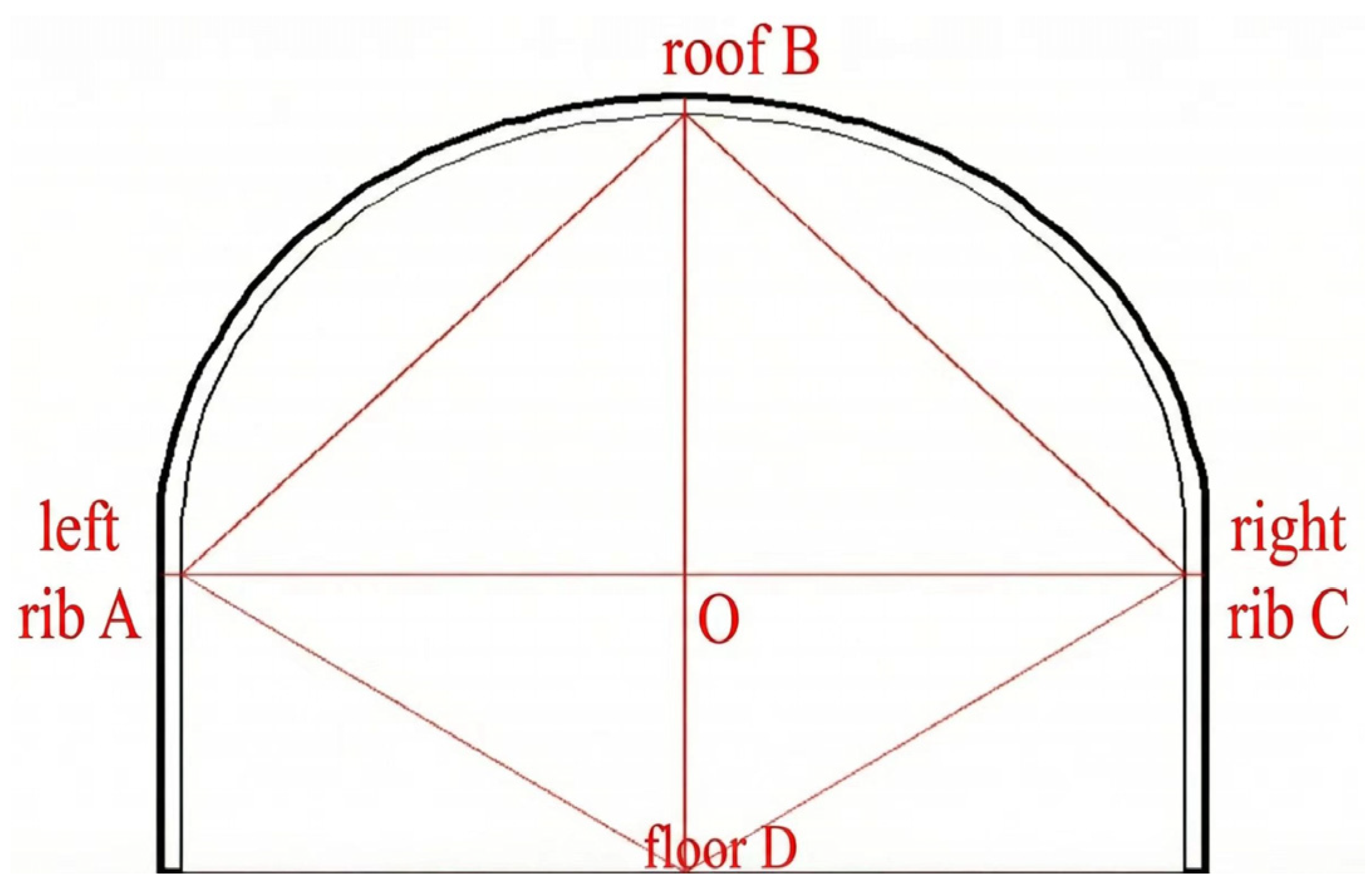
During the reinforcement construction of the auxiliary transportation roadway in the north wing of the Shaanxi Jinyuan Zhaoxian Coal Mine, surface convergence deformation monitoring points were installed in the section located 50–70 m in front of point Y12, and monitoring was carried out (monitoring was affected during shotcrete operations). The monitored test section corresponds to the optimized combined consolidation/support system, i.e., 29U-type closed steel sets together with grouted bolts and bundled grouted cable bolts. Due to space limitations, only the convergence deformation curves of three monitored cross-sections are presented. A schematic drawing (
Figure 9) is provided to illustrate the monitoring points and measurement directions.
Specifically,
Figure 9 reports the sidewall convergence, which is a horizontal quantity read between the monitoring points on the left and right ribs (points A and C) and defined as the decrease in the horizontal distance between A and C. And it reports the roof subsidence, which is a vertical quantity read at the roof monitoring point (point B) relative to the floor reference point (point D) and defined as the decrease in the vertical distance between B and D. For clarity,
Figure 9 presents these quantities as convergence/subsidence measures rather than total displacement magnitudes.
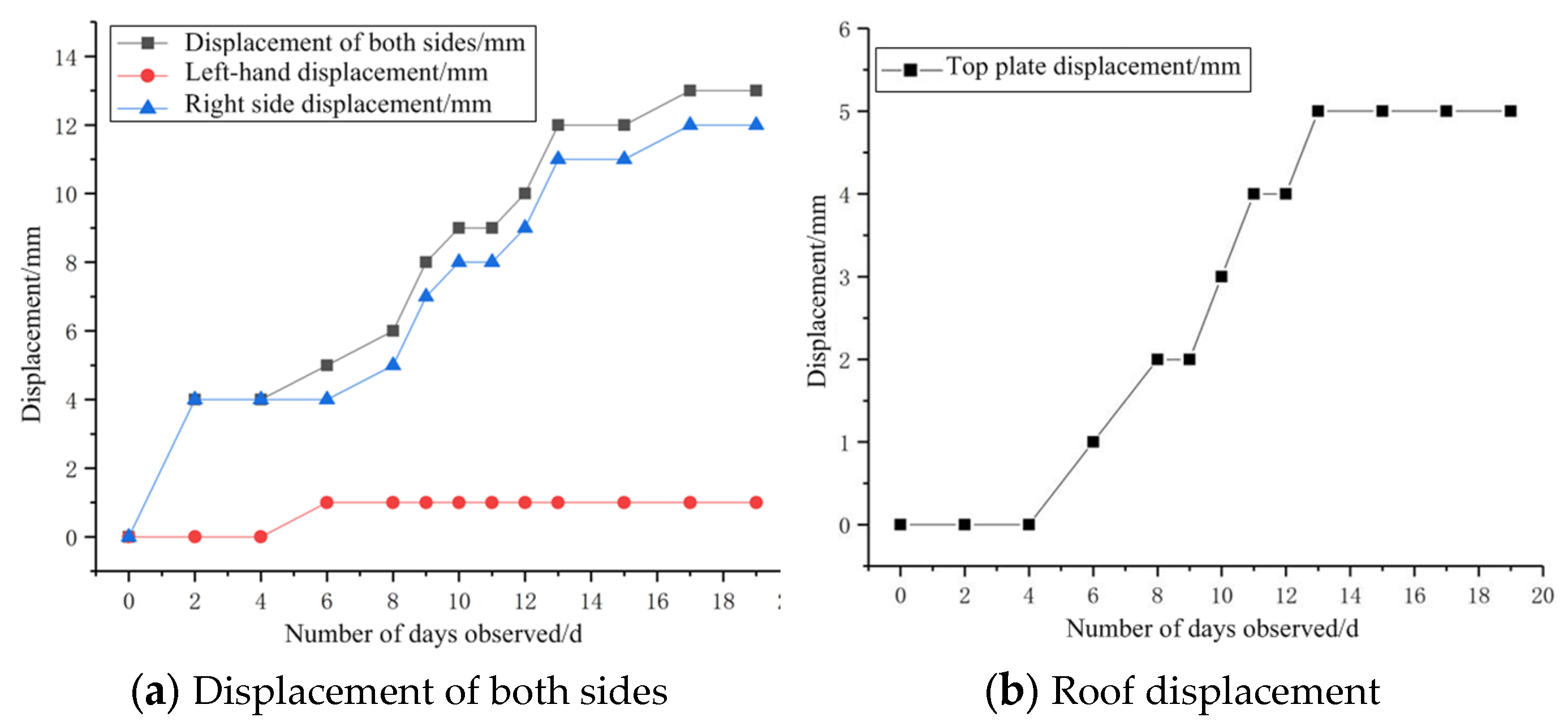
For Cross-section 1 (
Figure 10), the displacement variation is small, and no significant convergence deformation of the two sidewalls is observed. The maximum convergence is 16 mm, with the left sidewall showing a maximum of 11 mm and the right sidewall 5 mm. The roof subsidence also shows no obvious change, with a maximum value of 13 mm.
For Cross-section 2, the displacement variation is also small, with no significant convergence deformation of the two sidewalls. The maximum convergence is 15 mm, with the left sidewall at 11 mm and the right sidewall at 4 mm. The roof subsidence remains insignificant, with a maximum value of 15 mm.
For Cross-section 3, the displacement variation remains small, and no appreciable convergence deformation of the sidewalls is observed. The maximum convergence is 13 mm, with the left sidewall exhibiting a maximum of 1 mm and the right sidewall 12 mm. The roof subsidence is minimal, with a maximum value of 5 mm.
From the overall trend of the surface convergence deformation curves of the test roadway, the deformation of the surrounding rock in this section is relatively small. During the first ten days of monitoring, the roadway was in the stage of installing the U-shaped steel sets, and the contact between the surrounding rock and the 29U sets was not yet fully established; therefore, the monitoring data of Cross-sections 1 and 2 did not show obvious changes. After the installation of the steel sets and completion of shotcrete reinforcement on November 9, monitoring points were rearranged. The average convergence of the two ribs at the monitored section was 15 mm, and the average roof subsidence was 11 mm. The deformation of both ribs and the roof in this test section was small, indicating good stability of the roadway surrounding rock, and an ideal reinforcement and support effect was achieved.
Pressure cells were installed at the center of the bases of the 7th and 21st support sets. To ensure close contact between the pressure cells and the U-shaped inverted-arch support, cable-bolt bearing plates were placed above and below each cell, followed by backfilling. During the observation period from 18 October to 25 November, the pressure readings remained at their initial values. It should be noted that the field monitoring period in this study (18 October–25 November) mainly captures the early-stage deformation response after support installation. Although long-term disturbances (e.g., subsequent mining and groundwater effects) are not fully covered, the monitored convergence trends provide direct evidence of the short-term stability improvement. Long-term monitoring will be continued to further evaluate the durability of the optimized scheme under repeated disturbances.
5.3. Comparison Between Field Monitoring and Numerical Predictions
As shown in
Table 5, the maximum convergence of the two ribs at Cross-sections 1–3 is 16 mm, 15 mm, and 13 mm, respectively, while the maximum roof subsidence is 13 mm, 15 mm, and 5 mm, respectively. Overall, the deformation is small, indicating that the surrounding rock mass remains in a relatively stable state. In contrast, the numerical simulation results for the optimized support scheme (d) show a maximum rib convergence of 37 mm (25 mm for the left rib and 12 mm for the right rib) and a maximum roof subsidence of 11 mm. These values are of the same order of magnitude as the field monitoring results, suggesting that the optimized combined support system can effectively control the deformation of the surrounding rock mass.
Model validation using field monitoring. For the optimized support scheme (d),
Table 3 reports a maximum roof displacement of 0.011 m (11 mm), which is in excellent agreement with the monitored average roof subsidence of approximately 11 mm, giving a percentage error of about 0%. For lateral deformation,
Table 3 gives maximum rib displacements of 0.028 m (28 mm) on the left rib and 0.012 m (12 mm) on the right rib; summing these two maxima yields an equivalent maximum side convergence of about 0.040 m (40 mm). Compared with the monitored average side convergence of approximately 15 mm, the numerical result is higher, corresponding to an overestimation of about 167%. This discrepancy is mainly attributed to: (i) the numerical values represent peak (maximum) displacements in the model, whereas the reported monitoring value is an average over multiple sections and time intervals; (ii) the model outputs rib displacements at the locations of maximum response, which may not coincide with the exact field measurement points used to compute convergence; and (iii) inevitable uncertainties and simplifications in numerical modeling, including the assumed homogeneity of rock-mass properties, constitutive idealization, boundary conditions, and the simplified representation of construction sequence and rock–support interaction, as well as short-term monitoring disturbances during shotcrete operations.
It should be noted that certain discrepancies exist between the numerical simulation and the field monitoring results. On the one hand, the on-site monitoring was affected during the shotcreting operation, and—due to space limitations—only three cross-sections were selected for presentation; therefore, the monitoring data are inherently stage-dependent and have limited representativeness. On the other hand, the numerical results correspond to the predicted response after excavation and support installation when the calculation reaches a new stress-equilibrium state. As such, they reflect the overall behavior under idealized conditions, whereas the field deformation is influenced by construction-related factors (e.g., the gradual establishment of contact between the support system and the surrounding rock mass, as well as changes in monitoring-point installation and reading conditions). Accordingly, it is understandable that deviations occur in indicators such as rib convergence. Overall, both the monitoring and simulation results indicate that, under the optimized scheme (d), the roadway deformation remains small and the support system provides effective control of the surrounding rock mass.
6. Discussion
- (1)
Due to underground construction logistics and production constraints, synchronous comparative monitoring under the same geological and stress conditions was not available for the original support schemes (bolt–mesh–cable support or U-shaped steel sets alone). Therefore, an indirect comparison was adopted by combining the documented historical performance of the roadway with the short-term monitoring response of the trial section. Field and report records indicate that the roadway initially supported by bolt–mesh–cable with shotcrete (with no floor reinforcement) suffered pronounced floor heave, rib cracking, and roof damage, and that repeated floor re-excavation/repair could not prevent recurrent floor heave. Even after reinforcement measures such as adding cable bolts or installing 29U steel sets, unfavorable phenomena including floor heave, inward movement of set legs, and roof subsidence were still observed, suggesting that conventional or single-measure supports provide limited long-term control for roadways subjected to repeated repair disturbances. In contrast, the optimized combined system adopted in the trial section—consistent with the integrated control concept of “closed confinement + rock-mass strengthening + floor anti-arch reinforcement”—showed small convergence and roof subsidence with a stabilizing trend during the monitoring period, indicating an improved short-term surrounding-rock control effect after support formation. It should be emphasized that the present evidence mainly supports the early-stage effectiveness; the long-term resistance of the optimized system to secondary disturbances (e.g., subsequent mining and groundwater effects) requires continued follow-up monitoring.
- (2)
Selection of yield criterion (Mohr–Coulomb vs. Hoek–Brown): Although the Hoek–Brown criterion is widely used for jointed rock masses, the Mohr–Coulomb (M–C) model was adopted in this study for two practical reasons and for consistency with the study objectives. First, the input dataset for the coal–rock mass was obtained from site investigation and laboratory mechanical tests as conventional parameters (c, φ, E, ν and tensile strength), which can be directly implemented in an M–C framework for each lithological unit. In contrast, Hoek–Brown requires additional rock-mass classification parameters (e.g., GSI, mi and disturbance factor D) whose calibration is often uncertain for highly fractured, water-sensitive coal–rock masses subjected to repeated disturbance, potentially introducing extra variability into the analysis. Second, the main purpose of the numerical modeling here is to provide an engineering-oriented comparison among alternative support schemes (i.e., relative differences in deformation control, stress redistribution and yield-zone evolution) rather than to uniquely fit the full nonlinear strength envelope of the rock mass. Under this comparative objective, the M–C model is sufficient to capture the key trends and mechanisms relevant to support optimization, and its rationality is further supported by the agreement in deformation level between the simulations and field monitoring for the optimized support scheme.
- (3)
Model validation against field monitoring: For the optimized support scheme (d), the numerical model predicts a maximum roof displacement of 0.011 m (11 mm) in
Table 3, which matches well with the monitored average roof subsidence of approximately 11 mm, corresponding to a percentage error of ~0%. For lateral deformation,
Table 3 reports maximum rib displacements of 0.028 m (28 mm) on the left rib and 0.012 m (12 mm) on the right rib. When these two peak values are combined as an equivalent maximum side convergence, the numerical convergence is about 0.040 m (40 mm), which exceeds the monitored average side convergence of ~15 mm (overestimation ~167%). This difference is expected and can be explained by several factors. First, the numerical results represent peak (maximum) responses within the modeled domain, whereas the field value reported in
Section 4.2 is an average derived from multiple monitored cross-sections and time intervals. Second, the locations of maximum rib displacement in the model do not necessarily coincide with the exact monitoring points used to calculate convergence in the field. Third, the model inevitably involves idealizations and uncertainties, such as the assumed homogeneity of rock-mass properties, constitutive simplifications, boundary-condition idealization, and a simplified representation of the construction sequence and support–rock interaction. In addition, short-term disturbances during shotcrete operations may have affected the monitoring records. Overall, the roof subsidence shows excellent agreement, while the lateral deformation is conservatively estimated by the model, which is acceptable for engineering-oriented stability assessment.
7. Results
- (1)
For roadways that have undergone multiple repair disturbances, relying solely on bolts and cable bolts for controlling the plastic yielding of the surrounding rock is unfavorable. The use of closed steel sets alone does not enhance the intrinsic strength of the rock mass. However, grouting, which fills rock fractures and cements fractured rock, significantly improves the overall integrity and self-supporting capacity of the surrounding rock, making it more resilient to disturbances.
- (2)
Significant stress concentration zones exist in rock supported only by bolts and cable bolts. Under the support of floor bolts and cable bolts, the stress reduction zone in the floor is small. Within the 0–2.0 m range from the floor, the surrounding rock stress reaches its minimum, indicating complete rock failure. In the 2.0–4.0 m range, the surrounding rock stress ranges from 2.0 MPa to 8.0 MPa, corresponding to plastic yielding. The use of U-shaped closed steel sets (scheme c) and U-shaped steel sets combined with grouting (scheme d) effectively control rock deformation, with the stress distribution showing no significant stress concentration zones.
- (3)
Control of Floor Heave and Surrounding Rock Deformation
Floor bolts and cable bolts alone have a limited effect on controlling floor heave. In contrast, support schemes (c) and (d), which include U-shaped closed steel sets and grouting, can effectively control surrounding rock deformation. Based on the analyses of rock displacement, support structural forces, and shear strain increments, the effectiveness of the support schemes in controlling roof and floor displacement is ranked in descending order:
(d) Rock bolts, cable bolts, floor cable bolts, U-shaped closed steel sets, and grouting.
(c) Rock bolts, cable bolts, floor cable bolts, and U-shaped closed steel sets.
(b) Rock bolts, cable bolts, and floor cable bolts.
(a) Rock bolts and cable bolts.
Author Contributions
Z.L.: investigation, validation, data curation, experiments, validation, writing—original draft. M.C.: investigation, validation, experiments, writing—review and editing. All authors have read and agreed to the published version of the manuscript.
Funding
This research was funded by Coal-Major Project (2025ZD1700904).
Data Availability Statement
The original contributions presented in the study are included in the article, further inquiries can be directed to the corresponding author. The raw data supporting the conclusions of this article will be made available by the corresponding author on request.
Acknowledgments
The successful completion of this study would not have been possible without support and assistance from various parties. First, I would like to express my sincere gratitude to Shaanxi Jinyuan Zhaoxian Mining for providing valuable data and technical documentation throughout the research process, which laid a solid foundation for the study. I would also like to thank the company’s administrative department for its efficient support in data coordination and communication.
Conflicts of Interest
The authors declare that the research was conducted in the absence of any commercial or financial relationships that could be construed as a potential conflict of interest.
References
- Meng, N.; Bai, J.; Yoo, C. Failure mechanism and control technology of deep soft-rock roadways: Numerical simulation and field study. Undergr. Space 2023, 12, 1–17. [Google Scholar] [CrossRef]
- Sakhno, I.; Sakhno, S. Numerical studies of floor heave mechanism and the effectiveness of grouting reinforcement of roadway in soft rock containing the mine water. Int. J. Rock Mech. Min. Sci. 2023, 170, 105484. [Google Scholar] [CrossRef]
- Li, Y.; Dai, X.; Yang, R.; Zhu, Y.; Li, R.; Zhou, C.; Xie, L.; Li, W. Failure Mechanism and Support Technology of Weakly Cemented Soft Rock Roadway in Water-Rich Environment. Geotech. Geol. Eng. 2025, 43, 213. [Google Scholar] [CrossRef]
- Fu, Y.; Ren, Y.; He, Y.; Li, C. Mechanism and control technology of roadway floor heave deformation and failure under the influence of repeated mining in multiple coal seams. Sci. Rep. 2025, 15, 31415. [Google Scholar] [CrossRef] [PubMed]
- Yu, W.; Wang, W.; Huang, W.; Wu, H. Deformation mechanism and rework control technology of high stress and soft rock roadway. J. China Coal Soc. 2014, 39, 614–623. [Google Scholar]
- Yu, W.; Feng, T.; Wang, W. Deformation Mechanism Control Principle and Technology of Soft Half Coal Rock Roadway. Chin. J. Rock Mech. Eng. 2014, 33, 658–671. [Google Scholar]
- Zhang, S.; Qiu, S.; Jiang, Q.; Kou, Y.; Zhang, H.; Xie, Z. Deformation failure mechanism and support effect in deep fractured rock masses. Bull. Eng. Geol. Environ. 2025, 84, 593. [Google Scholar] [CrossRef]
- Guo, Z.; Cao, T.; Sun, X. Deformation mechanism of deep soft rock roadway in shaft bottom and its coupling control strategy. J. Min. Saf. Eng. 2017, 34, 968–971. [Google Scholar]
- Wang, J.; Hu, C.; Zuo, J. Mechanism of roadway floor heave and control technology in fault fracture zone. J. China Coal Soc. 2019, 44, 397–408. [Google Scholar]
- Zheng, W. Study on Floor Heave Mechanics and Bolting Technology for Roadways in High Stress. Doctoral Dissertation, Taiyuan University of Technology, Taiyuan, China, 2016. [Google Scholar]
- Li, X.; Sun, L.; Yang, B. Simulation of the influence of thickness of the weak interlayer on the floor heave of the roadway. J. Min. Saf. Eng. 2017, 34, 504–510. [Google Scholar]
- Yang, J.; Yu, S.; Tao, Z. On the deformation and failure characteristics of the Tertiary soft rock roadway and coupling control measures. J. Min. Saf. Eng. 2014, 31, 373–378. [Google Scholar]
- Wang, F.; Zhang, C.; Wei, S.; Zhang, X.; Guo, S. Whole section anchor–grouting reinforcement technology and its application in underground roadways with loose and fractured surrounding rock. Tunn. Undergr. Space Technol. 2016, 51, 133–143. [Google Scholar] [CrossRef]
- Wang, H.; Zheng, P.-Q.; Zhao, W.-J.; Tian, H.-M. Application of a combined supporting technology with U-shaped steel support and anchor-grouting to surrounding soft rock reinforcement in roadway. J. Cent. South Univ. 2018, 25, 1240–1250. [Google Scholar] [CrossRef]
- Shi, J.; Feng, J.; Peng, R. Study on Support Technology of Deep Mine Roadway in Xingdong Coal Mine. Geotech. Geol. Eng. 2021, 39, 1683–1688. [Google Scholar] [CrossRef]
- Jia, C.; Li, S.; Fan, C.; Rong, H.; Yang, L.; Pu, Z. Numerical simulation of roadway deformation and failure under different degrees of dynamic disturbance. Sci. Rep. 2022, 12, 20017. [Google Scholar] [CrossRef]
- Li, Y.; Wang, N.; Lei, X.; Li, T.; Ren, Y.; Jin, X. Stress Evolution of Repeated Mining Based on the Double-Yield Model in Multiple Coal Seam. Rock Mech. Rock Eng. 2024, 57, 2809–2827. [Google Scholar] [CrossRef]
- Li, T.; Hao, B.; Shi, C. Study on the Mechanisms of Floor Heave in Roadways and Control Strategies via Grooving and Pressure Relief. Processes 2025, 13, 1642. [Google Scholar] [CrossRef]
- Wu, B.; Chang, J.; Li, C.; Wang, T.; Shi, W.; Wang, X. Mechanism of Time-Dependent Instability of Deep Soft-Rock Roadway and Crack-Filling Reinforcement Technology. Appl. Sci. 2023, 13, 4641. [Google Scholar] [CrossRef]
- Liao, Z.; Feng, T. Mechanism and Application of Layered Grouting Reinforcement for Fractured Coal and Rock Roadway. Appl. Sci. 2023, 13, 724. [Google Scholar] [CrossRef]
- Zhang, L.X.; Wei, X.J.; Liu, G. The application of grouting reinforcement to the broken surrounding rock of 1366 stoping roadway. J. Min. Sci. Technol. 2023, 8, 583–592. [Google Scholar]
- Kang, H.; Yang, J.; Jiang, P.; Gao, F.; Li, W.; Li, J.; Chen, H. Theory, technology and application of grouted bolting in soft rock roadways of deep coal mines. Int. J. Miner. Metall. Mater. 2024, 31, 1463–1479. [Google Scholar] [CrossRef]
- Zhou, C.; Huang, C.; Chen, Y.; Zhang, W.; Wang, L. Performance of a novel resistant rock bolt with periodic energy absorption and release: Theory and experiment. Acta Geotech. 2024, 19, 363–378. [Google Scholar] [CrossRef]
- Shou, Y.; Guo, L.; Zhou, X. Development of the rolling extrusion rock bolt with constant resistance and large deformation. Deep. Resour. Eng. 2024, 1, 100004. [Google Scholar] [CrossRef]
- Lu, Y.; He, B.-G.; Li, Q.; Li, H.-P. Numerical Investigation of the Cumulative Damage Effects and Safety Criterion of Deep Tunnels in a Layered Rock Mass Under Full-Face Blasting. Rock Mech. Rock Eng. 2025, 1–25. [Google Scholar] [CrossRef]
- Wang, Z.; Dou, L.; Wang, G.; He, J.; Hu, J. Failure Mechanism of Anchored Roadway Surrounding Rocks under Near-Field Dynamic Disturbance. Tunn. Eng. 2024, 28, 2454–2468. [Google Scholar] [CrossRef]
| Disclaimer/Publisher’s Note: The statements, opinions and data contained in all publications are solely those of the individual author(s) and contributor(s) and not of MDPI and/or the editor(s). MDPI and/or the editor(s) disclaim responsibility for any injury to people or property resulting from any ideas, methods, instructions or products referred to in the content. |